Health Care
Paragraphs

This paper describes the qualitative results of the mixed-methods study by Eggleston and her colleagues. For the quantitative results of the study, read the April 2021 paper in the journal BMC Public Health. Also, watch and read our full story and interview with Eggleston.

Objective

People with chronic conditions are known to be vulnerable to the COVID-19 pandemic. This study aims to describe patients’ lived experiences, challenges faced by people with chronic conditions, their coping strategies, and the social and economic impacts of the COVID-19 pandemic.
 

Design, Setting, and participants

We conducted a qualitative study using a syndemic framework to understand the patients’ experiences of chronic disease care, challenges faced during the lockdown, their coping strategies and mitigators during the COVID-19 pandemic in the context of socioecological and biological factors. A diverse sample of 41 participants with chronic conditions (hypertension, diabetes, stroke, and cardiovascular diseases) from four sites (Delhi, Haryana, Vizag, and Chennai) in India participated in semistructured interviews. All interviews were audio-recorded, transcribed, translated, anonymized and coded using MAXQDA software. We used the framework method to qualitatively analyze the COVID-19 pandemic impacts on health, social and economic well-being.
 

Results

Participant experiences during the COVID-19 pandemic were categorized into four themes: challenges faced during the lockdown, experiences of the participants diagnosed with COVID-19, preventive measures taken, and lessons learned during the COVID-19 pandemic. A subgroup of participants faced difficulties in accessing healthcare while a few reported using teleconsultations. Most participants reported the adverse economic impact of the pandemic which led to higher reporting of anxiety and stress. Participants who tested COVID-19 positive reported experiencing discrimination and stigma from neighbors. All participants reported taking essential preventive measures.
 

Conclusion

People with chronic conditions experienced a confluence (reciprocal effect) of COVID-19 pandemic and chronic diseases in the context of difficulty in accessing healthcare, sedentary lifestyle, and increased stress and anxiety. Patients’ lived experiences during the pandemic provide important insights to inform effective transition to a mixed realm of online consultations and ‘distanced’ physical clinic visits.


Karen Eggleston 4X4

Karen Eggleston, PhD

Senior Fellow at FSI, Director of the Asia Health Policy Program at Shorenstein Asia-Pacific Research Center
Full Biography
All Publications button
1
Publication Type
Journal Articles
Publication Date
Subtitle
A Qualitative Study
Journal Publisher
BMJ Open
Authors
Karen Eggleston
Number
2021;11:e048926
Authors
Noa Ronkin
News Type
News
Date
Paragraphs

Technological progress boosts productivity and has made societies wealthier, but the impact of new digital technologies could be different from anything seen before. Some experts predict a future with robots and other forms of automation increasingly replacing workers, contributing to stagnant income, and worsening inequality. Yet it is difficult to pinpoint the net impact of advanced technologies on labor. There is anecdotal evidence that robotics and automation reduce manufacturing employment and wages, but evidence from the service sector remains scant. Collaborative research by APARC experts is now starting to fill this gap.

The researchers — including Karen Eggleston, APARC deputy director and director of the Asia Health Policy Program (AHPP), Yong Suk Lee, the deputy director of the Korea Program, and University of Tokyo health economist Toshiaki Iizuka, a former AHPP visiting scholar — set out to probe the impact of robots on services provided in nursing homes in Japan. Their study, one of the first investigations of service sector robots, offers an offset to the dystopian predictions of robot job replacement.

Published by the National Bureau of Economic Research, the study suggests that robot adoption has increased employment opportunities for non-regular care workers, helped mitigate the turnover problem that plagues nursing homes, and provided greater flexibility for workers. It is also published in AHPP's working paper series and is part of a broader research project by Eggleston, Lee, and Iizuka, that explores the impact of robots on nursing home care in Japan and the implications of robotic technologies adoption in aging societies.

Since we are currently still in the early phase of robot diffusion in the service sector, researchers and policymakers need to continue to monitor and assess the extent to which robots complement or augment some types of labor while substituting for others.
Eggleston, Lee, and Iizuka

[Subscribe to APARC's newsletters for the latest analysis from our experts.]

Japan has been on the front lines of a demographic crisis, grappling with a declining overall population, increasing proportion of seniors, and aversion to large-scale immigration. It has also been an early adopter of robots to address the shortage of care workers relative to a growing demand for long-term care services. Japan’s experience is especially instructive as more countries face aging populations, helping shed light on how demographics interact with new automation technologies.

In a VoxEU.org article, Eggleston, Lee, and Iizuka describe their study, its findings, and its implications. Examining the relationship between robot adoption and nursing home staffing in Japan, they find that robot-adopting nursing homes had between 3% and 8% more staff than their non-adopting counterparts. The increases in staffing occurred entirely among the non-regular employees. Nursing homes with robots also appeared to have higher management quality and were better able to reduce the burden on care workers. The results suggest “that the wave of technologies that inspires fear in many countries could help remedy the social and economic challenges posed by population aging in others.”

The Financial Times Magazine has recently featured the study by Eggleston, Lee, and Iizuka, calling it “groundbreaking in several ways but perhaps most clearly for setting its sights not on manufacturing but on the services sector, where robots are only just beginning to make their mark.” The great value of the study, the article notes, is that it lays the foundation for an empirical debate “on a subject that will be deluged with human emotion as robots continue their march into the services sector.”

You can also listen to a Financial Times podcast that features the new study (the segment starts at 4:52).

Read More

[Left] A nurse assists an elderly woman in a wheel chair; [Right] Oliver Hart
News

Public-Private Partnerships for Effective Healthcare: Theory and Practice

In its 2020-21 colloquium series, the Asia Health Policy Program weighs the balance, benefits, and considerations in providing health services through national governments and contracting with private organizations.
Public-Private Partnerships for Effective Healthcare: Theory and Practice
Male Japanese doctor showing senior patient records on a clipboard
News

Health Signals Increase Preventive Care, Improve Health Outcomes for Individuals at High Risk of Diabetes, Evidence from Japan Shows

Among the general population, however, researchers including Asia Health Policy Program Director Karen Eggleston find no evidence that additional care improves health outcomes.
Health Signals Increase Preventive Care, Improve Health Outcomes for Individuals at High Risk of Diabetes, Evidence from Japan Shows
A man with interacts with 'Emiew,' a humanoid robot.
News

“Co-Bots,” Not Overlords, Are the Future of Human-Robot Labor Relationships

Yong Suk Lee and Karen Eggleston’s ongoing research into the impact of robotics and AI in different industries indicates that integrating tech into labor markets adjusts, but doesn’t replace, the long-term roles of humans and robots.
“Co-Bots,” Not Overlords, Are the Future of Human-Robot Labor Relationships
Hero Image
A Japanese robot prototype lifts a dummy patient
Ri-man, a Japanese robot prototype under development to help assist nurses to lift patients from their bed. As Japan's society ages and nursing shortage increases, there will be a need for a robot to do the heavy lifting, especially since nurses themselves are aging.
Karen Kasmauski via Getty Images
All News button
1
Subtitle

In one of the first studies of service sector robotics, APARC scholars examine the impacts of robots on nursing homes in Japan. They find that robot adoption may not be detrimental to labor and may help address the challenges of rapidly aging societies.

Authors
News Type
News
Date
Paragraphs

Of the many issues that the COVID-19 pandemic has brought into focus, foremost in the spotlight is the vital role that healthcare systems play in societal wellbeing and security. Around the world, health systems of all types have had to rapidly adapt, reassess, and react to constantly changing needs.

The 2020-21 Asia Health Policy Program (AHPP) colloquium series, “Health, Medicine, and Longevity: Exploring Public and Private Roles,” brings together academics, theorists, on-the-ground NGO leaders, and government advisors to explore how partnerships between public providers and private organizations affect the quality and access to healthcare the world over.

The series recently featured a keynote address by Harvard economist Oliver Hart, the 2016 co-recipient of the Nobel Prize in Economics for his work on contract theory — a framework known as ‘The Proper Scope of Government.’ Hart joined AHPP Director and APARC Deputy Director Karen Eggleston to reflect on the impact his theory has had across disciplines in the 25 years since its publication and on the future of research into contract theory. Watch the conversation with Hart below.

[Subscribe to our newsletters to stay informed on research happening at APARC.]

Oliver Hart and the ‘Proper Scope of Government’

Hart’s seminal economic theory, ‘The Proper Scope of Government,” underpins much of the research into public-private partnerships in healthcare. Hart developed this touchstone framework jointly with Andrei Shleifer and Robert W. Vishny to better evaluate when a government should provide a service itself and when it should contract with a private provider for support and execution of services.

The model outlined in Hart, Shleifer, and Vishny’s original 1996 working paper is designed to help providers and contractors consider the costs and benefits of a proposed contractual service agreement. While this model was originally applied to the case of prison privatization, the framework has served as an invaluable tool for researchers in multiple sectors including health policy and provision.

Reflections and Updates to the Theory

In reflecting on ‘The Proper Scope of Government,’ there are things Hart would like to see more fully incorporated into the theory to enrich its real-world applicability. Chiefly among these is better accounting for contractual incompleteness or the reality that a contract cannot anticipate and outline every possible unforeseen event or area of ambiguity. However, modeling contractual incompleteness is notoriously difficult given the almost-limitless factors of variability.

Some of Hart’s recent work on guiding principles responds to this challenge. Rather than trying to predict every aspect of a contractual relationship within the framing and language of a standard contract model, Hart argues that mutually agreed-upon guiding principles —such as equity, loyalty, and honesty — can serve as a foundation for navigating inevitable areas of ambiguity and potential conflict that a contract does not specifically state or that the original theory does not fully account for.

These guiding principles also help preserve space for renegotiation and innovation, which are necessary in an era of rapid technological advances and explosion of measurable data. In this context, Hart cautions against the mentality of ‘more is more:’

“If you put more and more things into the contract and then something happens that wasn’t in the contract, the fact that you put so much more in may make it more difficult to negotiate about the thing that you didn’t put in.”

 Applying ‘The Proper Scope of Government’

Hart shared a prime example of his theory at work in health systems in a case study of the Vancouver Island Health Authority. Traditionally, family physicians would continue as the primary care provider for their patients even if a patient needed hospitalization. But a change of law in 2006 required all specialized in-hospital care be contracted to hospitalists with little to no crossover with care provided by family practice physicians.

The result was a rise in caseload and stress levels amongst hospital specialists and repeated failed negotiations of the standard contract. The addition of guiding principles to the contract, however, provided avenues where reasonable solutions and additional communications could happen beyond the limits of the formal contract.

This is just one case of innumerable where Hart’s work has helped inform and contextualize how policymakers consider relationships between the public and private spheres of healthcare. Responding to the praise and input from fellow economists presented in a tribute documentary to the impact of his framework, Hart remarked:

“I hadn't realized how many people have been influenced by this paper and how they've been using it in different contexts. I knew some of the applications, but there were others I didn't, and it’s been truly amazing to see that.”

Looking Toward the Future

The tradeoffs between public and private partnerships in healthcare systems across the world will continue to be a dynamic and evolving area of research that will rely on theories such as ‘The Proper Scope of Government’ for framing and application. Looking towards the future, Hart was hopeful but cautious about the vitality of the kind of theoretical tradition which allowed for the development of his original theory. He recognizes that specialties such as contract theory and contractual incompleteness are inherently “messy” and somewhat out of vogue with current trends in economics which tend to favor theories that are “impressive, clever, and non-obvious,” regardless of whether they address important questions.

As he iterated in his Nobel Prize lecture, the incomplete world of contracts nonetheless “underlies numerous significant phenomena, some of which have great policy relevance,” and therefore fully deserving of upcoming economists’ time and efforts.

Further Research into Public-Private Partnerships

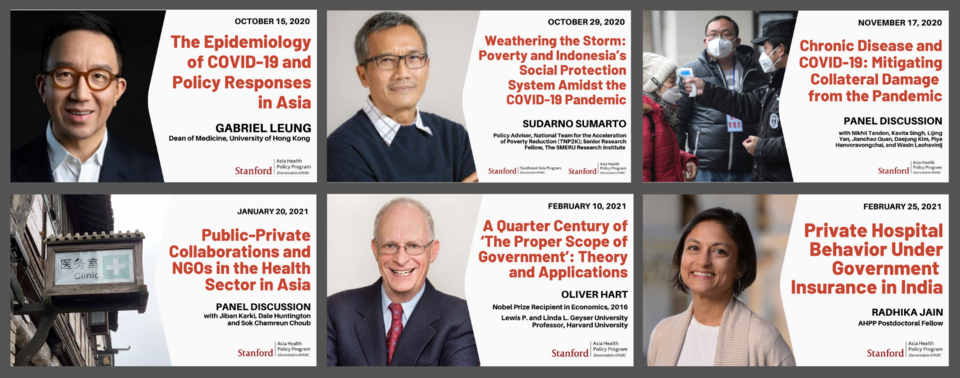
The Asia Health Policy Program’s 2020-21 colloquium series focuses on the roles and impacts of public-private partnerships in healthcare and the tradeoffs in equity, accessibility, and cost that come with contracted agreements in health systems. All of the events from the colloquium series are available on our YouTube channel. Click the thumbnails below to start exploring.

Collaborative governance — that is, relationships involving both the private and public sectors in the pursuit of public value — is part of ongoing research by Karen Eggleston. Her forthcoming book, The Dragon, the Eagle, and the Private Sector (Cambridge University Press), co-authored with Harvard’s John D. Donahue and Richard J. Zeckhauser, examines the ways in which collaborative governance works across a wide range of policy arenas in China and the United States, with the goal of empowering public decisionmakers to more wisely engage the private sector. Join us for the book launch event, which will be held jointly with the Harvard Kennedy School on March 5 


Image
Thumbnail images for the webinar events in the AHPP's 2020-21 colloquium series, "Health, Medicine, and Longevity: Exploring Public and Private Roles."

Read More

Male Japanese doctor showing senior patient records on a clipboard
News

Health Signals Increase Preventive Care, Improve Health Outcomes for Individuals at High Risk of Diabetes, Evidence from Japan Shows

Among the general population, however, researchers including Asia Health Policy Program Director Karen Eggleston find no evidence that additional care improves health outcomes.
Health Signals Increase Preventive Care, Improve Health Outcomes for Individuals at High Risk of Diabetes, Evidence from Japan Shows
An elderly individual travels in a cart up a street.
News

Researchers Develop New Method for Projecting Future Wellness of Aging Populations

Asia Health Policy Director Karen Eggleston and her colleagues unveil a multistate transition microsimulation model that produces rigorous projections of the health and functional status of older people from widely available datasets.
Researchers Develop New Method for Projecting Future Wellness of Aging Populations
A communications robot named Pepper by Softbank
Q&As

Robots May Be the Right Prescription for Struggling Nursing Homes

Karen Eggleston and Yong Suk Lee speak to the Oliver Wyman Forum on how robotics and advancing technologies are helping staff in Japanese nursing homes provide better and safer care to their patients.
Robots May Be the Right Prescription for Struggling Nursing Homes
Hero Image
[Left] A nurse assists an elderly woman in a wheel chair; [Right] Oliver Hart
The AHPP 2020-21 colloquium series explores the roles of the public and private sectors in providing equitable and accessible health services. The keynote address was given by Nobel laureate Oliver Hart.
Getty Images
All News button
1
Subtitle

In its 2020-21 colloquium series, the Asia Health Policy Program weighs the balance, benefits, and considerations in providing health services through national governments and contracting with private organizations.

Paragraphs
Cover of book "The Dragon, the Eagle, and the Private Sector" with an image of a red dragon and a blue eagle.

The governments of China and the United States -- despite profound differences in history, culture, economic structure, and political ideology -- both engage the private sector in the pursuit of public value. This book employs the term collaborative governance to describe relationships where neither the public nor private party is fully in control, arguing that such shared discretion is needed to deliver value to citizens. This concept is exemplified across a wide range of policy arenas, such as constructing high speed rail, hosting the Olympics, building human capital, and managing the healthcare system. This book will help decision-makers apply the principles of collaborative governance to effectively serve the public, and will enable China and the United States to learn from each other's experiences. It will empower public decision-makers to more wisely engage the private sector. The book's overarching conclusion is that transparency is the key to the legitimate growth of collaborative governance.

This book provides a key to understanding how to achieve . . . quality public-private collaboration, done right. Delving deep into two very different societies. . . the authors provide lessons that illuminate and should inform scholars and policymakers alike.
Fareed Zakaria
Journalist and author
This is the rare book that is both analytic and a pleasure to read. It makes a lasting impression. It deserves a very wide readership among all those concerned about the future of the global economy.
Lawrence H. Summers
President Emeritus, Harvard University
Eggleston, Donahue, and Zeckhauser offer an authoritative and intriguing account of why and how collaborative governance. . . has been widely and deeply practiced in two vastly different countries, China and the US.
Yijia Jing
Fudan University
All Publications button
1
Publication Type
Books
Publication Date
Subtitle
Public-Private Collaboration in China and the United States
Authors
Karen Eggleston
Book Publisher
Cambridge University Press
Paragraphs

This study investigates the marginal value of information in the context of health signals that people receive after checkups. Although underlying health status is similar for individuals just below and above a clinical threshold, treatments differ according to the checkup signals they receive. For the general population, whereas health warnings about diabetes increase healthcare utilization, health outcomes do not improve. However, among high-risk individuals, outcomes do improve, and improved health is worth its cost. These results indicate that the marginal value of health information depends on setting appropriate thresholds for health warnings and targeting individuals most likely to benefit from follow-up medical care.

All Publications button
1
Publication Type
Journal Articles
Publication Date
Journal Publisher
Journal of Public Economics
Authors
Karen Eggleston
Toshiaki Iizuka
Paragraphs

Shorenstein APARC's annual overview for the academic year 2019-20 is now available.

Learn about the research, events, and publications produced by the Center's programs over the last twelve months. Feature sections look at how APARC has continued its mission amid COVID-19 restrictions and how our research has been adapted to factor in the impact of the pandemic. Learn about new talent at the Center, including new leadership of the Japan Program and an enhanced focus on South Asia research. Catch up on the Center's policy work, education initiatives, events, and outreach.

Read online:

All Publications button
1
Publication Type
Annual Reports
Publication Date
Authors
News Type
Blogs
Date
Paragraphs

In the time of COVID-19, the attention of physicians and policymakers alike has largely been focused on responding to the immediate needs of people experiencing the fallout from the novel coronavirus. For Radhika Jain, a postdoctoral fellow with the Asia Health Policy Program (AHPP) at APARC, the pandemic has further highlighted the importance of advancing policies that support effective and equitable public health systems.

We sat down with Jain to discuss her work and recent research into the ways the COVID-19 pandemic has affected the efficacy of India’s healthcare services for people living with chronic, non-communicable diseases. Listen to the full conversation above or via our Soundcloud channel.

[Subscribe to APARC’s newsletters to get the latest from our researchers.]

Jain’s research focuses on the role of the private sector in health systems, frictions in health care markets, the extent to which public health policies serve the needs of target populations, and health policy design in lower-income countries. In particular, she studies India's health care system, probing into data sets and administrative records to identify the factors that contribute to poor health outcomes and determine what interventions increase the effectiveness of public health insurance.

In the case of India, the private healthcare sector is highly fragmented and made up of a collage of small and independently-run hospitals and service providers with varying levels of oversight and administrative regulation. Gathering data on patient costs, insurance use, and benefit allocation for different cohorts of people using private healthcare in the world's second-most populous nation is a central pillar in Jain's efforts to better understand and document how health systems are used and how they can be improved to better serve vulnerable populations.

COVID-19 Lockdown Impacts on Non-COVID Health Care and Outcomes


For Jain, the ongoing effects of the COVID-19 pandemic have re-emphasized the crucial role that a well-functioning public, government-backed health system plays in providing care to citizens during times when the private sector experiences sudden and severe disruptions. Working in collaboration with Pascaline Dupas, the faculty director at the Stanford King Center on Global Development and a senior fellow at the Stanford Institute for Economic Policy Research, Jain has documented the adverse effects of COVID-19 on accessibility to health services for patients needing treatment for chronic, non-communicable diseases.("The Effects of India’s Covid-19 Lockdown on Critical Non-Covid Health Care and Outcomes: Evidence From a Retrospective Cohort Analysis of Dialysis Patients"

Jain's and Dupas' recent working paper (published in AHPP's Working Paper Series) shows that the abrupt, severe lockdown instituted by the Indian government as a preventive measure against the spread of the coronavirus had widespread impacts on individuals' ability to receive care for non-COVID-related healthcare needs such as dialysis. Their findings indicate that, among patients needing dialysis, the death rate between April and July 2020 was 25 percent higher than the death rate for a comparable cohort in the same months in 2019.

During something like a pandemic, the importance of having a social safety net and a strong public health system that the government can deploy to protect households experiencing medical hardships becomes all the more clear.
Radhika Jain
Postdoctoral Fellow, Asia Health Policy Program

This increase in mortality is directly related to disruptions to critical health service delivery and accessibility caused by the lockdown measures. Sixty-three percent of those surveyed by Jain and Dupas reported experiencing disruptions to their care, with travel barriers and hospital closures or refusals cited as the most common causes. As a cohort, vulnerable populations were affected most by both the lockdown and ensuing disruptions to healthcare access.

Discrepancies like this between how a health system performs on paper and what happens in real-world practice is something Jain has a deeper appreciation for in light of the pandemic. “There were many policy prescriptions about how to respond to the lockdown, but what was done in India was a poorly conceived political response,” she cautions. “That’s something we who work on health policy need to keep in mind and contend with: What is the role of the political system, what is the role of the health system, and how does our research interact with all of that?”

Looking ahead, Radhika intends to continue researching and writing recommendations on how to make health systems viable and usable for all populations, including the most vulnerable. In particular, she is interested in investigating strategies to close engagement gaps and accessibility challenges women in India experience in utilizing healthcare services. She will continue working at APARC as a postdoctoral fellow with the Asia Health Policy Program through the end of the 2021-22 academic year.

Read More

Portrait of Young Kyung Do, Winner of the 2020 Rothman Epidemiology Prize
News

Asia Health Policy Program Alum Wins Rothman Epidemiology Prize

Dr. Young Kyung Do, an expert in health policy and management at the Seoul National University College of Healthy Policy and the inaugural postdoctoral fellow in Asia health policy at APARC, has been awarded the 2020 prize for his outstanding publication in the journal Epidemiology last year.
Asia Health Policy Program Alum Wins Rothman Epidemiology Prize
An elderly individual travels in a cart up a street.
News

Researchers Develop New Method for Projecting Future Wellness of Aging Populations

Asia Health Policy Director Karen Eggleston and her colleagues unveil a multistate transition microsimulation model that produces rigorous projections of the health and functional status of older people from widely available datasets.
Researchers Develop New Method for Projecting Future Wellness of Aging Populations
A man with interacts with 'Emiew,' a humanoid robot.
News

“Co-Bots,” Not Overlords, Are the Future of Human-Robot Labor Relationships

Yong Suk Lee and Karen Eggleston’s ongoing research into the impact of robotics and AI in different industries indicates that integrating tech into labor markets adjusts, but doesn’t replace, the long-term roles of humans and robots.
“Co-Bots,” Not Overlords, Are the Future of Human-Robot Labor Relationships
Hero Image
[Left] Radhika Jain, [Right] Postdoc Spotlight, Radhika Jain, Asia Health Policy Program
Radhika Jain, a postdoctoral fellow at APARC with the Asia Health Policy Program.
All News button
1
Subtitle

Radhika Jain, a postdoctoral fellow with the Asia Health Policy Program, shares insights on her research into India’s health care system and how it is responding to both the COVID-19 pandemic and standard healthcare needs of citizens.

Date Label
Authors
Noa Ronkin
News Type
News
Date
Paragraphs

The world’s population is aging at a faster rate and in larger cohorts than ever before. In countries like Japan that have low fertility rates and high life expectancy, population aging is a risk to social sustainability. Developing policies and healthcare infrastructure to support aging populations is now critical to the social, economic, and developmental wellbeing of all nations. As the COVID-19 pandemic has repeatedly shown, accurate projections of future population health status are crucial for designing sustainable healthcare services and social security systems.

Such projections necessitate models that incorporate the diverse and dynamic associations between health, economic, and social conditions among older people. However, the currently available models – known as multistate transition microsimulation models – require high-quality panel data for calibration and meaningful estimates. Now a group of researchers, including APARC Deputy Director and Asia Health Policy Program Director Karen Eggleston, has developed an alternative method that relaxes this data requirement.

In a newly published paper in Health Economics, Eggleston and her colleagues describe their study that proposes a novel approach using more readily-available data in many countries, thus promising more accurate projections of the future health and functional status of elderly and aging populations. This alternative method uses cross‐sectional representative surveys to estimate multistate‐transition contingency tables applied to Japan's population. When combined with estimated comorbidity prevalence and death record information, this method can determine the transition probabilities of health statuses among aging cohorts.

In comparing the results of their projections against a control, Eggleston and her colleagues show that traditional static models do not always accurately forecast the prevalence of some comorbid conditions such as cancer, heart disease, and stroke. While the sample sets used to test the new methodology originate in Japan, the proposed multistate transition contingency table method has important applications for aging societies worldwide. As rapid population aging becomes a global trend, the ability to produce robust forecasts of population health and functional status to guide policy is a universal need.

Read the full paper in Health Economics.

Learn more about Eggleston’s research projects >>

Read More

A communications robot named Pepper by Softbank
Q&As

Robots May Be the Right Prescription for Struggling Nursing Homes

Karen Eggleston and Yong Suk Lee speak to the Oliver Wyman Forum on how robotics and advancing technologies are helping staff in Japanese nursing homes provide better and safer care to their patients.
Robots May Be the Right Prescription for Struggling Nursing Homes
Portrait of Young Kyung Do, Winner of the 2020 Rothman Epidemiology Prize
News

Asia Health Policy Program Alum Wins Rothman Epidemiology Prize

Dr. Young Kyung Do, an expert in health policy and management at the Seoul National University College of Healthy Policy and the inaugural postdoctoral fellow in Asia health policy at APARC, has been awarded the 2020 prize for his outstanding publication in the journal Epidemiology last year.
Asia Health Policy Program Alum Wins Rothman Epidemiology Prize
Cover image of the book "Healthy Aging in Asia", showing a smiling elderly Chinese woman with a cane standing in a small village.
News

New Book Highlights Policy Initiatives and Economic Research on Healthy Longevity Across Asia

Asia health policy expert Karen Eggleston’s new volume, ‘Healthy Aging in Asia,’ examines how diverse Asian economies – from Singapore and Hong Kong to Japan, India, and China – are preparing for older population age structures and transforming health systems to support patients who will live with chronic disease for decades.
New Book Highlights Policy Initiatives and Economic Research on Healthy Longevity Across Asia
Hero Image
An elderly individual travels in a cart up a street.
Galen Crout, Unsplash
All News button
1
Subtitle

Asia Health Policy Director Karen Eggleston and her colleagues unveil a multistate transition microsimulation model that produces rigorous projections of the health and functional status of older people from widely available datasets.

Paragraphs

Accurate future projections of population health are imperative to plan for the future healthcare needs of a rapidly aging population. Multistate‐transition microsimulation models, such as the U.S. Future Elderly Model, address this need but require high‐quality panel data for calibration. We develop an alternative method that relaxes this data requirement, using repeated cross‐sectional representative surveys to estimate multistate‐transition contingency tables applied to Japan's population. We calculate the birth cohort sex‐specific prevalence of comorbidities using five waves of the governmental health surveys. Combining estimated comorbidity prevalence with death record information, we determine the transition probabilities of health statuses.

We then construct a virtual Japanese population aged 60 and older as of 2013 and perform a microsimulation to project disease distributions to 2046. Our estimates replicate governmental projections of population pyramids and match the actual prevalence trends of comorbidities and the disease incidence rates reported in epidemiological studies in the past decade. Our future projections of cardiovascular diseases indicate lower prevalence than expected from static models, reflecting recent declining trends in disease incidence and fatality.

All Publications button
1
Publication Type
Journal Articles
Publication Date
Journal Publisher
Health Economics
Authors
Karen Eggleston
Authors
Callista Wells
News Type
News
Date
Paragraphs

To celebrate its May Release, the Stanford China Program hosted a virtual book launch event for Fateful Decisions: Choices That Will Shape China’s Future (Stanford University Press) on June 2nd. Joining co-authors Thomas Fingar (Shorenstein APARC Fellow, Stanford University) and Jean C. Oi (Director, Stanford China Program; William Haas Professor of Chinese Politics, Stanford University) were contributors Karen Eggleston (Senior Fellow at FSI; Director of the Asia Health Policy Program, Shorenstein APARC, Stanford University), Barry Naughton (Sokwanlok Chair of Chinese International Affairs, School of Global Policy and Strategy, UC San Diego), and Andrew Walder (Senior Fellow at FSI; Denise O'Leary and Kent Thiry Professor, Stanford University). As Fingar and Oi point out in their volume, despite China’s extraordinary growth over the past 40 years, the country’s future is uncertain. China has enjoyed optimal conditions for development since the 1980s, but new hurdles including an aging populace, the loss of comparative economic advantage, a politically entrenched elite, and a population with rising expectations will test the country’s leaders. With each focusing on a different facet of China’s challenges, the panelists gathered to share their expertise and provide the audience with a glimpse into what the future might hold for this important country.

Following an introduction from Professor Jean Oi, the program kicked off with Professor Barry Naughton of University of California, San Diego, who discussed his chapter entitled “Grand Steerage.” Professor Naughton argued that, as it plans for the future, China’s policymaking is becoming increasingly technology-focused, particularly in the realm of economic policy. Naughton further notes that China’s economy is becoming simultaneously more state-guided and more centered around technology. This decision is a gamble, though: China is investing heavily in high-tech industries, advancing massive, centrally steered projects like the Greater Bay Area initiative and the Xiong’an New District. If they are successful, says Naughton, this will indeed be an incredible success. But, if they are not, China’s losses will be major: “There’s not really a middle ground.”

After Professor Naughton was Professor Karen Eggleston, an expert on health policy in Asia. Professor Eggleston’s chapter, “Demographic and Healthcare Challenges,” deals with emerging obstacles for China’s healthcare system, including population aging and the problems that come with it, like chronic diseases and elder care. Although China’s healthcare system has improved dramatically in recent decades, it has done so unevenly, notes Eggleston: life expectancy has greatly increased, but with disparities according to income, region, and urban vs. rural status; universal healthcare is available, but the benefit level is low, effectively limiting the standard of care many can receive. The ratio of health spending to GDP is also increasing, yet it is still modest compared to high-income countries. The COVID-19 crisis has, of course, introduced even more challenges: Will China be able to distribute future vaccines equitably? Will this crisis negatively affect young people’s decisions to choose healthcare as a career? Will telemedicine, which has seen a surge under the pandemic, improve or exacerbate existing disparities? China faces a multitude of constraints and choices going forward if it hopes to meet its population’s healthcare needs.

The audience then had a chance to hear from co-editor Thomas Fingar, speaking on his chapter, “Sources and Shapers of China’s Foreign Policy.” Fingar noted three key takeaways from both his chapter and his talk: Firstly, China’s foreign policy is a fundamental part of its national policy. Secondly, the global political environment plays an important role in shaping both foreign and domestic policy which, thirdly, plays an important role in shaping foreign policy. The conditions that allowed China to flourish over the past 40 years, emphasized Fingar, are very different from those of the present. In the 1970s and 80s, China was able to take advantage of Cold War bipolarity, globalization was in its infancy, and “China was the only significant developing country willing to embark, at that time, on the export-led path of development.” In recent years, though, China’s behavior internationally has alienated other countries; there are many competitors pursuing its style of development; and its needs and aspirations have changed, requiring more raw materials and depending upon multi-national economic agreements. Fingar suggests two potential foreign policy options: China could continue with its wolf warrior diplomacy, which has “alienated essentially all China’s neighbors to some degree,” or it could return to a style more similar to that of the 1980s and 90s Reform and Opening era. It remains to be seen which style will win out.

Finally, Professor Andrew Walder concluded the program with his discussion of China’s political future at large. His chapter, “China’s National Trajectory,” follows China’s remarkable advancement in recent years and “tr[ies] to divine what a lower growth era will mean for China’s political future.” The last 40 years of rapid growth have generated support for China’s political system, more patriotism, the near eradication of democracy movements, and an elite unity not seen in the 1970s and 80s. However, low growth rates could mean a reversal for many of these trends, says Walder. While the aforementioned support for and stability of the Chinese government was maintained by ever-improving living standards and upward mobility, a low growth period (coupled with an aging population) means the government will no longer be able to rely on these trends for popular support. Rather, it will need to improve its provision of public services to address present-day challenges. Regardless, argues Walder, the low growth era will undoubtedly lead to “dynamic changes underneath the façade of stability of Chinese politics….”

For more insights on the modern obstacles China faces and what they mean for the country’s future, check out Fateful Decisions: Choices That Will Shape China's Future, available for purchase now.

Read More

Elderly Chinese citizens sit together on a park bench.
Q&As

Karen Eggleston Examines China’s Looming Demographic Crisis, in Fateful Decisions

Karen Eggleston Examines China’s Looming Demographic Crisis, in Fateful Decisions
Quote from Thomas Fingar and Jean Oi from, "China's Challeges: Now It Gets Much Harder"
Commentary

Now It Gets Much Harder: Thomas Fingar and Jean Oi Discuss China’s Challenges in The Washington Quarterly

Now It Gets Much Harder: Thomas Fingar and Jean Oi Discuss China’s Challenges in The Washington Quarterly
Hero Image
Fateful Decisions book cover
All News button
1
Subscribe to Health Care