Health Care
News Type
Q&As
Date
Paragraphs

This interview was originally produced by the Oliver Wyman Forum.

Coronavirus has dramatically increased the use of technology as governments, healthcare providers, and businesses tackle the pandemic and its devastation. But even before the crisis, Japan, a country long at the forefront of robot production and usage, had begun to use this technology in many of its nursing homes.

About 60 percent of the country’s nursing facilities now use robots. The proliferation of machines has had a relatively minor impact on turnover or wages of caregivers because of strong demand for care, an aging working population, and government subsidies for robot implementation, according to research by Karen Eggleston, the deputy director of the Shorenstein Asia-Pacific Research Center and director of the Asia Health Policy Program (AHPP), Yong Suk Lee, a center fellow and the deputy director of the Korea Program, and Toshi Iizuka, professor at the University of Tokyo and former visiting scholar with AHPP. Robot-adopting nursing homes, the researchers found, had between eight to 11 percent more staff than those who didn't adopt robots.

Caregiving is a physically demanding task. Staff frequently lift residents in and out of bed, and many suffer from back pain. Many of the robots deployed in Japan either help caregivers perform physical tasks or facilitate movement by the residents themselves.

The research couldn’t be timelier. Nursing homes have taken a heavy toll from the coronavirus. The disease has claimed the lives of more than 28,000 residents and workers of care facilities in the United States – approximately 35 percent of all deaths in the nation as of May 11. By contrast, Japan’s overall death toll stands at a little over 900 in early June.

Professors Eggleston and Lee discussed the implications of their research in a Zoom interview with Partha Bose, a partner at Oliver Wyman and a leader of the Oliver Wyman Forum, as well as Jilian Mincer, managing editor of the Oliver Wyman Forum, and Dan Kleinman, the Forum’s digital editor.

[Like what you're reading? Sign up for our newsletters to get content like this delivered directly to your inbox.]

From a labor economics point of view, Japan has been struggling with staffing in these care facilities. What made it much more acceptable for robots to be used in their situation versus other sectors?

Karen Eggleston: Japan has an extreme demography that it’s dealing with. The demand for long-term care is going up quite a bit while the overall population is declining. Although they're relaxing some immigration, there are issues with that. Some of the policy goals were to support robotics and to understand how it complements or substitutes for specific tasks in long-term care — to bring down back pain among care workers, for example — and to explicitly set a target for percentage of healthcare providers and long-term care clients who say it's acceptable to have a robot involved in their care.

They went into it well aware that robots weren't going to completely push out the workforce, but it's all a question of what type of tasks they can be involved with and how they can get an early read on that and start developing appropriate robots and re-engineering the care processes to meet that surge in demand.

What kinds of tasks are robots being used for in Japan right now?

Yong Suk Lee: There are these wearable transfer-aid robots that can actually help care workers lift persons and move around. There are similar types of robots that are non-wearable. And there are robots that directly assist the elderly in their care: They can use these to move around, and related to that, bathing activities, going to the bathroom, and so on.

The main type of robots are monitoring robots. They’re basically a camera system. They signal to the nurses or caregivers in an aid station if there seems to be abnormal movement so that they can actually go there — especially during the night when there's less staffing to actually go and check how the residents are doing. Those are the highest in terms of rate of adoption. And then there are those cute communication types of robots to help patients with dementia communicate with their families and caregivers.
 
What sort of facilities are using these robots? Do they tend to be urban facilities, or can they be anywhere in the country, like rural areas?

Lee: Based on preliminary results, adoption is higher in urban areas, but it's not significantly different. In China, it could differ drastically because there's a huge urban-rural divide in China of public health systems or public service in general. Robots are capital intensive. In South Korea, there are private homes that are wealthier and those could adopt new technologies earlier, but still, adoption in general is not widespread due to sufficient immigrant labor providing care. There could be an urban-rural divide for sure. Because of government subsidies in Japan, it equalizes distribution across regions.
 
Eggleston: We find more part-time or irregular nurses in urban areas. That may seem counterintuitive, but when you think about it, having that concentration of human capital in urban areas might facilitate that kind of part-time work and so on. There are differences we can see in our data between urban and rural homes, but we don't see large differences in terms of robot adoption and use.

Are there kinds of conditions that robots are better suited for than others?

Lee: In general, most robots are related to mobility issues. The biggest consequences of the elderly staying in homes are pressure ulcers on their skin because of their extended time in bed and low levels of mobility. Robots could provide a major contribution if they help residents move about and reduce pressure ulcers.

Communication robots are helpful for patients with dementia. The adoption of those isn't high compared to monitoring robots, but I think it's becoming more accepted and especially helpful for certain types of patients.
 
Do you think robots will be helpful for medical care?

Eggleston: That's the hope. For example, night monitoring reduces the probability of a severe fall which requires hospitalization and so on. There are contentious issues with nursing homes about physical restraints for patients, which are not allowed. And so, adding robots might deal with some of the outcomes. Both the producers and users of robots are hoping this will have a significant impact on the quality of care. 

As you look at how the coronavirus has affected long-term care facilities, do you wonder what the outcomes might've been had some of these facilities had robots?

Lee: Yes. What our findings indicate is that robots are not replacing workers in Japan. They're allowing firms to adopt more nurses — the skilled type of caregivers, which is an important finding directly related to the quality of care. Allowing critical personnel to actually focus more on patients. If there were certain technologies in place, caregivers could have spent their time more efficiently. I believe that's going to be a discussion going forward in the US and in many other countries that have suffered drastically. 

Eggleston: Particularly the communication and monitoring robots would help to some extent. They can save caregivers from having to go room-to-room and enable communication between people at the facility, and also with their households.

We do know that there's a potential there, and it might affect future adoption in nursing homes in the US and elsewhere. But given the huge financial hit the industry has taken as a whole, it might be a while before that plays out.

Given the coronavirus’s prevalence in nursing homes, people may be wary of taking jobs there. Can these robots be used in a recruiting capacity for nursing homes?

Lee: Certified nursing assistants in the US are not well-paid and it’s a physically demanding job. Now there's an extra concern of, "What will happen to me when I work here?" A lot of nursing homes had enormous difficulty recruiting people. They were paying extra for nurse aids, but they weren't able to recruit given the situation.

Potentially, nursing home facilities that have the capacity to adopt robots may be able to advertise this as not only being able to improve the quality of care for the residents but providing better work conditions for the caregivers. What we're finding in our research is those that adopt these robots tend to have better management practices.

What has surprised you most in your research?

Lee: We didn't find that robots replaced care workers. They’re being used to supplement the workers and maybe have better outcomes in quality of care. This is having an overall net positive effect both on jobs and productivity.

Read More

Cover image of the book "Healthy Aging in Asia", showing a smiling elderly Chinese woman with a cane standing in a small village.
News

New Book Highlights Policy Initiatives and Economic Research on Healthy Longevity Across Asia

Asia health policy expert Karen Eggleston’s new volume, ‘Healthy Aging in Asia,’ examines how diverse Asian economies – from Singapore and Hong Kong to Japan, India, and China – are preparing for older population age structures and transforming health systems to support patients who will live with chronic disease for decades.
New Book Highlights Policy Initiatives and Economic Research on Healthy Longevity Across Asia
gettyimages 98590925
Blogs

U.S. Tech Companies Can Do More During the COVID-19 Outbreak

U.S. Tech Companies Can Do More During the COVID-19 Outbreak
Michael McFaul, Xueguang Zhou, Karen Eggleston, Gi-Wook Shin, Don Emmerson, and Yong Suk Lee
News

FSI Hosts APARC Panel on COVID-19 Impacts in Asia

Scholars from each of APARC's programs offer insights on policy responses to COVID-19 throughout Asia.
FSI Hosts APARC Panel on COVID-19 Impacts in Asia
Hero Image
A robot names Pepper Courtesy of Alex Knight, Unsplash
All News button
1
Subtitle

Karen Eggleston and Yong Suk Lee speak to the Oliver Wyman Forum on how robotics and advancing technologies are helping staff in Japanese nursing homes provide better and safer care to their patients.

Authors
News Type
Blogs
Date
Paragraphs

Mongolia, a nation bordered by China and Russia, does not usually attract much public attention. Its success so far in containing COVID-19, however, is well worth considering.

Any of several factors could make Mongolia highly vulnerable to COVID-19: its weak healthcare system, its proximity to China, the first epicenter of the coronavirus, and its close ties to South Korea, which experienced one of the largest initial outbreaks of COVID-19 outside China and which is home to a relatively large population of Mongolian migrant workers. Yet Mongolia’s strategy in fighting the pandemic seems to have worked well thus far for its 3.2 million people.

In the following post, Dr. Gendengarjaa Baigalimaa, a gynecological oncologist at the Mungun Guur Hospital in Ulaanbaatar, Mongolia’s capital, discusses the country’s response to the pandemic and its implications. Baigalimaa was a 2013-14 postdoctoral fellow on developing Asia health policy with APARC’s Asia Health Policy Program.


This is the second installment in our series, “Stories in a Time of Pandemic,” in which APARC alumni across Asia share their perspectives on the responses to and implications of COVID-19 in their communities. You can read the first part in the series, featuring reflections by several former Global Affiliates Program Fellows.

[To get stories like this delivered directly to your inbox sign up for our newsletters]


Dr. Gendengarjaa Baigalimaa Dr. Gendengarjaa Baigalimaa
As of May 17, 2020, the number of new coronavirus infections in Mongolia has reached 136. All of them are imported cases, including four foreigners and 132 Mongolians who came from abroad. They have been treated by the National Center for Communicable Diseases and some have been discharged as totally recovered. Most notably, there have been no reports of community transmission.

Following the World Health Organization's recommendation of January 22 that countries begin considering containment measures, Mongolia immediately activated its inter-agency State Emergency Commission in support of the Ministry of Health as a lead agency in the response against the coronavirus outbreak. The Mongolian government made an unprecedented decision to close all schools and kindergartens starting January 25. All classes are now being conducting via TV and the internet.


Already in mid-February, with the pandemic's spreading in China, the Mongolian government’s strategy was to adopt decisive preventative measures, including the cancelation of the national holiday Tsagaan Sar, the Mongolian lunar new year, and closure of all travel between Ulaanbaatar and provinces outside the capital. Mongolia also closed its borders with China and Russia, stopping the inflow and outflow of people, and banned international flights from all airlines. The government has been mobilizing its citizens to return home from countries like South Korea, Japan, Turkey, and Russia. Those arriving are quarantined for an extended 21-day period, with multiple coronavirus screenings.

The Mongolian government’s strategy was to adopt decisive preventative measures. These steps have helped immensely to contain the spread of COVID-19. They have also had the added benefit of reducing the number of flu infections.
Dr. Gendengarjaa Baigalimaa

The use of masks, especially from early November, when flu season starts and air pollution worsens, is already familiar to Mongolians. This season, the government has enforced mask-wearing in public places. In the capital city of Ulaanbaatar, the requirement that all employees at government offices, banks, shops, and markets wear masks was imposed as early as January 25. The State Emergency Commission would issue fines of 150,000₮ (54 USD) for violating the order. At the same time, health professionals and community leaders conveyed the importance of mask-wearing and handwashing and worked to increase sanitation at all public places.    

These steps have helped immensely to contain the spread of COVID-19. They have also had the added benefit of sharply reducing the number of flu infections. At the start of the flu season last year, almost 12.7 percent of all hospital visits were flu-related, compared to 1.8 percent this year. Another unexpected benefit was the drop in gastrointestinal infections among children. Children were staying home and washing their hands properly. As a result, there have been no cases of gastrointestinal infections registered this year so far.

“Not only did Mongolia close its borders early and move promptly, but also did a great job at quarantining evacuees from overseas immediately upon arrival and taking safety measures,” said Mr. Sergey Diorditsa, the WHO representative to Mongolia. He praised the country’s economic stimulus measures and noted that prolonged restrictions may adversely affect its social and economic sectors and that WHO Mongolia is conducting a study on the in-country impacts of COVID-19. Indeed, data provided by the National Statistical Office shows that the country’s economy is expected to decline sharply due to the adverse effects of the pandemic.

Mongolia’s urgent response to COVID-19 offers lessons for vulnerable communities on containment of the coronavirus and prevention of its spread. The country is also a relevant case study for the economic repercussions of the pandemic.

Read More

Cover image of the book "Healthy Aging in Asia", showing a smiling elderly Chinese woman with a cane standing in a small village.
News

New Book Highlights Policy Initiatives and Economic Research on Healthy Longevity Across Asia

Asia health policy expert Karen Eggleston’s new volume, ‘Healthy Aging in Asia,’ examines how diverse Asian economies – from Singapore and Hong Kong to Japan, India, and China – are preparing for older population age structures and transforming health systems to support patients who will live with chronic disease for decades.
New Book Highlights Policy Initiatives and Economic Research on Healthy Longevity Across Asia
Michael McFaul, Xueguang Zhou, Karen Eggleston, Gi-Wook Shin, Don Emmerson, and Yong Suk Lee
News

FSI Hosts APARC Panel on COVID-19 Impacts in Asia

Scholars from each of APARC's programs offer insights on policy responses to COVID-19 throughout Asia.
FSI Hosts APARC Panel on COVID-19 Impacts in Asia
Karen Eggleston, Hongbin Li, Scott Rozelle, and Xueguang Zhou during a virtual panel discussion
News

APARC Scholars Discuss the Economic Impact of COVID-19 in China

Karen Eggleston, Scott Rozelle, and Xueguang Zhou join the King Center on Global Development’s Hongbin Li to examine how COVID-19 has impacted urban and rural employment in China’s health care sectors.
APARC Scholars Discuss the Economic Impact of COVID-19 in China
Hero Image
A coronavirus spinning with Mongolia flag behind Photo credit: Ahmed Zaggoudi via Getty Images
All News button
1
Subtitle

Dr. Gendengarjaa Baigalimaa, an oncologist at a hospital in Mongolia’s capital and former postdoctoral fellow with APARC’s Asia Health Policy Program, explains how decisive preventative measures have helped the country prevail in the fight against COVID-19.

Authors
Noa Ronkin
News Type
News
Date
Paragraphs

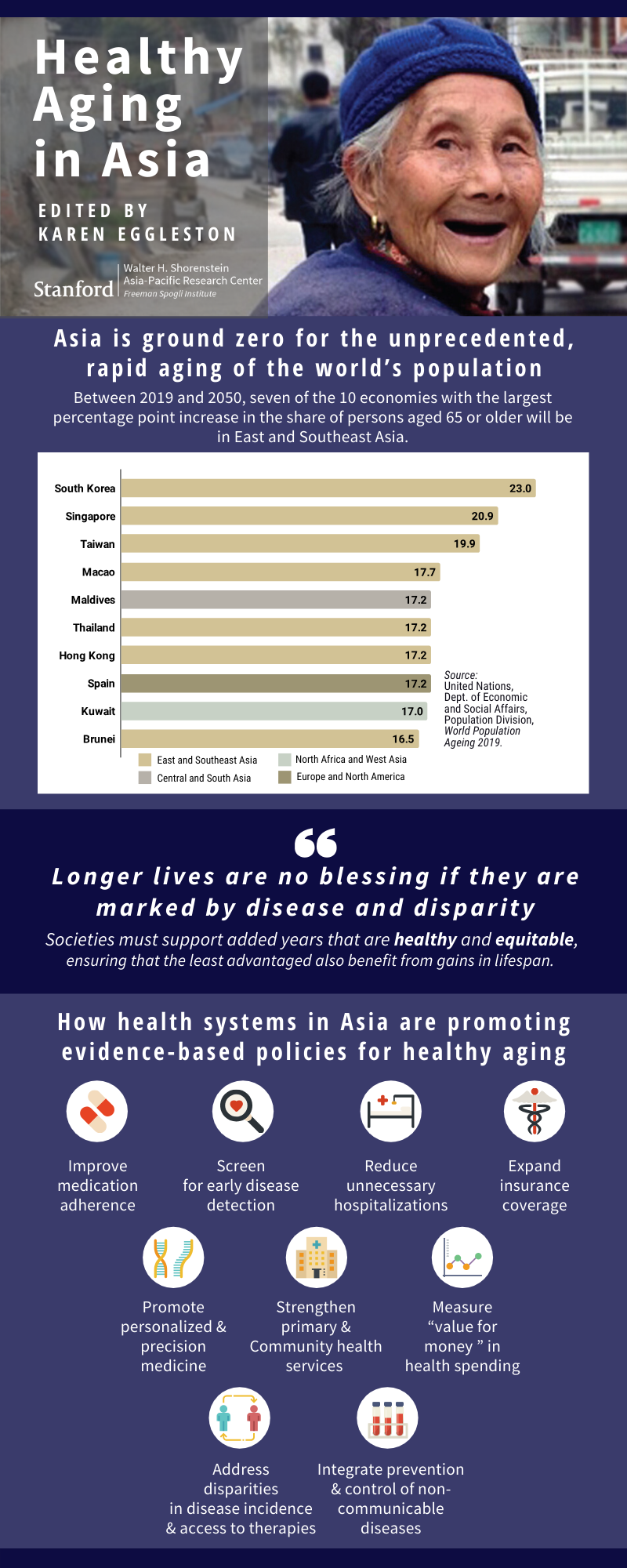
Rapid population aging is transforming societies around the world, and the Asia-Pacific region is on the frontlines of this unprecedented demographic shift. Life expectancy in Japan, South Korea, and much of urban China has now outpaced that of the United States and other high-income countries. With this triumph of longevity, however, comes a host of health, social, and economic challenges.

Longer lifespans will necessitate working to older ages, “but extending work lives will only be feasible if the added years are healthy ones, and will only be equitable if the least advantaged also benefit from healthy aging,” writes APARC Deputy Director and Asia Health Policy Program Director Karen Eggleston in her new book, Healthy Aging in Asia. “The great blessing of longer lives dims when clouded by pain, disability, and loss of dignity.”

[Listen to our conversation with Eggelston about the book and continue reading below. To receive stories like this directly in your inbox sign up for APARC newsletters]

Shorenstein APARC · Healthy Aging In Asia | Karen Eggleston

Image
Poster featuring the book Healthy Aging in Asia


Societies around the world must reduce disparities in health outcomes and address the older age-associated rise in the burden of noncommunicable diseases (NCDs) such as diabetes, hypertension, and cancer. Indeed, the COVID-19 pandemic has underscored the vulnerability of older adults suffering from NCDs to newly emerging pathogens and the importance of building long-term, resilient health systems.


How are health systems in Asia promoting evidence-based policies for healthy aging? What strategies have they used to prevent NCDs, screen for early disease detection, raise the quality of care, improve medication adherence, reduce unnecessary hospitalizations, and increase “value for money” in health spending?

The concise chapters in Healthy Aging in Asia examine these questions, covering multiple aspects of policy initiatives and economic research on healthy longevity in diverse Asian economies — from cities such as Singapore and Hong Kong to powerhouses such as Japan, India, and China — as they transform their health systems to support wellbeing in older age. Eggleston edited and contributed multiple chapters to this new volume, now available via Brookings Institution Press. This publication is part of APARC’s in-house series with the Brookings Institution.

Dr. Karen Eggleston

Karen Eggleston

Senior Fellow at the Freeman Spogli Institute for International Studies, Director of the Asia Health Policy Program, and Deputy Director of the Shorenstein Asia-Pacific Research Center
Full Biography

Read More

Karen Eggleston speaking to an online panel.
News

Karen Eggleston Testifies on China’s Healthcare System to Congressional Review Commission

Asia health policy expert Karen Eggleston provides testimony for a U.S.-China Economic and Security Review Commission hearing on China's domestic healthcare infrastructure and the use of technology in its healthcare system amid COVID-19.
Karen Eggleston Testifies on China’s Healthcare System to Congressional Review Commission
Elderly Chinese citizens sit together on a park bench.
Q&As

Karen Eggleston Examines China’s Looming Demographic Crisis, in Fateful Decisions

Karen Eggleston Examines China’s Looming Demographic Crisis, in Fateful Decisions
Michael McFaul, Xueguang Zhou, Karen Eggleston, Gi-Wook Shin, Don Emmerson, and Yong Suk Lee
News

FSI Hosts APARC Panel on COVID-19 Impacts in Asia

Scholars from each of APARC's programs offer insights on policy responses to COVID-19 throughout Asia.
FSI Hosts APARC Panel on COVID-19 Impacts in Asia
All News button
1
Subtitle

Asia health policy expert Karen Eggleston’s new volume, ‘Healthy Aging in Asia,’ examines how diverse Asian economies – from Singapore and Hong Kong to Japan, India, and China – are preparing for older population age structures and transforming health systems to support patients who will live with chronic disease for decades.

Authors
Noa Ronkin
News Type
News
Date
Paragraphs

What are the Chinese government’s objectives for the development of its healthcare system? How do these ambitions affect its interaction with U.S. and other foreign healthcare markets? And what policy recommendations should lawmakers consider regarding the development of China's healthcare system and its implications for U.S. national interests? These are some of the questions that APARC Deputy Director and Asia Health Policy Program Director Karen Eggleston discussed in her testimony before the U.S.-China Economic and Security Review Commission on May 7, 2020.

Watch Eggleston’s testimony (start time 23:25]

Read Eggleston's complete testimony
Download pdf

[To receive more stories like this in your inbox sign up for APARC’s newsletters]

Chaired by Dr. Robin Cleveland, the commission’s hearing, “China’s Evolving Healthcare Ecosystem: Challenges and Opportunities,” focused on China's domestic healthcare infrastructure and its use of technology in the light of the COVID-19 pandemic. The commission listened as Eggleston reviewed the strides China has made in its national health reforms and highlighted the many challenges its health system now faces. “It is in the interest of Americans and Chinese to have a strong, resilient healthcare system in China,” she said. “The United States should reemphasize scientific, evidence-based health policy and regulation, and encourage China to do so as well.”

The commission’s mandate is to investigate and submit to Congress an annual report on the national security implications of the bilateral trade and economic relationship between the United States and China and to provide recommendations to Congress for legislative action.

Ambitious Goals, Complex Challenges

Reforms over the past two decades, noted Eggleston, have brought China’s health system closer to a level of reliability and accessibility commensurate with the country’s dramatic economic growth. The government has already achieved its goal of providing universal health coverage and has made significant progress in many of the areas outlined in its “Healthy China 2030” blueprint, including tackling health disparities between regional and urban/rural population subgroups and building a more comprehensive and higher quality health service delivery system.

Still, China faces many daunting challenges, from dealing with COVID-19 and its aftermath to other urgent and lingering needs, such as tackling its looming demographic crisis and promoting healthy aging, addressing patient-provider tensions and trust, and changing provider payment to promote “value” rather than volume. If China is to make its investments in universal health coverage and rapid medical spending growth sustainable, said Eggleston, then it must build an infrastructure that increases health system efficiency, strengthens primary care, reforms provider payment system, and protects the most vulnerable from illness-induced poverty.

Constructive policies in support of health system improvements in both the United States and China could strengthen the global capacity to control future pandemics and avoid the devastating social and economic effects of future outbreaks on the scale of COVID-19.
Karen Eggleston

Technology and COVID-19 Response

Like other countries, China’s government and private sector have utilized various technologies in response to the COVID-19 crisis, such as telemedicine, “internet-plus” healthcare, and contact tracing applications, and are deploying digital and biotechnologies in efforts focused on epidemic mentoring and on treatment and vaccine development. Eggleston noted that the response to COVID-19 “will leave an indelible mark on health policies for decades to come,” not only in terms of technology adoption but also organizational innovation. One would hope to see future prioritization in resource allocation and renewed investment in the diagnosis and treatment of health system weaknesses, she added.

Recommendations for Congress

In all our policies and interactions, Eggleston concluded her testimony, we should remember that China is large and diverse, that local government agencies are those that make many important decisions in health policies as in other policies, and that the “Chinese people” are not synonymous with any given leader. “Avoid politicizing the COVID-19 pandemic and other health and humanitarian issues,” she noted. “In other geopolitical considerations in bilateral US-China relations, uphold U.S. interests while encouraging the PRC to be active as a globally responsible stakeholder.”

The U.S. government should encourage China and its scientists and firms to work collaboratively with multilateral efforts to prevent and control future pandemics, she argued. Specific recommended actions include supporting efforts to strengthen primary care and population health interventions with proven cost-effectiveness; sharing experiences with regional, community-based efforts to address the social determinants of health and promote multisector policies for healthy aging; encouraging public-private collaborative governance arrangements to strengthen the health sector in China; promoting transparent peer review of research and international collaboration between Chinese and American scientists, medical educators, health systems researchers, and technology developers; and collaborating with Chinese counterparts to address regional issues of population health importance, such as health problems in the DPRK and integration of public health priorities into China’s Belt and Road Initiative.

Read Eggleston's complete testimony >> 

Read More

Elderly Chinese citizens sit together on a park bench.
Q&As

Karen Eggleston Examines China’s Looming Demographic Crisis, in Fateful Decisions

Karen Eggleston Examines China’s Looming Demographic Crisis, in Fateful Decisions
Young patients receive treatment at Chongqing Children's Hospital in Chongqing Municipality, China.
News

On China’s Dramatic Health Care System Improvements – and Its Tortuous Road Ahead

On China’s Dramatic Health Care System Improvements – and Its Tortuous Road Ahead
Michael McFaul, Xueguang Zhou, Karen Eggleston, Gi-Wook Shin, Don Emmerson, and Yong Suk Lee
News

FSI Hosts APARC Panel on COVID-19 Impacts in Asia

Scholars from each of APARC's programs offer insights on policy responses to COVID-19 throughout Asia.
FSI Hosts APARC Panel on COVID-19 Impacts in Asia
Hero Image
Karen Eggleston speaking to an online panel.
All News button
1
Subtitle

Asia health policy expert Karen Eggleston provides testimony for a U.S.-China Economic and Security Review Commission hearing on China's domestic healthcare infrastructure and the use of technology in its healthcare system amid COVID-19.

-

This is a virtual event. Please click here to register and generate a link to the talk. 
The link will be unique to you; please save it and do not share with others.


To celebrate its May release, contributors Karen Eggleston, Barry Naughton, and Andrew Walder will join editors Thomas Fingar and Jean Oi for a panel discussion of their volume Fateful Decisions: Choices That Will Shape China’s Future (Stanford University Press).  China has enjoyed an extraordinary run of rapid growth and development over the last 40 years.  Yet, as Fingar and Oi point out, China’s future is hardly set in stone.  Sustained economic growth, social welfare and stability will depend upon tough policy decisions confronting Beijing’s leaders today in what is a watershed moment.  Casting doubt on Beijing’s aversion to major reforms and its return to certain Mao-era policy tools, Oi and Fingar argue that China’s challenges are not only complex, but high-stakes – challenges that have become even more daunting in the aftermath of COVID-19.  As China battles the difficulties caused by an aging population, the loss of comparative economic advantage, a politically entrenched elite, and a population with rising expectations, today’s policy decisions will weigh heavily on its future. Topics explored in the volume include China's healthcare challenges in a slowing economy, its global ambitions and track record, economic aims and realities, the country’s mounting governance pressures, and more. 


Fateful Decisions is available for purchase here.


Fore more information on Fateful Decisions, check out these articles:

Karen Eggleston Examines China’s Looming Demographic Crisis, in Fateful Decisions

Now It Gets Much Harder: Thomas Fingar and Jean Oi Discuss China’s Challenges in The Washington Quarterly

China’s Challenges: Now It Gets Much Harder


Portrait of Karen EgglestonKaren Eggleston is a senior fellow at the Freeman Spogli Institute for International Studies (FSI) at Stanford University, director of the Stanford Asia Health Policy Program, and deputy director of the Walter H. Shorenstein Asia-Pacific Research Center at FSI. She is also a fellow with the Stanford Center for Innovation in Global Health and a faculty research fellow of the National Bureau of Economic Research (NBER). Eggleston earned her PhD in public policy from Harvard University, studied in China for two years, and was a Fulbright scholar in South Korea. Her research focuses on comparative health systems and health reform in Asia, especially China; government and market roles in the health sector; supply-side incentives; healthcare productivity; and economic aspects of demographic change.


Portrait of Thomas FingarThomas Fingar is a Shorenstein Distinguished Fellow in the Shorenstein Asia-Pacific Research Center at Stanford University. From May 2005 through December 2008, he served as the first deputy director of national intelligence for analysis and, concurrently, as chairman of the National Intelligence Council. Previous positions include assistant secretary of state for Intelligence and Research (2000-2001, 2004–2005), principal deputy assistant secretary (2001–2003), deputy assistant secretary for analysis (1994–2000), director of the Office of Analysis for East Asia and the Pacific, and chief of the China Division. Fingar is a graduate of Cornell University (AB in government and history) and Stanford University (MA and PhD, both in political science). His most recent books are Uneasy Partnerships: China’s Engagement with Japan, the Koreas, and Russia in the Era of Reform (editor) (Stanford University Press, 2017); The New Great Game: China’s Relations with South and Central Asia in the Era of Reform (editor) (Stanford University Press, 2016); and Reducing Uncertainty: Intelligence Analysis and National Security (Stanford University Press, 2011).


Image
Photo of Barry Naughton
Barry Naughton is the So Kwanlok Professor at the School of Global Policy and Strategy, University of California–San Diego. Naughton’s work on the Chinese economy focuses on market transition; industry and technology; foreign trade; and political economy. His first book, Growing Out of the Plan, won the Ohira Prize in 1996, and a new edition of his popular survey and textbook, The Chinese Economy: Adaptation and Growth, appeared in 2018. Naughton did his dissertation research in China in 1982 and received his PhD in economics from Yale University.

 

Jean C. OiJean C. Oi is the William Haas Professor of Chinese Politics in the Department of Political Science and a senior fellow in the Freeman Spogli Institute for International Studies at Stanford University. She directs the China Program at the Walter H. Shorenstein Asia-Pacific Research Center and is the Lee Shau Kee Director of the Stanford Center at Peking University. Oi has published extensively on China’s reforms. Recent books include Zouping Revisited: Adaptive Governance in a Chinese County, coedited with Steven Goldstein (Stanford University Press, 2018), and Challenges in the Process of China’s Urbanization, coedited with Karen Eggleston and Yiming Wang (2017). Current research is on fiscal reform and local government debt, continuing SOE reforms, and the Belt and Road Initiative.


Portrait of Andrew WalderAndrew G. Walder is the Denise O’Leary and Kent Thiry Professor of Sociology in the School of Humanities and Sciences, and a senior fellow in the Freeman Spogli Institute for International Studies at Stanford University. A political sociologist, Walder has long specialized in the study of contemporary Chinese society and political economy. After receiving his PhD at the University of Michigan, he taught at Columbia, Harvard, and the Hong Kong University of Science and Technology. At Stanford he has served as chair of the Department of Sociology, director of the Asia-Pacific Research Center, and director of the Division of International, Comparative, and Area Studies in the School of Humanities and Sciences. His most recent books are Fractured Rebellion: The Beijing Red Guard Movement (2009), China under Mao: A Revolution Derailed (2015), and Agents of Disorder: Inside China’s Cultural Revolution (2019).

Via Zoom Webinar.
Register at: https://bit.ly/2WiwPvm

Karen Eggleston <br> Senior Fellow at FSI; Director of the Asia Health Policy Program, Shorenstein APARC, Stanford University <br><br>
Thomas Fingar <br> Shorenstein APARC Fellow, Stanford University <br><br>
Barry Naughton <br> Sokwanlok Chair of Chinese International Affairs, School of Global Policy and Strategy, UC San Diego <br><br>
Jean C. Oi <br> Director, Stanford China Program; William Haas Professor of Chinese Politics, Stanford University <br><br>
Andrew Walder <br> Senior Fellow at FSI; Denise O'Leary and Kent Thiry Professor, Stanford University <br><br>
Panel Discussions
Paragraphs
Cover of Healthy Aging in Asia that shows an elderly woman in a Chinese village.
Life expectancy in Japan, South Korea, and much of urban China has now outpaced that of the United States and other high-income countries. With this triumph of longevity, however, comes a rise in the burden of noncommunicable diseases (NCDs) like diabetes and hypertension, reducing healthy life years for individuals in these aging populations, as well as challenging the healthcare systems they rely on for appropriate care.  
 
The challenges and disparities are even more pressing in low- and middle-income economies, such as rural China and India. Moreover, the COVID-19 pandemic has underscored the vulnerability to newly emerging pathogens of older adults suffering from NCDs, and the importance of building long-term, resilient health systems. 
 
What strategies have been tried to prevent NCDs—the primary cause of morbidity and mortality — as well as to screen for early detection, raise the quality of care, improve medication adherence, reduce unnecessary hospitalizations and increase “value for money” in health spending? 
 
Fourteen concise chapters cover multiple aspects of policy initiatives for healthy aging and economic research on chronic disease control in diverse health systems — from cities such as Singapore and Hong Kong to large economies such as Japan, India, and China. 
 

Desk, examination, or review copies can be requested through Stanford University Press.

All Publications button
1
Publication Type
Books
Publication Date
Authors
Karen Eggleston
Book Publisher
Shorenstein APARC
Authors
Noa Ronkin
News Type
Q&As
Date
Paragraphs

This is the first installment in a series leading up to the publication of Fateful Decisions.

China has tremendous resources, both human and financial, but it may now be facing a perfect storm of challenges. Its future is neither inevitable nor immutable, and its further evolution will be highly contingent on the content and efficacy of complex policy choices.

Image
Fateful Decisions: Choices That Will Shape China's Future
This is the core argument in a new volume, Fateful Decisions: Choices that Will Shape China’s Future, edited by Shorenstein APARC Fellow Thomas Fingar and China Program Director Jean Oi. Forthcoming in May 2020 as part of Stanford University Press monograph series with APARC, this volume combines the expertise of researchers from across the disciplines of sociology, history, economics, health policy, and political science, who examine the factors and constraints that are likely to determine how Chinese actors will manage the daunting challenges they now face.

One of these challenges — how China must soon achieve economic growth as it grapples with the realities of a rapidly aging population and a shrinking workforce — is the subject of a chapter authored by Karen Eggleston, the deputy director of APARC and director of the Center’s Asia Health Policy Program. In the following interview, Eggleston shares perspectives from her chapter, “Demographic Challenges.”

[To get more stories like this delivered to your inbox, sign up for our newsletters]


Q: What are some of the fateful decisions China is facing regarding the responsibilities of caring for a large, aging population?

A: China has achieved impressive improvements in health and longevity. It has implemented universal health coverage and is experimenting with financial support for long-term care for older adults. Yet significant gaps between the most- and least-privileged Chinese citizens persist, and in some cases are growing. As I have written elsewhere, it is not surprising that there are wide disparities in health and healthcare between different population subgroups in a country as populous, expansive, and diverse as China. How effectively and efficiently China meets these and other health- and aging-related issues will have a major impact on its ability to manage other social and economic challenges.

In the chapter I contributed to the volume Fateful Decisions, I note that China’s current population and demographic trends — including relatively rapid aging — reflect the success of earlier investments in infectious disease control, public health measures, and other contributors to mortality reduction. The lingering effects of family planning policies, historic preferences for sons, and rapid economic development are also major considerations. Together, these factors have produced a shrinking working-age population, a growing number of elderly, a gender imbalance, and hurdles for inclusive urbanization. An urgent question for China’s future is to what extent policies will ameliorate disparities in health, healthcare use, and the burden of medical spending.

The unfolding COVID-2019 outbreak is a powerful illustration of just how fateful decisions about health systems can be. Compared to the SARS outbreak almost two decades ago, China has been better prepared for this situation. SARS raised health system reform to the top of the political agenda and, many argue, played a direct role in China’s achieving universal health coverage and vastly strengthening the public health system.

But as China has become a middle-income global economic powerhouse in the years since SARS and the ensuing wave of health policy reforms, the expectations of its citizens about their health system have also risen. Has the health system, including public health and medical care, been strengthened to the same degree as other parts of the economy and public services? The impact of and lasting response to COVID-2019 may prove a litmus test.

Q: Why do these decisions about health carry such importance for China’s future development?

Through the last four decades, China has benefitted from a demographic dividend caused by the large bulge in the working-age population. But to achieve future economic growth and productivity, investments in human capital particularly in health and education —need to be made. This higher productivity will, in turn, be the means by which a smaller workforce can support China’s large and growing cohort of retirees.

As we’ve already seen, health expenditures have increased rapidly as China has developed its system of universal health coverage. Double-digit health spending growth surpassed the rate of economic growth, and as a result, health spending absorbs an increasingly larger share of the total economy. China needs to make sure additional spending on health and elderly care is efficient and effective, while also addressing the nonmedical determinants of health and promoting healthy aging. The health system needs to be reengineered to emphasize prevention, provide coordinated health care for people with multiple chronic diseases, assure equitable access to rapidly changing medical technologies, and ensure long-term care for frail elderly, all without unsustainable increases in opportunity costs for China’s future generations.

Q: What is the Chinese government doing to improve healthcare quality and delivery, and what more could it do to affect meaningful change in its systems?

China’s current policies seek to balance individual responsibility, community support, and taxpayer redistribution through safety-net coverage funded by central and local governments. Like many countries, China would benefit from improved coordination across multiple agencies and structure incentives to avoid or mitigate unintended consequences that undermine the goals of its health system. Recent governance reforms, such as the creation of the National Healthcare Security Administration, aim to address these challenges.

China’s achievements and remaining challenges can be illustrated with the Healthcare Access and Quality Index (HAQ), which measures premature mortality from causes that should not occur if the individual had access to high-quality healthcare: among 195 countries and territories, China achieved the highest absolute increase in the HAQ Index from 2000 to 2016. However, the 43-point regional disparity in HAQ within China is the equivalent of the difference between Iceland (the highest HAQ in the world) and North Korea.

Q: The subject of your chapter, China’s demographic challenges, is one of the issues you investigate in your upcoming book, Healthy Aging in Asia. As you show in this volume, challenges at the intersection of aging, economics, demographic transition, and healthcare policy are not unique to China. How are other countries in Asia responding to them and what lessons could benefit China?

 As I note in the introduction of Healthy Aging in Asia, the demographic transition from high to low fertility and mortality has been more rapid in much of Asia than in Europe and North America. That means social institutions, such as retirement, living arrangements, and intergenerational support, have to adapt quickly. For example, extending work-lives (as is happening in Japan) will be necessary but feasible only if the added years are healthy ones and equitable only if the least advantaged also benefit from healthy aging. The blessings of longevity dim when clouded by pain, disability, and loss of dignity.

 Investment strategies in insurance and managing chronic conditions are also important considerations. Japan and Korea have adopted insurance systems for financing long-term care for frail elderly, while places like Hong Kong have good empirical research on chronic condition management.

 No country or system has a “magic pill” to address these challenges, but the empirical evidence and rich policy experience documented in Healthy Aging from health systems as diverse as those in the cities of Singapore and Hong Kong to large economies such as Japan, India, and China can certainly be instructive.

Hero Image
Elderly Chinese citizens sit together on a park bench. Getty Images
All News button
1
Paragraphs

Explore our series of multimedia interviews and Q&As with the contributors to this volume: 


China's future will be determined by how its leaders manage its myriad interconnected challenges. In Fateful Decisions, leading experts from a wide range of disciplines eschew broad predictions of success or failure in favor of close analyses of today's most critical demographic, economic, social, political, and foreign policy challenges. They expertly outline the options and opportunity costs entailed, providing a cutting-edge analytic framework for understanding the decisions that will determine China's trajectory.

Xi Jinping has articulated ambitious goals, such as the Belt and Road Initiative and massive urbanization projects, but few priorities or policies to achieve them. These goals have thrown into relief the crises facing China as the economy slows and the population ages while the demand for and costs of education, healthcare, elder care, and other social benefits are increasing. Global ambitions and a more assertive military also compete for funding and policy priority. These challenges are compounded by the size of China's population, outdated institutions, and the reluctance of powerful elites to make reforms that might threaten their positions, prerogatives, and Communist Party legitimacy. In this volume, individual chapters provide in-depth analyses of key policies relating to these challenges. Contributors illuminate what is at stake, possible choices, and subsequent outcomes. This volume equips readers with everything they need to understand these complex developments in context.

Available May 2020.

This book is part of the Stanford University Press series, "Studies of the Walter H. Shorenstein Asia-Pacific Research Center"

All Publications button
1
Publication Type
Books
Publication Date
Journal Publisher
Stanford University Press
Authors
Jean C. Oi
Thomas Fingar
Authors
News Type
Q&As
Date
Paragraphs

Updated January 24
Millions of residents in China are under lockdown measures as the number of reported deaths from the coronavirus outbreak rises to 26. In the United States, dozens of people are being monitored for the virus. The World Health Organization on January 23 said at a press conference the outbreak did not yet constitute a global public health emergency.


The outbreak of a novel coronavirus that began in December 2019 in Wuhan, China “is evolving and complex,” said the head of the World Health Organization (WHO) after its emergency committee convened on Wednesday, January 22, and decided that more information was needed before the WHO declares whether or not the outbreak is a public health emergency of international concern. The new virus, known as 2019-nCoV, causes respiratory illness and continues to spread across China. Chinese health authorities, reports the Washington Post, announced that at least 17 people have now died as a result of infection and confirmed cases have been reported in Japan, Thailand, South Korea, Hong Kong, and Macao, with one travel-related case detected in the United States, in the State of Washington. The WHO decision was made as the city of Wuhan shut down all air and train traffic to try to contain the spread of the virus.

With concern over and coverage of the situation rapidly developing, Karen Eggleston, APARC Deputy Director and the Asia Health Policy Program Director at the Shorenstein Asia-Pacific Research Center, offered her insights on the outbreak and its impact on both Asian and international healthcare systems.

Q: Why has this outbreak raised so much concern in China and internationally, and how worried should people be about it?

Infectious disease outbreaks can challenge any health system. Events such as SARS, Ebola, and MERS outbreaks, and even the devastating flu pandemic a century ago, remind us of the frightening power that infectious diseases with high-case fatality can have. The global burden of mortality and morbidity is mostly from non-communicable chronic diseases, but no country or society is immune to old, newly emerging, and re-emerging infectious diseases. And although health systems are generally stronger now and have more technologies to trace and contain outbreaks, there are also deep and complicated challenges that make swift, coordinated disease response difficult even in the modern era.

Any government leadership or healthcare responders who have tried to manage an outbreak situation before are hyper-aware of the need to prepare for and manage future incidents, but we are living in a moment of very complicated social dynamics surrounding public health and healthcare. Distrust in drug companies and government agencies, controversies over vaccines, and increasing skepticism in science, even if only from vocal minorities, all make it more difficult to manage a cohesive international response to an outbreak situation and protect vulnerable people.

Q: As you’ve mentioned, many people looking at this situation with the memory of outbreaks such as SARS or H1N1 in mind. How is the Chinese government addressing this crisis and how does its reaction compare with China’s history of emergency health responses?

China’s health system is much more prepared now, compared to the SARS crisis 17 years ago. More training and investment in primary health care, disease surveillance and technology systems for tracking and monitoring outbreaks, and the achievement of universal health coverage with improving catastrophic coverage even for the rural population, all suggest a health system that is much better prepared to handle a situation like this. Top-level leadership in China had already begun to publicly address the situation within days of the outbreak to assure the public that strict prevention measures will be taken and to urge local officials to take responsibility and share full information. Until more information is gained and more is understood about the nature of this virus, it’s been categorized as a “Grade B infectious disease” but will be managed as if it is a "Grade A infectious disease," which requires the strictest prevention and control measures, including mandatory quarantine of patients and medical observation for those who have had close contact with patients, according to the commission. China currently only classifies two other diseases as Grade A infection diseases—bubonic plague and cholera—and so that tells you something about how seriously this is being treated by those in leadership positions.

Q: And what about the response from the international health communities?

As with any major healthcare crisis, health systems around the globe must also respond with alacrity and integrity, including effective surveillance, monitoring, and infection control. Individuals also play a crucial role in supporting the instructions and recommendations made by established healthcare professionals. For example, the individual with the confirmed case in Washington State proactively told medical personnel about his recent visit to the Wuhan area. His medical providers then exercised appropriate levels of caution, given the unknown nature of the virus, and isolated him while his symptoms developed. He is currently combatting an infection similar in severity to that of mild pneumonia, and so far no other cases have been reported in the United States, though some may arise in the coming days and weeks.

There is always a fine balance between safeguarding public health while still respecting individual rights, civil liberties, and undertaking a prudent, scientific response. The aim is to remain clear and transparent in communications and actions without reverting to disproportionate or overly aggressive responses which lead to panic, distortion, and misinformation about the situation. Some countries, like the Democratic People’s Republic of Korea, may choose to seal their international borders until more is understood about the nature of this virus, but most nations will use tried-and-tested methods of monitoring travelers and alerting population health systems so that information about cases is widely available to health authorities and medical researchers trying to understand the cause and develop a potential cure.

Q: As this situation continues to develop, and with inevitable future disease outbreaks around the globe, what would you hope people keep in mind about the role we all play in healthcare crises and in public health?

One issue this outbreak reminds us of in a visceral and intimate way is how closely people are linked together across the world. Globalization and air travel almost instantaneously link continents, countries, and regions. The timing of this outbreak is particularly fraught, because it’s the beginning of the Lunar New Year, when there is a vast migration of people both within China, throughout greater Asia, and across the globe as massive populations go home to celebrate the holidays with family. The potential for a contagious disease to spread easily through crowds and across borders in circumstances like this is very high, and highlights the need for the international communities to share information, scientific expertise, and understanding.

We need to remember that this is not just a problem in a remote part of the world that has no impact on those of us who live in relative comfort in high-income countries. Rather, this is something that could easily impact anyone. Perhaps this latest outbreak and response will showcase how vital additional, ongoing investments in both domestic and international healthcare systems, technologies, and people are.

Hero Image
Security personnel check the temperature of passengers in the Wharf at the Yangtze River on January 22, 2020 in Wuhan, Hubei province, China.
Getty Images
All News button
1
Shorenstein APARCStanford UniversityEncina Hall E301Stanford, CA 94305-6055
0
Visiting Scholar at APARC
Winter 2020
Ph.D.

Kavita Singh joined the Walter H. Shorenstein Asia-Pacific Research Center (APARC) for the winter quarter of 2020 as a visiting scholar from the Public Health Foundation of India, where she serves as a research scientist at the Centre for Chronic Conditions and Injuries.  At APARC, she will be working with Dr. Karen Eggleston conducting research on diabetes management and health economics in South Asia.

Subscribe to Health Care