Health policy
Authors
Noa Ronkin
News Type
News
Date
Paragraphs

Does the new wave of digital technologies portend a future in which robots and automation increasingly replace workers and destroy livelihoods? In one of the first studies of service sector robots, APARC experts find evidence to offset dystopian predictions of robot job replacement.

The researchers — Asia Health Policy Program Director Karen Eggleston, SK Center Fellow Yong Suk Lee, and University of Tokyo health economist Toshiaki Iizuka, our former visiting scholar — set out to examine how robots affect labor, productivity, and quality of care in Japan’s nursing homes. Their findings indicate that robot adoption may not be detrimental to labor and may help address the challenges of rapidly aging societies.

Eggleston recently joined the Future Health podcast, an initiative of the New South Wales Ministry of Health, to discuss the study and its implications. The program is available both as a video and audio podcast. Watch and listen below:

Sign up for APARC newsletters to receive the latest updates from our scholars.


Published by the National Bureau of Economic Research, the study suggests that robot adoption has increased employment opportunities for non-regular care workers, helped mitigate the turnover problem that plagues nursing homes, and provided greater flexibility for workers. It is also published in AHPP's working paper series and is part of a broader research project by Eggleston, Lee, and Iizuka, that explores the impact of robots on nursing home care in Japan and the implications of robotic technologies adoption in aging societies.

The study has attracted media attention. The Financial Times Magazine, in a feature story and podcast, called it “groundbreaking in several ways but perhaps most clearly for setting its sights not on manufacturing but on the services sector, where robots are only just beginning to make their mark.” The Freakonomics Radio podcast also hosted Eggleston and Lee for a conversation about their research as part of an episode on collaborative robots and the future of work.

Read More

Autonomous caregiver robot is holding a insulin syringe, giving it to an senior adult woman, concept ambient assisted living
News

The Unfolding Relationship Between Human Workers and Robots in an Aging World

On the Freakonomics Radio podcast, Karen Eggleston and Yong Suk Lee discuss their research into the effects of robots on staffing in Japanese nursing homes.
The Unfolding Relationship Between Human Workers and Robots in an Aging World
A Japanese robot prototype lifts a dummy patient
News

Robot Adoption Brings Benefits to Japan’s Aging Society

In one of the first studies of service sector robotics, APARC scholars examine the impacts of robots on nursing homes in Japan. They find that robot adoption may not be detrimental to labor and may help address the challenges of rapidly aging societies.
Robot Adoption Brings Benefits to Japan’s Aging Society
A woman walks past a mural referring to the Covid-19 coronavirus painted on a wall on December 10, 2020 in New Delhi, India.
News

How COVID-19 Disproportionately Impacts People with Chronic Conditions in India

A collaborative study by a group of researchers including APARC’s Karen Eggleston documents the adverse effects of COVID-19 on people with chronic conditions in India, particularly among poor, rural, and marginalized populations. The pandemic’s impacts extend beyond health disparities to encompass psychosocial and economic consequences, the study shows.
How COVID-19 Disproportionately Impacts People with Chronic Conditions in India
Hero Image
Logo of the New South Wales Ministry of Health's podcast Future Health
All News button
1
Subtitle

On the Future Health podcast, Karen Eggleston discusses the findings and implications of her collaborative research into the effects of robot adoption on staffing in Japanese nursing homes.

Paragraphs

This paper describes the qualitative results of the mixed-methods study by Eggleston and her colleagues. For the quantitative results of the study, read the April 2021 paper in the journal BMC Public Health. Also, watch and read our full story and interview with Eggleston.

Objective

People with chronic conditions are known to be vulnerable to the COVID-19 pandemic. This study aims to describe patients’ lived experiences, challenges faced by people with chronic conditions, their coping strategies, and the social and economic impacts of the COVID-19 pandemic.
 

Design, Setting, and participants

We conducted a qualitative study using a syndemic framework to understand the patients’ experiences of chronic disease care, challenges faced during the lockdown, their coping strategies and mitigators during the COVID-19 pandemic in the context of socioecological and biological factors. A diverse sample of 41 participants with chronic conditions (hypertension, diabetes, stroke, and cardiovascular diseases) from four sites (Delhi, Haryana, Vizag, and Chennai) in India participated in semistructured interviews. All interviews were audio-recorded, transcribed, translated, anonymized and coded using MAXQDA software. We used the framework method to qualitatively analyze the COVID-19 pandemic impacts on health, social and economic well-being.
 

Results

Participant experiences during the COVID-19 pandemic were categorized into four themes: challenges faced during the lockdown, experiences of the participants diagnosed with COVID-19, preventive measures taken, and lessons learned during the COVID-19 pandemic. A subgroup of participants faced difficulties in accessing healthcare while a few reported using teleconsultations. Most participants reported the adverse economic impact of the pandemic which led to higher reporting of anxiety and stress. Participants who tested COVID-19 positive reported experiencing discrimination and stigma from neighbors. All participants reported taking essential preventive measures.
 

Conclusion

People with chronic conditions experienced a confluence (reciprocal effect) of COVID-19 pandemic and chronic diseases in the context of difficulty in accessing healthcare, sedentary lifestyle, and increased stress and anxiety. Patients’ lived experiences during the pandemic provide important insights to inform effective transition to a mixed realm of online consultations and ‘distanced’ physical clinic visits.


Karen Eggleston 4X4

Karen Eggleston, PhD

Senior Fellow at FSI, Director of the Asia Health Policy Program at Shorenstein Asia-Pacific Research Center
Full Biography
All Publications button
1
Publication Type
Journal Articles
Publication Date
Subtitle
A Qualitative Study
Journal Publisher
BMJ Open
Authors
Karen Eggleston
Number
2021;11:e048926
Authors
News Type
News
Date
Paragraphs

Of the many issues that the COVID-19 pandemic has brought into focus, foremost in the spotlight is the vital role that healthcare systems play in societal wellbeing and security. Around the world, health systems of all types have had to rapidly adapt, reassess, and react to constantly changing needs.

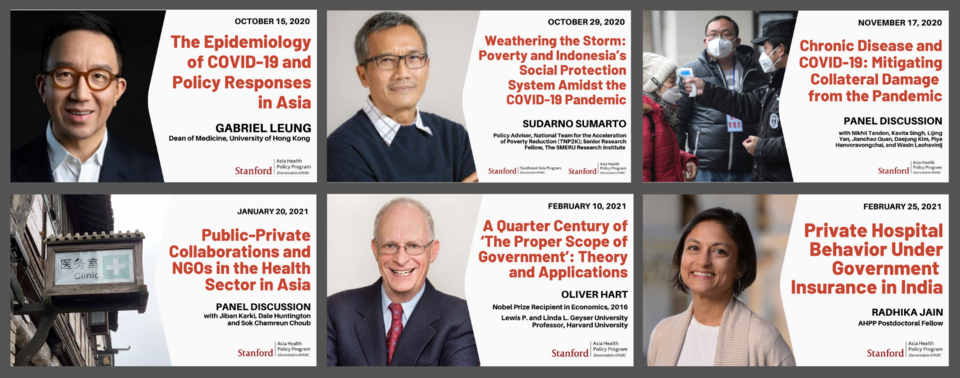
The 2020-21 Asia Health Policy Program (AHPP) colloquium series, “Health, Medicine, and Longevity: Exploring Public and Private Roles,” brings together academics, theorists, on-the-ground NGO leaders, and government advisors to explore how partnerships between public providers and private organizations affect the quality and access to healthcare the world over.

The series recently featured a keynote address by Harvard economist Oliver Hart, the 2016 co-recipient of the Nobel Prize in Economics for his work on contract theory — a framework known as ‘The Proper Scope of Government.’ Hart joined AHPP Director and APARC Deputy Director Karen Eggleston to reflect on the impact his theory has had across disciplines in the 25 years since its publication and on the future of research into contract theory. Watch the conversation with Hart below.

[Subscribe to our newsletters to stay informed on research happening at APARC.]

Oliver Hart and the ‘Proper Scope of Government’

Hart’s seminal economic theory, ‘The Proper Scope of Government,” underpins much of the research into public-private partnerships in healthcare. Hart developed this touchstone framework jointly with Andrei Shleifer and Robert W. Vishny to better evaluate when a government should provide a service itself and when it should contract with a private provider for support and execution of services.

The model outlined in Hart, Shleifer, and Vishny’s original 1996 working paper is designed to help providers and contractors consider the costs and benefits of a proposed contractual service agreement. While this model was originally applied to the case of prison privatization, the framework has served as an invaluable tool for researchers in multiple sectors including health policy and provision.

Reflections and Updates to the Theory

In reflecting on ‘The Proper Scope of Government,’ there are things Hart would like to see more fully incorporated into the theory to enrich its real-world applicability. Chiefly among these is better accounting for contractual incompleteness or the reality that a contract cannot anticipate and outline every possible unforeseen event or area of ambiguity. However, modeling contractual incompleteness is notoriously difficult given the almost-limitless factors of variability.

Some of Hart’s recent work on guiding principles responds to this challenge. Rather than trying to predict every aspect of a contractual relationship within the framing and language of a standard contract model, Hart argues that mutually agreed-upon guiding principles —such as equity, loyalty, and honesty — can serve as a foundation for navigating inevitable areas of ambiguity and potential conflict that a contract does not specifically state or that the original theory does not fully account for.

These guiding principles also help preserve space for renegotiation and innovation, which are necessary in an era of rapid technological advances and explosion of measurable data. In this context, Hart cautions against the mentality of ‘more is more:’

“If you put more and more things into the contract and then something happens that wasn’t in the contract, the fact that you put so much more in may make it more difficult to negotiate about the thing that you didn’t put in.”

 Applying ‘The Proper Scope of Government’

Hart shared a prime example of his theory at work in health systems in a case study of the Vancouver Island Health Authority. Traditionally, family physicians would continue as the primary care provider for their patients even if a patient needed hospitalization. But a change of law in 2006 required all specialized in-hospital care be contracted to hospitalists with little to no crossover with care provided by family practice physicians.

The result was a rise in caseload and stress levels amongst hospital specialists and repeated failed negotiations of the standard contract. The addition of guiding principles to the contract, however, provided avenues where reasonable solutions and additional communications could happen beyond the limits of the formal contract.

This is just one case of innumerable where Hart’s work has helped inform and contextualize how policymakers consider relationships between the public and private spheres of healthcare. Responding to the praise and input from fellow economists presented in a tribute documentary to the impact of his framework, Hart remarked:

“I hadn't realized how many people have been influenced by this paper and how they've been using it in different contexts. I knew some of the applications, but there were others I didn't, and it’s been truly amazing to see that.”

Looking Toward the Future

The tradeoffs between public and private partnerships in healthcare systems across the world will continue to be a dynamic and evolving area of research that will rely on theories such as ‘The Proper Scope of Government’ for framing and application. Looking towards the future, Hart was hopeful but cautious about the vitality of the kind of theoretical tradition which allowed for the development of his original theory. He recognizes that specialties such as contract theory and contractual incompleteness are inherently “messy” and somewhat out of vogue with current trends in economics which tend to favor theories that are “impressive, clever, and non-obvious,” regardless of whether they address important questions.

As he iterated in his Nobel Prize lecture, the incomplete world of contracts nonetheless “underlies numerous significant phenomena, some of which have great policy relevance,” and therefore fully deserving of upcoming economists’ time and efforts.

Further Research into Public-Private Partnerships

The Asia Health Policy Program’s 2020-21 colloquium series focuses on the roles and impacts of public-private partnerships in healthcare and the tradeoffs in equity, accessibility, and cost that come with contracted agreements in health systems. All of the events from the colloquium series are available on our YouTube channel. Click the thumbnails below to start exploring.

Collaborative governance — that is, relationships involving both the private and public sectors in the pursuit of public value — is part of ongoing research by Karen Eggleston. Her forthcoming book, The Dragon, the Eagle, and the Private Sector (Cambridge University Press), co-authored with Harvard’s John D. Donahue and Richard J. Zeckhauser, examines the ways in which collaborative governance works across a wide range of policy arenas in China and the United States, with the goal of empowering public decisionmakers to more wisely engage the private sector. Join us for the book launch event, which will be held jointly with the Harvard Kennedy School on March 5 


Image
Thumbnail images for the webinar events in the AHPP's 2020-21 colloquium series, "Health, Medicine, and Longevity: Exploring Public and Private Roles."

Read More

Male Japanese doctor showing senior patient records on a clipboard
News

Health Signals Increase Preventive Care, Improve Health Outcomes for Individuals at High Risk of Diabetes, Evidence from Japan Shows

Among the general population, however, researchers including Asia Health Policy Program Director Karen Eggleston find no evidence that additional care improves health outcomes.
Health Signals Increase Preventive Care, Improve Health Outcomes for Individuals at High Risk of Diabetes, Evidence from Japan Shows
An elderly individual travels in a cart up a street.
News

Researchers Develop New Method for Projecting Future Wellness of Aging Populations

Asia Health Policy Director Karen Eggleston and her colleagues unveil a multistate transition microsimulation model that produces rigorous projections of the health and functional status of older people from widely available datasets.
Researchers Develop New Method for Projecting Future Wellness of Aging Populations
A communications robot named Pepper by Softbank
Q&As

Robots May Be the Right Prescription for Struggling Nursing Homes

Karen Eggleston and Yong Suk Lee speak to the Oliver Wyman Forum on how robotics and advancing technologies are helping staff in Japanese nursing homes provide better and safer care to their patients.
Robots May Be the Right Prescription for Struggling Nursing Homes
Hero Image
[Left] A nurse assists an elderly woman in a wheel chair; [Right] Oliver Hart
The AHPP 2020-21 colloquium series explores the roles of the public and private sectors in providing equitable and accessible health services. The keynote address was given by Nobel laureate Oliver Hart. | Getty Images
All News button
1
Subtitle

In its 2020-21 colloquium series, the Asia Health Policy Program weighs the balance, benefits, and considerations in providing health services through national governments and contracting with private organizations.

Paragraphs

This study investigates the marginal value of information in the context of health signals that people receive after checkups. Although underlying health status is similar for individuals just below and above a clinical threshold, treatments differ according to the checkup signals they receive. For the general population, whereas health warnings about diabetes increase healthcare utilization, health outcomes do not improve. However, among high-risk individuals, outcomes do improve, and improved health is worth its cost. These results indicate that the marginal value of health information depends on setting appropriate thresholds for health warnings and targeting individuals most likely to benefit from follow-up medical care.

All Publications button
1
Publication Type
Journal Articles
Publication Date
Journal Publisher
Journal of Public Economics
Authors
Karen Eggleston
Toshiaki Iizuka
Paragraphs

Image
Journal of BMC Medicine

India, as part of its bid to achieve universal health coverage, has expanded government health programs over the last two decades, most notably with the establishment of the National Health Mission and the rollout of public health insurance programs targeting poor households. However, national spending on health remains among the lowest in the world. As the government increasingly takes on the role of purchaser of health care, decisions about the allocation of scarce resources for health will have substantial fiscal and health consequences and must be based on evidence. Additionally, in order to control costs and effectively address the growing chronic disease burden, public programs will need to find ways to integrate curative hospital services with the most cost-effective preventive and primary interventions. Currently, in part because the evidence base on economic evaluations of health interventions in India remains sparse and of low quality, decisions about which health care services to cover are typically made by expert committees rather than through systematic assessments of efficacy and cost-effectiveness.

However, in recent years, the government has taken several steps towards establishing the infrastructure for evidence-based priority setting and resource allocation, including the establishment of a body for Health Technology Assessment in India (HTAIn) within the Department of Health Research to collate and generate evidence on the clinical efficacy and cost-effectiveness of new and existing health technologies and programs. Research evidence on the cost-effectiveness of both preventive and curative health interventions in the Indian context is going to be a critical input to the HTAIn.

Dr. Karen Eggleston

Karen Eggleston, PhD

Senior Fellow at FSI, Director of the Asia Health Policy Program at Shorenstein APARC
Full Biography
Portrait of Radhika Jain

Radhika Jain, PhD

2019-2022 Asia Health Policy Postdoctoral Fellow
Full Biography
All Publications button
1
Publication Type
Journal Articles
Publication Date
Journal Publisher
BMC Medicine
Authors
Karen Eggleston
Radhika Jain
Paragraphs

Shorenstein APARC's annual overview for the academic year 2019-20 is now available.

Learn about the research, events, and publications produced by the Center's programs over the last twelve months. Feature sections look at how APARC has continued its mission amid COVID-19 restrictions and how our research has been adapted to factor in the impact of the pandemic. Learn about new talent at the Center, including new leadership of the Japan Program and an enhanced focus on South Asia research. Catch up on the Center's policy work, education initiatives, events, and outreach.

Read online:

All Publications button
1
Publication Type
Annual Reports
Publication Date
News Type
News
Date
Paragraphs

India is facing a mounting burden of noncommunicable diseases (NCDs) such as diabetes, cancers, and cardiovascular diseases. NCDs affect more than 20 percent of the Indian population and their prevalence is projected to expand substantially as the population aged 60 and over increases. Left unchecked, the costs of managing chronically ill and aging sectors of the population grow exponentially.

To control costs and address the growing chronic disease burden, India’s public programs must integrate curative hospital services with the most cost-effective preventive and primary interventions, argue Karen Eggleston, APARC’s deputy director and the director of the Asia Health Policy Program (AHPP), and Radhika Jain, a postdoctoral research fellow with AHPP. India must also urgently expand and improve the evidence base on economic evaluations of both preventive and curative health interventions in the country.

[Sign up for our newsletters to get the latest updates from our scholars.]

In a correspondence piece published by BMC Medicine, Eggleston and Jain examine the features and limitations of a study that takes an important first step in that direction: a cost-effectiveness study of the Kerala Diabetes Prevention program (K-DPP) that adds such evidence on how to prevent diabetes cost-effectively in India and other low- and middle-income countries.

The study’s authors present a cost-effectiveness analysis of 1007 participants in the K-DPP, and their estimates indicate that K-DPP was cost-effective. Indeed, Eggleston and Jain determine that the analysis shows potential cost-effectiveness in “nudging” the participants towards a healthier lifestyle through suggestive reductions in tobacco and alcohol use and waist circumference. The results of the cost-effectiveness analysis of the K-DPP “highlight the importance of continued research on community-based promotion of healthy lifestyles,” say Eggleston and Jain.

Evidence-based approaches to chronic noncommunicable disease intervention are essential for providing cost-effective care and creating models for future programs like the K-DPP. Eggleston and Jain conclude that future studies advancing evidence-based approaches to chronic noncommunicable disease intervention — ones that cover larger and more representative populations over longer time periods — remain important for more generalizable assessments to inform policy decisions.

Read More

[Left] Radhika Jain, [Right] Postdoc Spotlight, Radhika Jain, Asia Health Policy Program
Blogs

Postdoctoral Fellow Spotlight: Radhika Jain on Reducing Inequalities in Health Care and Outcomes

Radhika Jain, a postdoctoral fellow with the Asia Health Policy Program, shares insights on her research into India’s health care system and how it is responding to both the COVID-19 pandemic and standard healthcare needs of citizens.
Postdoctoral Fellow Spotlight: Radhika Jain on Reducing Inequalities in Health Care and Outcomes
An elderly individual travels in a cart up a street.
News

Researchers Develop New Method for Projecting Future Wellness of Aging Populations

Asia Health Policy Director Karen Eggleston and her colleagues unveil a multistate transition microsimulation model that produces rigorous projections of the health and functional status of older people from widely available datasets.
Researchers Develop New Method for Projecting Future Wellness of Aging Populations
People receiving diabetes care in a rural clinic in India
News

Confronting South Asia’s Diabetes Epidemic

Confronting South Asia’s Diabetes Epidemic
Hero Image
A woman has blood drawn at a clinic in Bombay, India
A woman has blood drawn at a clinic in Bombay, India. | Alyssa Banta, Getty Images
All News button
1
Subtitle

Addressing the epidemic of chronic diseases in India and other low- and middle-income countries requires comprehensive evidence on the cost-effectiveness of health interventions, argue APARC’s Asia Health Policy Program Director Karen Eggleston and Postdoctoral Fellow Radhika Jain.

News Type
News
Date
Paragraphs

China's future will be determined by how its leaders manage its myriad interconnected challenges. In Fateful Decisions (Stanford University Press, May 2020), editors Thomas Fingar, a center fellow at APARC, and Jean Oi, the director of APARC’s China Program, join other experts across multiple disciplines in providing close analyses of the most critical demographic, economic, social, political, and foreign policy challenges China’s leaders face today. They outline the options and opportunity costs entailed, providing an analytic framework for understanding the decisions that will determine China's trajectory.

Fingar and Oi discussed the main arguments in their edited volume at a virtual program of the National Committee on U.S.-China Relations. Watch here:

Read More

Quote from Thomas Fingar and Jean Oi from, "China's Challeges: Now It Gets Much Harder"
Commentary

Now It Gets Much Harder: Thomas Fingar and Jean Oi Discuss China’s Challenges in The Washington Quarterly

Now It Gets Much Harder: Thomas Fingar and Jean Oi Discuss China’s Challenges in The Washington Quarterly
BEIJING, CHINA - Workers sit near a CRH (China Railway High-speed) "bullet train" at the Beijing South Railway Station under reconstruction.
News

High-Speed Rail Holds Promise and Problems for China, Explains David M. Lampton

In a new audio interview, Lampton discusses some of the challenges, uncertainties, and decisions that loom ahead of China's Belt and Road Initiative.
High-Speed Rail Holds Promise and Problems for China, Explains David M. Lampton
Elderly Chinese citizens sit together on a park bench.
Q&As

Karen Eggleston Examines China’s Looming Demographic Crisis, in Fateful Decisions

Karen Eggleston Examines China’s Looming Demographic Crisis, in Fateful Decisions
Hero Image
Cover of the book Fateful Decisions: Choices That Will Shape China's Future
All News button
1
Subtitle

Fingar and Oi joined the National Committee on U.S.-China Relations to discuss their edited volume, ‘Fateful Decisions: Choices that Will Shape China’s Future.’

News Type
News
Date
Paragraphs

As the COVID-19 pandemic continues to take massive tolls on lives and livelihoods at home and abroad, students have been thrown into turmoil and are facing uncertainties about funding, graduation, research opportunities, and career choices. At Shorenstein APARC, we are committed to supporting Stanford students as best we can. We are therefore announcing today new quarter-long research assistantships for current undergraduate and graduate students working in the area of contemporary Asia. These opportunities are in addition to our recent internship and fellowship offerings.

Guidelines

Shorenstein APARC is seeking to hire motivated and dedicated undergraduate and graduate students as paid research assistants who will work with assigned APARC faculty members on projects focused on contemporary Asia, studying varied issues related to the politics, economies, populations, security, foreign policies, and international relations of the countries of the Asia-Pacific region.

2020-21 research assistant positions will be offered in the fall, winter, spring, and summer quarters. We expect to hire up to 10 research assistants per quarter.

Application Cycles
Students should submit their applications by the following deadlines:

  • Applications for fall 2020 by September 1, 2020;
  • Applications for winter 2020 by December 1, 2020;
  • Applications for spring 2021 by March 1, 2021.
     

The positions are open to current Stanford students only. Undergraduate- and graduate-level students are eligible to apply.

All positions will be up to 15 hours per week for undergraduate students and up to 20 hours per week for graduate students (minimum of 10 hours per week). The hourly pay rate is $17 for undergraduate students, $25 for graduate students.

Hiring is contingent upon verification of employment eligibility documentation.

The fall-quarter employment start date is September 16, 2020.

Successful candidates may request appointment renewal for a consecutive quarter.

Apply Now

  • Complete the application form and submit it along with these 3 required attachments:
  • Arrange for a letter of recommendation from a faculty to be sent directly to APARC. Please note: the faculty members should email their letters directly to Kristen Lee at kllee@stanford.edu.
     

We will consider only applications that include all supporting documents.

Read More

A young boy prays after releasing a floating lantern onto the Motoyasu River in front of the Atomic Bomb Dome in Hiroshima, Japan.
Commentary

Why the US-Japan Partnership Prospered Despite Hiroshima and Nagasaki

There has been little diplomatic conflict between the United States and Japan over the atomic bombings of Hiroshima and Nagasaki during WWII, but that stability could change in the future, writes Japan Program Director Kiyoteru Tsutsui in an op-ed for The Hill.
Why the US-Japan Partnership Prospered Despite Hiroshima and Nagasaki
Portrait of Oriana Mastro with text: "Q&A with Oriana Skylar Mastro"
Q&As

FSI’s Incoming Center Fellow Oriana Skylar Mastro Discusses Chinese Ambitions, Deteriorating U.S.-China Relations

Mastro, whose appointment as a Center Fellow at Shorenstein APARC begins on August 1, considers the worsening relations between the world’s two largest economies, analyzes Chinese maritime ambitions, and talks about her military career and new research projects.
FSI’s Incoming Center Fellow Oriana Skylar Mastro Discusses Chinese Ambitions, Deteriorating U.S.-China Relations
Shiran Shen (left) and Lizhi Liu (right)
News

Former Doctoral Students Win Prestigious Dissertation Awards

Interdisciplinary environmental scholar Shiran Victoria Shen is the recipient of the Harold D. Lasswell Award and political economist Lizhi Liu is the recipient of the Ronald H. Coase Award in recognition of their outstanding doctoral dissertations.
Former Doctoral Students Win Prestigious Dissertation Awards
Hero Image
Encina Courtyard
Rod Searcey
All News button
1
Subtitle

To support Stanford students working in the area of contemporary Asia, the Shorenstein Asia-Pacific Center is offering research assistant positions for the fall, winter, and spring quarters of the 2020-21 academic year.

Authors
Callista Wells
News Type
News
Date
Paragraphs

To celebrate its May Release, the Stanford China Program hosted a virtual book launch event for Fateful Decisions: Choices That Will Shape China’s Future (Stanford University Press) on June 2nd. Joining co-authors Thomas Fingar (Shorenstein APARC Fellow, Stanford University) and Jean C. Oi (Director, Stanford China Program; William Haas Professor of Chinese Politics, Stanford University) were contributors Karen Eggleston (Senior Fellow at FSI; Director of the Asia Health Policy Program, Shorenstein APARC, Stanford University), Barry Naughton (Sokwanlok Chair of Chinese International Affairs, School of Global Policy and Strategy, UC San Diego), and Andrew Walder (Senior Fellow at FSI; Denise O'Leary and Kent Thiry Professor, Stanford University). As Fingar and Oi point out in their volume, despite China’s extraordinary growth over the past 40 years, the country’s future is uncertain. China has enjoyed optimal conditions for development since the 1980s, but new hurdles including an aging populace, the loss of comparative economic advantage, a politically entrenched elite, and a population with rising expectations will test the country’s leaders. With each focusing on a different facet of China’s challenges, the panelists gathered to share their expertise and provide the audience with a glimpse into what the future might hold for this important country.

Following an introduction from Professor Jean Oi, the program kicked off with Professor Barry Naughton of University of California, San Diego, who discussed his chapter entitled “Grand Steerage.” Professor Naughton argued that, as it plans for the future, China’s policymaking is becoming increasingly technology-focused, particularly in the realm of economic policy. Naughton further notes that China’s economy is becoming simultaneously more state-guided and more centered around technology. This decision is a gamble, though: China is investing heavily in high-tech industries, advancing massive, centrally steered projects like the Greater Bay Area initiative and the Xiong’an New District. If they are successful, says Naughton, this will indeed be an incredible success. But, if they are not, China’s losses will be major: “There’s not really a middle ground.”

After Professor Naughton was Professor Karen Eggleston, an expert on health policy in Asia. Professor Eggleston’s chapter, “Demographic and Healthcare Challenges,” deals with emerging obstacles for China’s healthcare system, including population aging and the problems that come with it, like chronic diseases and elder care. Although China’s healthcare system has improved dramatically in recent decades, it has done so unevenly, notes Eggleston: life expectancy has greatly increased, but with disparities according to income, region, and urban vs. rural status; universal healthcare is available, but the benefit level is low, effectively limiting the standard of care many can receive. The ratio of health spending to GDP is also increasing, yet it is still modest compared to high-income countries. The COVID-19 crisis has, of course, introduced even more challenges: Will China be able to distribute future vaccines equitably? Will this crisis negatively affect young people’s decisions to choose healthcare as a career? Will telemedicine, which has seen a surge under the pandemic, improve or exacerbate existing disparities? China faces a multitude of constraints and choices going forward if it hopes to meet its population’s healthcare needs.

The audience then had a chance to hear from co-editor Thomas Fingar, speaking on his chapter, “Sources and Shapers of China’s Foreign Policy.” Fingar noted three key takeaways from both his chapter and his talk: Firstly, China’s foreign policy is a fundamental part of its national policy. Secondly, the global political environment plays an important role in shaping both foreign and domestic policy which, thirdly, plays an important role in shaping foreign policy. The conditions that allowed China to flourish over the past 40 years, emphasized Fingar, are very different from those of the present. In the 1970s and 80s, China was able to take advantage of Cold War bipolarity, globalization was in its infancy, and “China was the only significant developing country willing to embark, at that time, on the export-led path of development.” In recent years, though, China’s behavior internationally has alienated other countries; there are many competitors pursuing its style of development; and its needs and aspirations have changed, requiring more raw materials and depending upon multi-national economic agreements. Fingar suggests two potential foreign policy options: China could continue with its wolf warrior diplomacy, which has “alienated essentially all China’s neighbors to some degree,” or it could return to a style more similar to that of the 1980s and 90s Reform and Opening era. It remains to be seen which style will win out.

Finally, Professor Andrew Walder concluded the program with his discussion of China’s political future at large. His chapter, “China’s National Trajectory,” follows China’s remarkable advancement in recent years and “tr[ies] to divine what a lower growth era will mean for China’s political future.” The last 40 years of rapid growth have generated support for China’s political system, more patriotism, the near eradication of democracy movements, and an elite unity not seen in the 1970s and 80s. However, low growth rates could mean a reversal for many of these trends, says Walder. While the aforementioned support for and stability of the Chinese government was maintained by ever-improving living standards and upward mobility, a low growth period (coupled with an aging population) means the government will no longer be able to rely on these trends for popular support. Rather, it will need to improve its provision of public services to address present-day challenges. Regardless, argues Walder, the low growth era will undoubtedly lead to “dynamic changes underneath the façade of stability of Chinese politics….”

For more insights on the modern obstacles China faces and what they mean for the country’s future, check out Fateful Decisions: Choices That Will Shape China's Future, available for purchase now.

Read More

Elderly Chinese citizens sit together on a park bench.
Q&As

Karen Eggleston Examines China’s Looming Demographic Crisis, in Fateful Decisions

Karen Eggleston Examines China’s Looming Demographic Crisis, in Fateful Decisions
Quote from Thomas Fingar and Jean Oi from, "China's Challeges: Now It Gets Much Harder"
Commentary

Now It Gets Much Harder: Thomas Fingar and Jean Oi Discuss China’s Challenges in The Washington Quarterly

Now It Gets Much Harder: Thomas Fingar and Jean Oi Discuss China’s Challenges in The Washington Quarterly
Hero Image
Fateful Decisions book cover
All News button
1
Subscribe to Health policy