Foreign Policy
Authors
Noa Ronkin
News Type
News
Date
Paragraphs

Indo-Pacific nations are racing to adapt to a world in which the United States has become fundamentally unpredictable. The 2026 Oksenberg Conference, hosted by the Shorenstein Asia-Pacific Research Center (APARC), gathered scholars and foreign service veterans at Stanford University to assess how regional stakeholders are confronting what Canada's Prime Minister Mark Carney had famously named "a rupture, not a transition" in the post-World War II order. The conference took place as Carney was in the midst of an Indo-Pacific trip, visiting Australia, India, and Japan to forge "middle power" trade alliances, and as the United States joined Israel in a war against Iran.

“For Indo-Pacific countries, the question is no longer just how to balance between Washington and Beijing,” said APARC Director Kiyoteru Tsutsui in his welcome remarks, “but how to understand and respond to the emergence of a multipolar world in which the United States is less predictable, less committed to multilateral frameworks, less invested in alliance maintenance, and more willing to pursue narrowly defined national interests at the expense of broader international stability.”

The panelists agreed that, while the U.S. retreat from the eight-decade-old international order it had previously championed creates multiple opportunities for China, Beijing is not naturally filling the vacuum, and regional powers are not pivoting toward it but instead scrambling to diversify security and economic partnerships. The consensus is that the international system is moving toward multipolarity and the world toward an increasingly unstable period, and no one knows yet what will replace the disintegrating post-WWII order.


Sign up for APARC newsletters to receive our event invitations and highlights > 

China has a very low appetite for global governance or leadership [...] We want to be powerful and respected in the region.
Da Wei

China Sees Opportunity in Multipolarity


To commemorate the legacy of the late Michel Oksenberg, a renowned scholar of contemporary China and a pioneer of U.S.-Asia engagement, the Oksenberg Conference, an annual tradition sponsored by APARC and led by the center’s China Program, gathers individuals who have advanced U.S.-Asia dialogue to examine pressing issues affecting China, U.S.-China relations, and broader U.S. Asia policy.

At this year’s convening, the first panel, moderated by Shorenstein APARC Fellow Thomas Fingar, focused on how China perceives, interprets, and responds to the new vulnerabilities and opportunities in the international system.

Speaking via video link from the Stanford Center at Peking University, Da Wei is shown on a screen.
Da Wei Speaks via video link from the Stanford Center at Peking University. | Rod Searcey

Speaking via video link from Beijing, Da Wei, a professor in the Department of International Relations at Tsinghua University and the director of its Center for International Security and Strategy, said China views the current moment as neither ideal nor catastrophic but better than recent alternatives.

China has experienced three scenarios, Da explained. First, from the 1990s through the Obama era, China benefited greatly from the U.S.-led liberal order, but was increasingly criticized by the West. Second, during Trump's first term and the Biden administration, while facing mounting pressure of decoupling in a bipolar system, China was forced into a camp with Russia, which Da characterized as Beijing’s “worst scenario.” Now, under Trump's second term, the shift toward multipolarity has redirected pressure away from China and onto multilateral institutions and U.S. allies – "the least bad option" from Beijing’s perspective.

Da argued that “culturally, China has a very low appetite for global governance or leadership.” China sees itself primarily as a regional power, he said. Rather than filling the vacuum left by the U.S. withdrawal from international institutions, "we want to be powerful and respected in the region. I don't think China has a very big appetite for leadership in faraway regions, except for economic interests." He contrasted this “Emperor's perspective,” demonstrated by China’s foreign policy, with the U.S. “boss perspective.”

Susan Shirk, a research professor at the University of California, San Diego’s School of Global Policy and Strategy and director emeritus of its 21st Century China Center, noted that China's response to Trump's trade war has been robust, muscular, but disciplined. "The Xi Jinping administration was operating in a more disciplined manner than it had previously," she said, contrasting this approach with what she called Xi's "rash reactions” to Japan and failure to engage Taiwan diplomatically.

Thomas Fingar, Susan Shirk, and Mark Lambert at the 2026 Oksenberg Conference.
L to R: Thomas Fingar, Susan Shirk, and Mark Lambert at the first panel of the 2026 Oksenberg Conference. | Rod Searcey

Shirk stated that, while Trump's alienation of U.S. allies through extreme tariffs and military interventions has created clear opportunities for China to expand its influence and further divide Washington from Europe and Asian partners, Beijing has only modestly exploited these openings.

She emphasized that Xi's support for Russia in its war against Ukraine represents "self-defeating overreach" that undermines China's ability to improve relations with Europe. "Russia represents an existential threat to Europe," she said. "Xi Jinping really doesn't grasp how important this is."

Mark Lambert, a recently retired U.S. State Department official who served as China coordinator and deputy assistant secretary in the Bureau of East Asia and Pacific Affairs, contrasted the Biden administration's China strategy with the current U.S. policy vacuum.

The Biden approach, he explained, was rooted in U.S. relations with five Asian treaty allies plus NATO and positioned China as the only country with the means and capabilities to reshape the post-World War II order. It required "all hands on deck" to address this challenge through what U.S. officials called a "lattice work of relations": the Quad involving India, AUKUS with Australia, the Camp David summit between South Korea and Japan, and strengthened linkages between NATO allies and East Asian partners. China's support for Russia's invasion of Ukraine unified Europeans in understanding the China challenge in ways never seen before. The administration also successfully reframed Taiwan's importance, emphasizing that Taiwan's chip dominance was vital to global prosperity.

Today, Lambert argued, the United States either has no China strategy or “one so classified that neither our allies nor our practitioners know what it is.” On security, trade, technology, and international cooperation, the United States has given China “fantastic opportunities,” he noted.

Laura Stone, Victor Cha, and Katherine Monahan at the 2026 Oksenberg Conference.
L to R: Laura Stone, Victor Cha, and Katherine Monahan at the second panel of the 2026 Oksenberg Conference. | Rod Searcey

Allies’ Transactional Coping Strategies


The second panel, moderated by Laura Stone, a retired U.S. ambassador and APARC's inaugural China Policy Fellow, turned to other regional states – South Korea, Japan, Russia, and India – and how they read the geopolitical landscape and devise strategies to shape the regional order.

Victor Cha, the D.S. Song-KF Chair and professor of government at Georgetown University and president of the Geopolitics and Foreign Policy Department at the Center for Strategic and International Studies (CSIS), noted that "every U.S. ally around the world is looking at a Plan B," pointing out that, in the first year of the second Trump administration, allies were not acting on these plans, but that "we’re now at a threshold where many of them are executing their Plan B's."

Cha identified seven types of behavior that U.S. partners have adopted when dealing with the Trump administration. These are drawn from a recent CSIS project on ally and partner responses to the paradigm shift in U.S. foreign policy. First is prioritizing face-to-face meetings with Trump himself, "because there's a recognition that the policy process in the United States is broken,” Cha said, “and that policy making is not being informed, as it traditionally has been, by foreign policy professionals. It's all happening at the leader level."

Other strategies include minimizing risk to avoid what Cha called "the Zelensky moment" – the public humiliation Ukraine's president suffered in the Oval Office in February 2025 – and preparing "trophy deliverables," such as South Korea's promise to buy Boeing airplanes and Japan's commitment to purchase Ford trucks.

“The America First policies have effectively put the custodial burden of maintaining the alliance on the partner,” Cha said. “Whether it's Japan, Korea, Taiwan, the Philippines, or whoever it might be, the burden traditionally has been on the United States, but now it's on the partner. They're the ones who have to try to maintain this relationship. So it's about minimizing risk.” 

We have two leaders in Korea and Japan that normally we would think would not get along [...], but because of the very difficult situation they're both in, they find a way to do it.
Victor Cha

South Korea's recent summit with Trump yielded a $350 billion investment package, yet soon after, U.S. immigration authorities raided a Hyundai facility, and Trump threatened 25% tariffs on Korea.

"Why take all this abuse?" Cha asked. His answer: South Korea and Japan see no alternative to the United States on security, and they secured previous concessions in areas such as nuclear submarines, ship building, and enrichment and reprocessing of spent nuclear fuel, which they do not want to renegotiate. 

One positive outcome, Cha pointed out, has been the unexpectedly warm bilateral relationship between Japan and Korea. Despite having leaders who would normally clash – a far-right conservative in Japan and a progressive in South Korea – the uncertain geopolitical environment has brought the two countries together.

He predicted China would eventually use economic coercion against South Korea over the U.S.-Korea nuclear submarine agreement, just as it did during the 2016-17 THAAD dispute and is currently doing to Japan. "It's not happening now because I don't think China wants bad relations with Japan and Korea at the same time, but it's coming," he said, adding that this development will likely push South Korea closer to the United States and Japan.

Economically, Japan was always talking about de-risking from China. You're not hearing that language anymore. I'm starting to hear about balancing trade with China.
Katherine Monahan

Japan Reconsiders Alliance Dependence as Its "Too Big to Fail" Status Proves No Shield


Katherine Monahan, a 2025-26 visiting scholar and Japan Program Fellow at APARC and a foreign service officer with the U.S. Department of State, said Japan's relationship with the United States is "too big to fail," but that has not prevented serious strain between the two allies.

Having served in Tokyo as deputy chief of mission at the U.S. Embassy in Japan until April 2025, Monahan shared that, when Trump's Liberation Day tariffs hit Japan with a 25% rate, the Japanese could not believe that was the figure next to their name, while other allies were at 20% and 15%. They wondered, “Don't we have any special relationship at all?”

Monahan called attention to a recent Foreign Affairs article by Masataka Okano, Japan's former national security advisor, in which he argues that Japan needs to take strategic autonomy more seriously. When made by a former Japanese official, such a statement represents a significant shift in the nation’s mindset, she said. 

Japan is also reconsidering previously used language around "de-risking" from China in favor of diversifying trade with multiple partners, including China, Canada, and Europe. This shift is happening on the backdrop of the current war with Iran, as 90% of Japanese oil comes through the Strait of Hormuz. “Japan has to start balancing sources and supply chains,” Monahan argued.

From left to right: Laura Stone, Victor Cha, Katherine Monahan, Kathryn Stoner, and Emily Tallo at a panel of the 2026 Oksenberg Conference.
The second panel at the 2026 Oksenberg conference brought together (L to R) Laura Stone, Victor Cha, Katherine (Kemy) Monahan, Kathryn Stoner, and Emily Tallo. | Rod Searcey
Putin wants multipolarity [...] Reclaiming Imperial Russia is really the goal.
Kathryn Stoner

Russia Exploits American Unreliability


Russia expert Kathryn Stoner, the Satre Family Senior Fellow at Stanford’s Freeman Spogli Institute for International Studies, said America’s unpredictability under Trump represents pure opportunity for Vladimir Putin.

"Putin knows Trump. He gets him," Stoner said. "They have a not-completely dissimilar worldview." Trump's red carpet welcome for Putin at last year's Alaska summit, despite the Russian leader's indictment by the International Criminal Court for war crimes, sent a powerful message, Stoner asserted. So did Trump's lack of concern for democratic values and his criticism of U.S. allies.

She reminded the audience that Putin has been in power for 26 years and has watched multiple U.S. presidents come and go, adapting successfully to each. Putin wants multipolarity, she said, and Trump’s actions have emboldened him. Putin’s goal is to “reclaim Imperial Russia as a global power and restore what he views as its proper sphere of influence,” extending through Ukraine and Belarus into Poland, up to German borders in the west and to the south, through Moldova, Serbia and Bulgaria, to the Black Sea in the east, all the way to the Kamchatka Peninsula. 

According to Stoner, the Russia-China relationship is significantly more durable than many believe. The relationship between the two powers extends beyond oil sales to investment, defense coordination, and sophisticated military exercises. “It kind of doesn't matter whether there's love lost or not. There's an opportunity to be gained on both sides."

"Russia's economy is actually not on the verge of collapse," Stoner added. "It has completely retooled toward the military."

India wants to be a regional power aligned with but not allied with the United States [...] They want to be considered as the United States’ main partner in Asia and a major counterbalance to China.
Emily Tallo

India Feels Betrayed


Emily Tallo, a postdoctoral fellow at Stanford’s Center for International Security and Cooperation, who studies how political elites structure foreign policy debates in democratic countries, especially in India, explained that New Delhi felt especially betrayed by Trump's foreign policy pivot.

The first Trump administration had centered India as a key partner against China. In May 2025, however, when an India-Pakistan conflict flared up, Trump claimed credit for brokering peace, but India took issue with his threat of trade measures to bring an end to the conflict. He then hosted Pakistan's army chief at the White House and signed deals with Islamabad. "This was a twist of the knife for India," Tallo said.

Trump also imposed 50% tariffs on India, including a penalty for buying Russian crude oil, which was not applied to China, and backed out of a QUAD summit in New Delhi.

India now views China as its primary security threat, and the recent India-Pakistan crisis, in which China supplied all of Pakistan's weapon systems and possibly intelligence, made New Delhi’s two-front threat fears a reality. "India is really sensitive to any hints of U.S. retreat in the Indo-Pacific, and any acceptance of Chinese Hegemony in the region," according to Tallo.

She concluded that, like other regional powers, India is committed to preserving the U.S. partnership but is diversifying and seeking a “Plan B.” It finalized free trade agreements with the European Union and the United Kingdom, agreed to purchase French Dassault Rafale jets, and conducted a pragmatic reset with China, citing U.S. unreliability as cover to stabilize a difficult bilateral relationship.

“India wants to be a regional power aligned with but not allied with the United States [...] They want to be considered as the United States’ main partner in Asia and a major counterbalance to China.”

Read More

Chinese President Xi Jinping is applauded by senior members of the government and delegates.
News

A World Safe for Autocracy: How Chinese Domestic Politics Shapes Beijing's Global Ambitions

China studies expert Jessica Chen Weiss of the Johns Hopkins School of Advanced International Studies reveals how the Chinese Communist Partyʼs pursuit of domestic survival, which balances three core pillars, drives Beijingʼs assertive yet pragmatic foreign policy in an evolving international order.
A World Safe for Autocracy: How Chinese Domestic Politics Shapes Beijing's Global Ambitions
Oriana Skylar Mastro (left), Map of Venezuela (center), and Larry Diamond (right)
Commentary

U.S. Venezuela Operation Likely Emboldens China, Risks Strategic Neglect of Indo-Pacific, Stanford Scholars Caution

Speaking on the APARC Briefing video series, Larry Diamond and Oriana Skylar Mastro analyze the strategic implications of the U.S. operation in Venezuela for the balance of power in the Taiwan Strait, Indo-Pacific security, America’s alliances, and the liberal international order.
U.S. Venezuela Operation Likely Emboldens China, Risks Strategic Neglect of Indo-Pacific, Stanford Scholars Caution
CP_David_Meale
News

The Future of U.S.-China Relations: A Guardedly Optimistic View

Eurasia Group’s David Meale, a former Deputy Chief of Mission at the U.S. Embassy in Beijing, reflects on the last 30 years and describes how the two economic superpowers can maintain an uneasy coexistence.
The Future of U.S.-China Relations: A Guardedly Optimistic View
Hero Image
Panelists gather for a group photo at the 2026 Oksenberg Conference.
Panelists gather for a group photo at the 2026 Oksenberg Conference. Photo Credit: Rod Searcey
All News button
1
Subtitle

At the 2026 Oksenberg Conference, scholars and foreign policy experts assessed how Indo-Pacific powers are coping with a less predictable United States as China pursues selective leadership and Russia exploits Western divisions.

Date Label
Display Hero Image Wide (1320px)
Yes
Authors
George Krompacky
News Type
News
Date
Paragraphs
Image
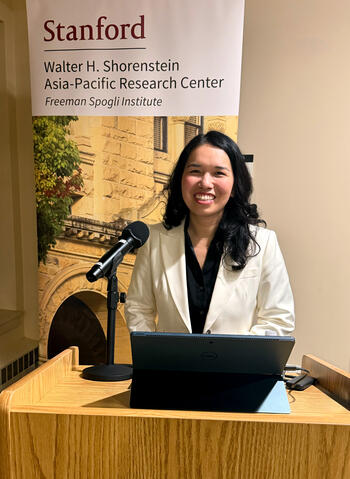
Image of Jessica Chen Weiss at the podium

At a recent seminar hosted by APARCʼs China Program, Professor Jessica Chen Weiss, the David M. Lampton Professor of China Studies at the Johns Hopkins University's School of Advanced International Studies, presented findings from her forthcoming book, Faultlines: The Tensions Beneath China's Global Ambitions (under contract with Oxford University Press), which examines how domestic politics and regime insecurity shape China’s foreign policy ambitions, prospects for peaceful coexistence, and the future of international order. Drawing on research and fieldwork in China, Weiss argued that understanding Beijingʼs behavior on the world stage requires looking beyond ideology to the contested priorities and political calculations that drive decision-making within the Chinese Communist Party (CCP).

Weiss proposed a framework centered on three pillars that have sustained CCP legitimacy since the late 1970s: sovereignty (nationalism), security (civility), and development. Her analysis reveals that China's objectives are not static but moving targets shaped by competing domestic interests, leadership priorities, and international pressures.


Sign up for APARC newsletters to receive our event invitations and programming highlights >


The Sovereignty-Security-Development Paradigm
 

At the heart of Weissʼs argument is the recognition that the CCPʼs foremost concern is domestic survival. In the face of the collapse of most communist regimes, the Party has remained vigilant against what it calls “peaceful evolution” and democratic contagion.

On issues touching core sovereignty concerns – Taiwan, Hong Kong, and maritime territorial claims – China has been “hyperactive” in making demands, even when doing so invites international censure. Weiss explained that the more central an issue is to CCP domestic legitimacy, the harder it becomes to make concessions, and the more likely international pressure is to backfire.

Yet tensions exist between competing priorities. China has compromised on certain border disputes to shore up domestic security, while its evolving stance on climate change reflects a shift from viewing carbon limits as threats to growth to recognizing the greater threat environmental catastrophes present to the nation’s stability.

Beyond the Monolith: China's Internal Contestation
 

Weissʼs research demonstrates that authoritarian China is far from monolithic. Different geographic, economic, institutional, and even ideological interests shape policy debates, even if most actors lack formal veto power. Local governments can resist central directives, as evidenced during the COVID-19 outbreak, when local officials initially withheld information about human-to-human transmission from the central government to prevent panic from disrupting important political meetings.

This pattern of center-local tension extends to China's international commitments. Local officials often game environmental regulations to juice growth and secure promotions, undermining Beijingʼs pledges on carbon emissions. On issues ranging from Belt and Road investments to export controls, implementation frequently diverges from stated policy as local actors pursue their own interests.

Weiss’s framework distinguishes among issues that are both central and uncontested (such as Taiwan), those that are central but contested (like climate change and trade policy), and peripheral issues where Beijing has shown greater flexibility (such as demonstrated by many UN peacekeeping initiatives). This helps explain why international pressure succeeds in some domains but fails spectacularly in others.

"The more central an issue is domestically, the more pressure the government faces to perform, and the harder it is to defy these domestic expectations," Weiss said. As a result, international pressure on these central issues is more likely to backfire, forcing the government to be seen as defending its core interests. She underscored that "even on these central issues, there's often tension with other central priorities, and managing these trade-offs comes with a number of different risks. It also means that sometimes an issue that touches on one pillar of regime support can yield to another."

Nationalism as Constraint and Tool
 

Weiss described nationalism as both a pillar of the CCPʼs legitimacy and a potential vulnerability when the government’s response appears weak. While large-scale anti-foreign protests have become rare, nationalist sentiment remains active online and shapes diplomatic calculations.

During Speaker Nancy Pelosiʼs 2022 visit to Taiwan, Chinese social media erupted with calls for the PLA to shoot down her plane. One interlocutor told Weiss his 14-year-old son and friends had stayed up past bedtime to watch Pelosiʼs plane land, illustrating nationalismʼs penetration into Chinese society.

Survey research reveals Chinese public opinion is quite hawkish, with majorities supporting military spending and viewing the U.S. presence in Asia as a threat. The government often refrains from suppressing nationalist sentiment to avoid backlash, even when doing so creates diplomatic complications. Weissʼs public opinion survey experiments, however, reveal that tough but vague threats can provide the government with wiggle room for de-escalation, although disapproval emerges when action is not sufficiently tough.

China's activities are making autocracy more viable and, to the extent that China is succeeding, making China's example more appealing as a consequence. But its strategy doesn't hinge on defeating democracy around the world.
Jessica Chen Weiss

Regime Security Without Ideological Crusade
 

Weiss pushed back against arguments that China is bent on global domination or that ideology drives conflict with the West. While the CCP seeks a less ideologically threatening environment, it must balance this against development and market access.

This pragmatic calculus explains China's constrained support for Russiaʼs war in Ukraine — Beijing fears secondary sanctions more than it values autocratic solidarity. Rather than exporting revolution, China has worked with incumbents of all political stripes in the service of its national interests.

Chinaʼs strategy focuses on making autocracy viable at home, not on defeating democracy globally. This suggests room for coexistence if both sides can reach a détente on interference in internal affairs.

“China's activities are making autocracy more viable and, to the extent that China is succeeding, making China's example more appealing as a consequence. But its strategy doesn't hinge on defeating democracy around the world,” argued Weiss. This implies, to her view, that “there is more room for coexistence between autocracies and democracies if these different systems can find or reach a potential détente in the realm of ideas about how countries govern themselves, and importantly, they need to pull back their efforts in other societies across boundaries.”

Interdependence and Future Trajectories
 

Weiss concluded by outlining how her framework suggests different engagement strategies depending on where issues fall within the centrality-contestation matrix. On central but uncontested issues like Taiwan, pressure proves counterproductive, and reciprocal restraint may be most promising. On central but contested issues like currency, multilateral pressure can influence certain Chinese constituencies against others. On peripheral issues, such pressure is most effective unless powerful domestic constituencies subvert implementation.

Addressing questions about U.S.-China decoupling, Weiss noted that both sides recognize there are interdependencies that don’t have quick solutions. Even in a critical area like minerals, diversification will take at least a decade, and Chinese processing will still dominate globally. The goal of diversification should be to preempt coercion, not to achieve true decoupling.

Read More

Oriana Skylar Mastro (left), Map of Venezuela (center), and Larry Diamond (right)
Commentary

U.S. Venezuela Operation Likely Emboldens China, Risks Strategic Neglect of Indo-Pacific, Stanford Scholars Caution

Speaking on the APARC Briefing video series, Larry Diamond and Oriana Skylar Mastro analyze the strategic implications of the U.S. operation in Venezuela for the balance of power in the Taiwan Strait, Indo-Pacific security, America’s alliances, and the liberal international order.
U.S. Venezuela Operation Likely Emboldens China, Risks Strategic Neglect of Indo-Pacific, Stanford Scholars Caution
CP_David_Meale
News

The Future of U.S.-China Relations: A Guardedly Optimistic View

Eurasia Group’s David Meale, a former Deputy Chief of Mission at the U.S. Embassy in Beijing, reflects on the last 30 years and describes how the two economic superpowers can maintain an uneasy coexistence.
The Future of U.S.-China Relations: A Guardedly Optimistic View
Stanford campus scene with a palm tree seen through an arch. Text about call for nominations for the 2026 Shorenstein Journalism Award.
News

2026 Shorenstein Journalism Award Open for Nominations

Sponsored by Stanford University’s Shorenstein Asia-Pacific Research Center, the annual award recognizes outstanding journalists and news media outlets for excellence in covering the Asia-Pacific region. News editors, publishers, scholars, and organizations focused on Asia research and analysis are invited to submit nominations for the 2026 award through February 15, 2026.
2026 Shorenstein Journalism Award Open for Nominations
Hero Image
Chinese President Xi Jinping is applauded by senior members of the government and delegates.
Chinese President Xi Jinping is applauded by senior members of the government and delegates as he walks to the podium before his speech during the Opening Ceremony of the 20th National Congress of the Communist Party of China at The Great Hall of People on October 16, 2022 in Beijing, China.
Kevin Frayer/ Getty Images
All News button
1
Subtitle

China studies expert Jessica Chen Weiss of the Johns Hopkins School of Advanced International Studies reveals how the Chinese Communist Partyʼs pursuit of domestic survival, which balances three core pillars, drives Beijingʼs assertive yet pragmatic foreign policy in an evolving international order.

Date Label
In Brief
  • Chinaʼs foreign policy is driven by three domestic pillars: The CCPʼs pursuit of sovereignty, security, and development creates competing priorities that shape Beijingʼs assertiveness on core issues like Taiwan, while allowing flexibility on peripheral concerns such as UN peacekeeping.
  • International pressure often backfires on central issues: The more important an issue is to CCP domestic legitimacy, the harder it becomes to make concessions, meaning external pressure regarding Taiwan or territorial disputes tends to strengthen rather than moderate Beijingʼs position.
  • China is not monolithic: Local governments, industries, and different Party factions contest policy implementation, creating gaps between Beijingʼs stated commitments and actual behavior on issues ranging from environmental regulations to trade.
     
Display Hero Image Wide (1320px)
Yes
Paragraphs
3D cover for "Reimagining Aid"

It was long assumed that Western liberal democracy and free-market capitalism held all the answers for development and national progress. Today, in the face of growing inequality and global power imbalances, this post–Cold War narrative has faltered. New players on the international scene, many from South and East Asia, have emerged to vie for influence and offer new models of development. Despite these recent changes, however, prominent international aid organizations still work under the assumption there are one-size-fits-all best practices. In Reimagining Aid, Wilks takes readers to Cambodia, a country at the heart of this transformation. Through a vivid, multi-sited ethnography, the book investigates the intricate interplay between aid donors from Japan and the United States, their competing priorities, and their impact on women's health initiatives in Cambodia. Cambodian development actors emerge not just as recipients of aid, but as key architects in redefining national advancement in hybrid, regional terms that juxtapose "Asia" to the "West." This book is a clarion call for practitioners, policymakers, and scholars to rethink what development means in a multipolar world. A must-read for anyone invested in Southeast Asia's role in global affairs and evolving definitions of gender in development, Reimagining Aid is a powerful reminder that the next chapter of global advancement is being written in unexpected places.


About the Author

Mary-Collier Wilks is currently an assistant professor of sociology at the University of North Carolina Wilmington. She was a 2021–2022 APARC Postdoctoral Fellow in Contemporary Asia at Shorenstein Asia-Pacific Research Center.

Read our interview with Wilks > 


Advance Praise for "Reimagining Aid"

"Reimagining Aid is a groundbreaking and deeply insightful ethnography that reframes how we understand the global development apparatus. Through richly textured fieldwork, Mary-Collier Wilks exposes the tensions between Western and East Asian donor regimes and the ways in which Cambodian practitioners navigate and rework these competing imaginaries. Essential reading for anyone interested in global health, feminist development, and the shifting geopolitics of aid."
—Kimberly Kay Hoang, University of Chicago

"At a time of Asian ascendance and American retreat from foreign aid, Reimagining Aid centers attention on the power of Asian and Western imaginaries in the development field. A must-read for anyone concerned with how development happens, resistance to hegemony in the Global South, and the ways narratives of progress are intimately bound up with ideas about family, gender, and motherhood. A real tour de force!"
—Joseph Harris, Boston University

"This brilliant, beautifully intimate ethnography challenges the image of post-war Western aid hegemony, illustrating the new regionalized global society in which we live. As Cambodian aid workers navigate between Japanese and U.S. aid agencies and between competing 'regional development imaginaries,' they resist what they see as culturally alien, while creatively reconstructing models of aid, and of gender, for their own societies."
—Ann Swidler, University of California, Berkeley
 

All Publications button
1
Publication Type
Books
Publication Date
Subtitle

Foreign Donors, Women’s Health, and New Paths for Development in Cambodia

Authors
Mary-Collier Wilks
Book Publisher
Stanford University Press
-

This event has reached capacity. Registration is now closed.

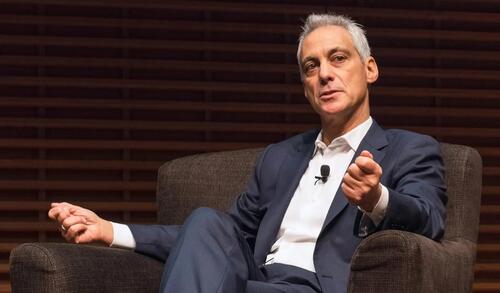
Portrait of Rahm Emanuel.

EVENT UPDATE: Due to overwhelming interest, registration for this event is now on a first-come, first-served basis with no waitlist to ensure fairness and accommodate as many guests as possible. Seating is not guaranteed, so please arrive early. An overflow space will be available. Expect a confirmation email from our event team by January 22.

The Freeman Spogli Institute for International Studies and the Shorenstein Asia-Pacific Research Center (APARC) are pleased to host Ambassador, Mayor, Congressman, and White House Chief of Staff Rahm Emanuel for a fireside chat with Ambassador Michael McFaul, with welcome remarks by Kiyoteru Tsutsui, the director of APARC, and a Q&A session to follow. 

Ambassador Emanuel, most recently the Ambassador of the United States to Japan, is famous for straight talk, relentless drive, and game-changing results. He will share his unvarnished thoughts on America’s relationships with Japan and other key allies, and, more broadly, what it means to lead and the leadership we need at home and abroad at this moment in history. Ambassador Emanuel is a brilliant strategist and an engaging speaker who will hold us accountable. Get ready for a fast-paced and wide-ranging discussion, including important insights from one of our generation’s brightest minds and greatest leaders.


Speaker

Image
Colored photo of Rahm Emanuel sitting on a chair giving discussion at a 2017 Stanford Event

Rahm Emanuel has devoted his life to public service, with a remarkable number of impactful leadership positions across government.  Appointed the 31st United States Ambassador to Japan by President Joe Biden, he most recently served in Tokyo from 2021 – 2025 during a period of expanding Chinese aggression and massive investment in our Asia Pacific Alliances.  As Mayor of the City of Chicago from 2011-2019, he invested in education, providing universal public pre-kindergarten and full-day kindergarten for every Chicago child, and free community college.  Chicago led the U.S. in corporate relocations and foreign direct investment for seven consecutive years during his administration, and he prioritized investment in infrastructure, public transportation, open space, and cultural attractions.

From 2008-2010, Ambassador Emanuel was President Barack Obama’s Chief of Staff and top advisor, helping secure the passage of the Dodd-Frank Wall Street Reform Act and the landmark Affordable Care Act.  Emanuel was elected four times as a Member of the U.S. House of Representatives from Illinois’s 5th Congressional District (2002-2008). As Chairman of the House Democratic Caucus, Emanuel helped pass legislation to raise the minimum wage and authored the Great Lakes Restoration Act.  From 1993 to 1998, Ambassador Emanuel rose to serve as Senior Advisor to the President for Policy and Politics in the Clinton Administration, spearheading efforts to pass the President’s signature achievements, including the Federal Assault Weapons Ban, the Brady Handgun Violence Prevention Act, and the historic Balanced Budget Act, which created the Children’s Health Insurance Program expanding health care coverage to 10 million children.


Moderator

Image
Photo of Michael McFaul

Michael McFaul is a senior fellow at the Freeman Spogli Institute for International Studies (FSI) and former director of FSI, the Ken Olivier and Angela Nomellini Professor of International Studies in the Department of Political Science, and the Peter and Helen Bing Senior Fellow at the Hoover Institution, all at Stanford University. He joined the Stanford faculty in 1995. Dr. McFaul is also an international affairs analyst for NBC News. He served for five years in the Obama administration, first as special assistant to the president and senior director for Russian and Eurasian Affairs at the National Security Council at the White House (2009-2012), and then as U.S. Ambassador to the Russian Federation (2012-2014).

He has authored several books, most recently Autocrats versus Democrats: China, Russia, America, and the New Global Disorder. Earlier books include the New York Times bestseller From Cold War to Hot Peace: An American Ambassador in Putin’s Russia, Advancing Democracy Abroad: Why We Should, How We Can; Transitions To Democracy: A Comparative Perspective (eds. with Kathryn Stoner); Power and Purpose: American Policy toward Russia after the Cold War (with James Goldgeier); and Russia’s Unfinished Revolution: Political Change from Gorbachev to Putin.

He teaches courses on great power relations, democratization, comparative foreign policy decision-making, and revolutions.

Michael A. McFaul

Bechtel Conference Center
Encina Hall, First floor, Central, S150
616 Jane Stanford Way, Stanford, CA 94305

Rahm Emanuel
Lectures
Date Label
Authors
George Krompacky
News Type
News
Date
Paragraphs

David Meale, former U.S. diplomat and current consultant, offered a cautiously optimistic perspective on U.S.-China relations at an APARC China Program seminar, arguing that despite significant tensions, there remains substantial room for what he calls “managed rivalry”—a relationship that is neither warm nor easy, but constructive enough for both countries to serve their populations and address global challenges. Drawing on his 33 years in the U.S. Foreign Service, he traced the evolution of U.S.-China relations over the past three decades and assessed current trajectories, bringing both diplomatic experience and fresh insights from private sector concerns to his analysis.

Three Decades of Evolving Relations
 

His entry into China-focused diplomacy came in 1995 when he was assigned to Hong Kong during the handover. During that era and through the early 2000s, U.S. policy operated under the assumption that China would gradually embrace the post-war rules-based international order shaped largely by the United States. The thinking was that China would develop a self-interest in preserving this order, becoming a constructive, if not easy, partner. This belief undergirded the strong U.S. effort to bring China into the World Trade Organization in 2001.

During his service as an Economic Officer in Taiwan in the 2000s, Meale witnessed the merging of talent from Asia and the United States that built China’s electronics manufacturing industry. Five percent of Taiwan’s workforce had moved to the mainland; there were even Shanghainese dialect programs on Taiwanese television at night for those dreaming of seeking their fortunes through cross-strait opportunities. Although there was tension with the Chen Shui-bian administration, there was a surprising amount of positivity in Taiwan about the mainland. That, of course, has now changed.

The Obama administration continued to work within the framework of bringing China into the existing international order, even as concerns grew. The approach aimed to convince China to preserve and, if necessary, shape this order, while using it to constrain China when necessary, as demonstrated by the attempt to resolve the South China Sea dispute involving the Philippines through the United Nations Convention on the Law of the Sea (UNCLOS).

The Trump administration marked a decisive shift. Meale noted that Trump openly discarded the goal of integrating China into the existing order, instead pursuing aggressive trade policies, technology restrictions, and explicit framing of China as a threat. The Chinese hoped the Biden administration would turn this around, but it instead maintained this posture, pursuing an “invest, align, compete” strategy—investing in the United States, aligning with allies, and defining the relationship as a competition.

Trump 2.0 brought “Liberation Day,” which Meale sees as the belief that the U.S. place in the world needs to be corrected; the United States is economically overextended, the trade imbalances and the associated debt cannot continue, and the supply chain vulnerability from COVID must be addressed. Tariffs were ratcheted up, and both sides imposed export controls. 

The Chinese hit back hard; Chinese officials are very proud of China’s pushback against an unchecked Trump. China’s economic growth is forecast at 5 percent this year, and the feeling from China is that it has shown the world the United States cannot push it around.

Looking ahead to 2026, Meale is optimistic. There will undoubtedly be crises that pop up: the Chinese will overreach on rare earth elements, and the United States will take an economic action that the Chinese did not plan on. Meale sees this as the “sine curve” of the U.S.-China relationship. There’s a crisis, tensions rise, there’s a response, and things eventually cool down. The curve goes up and down, but very little gets resolved.


Sign up for APARC newsletters to receive our event invitations and guest speakers' insights >


China's Current Challenges
 

China, Meale noted, effectively contains two economies: one serving approximately 400 million people who are producing world-class products with perhaps the world's best industrial ecosystem and impressive infrastructure, and another economy serving the rest of China's population, which has improved significantly over recent decades but relies heavily on informal work and the gig economy.
China faces deep structural problems, including a property sector crisis that has destroyed significant household wealth, an economy structured excessively around investment rather than consumption, youth unemployment reflecting a mismatch between graduating students and available jobs, and "involution" (neijuan, 内卷)—a race to the bottom in sectors where government incentives have driven overcapacity. China's reliance on export-led growth comes at a time when its overcapacity is increasingly unwelcome not just in developed countries but across the global South.

These challenges, Meale argues, will not result in a financial crisis or recession, but rather chronic headaches that will affect its foreign relations. Growth will continue, albeit at a slower pace, and the country will have significant work ahead to address inequality and structural imbalances.

On the question of Taiwan, Meale pushed back against predictions of imminent Chinese military action, particularly speculation about 2027 as a critical year tied to the 100th anniversary of the People's Liberation Army. He argued that, right now, one of China’s top goals is to avoid being drawn into a Taiwan conflict. China has recently purged nine senior military officials and is dealing with serious problems in its military. Five years from now, however, the situation could look quite different.

Defining End States and Finding Common Ground
 

Meale concluded by outlining what he believes each side seeks as an end state, arguing that these visions, while different, are not irreconcilable. Rather than global domination, he argued China seeks a world that works for what it calls "grand rejuvenation." This means overcoming the century of humiliation, reunifying with Taiwan, and living safely and securely on its own terms. China wants recognition as a global power, dominance in its near seas, freedom from technology containment, elimination of shipping chokepoints, access to markets, and the ability to pursue relationships with ideologically aligned countries.

The United States, meanwhile, accepts that competition with China is permanent but seeks a predictable China. U.S. goals include protecting advanced technology where it has an advantage, avoiding supply chain vulnerabilities, shaping Beijing's choices without attempting to control them, maintaining the Taiwan status quo until it evolves in a mutually and naturally agreed way, and ensuring fair trade to address what it sees as a stacked deck in current trade relationships. The United States also wants to prevent China from enabling adversaries, as seen in Chinese firms rebuilding Russia's military-industrial complex while maintaining nominal neutrality on Ukraine.

These end states, Meale acknowledged, collide in many ways but not in absolute ways. He sees substantial room for leader-driven, managed rivalry that can function constructively. This rivalry will not be easy or warm, but it can allow both countries to serve their populations while cooperating where global interests align.
 

Key Takeaways  
 

  • The “integrated China” assumption is over. U.S. policy no longer aims to bring China into the existing international order, marking a fundamental shift from decades of engagement strategy.
  • China's economy faces structural challenges, not a crisis. China will continue to grow, but must address inequality, overcapacity, and wealth destruction from the property crisis.
  • Taiwan timing matters more to Beijing than deadlines. China seeks to control when and how the Taiwan issue is resolved, preferring not to be forced into premature action.
  • Managed rivalry is possible. Despite significant tensions and incompatible elements of each side's goals, there remains space for constructive competition. While the relationship between the world's two largest economies will stay competitive and often contentious, it need not become catastrophic.
     

Read More

Lawmakers and members of the South Korea's main opposition Democratic Party (DP) demonstrate against the country's president at the National Assembly on December 04, 2024 in Seoul, South Korea.
Commentary

South Korea’s Fractured Democracy: One Year After Martial Law

The country’s political polarization has metastasized. What can be done?
South Korea’s Fractured Democracy: One Year After Martial Law
Japanese Prime Minister Sanae Takaichi delivers remarks while seated in front of the Japanese flag.
Commentary

Japan's Prime Minister Takaichi: A First-Month Report Card

Stanford sociologist Kiyoteru Tsutsui, director of the Shorenstein Asia-Pacific Research Center and the Japan Program, evaluates Japanese Prime Minister Sanae Takaichi's first month in office.
Japan's Prime Minister Takaichi: A First-Month Report Card
On an auditorium stage, panelists discuss the documentary 'A Chip Odyssey.'
News

‘A Chip Odyssey’ Illuminates the Human Stories Behind Taiwan’s Semiconductor Dominance

A screening and discussion of the documentary 'A Chip Odyssey' underscored how Taiwan's semiconductor ascent was shaped by a collective mission, collaboration, and shared purpose, and why this matters for a world increasingly reliant on chips.
‘A Chip Odyssey’ Illuminates the Human Stories Behind Taiwan’s Semiconductor Dominance
Hero Image
CP_David_Meale
All News button
1
Subtitle

Eurasia Group’s David Meale, a former Deputy Chief of Mission at the U.S. Embassy in Beijing, reflects on the last 30 years and describes how the two economic superpowers can maintain an uneasy coexistence.

Date Label
Authors
News Type
News
Date
Paragraphs

We are pleased to share that Jihui Seong (MA '25 East Asian Studies) is the recipient of the 14th annual Korea Program Prize for Writing in Korean Studies, for her thesis "A Truce Built on Tension: The Korean War Armistice Negotiations and the Strategic Divergence Between Allies."

Advisor Daniel Sneider, Lecturer in East Asian Studies, notes that "Ms. Seong carried out extensive archival research at the National Archives in Washington, as well as digital archives of U.S. diplomatic and other records. She did similar research in the archives of the Republic of Korea. Ms. Seong read deeply into the secondary literature on this period of history...and consulted the memoirs of key figures, including Korean language memoirs.... The result of this research was a remarkably well-written and insightful thesis, one which genuinely breaks ground in its detailed research, analytical framing and persuasive argument. The conclusion has additional power in taking the thesis research and applying its conclusions and lessons to current alliance relations."

Reflecting on her thesis, Seong notes: "My thesis explores the Korean War armistice negotiations (1951–1953), with a focus on the deep strategic and political divergences between the United States and the Republic of Korea. While the two nations were de facto allies under the UN Command, they held fundamentally different visions for Korea’s future. Drawing from extensive archival research—including diplomatic cables, negotiation transcripts, and U.S. policy documents—I analyze how President Syngman Rhee’s opposition to a ceasefire clashed with Washington’s desire to end the war through limited settlement, leading to recurring tensions, threats of alliance rupture, and backchannel bargaining. The paper highlights that these conflicts were not merely tactical disagreements, but expressions of diverging national priorities, domestic political constraints, and fundamentally different perceptions of sovereignty and security. Ultimately, I argue that the Korean War armistice was not simply the cessation of hostilities between adversaries, but rather a fragile truce built through uneasy compromise forged through internal struggle between wartime partners—one that shaped the foundations of today’s East Asian geopolitical order and the enduring complexities of U.S.–ROK alliance management."

Sponsored by the Korea Program and the Center for East Asian Studies, the writing prize recognizes and rewards outstanding examples of writing by Stanford students in an essay, term paper, or thesis produced during the current academic year in any discipline within the area of Korean studies, broadly defined. The competition is open to both undergraduate and graduate students.

Past Recipients:

13th Annual Prize Co-recipients (2024)
12th Annual Prize (2023)
11th Annual Prize (2022)
10th Annual Prize (2021)
9th Annual Prize (2020)
8th Annual Prize (2019)
7th Annual Prize (2018)
6th Annual Prize (2017)
5th Annual Prize (2016)
4th Annual Prize (2015)
3rd Annual Prize (2014)
2nd Annual Prize (2013)
1st Annual Prize (2012)

Hero Image
headshot of Jihui Seong
All News button
1
Subtitle

Jihui Seong (MA '25 East Asian Studies) is the recipient of the 14th annual Korea Program Prize for Writing in Korean Studies, for her thesis "A Truce Built on Tension: The Korean War Armistice Negotiations and the Strategic Divergence Between Allies."

Date Label
Authors
News Type
News
Date
Paragraphs

We are pleased to share the publication of a new volume, Cold War Refugees: Connected Histories of Displacement and Migration across Postcolonial Asia, edited by the Korea Program's Yumi Moon, associate professor in Stanford's Department of History.

The book, now available from Stanford University Press, revisits Cold War history by examining the identities, cultures, and agendas of the many refugees forced to flee their homes across East, Southeast, and South Asia due to the great power conflict between the US and the USSR. Moon's book draws on multilingual archival sources and presents these displaced peoples as historical actors in their own right, not mere subjects of government actions. Exploring the local, regional, and global contexts of displacement through five cases —Taiwan, Vietnam, Korea, Afghanistan, and Pakistan — this volume sheds new light on understudied aspects of Cold War history.

This book is an important new contribution to our understanding of population flows on the Korean Peninsula across decades.
Paul Chang
Deputy Director, Korea Program

The book's chapters — written by Phi-Vân Nguyen, Dominic Meng-Hsuan Yang, Yumi Moon, Ijlal Muzaffar, Robert D. Crews, Sabauon Nasseri, and Aishwary Kumar — explore Vietnam's 1954 partition, refugees displaced from Zhejiang to Taiwan, North Korean refugees in South Korea from 1945–50, the Cold War legacy in Karachi, and Afghan refugees.

Purchase Cold War Refugees at www.sup.org and receive 20% off with the code MOON20.

Read More

Korean activists released from prison on August 16, 1945.
Commentary

Can the United States and Asia Commemorate the End of the Pacific War Together?

Within Asia, World War II memories and commemorations are not only different from those in the United States but also divided and contested, still shaping and affected by politics and nationalism. Only when U.S. and Asian leaders come together to mark the end of the Asia-Pacific war can they present a credible, collective vision for the peace and prosperity of this important region.
Can the United States and Asia Commemorate the End of the Pacific War Together?
Gi-Wook Shin seated in his office, speaking to the camera during an interview.
News

Sociologist Gi-Wook Shin Illuminates How Strategic Human Resource Development Helped Build Asia-Pacific Economic Giants

In his new book, The Four Talent Giants, Shin offers a new framework for understanding the rise of economic powerhouses by examining the distinct human capital development strategies used by Japan, Australia, China, and India.
Sociologist Gi-Wook Shin Illuminates How Strategic Human Resource Development Helped Build Asia-Pacific Economic Giants
Stanford Next Asia Policy Lab team members and invited discussants during a roundtable discussion in a conference room.
News

Stanford Next Asia Policy Lab Probes Political Messaging and Public Attitudes in U.S.-China Rivalry

At a recent conference, lab members presented data-driven, policy-relevant insights into rival-making in U.S.-China relations.
Stanford Next Asia Policy Lab Probes Political Messaging and Public Attitudes in U.S.-China Rivalry
Hero Image
3d cover image of the book "Cold War Refugees," showing Asian refugees walking up from a beach, with boats in the background.
All News button
1
Subtitle

The new volume, edited by Stanford historian Yumi Moon, examines the experiences of Asian populations displaced by the conflict between the United States and the Soviet Union.

Date Label
Authors
Noa Ronkin
News Type
News
Date
Paragraphs

As the U.S.-China competition unfolds in areas ranging from trade to technology to the military, the rival-making discourse surrounding this great power competition was the focus of the conference Beyond a New Cold War, organized and hosted by the Stanford Next Asia Policy Lab (SNAPL).

Held on August 14, 2025, the event showcased SNAPL research illuminating how U.S. political leaders and the media shape narratives concerning China and how citizens in young democracies perceive these narratives. Serving as discussants were experts from Columbia University, the University of California, Berkeley, the Hoover Institution (represented by a former National Security Affairs Fellow), and the U.S. Congressional-Executive Commission on China.

The studies presented and discussed at the conference are part of SNAPL’s U.S.-Asia Relations research track, one of four research streams the lab pursues. Housed at the Shorenstein Asia-Pacific Research Center (APARC) and founded by sociologist Gi-Wook Shin, the lab aims to generate evidence-based policy recommendations and promote transnational collaboration with academic and policy institutions to advance the future prosperity of Asia and U.S.-Asia relations.

“This conference provided an excellent opportunity to engage the policy community with our research findings,” says Shin, the William J. Perry Professor of Contemporary Korea, a senior fellow at the Freeman Spogli Institute for International Studies (FSI), and the director of APARC and the Korea Program. “The lab will continue to foster ongoing dialogue between academic and policy circles.” 

The conference builds on previous SNAPL forums and meetings with policy and academic communities in Washington, D.C., held in September 2024. These policy engagement activities are made possible thanks to a grant from FSI


Sign up for APARC newsletters to receive our experts' updates >


Xinru Ma presenting from a lectern, poninting to a screen behind her.
Xinru Ma

Dynamics of American Elite Discourse on China


At the first conference panel, Research Fellow Xinru Ma shared a study that unravels who leads elite discourse on U.S.-China relations – whether Congress, the White House, or the media. While prior research suggests that each of these actors could have distinct agenda-setting capacities, their relative influence and its directionality in foreign policy discourse remain empirically underexamined.

The study addresses this question by investigating China-focused discourse and framing by the U.S. legislative and executive branches as well as the media. Using computational and causal inference methods, the study analyzes social media data from the legislative and executive branches alongside major U.S. media outlets across two periods: the 116th Congress (January 3, 2019 – January 3, 2021) and the 118th Congress (January 3, 2023 – January 3, 2025).

The analysis reveals that, both in terms of issue attention and framing, the media tends to follow the lead of Congress and the President. The findings also indicate that Republican lawmakers exert greater influence on setting the China agenda in the media. In contrast, Democratic lawmakers are stronger predictors of how the media frames the issues at stake. Moreover, the findings suggest that presidential influence on China discourse weakened sharply in the 118th Congress, and that there is an overall shift toward party-driven, rather than institutionally mediated, communication among elites. 


Policy Implications
 

  • Media Weakness: The reliance of media outlets on partisan cues from political elites on foreign policy issues increases the risk of incomplete or skewed public understanding of China and U.S.-China relations. The risk is especially disconcerting as U.S. reporters face limited access to China.
  • Partisan Echo Chambers: Communication flows primarily within partisan networks rather than across institutions, with the separation of powers becoming less effective as a system of checks and balances. The splintering of political discourse into parallel echo chambers risks eroding opportunities for cross-party dialogue and democratic deliberation on complex foreign policy issues.
  • Fragmented Messaging: Divergent partisan messaging on China signals inconsistency to both domestic and international audiences who might draw contradictory conclusions about U.S. intentions. This dynamic gives rise to strategic miscalculations abroad and a fragmented public understanding of China policy at home.
  • Declining  Institutional Voices: The decline of institutional power over shaping U.S. discourse on China has created a growing vulnerability. As individual political figures gain sway, personalized narratives often prioritize short-term visibility over a coherent, long-term strategy.
Gidong Kim delivers a presentation in a conference room.
Gidong Kim

Democracy vs. Autocracy: A View from Young Democracies


Despite their deep divisions on most issues, there is one topic Republicans and Democrats converge on: China. Both parties increasingly frame the intensifying U.S.-China tensions as a strategic competition between democracy and autocracy. But is the value diplomacy this approach begets effective in promoting liberal values in young democracies?

At the second conference panel, Visiting Scholar Gidong Kim presented a study that addresses this question. “This study challenges the effectiveness of the value-laden U.S. diplomacy in young democracies and presents a more nuanced explanation of democracy's role in forming public opinion on foreign policy,” says Kim, formerly a postdoctoral fellow with SNAPL and currently an assistant professor of political science at Hankuk University of Foreign Studies (HUFS).

The study hypothesizes that in young democracies, where democratic histories are relatively short and legacies of authoritarian rule endure, citizens tend to understand democracy in terms of electoral institutions rather than liberal values. Similarly, in the context of the U.S.-China competition, citizens in these countries tend to perceive China’s threats to electoral institutions more seriously than its threats to liberal values.

To test this proposition, the study uses a country-level, cross-national analysis and an original survey experiment in South Korea. The findings support the hypothesis.

Policy Implications
 

  • Context Matters: U.S. policymakers must acknowledge the limits of value-driven diplomacy. Washington should diversify its foreign policy toolkit and adapt it to regional contexts: in Western Europe, liberal values rhetoric can reinforce alliances, but in young democracies, the design and strength of electoral institutions carry greater weight.
  • A Crisis of Credibility: For China, there is an equally clear lesson about the need to rethink its approach to diplomacy. Without addressing suspicions of election interference in democratic countries, Beijing will struggle to gain traction with the publics in young Asian democracies and dissipate anti-China sentiments in those countries, even if it increases its soft power through liberalization policies.


SNAPL’s studies presented at the conference underscore the crucial role that narratives and public perceptions play in international relations. They suggest that great power competition is not just about power. Rather, it is also about persuasion, which, in turn, depends on how different audiences — at home and abroad — perceive the story.

Read More

Gi-Wook Shin seated in his office, speaking to the camera during an interview.
News

Sociologist Gi-Wook Shin Illuminates How Strategic Human Resource Development Helped Build Asia-Pacific Economic Giants

In his new book, The Four Talent Giants, Shin offers a new framework for understanding the rise of economic powerhouses by examining the distinct human capital development strategies used by Japan, Australia, China, and India.
Sociologist Gi-Wook Shin Illuminates How Strategic Human Resource Development Helped Build Asia-Pacific Economic Giants
Collage of headshots of Stanford students
News

Stanford Next Asia Policy Lab Research Assistants Admitted to Top Doctoral Programs

A Stanford student and four recent alumni who served as research assistants at the Stanford Next Asia Policy Lab will begin doctoral studies at top institutions in fall 2025. At the lab, which is committed to rigorous, policy-relevant research and student mentorship, they gained hands-on experience and honed skills valuable for the next stage of their academic journeys.
Stanford Next Asia Policy Lab Research Assistants Admitted to Top Doctoral Programs
Korean activists released from prison on August 16, 1945.
Commentary

Can the United States and Asia Commemorate the End of the Pacific War Together?

Within Asia, World War II memories and commemorations are not only different from those in the United States but also divided and contested, still shaping and affected by politics and nationalism. Only when U.S. and Asian leaders come together to mark the end of the Asia-Pacific war can they present a credible, collective vision for the peace and prosperity of this important region.
Can the United States and Asia Commemorate the End of the Pacific War Together?
Hero Image
Stanford Next Asia Policy Lab team members and invited discussants during a roundtable discussion in a conference room.
Stanford Next Asia Policy Lab members and invited discussants at the conference "Beyond a New Cold War: Political Messaging and Public Perceptions on China" – August 14, 2025.
All News button
1
Subtitle

At a recent conference, lab members presented data-driven, policy-relevant insights into rival-making in U.S.-China relations.

Date Label
1
Visiting Scholar at APARC, Japan Program Fellow, 2025-2026
kemy_monahan.jpg

Katherine (Kemy) joined the Walter H. Shorenstein Asia-Pacific Research Center (APARC) as a visiting scholar, Japan Program Fellow, from September 2025 to March 2026. Ms. Monahan has completed 16 assignments on four continents in her 30 years as a Foreign Service Officer with the U.S. Department of State.  She recently returned from Tokyo, where she was Deputy Chief of Mission at the U.S. Embassy in Japan, following roles as Charge d’affaires for Papua New Guinea, Solomon Islands, and Vanuatu, and Deputy Chief of Mission to New Zealand, Samoa, Cook Islands, and Niue.  She was Director for East Asia at the National Security Council from 2022 to 2023.  Previously, she worked for the U.S. Department of Treasury in Tokyo, as Economic, Trade and Labor Counselor in Mexico City, Privatization lead in Warsaw after the fall of the Berlin Wall, Advisor to the World Bank, and Deputy Executive Director of the Secretary of State’s Global Health Initiative, among other roles.  As lead of UNICEF’s International Financial Institutions office, Ms. Monahan negotiated over $1 billion in funding for children. A member of the Bar in California and DC, Ms. Monahan began as an attorney in Los Angeles. 

Date Label
Authors
News Type
News
Date
Paragraphs

This interview first appeared in the Brazilian newspaper Folha de S.Paolo, on April 6. The following English version was generated using machine translation and subsequently edited for accuracy and clarity.


WASHINGTON — The tariff hike against all countries announced last week by President Donald Trump may bolster China's image, but that doesn't mean China or any other country is poised to replace the United States, says Thomas Fingar, Shorenstein APARC Fellow at the Freeman Spogli Institute at Stanford University.

Fingar, a former chief of the State Department's China Division, among other roles in the U.S. Foreign Service and national intelligence, believes that Trump's tariffs will be bad for all nations.

"I hesitate to predict how other countries will react, except that this has more or less given everyone an incentive to bypass the U.S.," he tells Folha.

Donald Trump announced tariffs this week against virtually every country. China has already announced retaliation, imposing a 34% tariff on American products. Are we facing a trade war?

I don't think the war metaphor works for me. I don't know what Trump is trying to do. One could say that this is a game of imposing an outrageous tariff in the hope that specific targets, which are basically all countries, might give in to what they say are their demands. In doing so, they would reduce barriers to trade with the United States. To me, it doesn't make sense with the vast majority of targets of the 10% tariffs.

Why?

I hesitate to predict how other countries will react, except that this has more or less given everyone an incentive to bypass the U.S., to make the U.S. a supplier of last resort, to hold the line, to have a kind of united front to compete with each other.

If the assessment is that the Dutch or the French or the Germans or the Brazilians or somebody else is talking about doing something to eliminate a 10% tariff to gain a comparative advantage in accessing the U.S. market, if that's the logic, then fine. Maybe there's something rational about that, but I think it's more likely that the targets of those low tariffs are just getting together.

My main trade competitor has the same or higher tariffs levied against them. Why should I give in if we are competing on a level playing field?

I think Trump is going to make the U.S. pay a huge geopolitical price. But what he thinks he will gain from this, I don't know. Is it likely that he will achieve anything really significant from it? I doubt it.

You mentioned a geopolitical price tag for the United States. What would it be?

The tendency of much of the world, most of the time, was to try to work with the United States, to the extent that they couldn't automatically do what Washington wanted, but they were inclined to cooperate because they saw it as benign, if not beneficial, to their interests. I think Trump has reversed that. This is going to lead to a disinclination to work with us, an incentive to try to bypass us. I think the inclination now is going to be: I'm not going to vote with the Americans, I'm going to look elsewhere first, for my investment, for my capital, for the market, for what I'm doing, for partners.

But I don't think that these measures are necessarily going to play in favor of any particular country. Maybe China in some places, the European Union in some places, Japan in some places. It's going to be a very different environment for the United States, for American companies and diplomats to operate in. It's going to be much more difficult.

This tariff strategy that you say is hard to understand is seen by some analysts as part of Trump's isolationist policy.

As my kids would say, this is so last century. This is really 19th century, the idea of bringing industries, manufacturing back to the United States. Very little manufacturing, I think, is going to come back to the United States. We have 4% unemployment. We can't fill the jobs that we have now, imagine bringing back manufacturing of basic commodities like shoes, toys, that kind of thing.

That left the United States a long time ago and went to Japan, moved from Japan to Taiwan, moved from Taiwan to South Korea, moved from South Korea to somewhere else, and then moved to China and then to Vietnam. Those things are not coming back here because there's not enough profitability to justify investing in robots and mechanizing those things to bring them back to the United States. Our workforce is small relative to the size of the economy. It's not coming back.

It's already moving from China because labor costs are so high. The fallacy in Trump's logic is that things like furniture, construction, textiles, clothing, and manufacturing would come back. And the people who would actually do the work are the people he's persecuting with his ridiculous immigration policies.

Trump has argued that he imposed the tariffs to curb alleged abuses against the United States that would benefit China. Is he containing Beijing with this move?

I don't think he really cares about containing China. But the answer is no. These moves boost China's image. Beijing has seized on the rhetoric of defending the open, globalized international trading order that the United States has attacked. They will take advantage of that as much as they can. I don't think the tariffs are part of the U.S. rivalry with China. China's rise has not disadvantaged the United States economically — it has done so to Japan, and, to some extent, South Korea and Taiwan, but not the United States. So Trump is using this argument with false, exaggerated, and distorted statements.

Could we witness a change in the world order, the end of the American era and the beginning of a Chinese era?

No.

Not even as a consequence of tariffs?

Absolutely not. Part of the problem is that China's economy is closed. One of the reasons is that it doesn't have a consumer society because people don't have enough income. That's because of the amount of wealth that the state extracts to pay for high-speed rail, military structures, and energy development. Some of that is good, some of it is excess.

U.S. tariffs won’t create a market that can rival the size and influence of the United States. It would have to be somewhere else that is very rich, and China is not very rich. China is barely in the middle-income category, it has a per capita income at a level that Mexico has been at for decades. It's not binary. So, the U.S. retreat from its leadership position in the world order, which I don't necessarily see as a bad thing, doesn't automatically hand that role over to China, Russia, the European Union, Japan, Brazil, the BRICS, or any other set of players.

Can China gain ground by investing more in countries that are affected by tariffs?

China has invested more in countries that are affected by tariffs, like Indonesia and Vietnam. These countries are very wary of Chinese investment for various historical reasons, and to some extent for ethnic reasons. But China is actually cutting back on its overseas investments because its own population is asking: Why are we giving money to countries that are richer than us? That is a reasonable question.

They have real problems meeting the expectations, demands, and needs of their own population, which is now largely urban. The cities have to function, you can't say, "Go back to the farm and do sustainable agriculture." That phase is long gone in China. So they have to spend more. Half of the population still has rural identity cards. That means they don't get free education beyond primary school. That means 50% of the future workforce won't have more than a primary school education. This is a country with enormous challenges. Can they manage them? Probably yes, but there is not much room for maneuver. Their own slowing economy will be hurt by these tariffs. I don't think that's Trump's intention, but it will hurt them.

What impact might the tariffs have on Brazil and Latin America? Do you think China will become more attractive?

I don't know specific commodities from specific places, but my general starting point is that a 10% distribution across Latin America won't have much of an impact on the price for consumers in those countries. You'll export the same amount; we'll pay more for whatever the commodity is, flowers from Colombia, grapes, wine from Argentina or Chile. Since the tariff is general, it doesn't give Chile an advantage on wine over Argentina, because they both have the same amount. Most of what Latin America exports to the United States doesn't go to China.

In short, what are the main consequences of tariffs in terms of the geopolitical landscape and the domestic landscape?

It destabilizes the international trading system that has benefited most countries for a long time. It will force adjustments, that is number one. And number two is that it undermines the image of the United States, and therefore its influence as a stabilizing, predictable, and broadly beneficial member of the international community. It disrupts economies and undermines American influence and attractiveness.

In the end, does anyone benefit from Trump's tariff policies?

No one. This is not a policy that works to anyone's obvious benefit. It upsets everyone. And there is no alternative to the United States, in the sense that the Soviet Union was during the Cold War. China is not that, and China does not want to be that.

Read More

American flag and network imagery
Commentary

US Research in Retreat?

Zealous measures to defend against foreign exploitation of university-based research would be inadequate to preserve US preeminence in science and technology without much greater effort to strengthen US capabilities.
US Research in Retreat?
A collage of group photos featuring speakers at the Taiwan Forward conference.
News

Stanford Conference in Taipei Ponders Taiwan’s Path Forward in a Changing World

At its first convening in Taiwan, APARC’s Taiwan Program gathered scholars and industry experts to consider policy measures and practices for tackling the technological, economic, social, and demographic forces shaping the island nation’s future and strategies for ensuring its continued growth and success.
Stanford Conference in Taipei Ponders Taiwan’s Path Forward in a Changing World
Oksenberg Symposium panelists (L to R) Jean C Oi, Alex Gabuev, Sumit Ganguly, Da Wei, Michael McFaul
News

Oksenberg Symposium Panelists Analyze Evolving Strategic Dynamics Between China, Russia, India, and the United States

APARC's 2025 Oksenberg Symposium explored how shifting political, economic, and social conditions in China, Russia, India, and the United States are reshaping their strategies and relationships. The discussion highlighted key issues such as military and economic disparities, the shifting balance of power, and the implications of these changes for global stability, especially in the Indo-Pacific region.
Oksenberg Symposium Panelists Analyze Evolving Strategic Dynamics Between China, Russia, India, and the United States
Hero Image
U.S. President Donald Trump holds up a chart of "reciprocal tariffs" while speaking
U.S. President Donald Trump holds up a chart of "reciprocal tariffs" while speaking during a “Make America Wealthy Again” trade announcement event in the Rose Garden at the White House on April 2, 2025 in Washington, DC.
Photo by Chip Somodevilla/Getty Images
All News button
1
Subtitle

President Trump's tariff policy will serve no one's interests, says Thomas Fingar, a Shorenstein APARC Fellow at Stanford University's Freeman Spogli Institute for International Studies.

Date Label
Subscribe to Foreign Policy