


Walder receives award for Cultural Revolution research
News Type
News
Date
Paragraphs
Image

Stanford professor Andrew Walder has been awarded the Founder’s Prize from the journal Social Science History for his paper, “Rebellion and Repression in China, 1966-1971.” The journal’s editorial board selects one recipient annually for exemplary scholarly work.
Using data from 2,213 historical county and city annals, the paper charts the breadth of the Chinese Cultural Revolution, its evolution through time and the repression through which state structures were rebuilt in the post-Mao era.
Walder, who is a senior fellow in the Freeman Spogli Institute for International Studies and director emeritus of the Shorenstein Asia-Pacific Research Center, has long studied the sources of conflict, stability and change in communist regimes. He recently published China under Mao, a book that explores the rise and fall of Mao Zedong’s radical socialism.
Hero Image

All News button
1
Sixteenth Korea-U.S. West Coast Strategic Forum
Paragraphs
The sixteenth session of the Korea-U.S. West Coast Strategic Forum, held at Stanford University on June 28, 2016, convened senior South Korean and American policymakers, scholars and regional experts to discuss North Korea policy and recent developments on the Korean Peninsula. Hosted by the Korea Program at the Walter H. Shorenstein Asia-Pacific Research Center at Stanford University, the Forum is also supported by the Sejong Institute.
All Publications button
1
Publication Type
Policy Briefs
Publication Date
Journal Publisher
Shorenstein APARC
Womenomics, the Workplace, and Women: Stanford Silicon Valley US-Japan Dialogue 2016
-
As Japan faces a shrinking and aging population, it must pursue productivity growth to remain a wealthy nation. Women, long underrepresented Japan’s workforce, are receiving renewed attention with the Abe administration’s slogan of Womenomics as part of his Abenomics economic reform package. In the second World Assembly for Women in Tokyo (named WAW!) in late August 2015, Prime Minister Abe even went so far as to say “Abenomics is Womenomics.” At the same time as the WAW! meeting, the National Diet passed a law requiring large companies to analyze their current status of women and set numerical targets in one of several areas. Now that the issue of women in the workplace is being taken more seriously than ever before, it is time to mobilize serious research in the form of policy evaluation, create a new dialogue that can spark innovative ideas by injecting Silicon Valley ideas and people into U.S.-Japan policy discussions, and link entrepreneurs, policymakers, and researchers from both sides to cultivate sustained interpersonal networks.
This conference takes on the issue of women leadership and women’s positions in the Japanese workforce and society, with the objective to bring issues to the table and explore concrete mechanisms by which government policy, business practices, and social factors can be influences to make concrete progress for women's leadership and participation in Japan.
Sponsored by the US-Japan Foundation (USJF), Japan Society for the Promotion of Science (JSPS), and Stanford University's Shorenstein Asia-Pacific Research Center (S-APARC) and Clayman Institute for Gender Research.
*The below program is subject to change.
Conference Program
8:55-9:25 Registration and Breakfast
9:25-9:40 Welcome & Opening Remarks
Takeo Hoshi (Stanford University)
David Janes (US-Japan Foundation)
Toru Tamiya (Japan Society for the Promotion of Science)
9:40-11:00 Panel Discussion I:
Women in the Silicon Valley Ecosystem- Progress and Challenges
Chair: Shelley Correll (Stanford University)
Panelists: Ari Horie (Women's Startup Lab)
Yoky Matsuoka
Emily Murase (San Francisco Department on the Status of Women)
Mana Nakagawa (Facebook)
11:00-11:20 Coffee Break
11:20-12:40 Panel Discussion II:
Women in the Japanese Economy- Progress and Challenges
Chair: Mariko Yoshihara Yang (Stanford University)
Panelists: Mitsue Kurihara (Development Bank of Japan)
Akiko Naka (Wantedly)
Yuko Osaki (Ministry of Internal Affairs and Communications, Japanese Government)
Machiko Osawa (Japan Women's University)
12:40-14:00 Lunchtime
14:00-15:20 Panel Discussion III:
Women's Advancement in the Workplace
Chair: Takeo Hoshi (Stanford University)
Panelists: Keiko Honda (Multilateral Investment Guarantee Agency (MIGA), the World Bank Group)
Chiyo Kobayashi (Washington Core)
Sachiko Kuno (S&R Foundation)
Kazuo Tase (Deloitte Tohmatsu Consulting)
15:20-15:40 Coffee Break
15:40-17:00 Panel Discussion IV:
Work-Life Balance and Womenomics
Chair: Kenji Kushida (Stanford University)
Panelists: Diane Flynn (ReBoot Career Accelerator for Women)
Atsuko Horie (Sourire)
Nobuko Nagase (Ochanomizu Women's University)
Myra Strober (Stanford University)
17:00-17:05 Closing Remarks
Conferences
Kanjiro Onishi
0
Corporate Affiliate Visiting Fellow, 2016-17
Kanjiro Onishi is a corporate affiliate visiting fellow at the Walter H. Shorenstein Asia-Pacific Research Center (Shorenstein APARC) for 2016-17. Onishi has served as a government officer of the Ministry of Finance, Japan for more than 10 years, and has held various positions, such as a financial attaché of Mission Japan to the EU and a representative of the Washington, D.C. office of the Japan Bank for International Cooperation. Prior to joining Shorenstein APARC, he supervised several Official Development Assistance projects of the Policy Research Institute of the Ministry, including the policy finance projects in Myanmar and Lao PDR.
Hide publication sections
Off
How the United States views Japan's election results
News Type
Commentary
Date
Paragraphs
Japanese Prime Minister Shinzo Abe and his Liberal Democratic Party won by a landslide in the national election for the upper house of parliament on July 10. Writing for Toyo Keizai, Shorenstein APARC Associate Director for Research Daniel Sneider said American policymakers hope the Prime Minister will use the fresh mandate to kick-start stalled economic reforms and to move ahead on implementation of Japan’s new security legislation. Read the article here.
Hero Image

All News button
1
Failed Democratization in Prewar Japan: Breakdown of a Hybrid Regime
Paragraphs
Failed Democratization in Prewar Japan presents a compelling case study on change in political regimes through its exploration of Japan's transition to democracy. Within a broad-ranging examination of Japan's "semi-democratic" political system from 1918 to 1932, when political parties tended to dominate the government, the book analyzes in detail why this system collapsed in 1932 and discusses the implications of the failure.
By reference to comparable cases—prewar Argentina, prewar Germany, postwar Brazil, and 1980s Thailand—Harukata Takenaka reveals that the factors responsible for the breakdown of the Taisho democracy in Japan replicated those that precipitated the collapse of democracy in Europe, Latin America, and elsewhere in Asia.
While most literature on these transitions focuses on successful cases, Takenaka explores democratic failure to answer questions about how and why political parties and their leaders can behave in ways that undermine the democratic institutions that serve as the basis for their formal authority.
This book is part of the Studies of the Walter H. Shorenstein Asia-Pacific Research Center series at Stanford University Press.
All Publications button
1
Publication Type
Books
Publication Date
Journal Publisher
Stanford University Press
Contested Embrace: Transborder Membership Politics in Twentieth-Century Korea
Paragraphs
Scholars have long examined the relationship between nation-states and their "internal others," such as immigrants and ethno-racial minorities. Contested Embrace shifts the analytic focus to explore how a state relates to people it views as "external members" such as emigrants and diasporas. Specifically, Jaeeun Kim analyzes disputes over the belonging of Koreans in Japan and China, focusing on their contested relationship with the colonial and postcolonial states in the Korean peninsula.
Extending the constructivist approach to nationalisms and the culturalist view of the modern state to a transnational context, Contested Embrace illuminates the political and bureaucratic construction of ethno-national populations beyond the territorial boundary of the state. Through a comparative analysis of transborder membership politics in the colonial, Cold War, and post-Cold War periods, the book shows how the configuration of geopolitics, bureaucratic techniques, and actors' agency shapes the making, unmaking, and remaking of transborder ties. Kim demonstrates that being a "homeland" state or a member of the "transborder nation" is a precarious, arduous, and revocable political achievement.
This book is part of the Studies of the Walter H. Shorenstein Asia-Pacific Research Center series at Stanford University Press.
All Publications button
1
Publication Type
Books
Publication Date
Journal Publisher
Stanford University Press
Policy Challenges from Demographic Change in China and India
Paragraphs
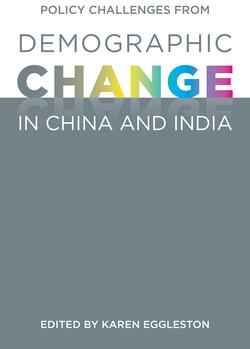
The world’s two most populous countries face numerous policy challenges from rapid demographic change. Drawing on social science expertise from China, India, and the United States, the contributors examine the social and economic challenges for policies across a range of domains, from China’s changed family planning policies and India’s efforts to address gender imbalance, to both countries’ policies regarding old-age support, human capital investment, poverty alleviation, and broader issues of governance.
Sections focus on:
- Policy Challenges and Economic Impact
- Fertility and Sex Imbalance
- Human Capital and Urbanization
- Population Aging
Desk or examination copies can be ordered from Stanford University Press.
All Publications button
1
Publication Type
Books
Publication Date
Book Publisher
Shorenstein APARC
Book Publisher External URL
Bloomberg TV: Next steps for the Bank of Japan
News Type
Commentary
Date
Paragraphs
The Bank of Japan (BOJ) convened in late April to discuss the future of Japanese monetary policy. An outcome of that meeting was a decision to hold interest rates steady. On Bloomberg TV, Stanford economist Takeo Hoshi said the non-move is unsurprising and offered views on what to expect next from the BOJ.
The interview can be viewed here.
Hero Image

All News button
1