


The Colonial Origins of Ethnic Violence in India
Paragraphs
The neighboring north Indian districts of Jaipur and Ajmer are identical in language, geography, and religious and caste demography. But when the famous Babri Mosque in Ayodhya was destroyed in 1992, Jaipur burned while Ajmer remained peaceful; when the state clashed over low-caste affirmative action quotas in 2008, Ajmer's residents rioted while Jaipur's citizens stayed calm. What explains these divergent patterns of ethnic conflict across multiethnic states? Using archival research and elite interviews in five case studies spanning north, south, and east India, as well as a quantitative analysis of 589 districts, Ajay Verghese shows that the legacies of British colonialism drive contemporary conflict.
Because India served as a model for British colonial expansion into parts of Africa and Southeast Asia, this project links Indian ethnic conflict to violent outcomes across an array of multiethnic states, including cases as diverse as Nigeria and Malaysia. The Colonial Origins of Ethnic Violence in Indiamakes important contributions to the study of Indian politics, ethnicity, conflict, and historical legacies.
This book is part of the Studies of the Walter H. Shorenstein Asia-Pacific Research Center series at Stanford University Press.
All Publications button
1
Publication Type
Books
Publication Date
Journal Publisher
Stanford University Press
Policy Challenges from Demographic Change in China and India
Paragraphs
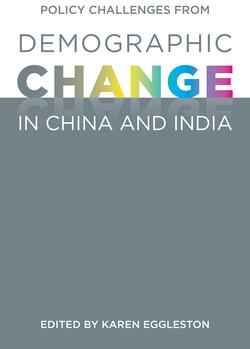
The world’s two most populous countries face numerous policy challenges from rapid demographic change. Drawing on social science expertise from China, India, and the United States, the contributors examine the social and economic challenges for policies across a range of domains, from China’s changed family planning policies and India’s efforts to address gender imbalance, to both countries’ policies regarding old-age support, human capital investment, poverty alleviation, and broader issues of governance.
Sections focus on:
- Policy Challenges and Economic Impact
- Fertility and Sex Imbalance
- Human Capital and Urbanization
- Population Aging
Desk or examination copies can be ordered from Stanford University Press.
All Publications button
1
Publication Type
Books
Publication Date
Book Publisher
Shorenstein APARC
Book Publisher External URL
India and the United States in the 21st Century: Charting a Path for the Indo-Pacific
-
The United States and India continue to expand strategic ties and areas of collaboration in unprecedented ways. This of course has not come without constraints or significant obstacles. Under the Obama Administration, the relationship has arguably been elevated to a new level of cooperation, but space remains for a potentially significant further expansion of both ties and collaboration on all levels. This will have strategic implications for both nations, their neighbors, and the overall region itself.
As the U.S.-India relationship continues to grow into the 21st century, a new regional construct has the potential for developing along with it. At the confluence of India's Act East foreign policy and the United States' strategic rebalance to Asia lies the relatively undefined domain of the Indo-Pacific. This seminar will touch upon the efforts of the Obama Administration to further this "defining partnership of the 21st century", and then delve into the potential future of the Indo-Pacific and the strategic implications and challenges of a developing Indo-Pacific reality from political, economic, security, and technological perspectives
Philip James Reiner is an Affiliate at Stanford University’s Center for International Security and Cooperation, an Adjunct Senior Fellow with the Asia-Pacific Security Program at the Center for a New American Security, and serves as a consultant to both the private and public sectors. He previously served as Senior Director for South Asia at the National Security Council (NSC), where he successfully led U.S. government efforts to revitalize the U.S.-India bilateral relationship, and oversaw two head-of-state level engagements including the groundbreaking visit of President Obama as Chief Guest at India’s Republic Day celebrations in January 2015. Prior to his appointment as Senior Director, Mr. Reiner served at the NSC for three years, first as Director for Pakistan and then as Senior Advisor for Afghanistan and Pakistan. In these capacities, he helped to manage the war-time requirements of effectively staffing the President, the National Security Advisor, and senior White House and NSC leadership, while helping to lead team efforts to sustain an international coalition of more than 40 countries in Afghanistan, with functional focus on both counterterrorism and countering the proliferation of weapons of mass destruction. He also played an instrumental role in managing significant bilateral and regional crises and helping to reset and rebalance U.S.-Pakistan relations after the tensions of 2011.Image

Prior to joining the White House, Mr. Reiner worked in the Office of the Under Secretary of Defense for Policy at the Pentagon, where he received the Office of the Secretary of Defense Medal for Exceptional Civilian Service; and at Raytheon Space and Airborne Systems. Mr. Reiner holds a Master’s degree in International Relations from the Johns Hopkins School of Advanced International Studies, and a Bachelor of Arts in Comparative Religions with a minor in History from the University of California at Santa Barbara. He currently resides in the San Francisco Bay Area with his wife and daughter.
This event is co-sponsored by the Shorenstein Asia-Pacific Research Center and the Center for International Security and Cooperation
Philip James Reiner
Former Senior Director for South Asia, National Security Council
Seminars


Corporate Affiliates Program welcomes 2015-16 fellows
News Type
News
Date
Paragraphs
As the new academic year gets underway, the Walter H. Shorenstein Asia-Pacific Research Center’s Corporate Affiliates Program is excited to welcome its new class of fellows to Stanford University:
- Yuta Aikawa, Ministry of Economy, Trade & Industry, Japan
- Wataru Fukuda, Shizuoka Prefectural Government
- Huang (Catherine) Huang, Beijing Shanghe Shiji Investment Company
- Avni Jethwa, Reliance Life Sciences
- Satoshi Koyanagi, Ministry of Economy, Trade & Industry, Japan
- An Ma, PetroChina
- Huaxiang Ma, Peking University
- Yuichiro Muramatsu, Mitsubishi Electric
- Tsuzuri Sakamaki, Ministry of Finance, Japan
- Tsuneo Sasai, The Asahi Shimbun
- Ravishankar Shivani, Reliance Life Sciences
- Aki Takahashi, Nissoken
- Mariko Takeuchi, Sumitomo Corporation
- Hideaki Tamori, The Asahi Shimbun
- Ryo Washizaki, Japan Patent Office
- Hung-Jen (Fred) Yang, MissionCare
During their stay at Stanford University, the fellows will audit classes, work on English skills, and conduct individual research projects; at the end of the year they will make a formal presentation on the findings from their research. During their stay at the center, they will have the opportunity to consult with Shorenstein APARC's scholars and attend events featuring visiting experts from around the world. The fellows will also participate in special events and site visits to gain a firsthand understanding of business, society and culture in the United States.
Hero Image

All News button
1
China and India: Seeking a New Balance
-
Image

For nearly thirty years before he joined Yale University, Mr. Chanda was with the Hong Kong-based magazine the Far Eastern Economic Review as its editor, editor-at-large and correspondent. In 1989-90 Chanda was a Senior Fellow at the Carnegie Endowment for International Peace in Washington. From 1990-1992 Chanda was editor of the Asian Wall Street Journal Weekly, published from New York. He is the author of Bound Together: How Traders, Preachers, Adventurers and Warriors Shaped Globalization. He is also the author of Brother Enemy: The War After the War and co-author of over a dozen books on Asian politics, security and foreign policy including Soldiers and Stability in Southeast Asia and The Political Economy of Foreign Policy In Southeast Asia and The International Relations of Asia. He co-edited with Strobe Talbott The Age of Terror: America and the World After September 11.
Chanda writes a fortnightly column 'Bound Together' in India's BusinessWorld magazine and Singapore Straits Times. He is an occasional contributor to the opinion page of the International Herald Tribune and is a member of the editorial board of GlobalAsia , New Global Studies journal. He is a member of the Advisory Council for the Center for Northeast Asian Policy Studies at the Brookings Institution. He is the recipient of the Shorenstein Journalism Award for 2005.
Nayan Chanda
Director of Publications and the Editor of YaleGlobal Online Magazine at the Yale Center for the Study of Globalization
Lectures
Stanford scholars hold dialogue in New Delhi
News Type
News
Date
Paragraphs
The Shorenstein Asia-Pacific Research Center (APARC) hosted its inaugural event in New Delhi, a public seminar titled India’s Relations with its Northeast Asian Neighbors, in late 2014. Experts from Shorenstein APARC and the Brookings Institution’s India Center spoke about recent developments in India’s foreign policy under the nation’s new prime minister, Narendra Modi, and provided an outlook on where India fits in the context of an emerging Northeast Asia.
The panel consisted of Stanford scholars: Gi-Wook Shin, professor of sociology and director of Shorenstein APARC; Michael Armacost, a Shorenstein Distinguished Fellow; and Karl Eikenberry, a Shorenstein Distinguished Fellow; and Brookings scholars: Vikram S. Mehta, executive chairman; and W.P.S. Sidhu, a senior fellow.
Video and transcript of the event are available below. A list of key discussion points was also written up by Brookings India and is available by clicking here.
The seminar was one event in a larger visit by Shorenstein APARC to New Delhi. Armacost, Eikenberry, Shin, and Huma Shaikh, the associate director for administration, hosted a series of private roundtable discussions at two universities, Jawaharlal Nehru University and Delhi University.
Kathleen Stephens, the then-charge d’affaires for the United States in India, also hosted Shorenstein APARC at Roosevelt House, the official U.S. ambassadorial residence. There, at the entrance, the group was greeted with a Stanford “S” prepared in “rangoli” style, an Indian custom of welcoming guests with an intricate design made of colored rice and flowers.
On Twitter, Stephens (@AmbStephens) shared a series of tweets, a few are included below:
Image

Stephens was the Koret Distinguished Fellow in the Korea Program at Shorenstein APARC from 2013-14; she served as U.S. ambassador to the Republic of Korea from 2008 to 2011, among other posts.
The events were part of an effort to reinvigorate the South Asia Initiative, a Stanford program that seeks to conduct policy-relevant research and convene conferences on topics related to the United States and the nations of South Asia.
Hero Image

All News button
1