Military
News Type
Commentary
Date
Paragraphs

India-China border tensions along the disputed Line of Actual Control show no signs of letting up and the prospects of peace in the conflict between the nuclear-armed rivals are daunting. How do the Indian and Chinese militaries compare against each other?

FSI Center Fellow at APARC Oriana Skylar Mastro and our South Asia Research Scholar Arzan Tarapore join the Observer Research Foundation’s ‘Armchair Strategist’ podcast to discuss the Indian and Chinese strategic power postures, military modernization and reform by the two Asian neighbors, the ways they can marshal both military and non-military forces, and the possible outcomes of a confrontation along their Himalayan border. Listen here:

Based in Delhi, the Observer Research Foundation (ORF) is a leading South Asian nonprofit policy research institution whose work spans a wide range of topics, including national security, economic development, cyber issues and media, and climate and energy.

Read More

Chinese President Xi Jinping (R) talks with India's Prime Minister Manmohan Singh (L) during a meeting at the Diaoyutai State Guesthouse in 2013.
Commentary

China-India: Talk is Cheap, But Never Free

Nations often hesitate to negotiate with opponents during conflict. But Oriana Skylar Mastro urges that this is precisely what India and China need to do in order to curb the potential for a protracted, costly war with devastating geopolitical implications.
China-India: Talk is Cheap, But Never Free
An Indian army soldier watches a fighter plane from a convoy of trucks in Gagangir, India.
Commentary

India and China are Taking New Risks Along Their Border

Will diplomacy help defuse the current tensions brewing along the India-China border? Arzan Tarapore analyzes why restoring peace between the two countries may prove difficult.
India and China are Taking New Risks Along Their Border
An Indian Army soldier looking through a military monocular over hills in the background
News

U.S. Policymakers Cannot Assume the Fixity of Indian Strategic Preferences, Argues South Asia Research Scholar Arzan Tarapore

In a special report published by the National Bureau of Asian Research, Tarapore analyzes possible scenarios for India’s strategic future that expose risks and tensions in current U.S. policy.
U.S. Policymakers Cannot Assume the Fixity of Indian Strategic Preferences, Argues South Asia Research Scholar Arzan Tarapore
Hero Image
Logo of the Observer Research Foundation's 'Armchair Strategist' podcast with portraits of Oriana Skylar Mastro and Arzan Tarapore
All News button
1
Subtitle

Oriana Skylar Mastro and Arzan Tarapore join the Observer Research Foundation’s ‘Armchair Strategist’ podcast to discuss how the Indian and Chinese militaries stack up as tensions between the two Asian neighbors continue to heat up.

Authors
News Type
Commentary
Date
Paragraphs

This analysis by Arzan Tarapore was originally published at The Monkey Cage by The Washington Post.


Last week, the India-China border standoff came the closest it has yet to war. As Taylor Fravel explained, the long-standing border dispute dates from the 1962 Sino-Indian War. The dispute came to a boil in May when a large force of Chinese soldiers crossed the Line of Actual Control (LAC), the disputed border between the two countries since 1962. A deadly skirmish in June temporarily raised tensions, but it was the result of tragic happenstance rather than large and risky military maneuvers.

Tensions have escalated more seriously since late August because both sides have jostled for tactical advantage, creating incentives for each side to outflank or even fight the other.

Here’s where things stand in this crisis.

Aggressive tactical maneuvers led to rising tensions

A new phase of the four-month-long border crisis opened when Indian special forces quietly occupied several peaks in the mountainous Chushul sector of Ladakh during the night of Aug. 29-30. These peaks sit on India’s side of the LAC, just south of a divided lake — Pangong Tso — but had been left unoccupied in accordance with confidence-building agreements. They were the site of tenacious fighting in the 1962 border war and hold particular tactical significance because they overlook an important pathway through the mountains between India and China.

Occupying the high ground in Chushul was designed to prevent Chinese forces from establishing an even stronger position. India also may have calculated that it could negotiate a withdrawal from those tactically valuable peaks in return for a Chinese withdrawal from areas seized after May.

Tensions rose. Indian and Chinese troops also scrambled to secure high ground overlooking new Chinese fortifications on the north bank of Pangong Tso. They reinforced their positions with additional aircraft and armor and accused each other of firing the first gunshots on the LAC since 1975. Some Indian analysts warned that China might risk war to reverse India’s occupation of the Chushul peaks.

Continue reading Arzan's full analysis on Monkey Cage at The Washington Post >>

[Subscribe to our newsletters to get the latest commentary from APARC scholars.]

Read More

A regiment of the Indian Army practices in dress uniform for Republic Day
Commentary

Rethinking the Defense Doctrine of India

The security threats India faces along its borders require new strategies, and in order to manage and prevent future risks, the military needs to overhaul its traditional playbook of deterring and defending against conventional attacks says Arzan Tarapore.
Rethinking the Defense Doctrine of India
An Indian Army soldier looking through a military monocular over hills in the background
News

U.S. Policymakers Cannot Assume the Fixity of Indian Strategic Preferences, Argues South Asia Research Scholar Arzan Tarapore

In a special report published by the National Bureau of Asian Research, Tarapore analyzes possible scenarios for India’s strategic future that expose risks and tensions in current U.S. policy.
U.S. Policymakers Cannot Assume the Fixity of Indian Strategic Preferences, Argues South Asia Research Scholar Arzan Tarapore
Hero Image
An Indian army soldier watches a fighter plane from a convoy of trucks in Gagangir, India.
An Indian army soldier watches fighter plane from a convoy of trucks in Gagangir, India.
Yawar Nazir / Stringer, Getty Images
All News button
1
Subtitle

Will diplomacy help defuse the current tensions brewing along the India-China border? Arzan Tarapore analyzes why restoring peace between the two countries may prove difficult.

Authors
Noa Ronkin
News Type
News
Date
Paragraphs

U.S. policymakers are counting on India as a natural strategic partner. They focus on India’s increasing national power and its enticing potential as a counterbalance to China. But what happens if India’s strategic preferences shift? Will it fulfill its potential so that the U.S. strategic bet pays off?

In a special report, Exploring India's Strategic Futures, published by the National Bureau of Asian Research (NBR), APARC South Asia Research Scholar and NBR Nonresident Fellow Arzan Tarapore identifies a set of challenges for American strategists, illustrating alternative futures of India as a strategic actor and focusing on futures that may pose challenges to U.S. security interests.

Tarapore uses a novel method of major/minor trends to demonstrate that India’s strategic preferences are not fixed but could vary discontinuously under different environmental conditions. Based on detailed historical analysis, this method offers a powerful tool to sensitize decision makers to a range of possible futures. He analyzes three plausible scenarios:

First, a revisionist India driven by Hindu-nationalist ideology to settle the score with Pakistan, which will require it to keep the China front quiet and accommodate China’s Belt and Road Initiative in Eurasia. This scenario may severely complicate U.S. strategy in the Indo-Pacific and its efforts to counterbalance China.

Second, a risk-acceptant Indian military that engages in brinkmanship, which may endanger strategic stability with both Pakistan and China. In this scenario, rather than keeping the Chinese military in check, India may paradoxically have the opposite effect.

Third, an India that expands its competition with China into continental Eurasia, making common cause with U.S. rivals such as Russia and Iran. This scenario illustrates the tensions in a U.S. global strategy that lacks prioritization and prompts Washington to more carefully consider its preferences in Central Asia.

Tarapore by no means suggests that such futures are likely — they are decidedly unlikely — but rather that U.S. strategists should consider them plausible. Indeed, the three scenarios are all grounded in political processes that have long existed in India, from communalism to military adaptation, to the balancing of external threats. Therefore, argues Tarapore, U.S. policymakers should not assume Indian strategic preferences are stable. They must consider scenarios in which India might challenge U.S. security interests.

Read More

Portrait of Arzan Tarapore and text: "Q&A with Arzan Tarapore"
Q&As

Internal Balancing Will Determine India’s Relationships with the US and China, Argues APARC’s Newest Research Scholar

Indo-Pacific security expert Arzan Tarapore, whose appointment as a research scholar at APARC begins on September 1, discusses India’s military strategy, its balancing act between China and the United States, and his vision for revitalizing the Center’s research effort on South Asia.
Internal Balancing Will Determine India’s Relationships with the US and China, Argues APARC’s Newest Research Scholar
Japanese Prime Minister Shinzo Abe speaks at a podium with audience seen at the front
Commentary

Three Hits and Three Misses: What is Prime Minister Abe’s Legacy?

Despite this long period as prime minister, it is not entirely clear that Abe accomplished major policy goals.
Three Hits and Three Misses: What is Prime Minister Abe’s Legacy?
Leaders from the ASEAN league gather onstage at the 33rd ASEAN Summit in 2018 in Singapore.
Commentary

Southeast Asia's Approach to China and the Future of the Region

In an interview with The Diplomat, Donald Emmerson discusses how factors like the South China Sea, U.S.-China competition, and how COVID-19 are affecting relations between Southeast Asia, China, and the United States.
Southeast Asia's Approach to China and the Future of the Region
Hero Image
An Indian Army soldier looking through a military monocular over hills in the background
An Indian Army soldier guards the line dividing Kashmir between India and Pakistan.
Farooq Khan-Pool/ Getty Images
All News button
1
Subtitle

In a special report published by the National Bureau of Asian Research, Tarapore analyzes possible scenarios for India’s strategic future that expose risks and tensions in current U.S. policy.

Authors
Noa Ronkin
News Type
News
Date
Paragraphs

We are pleased to share that Oriana Skylar Mastro, FSI Center Fellow at APARC, has won the 2020 International Security Section of the American Political Science Association Best Book by an Untenured Faculty Member Award for her book The Costs of Conversation: Obstacles to Peace Talks in Wartime (Cornell University Press, 2019).

Each year, APSA recognizes excellence in the political science profession and its various subfields. Mastro has won the Association’s award for an untenured scholar who has published the highest quality book in Security Studies in the previous calendar year.

[To receive the latest updates on our scholars' research sign up for APARC’s newsletters]

Mastro is an international security expert with a focus on Chinese military and security policy issues, Asia-Pacific security, war termination, and coercive diplomacy. Her research addresses critical questions at the intersection of interstate conflict, great power relations, and the challenge of rising powers. In The Costs of Conversation, she argues that states are primarily concerned with the strategic costs of conversation, and these costs need to be low before combatants are willing to engage in direct talks with their enemy. She examines two factors leaders look to when determining the strategic costs of demonstrating a willingness to talk: the likelihood the enemy will interpret openness to diplomacy as a sign of weakness, and how the enemy may change its strategy in response to such an interpretation. A state will be open to talking with the enemy only if it thinks it has demonstrated adequate strength and resiliency to avoid the inference of weakness and if it believes that its enemy has limited capacity to escalate or intensify the war.

Mastro uses four primary case studies — North Vietnamese diplomatic decisions during the Vietnam War, those of China in the Korean War and Sino-Indian War, and Indian diplomatic decision making in the latter conflict — to demonstrate that the costly conversations thesis best explains the timing and nature of countries' approach to wartime talks, and therefore when peace talks begin. Her findings have significant theoretical and practical implications for war duration and termination, as well as for military strategy, diplomacy, and mediation.

Read More

[left: image] Oriana Skylar Mastro, [right: text] Congratulations, Oriana Skylar Mastro, Recipient of the 2020 America in the World Consortium Prize for 'Best Policy Article' from Duke University, Johns Hopkins SAIS, and Texas University at Austin
News

Oriana Skylar Mastro Awarded America in the World Consortium Prize for Best Policy Article

Mastro, who begins her role as FSI Center Fellow on August 1, has won the AWC Best Policy Article on U.S. Foreign Policy and Grand Strategy award for her insights on how China leverages ambiguity to gain global influence and what the United States can do to counter the PRC’s ambitions.
Oriana Skylar Mastro Awarded America in the World Consortium Prize for Best Policy Article
Portrait of Oriana Mastro with text: "Q&A with Oriana Skylar Mastro"
Q&As

FSI’s Incoming Center Fellow Oriana Skylar Mastro Discusses Chinese Ambitions, Deteriorating U.S.-China Relations

Mastro, whose appointment as a Center Fellow at Shorenstein APARC begins on August 1, considers the worsening relations between the world’s two largest economies, analyzes Chinese maritime ambitions, and talks about her military career and new research projects.
FSI’s Incoming Center Fellow Oriana Skylar Mastro Discusses Chinese Ambitions, Deteriorating U.S.-China Relations
Portrait of Arzan Tarapore and text: "Q&A with Arzan Tarapore"
Q&As

Internal Balancing Will Determine India’s Relationships with the US and China, Argues APARC’s Newest Research Scholar

Indo-Pacific security expert Arzan Tarapore, whose appointment as a research scholar at APARC begins on September 1, discusses India’s military strategy, its balancing act between China and the United States, and his vision for revitalizing the Center’s research effort on South Asia.
Internal Balancing Will Determine India’s Relationships with the US and China, Argues APARC’s Newest Research Scholar
Hero Image
Portrait of Oriana Skylar Mastro and a 3D cover of her book, 'The Costs of Conversation: Obstacles to Peace Talks in Wartime'
All News button
1
Subtitle

The American Political Science Association recognizes Oriana Skylar Mastro for her work on military strategy and mediation.

Authors
Noa Ronkin
News Type
Q&As
Date
Paragraphs

Amid the intensifying security rivalry between the United States and China and the rapidly changing power balances in the Indo-Pacific, India has emerged as an increasingly important partner for U.S. interests in the region. What factors will shape India’s relationships with the world’s two largest superpowers? How should Washington interpret New Delhi’s evolving understanding of strategic autonomy? And is Indian defense policy equipped to meet today’s security threats?  

These are some of the questions that occupy Arzan Tarapore, our new research scholar on South Asia effective September 1. At APARC, Tarapore will continue his research on Indo-Pacific security and military effectiveness. He will also be at the forefront of advancing the Center’s South Asia research and engagement effort – a role to which he brings his experience that combines academic scholarship with over a decade of government service. Before his appointment at Stanford, Tarapore was an adjunct assistant professor at Georgetown University. He continues to serve as a nonresident fellow at the National Bureau of Asian Research and an adjunct researcher at the RAND Corporation.

Here, Tarapore explains how “internal balancing” may shape India’s relationships with China and the United States, considers what’s at stake for India’s military strategy, and shares some of his plans for APARC’s South Asia initiative.

[To receive stories like this directly in your inbox sign up for APARC’s newsletters]


How is India’s own tense relationship with China, which burst into view in the recent border clash in the Himalayas, poised to affect its ties with the United States and its approach to strategic partnerships with other countries, such as Japan and Australia?

Tarapore: In the last two decades, Washington has latched on to India as a strategic partner in large part because it recognizes that India is a natural competitor to China. This is rooted in structural reasons – because of India and China’s geography, history, and strategic interests. So India has pursued its own brand of strategic competition with China for over half a century – it’s just that its tactics may sometimes appear desultory to some American (and Indian!) observers. Those tactics, which in the recent past have included back-slapping summitry and avoidance of provocations, are largely rooted, at bottom, in India’s relatively modest power.

Rather than focusing just on India’s alignments – what scholars call 'external balancing' – we should watch closely for changes in India’s defense policy and military modernization – or 'internal balancing.'
Arzan Tarapore

Now, some observers have asserted (or hoped) that the current border crisis in Ladakh may shake New Delhi out of this posture and catalyze a closer relationship – even an alliance – with the United States. As I’ve argued elsewhere, an alliance with the U.S. is neither plausible nor necessary. India has forged a much closer defense relationship with the United States and other like-minded regional states like Japan and Australia. The current crisis may accelerate some of that alignment a little, but this trend was already well underway. To be sure, the crisis – and especially the Indian fatalities – has hardened popular opinion against China. But Indian officialdom did not need to be convinced of the China threat, or the merits of cooperation with the United States. Their inhibitions to an alliance – just like their threat perceptions of China – are structural and not likely to be dispelled anytime soon.

Rather than focusing just on India’s alignments – what scholars call “external balancing” – we should watch closely for changes in India’s defense policy and military modernization – or “internal balancing.” There is a chance this crisis will prompt India to correct some of the long-standing distortions in defense policy. If it does, those changes – rather than any outward displays of alignment – will have a far greater impact on India’s competition with China, and on its partnership with the United States.

One of your research areas is focused on strategic effectiveness, particularly Indian military strategy-making. In your recent Carnegie India paper, The Army in Indian Military Strategy, you argue that the Indian army must rethink its use of force to meet today’s new challenges. What is the problem with its prevailing doctrine and what are your specific recommendations for it and Indian defense policy?   

Tarapore: I’ve argued that Indian military strategy over at least the past half-century has been dominated by an army doctrine that is designed to fight large conventional wars. This doctrine drives the Indian military’s force structure and its ideas about how to use force. The problem is, the doctrine is unsuited to the more-common security challenges that India currently faces – challenges exemplified perfectly by China’s borderland grab in Ladakh this past summer.

If it does not rethink its doctrine, the Indian Army risks becoming less and less relevant as a tool of statecraft.
Arzan Tarapore

The Indian Army should certainly still prepare for major wars, but I argue in this paper that it also needs to develop new concepts for dealing with threats below the threshold of war. If it does not rethink its doctrine, it risks becoming less and less relevant as a tool of statecraft. Specifically, I argue that the Indian Army should consider new “theories of victory” that focus on denying the enemy’s goals rather than threatening to punish it; consider how to better support the air force and navy; and consider emphasizing certain niche capabilities of modern warfighting.

What are some of the projects and activities you plan to focus on at APARC, both in your research and as part of the effort to revitalize the Center’s research and education initiative on South Asia?

Tarapore: As mentioned at the outset, Washington sees India as a central partner in the Indo-Pacific. I want to position APARC and Stanford to effectively support that policy. My research, at least for now, focuses on Indian defense issues. For example, I have a book project that looks at how India has historically approached the use of force – our policymakers need to understand India’s particular constraints and patterns. Second, I will continue to engage in a stream of research on how the United States, India, and their like-minded partners can manage security risks in the Indian Ocean region.

Beyond my own research, I want to take advantage of Stanford’s community of scholars, and build on my network in the region, to work on issues that are often overlooked by Washington-based policy tribes. For example, I am keen to explore the effects of climate change across South Asia – the challenges it poses to security and governance, and how it may force regional states to respond. These issues are critically important but often overshadowed by more urgent crises.

Your career combines both academic scholarship and government experience. Tell us more about your government service, what drew you to it, and how you became interested in Indo-Pacific security issues.

Tarapore: My government work completely shaped my scholarship. I served for 13 years in the Australian Defence Department, as an analyst, leader, and liaison officer. My time there was dominated by the post-9/11 wars and security crises – so even as a civilian, I deployed on operations and worked closely with the military. This has left me with an abiding dedication to being task-oriented – ensuring that my scholarship has direct utility for decision makers – and an abiding preference for working among teams of people smarter than I am. With my professional background in Australia, my academic interest in India, and my new home in the United States, I’m entirely comfortable with the concept and the region of the “Indo-Pacific.” This is why Stanford and APARC, with policy focus and community of scholars working on Asia, are so exciting.

What is it like to begin a new academic post remotely in a COVID-19 world? How has the pandemic affected your work?

Tarapore: I’ve often thought about how fortunate I am to work in a field where I can keep working, with some adjustments, even amid a global pandemic. If we’re honest, I suspect some people even thrive on the enforced solitude. For me, it’s a nuisance and it requires adjustments – none more so than rethinking childcare arrangements. From a professional perspective, one of the biggest obstacles it creates is the inability to travel to India for fieldwork, or around the region to build our professional networks. The other, more quotidian difficulty is the obstacle to in-person teamwork. Obviously, something is lost when we have to stare at each other through screens, so I can’t wait to walk the halls of Encina Hall.

Read More

The Japanese delegation onboard the USS Missouri during the surrender ceremony on September 2, 1945.
Q&As

How WWII Continues to Shape Regional and International Relations in Asia

In an interview with Stanford News, Gi-Wook Shin, the director of APARC and the Korea Program, describes how divergent perspectives on the legacies of WWII continue to shape different understandings of history and impact inter-Asia and U.S.-Asia relations.
How WWII Continues to Shape Regional and International Relations in Asia
Encina Courtyard
News

Call for Stanford Student Applications: APARC Hiring 2020-21 Research Assistants

To support Stanford students working in the area of contemporary Asia, the Shorenstein Asia-Pacific Center is offering research assistant positions for the fall, winter, and spring quarters of the 2020-21 academic year.
Call for Stanford Student Applications: APARC Hiring 2020-21 Research Assistants
Portrait of Oriana Mastro with text: "Q&A with Oriana Skylar Mastro"
Q&As

FSI’s Incoming Center Fellow Oriana Skylar Mastro Discusses Chinese Ambitions, Deteriorating U.S.-China Relations

Mastro, whose appointment as a Center Fellow at Shorenstein APARC begins on August 1, considers the worsening relations between the world’s two largest economies, analyzes Chinese maritime ambitions, and talks about her military career and new research projects.
FSI’s Incoming Center Fellow Oriana Skylar Mastro Discusses Chinese Ambitions, Deteriorating U.S.-China Relations
Hero Image
Portrait of Arzan Tarapore and text: "Q&A with Arzan Tarapore"
All News button
1
Subtitle

Indo-Pacific security expert Arzan Tarapore, whose appointment as a research scholar at APARC begins on September 1, discusses India’s military strategy, its balancing act between China and the United States, and his vision for revitalizing the Center’s research effort on South Asia.

Stanford CISAC
Stanford University
Encina Hall
Stanford,  CA  94305-6055

0
Center Fellow at the Freeman Spogli Institute for International Studies
Courtesy Assistant Professor of Political Science
Faculty Affiliate at the Walter H. Shorenstein Asia-Pacific Research Center
OrianaSkylarMastro_2023_Headshot.jpg PhD

Oriana Skylar Mastro is a Center Fellow at the Freeman Spogli Institute for International Studies and Courtesy Assistant Professor of Political Science at Stanford University, where her research focuses on Chinese military and security policy, Asia-Pacific security issues, war termination, and coercive diplomacy. She is also a nonresident scholar at the Carnegie Endowment for International Peace and a member of the Council on Foreign Relations. She was previously an assistant professor of security studies at Georgetown University. Mastro continues to serve in the United States Air Force Reserve, for which she currently works at the Pentagon as Deputy Director of Reserve Global China Strategy. For her contributions to U.S. strategy in Asia, she won the Individual Reservist of the Year Award in 2016 and 2022 (FGO).

She has published widely, including in International Security, Security Studies, Foreign Affairs, the Journal of Strategic Studies, The Washington Quarterly, the Economist, and the New York Times. Her most recent book, Upstart: How China Became a Great Power (Oxford University Press, 2024), evaluates China’s approach to competition. Her book, The Costs of Conversation: Obstacles to Peace Talks in Wartime (Cornell University Press, 2019), won the 2020 American Political Science Association International Security Section Best Book by an Untenured Faculty Member.

She holds a B.A. in East Asian Studies from Stanford University and an M.A. and Ph.D. in Politics from Princeton University.

Her publications and commentary can be found at orianaskylarmastro.com and on Twitter @osmastro.

Selected Multimedia

CV
Date Label
Authors
Noa Ronkin
News Type
Q&As
Date
Paragraphs

U.S.-China relations have been deteriorating at an alarming speed, and as distrust grows on both sides, it is unclear how to stop the downward spiral. What does China want and how can we best assess Chinese intentions?

This is a key question on the research agenda of East Asian security expert Oriana Skylar Mastro, FSI’s newest Center Fellow. Mastro, an assistant professor of security studies at Georgetown University’s Edmund A. Walsh School of Foreign Service, will begin her appointment at FSI on August 1 and be based at the Shorenstein Asia-Pacific Research Center (APARC), where she will continue her research on Chinese military and security policy, Asia-Pacific security issues, war termination, and coercive diplomacy. She will also work with the Center for International Security and Cooperation (CISAC), and teach students in both the CISAC Honors program and the Ford Dorsey Master’s in International Policy program.

Here, Mastro discusses Chinese ambitions and the rapidly increasing tensions in U.S.-China relations; talks about her military career and new research projects; shares how she first became interested in East Asian security issues as a Stanford undergraduate student; and even reveals some things we don’t know about her.

[To receive stories like this directly in your inbox sign up for APARC’s newsletters]


You have argued in your writings that although China does not want to usurp the United States’ position as the leader of the global order, its strategic goal in the Indo-Pacific region is nearly as consequential. Why is it so? What do you foresee for Chinese aims and the U.S.-China rivalry as we near the U.S. presidential election?

Mastro: My claim is that China doesn't want to replace the United States but rather displace the United States. It’s an important distinction because it’s become popular to assume that China wants to have everything that we, the United States, have and that its view of power is the same as ours. But if you look throughout history, every time a country rises, it exercises its power differently. The United States, for example, didn't build colonies because Great Britain had had colonies. It is equally unlikely to assume that China is going to build a global military and engage in foreign military interventions.

We make assumptions about what China wants and how it will get there based on our own experiences, and those tend to be incorrect.
Oriana Skylar Mastro

Therefore, I argue that China doesn't want to dominate the world. This doesn’t mean that its ambitions are limited, but rather that it thinks that the U.S. in-depth global involvement is an ineffective and costly way of doing business. Outside of Asia, China relies mainly on political and economic influence to ensure that no one goes against its interests. It is only in Asia where China’s military goals are problematic for the United States and where it wants to dominate and see the U.S. military less active. Again, this isn't due to lack of ambition: from China’s viewpoint, whoever dominates Asia, the world’s most dynamic and economically important region, is a superpower, just like whoever dominated Europe during the Cold War would have been a superpower. In short, I think we make assumptions about what China wants and how it will get there based on our own experiences, and those tend to be incorrect.

As for what’s ahead for the U.S.-China relationship and the coming presidential election, I think it’s a misconception to interpret the frictions between the two countries as stemming from the Trump administration. There are aspects of Chinese behavior that both the Republican and Democratic parties find problematic and I believe we will see a tougher policy towards China, regardless of who wins the election. A Democratic president might be less willing to risk confrontation with the Chinese the way the Trump administration is, but either way, I see increased tensions between the two sides as the norm for the next several years.

In your recent testimony on China’s maritime ambitions before the House Committee on Foreign Affairs, you distinguish between China's aims in its near seas and far seas. How do these intentions differ and why is it important to make the distinction between them?

Mastro: In the near seas — the South China Sea (SCS) and the East China Sea (ECS) — China is concerned with sovereignty, which is absolute control of these waters, and with regional hegemony. In the far seas — the Indian Ocean and beyond — China aims to operate, but it doesn’t aspire to exclude others from doing so. In these waters, China's ambitions are driven primarily by the desire to protect its strategic lines of communication and its economic and political interests.

While China's objectives in the South China Sea and East China Sea are detrimental to U.S. interests, some aspects of its objectives in the Indian Ocean and beyond are legitimate and do not necessarily threaten U.S. interests, although they are not without risks.
Oriana Skylar Mastro

It’s important to make this distinction for strategy reasons, which goes right to my previous point. There’s a growing sense now that “whatever China does is bad and the United States needs to counter everything China does,” but that's not quite true. While China's objectives in the SCS and ECS are detrimental to U.S. interests, some aspects of its objectives in the Indian Ocean and beyond are legitimate and do not necessarily threaten U.S. interests, although they are not without risks.

U.S. policy needs to consider these differences in the degree of threat because prioritization is crucial for strategy. If we are to prioritize our strategies, then we should prioritize countering China’s ambitions in its near seas and try to shape its objectives in the far seas, perhaps through more cooperative policies. Perceiving everything that China does as bad isn’t the right approach to competing with it.

In addition to your academic career, you have an extensive military portfolio: for over ten years, you have served in the United States Air Force Reserve. You have just been awarded the Meritorious Service Medal. Tell us more about this award, how your academic and military careers influence each other, and what it’s like to balance the two.

Mastro: I'm a special type of reservist called Individual Mobilization Augmentee (IMA), which means that I have a custom duty schedule and work with my active-duty supervisors to help meet mission requirements of whatever the priority is at the time. The award I just received, the Meritorious Service Medal, which is a recognition of commendable noncombatant service, is for my last role as a senior China analyst at the Pentagon. My main duties in that role were to prepare intel products and brief the senior leadership of Headquarters Air Force at the Pentagon.

I think that the mix of my two careers makes me a better military officer and a better scholar. My experiences in the military inspire a lot of my research projects, oftentimes regarding questions that I don't have good answers for. As an officer, I need the power of argumentation on my side if I am to make a difference. After I engage in the good academic practice of spending a year or more researching something in-depth, I can then go back and provide inputs into the Department of Defense. There is a synergy between the two careers in terms of topics.

Moreover, my experiences in the military have taught me leadership and teamwork skills that we don’t necessarily learn from being professors. There’s a vast difference in leadership and teamwork dynamics between the military and academia. When I’m on active duty, I'm there as Major Mastro to provide my expertise but also be a strong part of a team with a chain of command.

Of course, managing both civilian and military careers demands considerable planning and balancing. I schedule my deployments around my teaching schedule, but sometimes there are urgent assignments given current world events. For example, last semester, I was on duty one day a week while teaching full time. So that requires planning and flexibility on the part of my family, as well as support from the people who employ me.

How did you first become interested in China and East Asian security issues, and what made you pursue a military career?

Mastro: This is a fun topic to talk about at Stanford because it's all thanks to my experiences as an undergraduate student on The Farm. As a freshman, I began learning Chinese, and in the following years, being humanities- and arts-focused, I mainly studied ancient China and Chinese literature. When I returned to campus after a year of intensive study in China, I was looking for a research opportunity and heard about the CISAC Honors Program in International Security Studies. So it was only in my senior year that I took my first course in political science and was exposed to international security studies. I discovered a passion for this topic like nothing else I had studied before. I wanted to learn more and got my first job, at the Carnegie Endowment, researching security issues, and then decided to continue with graduate studies.

During my Ph.D. at Princeton, I met a General in the Air Force who told me I should join the military. At that point, I'd never met anyone in the military. I thought, “I’m not very tough; what could I possibly contribute?” But I took up on his suggestion to do an internship with the U.S. Indo-Pacific Command and realized that my Chinese language skills and knowledge about China could be useful. I wanted to serve and planned to do my duty for four years and be done, yet here we are, nearly 11 years later. It’s been a blessing to make a whole career out of this and it’s truly all thanks to many memorable experiences at Stanford and the CISAC Honors Program. I’m thrilled to be back and looking forward to teaching and mentoring students in the Honors program and the Ford Dorsey Master’s in International Policy program.

What are some of your current research projects and what do you plan to work on at APARC and Stanford at large?

Mastro: My main project is researching a book about what China wants – a framework for understanding how to assess Chinese intentions. This is a policy-relevant book that engages with international relations theory and literature, where understanding state intentions plays a key role. The framework I’m developing assesses information to answer what China’s intentions are in several areas and regarding several cases. There will be chapters on China’s regional ambitions, global ambitions, approach to international institutions, and intentions towards the economic and technological order. As part of this project, you may see me currently publishing works on the South China Sea or the Indian Ocean.

China doesn't have any alliances, but that doesn't mean it isn’t aligned or working with other countries.
Oriana Skylar Mastro

Another project, in its beginning stages, focuses on the China-Russia relationship. Here the overarching framework is an attempt to understand state cooperation. This relates to alliances, though the notion of alliances is rather outdated. China doesn't have any alliances, but that doesn't mean it isn’t aligned or working with other countries. The question is what types of cooperation between China and Russia are problematic for the United States and what types are not. Again, we need to prioritize: is it so bad if China and Russia back each other in the UN, or is it worse that they exercise together? I don't know yet, but I think that international relations theory can shed some light on these questions.

Tell us something we don’t know about you.

Mastro: It may seem that I constantly work because I have a military career in addition to being very involved in the policy and academic worlds, but many people don't realize that I'm a big fan of leisure. I spend plenty of time with my children and have multiple hobbies that I engage in daily: I read novels, do yoga and CrossFit, play the piano, and manage to sleep! I was a very serious pianist and still take Skype lessons with my old teacher back in Chicago. Now with the move to California, I’ll finally be able to enjoy the grand piano my parents bought me for my 16th birthday, which I never had room for. I'm a firm believer in work-life balance. It's just that my work, too, is a passion and a hobby of mine.

Read More

A Chinese day trader reacts as he watches a stock ticker at a local brokerage house on August 27, 2015 in Beijing, China
News

China Faces Tough Decisions and Stronger Headwinds

China has had great success, but the era of miracle growth is over. Citizen needs and expectations are rising, and deferred reforms are riskier and more necessary, explain Jean Oi and Thomas Fingar on the World Class Podcast.
China Faces Tough Decisions and Stronger Headwinds
(From left to right) Siegfried Hecker, Victor Cha, Oriana Mastro, Gi-Wook Shin, Robert Carlin
News

Experts Discuss Future U.S. Relations with North Korea Amid Escalations

Led by APARC, a panel of scholars hosted by the Freeman Spogli Institute weighs in on the implications of recent events on the Korean peninsula and the ongoing uncertainties in charting a future course with the DPRK.
Experts Discuss Future U.S. Relations with North Korea Amid Escalations
Cover of the book 'The Deer and the Dragon' on the background of a Southeast Asia map
News

New Book Analyzes the Dynamics of Inequality Between China and Southeast Asia

In a new volume, Donald Emmerson explores how the ASEAN nations are navigating complex political and policy issues with China during a time when political cohesion within ASEAN is fractured and China is increasingly assertive in its goals.
New Book Analyzes the Dynamics of Inequality Between China and Southeast Asia
Hero Image
Portrait of Oriana Mastro with text: "Q&A with Oriana Skylar Mastro"
All News button
1
Subtitle

Mastro, whose appointment as a Center Fellow at Shorenstein APARC begins on August 1, considers the worsening relations between the world’s two largest economies, analyzes Chinese maritime ambitions, and talks about her military career and new research projects.

Authors
Noa Ronkin
News Type
News
Date
Paragraphs

Southeast Asia, home to over 640 million people across 10 countries, is one of the world’s most dynamic and fastest growing regions. APARC just concluded the year 2019 with a Center delegation visit to two Southeast Asian capital cities, Hanoi and Bangkok, where we spent an engaging week with stakeholders in the academic, policy, business, and Stanford alumni communities.

Led by APARC Director Gi-Wook Shin, the delegation included APARC Deputy Director and Asia Health Policy Program Director Karen Eggleston, Southeast Asia Program Director Donald Emmerson, and APARC Associate Director for Communications and External Relations Noa Ronkin. Visiting Scholar Andrew Kim joined the delegation in Bangkok.

With a focus on health policy, our first day in Hanoi included a visit to Thai Nguyen University, a meeting with government representatives at the Vietnam Ministry of Health, and a seminar on healthy aging and innovation jointly with Hanoi Medical University.

Image
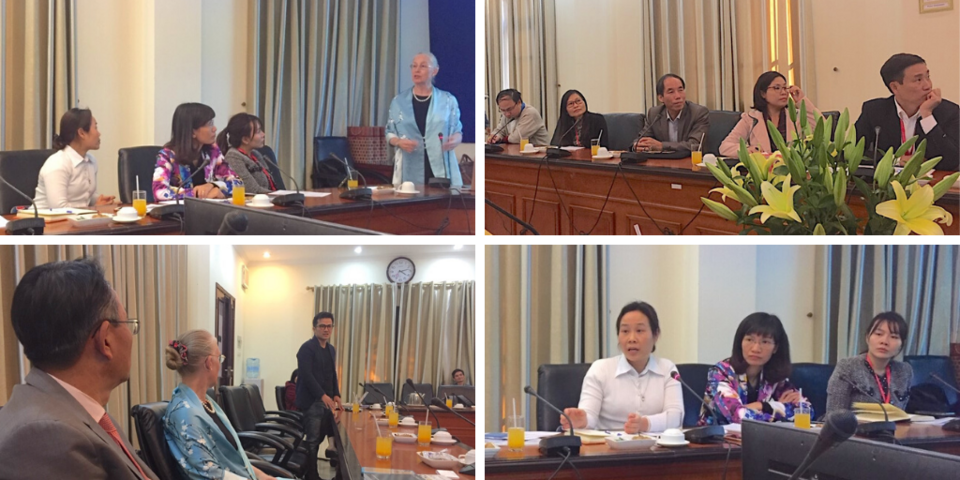
Collage of four images showing participants at a roundtable held at Hanoi Medical University with APARC delegation members

Karen Eggleston and participants at the roundtable held at Hanoi Medical University, December 9, 2019.

Throughout the day, Eggleston presented some of her collaborative research that is part of two projects involving international research teams: one that assesses public-private roles and institutional innovation for healthy aging and another that examines the economics of caring for patients with chronic diseases across diverse health systems in Asia and other parts of the world. We appreciated learning from our counterparts about the health care system and health care delivery in Vietnam.

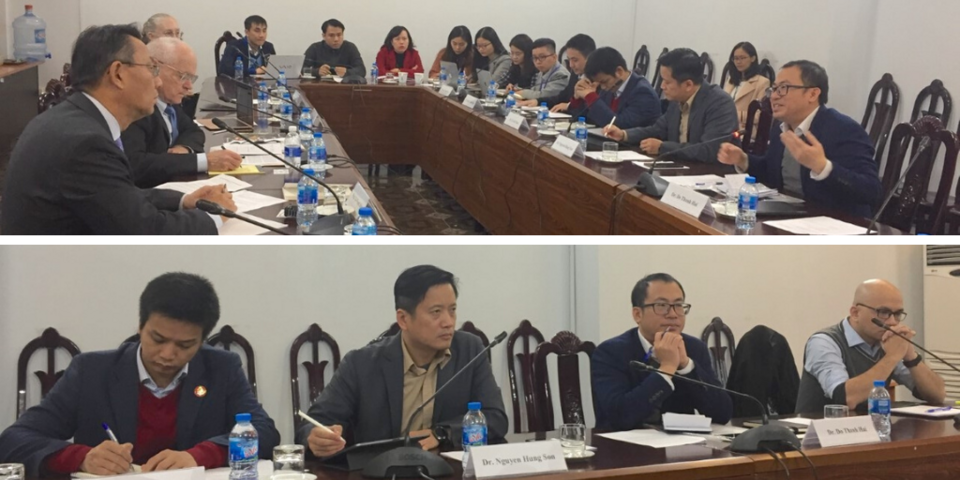
Shifting focus to international relations and regional security, day 2 in Hanoi opened with a roundtable, “The Rise of the Indo-Pacific and Vietnam-U.S. Relations,” held jointly with the East Sea Institute (ESI) of the Diplomatic Academy of Vietnam (DAV). Following a welcome by ESI Director General Nguyen Hung Son, the program continued with remarks by Shin, Emmerson, ESI Deputy Director General To Anh Tuan, and Assistant Director General Do Thanh Hai.

Image
Participants at a roundtable held at the Diplomatic Academy of Vietnam with APARC delegation members

Roundtable at the Diplomatic Academy of Vietnam, December 10, 2019.

The long-ranging conversation with DAV members included issues such as the future of the international order in Asia; the U.S. withdrawal from multilateralism; the concern about a lack of U.S. engagement in Southeast Asia, sparked by President Trump’s absence from the November 2019 summit of the Association of Southeast Asian Nations (ASEAN) at a time when China is bolstering its influence in the region and when ASEAN hopes to set a code of conduct with China regarding disputed waters in the South China Sea; the priorities for Vietnam as it assumes the role of ASEAN chair in 2020; and the challenges for the Vietnam-U.S. bilateral relationship amid the changing strategic environment in Southeast Asia.

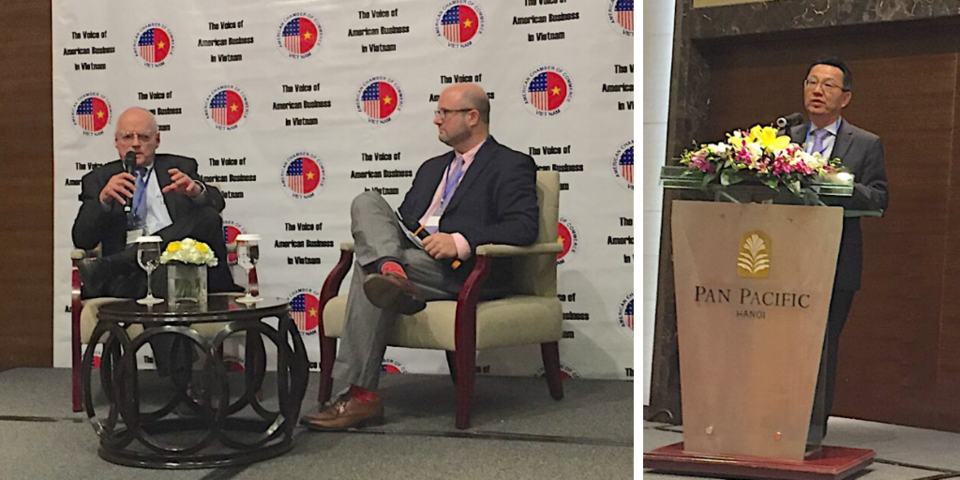
In the afternoon we were joined by members of the American Chamber of Commerce in Hanoi at an AmCham-hosted Lunch ‘n’ Learn session on Vietnam's challenges and opportunities amid the U.S.-China rivalry. The event featured Emmerson in conversation with AmCham Hanoi Executive Director Adam Sitkoff.

Image
Two men in conversation seated on stage and a man speaking at a podium

(Left) Donald Emmerson in conversation with Adam Sitkoff; (right) Gi-Wook Shin welcomes AmCham Hanoi members; December 10, 2019. 

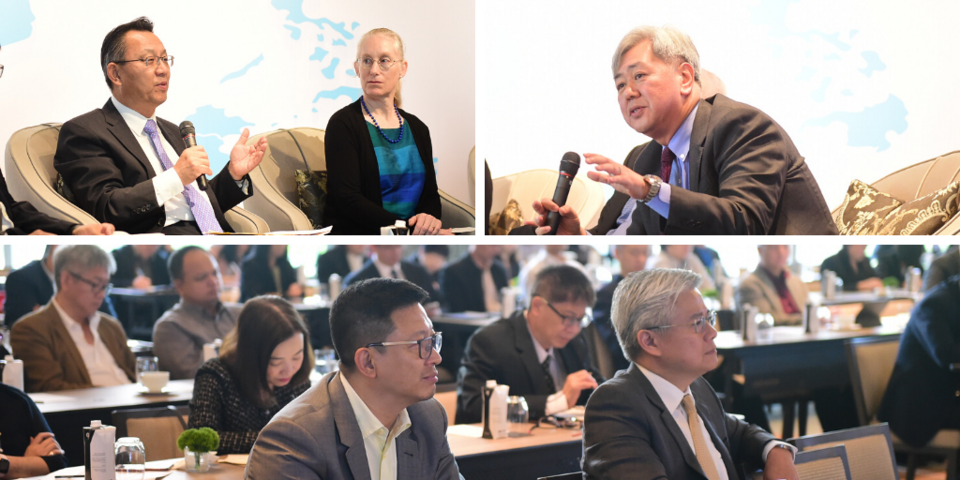
Moving to Bangkok, delegation members Shin, Eggleston, Emmerson, and Kim spoke on a panel for executives of the Charoen Pokphand Group (C.P. Group), one of Thailand’s largest private conglomerates, addressing some of the core issues that lie ahead for Southeast Asia in 2020 and beyond in the areas of geopolitics, innovation, and health.

Image
Participants at a panel discussion with APARC delegation hosted by the C.P. Group, Thailand

Top, from left to right: Gi-Wook Shin, Karen Eggleston, Andrew Kim; bottom: C.P. Group executive listening to the panel, December 12, 2019.

We also enjoyed a tour at True Digital Park, Thailand’s first startup and tech entrepreneur’s campus. Developed by the C.P. Group, True Digital Park aspires to be an open startup ecosystem that powers Thailand to become a global hub for digital innovation.

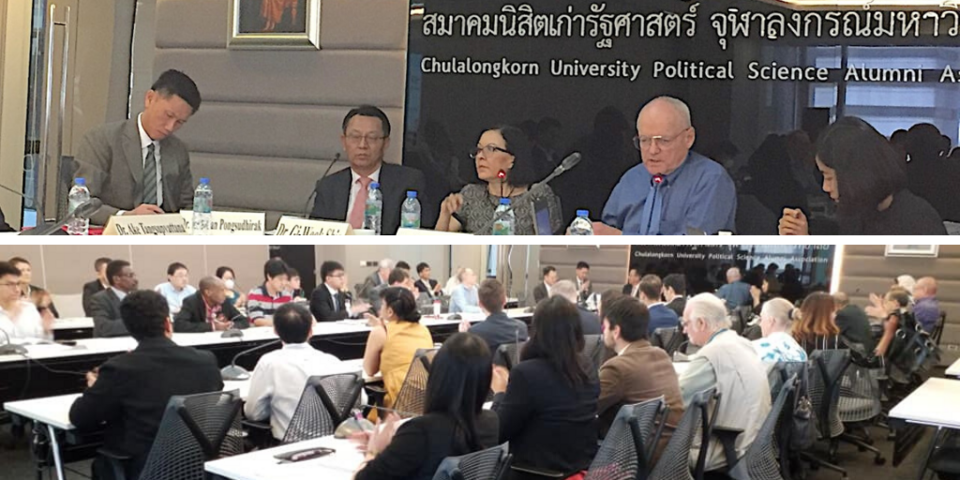
The following day, Shin and Emmerson participated in a public forum hosted by Chulalongkorn University’s Institute of Security and International Studies (ISIS Thailand), "Where Northeast Asia Meets Southeast Asia: The Great Powers, Global Disorder and Asia’s Future.” They were joined by ISIS Thailand Director Thitinan Pongsudhirak and Chulalongkorn University Faculty of Political Science Associate Dean for International Affairs and Graduate Studies Kasira Cheeppensook. The panel was moderated by Ms. Gwen Robinson, ISIS Thailand senior fellow and editor-at-large of the Nikkei Asian Review.

Image
Panelists and participants at a public forum held at Chulalongkorn University

ISIS Thailand forum participants and panelists, from left: Pngsukdhirak, Shin, Robinson, Emmerson, Cheeppensook; December 13, 2019.

As part of that discussion, Emmerson speculated that – driven by deepening Chinese economic and migrational involvement in Southeast Asia’s northern tier – Cambodia and Laos, less conceivably Myanmar, and still less conceivably Thailand could become incorporated de facto into an economically integrated “greater China” that could eventually reduce ASEAN to a more-or-less maritime membership in the region’s southern tier. Emmerson’s speculation was made in the context of his critique of ASEAN’s emphasis on its own “centrality” to the neglect of its lack of the proactivity that would serve as evidence of centrality and of a desire not to be rendered peripheral by the growing centrality-cum-proactivity of China. The event was covered by the Bangkok Post (although that report’s headline and quote of Emmerson are inaccurate, as neither the panel nor Emmerson predicted the “break-up of ASEAN.”)

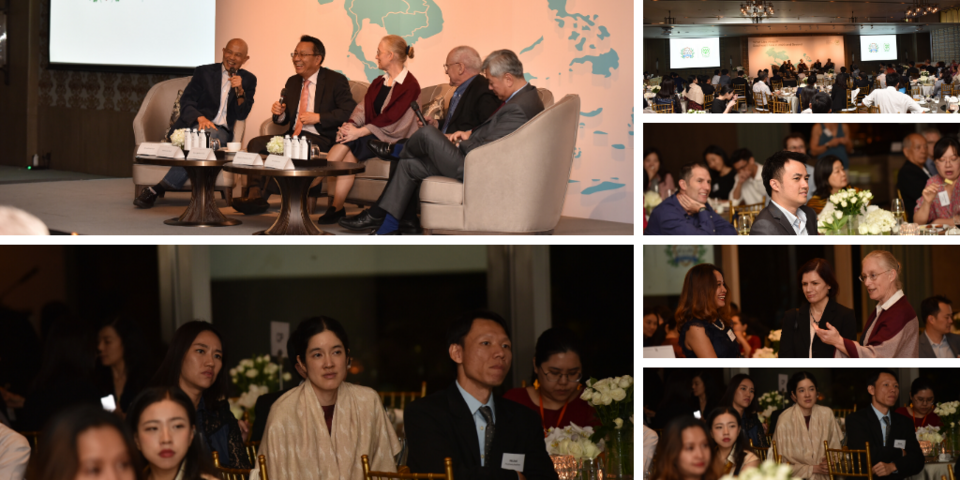
Our delegation visit in Bangkok concluded with a buffet dinner reception and panel discussion jointly with the Stanford Club of Thailand.

Image
alumni event

Stanford and IvyPlus alumni listening to the panel, December 13, 2019.

Moderated by Mr. Suthichai Yoon, a veteran journalist and founder of digital media outlet Kafedam Group, the conversation focused on the changing geopolitics of Southeast Asia, innovation and health in the region, and the opportunities and challenges facing Thailand-U.S. relations. It was a pleasure to meet many new and old friends from the Stanford and IvyPlus alumni communities.

APARC would like to thank our partners and hosts in Hanoi and Bangkok for their hospitality, collaboration, and the stimulating discussions throughout our visit. We look forward to keeping in touch!

Hero Image
APARC delegation speaking to Stanford and IvyPlus alumni, Bangkok
All News button
1
-

Image
Portrait of M Taylor Fravel
Since 1949, China has adopted nine national military strategies, known as “strategic guidelines.” The strategies adopted in 1956, 1980, and 1993 represent major changes in China's military strategy or efforts by the People's Liberation Army to wage war in a new way. This talk examines why major changes in strategy have been pursued at these periods and not at other times, highlighting the role of shifts in the conduct of warfare in the international system and unity among the top leaders of the Chinese Communist Party.

M. Taylor Fravel is the Arthur and Ruth Sloan Professor of Political Science and Director of the Security Studies Program at the Massachusetts Institute of Technology.  Taylor studies international relations, with a focus on international security, China, and East Asia.  His books include Strong Borders, Secure Nation: Cooperation and Conflict in China's Territorial Disputes (Princeton University Press, 2008) and Active Defense: China's Military Strategy Since 1949 (Princeton University Press, 2019).  His other publications have appeared in International SecurityForeign AffairsSecurity StudiesInternational Studies ReviewThe China QuarterlyThe Washington QuarterlyJournal of Strategic StudiesArmed Forces & SocietyCurrent HistoryAsian SurveyAsian SecurityChina Leadership Monitor, and Contemporary Southeast Asia. Taylor is a graduate of Middlebury College and Stanford University, where he received his PhD.  He also has graduate degrees from the London School of Economics and Oxford University, where he was a Rhodes Scholar.  In 2016, he was named an Andrew Carnegie Fellow by the Carnegie Corporation.  Taylor serves on the board of directors of the National Committee on U.S.-China Relations and as the Principal Investigator for the Maritime Awareness Project.


Image
Image of red flag over the Shanghai Bund

This event is part of the 2020 Winter/Spring Colloquia series, The PRC at 70: The Past, Present – and Future?, sponsored by APARC's China Program.
 

M. Taylor Fravel Arthur and Ruth Sloan Professor of Political Science, MIT
Seminars
Subscribe to Military