Forty years after the establishment of diplomatic relations between the United States and China, the two superpowers are competing and contesting every arena, from trade to AI research and from space exploration to maritime rights. Instead of what Americans referred to as engagement and Chinese called reform and opening, many experts and analysts now characterize the relations between the two countries as dangerously brittle. Some see a new kind of Cold War in the making. Such assertions, however, argues Shorenstein APARC Fellow Thomas Fingar, “both ignore history and impute a level of fragility that has not existed for many years.”
Fingar reflects on the U.S.-China bilateral relationship in a new article, “Forty years of formal—but not yet normal—relations,” published in the China International Strategy Review. He claims that the relationship is resilient and not destined for conflict, albeit it is beset by a host of aspirational, perceptual, and structural differences.
A political scientist and China specialist who served over two decades in senior government positions, Fingar urges readers to remember that assertions of fragility of the U.S.-China relationship undervalue the strength, scope, and significance of interdependence, shared interests, and constituencies in both countries. These, he says, have a substantial stake in the maintenance of at least minimally cooperative relations.
U.S.-China relations are indeed highly asymmetrical: Chinese citizens and organizations have far greater access to the United States than Americans do to China, notes Fingar. He also recognizes that the troubles that have soured the relationship are more intricate and often more sensitive than those of the past. Decades ago, most of the issues that arose were handled at the governmental level. But now “the number and variety of players with stakes in the relationship and disputes with counterpart actors are much greater.” Furthermore, explains Fingar, the U.S. business community is expressing a stronger voice for government action to change Chinese behavior and is not as consistent an advocate of stability in U.S. policy toward China as it used to be. “This is an extremely important development,” he says, “because it reverses a key dynamic in the U.S.-China relationship.”
Ultimately, however, the two countries and our institutions and people are linked by myriad ties that bring mutual benefits as well as the constraints of interdependence. “I remain confident that we will continue to be able to manage the relationship,” concludes Fingar. He expresses disappointment, though, that normalization of U.S.-China relations remains a work in progress and cautions that merely managing the relationship to prevent it from deteriorating is an unsatisfactory goal that should be unacceptable to both sides. Not only does such a low bar limit what each counterpart can achieve, but it also inhibits the kind of cooperation required to address transnational challenges like climate change, infectious disease, and proliferation of dangerous technologies.
A display for facial recognition and artificial intelligence is seen on monitors at Huawei's Bantian campus in Shenzhen, China. The U.S. government battle with the Chinese telecom giant represents multiple concerns about China's technological prowess. | Kevin Frayer/ Getty Images
On March 31, Taiwan’s Ministry of Foreign Affairs reported that two Chinese Air Force (PLAAF) J-11 jets crossed the median line of the Taiwan Strait. This violated the long-held tacit agreement between China and Taiwan that neither side should cross the median line.
Taiwan deemed this “an intentional, reckless & provocative action,” which triggered “a 10-minute standoff” in the air. As Asia security expert Bonnie S. Glaser notes that, if intentional, this would be the first PLAAF crossing of the median line in about 20 years. In this case, it’s likely that Taiwan, not the South China Sea, prompted Beijing’s actions.
An unresolved issue from the Chinese civil war, Taiwan has always been a “core interest” to party leaders in Beijing. Here are some key takeaways from my research on China-Taiwan relations…
To hear more from Ketian, don't miss her recently posted video Q&A. In addition, be sure to RSVP for her April 16 seminar "Killing the Chicken to Scare the Monkey: Explaining Coercion by China in the South China Sea."
Hero Image
ZHANJIANG, CHINA - JANUARY 03: The marines of China navy participate in the annual military training on January 3, 2018 in Zhanjiang, Guangdong Province of China. | Pu Haiyang/VCG via Getty Images
On the heels of the abrupt ending of the Hanoi summit between President Trump and North Korean leader Kim Jong Un, with the future of the diplomacy of denuclearization in question, the Korea Program at Shorenstein APARC convened the 11th Koret Workshop, appropriately titled this year “North Korea and the World in Flux.”
The workshop, an annual gathering made possible through generous funding from the Koret Foundation, brought together international experts in Korean affairs for a full day of panel discussions. Participants assessed the U.S.-DPRK summit diplomacy, examined the challenges and opportunities in media coverage related to the negotiations between the two countries, and considered the prospects and pitfalls for summitry with North Korea in the near term. A report on the workshop proceedings is forthcoming.
At a midday public keynote, General Vincent Brooks, U.S. Army (Ret.), spoke before a packed audience about the challenges and opportunities in Korea. Brooks, who recently retired from active duty as the four-star general in command of all U.S. Forces in Korea, provided his unique and very-timely assessment of the situation on the Korean peninsula, and offered his insights on where the diplomacy of denuclearization may go next.
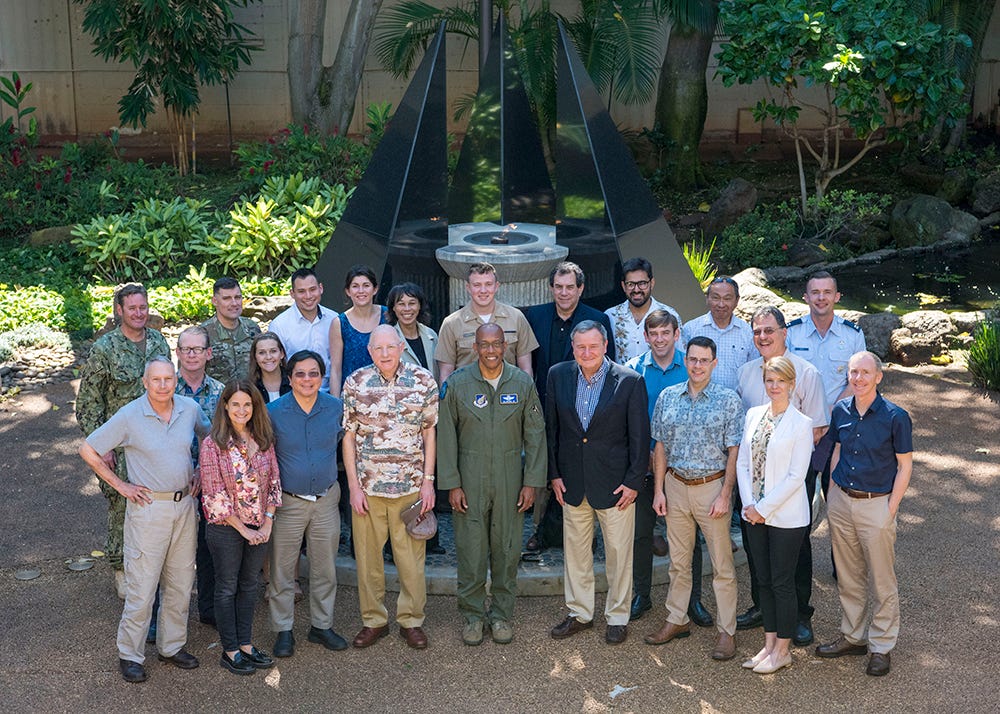
A group of 20 faculty and fellows participate in an orientation visit to Indo-Pacific Command headquarters, Honolulu, Hawaii, February 21–22, 2019, organized and sponsored by the U.S.-Asia Security Initiative. Photo courtesy of the U.S.-Asia Security Initiative
On February 21–22, faculty and fellows from Stanford University traveled to Oahu, Hawaii for an orientation visit at the United States Indo-Pacific Command (INDOPACOM), the U.S. military command responsible for the conduct of the U.S. military’s missions throughout the Indian and Pacific Oceans, and Asia.
The visit brought together scholars and researchers from Stanford, the Massachusetts Institute of Technology, the Council on Foreign Relations, and Macquarie University, Australia. Organized by the U.S.-Asia Security Initiative (USASI) and the Shorenstein Asia-Pacific Research Center at the Freeman Spogli Institute for International Studies (FSI), the visit included meetings with the commanders and staffs of INDOPACOM and five of its subordinate commands (U.S. Army Pacific, U.S. Pacific Fleet, U.S. Air Forces Pacific, U.S. Marine Forces Pacific, and U.S. Special Operations Command Pacific), and a tour of Arleigh Burke-class Aegis destroyer USS John Paul Jones (DDG-52).
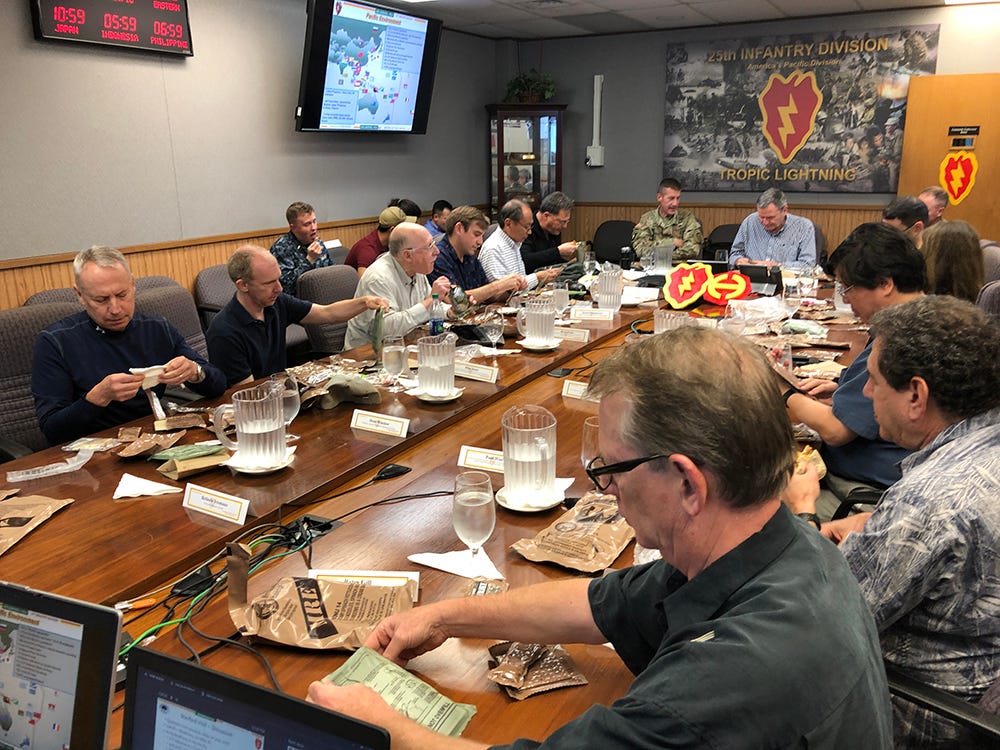
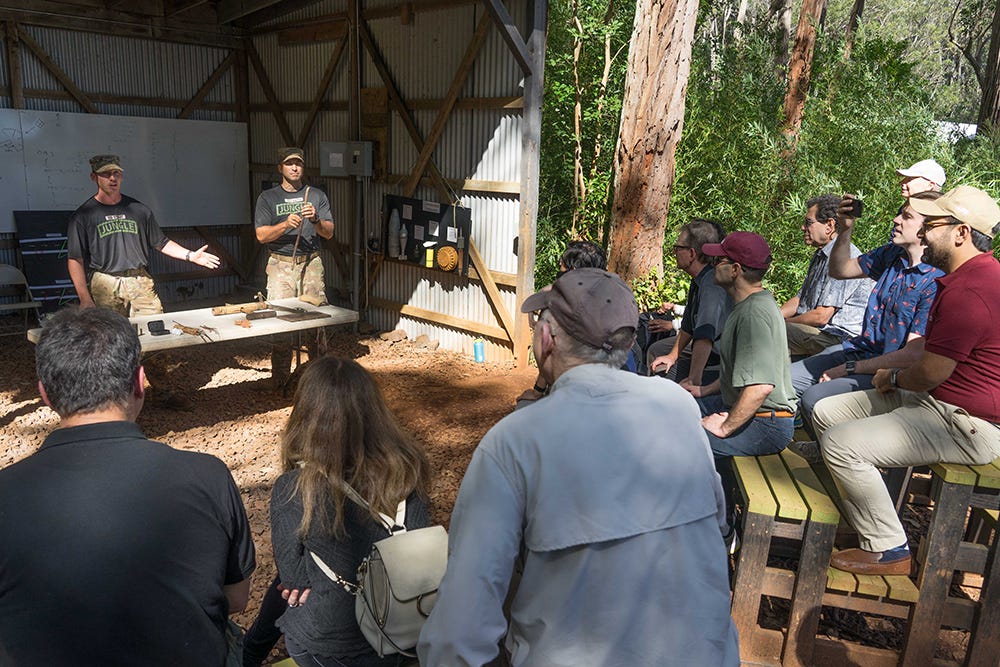
The visitors also interacted with the U.S. Army’s 25th Infantry Division’s leadership and the unit’s Jungle Training Center. The busy itinerary provided the group a superb opportunity to learn about INDOPACOM’s and its subordinate units’ threat assessments, capabilities, doctrine, regional partnerships, and readiness challenges.
These trips offer great access to America’s armed forces to those whose research focuses on or relates to national security issues, says Karl Eikenberry.
Karl Eikenberry, Director of the U.S.-Asia Security Initiative (USASI), a former U.S. ambassador to Afghanistan and himself a retired U.S. Army lieutenant general said: “USASI has over the past five years organized annual trips to U.S. military commands for Stanford FSI faculty and fellows. These trips offer great access to America’s armed forces to those whose research focuses on or relates to national security issues. The insights gained inform analysis, while the host organizations gain fresh perspectives different from those found within their commands.”
Photo courtesy of the U.S.-Asia Security Initiative
Discussions began on February 21st at Camp H.M. Smith, the Headquarters of INDOPACOM. Brigadier General Jonathan Braga, U.S. Army, SOCPAC Commander and his staff discussed his command’s unique capabilities and roles in both conventional and counterterrorist/counterinsurgency warfare operations. Major General Michael Minihan, U.S. Air Force, INDOPACOM Chief of Staff, then hosted a wide-ranging session on his organization’s implementation of the National Security Strategy and National Defense Strategy at a time of dynamic change within the region.
Photo courtesy of Timothy R. Mungie
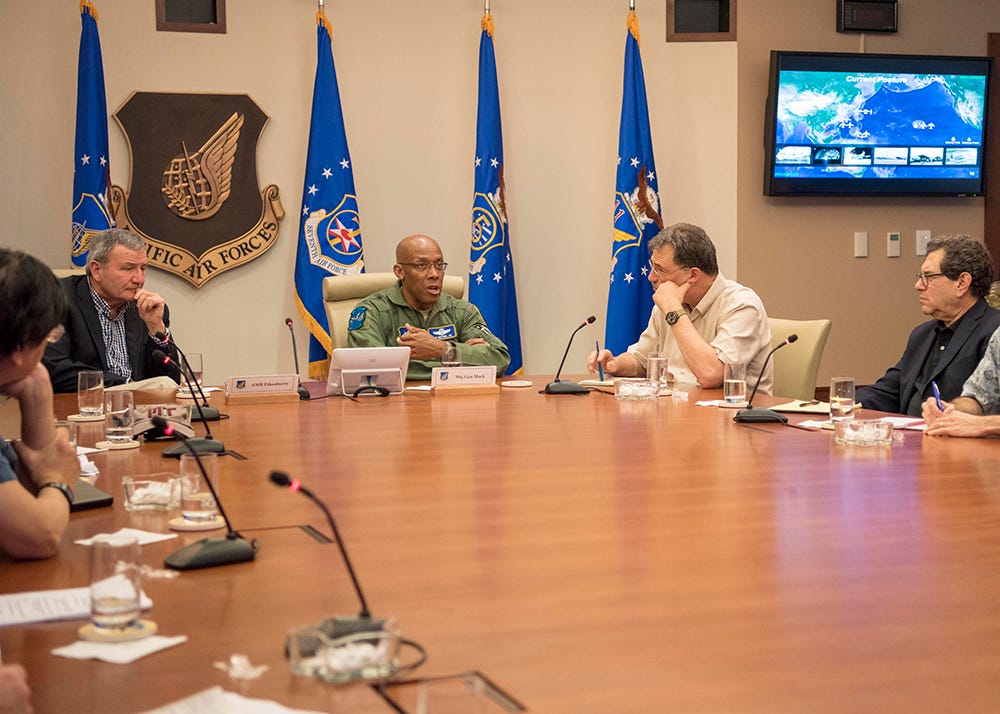
This was followed by a working lunch at the INDOPACOM Flag Mess with key staff members of MARFORPAC who explained U.S. Marine force posture and contingency missions throughout the Pacific Region. The Stanford group then proceeded to Hickam Field and met with General Charles Brown, Commander, PACAF, and his Deputy Commander, Major General Russell Mack. General Brown detailed the critical role played by airlift and airpower in the vast Indo-Pacific region, and the development of new concepts for the employment of U.S. Air Force capabilities in joint (inter-service) and combined (inter-allied) operations.
Photo courtesy of Timothy R. Mungie
The visiting faculty and fellows then transited to Pearl Harbor for a tour of USS John Paul Jones led by Commanding Officer, Commander Jesse Mink, United States Navy, and Executive Officer, Commander Robert Watts, USN. Noteworthy was the destroyer’s sophisticated integrated air, surface, and underseas warfare systems, and the emphasis placed on resilience in high-end combat situations. Following the ship tour, the group attended a PACFLT command briefing chaired by the Commander, Admiral John Aquilino.
The dialogue made clear PACFLT’s emphasis on a holistic approach to deterrence and decisive operations, with an eye on future requirements. The first day of the trip ended with a working reception at the historic “Nimitz House” hosted by Admiral Aquilino, offering the attendees a chance to engage in conversations with the Commander and his staff.
The second day of the trip began with an introduction to the Daniel K. Inouye Asia-Pacific Center for Security Studies (APCSS), followed by expert presentations and breakout sessions on select topics including the Chinese One Belt One Road plan, the security of Taiwan, pandemic threats in the Indo-Pacific region, and cyber operations. The Stanford team then traveled to Fort Shafter for a meeting with Brigadier General Pete Andrysiak, U.S. Army and Chief of Staff, USARPAC. BG Andrysiak and the USARPAC staff elaborated on the evolving U.S. Army’s regional doctrine and extensive partnership activities.
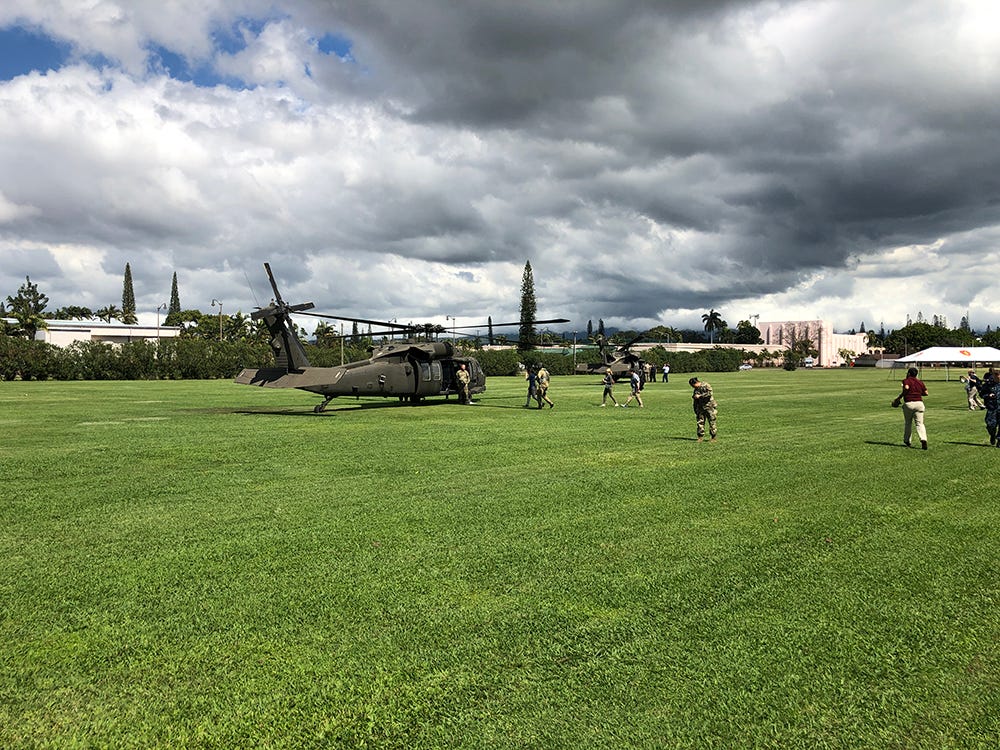
A highlight of the group’s time in Oahu came with a visit to the U.S. Army’s 25th Infantry Division at Schofield Barracks, and the 25th ID Jungle Training center via UH-60 Blackhawk Helicopters. There Brigadier General J.B. Vowell, Assistant Division Commander, 25th Infantry Division and U.S. Army Hawaii (himself a former FSI Senior Military Fellow), discussed the division’s extensive missions throughout the region, including in the Korean Peninsula.
Photo courtesy of Francis Fukuyama
Faculty and fellows were also able to “get their boots (or at least tennis shoes) muddy” in the U.S. Army’s rugged training area in northern Oahu, with highly skilled soldiers demonstrating jungle warfare tactics and techniques. The trip ended with the participants hosting a reception at the Hale Koa Hotel Warriors Lounge for their many hosts over the past two days.
The trip to INDOPACOM Headquarters provided a rare opportunity for participants to talk directly with senior U.S. military leaders in the most important region of the world and to gain a better understanding of their perspectives and the many challenges that they are addressing. Faculty and fellows interacted with junior leaders at the tactical level, helping them gain an appreciation of the ethos of those serving at the cutting edge. The hosts all commented on the benefit of learning the views of scholars, many of whom have spent their academic careers writing about national security issues.
The trip provided fascinating insights into how the U.S. military views the rapidly evolving national security challenges in the Indo-Pacific region, says Larry Diamond.
“The trip provided fascinating insights into how the U.S. military views the rapidly evolving national security challenges in the Indo-Pacific region, and how it is organized to defend against the threats. You can read about much of this in the media and the journals, but there is just no substitute for being there, seeing our facilities on the ground, and engaging directly with the remarkable men and women (and one thing that struck me is that there are quite a number of women) who are responsible for our defense,” said Larry Diamond, senior fellow at the Hoover Institution and at the Center on Democracy, Development & the Rule of Law (CDDRL) at FSI.
FSI scholars particularly valued the opportunity to connect one-on-one.
“It was invaluable to meet and hear directly from the individuals and organizations who are working so hard to ensure our security,” said Center for International Security and Cooperation (CISAC) Senior Research Scholar Megan Palmer. For CISAC Pre-doctoral Fellow Erik Lin-Greenberg, “the opportunity to interact with decision-makers from tactical to strategic levels was incredibly valuable and helped inform my own research.”
Shorenstein APARC's annual overview for academic year 2017-18 is now available.
Download it for information on the wide variety of Center research from the the past academic year, Shorenstein APARC's educational activities, and major Center events like the Shorenstein Journalism Award.
Col. Masahiro Shizu is a global affiliate visiting scholar at the Walter H. Shorenstein Asia-Pacific Research Center (Shorenstein APARC) for 2018-19. Shizu has almost 20 years of experience at the Japanese Ministry of Defense and the Ministry of Foreign Affairs. In his experience, he has been a member of the Joint Staff Office and the Air Staff Office as well as commanded units of the Japan Air Self Defense Force. Most recently, Shizu was part of the Defense Planning and Policy Department where he was responsible for acquisition of defense equipment and creating future military strategy, operational plans and capabilities.
From 31 January through 1 February 2018, Stanford University’s U.S.-Asia Security Initiative (USASI) and the Sasakawa Peace Foundation (SPF), gathered in Tokyo representatives from the government, defense, and academic sectors of the United States and Japan for the second workshop of the U.S.-Japan Security and Defense Dialogue Series. The purpose of the workshop was to facilitate frank discussions between academic scholars, subject matter experts, government officials, and military leaders on the current strategic and operational security challenges to the U.S.-Japan security alliance. The goal of the dialogue was to establish a common understanding of the problems facing the U.S.-Japan security alliance and to develop actionable policy recommendations aimed at addressing these issues.
This conference report provides an executive summary, policy recommendations, and a summary of the workshop sessions and findings. More information about USASI is available here.
On May 23, Stanford students enrolled in Technology and Security (MS&E 193/293) met with General James M. Holmes. General Holmes delivered delivered gave a talk, "Applying Technology--the Military Perspective," and engaged students in a Q&A session afterwards. The interisciplinary course explores the relation between technology, war, and national security policy from early history to modern day, focusing on current U.S. national security challenges and the role that technology plays in shaping our understanding and response to these challenges.
General James M. Holmes
[[{"fid":"231402","view_mode":"crop_870xauto","fields":{"format":"crop_870xauto","field_file_image_description[und][0][value]":"General James M. Holmes","field_file_image_alt_text[und][0][value]":"General James M. Holmes","field_file_image_title_text[und][0][value]":"General James M. Holmes","field_credit[und][0][value]":"Margaret Williams","field_caption[und][0][value]":"","thumbnails":"crop_870xauto"},"link_text":null,"type":"media","field_deltas":{"2":{"format":"crop_870xauto","field_file_image_description[und][0][value]":"General James M. Holmes","field_file_image_alt_text[und][0][value]":"General James M. Holmes","field_file_image_title_text[und][0][value]":"General James M. Holmes","field_credit[und][0][value]":"Margaret Williams","field_caption[und][0][value]":"","thumbnails":"crop_870xauto"}},"attributes":{"alt":"General James M. Holmes","title":"General James M. Holmes","class":"media-element file-crop-870xauto","data-delta":"2"}}]]
[[{"fid":"231403","view_mode":"crop_870xauto","fields":{"format":"crop_870xauto","field_file_image_description[und][0][value]":"General James M. Holmes","field_file_image_alt_text[und][0][value]":"General James M. Holmes","field_file_image_title_text[und][0][value]":"General James M. Holmes","field_credit[und][0][value]":"Margaret Williams","field_caption[und][0][value]":"","thumbnails":"crop_870xauto"},"link_text":null,"type":"media","field_deltas":{"3":{"format":"crop_870xauto","field_file_image_description[und][0][value]":"General James M. Holmes","field_file_image_alt_text[und][0][value]":"General James M. Holmes","field_file_image_title_text[und][0][value]":"General James M. Holmes","field_credit[und][0][value]":"Margaret Williams","field_caption[und][0][value]":"","thumbnails":"crop_870xauto"}},"attributes":{"alt":"General James M. Holmes","title":"General James M. Holmes","class":"media-element file-crop-870xauto","data-delta":"3"}}]]
Lee Jong-Seok served as vice-secretary of South Korea’s National Security Council and as its unification minister under the Roh Moo-Hyun administration (2003–08). After Roh’s tragic death in 2009, Lee resolved to present a record of the so-called participatory government’s achievements and failures in the realm of unification, foreign affairs, and national security.
Peace on a Knife’s Edge is the translation of Lee’s 2014 account of Roh’s efforts to bring peace to the Korean Peninsula in the face of opposition at home from conservative forces and abroad from the Bush administration’s hard stances of “tailored containment” and its declaration of the North as part of the “axis of evil.” Lee’s narrative will give American readers rare insights into critical moments of Roh’s incumbency, including the tumultuous Six-Party Talks; the delicate process of negotiating the relocation and reduction of United States Forces Korea; Roh’s pursuit of South Korea’s “autonomous defense”; conflicts with Japan over history issues; and the North’s first nuclear weapons test.
NBC Bay Area spoke with Shorenstein APARC director Gi-Wook Shin following a press conference held by DPRK foreign minister Ri Yong-Ho on September 25, in which Ri asserted that recent comments by President Donald Trump amounted to a "declaration of war."
The verbal barrage between North Korea and the United States has sharply escalated, with increased U.S. bomber flights near and around North Korea being met by North Korean threats to shoot down such flights, even those outside its borders.
While Shin still holds that the war of words will not turn into war, he is concerned that the escalation of rhetoric is dangerous.
"The South Korean people are really worried about the possibility of a military conflict," noted Shin. He further advised the president to deescalate personal attacks on Kim Jong-un, pointing out that Kim's "god-like" status in North Korea was effectively forcing the DPRK leader to respond to White House threats.
Hero Image
North Korea's foreign minister Ri Yong-Ho departs after speaking to reporters at the UN Millenium Plaza hotel on September 25, 2017 in New York City. | Amir Levy/Getty Images



 General James M. Holmes


