Security

FSI scholars produce research aimed at creating a safer world and examing the consequences of security policies on institutions and society. They look at longstanding issues including nuclear nonproliferation and the conflicts between countries like North and South Korea. But their research also examines new and emerging areas that transcend traditional borders – the drug war in Mexico and expanding terrorism networks. FSI researchers look at the changing methods of warfare with a focus on biosecurity and nuclear risk. They tackle cybersecurity with an eye toward privacy concerns and explore the implications of new actors like hackers.

Along with the changing face of conflict, terrorism and crime, FSI researchers study food security. They tackle the global problems of hunger, poverty and environmental degradation by generating knowledge and policy-relevant solutions. 

-

On 11/29/18 a group of leading experts on China and American foreign policy released “Chinese Influence and American Interests: Promoting Constructive Vigilance,” a report documenting Chinese efforts to influence American society. The report examines China's efforts to influence American institutions, including state and local governments, universities, think tanks, media, corporations, and the Chinese-American community, and differentiates between legitimate efforts--like public diplomacy--and improper interference, which demands greater awareness and a calibrated response.

In this special roundtable, two of the report’s co-editors, Orville Schell and Larry Diamond, and a Taiwanese scholar, Ji-Jen Hwang, will discuss the findings of the report and compare the forms and effects of Chinese “sharp power” in the United States with its practice in and toward Taiwan.

This event is co-sponsored by the US-Asia Security Initiative in the Asia-Pacific Research Center, and the Center on Democracy, Development, and the Rule of Law.  

Orville Schell

Orville Schell is the Arthur Ross Director of the Center on U.S.-China Relations at Asia Society in New York. He is a former professor and Dean at the University of California, Berkeley’s Graduate School of Journalism. Schell was born in New York City, graduated Magna Cum Laude from Harvard University in Far Eastern History, was an exchange student at National Taiwan University in the 1960s, and earned a Ph.D. (Abd) at University of California, Berkeley in Chinese History. He worked for the Ford Foundation in Indonesia, covered the war in Indochina as a journalist, and has traveled widely in China since the mid-70s.

Schell is the author of fifteen books, ten of them about China, and a contributor to numerous edited volumes. His most recent books are: Wealth and Power, China’s long March to the 21st Century; Virtual Tibet; The China Reader: The Reform Years; and Mandate of Heaven: The Legacy of Tiananmen Square and the Next Generation of China’s Leaders. He has written widely for many magazine and newspapers, including The Atlantic MonthlyThe New YorkerTime, The New RepublicHarpersThe NationThe New York Review of BooksWiredForeign Affairs, the China Quarterly, and the New York Times, the Washington Post and the Los Angeles Times.

He is a Fellow at the Weatherhead East Asian Institute at Columbia University, a Senior Fellow at the Annenberg School of Communications at USC and a member of the Council on Foreign Relations. Schell is also the recipient of many prizes and fellowships, including a Guggenheim Fellowship, the Overseas Press Club Award, and the Harvard-Stanford Shorenstein Prize in Asian Journalism.

Larry Diamond

Larry Diamond is a senior fellow at the Hoover Institution and at the Freeman Spogli Institute for International Studies. For more than six years, he directed FSI’s Center on Democracy, Development, and the Rule of Law, where he now leads its Program on Arab Reform and Democracy and its Global Digital Policy Incubator. He is the founding co-editor of the Journal of Democracy and also serves as Senior Consultant at the International Forum for Democratic Studies of the National Endowment for Democracy. His research focuses on democratic trends and conditions around in the world, and on policies and reforms to defend and advance democracy.  His 2016 book, In Search of Democracy, explores the challenges confronting democracy and democracy promotion, gathering together three decades of his writing and research, particularly on Africa and Asia.  He has just completed a new book on the global crisis of democracy, which will be published in 2019, and is now writing a textbook on democratic development.

Karl Eikenberry

is Director of the U.S.-Asia Security Initiative and faculty member at the Shorenstein Asia-Pacific Research Center, faculty member of the Center for International Security and Cooperation, and Professor of Practice at Stanford University. He is also an affiliate with the FSI Center for Democracy, Development, and Rule of Law, and The Europe Center.

Prior to his arrival at Stanford, he served as the U.S. Ambassador to Afghanistan from 2009 until 2011. Before appointment as Chief of Mission on Kabul, Ambassador Eikenberry had a thirty-five year career in the United States Army, retiring in April 2009 with the rank of Lieutenant General. His military operational posts included commander and staff officer with mechanized, light, airborne, and ranger infantry units in the continental U.S., Hawaii, Korea, Italy, and Afghanistan as the Commander of the American-led Coalition forces. He held various policy and political-military positions, including Deputy Chairman of the North Atlantic Treaty Organization (NATO) Military Committee in Brussels, Belgium; Director for Strategic Planning and Policy for U.S. Pacific Command at Camp Smith, Hawaii; U.S. Security Coordinator and Chief of the Office of Military Cooperation in Kabul, Afghanistan; Assistant Army and later Defense Attaché at the United States Embassy in Beijing, China; Senior Country Director for China, Taiwan, Hong Kong and Mongolia in the Office of the Secretary of Defense; and Deputy Director for Strategy, Plans, and Policy on the Army Staff.

Ji-Jen Hwang

Dr. Ji-Jen Hwang is a Research Scholar in the Institute for East Asian Studies (IEAS) at UC Berkeley. Before that, he was a Professor & Program Director of the International Master Program in Strategic Studies at the National Defense University in the Republic of China (Taiwan). In 2014-15, Dr. Hwang was a visiting fellow with the Freeman Chair in China Studies at the Center for Strategic & International Studies (CSIS) located in Washington D.C. He also completed an internship at the United States Library of Congress while doing his Master’s coursework. A native of Taiwan, he holds a Ph.D. in politics from the University of Newcastle upon Tyne in the U.K., as well as a Masters in Library Science & Information Studies from the University of North Carolina. He has been working for a non-profit Think Tank based in Washington D.C. area as a Deputy Managing Director since April 2018. His current research is focused on relations between the United States, China, and Taiwan, in which he particularly aims to study how social media and the features in cyberspace have political impacts on these relations. He is well-known known as an expert in this area and been invited as a special lecturer to think tanks such as CSIS in Washington D.C., ASPI in Canberra, NATO, GlobalSec in Europe, and INSS in Seoul.


Philippines Conference Room
Encina Hall, 3rd Floor
616 Serra Mall, Stanford, CA 94305

Orville Schell
Larry Diamond
Ji-Jen Hwang
Karl Eikenberry
Panel Discussions
Authors
News Type
News
Date
Paragraphs

“I learned long ago to never predict anything about North Korea.”

So began the keynote address by Anna Fifield, veteran journalist and winner of the 2018 Shorenstein Journalism Award. Speaking at the Award’s seventeenth annual panel discussion “How North Korea Is, and Isn’t, Changing under Kim Jong Un,” Fifield, the Beijing bureau chief for The Washington Post , shared some of the many observations she has made since she first began covering North Korea in 2004.

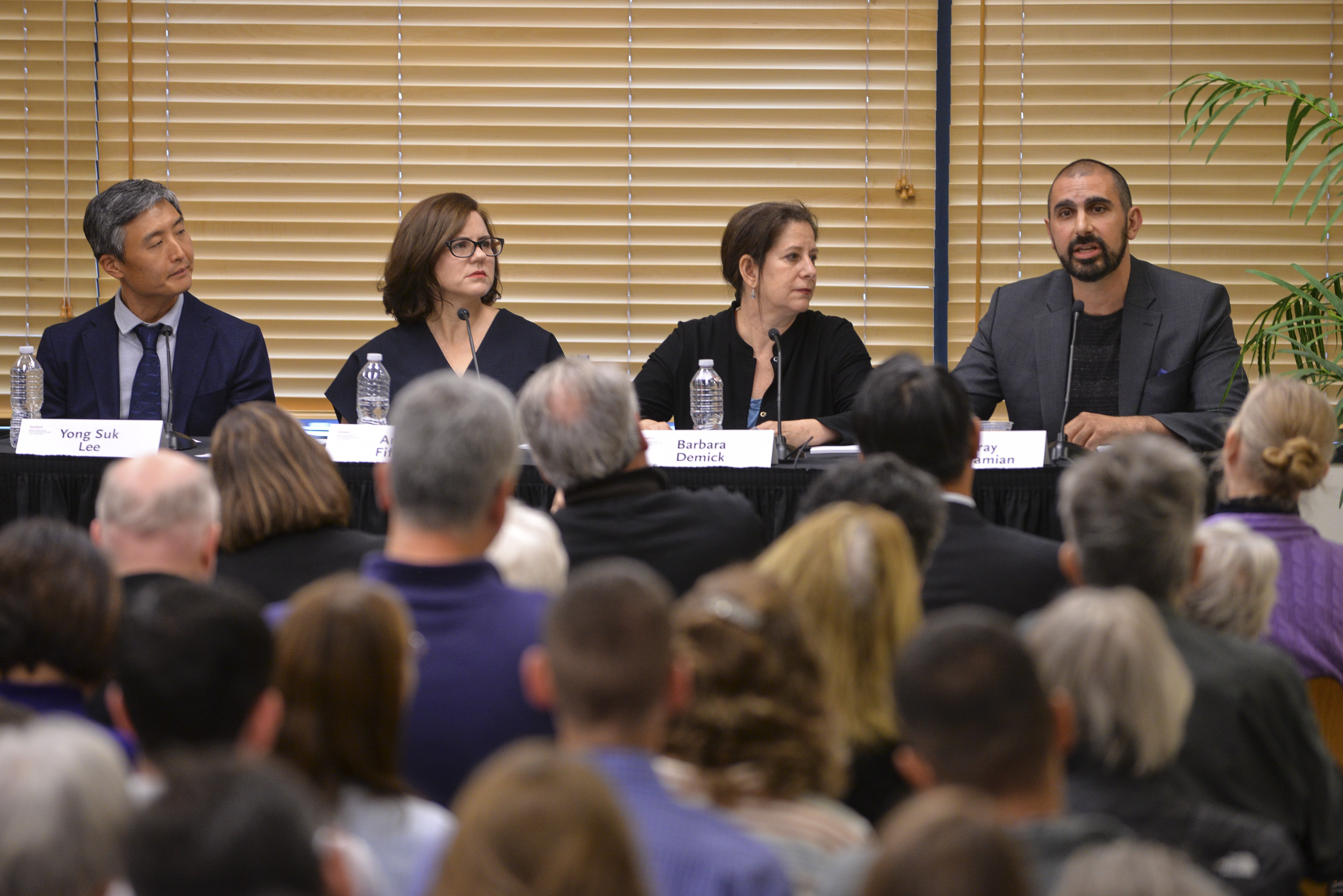
Two other North Korea experts joined Fifield at the panel: Barbara Demick, New York correspondent of the Los Angeles Times, formerly head of the bureaus in Beijing and Seoul, and the 2012 Shorenstein award winner; and Andray Abrahamian, the 2018-2019 Koret Fellow, whose previous role as executive director of Choson Exchange and other projects took him to the DPRK nearly 30 times. Yong Suk Lee, deputy director of the Korea Program at Shorenstein APARC, chaired the panel.

The presence of another person—the Dear Respected Comrade himself—was also very much felt in the room, if only in spirit.

Barbara Demick (center) speaks at 2018 Shorenstein Journalism Award.

Survival at any cost

At various points throughout its 70-year history, experts have predicted the demise of the "Hermit Kingdom." Fifield herself admitted to occasionally thinking along such terms.

And yet the country continues to prove them wrong.

“[D]uring my first stint covering North Korea, [I] just couldn’t envisage any way that this regime could survive the death of the second-generation leader and the transition to a third generation,” she said. “Kim Il Sung had created a myth of revolutionary heroism around himself, and a myth of divine selection around his son, Kim Jong Il. How could the North Korean people, who no longer live in a Hermit Kingdom, tolerate a third leader called Kim, let alone one who had no highly exaggerated or plain fictional back story?”

“Yet," Fifield continued, "here we are. Next month, Kim Jong Un will celebrate seven years in charge of North Korea.”

One prominent reason for the nation's recent survival, and an idea put forward by Fifield and supported by her co-panelists, was the development of markets in the communist state.

For decades, North Korea operated under the centrally-planned communist model. Even as China pursued reform and as the Soviet Union collapsed, the North Korean state maintained its central position in the economy.

However, following the famines of the 1990s, the state had no choice but to allow market activity to develop. Under the third Kim markets have continued to grow.

“There are now more than 400 established, state-sanctioned markets in North Korea,” said Fifield. “That’s more than double the number that existed when Kim Jong Un took over at the end of 2011.”

A side effect of this nascent market economy has been the emergence of new elites in the purported “classless” society. Fifield described the development of a capital within the capital—“Pyonghattan”—where newfound elites purchase clothes from western retailers and undergo plastic surgery for their eyelids.

Abrahamian concurred, noting that Kim Jong Un made sure to coddle this upper middle and upper class in Pyongyang. "The old way of doing that under Kim Jong Il and his father, Kim Il Sung, was very much through a loyalty and gift economy," Abrahamian said. "Money was not necessary in the old North Korea. Now it is. You do need it to get your daily necessities, and if you’re lucky enough, the products [from the “outside world”] help you to have a more pleasurable life through the market.”

At the other end of the spectrum, North Koreans turn to the markets not out of entrepreneurial zeal, but out of a need to survive. As an example, Fifield described meeting a mother and daughter living near the border with China. The mother took her daughter out of school in order to raise pigs and make tofu. Before dawn, they trekked into the mountains to tend crops of corn. It was a back-breaking existence. "If they were lucky, they made enough money each day to buy food for themselves," Fifield said. "Many days, they did all this to break even."

Andray Abrahamian responds to a question from the audience.

A smart tyrant not to be underestimated

The panel continued to focus on the man currently at the helm in North Korea.

“When I returned for my second go at covering the Koreas, I wanted to figure out how he’d done it," said Fifield. "How had this podgy young upstart with no qualifications other than being born into this family managed to take control of this regime…? How had he managed to keep intact this anachronistic system that should have died years, even decades, before?”

Fifield emphasized that her comments did not equate to admiration for Kim Jong Un. “He’s a tyrant,” she reminded the room. “But he’s a smart tyrant who’s been operating in a calculating way. To treat him as a joke or a madman is to underestimate the threat of him.”

“Kim Jong Un has not allowed these markets to flourish because he cares about the people and their wellbeing,” Fifield continued. “He has demonstrated time and time again that he doesn’t care at all about the people.”

“There’s only one thing he cares about and that is staying in power.” 

Demick cautioned further against over-estimating the positive impact of market development on life in North Korea. “The people Anna interviewed for her groundbreaking series in 2017 in The Washington Post were disgusted with the system,” said Demick. “With the income inequality, with the corruption, with the controls.”

“For them, what’s the worst thing about North Korea? Simply being born there.”

The panelists participated in a lively audience Q & A.

A celebration of journalism

The Shorenstein Journalism Award, which carries a cash prize of $10,000, recognizes accomplished journalists committed to critical reporting on and exploring the complexities of Asia through their writing. It alternates between honoring recipients from the West, who mainly address American audiences, and recipients from Asia, who pave the way for freedom of the press in their countries. Established in 2002, the award honors the legacy of APARC benefactor Mr. Walter H. Shorenstein. A visionary businessman, philanthropist, and champion of Asian-American relations, Shorenstein was dedicated to promoting excellence in journalism and a deeper understanding of Asia.

While the reporting of each year's recipient focuses on different regions and areas of interest, the award consistently recognizes quality journalism. In his welcome remarks, panel chair Yong Suk Lee stated, “In the face of current attacks on journalists and on the truth in the United States and the world, [Shorenstein APARC is] even more committed to excellence in journalism, and to defending independent and free media."

Fifield’s co-panelists spoke at length about how deserving she was of the award. Before their first meeting in Seoul, Abrahamian confessed to harboring skepticism about Fifield. “I had read some of her work before and knew she had analytical chops, but thought to myself that journalists are always fighting for the next scoop.” However, after talking to Fifield for only a few minutes, Abrahamian readily dropped his guard. “I told myself, 'This is a special journalist; she's got something.’"

A previous recipient of the Shorenstein Journalism Award herself, Demick was equally enthusiastic in her praise of Fifield. “For the last four years, [Anna] had owned the North Korea story like no other journalist I’ve met, including myself.”

Fifield was presented with the Shorenstein award and prize at a private evening ceremony.

Watch Fifield’s keynote speech below. An audio version is availalbe on our SoundCloud channel.

Hero Image
 Shorenstein Journalism Award winner Anna Fifield (right) speaks at award panel
Panel chair Yong Suk Lee (left) listens as 2018 Shorenstein Journalism Award winner Anna Fifield speaks to audience.
Rod Searcey
All News button
1
616 Serra StreetEncina Hall E301Stanford, CA 94305-6055
0
ketian_zhang.jpg Ph.D.

Ketian Vivian Zhang joined the Walter H. Shorenstein Asia-Pacific Research Center (APARC) as the 2018-2019 Shorenstein Postdoctoral Fellow in Contemporary Asia. Ketian studies coercion, economic sanctions, and maritime territorial disputes in international relations and social movements in comparative politics, with a regional focus on China and East Asia. She bridges the study of international relations and comparative politics and has a broader theoretical interest in linking international security and international political economy. Her book project examines when, why, and how China uses coercion when faced with issues of national security, such as territorial disputes in the South and East China Seas, foreign arms sales to Taiwan, and foreign leaders’ reception of the Dalai Lama. Ketian's research has been supported by organizations such as the Belfer Center for Science and International Affairs at the Harvard Kennedy School, Institute for Security and Conflict Studies at George Washington University, the Smith Richardson Foundation, and the Chiang Ching-kuo Foundation.

At Shorenstein APARC, Ketian worked on turning parts of her book project into academic journal papers while conducting fieldwork for her next major project: examining how target states of Chinese coercion respond to China's assertiveness, including the business community and ordinary citizens.

Ketian received her Ph.D. in Political Science at the Massachusetts Institute of Technology in 2018, where she is also an affiliate of the Security Studies Program. Before coming to Stanford, Ketian was a Predoctoral Research Fellow in the International Security Program at the Belfer Center for Science and International Affairs at the Harvard Kennedy School. Ketian holds a B.A. in Political Science and Sociology from the University of Wisconsin-Madison and was previously a research intern at the Institute for Policy Studies in Washington, D.C., where she was a contributor to its website Foreign Policy in Focus.

2018-2019 Shorenstein Postdoctoral Fellow in Contemporary Asia
News Type
News
Date
Paragraphs

On November 14, APARC honored the 2018 Shorenstein Journalism Award recipient, Washington Post Beijing bureau chief Anna Fifield. At a Stanford event, Fifield joined a panel discussing economic changes in North Korea, as well as the country’s position in global diplomacy under the leadership of Kim Jong Un.

A recap of the panel by The Stanford Daily is now available online.

Hero Image
Anna Fifield speaks at Shrenstein Journalism Awad Panel Rod Searcey
All News button
1
-

Four member states of the Association of Southeast Asian Nations (ASEAN) have made territorial claims in the South China Sea that conflict with China’s professed entitlement to all of the “islands and the adjacent waters.” Because the “ASEAN Way” is to make decisions by consensus, each member state can, in effect, veto what the group might otherwise decide. Prof. O’Neill will explore how China has used its financial power to divide ASEAN’s members in order to prevent them from acting collectively to resolve their territorial disputes with China in the South China Sea. He will compare China’s relations with Cambodia, the Philippines, and Myanmar in order to highlight the key role that a recipient country’s type of regime plays in enhancing or constraining Beijing’s ability to use aid, loans, and investments to influence the policies and politics of developing states. He will argue that authoritarian institutions facilitate Chinese influence while democratic institutions inhibit it.

Image
oneill dan 35 cropped
Daniel C. O’Neill’s current project is a co-authored volume on the politics of China’s Belt and Road Initiative in Southeast and South Asia. His new book, Dividing ASEAN and Conquering the South China Sea: China’s Financial Power Projection (2018), has been called “well-crafted and theoretically sound” by the highly regarded GWU Southeast Asianist Prof. Robert Sutter. O’Neill’s shorter writings have appeared in venues including Asian Survey, Contemporary Southeast Asia, the Journal of Eurasian Studies, and The Washington Post. Audiences have heard him lecture in, for example, the Philippines, China, and Kazakhstan. For three years running, the School of International Studies where he works named him “Outstanding Teacher of the Year.” His Ph.D. in political science is from Washington University in St. Louis.

Philippines Conference Room
Encina Hall, 3rd Floor
616 Serra Mall
Stanford, CA 94305

Daniel C. O’Neill Associate Professor of Political Science, School of International Studies, University of the Pacific
Seminars
-

Singapore’s government is widely seen as competent, honest, and meritocratic—an exceptional case of post-colonial governance.  Nor can any elected incumbent party anywhere match Singapore’s People’s Action Party’s 59-year record of uninterrupted rule.  But recent events have cast doubt on the PAP government’s reputation for performance and stability.  Despite acknowledging its need for new leaders, the government has been unable to select a clear successor to the current prime minister, even as his talented and popular deputy is sidelined, apparently due to his ethnic-minority background.  When the government tried to ascertain public opinion on legislation against “deliberate online falsehoods,” the exercise descended into name-calling and threats against witnesses.  Resentments have meanwhile risen over socioeconomic inequality and the mismanagement of public transport, housing, and health care.

How did this happen? In his talk, Dr. Thum will explore the historical forces that have shaped Singapore's politics and governance; explain the political economy of decision-making there; and recount his own experience with the turmoil affecting the country's government.  He will argue that Singapore's post-colonial independence and governance are an evolution of—not from—British colonial rule.  The government is responsive and accountable to international capital.  But the PAP needs the approval of voting citizens to legitimize its continuation in power. The party’s leaders embody this dilemma in their struggles to reconcile two such different and competing sets of interests.

Image
pj thum cropped
Thum Ping Tjin (“PJ”) is a historian. He founded and serves as managing director of New Naratif (www.newnaratif.com), a Southeast Asian platform for research, journalism, art, and community organization that supports democracy and human rights.  He is also a founding director of Project Southeast Asia, an interdisciplinary research cluster on the region at the University of Oxford.  A Rhodes Scholar, Commonwealth Scholar, Olympic athlete, and the only Singaporean to have swum the English Channel, his scholarship centers on the history of Southeast Asian governance and politics.  In March 2018 he was questioned for six hours by Singapore’s minister for law and home affairs for his criticism of statements and actions undertaken by PAP politicians acting under internal security laws in Singapore during the Cold War.

Philippines Conference Room Encina Hall, 3rd Floor 616 Serra Street, Stanford, CA 94305
Thum Ping Tjin Visiting Research Fellow, University of Oxford
Seminars
News Type
News
Date
Paragraphs
Rachel Hirshman, BS ’18, MS ’19, spent the summer in Hawaii helping plan and execute military exercises via an internship with the United States Indo-Pacific Command (USINDOPACOM) sponsored by APARC’s U.S.-Asia Security Initiative. Stanford News spoke with Hirshman about U.S. military operations in Hawaii and her work with INDOPACOM.


Hero Image
"Ships and submarines participating in the Rim of the Pacific (RIMPAC) 2012 exercise are underway in close formation during the Rim of the Pacific (RIMPAC) 2012 exercise." Stocktrek Images/ via Getty Images
All News button
1
Paragraphs

This third volume in the Japan Decides series remains the premier venue for scholarly research on Japanese elections. Spotlighting the 2017 general election, the contributors discuss the election results, party politics, coalition politics with Komeito, the cabinet, constitutional revision, new opposition parties, and Abenomics. Additionally, the volume looks at campaigning, public opinion, media, gender issues and representation, North Korea and security issues, inequality, immigration and cabinet scandals. With a topical focus and timely coverage of the latest dramatic changes in Japanese politics, the volume will appeal to researchers and policy experts alike, and will also make a welcome addition to courses on Japanese politics, comparative politics and electoral politics.

Chapter 15, Abenomics' Third Arrow: Fostering Future Competitiveness?, was written by Shorenstein APARC Research Scholar, Kenji Kushida.

All Publications button
1
Publication Type
Books
Publication Date
Authors
Kenji E. Kushida
-

Image
pekida 440

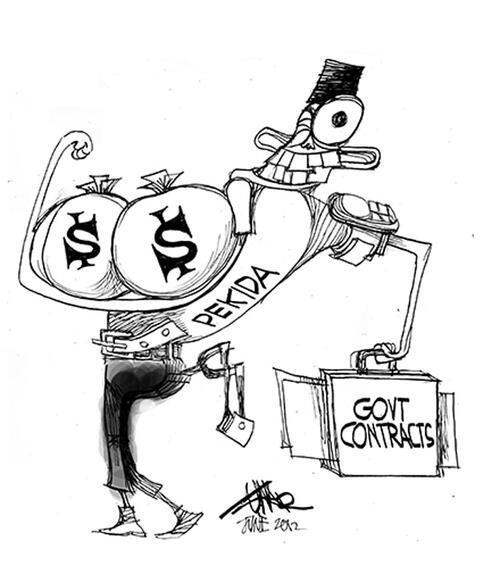
In Malaysia, criminality is a highly political question, and that is mainly why local scholarship on the topic is rare. Yet political participation by outlaws and criminalized groups is not new. Begun in 2008, Dr. Lemière’s research explores uncharted territory: how criminality related to politics in semi-authoritarian Malaysia, with a focus on the ruling party (UMNO) from 2008 to 2018.  She shows how gangs have created umbrella (Malay) NGOs, like Pekida (shown here in caricature), to formalize their ties to political parties. For gangs, political militancy has become a business; political parties (mostly UMNO) have sub-contracted political actions and violence to such groups. Dr. Lemière’s research raises question regarding the nature of civil society and democratization, and offers a new perspective of ethno-religious controversies and clashes in the 20th and 21st centuries.

Sophie Lemière is a political anthropologist at Harvard’s Ash Center for Democracy in its program on Democracy in Hard Places. Her research examines the nexus between religion, politics, and criminality in a comparative perspective. She will be at Stanford in the fall before transferring to the National University of Singapore in the spring.

Dr. Lemière has held research positions in Singapore at the Asia Research Institute (NUS) and the S. Rajaratnam School of International Studies (NTU).  She has been a visiting fellow at the University of Sydney, Cornell, UC Berkeley, and Columbia. She received her PhD from Sciences-Po in Paris. Her dissertation was the first study on the political links between gangs and umbrella NGOs in Malaysia.  Her master’s research on apostasy controversies and Islamic civil society was awarded second prize for young scholars by the International Institute for the Study of Islam in the Modern World (1998-2008) in Leiden.

Dr. Lemière believes it is essential for academics to disseminate their research findings widely, especially in the countries they study. Accordingly, her publications have been written both general and academic readers within and beyond Malaysia. She is the editor of a series of books on “Malaysian Politics and People.” Misplaced Democracy was released in 2014.  Illusions of Democracy (2017) will be re-published in 2018, and a third volume is expected in 2019, when her monograph “Gangsters and Masters: Complicit Militancy and Authoritarian Politics” will also appear. She is currently working on a political biography of Malaysia’s current prime minister during his recent campaign: “The Last Game: Malaysian Politics through Mahathir’s Eyes.”

Dr. Lemière maintains a blog on Mediapart and contributes regularly to New Mandala, The Conversation, Le Monde, and Libération among other outlets.  She has also begun to develop several documentary film projects with French production companies, including a series on arts and politics. Her first film “9/43” featuring the Malaysian cartoonist Zunar was chosen one of the 25 best movies at the French short-film festival Infracourt in 2016.

Sophie Lemière 2018-19 Lee Kong Chian NUS-Stanford Fellow on Contemporary Southeast Asia
Seminars
Subscribe to Security