FSI researchers work to understand continuity and change in societies as they confront their problems and opportunities. This includes the implications of migration and human trafficking. What happens to a society when young girls exit the sex trade? How do groups moving between locations impact societies, economies, self-identity and citizenship? What are the ethnic challenges faced by an increasingly diverse European Union? From a policy perspective, scholars also work to investigate the consequences of security-related measures for society and its values.
The Europe Center reflects much of FSI’s agenda of investigating societies, serving as a forum for experts to research the cultures, religions and people of Europe. The Center sponsors several seminars and lectures, as well as visiting scholars.
Societal research also addresses issues of demography and aging, such as the social and economic challenges of providing health care for an aging population. How do older adults make decisions, and what societal tools need to be in place to ensure the resulting decisions are well-informed? FSI regularly brings in international scholars to look at these issues. They discuss how adults care for their older parents in rural China as well as the economic aspects of aging populations in China and India.
This study focused on an important but often overlooked aspect of safety in medicine: physician safety. In China, patients may violently protest against doctors via disruptive behaviors when facing unsatisfying results, jeopardizing physicians’ security, affecting their diagnostic reasoning, and ultimately harming patient safety. We investigated the relationship between disruptive behaviors, government intervention, and protest results. Statistical analyses reveal that the ‘paying for peace’ mechanism can create distorted incentives for patients and encourage more riots. Efforts should be made to improve service quality and channel medical disputes into the legal framework.
Image
Lingrui Liu is an Associate Research Scientist at the Yale School of Public Health, Department of Health Policy and Management. Prior to joining the YSPH faculty in fall of 2018, she obtained an ScD from Harvard University (2018). Her research interests include health care organizations, quality improvement, patient safety, organizational design and culture, and implementation of evidence-based practices.
“I learned long ago to never predict anything about North Korea.”
So began the keynote address by Anna Fifield, veteran journalist and winner of the 2018 Shorenstein Journalism Award. Speaking at the Award’s seventeenth annual panel discussion “How North Korea Is, and Isn’t, Changing under Kim Jong Un,” Fifield, the Beijing bureau chief for The Washington Post , shared some of the many observations she has made since she first began covering North Korea in 2004.
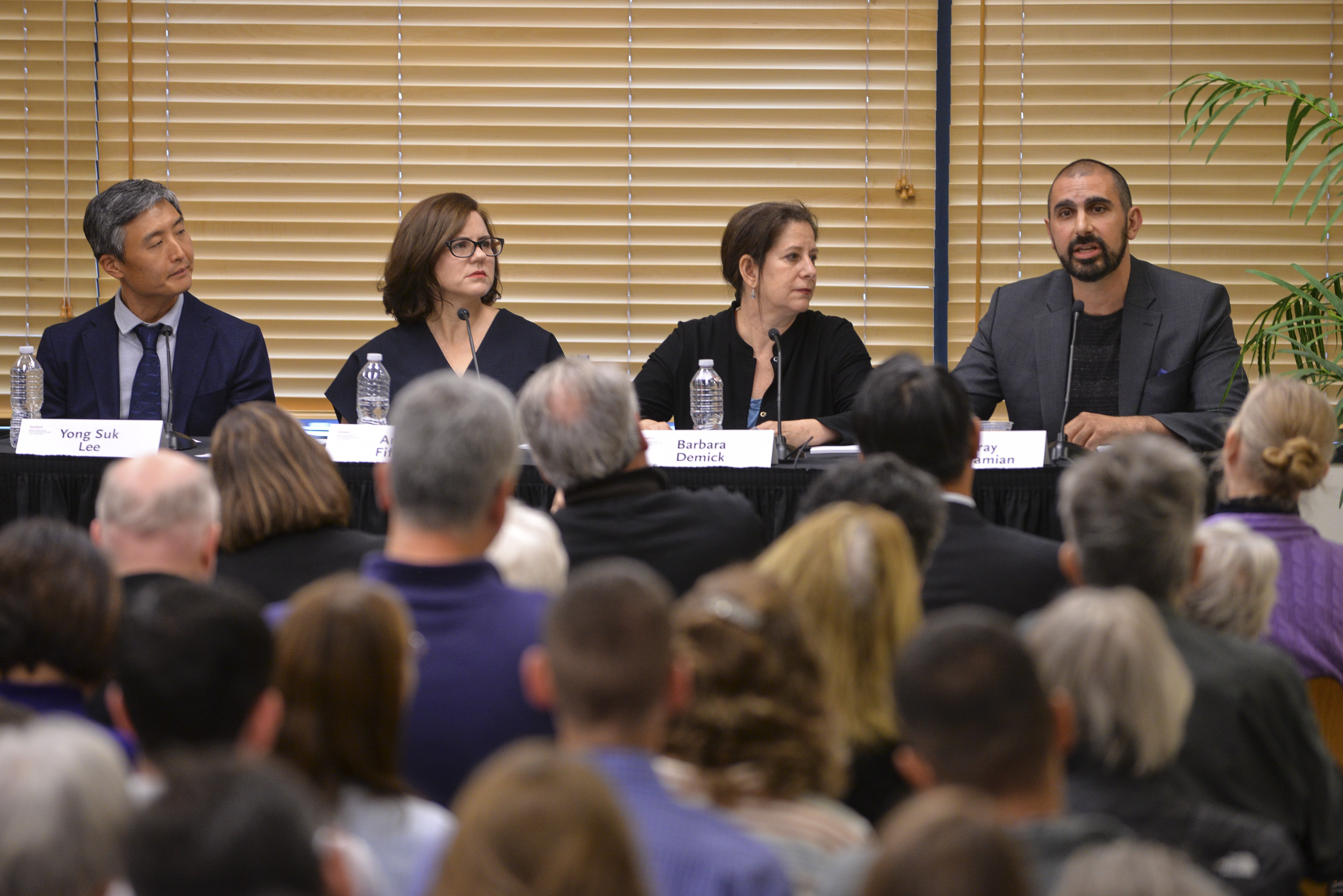
Two other North Korea experts joined Fifield at the panel: Barbara Demick, New York correspondent of the Los Angeles Times, formerly head of the bureaus in Beijing and Seoul, and the 2012 Shorenstein award winner; and Andray Abrahamian, the 2018-2019 Koret Fellow, whose previous role as executive director of Choson Exchange and other projects took him to the DPRK nearly 30 times. Yong Suk Lee, deputy director of the Korea Program at Shorenstein APARC, chaired the panel.
The presence of another person—the Dear Respected Comrade himself—was also very much felt in the room, if only in spirit.
Barbara Demick (center) speaks at 2018 Shorenstein Journalism Award.
Survival at any cost
At various points throughout its 70-year history, experts have predicted the demise of the "Hermit Kingdom." Fifield herself admitted to occasionally thinking along such terms.
And yet the country continues to prove them wrong.
“[D]uring my first stint covering North Korea, [I] just couldn’t envisage any way that this regime could survive the death of the second-generation leader and the transition to a third generation,” she said. “Kim Il Sung had created a myth of revolutionary heroism around himself, and a myth of divine selection around his son, Kim Jong Il. How could the North Korean people, who no longer live in a Hermit Kingdom, tolerate a third leader called Kim, let alone one who had no highly exaggerated or plain fictional back story?”
“Yet," Fifield continued, "here we are. Next month, Kim Jong Un will celebrate seven years in charge of North Korea.”
One prominent reason for the nation's recent survival, and an idea put forward by Fifield and supported by her co-panelists, was the development of markets in the communist state.
For decades, North Korea operated under the centrally-planned communist model. Even as China pursued reform and as the Soviet Union collapsed, the North Korean state maintained its central position in the economy.
However, following the famines of the 1990s, the state had no choice but to allow market activity to develop. Under the third Kim markets have continued to grow.
“There are now more than 400 established, state-sanctioned markets in North Korea,” said Fifield. “That’s more than double the number that existed when Kim Jong Un took over at the end of 2011.”
A side effect of this nascent market economy has been the emergence of new elites in the purported “classless” society. Fifield described the development of a capital within the capital—“Pyonghattan”—where newfound elites purchase clothes from western retailers and undergo plastic surgery for their eyelids.
Abrahamian concurred, noting that Kim Jong Un made sure to coddle this upper middle and upper class in Pyongyang. "The old way of doing that under Kim Jong Il and his father, Kim Il Sung, was very much through a loyalty and gift economy," Abrahamian said. "Money was not necessary in the old North Korea. Now it is. You do need it to get your daily necessities, and if you’re lucky enough, the products [from the “outside world”] help you to have a more pleasurable life through the market.”
At the other end of the spectrum, North Koreans turn to the markets not out of entrepreneurial zeal, but out of a need to survive. As an example, Fifield described meeting a mother and daughter living near the border with China. The mother took her daughter out of school in order to raise pigs and make tofu. Before dawn, they trekked into the mountains to tend crops of corn. It was a back-breaking existence. "If they were lucky, they made enough money each day to buy food for themselves," Fifield said. "Many days, they did all this to break even."
Andray Abrahamian responds to a question from the audience.
A smart tyrant not to be underestimated
The panel continued to focus on the man currently at the helm in North Korea.
“When I returned for my second go at covering the Koreas, I wanted to figure out how he’d done it," said Fifield. "How had this podgy young upstart with no qualifications other than being born into this family managed to take control of this regime…? How had he managed to keep intact this anachronistic system that should have died years, even decades, before?”
Fifield emphasized that her comments did not equate to admiration for Kim Jong Un. “He’s a tyrant,” she reminded the room. “But he’s a smart tyrant who’s been operating in a calculating way. To treat him as a joke or a madman is to underestimate the threat of him.”
“Kim Jong Un has not allowed these markets to flourish because he cares about the people and their wellbeing,” Fifield continued. “He has demonstrated time and time again that he doesn’t care at all about the people.”
“There’s only one thing he cares about and that is staying in power.”
Demick cautioned further against over-estimating the positive impact of market development on life in North Korea. “The people Anna interviewed for her groundbreaking series in 2017 in The Washington Post were disgusted with the system,” said Demick. “With the income inequality, with the corruption, with the controls.”
“For them, what’s the worst thing about North Korea? Simply being born there.”
The panelists participated in a lively audience Q & A.
A celebration of journalism
The Shorenstein Journalism Award, which carries a cash prize of $10,000, recognizes accomplished journalists committed to critical reporting on and exploring the complexities of Asia through their writing. It alternates between honoring recipients from the West, who mainly address American audiences, and recipients from Asia, who pave the way for freedom of the press in their countries. Established in 2002, the award honors the legacy of APARC benefactor Mr. Walter H. Shorenstein. A visionary businessman, philanthropist, and champion of Asian-American relations, Shorenstein was dedicated to promoting excellence in journalism and a deeper understanding of Asia.
While the reporting of each year's recipient focuses on different regions and areas of interest, the award consistently recognizes quality journalism. In his welcome remarks, panel chair Yong Suk Lee stated, “In the face of current attacks on journalists and on the truth in the United States and the world, [Shorenstein APARC is] even more committed to excellence in journalism, and to defending independent and free media."
Fifield’s co-panelists spoke at length about how deserving she was of the award. Before their first meeting in Seoul, Abrahamian confessed to harboring skepticism about Fifield. “I had read some of her work before and knew she had analytical chops, but thought to myself that journalists are always fighting for the next scoop.” However, after talking to Fifield for only a few minutes, Abrahamian readily dropped his guard. “I told myself, 'This is a special journalist; she's got something.’"
A previous recipient of the Shorenstein Journalism Award herself, Demick was equally enthusiastic in her praise of Fifield. “For the last four years, [Anna] had owned the North Korea story like no other journalist I’ve met, including myself.”
Fifield was presented with the Shorenstein award and prize at a private evening ceremony.
Watch Fifield’s keynote speech below. An audio version is availalbe on our SoundCloud channel.
Hero Image
Panel chair Yong Suk Lee (left) listens as 2018 Shorenstein Journalism Award winner Anna Fifield speaks to audience. | Rod Searcey
Future Visions: Challenges and Possibilities of Korean Studies in North America — Social Science panel. From left to right: UC Berkeley's Laura Nelson, University of Michigan's Jordan Siegel, Stanford's Yong Suk Lee, USC's David Kang, Harvard's Paul Chang.
How can Korean studies faculty cultivate supportive and critical scholarly communities with graduate students? What can be done to overcome the severe constraints on Korean language training in North America? Why is there a dearth of Korea scholarship in academic literature? And how should Korean studies librarians prepare for the future in the light of new technologies and young researchers’ increasing interest in digital scholarship?
These were some of the questions examined at a two-day conference, “Future Visions: Challenges and Possibilities of Korean Studies in North America,” convened by the Korea Program of Stanford’s Shorenstein Asia-Pacific Research Center (APARC) on November 1-2. Co-sponsored by the Seoul-based Foundation Academia Platonica, the conference, the first of its kind, gathered distinguished Korean studies scholars from twelve North American institutions to consider the state of the field, assess its challenges, and carry forward a vision for its future direction and potential. Its six unique panels focused not only on the major disciplines of Korean studies—history, literature, and the social sciences—but also on language education, library collections and services, and Korean Wave.
“The presentations and discussions by our fellow experts reflected the breadth and depth of Korean studies in North America,” says APARC Director and the Korea Program Director Gi-Wook Shin. “Our program was established at Stanford in 2001 and has since become a leader in Korean studies in North America, so it is a special privilege for us to bring together colleagues from eminent institutions around the continent to further advance Korean studies education and research in the academic and policy worlds, and to build upon our track record of action and achievements.”
“The field of Korean studies, however,” notes Shin, “has significantly changed over the past seventeen years and it isn’t without its challenges. This is our opportunity to consider frankly where we go next and how we could explore the path ahead together.”
Conference participants indeed engaged in deep conversations and shared ideas and dilemmas regarding teaching in the different disciplines of Korean studies in North America. Harvard sociologist Paul Chang listed three types of challenges facing the field: publication, academic, and professional challenges. David C. Kang, professor of international relations and director of the Korean Studies Institute at the University of Southern California, emphasized the publication challenge: why is it, asked Kang, that top academic journals in the discipline of political science and international relations publish so much more scholarship about Europe than they do about Korea and Asia at large, even while the rise of Asian nations is surely one of the most consequential issues of the twenty-first century? The onus, Kang argued, comes back to East Asia scholars “to produce better and more compelling scholarship, and to better train graduate students.”
University of British Columbia's Ross King and conference participants.
Yet complex issues surround the question of how to broaden graduate coursework—and whether to do so. Korean language and linguistics expert Ross King, head of the department of Asian Studies at the University of British Columbia in Vancouver, Canada, was one of several panelists who considered the obstacles to graduate training, among different aspects of academic challenges facing the field of Korean studies. King probed into how Sinocentrism and what he called the “Mandarin conceit”—that is, the notion that training in Literary Sinitic should be predicated on a near-native proficiency in modern Mandarin Chinese—are emerging as a major stumbling block to the study of premodern Korean literary culture. He also pointed to the constraints on language training in both Korean and hanmun in North America, which, he claimed, is why we can probably anticipate continued decrease in the number of ethnically non-Korean (non-Korea-educated) graduate students undertaking graduate study in Korean literature.
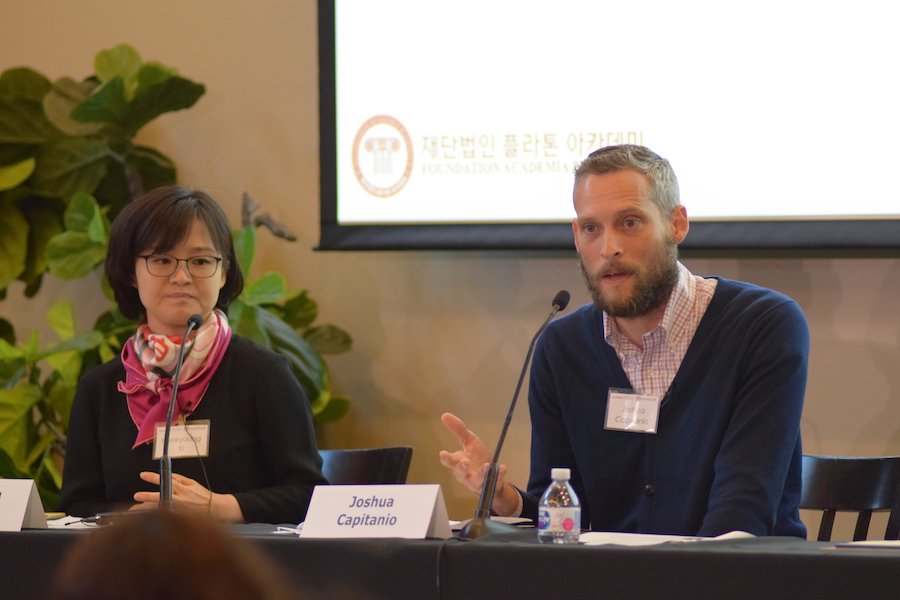
University of Washington's Hyokyoung Yi (left) and Stanford's Joshua Capitanio at a panel on library collections and service.
Sung-Ock Sohn, who coordinates the Korean language program in the department of Asian languages and cultures at the University of California – Los Angeles, further shed light on King’s prediction. She explained that while enrollments in Korean language classes have shown a sharp increase in American higher education institutions in the past decade, particularly at the introductory level and among ethnically non-Korean students, there is a high attrition rate of students from an introductory to advanced Korean classes nationwide.
How should the field move forward?
Participants proposed a host of ideas to that end. These included helping graduate students collaborate with colleagues in Korea; dedicating funding for junior faculty to spend periods of time before tenure conducting research and honing language skills in Korea at appropriate institutions, and for mid-career scholars to spend a year in Korea; emphasizing the application of social science theories and methods to premodern and modern East Asia; motivating scholars to apply a comparative lens to the study of the historical and contemporary experience of East Asia; and integrating linguistic and cultural diversity in Korean language classes by, for example, incorporating service learning in authentic contexts and extending the content spectrum to include topics such as Korean popular culture.
Image
K-pop star Siwon Choi (left) highlights closing panel on Korean Wave.
Korean Wave was the focus of the conference’s widely attended closing panel that featured K-pop star Siwon Choi, a member of Korean boy band Super Junior, and multi-platinum music producer Dominique Rodriguez, managing director of SM Entertainment USA. They spoke about the global reach of Korean pop music and some of the ways in which Korean popular culture could stimulate interest in Korean studies. Dafna Zur, assistant professor in Stanford’s department of East Asian languages and cultures, who chaired the panel, challenged her students to consider “what it means not just to monetize culture but to design culture with specific markets and audience in mind.” The Stanford Daily published a detailed article on the panel.
“We are grateful to Foundation Academia Platonica for its generous support of Stanford’s Korea Program at Shorenstein APARC and for making this conference possible through our shared vision for the future of Korean studies in North America,” said Gi-Wook Shin. “Our thanks also go to our many other friends and partners, including the Korea Foundation that has helped achieve great results through its commitment to promoting understanding of Korea in academia and beyond and its support of the overseas Korean Studies Program since its establishment in 1991.”
South Korean TV company SBS NBC filmed the conference that will be featured in an upcoming documentary about Korean studies in the United States.
Read the conference report or listen to the audio recordings of the sessions, below.
The idea that good management practices matter for organizational performance is widely accepted. An expanding literature suggests that better management practices improve the performance of organizations in various industries including manufacturing, health care, education, and government. In this paper we aim to present a more contextualized perspective. In particular, we examine how management practices affect performance in complex organizations that have multiple and potentially competing performance goals, that is, higher education.
To examine the impact of management practices on teaching and research outcomes, we analyze unique, nationally representative, and granular data that we collected from close to 300 university departments, 5,000 faculty, and 40,000 students in India. Through analyzing these data, we produce three novel sets of findings. First, we find that better management practices, on average, do not have significant effects on domain-specific or domain-general aspects of student learning. Any positive relationship between management practices and student learning disappears once we control for selection by student ability into institutions. Second, and by contrast, we find that better management practices—in particular better target-setting and performance-oriented practices—significantly increase faculty research productivity. Third, we find that the effect of better management practices depends on the performance goals of institutions.
Former SK Center Fellow at the Freeman Spogli Institute for International Studies
yong_resize2.jpg
PhD, MPP
Yong Suk Lee was the SK Center Fellow at the Freeman Spogli Institute for International Studies and Deputy Director of the Korea Program at the Walter H. Shorenstein Asia-Pacific Research Center at Stanford University. He served in these roles until June 2021.
Lee’s main fields of research are labor economics, technology and entrepreneurship, and urban economics. Some of the issues he has studied include technology and labor markets, entrepreneurship and economic growth, entrepreneurship education, and education and inequality. He is also interested in both the North and South Korean economy and has examined how economic sanctions affect economic activity in North Korea, and how management practices and education policy affect inequality in South Korea. His current research focuses on how the new wave of digital technologies, such as robotics and artificial intelligence affect labor, education, entrepreneurship, and productivity.
His research has been published in both economics and management journals including the Journal of Urban Economics, Journal of Economic Geography, Journal of Business Venturing, Journal of Health Economics, and Labour Economics. Lee also regularly contributes to policy reports and opinion pieces on contemporary issues surrounding both North and South Korea.
Prior to joining Stanford, Lee was an assistant professor of economics at Williams College in Massachusetts. He received his Ph.D. in Economics from Brown University, a Master of Public Policy from Duke University, and a Bachelor's degree and master's degree in architecture from Seoul National University. Lee also worked as a real estate development consultant and architecture designer as he transitioned from architecture to economics.
Populist leaders around the world often fight against corruption in an effort to win public support. Conventional wisdom holds that this strategy works because leaders can signal their benevolent intentions by removing corrupt officials. We argue that fighting against corruption can produce unintended consequences. By revealing scandals of corrupt officials, anti-corruption campaigns can alter citizens’ beliefs about public officials and lead to disenchantment about political institutions. We test this argument by examining how China’s current anti-corruption campaign has changed citizens’ public support for the government and the Communist Party. We analyze the results of two surveys conducted before and during the campaign, and employ a difference-in-differences strategy to show that corruption investigations decrease respondents’ support for the central government and party. We also examine our respondents’ prior and posterior beliefs, and the results support our updating mechanism.
SPEAKER:
Image
Yuhua Wang is an assistant professor in the Department of Government at Harvard University. He received his B.A. from Peking University and his Ph.D. from the University of Michigan. Yuhua's research has focused on the emergence of state institutions, with a regional focus on China. Yuhua is the author of Tying the Autocrat’s Hands: The Rise of the Rule of Law in China (Cambridge University Press, 2015). He is currently working on a book-length project to examine long-term state development in China.
In 2012, as giants such as Facebook, Twitter, and Google began to position themselves as the go-to places to read news, a little-known news app called SmartNews emerged and started gaining popularity in Japan. The SmartNews app has since been dubbed “App of the Year” on Google Play and won the “Best of” award in Apple’s App store, launched US operations in 2014, and now has over 10 million monthly active users in US and Japan.
In the age of fake news and information polarization, SmartNews is working to deliver to users a balanced diet of quality information from trusted journalism sources. The SmartNews news app uses machine learning to deliver curated news from more than 3000 sources and identify fake news. The SmartNews Delivery Algorithm not only considers users’ likes and clicks and other behavior on the app to generate suggestions, but also applies political balancing algorithms to ensure multiple viewpoints are expressed on important topics, and diversification algorithms to help break the filter bubble.
In this public forum, SmartNews Director of Product Management Yuhei Nishioka will talk about SmartNews’ story and growth trajectory, competing in the current news app landscape, and finally, discuss the process and considerations in creating the SmartNews News Delivery Algorithm. Introduction by Rich Jaroslovsky Vice President for Content and Chief Journalist of SmartNews and former Wall Street Journal White House correspondent.
MAIN SPEAKER:
Yuhei Nishioka, Director of Product Management, SmartNews
INTRODUCTION BY:
Rich Jaroslovsky, Vice President for Content and Chief Journalist, SmartNews and former Wall Street Journal White House correspondent
AGENDA:
4:15pm: Doors open 4:30pm-5:30pm: Main Content, followed by discussion 5:30pm-6:00pm: Networking
Please note there is significant construction taking place on campus, which is greatly affecting parking availability and traffic patterns at the university. Please plan accordingly.
Yuhei Nishioka, Director of Product Management, SmartNews
Sungmoon Lim (BA '18 Urban Studies) has won the 7th annual Korea Program Prize for Writing in Korean Studies for her paper, "Urban Design in the Age of Globalization: An Analysis of the Global Reception of Seoul’s Cheonggyecheon Stream Restoration Project." Gi-Wook Shin, director of the Korea Program at Shorenstein APARC, says, "Sungmoon's paper is superb. Her work is original and ambitious and her thesis will make an excellent contribution to various fields and sub-fields, including urban studies, globalization, and Korean studies." The award announcement may be viewed here.
Sponsored by the Korea Program and the Center for East Asian Studies, the writing prize recognizes and rewards outstanding examples of writing by Stanford students in an essay, term paper or thesis produced during the current academic year in any discipline within the area of Korean studies, broadly defined. The competition is open to both undergraduate and graduate students.
Stanford University’s Walter H. Shorenstein Asia-Pacific Research Center (Shorenstein APARC) is pleased to announce that The Washington Post’s Beijing Bureau Chief Anna Fifield is the 2018 recipient of the Shorenstein Journalism Award. The award, given annually by APARC, is conferred upon a journalist who has produced outstanding reporting on critical issues affecting Asia and has contributed significantly to greater understanding of the region.
Fifield has been selected in recognition of her exceptional work over a long career reporting on the Koreas, as well as on Japan and periodically other parts of Asia. She will receive the award at a special ceremony at Stanford on November 14, 2018. On that day, she will also headline an APARC-hosted panel discussion focusing on how North Korea is, and isn’t, changing under Kim Jong Un.
"We are delighted to honor Anna Fifield with the Shorenstein journalism award," says Gi-Wook Shin, Shorenstein APARC director. "Drawing on her knowledge of Asian societies and her remarkable ability to communicate insights to audiences all around the world, Anna exemplifies how crucial it is to get the complexities of Asia right and the profound role of journalism in shaping public and decision maker approaches to our counterparts in the region. Walter Shorenstein, APARC's benefactor and a champion of Asian-American relations, understood clearly that role. We are committed to upholding Walter's legacy with this award."
As the Post's Tokyo bureau chief from 2014 to 2018, Fifield’s journalism focused primarily on Japan and the Koreas. During this period, she particularly concentrated on North Korea, working to shed light on the lives of ordinary people there and on how the regime managed to stay in power.
Fifield started as a journalist in her home country of New Zealand, then for 13 years was a correspondent for the Financial Times , covering nearly 20 countries and reporting from, among other places, Sydney, Seoul, Pyongyang, Tehran, Beirut, and finally Washington D.C., where she was White House correspondent and covered the 2012 President election campaign. Prior to joining The Washington Post, Fifield was a fellow at the Nieman Foundation for Journalism at Harvard University, where she studied how change happens in closed societies.
“For many years, Anna Fifield has been the premier Western reporter on Korea, setting the standard for coverage of a story that occupies our front pages," notes Daniel Sneider, a member of the jury for the Shorenstein Award and a long-time foreign correspondent. "But she has also broadened her Asian expertise, as the Tokyo bureau chief for the Post and now in Beijing. She moves easily across the digital as well as the print space and is a crusader for diversity in sourcing. Anna Fifield, in short, is the very definition of a journalist in our modern era.”
Sixteen journalists have previously received the Shorenstein award, which carries a cash prize of $10,000. Among the award’s recent recipients are Siddharth Varadarajan, founding editor of The Wire and former editor of the The Hindu; Ian Johnson, a veteran journalist with a focus on Chinese society, religion, and history; and Yoichi Funabashi, former editor-in-chief of the Asahi Shimbun.
RSVPs for the Shorenstein award panel discussion are requested.
About the 2018 Shorenstein Journalism Award Panel Discussion and Award Ceremony
Shorenstein Journalism Award winner Anna Fifield will deliver a keynote speech and join a panel discussion focusing on how North Korea is, and isn’t, changing under Kim Jong Un. The panel includes Andray Abrahamian, the 2018-19 Koret Fellow in the Korea Program at Shorenstein APARC, and Barbara Demick, New York correspondent of the Los Angeles Times, former head of the bureaus in Beijing and Seoul, and the 2012 recipient of the Shorenstein Journalism Award. The panel will be chaired by Yong Suk Lee, SK Center Fellow at Stanford’s Freeman Spogli Institute for International Studies and Deputy Director of the Korea Program at APARC.
November 14, 2018, 12:00 – 1:30 p.m. (PDT)
Fisher Conference Center at the Frances C. Arrillaga Alumni Center, 326 Galvez St, Stanford, CA 94305
The panel discussion is open to the public. The award ceremony will take place in the evening for a private audience.
The Shorenstein Journalism Award, which carries a cash prize of $10,000, honors a journalist not only for a distinguished body of work, but also for the particular way in which that work has helped audiences around the world to understand the complexities of Asia. The award, established in 2002, was named after Walter H. Shorenstein, the philanthropist, activist, and businessman who endowed two institutions that are focused respectively on Asia and on the press: the Walter H. Shorenstein Asia-Pacific Research Center (Shorenstein APARC) in the Freeman Spogli Institute at Stanford University, and the Joan Shorenstein Center on the Press, Politics, and Public Policy in the Kennedy School of Government at Harvard University. In 2010, Shorenstein APARC expanded the scope of the award that since then has recognized Asian journalists who, in addition to their professional excellence and contribution to knowledge of Asia, have helped defend and build a free media in their home countries.
Media contact: Noa Ronkin, Associate Director for Communications and External Relations noa.ronkin@stanford.edu (650) 724-5667
Andray Abrahamian was the 2018-19 Koret Fellow at Stanford University. He is also an Honorary Fellow at Macquarie University, Sydney and an Adjunct Fellow at the Griffith Asia Institute. He is an advisor to Choson Exchange, a non-profit that trains North Koreans in economic policy and entrepreneurship. He was previously Executive Director and Research Director for Choson Exchange. That work, along with supporting sporting exchanges and a TB project, has taken him to the DPRK nearly 30 times. He has also lived in Myanmar, where he taught at Yangon University and consulted for a risk management company. He has conducted research comparing the two countries, resulting in the publication of "North Korea and Myanmar: Divergent Paths" (McFarland, 2018). Andray has published extensively and offers expert commentary on Korea and Myanmar, including for US News, Reuters, the New York Times, Washington Post, Lowy Interpreter and 38 North. He has a PhD in International Relations from the University of Ulsan, South Korea and an M.A. from the University of Sussex where he studied media discourse on North Korea and the U.S.-ROK alliance, respectively. Andray speaks Korean, sometimes with a Pyongyang accent.

 FSI researchers work to understand continuity and change in societies as they confront their problems and opportunities. This includes the implications of