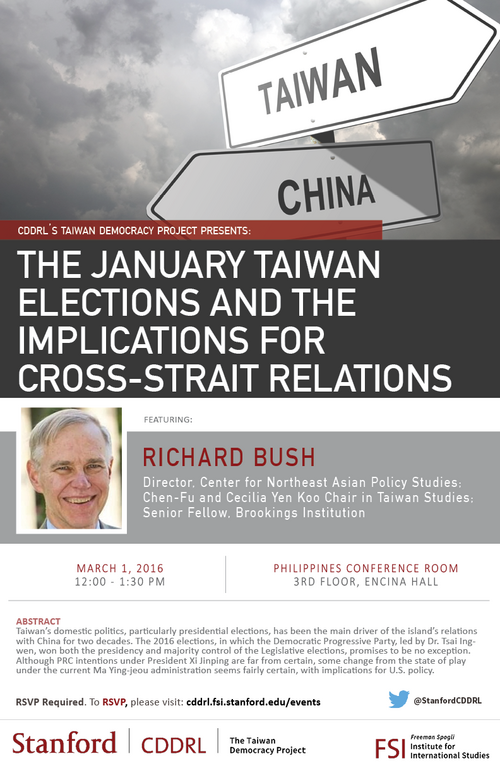
The January Taiwan Elections and the Implications for Cross-Strait Relations
Abstract
Taiwan’s domestic politics, particularly presidential elections, has been the main driver of the island’s relations with China for two decades. The 2016 elections, in which the Democratic Progressive Party, led by Dr. Tsai Ing-wen, won both the presidency and majority control of the Legislative elections, promises to be no exception. Although PRC intentions under President Xi Jinping are far from certain, some change from the state of play under the current Ma Ying-jeou administration seems fairly certain, with implications for U.S. policy.
Bio
Richard Bush is a Senior Fellow at the Brookings Institution and Director of its Center for Northeast Asian Policy Studies, and the Chen-Fu and Cecilia Yen Koo Chair in Taiwan Studies. He came to Brookings in July 2002 after nineteen years working in the US government, including five years as the Chairman and Managing Director of the American Institute in Taiwan. He is the author of a number of articles on U.S. relations with China and Taiwan, and of At Cross Purposes, a book of essays on the history of America’s relations with Taiwan, published in March 2004 by M. E. Sharpe. In the spring of 2005, Brookings published his study on cross-Strait relations, entitled Untying the Knot: Making Peace in the Taiwan Strait. In 2013, Brookings published his Uncharted Strait: The Future of China-Taiwan Relations.
This talk is co-sponsored by the Taiwan Democracy Project in the Center on Democracy, Development, and the Rule of Law and the U.S.-Asia Security Initiative in the Walter H. Shorenstein Asia-Pacific Research Center.
Shinzo Abe and the Reality of Japanese Democracy
Writing for the National Bureau of Asian Research, Daniel Sneider examines Prime Minister Shinzo Abe’s recent attempts to revise Japan’s defense guidelines. He considers how these attempts may affect the Japanese domestic political landscape and the implications that Abe’s actions may have for key issues in the U.S.-Japan alliance, including the Trans-Pacific Partnership and U.S. military interests in Okinawa.
Shuichiro Nishioka
Shuichiro Nishioka joins the Walter H. Shorenstein Asia-Pacific Research Center (Shorenstein APARC) during the 2015-16 academic year from the West Virginia University’s Department of Economics where he serves as an Associate Professor.
His research covers the broad issues on International Trade, Economic Development, and East Asian Economies. During his time at Shorenstein APARC, Nishioka will conduct research projects on the expanding inequality in China and Japan.
Nishioka previously affiliated for research and teaching at the Research Institute of Economy, Trade and Industry, the University of Pittsburgh and Hitotsubashi University. He contributes to articles to publications including the Journal of International Economics, the Journal of Development Economics, and European Economic Review.
Nishioka holds a PhD and an MA in Economics from the University of Colorado at Boulder, and a BA in Economics from Yokohama National University.
Abe at Stanford: Innovation will spur Japan's future
Japan must transform its economy in a way that mirrors the innovation ethos in places like Silicon Valley and Stanford University, Japanese Prime Minister Shinzo Abe said Thursday during a speech on campus.
As an example of how to encourage such creativity, Abe hailed a new partnership starting this fall with Stanford that will train the next generation of biomedical experts. In doing so, he urged a "fundamental change" in how Japanese society views the process of innovation, from how ideas originate to competition in the marketplace.
Japan Biodesign will be launched in collaboration with the Stanford Biodesign program and five higher education and research institutions in Japan. Faculty members will work together to create new interdisciplinary systems based on Stanford Biodesign. Stanford leaders will train and mentor their Japanese colleagues.
Abe, who is the first Japanese prime minister to visit Stanford, marveled at how the tech sector in the United States has "consistently evolved at top speed."
He said, "I want the best and brightest Japanese talent" to learn about Silicon Valley.
Abe shared the Bing Concert Hall stage with Stanford President John Hennessy and George Shultz, the former U.S. Secretary of State and distinguished fellow at the Hoover Institution. Abe's talk, titled "Innovation, Japan and Silicon Valley Symposium," included an introduction and remarks by Hennessy and Shultz. The event drew a full house of invited guests and members of the Stanford community.
"It is a great honor" to be at Stanford, Abe said in beginning his remarks.
He noted that Japan is revisiting its regulatory and tax systems in order to encourage more economic dynamism and competition. "The Japanese people will benefit from innovation," he said.
The challenge, he acknowledged, has been the slow pace of innovation in Japan. Today, however, the Internet economy and big data are creating "enormous changes" in his country's economic approach, he said. "We have to catch up, or otherwise Japan will lose vitality," Abe added.
Cultural connections
In his introduction of Abe, Hennessy chronicled Stanford's long history and friendship with Japan and its people.
Japan, he said, is home to more Stanford alumni than any other Asian country, and when the university's doors first opened in 1891, the pioneer class included a Japanese student. Currently, 139 students from Japan are enrolled at Stanford.
Hennessey described Abe as focused on revitalizing Japan's economy and stewarding it toward a greater global role.
Shultz, who knew Abe's parents, shared recollections of poignant moments between Abe's politically prominent family and his own.
Abe joined a roundtable discussion after his speech with Michael McFaul, director of the Freeman Spogli Institute for International Studies; Stanford Board of Trustees Chair Steve Denning; Stanford School of Medicine Dean Lloyd Minor; Stanford political science Professor Emeritus Daniel Okimoto; Yahoo co-founder Jerry Yang; and Twitter co-founder Jack Dorsey, among other scholars and dignitaries. He also met with Stanford students before leaving campus.
Afterward, McFaul wrote in an email, "I think it is fantastic that Prime Minister Abe came to Stanford and Silicon Valley after his very successful visit to Washington. He demonstrated that deepening U.S.-Japanese relations requires not only strong government-to-government ties, but also deepening ties between our societies, including educational institutions like Stanford."
Abe's state visit to the United States this week included the first address by a Japanese leader to a joint session of Congress. Abe served as prime minister of Japan in 2006-07 and returned to the position in 2012.
'Working together'
On Tuesday, U.S. President Barack Obama said after a meeting with Abe that the two countries had made progress in trade talks on a massive 12-nation trade deal that would open markets around the Pacific Rim to U.S. exports. Both nations face domestic political obstacles to concluding the Trans-Pacific Partnership agreement.
"This agreement would expand the coverage of the free trade agreements for both Japan and the U.S. substantially," said Stanford economist Takeo Hoshi, director of the Japan Program at the Shorenstein Asia-Pacific Research Center, in an interview. "The U.S. and Japan have been working together to maintain peace and sustain economic growth in the Pacific Asia."
Hoshi said that Abe's visit to the Silicon Valley confirms that Japan is serious about transforming its economy from one based on exports to one focused on innovations.
"Going forward, we can learn a lot from Japanese experience and their reform attempts," said Hoshi, who is also a senior fellow at the Freeman Spogli Institute.
Hoshi spoke with The Associated Press just before Abe’s arrival to California, citing Silicon Valley as the ideal place for Japan to learn about innovation. He also joined KQED’s Forum to discuss the current state of the U.S.-Japan alliance. Later, he was interviewed by BBC Business about Abe's visit to Stanford.
Stanford Biodesign
Founded in 2001, Stanford Biodesign has pioneered a new training methodology in which interdisciplinary teams of engineers and physicians go through a rigorous process of carefully characterizing unsolved clinical needs before jumping to technology solutions.
For the Japan Biodesign program, the bulk of the educational activities will take place at the campuses of the partner Japanese universities.
Clifton Parker is a writer for the Stanford News Service.
The Politics of Commoditization in Global ICT Industries: A Political Economy Explanation of the Rise of Apple, Google, and Industry Disruptors
The global Information and Communications Technologies (ICT) industry has experienced a rapid, radical reorganization of industry leaders and business models—most recently in mobile. New players Apple and Google abruptly redefined the industry, bringing a wave of commoditization to carriers and equipment manufacturers. Technologies, corporate strategies, and industry structures are usually the first places to look when explaining these industry disruptions, but this paper argues that it was actually a set of political bargains during initial phases of telecommunications liberalization, which differed across countries, that set the trajectories of development in motion. This paper shows how different sets of winners and losers of domestic and regional commoditization battles emerged in various ICT industries around the world. Carriers won in Japan, equipment manufacturers in Europe, and eventually, computer services industry actors rather than communications firms emerged as winners in the United States. These differences in industry winner outcomes was shaped by the relative political strength of incumbent communications monopolies and their will to remain industry leaders, given the political system and political dynamics they faced during initial liberalization. The U.S. computer services industry, which developed independently of its telecommunications sector due to antitrust and government policy, eventually commoditized all others, both domestically and abroad. This paper contends that a political economy approach, tracing how politics and regulatory processes shaped industry structures, allows for a better understanding of the underlying path dependent processes that shape rapidly changing global technological and industry outcomes, with implications beyond ICT.
Stanford scholars hold dialogue in New Delhi
The Shorenstein Asia-Pacific Research Center (APARC) hosted its inaugural event in New Delhi, a public seminar titled India’s Relations with its Northeast Asian Neighbors, in late 2014. Experts from Shorenstein APARC and the Brookings Institution’s India Center spoke about recent developments in India’s foreign policy under the nation’s new prime minister, Narendra Modi, and provided an outlook on where India fits in the context of an emerging Northeast Asia.
The panel consisted of Stanford scholars: Gi-Wook Shin, professor of sociology and director of Shorenstein APARC; Michael Armacost, a Shorenstein Distinguished Fellow; and Karl Eikenberry, a Shorenstein Distinguished Fellow; and Brookings scholars: Vikram S. Mehta, executive chairman; and W.P.S. Sidhu, a senior fellow.
Video and transcript of the event are available below. A list of key discussion points was also written up by Brookings India and is available by clicking here.
The seminar was one event in a larger visit by Shorenstein APARC to New Delhi. Armacost, Eikenberry, Shin, and Huma Shaikh, the associate director for administration, hosted a series of private roundtable discussions at two universities, Jawaharlal Nehru University and Delhi University.
Kathleen Stephens, the then-charge d’affaires for the United States in India, also hosted Shorenstein APARC at Roosevelt House, the official U.S. ambassadorial residence. There, at the entrance, the group was greeted with a Stanford “S” prepared in “rangoli” style, an Indian custom of welcoming guests with an intricate design made of colored rice and flowers.
On Twitter, Stephens (@AmbStephens) shared a series of tweets, a few are included below:
Stephens was the Koret Distinguished Fellow in the Korea Program at Shorenstein APARC from 2013-14; she served as U.S. ambassador to the Republic of Korea from 2008 to 2011, among other posts.
The events were part of an effort to reinvigorate the South Asia Initiative, a Stanford program that seeks to conduct policy-relevant research and convene conferences on topics related to the United States and the nations of South Asia.
"Wall Street Journal" reporter Jacob Schlesinger named 2014 Shorenstein award recipient
Tokyo-based reporter Jacob Schlesinger will receive award for his journalistic work and achievements spanning three decades
Stanford University’s Walter H. Shorenstein Asia-Pacific Research Center (APARC) is pleased to announce Wall Street Journal reporter Jacob Schlesinger as the 2014 recipient of the Shorenstein Journalism Award.
Schlesinger has been selected for his excellence in reporting on Japan’s economy, trade and politics, over a more than three-decade career in journalism. A Japan watcher since the late 1980s, Schlesinger incisively covered the nation at its economic height, the ‘boom’ period, through its ‘bust,’ as the financial system collapsed in the 1990s, and now, into an era that has seen signs of economic revival.
Commenting on the selection of Schlesinger for the award, Professor Daniel Okimoto, one of the leading American experts on Japanese political economy and a former director of Shorenstein APARC, said:
“Through the years, followers of Japan have had the benefit of being kept informed by a succession of first-rate journalists based in Tokyo, such as Bill Emmott (The Economist), author of “The Sun Also Sets,” and Gillian Tett (Financial Times), author of “Saving the Sun.” No foreign journalist has covered Japan longer, or understood its political economy more deeply, than Jacob M. Schlesinger (Wall Street Journal), author of “Shadow Shoguns.”
The Shorenstein Journalism Award, launched in 2002, is given to journalists who are outstanding in their reporting on Asia, and who have contributed significantly to Western understanding of the region. The award was originally designed to honor distinguished American journalists for their work on Asia, but since 2011, Shorenstein APARC re-envisioned the award to encompass Asian journalists who pave the way for press freedom, and have aided in the growth of mutual understanding between Asia and the United States. The award alternates between Western and Asian journalists.
The most recent award recipients were Aung Zaw, the founder of Burmese publication the Irrawaddy, and a pioneer of press freedom in that country, and Barbara Demick, the Los Angeles Times correspondent in Beijing and the author of ground-breaking studies of life in North Korea.
Schlesinger has covered Japan for the Wall Street Journal for nearly a decade. He is currently the Senior Asia Economics Correspondent and Central Banks Editor – Asia for the Journal, based in Tokyo. He came first to Japan as a reporter in the late 1980s, covering tech, trade and politics, and then reporting on Japan’s stock market crash and financial crisis, and the fallout that carried on through the mid-1990s, a period known as “the lost decade.”
Schlesinger then worked for 13 years in the Journal’s bureau in Washington DC, covering politics and the U.S. economy. He was part of the Journal’s team that was awarded a Pulitzer Prize in 2003 for the “What’s Wrong” series about the causes and consequences of the late-1990s financial bubble.
Schlesinger returned to Japan as the Japan editor/Tokyo bureau chief in 2009, overseeing the coverage of the historic transfer of power to the Democratic Party of Japan, and the triple disaster of the massive earthquake of March 2011 and the tsunami and Fukushima nuclear disaster that resulted. He has since closely followed the return to power of the conservative Liberal Democratic Party, and its leader Shinzo Abe, and his administration’s economic stimulus policy, known as ‘Abenomics,’ as well as growing tensions within the region.
Schlesinger is the author of the book, “Shadow Shoguns: The Rise and Fall of Japan’s Postwar Political Machine,” widely recognized as one of the most important works on Japan’s politicians, parties and the dramatic changes in its political order. Published in 1997, the book was hailed by Foreign Affairs as “a fascinating and penetrating tale.” He wrote the book while a visiting fellow at Shorenstein APARC.
Schlesinger will receive the award at a special ceremony at Stanford’s Bechtel Conference Center on March 9. He will also lead a panel discussion earlier that day examining the coverage of Japan’s economy, from boom to bust and back again, with Susan Chira, a former Tokyo correspondent and now deputy executive editor of The New York Times and Professor Takeo Hoshi, a prominent economist and director of Stanford’s Japan Program.
Please click here for the full press release.
Contact: Lisa Griswold, communications coordinator at Shorenstein APARC, with any questions about the award or the March 9 events.
At Stanford, US military commander underscores dialogue with China
The rise of China as a global and regional power has created areas where the interests of China and the United States overlap in competition, the senior U.S. military commander in the Pacific told a Stanford audience. But Admiral Samuel Locklear III, the commander of U.S. Pacific Command (USPACOM), rejected the traditional realpolitik argument, which predicts inevitable confrontation between the United States, a status quo power, and China, a rising power.
“Historians will say this will lead to conflict,” Locklear said, during an address at the Walter H. Shorenstein Asia-Pacific Research Center last Friday. “I don’t believe it has to.”
The United States and China have a “mutual skepticism of each other,” the Pacific Commander acknowledged, but he characterized the relationship as “collaborative, generally.”
He said the dangers of direct military confrontation between the two powers is low, but warned against Chinese tendencies to perceive the United States as engaged in an effort to ‘contain’ the expansion of China’s influence. Instead, Locklear urged China to work with the United States to build new security and economic structures in the region.
Economic interdependence between the countries makes it impossible for the two countries to avoid working together, he told the seminar, co-sponsored by the Center for International Security and Cooperation and the Freeman Spogli Institute for International Studies at Stanford University.
He said that China has also benefited from the security environment that the United States has helped shape and maintain in the region.
Locklear reminded the audience of the central importance of the vast area under his command, which stretches from the Indian subcontinent across the vast Pacific Ocean. More than nine out of 10 of the largest ports in the world are in the Asia-Pacific region, and over 70 percent of global trade passes through its waters. The U.S. rebalance to Asia, a policy pursued by the Obama administration as early as year 2009, largely happened because of the economic and political importance of that area.
The mutual interest in economic prosperity depends, however, on a stable security environment. Washington has an interest in maintaining the structure of security that has ensured peace for the last few decades. Beijing seeks to change the status quo, to build a regional system that reflects its growth as a power.
Locklear called on China to work with the United States and other nations in the region, such as Japan and Australia, as well as the countries of Southeast Asia, to take the current “patchwork quilt” of bilateral and multilateral alliances and build a basis to maintain economic interdependence and security. He pointed to the U.S.-led effort to form a Trans-Pacific Partnership as a 12-nation economic structure, which could eventually include China.
“We want China to be a net security contributor,” he said, “And my sense is that both the United States and the nations on the periphery of China are willing to allow China to do that – but with circumstances.” He said conditions for the United States included open access to shared domains in sea, air, space and cyberspace.
The Pacific Commander cautioned against the danger, however, of unintended conflict, fueled by territorial disputes and Chinese assertiveness that worries its neighbors. Locklear stressed the need for more dialogue, including among the militaries in the region, an effort that the U.S. Pacific Command is currently carrying out.
“There’s a trust deficit in Asia among the nations, as it relates in particular to China,” he said.
Relations have been so icy that the top political leaders of Japan and China didn’t meet for nearly two years, only breaking the divide for a 20-minute meeting at the Asia-Pacific Economic Summit (APEC) in Beijing last month.
Refusing to engage at the highest level has made it difficult for countries to work on solutions to shared problems. The region now sees a confluence of old and new challenges that could threaten global stability if ill-managed, said Locklear, who has led the U.S. military command in the Pacific since 2012.
For decades, China and Japan have been at odds about sovereignty claims over islands in the East China Sea. In the past, during the time of Deng Xiaoping’s rule in China, the two countries agreed to, as Deng reportedly put it, ‘kick the issue into the tall grass’ for future generations to deal with it. These disputes have resurfaced in recent years, threatening to trigger armed conflict between the air and naval forces of the two countries.
Locklear said he believed that China and Japan would avoid inadvertent escalation, thanks to improved communications and tight command and control over their forces. But he also warned that at least seven nations have conflicting claims in the South China Sea, which could easily escalate into direct conflict.
These situations, paired with an upsurge in Chinese military spending and the growing belief that the United States is a declining power, raise doubts about China’s intentions in the region. China’s Asian neighbors increasingly question the intensions of the world’s most populous nation, and second largest economy.
“Is it a return to the old days where you had basic tributary states? Is that the model that China is looking for? Or is it a 21st century model?”
Locklear said China and other nations in the Asia-Pacific, as well as the United States, need to work harder to form shared views and consensus, particularly among those who “own the guns.”
Dialogue and interactions among the militaries are crucial, especially those who are called upon to make quick decisions during a possible flashpoint, for instance an accidental clash of boats or planes.
“Trust really does fall in many ways to military leaders to get it right and to lead, to some degree, the politicians and the diplomats,” he said. Locklear spoke of a tangible example of collaboration in the Rim of the Pacific Exercise, also known as RIMPAC, hosted by USPACOM. Twenty-two countries participate in the world’s largest maritime warfare exercise in Hawaii, which this year included naval forces from China.
“Does it fix those friction points? No, it doesn’t.” But, Locklear concluded, “We hope that this kind of thing opens the door for future interaction.”
The audio file and transcript from the event can be accessed by clicking here.