
A New Cold War?: Sharp Power, Strategic Competition, and the Future of U.S.-China Relations
Image

On November 29, 2018, a working group, co-chaired by Larry Diamond, senior fellow at the Freeman Spogli Institute for International Studies and at the Hoover Institution, and Orville Schell, Arthur Ross director of the Asia Society’s Center on U.S.-China Relations, released the report “Chinese Influence and American Interests: Promoting Constructive Vigilance," which documents the extent of China’s influence-seeking activities in American society. The report details a range of assertive and opaque “sharp power” efforts that China has stepped up within the United States in multiple sectors. These, argue members of the working group, penetrate deeply the social and political fabric of our democratic society and exploit its openness.
APARC’s Donald K. Emmerson and Thomas Fingar provided the Chinese international affairs website Dunjiaodu with their own commentaries on the report. English language versions of both pieces were published by IPP Review (here and here), and are provided below.
APARC also hosted a special roundtable discussion of the report's findings and recommendations, featuring Diamond and Schell. You can listen to the event's audio recording on our website.
Comment on "Chinese Influence and American Interests"
By Donald K. Emmerson
December 24, 2018
Chinese Influence and American Interests: Promoting Constructive Vigilance is an important and timely report. It deserves translation into Chinese and wide circulation inside the PRC. It should be made available on-line for free downloading by people in China from all walks of life, including scholars, teachers, authors, entrepreneurs, and officials from Beijing down to the lowest levels of administration throughout the country. Relations between the US and China are far too important to the citizenries of our two countries to restrict access to the report to a miniscule proportion of China’s population—the elite English-reading few who enjoy privileged (uncensored) exposure to critical facts and comments regarding the Chinese government’s behavior abroad.
I willingly attended a meeting of the Working Group on Chinese Influence Activities in the United States. My academic specialty is Southeast Asia, including its relations with China, so I chose not contribute text to the report. Understandably, not every sentence in its the 199 pages exactly matches what I might have preferred to read or decided to write. (Relevant is my “Singapore and Goliath?” in the April 2018 Journal of Democracy.) But I supported the Working Group’s work and I agree with its outcome.
Included in the report is a dissenting opinion by Susan Shirk. I respect her view. But I am less concerned than she that the report risks “putting all ethnic Chinese under a cloud of suspicion.” The word “constructive” in the report’s subtitle explicitly conveys the Working Group’s desire neither to stereotype nor denigrate people of Chinese descent. At the meeting I attended, this wish was repeatedly expressed. I endorse and appreciate the editors’ caution that, alongside our critique, we “must be mindful to do no harm,” and that the report should not be misused to disparage ethnically Chinese people, who have indeed, as the editors state, made “enormous” contributions to American progress. I would merely enlarge that gratitude to include the economic, political, and cultural benefits attributable to ethnic Chinese individuals, historically and now, throughout the world—my own specialty, Southeast Asia, notably included.
"Flies and Barriers": On the China-U.S. Relationship
By Thomas Fingar
December 20, 2018
The recent report of the Working Group on Chinese Influence Activities in the United States was not timed to coincide with the 40th anniversary of Reform and Opening and the restoration of US-China diplomatic relations but it provides “teaching moment” opportunities for reflection on the ways in which China and the United States have managed the challenges of deeper engagement. I hope that the full report will be available in China and urge readers of this commentary to read it and to think about the issues it raises. I had no role in the preparation of the report but concur with the views expressed by Susan Shirk in her dissenting opinion.
One cluster of issues centers on important asymmetries in the US-China relationship. The report describes numerous ways in which Chinese entities interact with institutions and individuals in the United States and correctly notes the almost complete absence of legal and procedural impediments to such interaction. One cannot say the same about China. Four decades into the era of reform and opening, China remains far less open to foreign ideas, interaction, and influence than is the United States. I encourage readers to ask why that is the case and to consider the consequences and implications for China’s future development. To paraphrase Deng Xiaoping, the concerns raised in the Working Group report represent “flies” that entered the United States through the window of extensive engagement with China. The report calls for dealing with the flies, not closing the window. China seems increasingly determined to prevent the intrusion of foreign “flies” by erecting (or failing to lower) barriers.
Asymmetries in access are not limited to the dimensions of US-China relations discussed in this report. The US economy remains far more open to goods, investment, and ownership from China than China is to comparable forms of engagement by Americans. For decades, US laws, policy, and citizens accepted — even fostered — such asymmetries to strengthen our allies and partners. China has benefitted from this asymmetry, as have dozens of other countries. Policies to make our partners and allies stronger and more prosperous were designed to — and did — enhance American security and prosperity, but almost three decades after the end of the Cold War, many Americans understandably ask why we continue to accept such a high degree of inequality. What made sense during the Cold War and before our partners became stronger and more prosperous now seems unfair and unwise. As a result, American thinking about the ways we interact with other nations is shifting from acceptance of asymmetries to demands for reciprocity and equal treatment.
Some Chinese commentaries on the Working Group report have asserted that it reflects waning self-confidence and fear of China’s rise. Such assessments are wrong. Belief that we should receive essentially the same treatment from other countries as they accord to the United States and American citizens, firms, NGOs, and other entities reflects the strength of our commitment to fairness, not fear of competition. The long-held consensus that US policy should treat all countries (except explicit enemies, which China was from 1950 until the late 1960s) equally regardless of how they treated the United States has eroded significantly. That consensus is being replaced by calls for stricter reciprocity and treating other countries in the same way that they treat us. This sentiment is not limited to engagement with China but the Working Group report captures the emerging consensus by noting that Chinese media have far greater access to the United States than American reporters, newspapers, and broadcasts have to Chinese audiences. That is a fact, not an expression of paranoia or lack of confidence. Indeed, readers of this commentary might reflect upon why it is that China seems to lack confidence in the ability of its people to make their own judgments about foreign ideas and compete with foreign firms.
I was in China when the report was published and many Chinese interlocutors depicted its findings and recommendations as “proof” that the United States had abandoned engagement and reverted to containment policies designed to thwart China’s rise. Both their characterization of the report and their assertions about American policy are wrong. None of these interlocutors had read the report (their opinions were based on negative commentary), and I suspect that many would change their assessment if they had a chance to do so. I also suspect that many in China would change their minds about whether the United States is attempting to “contain” China if they had access to more — and more accurate — information about American willingness to acknowledge and manage the “flies” of engagement and Chinese efforts to erect barriers to Western ideas.

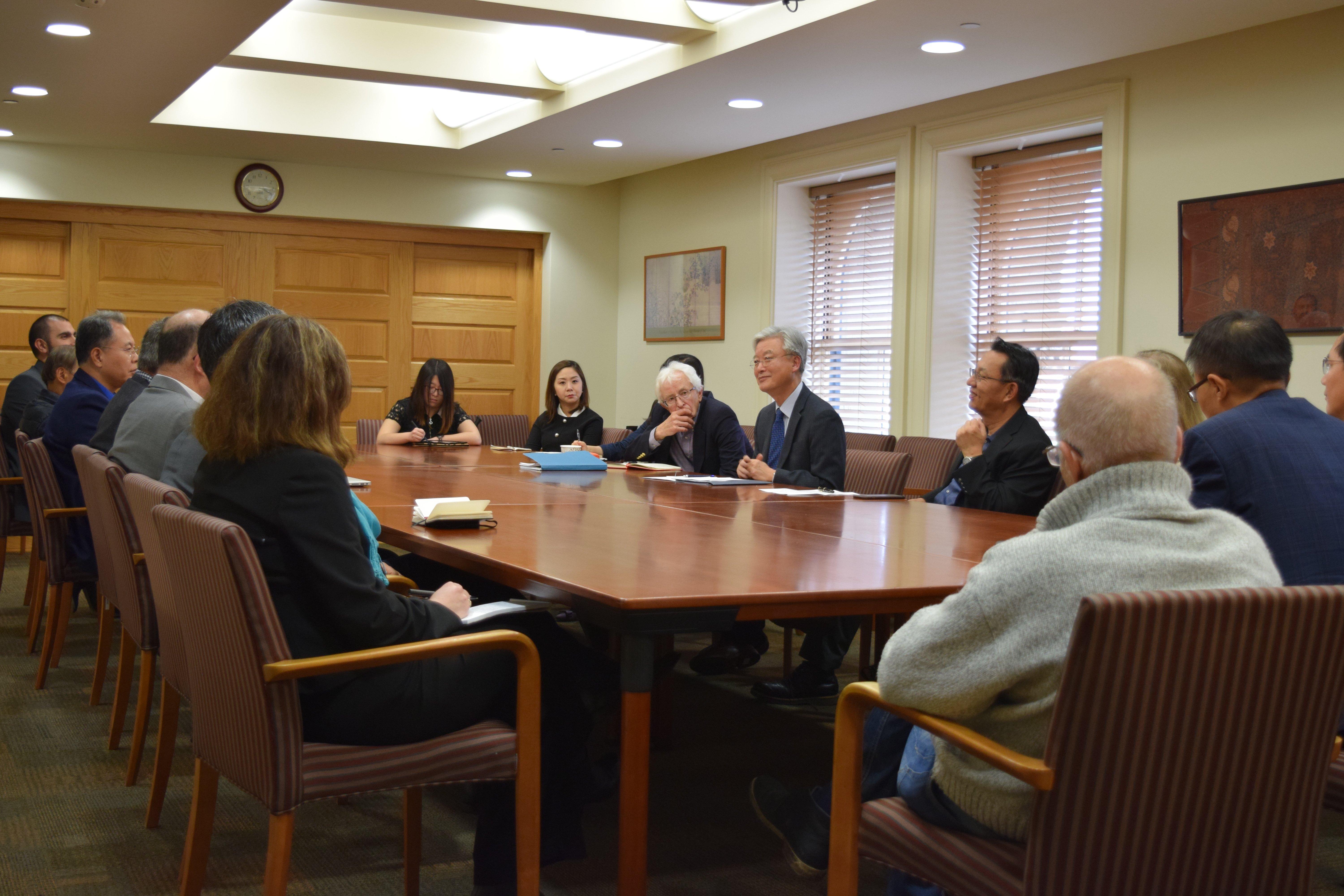 Rountable participants and Ambassador Cho at Shorenstein APARC. Photo: Thom Holme.

Shorenstein APARC's annual overview for academic year 2017-18 is now available.
Download it for information on the wide variety of Center research from the the past academic year, Shorenstein APARC's educational activities, and major Center events like the Shorenstein Journalism Award.
Ketian Vivian Zhang joined the Walter H. Shorenstein Asia-Pacific Research Center (APARC) as the 2018-2019 Shorenstein Postdoctoral Fellow in Contemporary Asia. Ketian studies coercion, economic sanctions, and maritime territorial disputes in international relations and social movements in comparative politics, with a regional focus on China and East Asia. She bridges the study of international relations and comparative politics and has a broader theoretical interest in linking international security and international political economy. Her book project examines when, why, and how China uses coercion when faced with issues of national security, such as territorial disputes in the South and East China Seas, foreign arms sales to Taiwan, and foreign leaders’ reception of the Dalai Lama. Ketian's research has been supported by organizations such as the Belfer Center for Science and International Affairs at the Harvard Kennedy School, Institute for Security and Conflict Studies at George Washington University, the Smith Richardson Foundation, and the Chiang Ching-kuo Foundation.
At Shorenstein APARC, Ketian worked on turning parts of her book project into academic journal papers while conducting fieldwork for her next major project: examining how target states of Chinese coercion respond to China's assertiveness, including the business community and ordinary citizens.
Ketian received her Ph.D. in Political Science at the Massachusetts Institute of Technology in 2018, where she is also an affiliate of the Security Studies Program. Before coming to Stanford, Ketian was a Predoctoral Research Fellow in the International Security Program at the Belfer Center for Science and International Affairs at the Harvard Kennedy School. Ketian holds a B.A. in Political Science and Sociology from the University of Wisconsin-Madison and was previously a research intern at the Institute for Policy Studies in Washington, D.C., where she was a contributor to its website Foreign Policy in Focus.
The evidentiary weight of North Korean defectors’ testimony depicting crimes against humanity has drawn considerable attention from the international community in recent years. Despite the ramped-up attention to North Korean human rights, what remains unexamined is the rise of the transnational advocacy network which drew attention to the issue in the first place. In their new book, North Korean Human Rights: Activists and Networks, Andrew Yeo and Danielle Chubb lead a team of scholars in tracing the emergence and evolution of North Korean human rights activism. Together they challenge existing conceptions of transnational advocacy, how they operate, and why they provoke a response from even the most recalcitrant regimes. In this event, Professor Yeo draws particular attention to the politics of North Korean human rights in both domestic and international contexts. He explains the relevance and importance of human rights even as the diplomatic environment on the Korean Peninsula shifts from pressure towards engagement.

Philippines Conference Room
Encina Hall, 3rd Floor
616 Serra Mall, Stanford, CA 94305
He holds a J.S.D. and LL.M. from NYU School of Law and M. Jur. and B. Jur. from Seoul National University.
After his secret meeting with President Xi Jinping of China in March, North Korea’s Kim Jong-un is set to meet with President Moon Jae-in of South Korea on April 27 at Peace House, south of the military demarcation line. This would make Kim Jong-un the first North Korean leader to set foot in South Korea since the Korean War. A panel of Korea experts will engage in discussion about outcomes and implications of this historic summit.
Panelists:
Gi-Wook Shin, Director of Shorenstein APARC; Senior Fellow at FSI; Professor of Sociology, Stanford University
Kathleen Stephens, William J. Perry Fellow at Shorenstein APARC; former U.S. Ambassador to South Korea
Philip Yun, Executive Director and Chief Operation Officer of Ploughshares Fund; former vice president at The Asia Foundation
Yong Suk Lee (moderator), Deputy Director of Korea Program, Shorenstein APARC; SK Center Fellow at FSI, Stanford University
The Taiwan Relations Act, along with the three U.S.-China joint communiques, remains the foundation for U.S. policy toward, and engagement with, Taiwan. Through this framework, the United States and Taiwan have built a comprehensive, durable, and mutually beneficial partnership, grounded in shared interests and values. Ambassador Moriarty, Chairman of the American Institute in Taiwan, will review the current state of this unique, “unofficial” relationship in the security, economic, and people-to-people realms. He will discuss the U.S. government’s support for Taiwan’s efforts to participate in and contribute to the international community. At this time of increased tensions between the PRC and Taiwan, Ambassador Moriarty will underscore the United States’ longstanding interest in peace and stability across the Taiwan Strait, opposition to unilateral attempts to change the status quo, and insistence on the peaceful resolution of differences.

Ambassador Moriarty served as Special Assistant to the President of the United States and Senior Director for Asia at the National Security Council (2002-2004). In that role, he advised the President and coordinated U.S. policy on East Asia, Southeast Asia, the Pacific, and South Asia. Moriarty served previously as Director for China Affairs at the National Security Council (2001-2002). He led the political sections at the U.S. Embassy in Beijing (1998-2001) and the American Institute in Taiwan (1995-1998). In Beijing, he helped negotiate agreements that put to rest tensions resulting from the U.S. bombing of the Chinese Embassy in Belgrade and the collision of a Chinese fighter jet with a U.S. EP3. In Taipei, he helped create the template for the United States to work with a democratically-elected Taiwan administration. Moriarty was U.S. ambassador to Bangladesh (2008-2011) and Nepal (2004-2007).
Since retiring from the Foreign Service in 2011, Ambassador Moriarty has worked in the private sector and as an independent consultant. He has spoken on U.S.-Asia relations, including at universities, in public fora, and before U.S. Congressional committees. Living in Jakarta in 2013-2014, Ambassador Moriarty set up PROGRESS, a U.S. Government project to build capacity in ASEAN’s political/security and social/cultural communities. Since 2016, Ambassador Moriarty has been the Country Director for the Alliance for Bangladesh Worker Safety, a coalition of North American importers of ready-made garments. As Country Director, Moriarty provides oversight and strategic guidance to a $50-million initiative that is building a sustainable culture of worker safety in Bangladesh.
"Moon's proposal of a trilateral summit between the two Koreas and the United States, undermining China's influence, turned out to be nothing more than a pipe dream," said researchers at the Shorenstein Asia-Pacific Research Center in a recently published article. "The series of summits that began with Kim's visit to Beijing should lead to Four Party Talks — involving the two Koreas, the United States, and China."
The full article in The Diplomat is available here.
