China and the United States have lately been characterized as geostrategic rivals and on a path toward inevitable conflict. But, according to Fu Ying, chairperson of China’s Foreign Affairs Committee of the National People’s Congress and former ambassador to the Philippines, Australia and the United Kingdom, this picture is incomplete and misrepresents a reality that is much more nuanced.
Fu discussed the current state of U.S.-China relations in a keynote speech at Stanford on Tuesday. Speaking to a full house in Encina Hall, she described different perspectives and shared challenges of China and the United States, and urged a new consensus between the world’s two largest economies.
“In the past thirty years, we’ve had friendly moments, but we were never very close. We had problems, but the relationship was strong enough to avoid derailing.
“Now we are at a higher level. If we work together now, we are capable of making big differences in the world. But if we fight, we will bring disasters – not only to the two countries, but to the world,” Fu said.
Fu’s visit was co-hosted by the China Program at the Shorenstein Asia-Pacific Research Center and the Center on Democracy, Development, and the Rule of Law, two centers in the Freeman Spogli Institute (FSI). Following her remarks, Thomas Fingar, a Shorenstein APARC Distinguished Fellow and former chairman of the National Intelligence Council, offered comments and took questions from the audience.
Fu opened her speech by saying she welcomed alternative views and “a debate.”
Misunderstandings, she said, afflict the U.S.-China relationship. Confusion shared between the two countries can largely be attributed to a “perception gap,” which, she said, is aggrandized through media reporting.
Concern on the American side over China, she said, is tied to its own doubts over its “constructive engagement” strategy. An approach held during the past eight U.S. administrations, the strategy was based on an assumption that supporting market-based reforms in China would lead to political change, she said. However, this has not occurred, and some in the U.S. are now urging the construction of another “grand strategy.”
The United States, she said, also has “rising anxiety about what kind of a global role China is going to play,” and about the future direction of the Chinese economy after its growth slid to hover around seven percent in the last two years compared to its once double digit growth in the past decade.
China interprets the United States’ apprehension as misguided, Fu said. “We see it as a reflection of the United States’ fear of losing its own primary position in the world.”
On the other hand, China, she said, is “relatively more positive” about its overall engagement with the United States. The purpose of Chinese foreign policy, Fu said, is to improve the international environment and to raise the standard of living of its people without exporting its values or seeking world power. “We believe China has achieved this purpose,” she added.
The United States and others must also remember that the past can loom large in the minds of the Chinese people, Fu said.
In attempting to understand China, “one should not lose sight of the historical dimension,” she said. China at various times in the nineteenth to early twentieth century was under occupation by foreign powers, she said, and this is a reason why sovereignty is a closely held value in the Chinese ethos.
The overall “perception gap” between China and the United States has moved from misunderstanding to fear, and that, she said, is causing negative spillover effects for both countries.
Two manifestations of this fear, she cited, are the United States’ “reluctance to acknowledge China’s efforts to help improve the existing order,” such as the development of the Asian Infrastructure Investment Bank and ‘One Belt, One Road’ initiative, and the U.S.’ “growing interference” in South China Sea issues.
“Will it lead to a reckless urge to ‘throw down the gauntlet’?” Fu asked.
She acknowledged that collision is a concern. China is focused on addressing its challenges with the United States, including avoiding potential incidents and finding ways “to adapt to and participate in adjustment in international order,” Fu said.
Yet, she cautioned that the two countries be realistic in their aims and know that China is not seeking to emulate the United States. China and the United States, unlike Japan and South Korea, do not have a formal strategic or security alliance, and they need not have one, Fu said.
“China is not an ally, and it should not be an enemy either,” she said.
“Can we accept and respect each other, and build new consensus?” she asked. She then stated, “I want to end my speech with a question mark as a salute to Stanford University which is renowned for its capability of addressing difficult questions.”
Fingar gave a brief response to Fu’s address.
Calling it largely “fictional,” he challenged the notion that there is high “American anxiety” about China. Instead, he noted, “Americans do not think very much about China,” as reflected in the multitude of polls taken recently during the primary campaigns. Thus, “there isn’t a lot of public drive to do things differently with China.”
Among U.S. academics, however, there is “puzzlement,” Fingar suggested. Puzzlement, he explained, borne less from any kind of loss of confidence in U.S. policy of constructive engagement but rather from China’s seeming departure from a trajectory that it had set for itself over the last 40 years. At the moment China’s reforms appear “bogged down;" its leaders, slow to take the critical steps necessary for economic growth; and its engagement with the outside world, increasingly unpredictable. “The puzzlement about China,” therefore, and “concern about policy has at least as much to do with concern that China may be stumbling as it does about a rising China,” he added. Debunking the zero-sum notion of international relations, Fingar emphasized instead that the United States has “done very well as a nation” in part because of its active engagement with and because of China’s success. “We welcome the rise of China, the rise of others,” he stated.
Fingar concluded with his opinion that the debacle in the South China Sea does not pose a serious threat to the relationship. Instead, “the world needs more examples of joint U.S.-Chinese cooperation and leadership” as was the case with recent breakthroughs in climate change between the United States and China. Otherwise, he added, other countries will not commit their resources for fear of a veto or objection from either the United States or China.
Later that day, Fu met with faculty members of FSI and Hoover.
Related links:
Photo gallery from the event


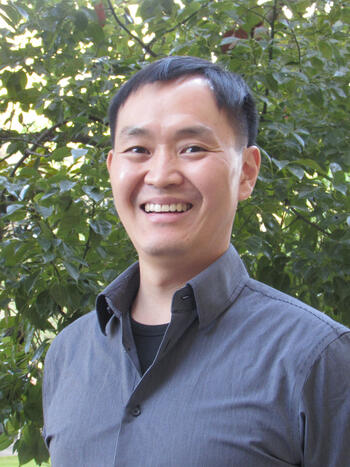
 Joe Studwell has worked as a freelance writer and journalist in East Asia for over twenty years. He has written for the Economist Intelligence Unit, The Economist, the Financial Times, the Wall Street Journal, the Far Eastern Economic Review, the Observer Magazine and Asia Inc. From 1997 to 2007, Mr. Studwell was the founding editor of the China Economic Quarterly and also founder and director of the Asian research and advisory firm Dragonomics, now GaveKal Dragonomics. Joe Studwell’s previous books include Asian Godfathers: Money and Power in Hong Kong and South-East Asia (2007) named one of the year’s ten best books on Asia by the Wall Street Journal. His latest book is How Asia Works: Success and Failure in the World’s Most Dynamic Region, which was placed by both the Financial Times and The Economist on their “books of the year” lists. Mr. Studwell is currently completing his mid-career Ph.D. at Cambridge University, U.K.