Security

FSI scholars produce research aimed at creating a safer world and examing the consequences of security policies on institutions and society. They look at longstanding issues including nuclear nonproliferation and the conflicts between countries like North and South Korea. But their research also examines new and emerging areas that transcend traditional borders – the drug war in Mexico and expanding terrorism networks. FSI researchers look at the changing methods of warfare with a focus on biosecurity and nuclear risk. They tackle cybersecurity with an eye toward privacy concerns and explore the implications of new actors like hackers.

Along with the changing face of conflict, terrorism and crime, FSI researchers study food security. They tackle the global problems of hunger, poverty and environmental degradation by generating knowledge and policy-relevant solutions. 

1
Bernard and Susan Liautaud Visiting Fellow, 2022-2023 & 2023-2024
Elbegdorj_2023_Headshot

Former President of Mongolia Elbegdorj joined the Freeman Spogli Institute for International Studies (FSI) and the Walter H. Shorenstein Asia-Pacific Research Center (Shorenstein APARC) in 2023 as Bernard and Susan Liautaud Visiting Fellow from February 2023 to July 2023, and from November 2023 to April 2024, after a career in public service to Mongolia as a Member of Parliament, Prime Minister, and President. Currently, Mr. Elbegdorj is continuing his work to improve public policy, governance, and democracy through the Elbegdorj Institute, a think tank he founded in 2008. Mr. Elbegdorj holds a Master of Public Administration from Harvard University John F. Kennedy School of Government (2002) and Bachelor’s Degree in Journalism from Land Forces Military Academy of Lviv of former USSR (1988).

While at Stanford, his focus included democracy, disarmament, and governance across Asia.

Authors
Noa Ronkin
News Type
News
Date
Paragraphs

The Walter H. Shorenstein Asia-Pacific Research Center (APARC), Stanford University’s hub for interdisciplinary research, education, and engagement on contemporary Asia, invites nominations for the 2023 Shorenstein Journalism Award. The award recognizes outstanding journalists and journalism organizations with outstanding track records of helping audiences worldwide understand the complexities of the Asia-Pacific region. The 2023 award will honor a recipient whose work has primarily appeared in Asian news media. APARC invites 2023 award nomination submissions from news editors, publishers, scholars, journalism associations, and entities focused on researching and interpreting the Asia-Pacific region. Submissions are due by Wednesday, February 15, 2023.

Sponsored by APARC, the award carries a cash prize of US $10,000. It alternates between recipients whose work has primarily appeared in Asian news media and those whose work has primarily appeared in American news media. The 2023 award will recognize a recipient from the former category.

For the purpose of the award, the Asia-Pacific region is defined broadly to include Northeast, Southeast, South, and Central Asia and Australasia. Both individual journalists with a considerable body of work and journalism organizations are eligible for the award. Nominees’ work may be in traditional forms of print or broadcast journalism and/or in new forms of multimedia journalism. The Award Selection Committee, whose members are experts in journalism and Asia research and policy, presides over the judging of nominees and is responsible for the selection of honorees.

An annual tradition since 2002, the award honors the legacy of APARC benefactor, Mr. Walter H. Shorenstein, and his twin passions for promoting excellence in journalism and understanding of Asia. Over the course of its history, the award has recognized world-class journalists who push the boundaries of coverage of the Asia-Pacific region and help advance mutual understanding between audiences in the United States and their Asian counterparts.

Recent honorees include NPR's Beijing Correspondent Emily Feng; Burmese journalist and human rights defender Swe Win; former Wall Street Journal investigative reporter Tom Wright; and the internationally esteemed champion of press freedom Maria Ressa, CEO and executive editor of the Philippine news platform Rappler and winner of the 2021 Nobel Peace Prize.

Award nominations are accepted electronically through Wednesday, February 15, 2023, at 11:59 PM PST. For information about the nomination procedures and to submit a nomination please visit the award nomination entry page. The Center will announce the winner by April 2023 and present the award at a public ceremony at Stanford in the autumn quarter of 2023.

Please direct all inquiries to aparc-communications@stanford.edu.

Read More

Emily Feng speaking at the 2022 Shorenstein Journalism Award.
News

Shorenstein Journalism Award Winner Emily Feng Examines the Consequences of China’s Information Void and the Future of China Reporting

The challenges facing foreign correspondents in China are forcing the West to reconfigure its understanding of the country, creating opacity that breeds suspicion and mistrust, says Emily Feng, NPR’s Beijing correspondent and recipient of the 2022 Shorenstein Journalism Award. But China seems to want the appearance of foreign media coverage without getting to the heart of what happens in the country.
Shorenstein Journalism Award Winner Emily Feng Examines the Consequences of China’s Information Void and the Future of China Reporting
Kiyoteru Tsutsui and book, Human Rights and the State
News

Stanford Sociologist Kiyoteru Tsutsui Wins the 44th Suntory Prize for Arts and Sciences

The Suntory Foundation recognizes Tsutsui, the Henri H. and Tomoye Takahashi Professor and Senior Fellow in Japanese Studies at the Shorenstein Asia-Pacific Research Center, for his book 'Human Rights and the State.'
Stanford Sociologist Kiyoteru Tsutsui Wins the 44th Suntory Prize for Arts and Sciences
Portrait of Oriana Skylar Mastro with text "Recipient of the Asia Pacific Foundation of Canada 2022-23 John H. McArthur Research Fellowship"
News

Center Fellow Oriana Skylar Mastro Awarded 2022-23 John H. McArthur Research Fellowship

The fellowship, established by the Asia Pacific Foundation of Canada, recognizes Mastro’s exceptional scholarly contributions in the fields of Chinese military, Asia-Pacific security, war termination, and coercive diplomacy.
Center Fellow Oriana Skylar Mastro Awarded 2022-23 John H. McArthur Research Fellowship
Hero Image
Stanford main quad at night and text calling for nominations for APARC's 2023 Shorenstein Journalism Award.
All News button
1
Subtitle

Sponsored by Stanford University’s Shorenstein Asia-Pacific Research Center, the annual award recognizes outstanding journalists and journalism organizations for excellence in coverage of the Asia-Pacific region. News editors, publishers, scholars, and organizations focused on Asia research and analysis are invited to submit nominations for the 2023 award through February 15.

Paragraphs

US defense strategy has long been predicated on the view that military activities, maneuvers, and deployments are credible conveyers of information to both adversaries and partners about US willingness to fight in specific circumstances. Brian Blankenship and Erik Lin-Greenberg’s article, “Trivial Tripwires? Military Capabilities and Alliance Reassurance,” makes an important contribution by demonstrating that not all military activities are created equal when it comes to reassuring allies and partners. Blankenship and Lin-Greenberg rightfully capture reassurance as a product of resolve and capability—thus a “reassuring” state can provide differing acts of reassurance depending on the degree of resolve it wishes to demonstrate and the capabilities it possesses. The authors evaluate four types of reassurance, which vary according to their strength of signaling resolve and capability: (1) tripwires; (2) fighting forces; (3) transient demonstrations; and (4) offshore presences. Relying largely on surveys of defense experts in the Baltics and Central Europe, they argue that a commitment of fighting forces—such as a permanent overseas base or a large in-country ground deployment—makes countries feel safest.

The big question that comes to mind is whether these findings are valid in other theaters, such as the Indo-Pacific. The rise of China presents the greatest challenge to the security and interests of the United States and its allies since the Cold War. As China’s military capabilities have grown, so too has its aggressiveness in pushing territorial issues in the South China Sea, East China Sea, along the Sino-Indian border, and regarding Taiwan. In response, the United States has undertaken numerous military efforts designed to enhance deterrence and reassure allies, including freedom-of-navigation operations (FONOPS), a continuous presence of strategic bombers at Andersen Air Force Base in Guam, and an expanded Marine Air Ground Task Force deployed to Darwin, Australia. America’s behavior reflects an ingrained conventional wisdom: increased military presence and activities will signal US resolve, thereby will enhancing deterrence against an adversary and reassuring allies.

Whether these policy decisions in Asia will indeed contribute to a peaceful and stable Asia directly concern the central claims made in Blankenship and Lin-Greenberg’s study. In this response, Mastro argues that although their research is a step in the right direction, their conclusions do not tell us much about how the United States can reassure Asian allies and partners. Indeed, the article is one more example of the broader problematic tendency to overly rely on Europe to build understanding in the security-studies field.

Mastro makes three main points in this response. First, whether a force deployment serves as a tripwire depends on the risk to forces, not the number of forces deployed (as Blankenship and Lin-Greenberg argue). Second, how capable a country’s deployment is cannot be evaluated in isolation; the enemy’s military capabilities greatly determine the relative capabilities of different posture decisions. Third, Blankenship and Lin-Greenberg’s assumption that transient military operations are low risk (and thus signal lower resolve) is not valid in the Asian theater.

All Publications button
1
Publication Type
Journal Articles
Publication Date
Journal Publisher
Security Studies
Authors
Oriana Skylar Mastro
Authors
News Type
Commentary
Date
Paragraphs

In October 2022, the Chinese Communist Party elected Xi Jinping for a third term as general secretary, setting Xi on a path to be the longest-serving leader since Mao Zedong’s rule ended in 1976.

The extension of Xi’s rule carries significant implications not only for China, but for the broader Indo-Pacific region and global geopolitical order. No country is more aware of this than Taiwan, which has carefully walked the line between its own autonomy and Beijing’s desire for reunification since the 1940s.

After a summer of rising tensions, many experts believe that Beijing’s timeline for an attempt at reunification is much shorter than conventional thinking has assumed. On the World Class podcast, Michael McFaul, director of the Freeman Spogli Institute for International Studies, discusses the prognosis for Taiwan with Oriana Skylar Mastro, an expert on the Chinese military and security, and Larry Diamond, a scholar of China’s sharp power and the role of Taiwan in the Indo-Pacific region.

Listen to the full episode and read highlights from their conversation below.

Click the link for a full transcript of “What We Need To Talk About When We Talk About Taiwan.“

The Likelihood of Invasion


In stark terms, Oriana Skylar Mastro, a center fellow at the Freeman Spogli Institute for International Studies, believes there’s a 100% chance China will use some sort of force against Taiwan in the next five years. For the last twenty years, China has been making concerted efforts to modernize its military and increase its capabilities not only to assert force against Taiwan, but to deter intervention from the United States.

In the majority of scenarios, the United States wins in a conflict with China over Taiwan. But the United States also carries a distinct geographic disadvantage. The distance across the Taiwan Strait between the island and mainland China is approximately 100 miles, which is roughly the distance between Richmond, Virginia and Washington D.C. If China moves quickly, PRC forces could take Taiwan before U.S. forces have time to move into position.

When considering possible outcomes in Taiwan, it is equally important to consider the motivations driving Beijing’s ambitions. The leadership on the mainland has been planning and thinking about how to retake Taiwan since 1949. With the modernized capabilities coming online, the balance of power has shifted in China’s military favor, and the cost-benefit calculus favors Beijing’s ambitions. The long-term planning stage is now reaching its end, and the prospects of direct action are increasing.

The clock is ticking. The problem is we don’t know how fast it’s ticking. But we need to move faster than we're moving.
Larry Diamond
Mosbacher Senior Fellow in Global Democracy at FSI

The View from Taipei


Political leaders in Taiwan recognize the growing danger they face across the Strait. In Larry Diamond’s assessment, the end of Hong Kong's autonomy and the suppression of the “one country, two systems” model, the rising military incursions into Taiwan's air defense identification zone and coastal waters, and the whole rising pace of Chinese military intimidation has sobered Taiwan and visibly impacted Taiwanese public opinion.

Concerningly though, while the political elite recognize the real and present danger of the situation, polling of the general Taiwan public suggests that the vast majority of citizens still feel like an attack or an invasion by China is unlikely. Similar majorities suggest that they would be willing to fight in Taiwan’s defense, but volunteering for military service remains at a minimum.

To maximize safety, Taiwan needs to find ways to strengthen itself in its ability to defend, resist, and deter China, while still avoiding any appearance of moving toward permanent independence or any other action that could be deemed by Beijing as a provocation, says Diamond.

There are things that can completely change Beijing's calculus, but it takes a lot of work, and I just don't see us doing the work yet.
Oriana Skylar Mastro
FSI Center Fellow

What the United States Can Do


When it comes to the defense of Taiwan, the strategic crutch hobbling the United States is geography. Most of the U.S. Pacific forces are not in Asia. The majority are in Hawaii and California, as well as a few bases and airfields in Japan. To be able to effectively deter China, the U.S. needs far greater forward deployed military capability in order to be able to either stop or stall the movement of Chinese troops into Taiwan, says Mastro.

Taiwan needs greater onshore military deterrence capabilities as well. One such strategy is the “porcupine approach,” which increases the number of smaller mobile lethal weapons. By Larry Diamond’s assessment, increased citizen participation in military training is also crucial, with an emphasis on weapons training and urban defense tactics. The U.S. could support these aims by overhauling the current system for weapons procurement to speed up the production and delivery of weapons systems not just for Taiwan, but to the benefit of U.S. defense and other contingencies as well. Working with leadership to create strategic stockpiles of food, and energy should also be a priority, says Diamond.

The U.S. also needs to put much more effort into its diplomatic efforts on behalf of Taiwan. Many U.S. allies and partners are reluctant to ostracize China because of economic ties and concerns over sparking their own conflict with China in the future. A key ally in all of this is Japan. If Japan fights with the United States on behalf of Taiwan, it is a guaranteed win and enough to effectively deter China. But much more needs to be done much more quickly in order to secure those guarantees and present them in a convincing way to Beijing.

“The clock is ticking,” Larry Diamond says. “And the problem is we don’t know how fast it’s ticking. “Taiwan is moving in the right direction. But we need to move faster than we're moving.”

Read More

A Taiwanese F-5 fighter jet is seen after taking off from Chihhang Air Base on August 06, 2022 in Taitung, Taiwan.
Commentary

China’s Huge Exercises Around Taiwan Were a Rehearsal, Not a Signal, Says Oriana Skylar Mastro

Nancy Pelosi’s visit was more pretext than provocation.
China’s Huge Exercises Around Taiwan Were a Rehearsal, Not a Signal, Says Oriana Skylar Mastro
Hero Image
The flag of Taiwan flies over a military monunment in Kinmen, Taiwan. Getty
All News button
1
Subtitle

Larry Diamond and Oriana Skylar Mastro join Michael McFaul on the World Class podcast to discuss China’s ambitions against Taiwan, and how the U.S. and its allies can deter Beijing.

Authors
Noa Ronkin
News Type
News
Date
Paragraphs

The Shorenstein Asia-Pacific Research Center (APARC) is delighted to share that Center Fellow Oriana Skylar Mastro is the recipient of the John H. McArthur Research Fellowship for 2022-23 in recognition of her outstanding scholarship.

Awarded by the Asia Pacific Foundation of Canada (APF Canada), the fellowship provides opportunities for exceptional mid-career scholars working on programs and research areas directly relevant to Canada and Canada’s interests in Asia. It honors the memory of John H. McArthur, a world-renowned Canadian business educator who, among other roles, was dean at Harvard Business School and chair of the APF Canada Board of Directors.

Mastro’s current research projects focus on the U.S.-China great power competition, deterrence in the Taiwan Strait, China’s maritime ambitions, and the China-Russia military relationship.

Prior to her appointment at Stanford in August 2020, Mastro was an assistant professor of security studies at the Edmund A. Walsh School of Foreign Service at Georgetown University. She holds a B.A. in East Asian Studies from Stanford University and an M.A. and Ph.D. in Politics from Princeton University.

Headshot of Oriana Skylar Mastro

Oriana Skylar Mastro

Center Fellow at the Freeman Spogli Institute for International Studies
Full biography

Read More

Chinese President Xi Jinping waves during a meeting.
News

China’s Xi Expands Power at Party Congress: Commentary Roundup

With Xi at the helm for a third term, we should expect to see a more assertive China and more turbulence in the regional and global order, say APARC Director Gi-Wook Shin and Center Fellow Oriana Skylar Mastro. They offer their assessments of the outcomes of the 20th National Congress of the Chinese Communist Party and its implications for China’s trajectory and U.S.-China relations.
China’s Xi Expands Power at Party Congress: Commentary Roundup
South Korean soldiers participate in a river crossing exercise with U.S. soldiers.
News

Striking the Right Balance: What South Korea Can Do to Enhance Deterrence in the Taiwan Strait

Despite obstacles and risks, there are good reasons why South Korea should want to increase deterrence against China. In a new article, Center Fellow Oriana Skylar Mastro and co-author Sungmin Cho chart an optimal strategy for Seoul to navigate the U.S.-China rivalry and support efforts to defend Taiwan.
Striking the Right Balance: What South Korea Can Do to Enhance Deterrence in the Taiwan Strait
U.S. President Joe Biden hosts a Quad Leaders Summit at the White House.
News

New Essay Collection Examines Minilateral Deterrence in the Indo-Pacific

A new Asia Policy roundtable considers whether and how minilateral groupings, such as the Quad and AUKUS, can deter coercion and aggression in the Indo-Pacific. The roundtable co-editor is APARC South Asia Research Scholar Arzan Tarapore, and it opens with an essay by Center Fellow Oriana Skylar Mastro.
New Essay Collection Examines Minilateral Deterrence in the Indo-Pacific
Hero Image
Portrait of Oriana Skylar Mastro with text "Recipient of the Asia Pacific Foundation of Canada 2022-23 John H. McArthur Research Fellowship"
All News button
1
Subtitle

The fellowship, established by the Asia Pacific Foundation of Canada, recognizes Mastro’s exceptional scholarly contributions in the fields of Chinese military, Asia-Pacific security, war termination, and coercive diplomacy.

Authors
Noa Ronkin
News Type
News
Date
Paragraphs

China's ruling Communist Party concluded its 20th National Congress on October 22, cementing Xi Jinping's status as the country’s most powerful leader in decades by awarding him an unprecedented third five-year term as party general secretary. The CCP also revealed the new lineup of the Politburo Standing Committee, China’s most powerful political body, made up entirely of Xi loyalists. APARC scholars outline the key takeaways from the Congress and consider its implications for China and the world.  

Xi's “Work Report” address to the party congress indicates continuity in policy direction. Xi’s long-term ambitions, driven by the grand “Chinese dream” of the “great rejuvenation of the Chinese nation,” have not changed, but now he can be more assertive than before in pursuing them, writes APARC and Korea Program Director Gi-Wook Shin in a co-authored Los Angeles Times opinion piece. Xi has demonstrated that he does not shy away from conflict with the United States, and China will likely strengthen ties with Russia, North Korea, and other like-minded authoritarian nations, says Shin. With Xi at the helm for a third term, “we should expect a more aggressive China and increasing turbulence in the regional and global order."

Center Fellow Oriana Skylar Mastro, an expert in Chinese military and Asia security, agrees that the next five years under Xi’s leadership look set to get more confrontational between the world’s two great powers. In coverage by multiple media outlets, Mastro explains the implications of the Party Congress for the United States and its partners.


Subscribe to APARC newsletters to receive our scholars' latest updates.

We will probably continue to see, in [Chinese people's] minds progress, and in our minds disruptions and harassment.
Oriana Skylar Mastro

In Xi's report to the Party Congress, he called for further investments in the military and reaffirmed that China will not rule out using force to bring Taiwan under its control. His address indicates that, despite recent challenges, such as economic slowdown and the rippling effects of the COVID pandemic, the Chinese think their country is on track with its trajectory, whether it be toward reunification with Taiwan or having a world-class military, Mastro tells the Christian Science Monitor. “We will probably continue to see, in their minds progress, and in our minds disruptions and harassment.”

Along with securing a third term in office, Xi also named two top generals as vice chairmen of the Central Military Commission, the top body overseeing the armed forces, as he looks to modernize China’s military and keep up pressure on Taiwan. One vice chair role went to He Weidong, who led the military command responsible for Taiwan. There is speculation He played a role in planning China’s unprecedented military drills around the island following U.S. House Speaker Nancy Pelosi’s visit in August 2022, Mastro says via Bloomberg. “The promotion of He Weidong is generally considered within China as a sign that Beijing is strengthening military preparations, or in the words of some Chinese military commentators, ‘strengthening combat preparations for military struggles against Taiwan,’” she notes.

China wants to reach the point where its predominant power allows its actions to go uncriticized and countries in its periphery accommodate Chinese preferences, Mastro explains in another interview with Bloomberg.

Under Xi’s watch, China’s military, the People’s Liberation Army, has undergone a tremendous modernization, with the goal of becoming a “world-class force” by 2049, the 100th anniversary of the founding of the People’s Republic of China. One area in which the PLA appears to be making progress is in bringing forces together for more complex joint exercises, helped by interaction with other militaries, especially Russia’s. “We are observing an increasing complexity and sophistication in how they are performing in exercises,” Mastro tells the Wall Street Journal.

With regards to the Taiwan flashpoint, it is almost guaranteed we will see lower-level conflicts and disruptions, Mastro predicts. China does not have to impose a complete blockade over the island, and could do something like a blockade for a week or two “just to teach Taiwan a lesson if they don’t like what happens in the next election, for example,” she says in an interview with the Hindustan Times.

China’s consistent trajectory of improving its military capabilities means a heavier reliance on those capabilities to achieve its goals over time, Mastro explains via Radio Free Asia. “The bottom line is, the next five years are undoubtedly going to be rockier for U.S.-China relations and for other countries with security concerns in the region,” she concludes.

The scenes from the 20th Party Congress reinforce the idea in the Biden administration’s new National Security Strategy, which recognizes that “the PRC presents America’s most consequential geopolitical challenge.” National Security Adviser Jake Sullivan, speaking hours after the strategy’s release, singled out China and did not mention Russia in his opening remarks to reporters, underscoring an intention to not allow Moscow’s war against Ukraine to distract from the Biden administration’s assessment that Beijing is a more crucial challenge to U.S. national security, Mastro tells the South China Morning Post. “I think the administration correctly assessed that in order to compete with China we have to stay focused, and we couldn’t be distracted by other challenges which are absolutely important but are not of the same severity or calibre as what China presents.”


More media coverage:

Read More

South Korean soldiers participate in a river crossing exercise with U.S. soldiers.
News

Striking the Right Balance: What South Korea Can Do to Enhance Deterrence in the Taiwan Strait

Despite obstacles and risks, there are good reasons why South Korea should want to increase deterrence against China. In a new article, Center Fellow Oriana Skylar Mastro and co-author Sungmin Cho chart an optimal strategy for Seoul to navigate the U.S.-China rivalry and support efforts to defend Taiwan.
Striking the Right Balance: What South Korea Can Do to Enhance Deterrence in the Taiwan Strait
U.S. President Joe Biden hosts a Quad Leaders Summit at the White House.
News

New Essay Collection Examines Minilateral Deterrence in the Indo-Pacific

A new Asia Policy roundtable considers whether and how minilateral groupings, such as the Quad and AUKUS, can deter coercion and aggression in the Indo-Pacific. The roundtable co-editor is APARC South Asia Research Scholar Arzan Tarapore, and it opens with an essay by Center Fellow Oriana Skylar Mastro.
New Essay Collection Examines Minilateral Deterrence in the Indo-Pacific
Emily Feng speaking at the 2022 Shorenstein Journalism Award.
News

Shorenstein Journalism Award Winner Emily Feng Examines the Consequences of China’s Information Void and the Future of China Reporting

The challenges facing foreign correspondents in China are forcing the West to reconfigure its understanding of the country, creating opacity that breeds suspicion and mistrust, says Emily Feng, NPR’s Beijing correspondent and recipient of the 2022 Shorenstein Journalism Award. But China seems to want the appearance of foreign media coverage without getting to the heart of what happens in the country.
Shorenstein Journalism Award Winner Emily Feng Examines the Consequences of China’s Information Void and the Future of China Reporting
Hero Image
Chinese President Xi Jinping waves during a meeting.
Chinese President Xi Jinping waves during the meeting between members of the standing committee of the Political Bureau of the 20th CPC Central Committee and Chinese and foreign journalists at The Great Hall of People on October 23, 2022 in Beijing, China.
Lintao Zhang/ Getty Images
All News button
1
Subtitle

With Xi at the helm for a third term, we should expect to see a more assertive China and more turbulence in the regional and global order, say APARC Director Gi-Wook Shin and Center Fellow Oriana Skylar Mastro. They offer their assessments of the outcomes of the 20th National Congress of the Chinese Communist Party and its implications for China’s trajectory and U.S.-China relations.

Authors
Noa Ronkin
News Type
News
Date
Paragraphs

Taiwan is currently the single biggest point of contention in U.S.-China relations, and U.S. allies have a crucial role to play in efforts to prevent a great-power war over the island. South Korea, however, has remained relatively ambiguous about its willingness to support U.S. efforts to push back against China’s growing influence in the region, including in the Taiwan Strait. As the Yoon administration is now creating an opening for a more proactive approach, what can South Korea do in a Taiwan contingency?

A new article in The Washington Quarterly provides a framework for analyzing South Korea’s potential role in this era of strategic competition through the lens of war over Taiwan. The authors — Oriana Skylar Mastro, a Center Fellow at APARC, and Sungmin Cho, a professor at the Daniel K. Inouye Asia-Pacific Center for Security Studies — build upon traditional concepts of balancing to create a nuanced, operationally relevant strategy for South Korea to contribute to the defense of Taiwan.

They explain South Korea’s approach to the Taiwan issue to date; evaluate South Korea’s strategic importance and what it can do to support U.S.-led efforts to compete with China; explore how China and North Korea may respond to increased South Korean cooperation with the United States, along with the potential obstacles this cooperation could create; and recommend ways to leverage the US-ROK alliance to enhance deterrence against China with respect to Taiwan.


Subscribe to APARC newsletters to receive our scholars’ updates.

There are politically feasible options for South Korea to greatly contribute to US-integrated deterrence in the Taiwan Strait.
Oriana Skylar Mastro and Sungmin Cho

Mastro and Cho recognize that it is operationally and politically infeasible for South Korea to fight side-by-side with U.S. forces against China in a Taiwan scenario or to build its military sufficiently to deter Chinese aggression against Taipei. South Korean strategists must also consider the costs of China’s and North Korea’s potential responses to greater South Korean involvement in defending Taiwan. Still, Seoul can play a significant role in deterring Chinese aggression.

According to Mastro and Cho, South Korea’s optimal strategy to navigate the U.S.-China rivalry should meet two conditions. First, it should contribute to the vision of a free and open Indo-Pacific, including deterring Chinese aggression against Taiwan. Second, it should be able to make China hesitate to take punitive actions against South Korea. Thus, South Korea can provide rear-area support to the United States, such as intelligence gathering, ammunition supplies, or noncombatant evacuation. It can also support the strategic flexibility of US Forces Korea (USFK) and be more proactive in deterring North Korean aggression and provocation to free up U.S. resources to focus on China in a contingency scenario.

Moreover, South Korea could contribute toward forms of “collective resilience” against China’s economic statecraft, such as collective economic sanctions, and leverage its position as one of the world’s leading producers of advanced semiconductors to complicate China’s calculus. Finally, Seoul’s diplomatic support of U.S.-led efforts to defend Taiwan can influence Beijing to take seriously the international community’s potential united response against any attempt to invade Taiwan.

“Given the heightened urgency over tensions in the Taiwan Strait, Washington and Seoul should pursue these options immediately to maintain peace and stability in the region before it is too late,” the authors conclude.

Get The Washington Quarterly article

Read More

U.S. President Joe Biden hosts a Quad Leaders Summit at the White House.
News

New Essay Collection Examines Minilateral Deterrence in the Indo-Pacific

A new Asia Policy roundtable considers whether and how minilateral groupings, such as the Quad and AUKUS, can deter coercion and aggression in the Indo-Pacific. The roundtable co-editor is APARC South Asia Research Scholar Arzan Tarapore, and it opens with an essay by Center Fellow Oriana Skylar Mastro.
New Essay Collection Examines Minilateral Deterrence in the Indo-Pacific
Chinese President Xi Jinping is applauded by senior members of the government and delegates.
Commentary

In China, Xi Jinping Is Getting an Unprecedented Third Term. What Should the World Expect?

Xi's plans are long term and unlikely to shift, but he can now be more aggressive than before in their pursuit.
In China, Xi Jinping Is Getting an Unprecedented Third Term. What Should the World Expect?
Emily Feng speaking at the 2022 Shorenstein Journalism Award.
News

Shorenstein Journalism Award Winner Emily Feng Examines the Consequences of China’s Information Void and the Future of China Reporting

The challenges facing foreign correspondents in China are forcing the West to reconfigure its understanding of the country, creating opacity that breeds suspicion and mistrust, says Emily Feng, NPR’s Beijing correspondent and recipient of the 2022 Shorenstein Journalism Award. But China seems to want the appearance of foreign media coverage without getting to the heart of what happens in the country.
Shorenstein Journalism Award Winner Emily Feng Examines the Consequences of China’s Information Void and the Future of China Reporting
Hero Image
South Korean soldiers participate in a river crossing exercise with U.S. soldiers.
South Korean soldiers participate in a river crossing exercise with U.S. soldiers in Yeoju, South Korea, October 19, 2022.
Chung Sung-Jun/ Getty Images
All News button
1
Subtitle

Despite obstacles and risks, there are good reasons why South Korea should want to increase deterrence against China. In a new article, Center Fellow Oriana Skylar Mastro and co-author Sungmin Cho chart an optimal strategy for Seoul to navigate the U.S.-China rivalry and support efforts to defend Taiwan.

Paragraphs

Image
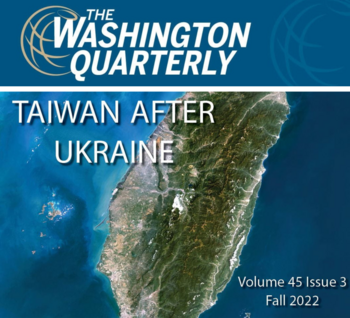
Aerial view of Taiwan and text "The Washington Quarterly, Vol 45 Issue 3, Fall 2022"
Compared to alliances like Japan and Australia, which seek to counter potential Chinese aggression, the role of South Korea is often secondary. Particularly with President Yoon’s new government in place, what can South Korea do to support U.S.-led efforts to compete with China, and what are the major hurdles in attaining deeper bilateral cooperation to enhance deterrence over Taiwan? 

To answer this question, the authors build upon traditional concepts of balancing to create a more granular, operationally relevant set of strategies for South Korea. They argue that, while it is politically infeasible for South Korea to fight side-by-side with US forces against China in a Taiwan scenario or to attempt to build its military sufficiently to deter the People’s Republic of China (PRC) from aggression against Taipei, these classic external and internal balancing strategies are not South Korea’s only options.

In this article, they provide background on South Korea’s approach to the Taiwan issue to date; evaluate South Korea’s strategic importance and what it can theoretically bring to the table; and explore how China and North Korea may respond to increased South Korean cooperation with the US, along with the potential obstacles this cooperation could create. Lastly, they recommend ways to leverage the US–South Korean alliance to enhance deterrence against China with respect to Taiwan.

All Publications button
1
Publication Type
Journal Articles
Publication Date
Journal Publisher
The Washington Quarterly
Authors
Oriana Skylar Mastro
Number
3
Paragraphs

Arzan Tarapore is the co-editor of the Asia Policy roundtable 'Minilateral Deterrence in the Indo-Pacific' and the co-author of its introductory essay, "Minilaterals and Deterrence: A Critical New Nexus." Oriana Skylar Mastro is the author of the first essay in the roundtable, "Deterrence in the Indo-Pacific." Excerpts from both essays are included below.


Excerpt from "Minilaterals and Deterrence: A Critical New Nexus," by Arzan Tarapore and Brendan Taylor:

As countries around the Indo-Pacific strive to manage the challenges of China’s growing power and assertiveness, they have emphasized two concepts. First, they have increasingly embraced “minilateral” groupings—small, issue-based, informal, and uninstitutionalized partnerships — as a way of coordinating international policy action.

Second, the United States and its allies, such as Australia and Japan, have renewed their commitment to deterrence to maintain regional stability. Rather than relying on institutions to deepen regional integration, which was their preferred option after the end of the Cold War, they are designing defense policies to dissuade potential adversaries, especially China, from revisionist behavior.

The Cold War produced a distinguished body of scholarship addressing the concept of deterrence.3 There is also a burgeoning literature on minilateral security cooperation in the Indo-Pacific.4 Yet little, if any, work has thus far addressed the potential convergence between these two increasingly dominant trends in the region’s security politics. By bringing together six leading security experts to explore the nexus between deterrence and minilateralism, this roundtable constitutes a first attempt to fill this gap. 


Excerpt from "Deterrence in the Indo-Pacific," by Oriana Skylar Mastro:

As China’s military might and tendency toward regional aggression grow, the United States and its allies are increasingly concerned with deterrence. Their strategies seek to prevent Beijing from disrupting the rules-based order in the Indo-Pacific by, for example, invading Taiwan or conducting gray-zone operations in the South China Sea.

Yet deterring China with minilateral groupings of states is more complex and difficult than traditional deterrence theory might suggest. This essay lays out some of the unique characteristics of the China challenge before considering how minilaterals can best enhance deterrence in these circumstances. 

All Publications button
1
Publication Type
Journal Articles
Publication Date
Subtitle

An Asia Policy roundtable co-edited by Arzan Tarapore, including an essay by Oriana Skylar Mastro.

Journal Publisher
Asia Policy
Authors
Oriana Skylar Mastro
Number
4
Authors
Noa Ronkin
News Type
News
Date
Paragraphs

Over the past decade, as China’s might and assertiveness have grown, countries around the Indo-Pacific have increasingly embraced informal partnerships, or minilateral groupings, to deepen international policy action and defense coordination. Two prominent examples of the minilateral model are the Quad, which comprises Australia, India, Japan, and the United States, and AUKUS, which includes Australia, the United Kingdom, and the United States. However, deterring China with minilateral groupings is more complex than traditional deterrence theory might suggest. Can minilateral groupings deter coercion and aggression in the Indo-Pacific, and if so, under what conditions? 

A collection of essays in a new Asia Policy roundtable tackles this question. Shorenstein APARC South Asia Research Scholar Arzan Tarapore is a co-editor of the roundtable. Center Fellow Oriana Skylar Mastro is the author of the first essay in the collection.


Sign up for APARC newsletters to receive our scholars' updates.

The roundtable brings together six leading security experts to explore the nexus between deterrence and minilateralism in Indo-Pacific security politics. The motivation for this endeavor, Tarpore and co-editor Brendan Taylor of the Australian National University explain in the roundtable introductory essay, is to fill the gap in the existing literature, which has largely not addressed the possible convergence between these two increasingly dominant trends in the region.

The roundtable opens with Mastro's essay, in which she identifies the unique characteristics of the China challenge and considers how minilateral groupings can best enhance deterrence in these circumstances. First, she explains why minilaterals, such as the Quad, could address some of the challenges of “deterrence by punishment.” This traditional form of deterrence employs the threat of severe penalties — ranging from economic sanctions to nuclear retaliation — to prevent attacks by an adversary. Here, Mastro says, “economic or political costs may have greater deterrent value against Beijing than military costs, thus creating an opportunity for the Quad.”

Next is the category of “deterrence by denial,” which includes strategies that prevent or limit aggressive actions of an adversary by creating the perception that they will not succeed. Such denial-based strategies are more effective than punishment-based ones in circumstances where China could blunt U.S. attempts at punishment or choose to incur the costs. But the United States, Mastro says, “does not have the regional force posture to deny China its objectives.” 

Mastro then considers a third, less analyzed category, “deterrence by resilience,” where the goal is to encourage the perception that disruptive events such as military operations will not be effective in attaining the adversary’s objectives. Here, “resiliency is about signaling to China that the benefits of a particular action are less than China believes them to be.” By building resiliency, smaller countries can push back against Chinese coercion to abide by China's interests. Countries in minilateral groupings should therefore prioritize this form of deterrence as they consider ways to cooperate, Mastro concludes.

Read More

 U.S. President Joe Biden speaks during the G7 summit at Schloss Elmau on June 26, 2022.
Commentary

Creativity Key for U.S. to Best China in Infrastructure Race

Biden's Partnership for Global Infrastructure and Investment can take lessons from successes involving the private sector.
Creativity Key for U.S. to Best China in Infrastructure Race
Chinese President Xi Jinping is applauded by senior members of the government and delegates.
Commentary

In China, Xi Jinping Is Getting an Unprecedented Third Term. What Should the World Expect?

Xi's plans are long term and unlikely to shift, but he can now be more aggressive than before in their pursuit.
In China, Xi Jinping Is Getting an Unprecedented Third Term. What Should the World Expect?
Emily Feng speaking at the 2022 Shorenstein Journalism Award.
News

Shorenstein Journalism Award Winner Emily Feng Examines the Consequences of China’s Information Void and the Future of China Reporting

The challenges facing foreign correspondents in China are forcing the West to reconfigure its understanding of the country, creating opacity that breeds suspicion and mistrust, says Emily Feng, NPR’s Beijing correspondent and recipient of the 2022 Shorenstein Journalism Award. But China seems to want the appearance of foreign media coverage without getting to the heart of what happens in the country.
Shorenstein Journalism Award Winner Emily Feng Examines the Consequences of China’s Information Void and the Future of China Reporting
Hero Image
U.S. President Joe Biden hosts a Quad Leaders Summit at the White House.
U.S. President Joe Biden hosts a Quad Leaders Summit along with Indian Prime Minister Narendra Modi, Australian Prime Minister Scott Morrison and Japanese Prime Minister Suga Yoshihide in the East Room of the White House on September 24, 2021 in Washington, DC.
Sarahbeth Maney-Pool/ Getty Images
All News button
1
Subtitle

A new Asia Policy roundtable considers whether and how minilateral groupings, such as the Quad and AUKUS, can deter coercion and aggression in the Indo-Pacific. The roundtable co-editor is APARC South Asia Research Scholar Arzan Tarapore, and it opens with an essay by Center Fellow Oriana Skylar Mastro.

Subscribe to Security