International Relations

FSI researchers strive to understand how countries relate to one another, and what policies are needed to achieve global stability and prosperity. International relations experts focus on the challenging U.S.-Russian relationship, the alliance between the U.S. and Japan and the limitations of America’s counterinsurgency strategy in Afghanistan.

Foreign aid is also examined by scholars trying to understand whether money earmarked for health improvements reaches those who need it most. And FSI’s Walter H. Shorenstein Asia-Pacific Research Center has published on the need for strong South Korean leadership in dealing with its northern neighbor.

FSI researchers also look at the citizens who drive international relations, studying the effects of migration and how borders shape people’s lives. Meanwhile FSI students are very much involved in this area, working with the United Nations in Ethiopia to rethink refugee communities.

Trade is also a key component of international relations, with FSI approaching the topic from a slew of angles and states. The economy of trade is rife for study, with an APARC event on the implications of more open trade policies in Japan, and FSI researchers making sense of who would benefit from a free trade zone between the European Union and the United States.

-

Myanmar’s junta is more than a year old.  The vast majority of the country’s people oppose the junta and favor democracy.  But the devil is in the details.  Many in the opposition want some form of multi-ethnic federal democracy.  But levels of disagreement and distrust among different communities, including some of the Ethnic Armed Groups, are impeding a unified vision to push the military out of power and establish civilian rule.  This webinar will examine the choices and challenges faced by the opponents of the regime as they try to unite these communities against it on behalf of a better future for Myanmar.

Image
Nyantha Maw Lin 041922
Nyantha Maw Lin is an independent analyst with more than a decade of interdisciplinary experience in government affairs, public policy, and political risk assessment related to Myanmar. Prior to the February 2021 coup, he supported community and stakeholder engagement efforts in Myanmar’s Rakhine State and served on a voluntary panel of industry and civil society representatives who advised the government on initiatives to fight corruption. He also helped to lead several innovative non-profit entities based in Yangon engaged in philanthropy, business, and social-impact activity. In addition to convening multi-sectoral dialogues with government, the private sector, and civil society in Myanmar, Nyantha has also participated in semi-official conversations elsewhere in Southeast Asia. A former Eisenhower Fellow (2018), he earned his BA in Political Science/International Relations from Carleton College (2008).  

Image
Marciel 041922
Scot Marciel has had a long career as an American diplomat serving in multiple countries, most recently as US Ambassador to Myanmar (2016-2020).  Earlier postings included as Ambassador to Indonesia (2010-2013) and concurrently as Ambassador for ASEAN affairs and Deputy Assistant Secretary of State for Southeast Asia (2007-2010).  He has also served in the Philippines and Vietnam.  His assignments at the State Department in Washington DC have included as Principal Deputy Assistant Secretary of State for East Asian Affairs and as Deputy Assistant Secretary of State of Southeast Asia.  Based on these experiences, he has been writing a book entitled “Imperfect Partners: The United States and Southeast Asia.”  He earned his MA at the Fletcher School of Law and Diplomacy (1983) and his BA in International Relations at the University of California at Davis (1981).

Donald K. Emmerson

 Via Zoom Webinar.

Nyantha Maw Lin Independent Analyst
1
Oksenberg-Rohlen Fellow
scot_marciel.jpg

Scot Marciel was the Oksenberg-Rohlen Fellow at the Freeman Spogli Institute for International Studies, affiliated with the Walter H. Shorenstein Asia-Pacific Research Center from 2022-2024. Previously, he was a 2020-22 Visiting Scholar and Visiting Practitioner Fellow on Southeast Asia at APARC.  A retired diplomat, Mr. Marciel served as U.S. Ambassador to Myanmar from March 2016 through May 2020, leading a mission of 500 employees during the difficult Rohingya crisis and a challenging time for both Myanmar’s democratic transition and the United States-Myanmar relationship.  Prior to serving in Myanmar, Ambassador Marciel served as Principal Deputy Assistant Secretary for East Asia and the Pacific at the State Department, where he oversaw U.S. relations with Southeast Asia.

From 2010 to 2013, Scot Marciel served as U.S. Ambassador to Indonesia, the world’s fourth most populous country.  He led a mission of some 1000 employees, expanding business ties, launching a new U.S.-Indonesia partnership, and rebuilding U.S.-Indonesian military-military relations.  Prior to that, he served concurrently as the first U.S. Ambassador for ASEAN Affairs and Deputy Assistant Secretary of State for Southeast Asia from 2007 to 2010.

Mr. Marciel is a career diplomat with 35 years of experience in Asia and around the world.  In addition to the assignments noted above, he has served at U.S. missions in Turkey, Hong Kong, Vietnam, Brazil and the Philippines.  At the State Department in Washington, he served as Director of the Office of Maritime Southeast Asia, Director of the Office of Mainland Southeast Asia, and Director of the Office of Southern European Affairs.  He also was Deputy Director of the Office of Monetary Affairs in the Bureau of Economic and Business Affairs.

Mr. Marciel earned an MA from the Fletcher School of Law and Diplomacy, and a BA in International Relations from the University of California at Davis.  He was born and raised in Fremont, California, and is married with two children.

Date Label
Visiting Practitioner Fellow on Southeast Asia, APARC, Stanford University
Panel Discussions
Authors
Michael Breger
News Type
Commentary
Date
Paragraphs

In February 2022, China’s Xi Jinping and Russia’s Vladimir Putin declared a partnership with no limits. Soon after, Russia invaded Ukraine, complicating the relationship of the two nations.

In conversation  WBUR's "On Point" with Meghna Chakrabarti, Center Fellow Oriana Skylar Mastro discussed the dynamics of the China-Russia relationship, and the implications of the war in Ukraine. 


Sign up for APARC newsletters to receive our experts' commentary and analysis.

"We shouldn't expect China to be forthcoming about support for Russia in Ukraine."
Oriana Skylar Mastro

According to Mastro, what China wants from the Russia-Ukraine War is a quick resolution through a negotiated settlement that provides Russia security assurances from the West and China legitimacy if they need to use force over Taiwan. "The China-Russia alignment is extremely deep," said Mastro "but the scope [of their security partnership] is very narrow." At present, Russia helps China challenge U.S. hegemony in Asia, but "we shouldn't expect China to be forthcoming about support for Russia in Ukraine."

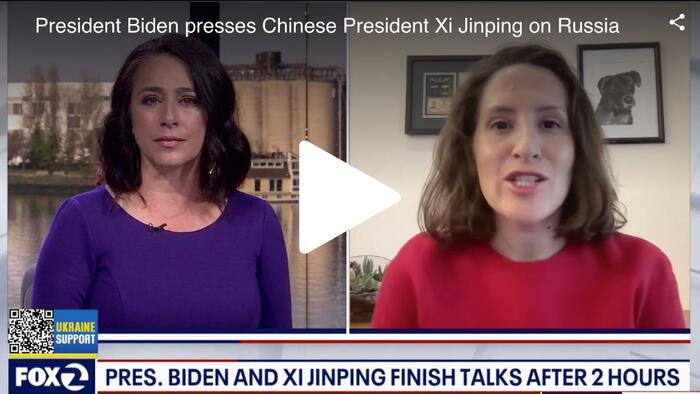
Mastro also spoke to Fox 2 KTVU following a two-hour phone call between President Biden and Chinese President Xi Jinping, in which Biden Warned Xi of ‘Consequences’ if China aids Russia’s invasion of Ukraine. Mastro remarked that China has "not come out in condemnation of this blatant use of force and China can't stand on the sidelines and expect for its reputation not to be tarnished if they continue to support Russia, even implicitly."

Image
Oriana Skylar Mastro on KTVU with a host of the show "Mornings on 2"

Mastro suggested that this moment has serious implications for the U.S.-China great power competition and that success in the U.S.-China relationship "isn’t about [the two powers] but about [their] relationships with the rest of the world...the United States is trying to compete with China economically, politically, and militarily around the world and [the United States has] commitments everywhere...China is very focused on the region, at least militarily, and that makes it difficult for the United States to compete."

Read More

Protesters display placards in front of the Representative Office of the Moscow-Taipei Coordination Commission to protest against Russia’s military invasion of Ukraine on February 25, 2022 in Taipei, Taiwan.
Commentary

Invasions Are Not Contagious

Russia’s War in Ukraine Doesn’t Presage a Chinese Assault on Taiwan
Invasions Are Not Contagious
Army Reserve members during practice
Commentary

Ukraine Is a Distraction from Taiwan

Getting bogged down in Europe will impede the U.S.’s ability to compete with China in the Pacific.
Ukraine Is a Distraction from Taiwan
Chinese military propaganda depicting the Second Taiwan Strait Crisis of 1958.
News

Reassessing China’s Capabilities and Goals for Strategic Competition

On the World Class podcast, Oriana Skylar Mastro argues that in order to set effective policy toward China, the United States needs to better understand how and why China is projecting power.
Reassessing China’s Capabilities and Goals for Strategic Competition
Hero Image
Putin and Xi Getty Images
All News button
1
Subtitle

On WBUR’s "On Point" and Fox 2 KTVU, Center Fellow Oriana Skylar Mastro shares insights about China's alignment with Russia and the worldwide implications of its calculus on Ukraine.

-

This event is made possible by generous support from the Korea Foundation and other friends of the Korea Program.

South Korean popular culture has spread to all corners of the globe, including South Korea’s closed-off neighbor to the north. While North Korea’s Kim Jong Un regime has sought to eradicate the presence of K-pop and South Korean television dramas in his country — even threatening execution for those who consume these cultural products — their popularity endures in North Korea. This panel will address questions relating to the spread of the Korean Wave (Hallyu) in North Korea. How widespread is consumption of South Korean popular culture in the North? Are these cultural products contributing to social change in North Korea, and if so, to what extent? Does the Korean Wave have the potential to contribute to political unrest and change in North Korea?

Speakers:

Image
portrait of Sunny Yoon

Sunny Yoon is a professor of Media and Communication at Hanyang University in Seoul. Her research encompasses the globalization of Korean media, the interaction of religion and new media, cultural politics, youth culture, and fandom of Korean popular culture. She is the author of Communication Technology and Creative Industries and Global Media and Asian Identity: Cultural Hybridity or Cultural Resistance, and she has authored papers and a book chapter on the impact of mobile media and South Korean media on North Korean youth culture and social change. She has served as Section Head for Visual Culture in the International Association for Media and Communication Research, as well as the editor-in-chief of the journal of Asian Communication Research. She has been a visiting fellow at Yale University and University of Cambridge, as well as a visiting professor at Doshisha University in Japan, National Taiwan University, and King's College London. Professor of Media and Communication, Hanyang University, Korea

Image
portrait of Suk-Young Kim

Suk-Young Kim is a professor of Theater and Performance Studies at UCLA where she also directs Center for Performance Studies. She is the author of Illusive Utopia :Theater, Film, and Everyday Performance in North Korea (Michigan, 2010), DMZ Crossing: Performing Emotional Citizenship Along the Korean Border (Columbia, 2014), and most recently, K-pop Live: Fans, Idols, and Multimedia Performance (Stanford, 2018). Her scholarship has been recognized by the James Palais Book Prize from the Association for Asian Studies, the Association for Theater in Higher Education Outstanding Book Award, and ACLS/SSRC/NEH International and Area Studies Fellowship. Currently She is working on a book titled Way Ahead of Squid Game (forthcoming in 2023), Millennial North Korea: Forbidden Media and Living Creatively with Surveillance (Stanford UP, under contract) and is editing Cambridge Companion to K-Pop. Her comments on Korean cultural politics have been featured in major media outlets, such as Billboard, CNN, NPR, and the New York Times.

Moderator: Haley Gordon, Research Associate in Korea Program at APARC, Stanford University

Via Zoom. Register at https://bit.ly/3JlGJDM

Panel Discussions

Shorenstein APARC
Stanford University
Encina Hall E301
Stanford, CA 94305-6055

(650) 497-2678
0
CheryllAlipio_2023_Headshot Ph.D.

Cheryll Alipio joined APARC in 2022 and serves as Associate Director for Program and Policy. Previously, she was the Program Director for Government Services and Engagement at the University of Maryland, College Park's Institute for Governmental Service and Research as well as Assistant Research Professor of Anthropology.

An economic and medical anthropologist, she has held teaching and research positions at York University in Canada, the University of Queensland in Australia, and the Asia Research Institute of the National University of Singapore. Her previous experience also includes roles with the Luce Scholars Program at The Asia Foundation and the Washington State Parks Foundation, among others.

Cheryll has extensive experience performing and administering qualitative, mixed methods, applied, and community-based research on contemporary Southeast Asia, Inter-Asia engagements, and Asia-U.S. relations. In addition, she has international and interdisciplinary research expertise and public service experience with nonprofits and NGOs.

She holds a Ph.D. and M.A. in Anthropology from the University of Washington and a B.A. in Anthropology and Psychology from the University of California, Davis. She is co-editor of Money and Moralities in Contemporary Asia (Amsterdam University Press, 2019), The ANNALS of the American Academy of Political and Social Science's special issue on "Transitioning to Adulthood in Asia" (2013), Children's Geographies' special section on "Asian Children and Transnational Migration" (2015), and the Journal of Modern Slavery's special issue on "New Research on Modern Slavery, Forced Labor, and Human Trafficking" (2022). In addition, she has authored several articles and book chapters on migration and development, transnationalism and diaspora, labor and governance, care work and health, and children and youth.

Associate Director for Program and Policy
Paragraphs

Image
Cover of the journal Asia Policy (vol 17.1, Jan. 2022)
How should we understand China’s grand strategy and intentions? The ascendance of Xi Jinping and the beginning of a slew of economic projects like the Belt and Road Initiative, interpreted by many as a tool in the framework of strategic competition with the United States, caused many to see Beijing as increasingly expansionist.5 Some more alarmist analysts, such as Department of Defense policy adviser Michael Pillsbury, have characterized China as having a grand scheme to supplant the United States as the sole global superpower.6 Others see strategic folly in overestimating the threat, focusing instead on the strong fundamentals of U.S. power7 or emphasizing China’s weaknesses and domestic challenges.8 Indeed, the range of academic inquiry and conflicting viewpoints is a testament to the complexity of understanding China and its role on the global stage.

Enter The Long Game: China’s Grand Strategy to Displace American Order, one of the most recent and significant attempts to understand what China wants. Written by Rush Doshi, a former Brookings fellow turned National Security Council staffer in the Biden administration, the book encapsulates rigorous social-scientific research approaches, clear argumentation, and policy relevance as well as is accessible to the average reader. 

All Publications button
1
Publication Type
Journal Articles
Publication Date
Subtitle

Oriana Skylar Mastro reviews Rush Doshi’s book The Long Game: China’s Grand Strategy to Displace American Order (New York: Oxford University Press, 2021).

Journal Publisher
Asia Policy
Authors
Oriana Skylar Mastro
Authors
Oriana Skylar Mastro
News Type
Commentary
Date
Paragraphs

This essay was originally published in Foreign Affairs magazine.

As Russian President Vladimir Putin intensifies his assault on Ukraine, a growing number of U.S. military and foreign policy analysts are voicing concern that China may be emboldened by Russia’s example and try to take Taiwan by force. “If Russia can grab chunks of Ukraine or install a puppet regime and withstand economic sanctions, that could embolden nationalists in China to look to Taiwan and think they could do the same,” Ian Johnson, a China expert at the Council on Foreign Relations, has argued. Representative Michael McCaul, Republican of Texas, made a similar argument in an interview last month, as did retired Army General Jack Keane, who said that Chinese President Xi Jinping sees “weakness in the West and how that can advantage him in terms of his national objectives as well.”

Xi is certainly watching events in Ukraine, but his calculus for whether to use force against Taiwan is shaped primarily by domestic factors, not foreign ones. As I have argued in Foreign Affairs, Chinese leaders are considering “armed reunification” with Taiwan more seriously than at any time in the last 50 years. But Xi will assert Chinese control over the island only if he is confident his military can conduct a successful amphibious invasion and if he believes the timing is right for his own career.


Sign up for our newsletters to receive in-depth analysis from our experts.


Shifts in the international environment would be important for Taiwan if they changed Xi’s thinking on either count. But the war in Ukraine has not. Xi’s views about U.S. power and resolve and about the likely international response to an invasion of Taiwan probably remain unchanged. If anything, China’s desire not to invite comparisons with Russia at a time when the world is united against Moscow will lengthen its timeline for taking control of Taiwan, not shorten it.

Too Big to Sanction?

The economic sanctions that the United States, Canada, and many European countries have imposed on Russia give China little reason for pause. To the contrary, these punitive measures simply confirm Beijing’s previous assessments of the possible economic repercussions of using force against Taiwan. Chinese leaders expect the economic costs of an invasion to be heavy but acceptable—partly because of how the international community has responded to Chinese provocations in the past and partly because Beijing’s foreign policy is designed to convince countries to stay out of China’s “internal” affairs, such as the status of Taiwan.

That is not to say the economic measures Washington and its allies have imposed on Russia in recent days are insignificant. The United States and European countries have blocked Russia’s access to most of its foreign currency reserves, making it impossible for Moscow to intervene to prop up its collapsing currency. They have frozen the assets of senior Russian officials, including Putin himself. And they have moved to exclude big Russian banks from SWIFT, the global financial messaging system.

China’s ability to retaliate against the West with economic sanctions of its own is much greater than Russia’s.
Oriana Skylar Mastro

But the United States and its allies could do more to punish Russia. They could bar all transactions with Russia, whether trade or financial. They could seize all Russian assets within their jurisdictions. Washington could announce secondary sanctions on anyone using U.S. dollars for any transaction with Russia. Most important, the United States could use these and other measures to prevent Russia from exporting oil and gas. Letting Russia continue to export oil and gas would be like letting China sell consumer electronics even after it had taken Taiwan by force.

If the United States and its allies have been cautious in their response to Russia, they are likely to be even more restrained when responding to China — and Beijing knows it. China’s ability to retaliate against the West with economic sanctions of its own is much greater than Russia’s. Singapore, which announced trade and banking restrictions against Moscow, trades about $2.5 billion worth of goods with Russia each year — but $57 billion worth of goods with China. China’s leaders likely do not fear U.S.-led economic sanctions in the event of a Taiwan takeover because they probably think that China’s own productive capacity, resources, and friendly partners will allow them to survive on their own, especially since China will soon be the world’s largest economy. They are probably right. China could absorb the types of sanctions being imposed on Russia. And given China’s ability to inflict pain on Western countries, any measures levied against Beijing would likely be softer than those imposed on Moscow.

Taiwan Is Not Ukraine

The Western military response to Russia’s invasion of Ukraine will have an even smaller impact than sanctions on China’s thinking about Taiwan. True, neither the United States nor NATO has deployed troops to fight on Ukraine’s behalf. And U.S. military assistance to Ukraine has been modest: late last month, President Joe Biden instructed the State Department to release up to an additional $350 million worth of weapons from U.S. stocks to Ukraine.

But Russia would have to invade a NATO ally without provoking a U.S. military response for Chinese leaders to seriously question Washington’s commitment to defending Taiwan. Biden has made clear from the beginning of the crisis that his administration will never send troops to Ukraine—a stark contrast with his rhetoric on Taiwan. Just last week, Biden stated unequivocally that the United States would defend Taiwan in the event of a Chinese attack. As a show of support, he also sent to the island a delegation of former U.S. officials led by Mike Mullen, a former chairman of the Joint Chiefs of Staff.

Chinese planners largely assume the United States would intervene militarily on behalf of Taiwan.
Oriana Skylar Mastro

In any case, Chinese planners largely assume the United States would intervene militarily on behalf of Taiwan. What some of them question is whether the United States could amass enough forces fast enough to blunt a Chinese assault on the island. Ironically, if the United States had launched a military operation in response to Russia’s invasion of Ukraine, Chinese leaders would have had further reason to question Washington’s ability to thwart a Chinese assault on Taiwan. The United States does not have the resources to fight the Russians in Europe and prepare adequately for a great-power war in Asia.  

Of course, these facts have not prevented China from trying to manipulate the narrative to undermine Taiwan’s resolve. Chinese state media has been flush with stories about how the United States did not come to Ukraine’s aid and therefore won’t come to Taiwan’s either. Like much of what appears on Chinese state media, however, these stories reflect what Chinese leaders want the world to believe—not what they believe themselves.

Not the Right Time

Chinese leaders are without a doubt considering an attack on Taiwan, but now is not the right time. China’s military is still honing the capabilities it would need to take and hold the island. And Xi is unlikely to take a dangerous gamble on Taiwan before the next Party Congress in late 2022, when he is widely expected to secure a third term as general secretary of the Chinese Communist Party. Xi is also working hard to lessen China’s technological dependence on the West, thus minimizing the impact on any further decoupling after a possible war. For all these reasons, an assault on Taiwan before 2025 is unlikely.

If anything, the crisis in Ukraine creates an additional incentive for China to wait. Beijing does not want the world to equate the two scenarios. From China’s perspective, Ukraine is an independent country engaged in a border dispute with Russia. Taiwan, by contrast, “has always been an inalienable part of China’s territory,” as China’s ambassador to the Association of Southeast Asian Nations, Deng Xijun, put it late last month. In other words, linking the two issues would undermine China’s claim to the island.

China also understands that moving against Taiwan now would solidify fears in the West of an axis of autocrats. The United States may not have the resolve to fight a protracted war to defend Taiwan. But suddenly faced with a need to defend freedom and democracy against an authoritarian alliance, Washington could muster a greater military response and convince its allies to do the same. Partly for this reason, China has desperately tried to maintain some semblance of neutrality during the Ukrainian crisis.

Russia’s invasion of Ukraine has certainly changed aspects of the international order. It has rallied European countries against Russia, prompted Germany to increase defense spending, and even convinced historically neutral countries such as Finland, Sweden, and Switzerland to take a stance against Moscow. From China’s perspective, however, nothing Russia or its adversaries have done meaningfully alters the calculus on Taiwan. 

Headshot of Oriana Skylar Mastro

Oriana Skylar Mastro

Center Fellow at the Freeman Spogli Institute for International Studies

Read More

Army Reserve members during practice
Commentary

Ukraine Is a Distraction from Taiwan

Getting bogged down in Europe will impede the U.S.’s ability to compete with China in the Pacific.
Ukraine Is a Distraction from Taiwan
President Xi and Kim Jong Un meet on a TV screen
Commentary

North Korea Is Becoming an Asset for China

Pyongyang’s Missiles Could Fracture America’s Alliances
North Korea Is Becoming an Asset for China
Chinese military propaganda depicting the Second Taiwan Strait Crisis of 1958.
News

Reassessing China’s Capabilities and Goals for Strategic Competition

On the World Class podcast, Oriana Skylar Mastro argues that in order to set effective policy toward China, the United States needs to better understand how and why China is projecting power.
Reassessing China’s Capabilities and Goals for Strategic Competition
Hero Image
Protesters display placards in front of the Representative Office of the Moscow-Taipei Coordination Commission to protest against Russia’s military invasion of Ukraine on February 25, 2022 in Taipei, Taiwan.
Lam Yik Fei/ Getty Images
All News button
1
Subtitle

Russia’s War in Ukraine Doesn’t Presage a Chinese Assault on Taiwan

Date Label
Paragraphs
3D mockup cover of APARC's volume 'South Korea's Democracy in Crisis'

Like in many other states worldwide, democracy is in trouble in South Korea, entering a state of regression in the past decade, barely thirty years after its emergence in 1987. The society that recently had ordinary citizens leading “candlelight protests” demanding the impeachment of Park Geun-hye in 2016-17 has become polarized amid an upsurge of populism, driven by persistent structural inequalities, globalization, and the rise of the information society. 

The symptoms of democratic decline are increasingly hard to miss: political opponents are demonized, democratic norms are eroded, and the independence of the courts is whittled away. Perhaps most disturbing is that this all takes place under a government dominated by former pro-democracy activists.

The contributors to this volume trace the sources of illiberalism in today’s Korea; examine how political polarization is plaguing its party system; discuss how civil society and the courts have become politicized; look at the roles of inequality, education, and social media in the country’s democratic decline; and consider how illiberalism has affected Korea’s foreign policy. 

Table of Contents

Introduction
Korea’s Democratic Decay: Worrisome Trends and Pressing Challenges
Gi-Wook Shin and Ho-Ki Kim

1. Why Is Korean Democracy Majoritarian but Not Liberal?
Byongjin Ahn

2. Uses and Misuses of Nationalism in the Democratic Politics of Korea
Aram Hur

3. The Weakness of Party Politics and Rise of Populism in Korea
Kwanhu Lee

4. The Politicization of Civil Society: No Longer Watchdogs of Power, Former Democratic Activists Are Becoming New Authoritarian Leaders 
Myoung-Ho Park

5. The Politicization of the Judiciary in Korea: Challenges in Maintaining the Balance of Power
Seongwook Heo

6. Two Divergences in Korea’s Economy and Democracy: Regional and Generational Disparities
Jun-Ho Jeong and Il-Young Lee

7. Democracy and the Educational System in Korea 
Seongsoo Choi

8. Social Media and the Salience of Polarization in Korea
Yong Suk Lee

9. Illiberalism in Korean Foreign Policy
Victor Cha

10. The Democratic Recession: A Global and Comparative Perspective
Larry Diamond

Epilogue
Korea’s 2022 Presidential Election: Populism in the Post-Truth Era
Ho-Ki Kim and Gi-Wook Shin

Media Coverage

To celebrate the publication of South Korea's Democracy in Crisis, APARC held a book launch seminar in Seoul on June 14, 2022. The event received extensive coverage in Korean media, including the following:

Desk, examination, or review copies can be requested through Stanford University Press.

All Publications button
1
Publication Type
Books
Publication Date
Subtitle

The Threats of Illiberalism, Populism, and Polarization

Authors
Gi-Wook Shin
Book Publisher
Shorenstein APARC
-

Time:  7:30am-8:45am  California, USA 2 March 2022 
9:00pm-10:15pm New Delhi, India 2 March 2022
 

India’s international position has evolved sharply in the first two decades of the 21st century, and it is poised to become only more consequential in coming decades. Its strategic interests and influence have now stretched into the distant reaches of the Indo-Pacific, it has emerged as a central actor in managing global governance challenges like climate change, and it may have the capacity to take a commanding position in some key leading-edge technologies. In this webinar, veteran journalist Indrani Bagchi, who spent nearly two decades covering India’s foreign relations for the Times of India, will reflect on India’s recent trajectory and its prospects. Through the prism of some key episodes and issues of India in the 21st century, the webinar will examine India’s capacity and approach to manage international issues, as well as the constraints and challenges Indian policymakers must face. 

Speaker: 

Image
Headshot photo of Indrani Bagchi
Indrani Bagchi is CEO-designate at Ananta Aspen Centre, India. She was Associate Editor with the Times of India, where she reported and analyzed foreign policy issues for the newspaper from 2004 until 2022. As Diplomatic Editor, Indrani covered the Ministry of External Affairs (MEA) on her news beat, and interpreted and analyzed global trends with an Indian perspective. Earlier, Indrani worked with India Today, the Economic Times and The Statesman, and has held fellowships at Oxford University and the Brookings Institution. She is a Fellow of the Kamalnayan Bajaj Fellowship Class 3 of the Ananta Aspen Centre and a member of Aspen Global Leadership Network. She graduated from Loreto College, Calcutta University with English honors. 

Moderator:

Image
Photo Portrait of Arzan Tarapore
Arzan Tarapore is the South Asia research scholar at the Shorenstein Asia-Pacific Research Center at Stanford University, where he leads the newly-restarted South Asia research initiative. He is also a senior nonresident fellow at the National Bureau of Asian Research. His research focuses on Indian military strategy and contemporary Indo-Pacific security issues. Prior to his scholarly career, he served as an analyst in the Australian Defense Department. Arzan holds a PhD in war studies from King’s College London. 


This event is co-sponsored by Center for South Asia

Via Zoom  Register at:
https://bit.ly/3HXiwTy

Indrani Bagchi, CEO-designate, Ananta Aspen Centre, India<br> Panelist
<br>Arzan Tarapore, South Asia Research Scholar, Shorenstein APARC Moderator South Asia Research Scholar, Shorenstein APARC
Seminars
Authors
Oriana Skylar Mastro
News Type
Commentary
Date
Paragraphs

This essay was originally published in Foreign Affairs magazine.

On January 30, North Korea fired an intermediate-range ballistic missile from the north province of Jagang, its seventh rocket test this year. At first glance, this may not seem like a huge deal. The rockets are not, after all, the nuclear bombs and intercontinental ballistic missiles (ICBMs) that North Korea has tested in the past. Russia is currently massing troops on the Ukrainian border, and COVID-19 cases are surging around the world thanks to the Omicron variant. By comparison, the launches may look like a lesser concern—just another routine military provocation from Pyongyang.

But the tests aren’t coming at a routine moment. Instead, they are occurring at a time of stark, rising competition between the United States and the Pacific’s other great power: China. Washington sold nuclear submarines to Australia as part of a new, trilateral security arrangement along with the United Kingdom. U.S. assistant secretary of defense Ely Ratner declared that deterring China from attacking Taiwan is “an absolute priority.” In explaining the United States’ withdrawal from Afghanistan, U.S. President Joe Biden argued Washington needed to refocus its energy and resources on the “serious competition with China.” The pivot to Asia, long elusive, is clearly underway.


Sign up for APARC newsletters to receive our experts' commentary and analysis.


In this context, North Korea’s tests take on a new meaning—and it is dangerous for U.S. ambitions. The heightened threat of North Korean missile attacks incentivizes both Japan and South Korea to avoid alienating Beijing, which they hope will help keep Pyongyang in check. (China is North Korea’s main patron and sole ally.) It also means both Japan and South Korea are likely to redouble their militaries’ focus on Pyongyang rather than support U.S. operations elsewhere in Asia. And if the United States has to bolster its armed posture on the Korean Peninsula, whether to assuage Seoul’s and Tokyo’s fears, better deter North Korea, or fight in an actual conflict, Washington will need to reposition forces designed to constrain China elsewhere. Pyongyang’s weapons program was long seen as a liability for Beijing, given the erratic and unpredictable behavior of North Korea’s leaders. Now, it is becoming an asset.

For China, this switch comes at an opportune time. Under President Xi Jinping, Beijing has grown more impatient, expansionist, and belligerent. It is increasingly possible that China will try to seize control of Taiwan, especially since the peaceful unification of the mainland and the island is clearly no longer an option. Xi is closely watching the U.S. response to North Korea’s provocations and drawing lessons about Washington’s credibility. To prevent conflict in the Korean Peninsula and keep pace in its competition with Beijing, the United States will need to come up with new ways to unite its allies and prove its resolve in the region.

Cracking Through

North Korea’s latest rockets may not be capable of reaching the continental United States, but that hardly means they aren’t dangerous. Missile defense systems cannot see low-flying objects until they are near their targets, and this year’s first and second tests were of hypersonic advanced boost-glide vehicle missiles, which can travel at low altitudes, evade radar, and maneuver to avoid last-second interception. In the third test, the North Korean military successfully launched a missile off a moving train, indicating that Pyongyang can fire rockets from a mobile system, in turn making both tracking and targeting even more difficult (especially given the country’s vast railway system). In other words, these recent tests may have neutralized U.S. missile defense capabilities, such as the U.S.-deployed Terminal High Altitude Area Defense missile system and the Aegis Ballistic Missile Defense system.

These capabilities were designed to protect Japan and, especially, South Korea. Their erosion comes at a tricky time for the United States’ relations with the latter. Biden has yet to designate a U.S. ambassador to Seoul, and he appointed a special envoy for North Korea only in May of last year. The president placed new sanctions on North Korea in December 2021, but they were human rights-related and largely viewed as symbolic. In response to January’s missile threats, the Biden administration implemented its first weapons-related sanctions, but they were relatively limited in scope. Some South Korean analysts now believe that the administration discusses North Korean issues with Seoul not because it seriously intends to resolve them but more to persuade the South Korean government to help the United States compete against Beijing. South Koreans fear that the Biden administration’s prioritization of China comes at the expense of the denuclearization of North Korea.

North Korea has explicitly tied its missiles to U.S. involvement in Taiwan.
Sungmin Cho and Oriana Skylar Mastro

This is a welcome development for Beijing. Chinese analysts view South Korea as a weak link in the United States’ East Asian alliances, and Beijing is trying to divide Washington and Seoul through a combination of compliments and threats. In August 2020, Chinese media praised South Korea’s efforts to "be objective and keep its friendship with China," and several weeks later, Chinese scholars commended South Korea’s “kindness to China” in a time of “U.S. suppression.” But after South Korean President Moon Jae-in discussed Taiwan with Biden at their May 2021 summit, China’s Foreign Ministry warned South Korea not to “play with fire.” It is telling that Chinese scholars at a government-affiliated institute are arguing openly that China needs to raise the cost of South Korea’s cooperation with the United States on Taiwan.

North Korea’s missile capabilities are helping accomplish this task. The newer rockets more effectively threaten South Korea, and they increase Seoul’s doubts about the efficacy of U.S. deterrence. North Korea has explicitly tied its menacing assets to the issues surrounding the island. Pyongyang has publicly criticized the United States policies’ on Taiwan and threatened that “tragic consequences” will result from U.S. support. “The indiscreet meddling by the U.S. into the issue of Taiwan entails a potential danger of touching off a delicate situation on the Korean peninsula,” North Korea’s vice foreign minister said in a statement. These words could make Seoul think twice about backing the United States in the Taiwan Strait.

Japan is more difficult to split from Washington. But North Korea’s activities can certainly draw some of Japan’s attention away from Beijing. Although Tokyo was getting onboard with playing a greater role in deterring China and defending Taiwan, Japan’s Ministry of Defense has identified North Korea’s military capabilities as a “grave and imminent” threat, and there is no doubt that the government’s focus will shift if Pyongyang escalates its provocations. In the White House’s statement regarding Biden’s January 21 meeting with Japanese Prime Minister Fumio Kishida, Taiwan was mentioned only once. In comparison, the two leaders cited North Korea three times, condemned the country’s recent missile tests, and committed to work with South Korea more closely. Although Tokyo could theoretically focus on both North Korea and China, in practice it might struggle. Pyongyang poses a far more direct threat to Japanese lives and territory than does Beijing, and it would be hard for Japanese leaders to concentrate on China if North Korea grows more belligerent.

Drawing the Heat

North Korea’s new capabilities don’t help Beijing just diplomatically. The tests provide tangible, military benefits. The United States has been attempting to enlist South Korea in its efforts to strengthen deterrence across the Taiwan Strait. But Pyongyang’s new missiles mean Seoul is less likely to focus its military somewhere other than North Korea, especially if it continues the provocations. Indeed, a South Korean expert on Chinese politics has argued that when Washington asks for support in its contest with Beijing, Seoul should explain that it is too busy handling Pyongyang.

To reassure its allies, the United States may also need to refocus military attention on the Korean Peninsula, reducing its ability to operate in other parts of Asia. In 2017, when North Korea conducted ICBM and nuclear tests, the United States responded by sending more strategic assets, including heavy naval power, near the Korean Peninsula. If tensions rise high enough, Washington may have to do so again, including by shifting the Seventh Fleet’s operational focus to the area. Stationed in the middle of Japan, this fleet has been one of the United States’ primary tools for deterring Beijing, conducting patrols near the Taiwan Strait and promoting freedom of navigation in the South China Sea. But given past positioning patterns, a crisis on the Korean Peninsula would also most certainly drag the fleet farther north, undermining Washington’s ability to carry out operations elsewhere.

A major war on the Korean Peninsula would prove particularly devastating to the United States’ competition with Beijing. In addition to the Seventh Fleet, the United States Forces Korea’s 28,000 soldiers, 40 F-16 fighters, 90 military aircrafts, 40 attack helicopters, and other assets would immediately become unavailable for operations beyond the peninsula. A majority of the United States Forces Japan’s aircraft, ships, and approximately 55,000 military personnel would also be deployed to Korea. Japan’s own military, which could help the United States if it needed to fight China, would grow busy providing combat support to protect U.S. naval forces—including antisubmarine operations and sea minesweeping—as U.S. troops prepared for an amphibious landing on the peninsula.

For China, a crisis on the Korean Peninsula would be a golden opportunity.
Sungmin Cho and Oriana Skylar Mastro

Beijing, by comparison, is in a better position. The United States has to worry that China will use a North Korea–spurred crisis to invade Taiwan, but the inverse isn’t true: Beijing isn’t concerned that Seoul or Washington will start a war over Taiwan if Pyongyang launches an attack. China’s commitment to North Korea is also not as comprehensive as the United States’ is to Seoul. In the event of a renewed Korean war, China plans to send mostly ground forces into the North. Its air and naval assets would remain focused across the Taiwan Strait.

For China, therefore, a crisis on the peninsula—especially one that evolves into a conflict—would be a golden opportunity to expand its power. It may even make it possible to defeat Taipei. With U.S. intelligence assets supporting troops in Korea, a Chinese amphibious force might be able to move on the island without giving the United States advanced warning. China could establish beachheads on Taiwan long before U.S. forces, bogged down on the peninsula, have time to arrive. The war’s eventual outcome would be a fait accompli.

North Korea’s latest tests may have already made a Chinese attack more likely. As Chinese media happily pointed out, Pyongyang’s January 11 missile launch briefly confused the United States Northern Command’s warning system, grounding some commercial airplanes for 15 minutes. China has the most advanced ballistic and cruise missile program in the world. If North Korea’s offensive strike capability can jeopardize the U.S. early warning system, it surely bodes well for Beijing’s ability to surprise and defeat Washington’s forces.

Better Together

To counter North Korea’s new missile threats and prevent them from helping China, the Biden administration needs a stronger North Korea strategy—one that deters further provocations, reassures South Korea, and demonstrates Washington’s continued resolve and credibility to Beijing. That means Washington must support South Korea’s efforts to advance its offensive capabilities, such as the development of nuclear-powered submarines. South Korea, meanwhile, must scale up its combined exercises with the United States. A stronger U.S.–South Korean alliance will improve the two countries’ combat readiness, which is especially critical at a time when North Korea appears to be building up to another round of ICBM and nuclear tests. Finally, closer ties would make it easier for the United States to marshal allies in its competition against China, including in the Taiwan Strait.

The United States should also use the renewed tensions on the Korean Peninsula to encourage closer Japanese–South Korean cooperation. Seoul has long had highly fraught relations with its former colonial ruler, and the two states have especially struggled to get along in recent years. But for better or worse, the Korean Peninsula, East China Sea, and Taiwan Strait are increasingly intertwined in the current era of strategic competition. Pyongyang's provocations against the United States and its allies on the peninsula can embolden the Chinese Communist Party to act in other regions. And if Beijing can weaken or defeat the United States and its Asian allies anywhere, both the Chinese Communist Party and the Kim regime will be emboldened to act on the peninsula. To cope with this changing security environment, it makes sense for strategists in Washington, Seoul, and Tokyo to package these issues together. By demonstrating greater coordination, the three countries would also make it harder for China or North Korea to fracture Washington’s East Asia alliances, regardless of the contingency.

Finally, these three states must prepare for simultaneous provocations in East Asia, including concurrent conflicts in Taiwan and on the Korean Peninsula. In consultation with one another, the United States and its allies must demonstrate a strong willingness to cooperate and take strategic risks. They should hold more trilateral defense minister meetings, more thoroughly review various contingency scenarios, and discuss how to enhance their combined capabilities. Hopefully, these countries will never need to put these plans and abilities into practice. But to deter Kim Jong Un and Xi Jinping, they need to prove that they can fight two wars—and win both—if the need arises.

Headshot of Oriana Skylar Mastro

Oriana Skylar Mastro

Center Fellow at the Freeman Spogli Institute for International Studies
Full Biography

Read More

Chinese military propaganda depicting the Second Taiwan Strait Crisis of 1958.
News

Reassessing China’s Capabilities and Goals for Strategic Competition

On the World Class podcast, Oriana Skylar Mastro argues that in order to set effective policy toward China, the United States needs to better understand how and why China is projecting power.
Reassessing China’s Capabilities and Goals for Strategic Competition
Taiwan
Commentary

America's Future in Taiwan

Intensifying threats of a military conflict over Taiwan have brought uncertainty to the stability of regional security for Southeast Asia, according to Center Fellow Oriana Skylar Mastro on radio show On Point.
America's Future in Taiwan
An Island that lies inside Taiwan's territory is seen with the Chinese city of Xiamen in the background.
Commentary

The Taiwan Temptation

Why Beijing Might Resort to Force
The Taiwan Temptation
Hero Image
President Xi and Kim Jong Un meet on a TV screen Chung Sung-Jun, Getty Images
All News button
1
Subtitle

Pyongyang’s Missiles Could Fracture America’s Alliances

Date Label
-

Time:  7:30am-8:45am  California, USA 15 February 2022 
3:30pm-4:45pm London, UK 15 February 2022
11:30pm-12:45am  Singapore, 15-16 February 2022

How does India’s civil-military relationship affect its security? Historically, civil-military relations have been characterized by an “absent dialogue,” with the military enjoying almost complete operational autonomy in planning and fighting wars. But that arrangement has produced some mixed results for Indian national security, and is coming under increasing strain in an environment of intensifying peacetime strategic competition. New Delhi recognizes the need for reform, and has made some halting progress. This webinar will examine the evolution of civil-military relations in India, the challenges with the current configuration, and the agenda for reform that will face the next Chief of Defence Staff.

Speakers: 

Image
anit_mukherjee
Anit Mukherjee is an Associate Professor at the S. Rajaratnam School of International Studies (RSIS), Nanyang Technological University, in Singapore. He is the award-winning author of The Absent Dialogue: Politicians, Bureaucrats and the Military in India, the definitive analysis of Indian civil-military relations. He is also Non-Resident Visiting Scholar at the Center for the Advanced Study of India (CASI), University of Pennsylvania, and at Centre for Social and Economic Progress (CSEP), New Delhi. Prior to his academic career, he was a Major in the Indian Army and is an alumnus of India’s National Defence Academy (NDA), Khadakwasla. Anit holds a Ph.D. from Johns Hopkins University.

Image
saawani
Saawani Raje-Byrne is a lecturer (assistant professor) in International History at the Department of War Studies, King’s College London. She is currently working on a book, based on her PhD dissertation, that presents novel theoretical analysis and detailed historical case studies of Indian civil-military relations. She previously taught at Defence Studies Department at King’s, and the Joint Services Command and Staff College at Shrivenham, and was a researcher at the Centre for Policy Research, New Delhi. She holds a PhD from King’s College London, and a BA from the University of Cambridge.

Moderated by :
Arzan Tarapore, South Asia research scholar at the Shorenstein Asia-Pacific Research Center, Stanford University

This event is co-sponsored by Center for South Asia

Via Zoom  Register at:
https://bit.ly/3HpyMMO

Seminars
Subscribe to International Relations