Society

FSI researchers work to understand continuity and change in societies as they confront their problems and opportunities. This includes the implications of migration and human trafficking. What happens to a society when young girls exit the sex trade? How do groups moving between locations impact societies, economies, self-identity and citizenship? What are the ethnic challenges faced by an increasingly diverse European Union? From a policy perspective, scholars also work to investigate the consequences of security-related measures for society and its values.

The Europe Center reflects much of FSI’s agenda of investigating societies, serving as a forum for experts to research the cultures, religions and people of Europe. The Center sponsors several seminars and lectures, as well as visiting scholars.

Societal research also addresses issues of demography and aging, such as the social and economic challenges of providing health care for an aging population. How do older adults make decisions, and what societal tools need to be in place to ensure the resulting decisions are well-informed? FSI regularly brings in international scholars to look at these issues. They discuss how adults care for their older parents in rural China as well as the economic aspects of aging populations in China and India.

-

IMPORTANT EVENT UPDATE:

In keeping with Stanford University's March 3 message to the campus community on COVID-19 and current recommendations of the CDC, the Asia-Pacific Research Center is electing to postpone this event until further notice. We appreciate your understanding and cooperation as we do our best to keep our community healthy and well. 


Co-sponsored by Shorenstein Asia-Pacific Research Center (APARC) and Center for South Asia (CSA).

When does mass nonviolent mobilization for political change occur, what prevents it from degenerating into violence, and when does it succeed in extracting concessions? We examine these questions in the context of India's movement for independence from Britain, and point to the key roles played by economic shocks and organization in the success of nonviolence.

Image
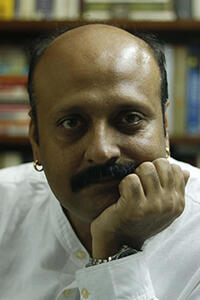
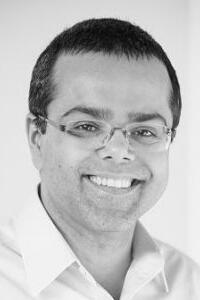
Rikhil Bhavnani

Rikhil R. Bhavnani is an Associate Professor in the Department of Political Science at the University of Wisconsin–Madison, and a faculty affiliate at the La Follette School of Public Affairs, the Elections Research Center and the Center for South Asia.

Professor Bhavnani’s research and teaching focus on inequalities in political representation, the political economy of migration, and the political economy of development. His research is particularly concerned with causal identification, and is focused on South Asia. Bhavnani is the co-author, with Bethany Lacina, of a book on the backlash against within-country migration across the developing world, published by Cambridge University Press. His articles have been published or are forthcoming in the American Political Science Review, American Journal of Political Science, Journal of Politics, World Politics, the American Economic Journal: Applied Economics, and other outlets. 

Prior to starting at UW–Madison, Professor Bhavnani was a visiting fellow at the Center for the Study of Democratic Politics at Princeton University. He has worked at the Center for Global Development and the International Monetary Fund, and received a PhD in political science and an MA in economics from Stanford University, and a BA in political science and economics from Yale University.

Rikhil Bhavnani, <i>Associate Professor, Department of Political Science</i> University of Wisconsin–Madison
Seminars
Shorenstein APARCStanford UniversityEncina Hall E301Stanford, CA 94305-6055
0
Visiting Scholar at APARC, 2019-2020
Ph.D.

Jialiang Huang joined the Walter H. Shorenstein Asia-Pacific Research Center (APARC) from November 2019 to May 2020 as visiting scholar from Renmin University, where he serves as Associate Professor in the Department of Sociology.  At APARC, he conducted research on grassroots social governance in China.

Authors
Noa Ronkin
News Type
News
Date
Paragraphs

Southeast Asia, home to over 640 million people across 10 countries, is one of the world’s most dynamic and fastest growing regions. APARC just concluded the year 2019 with a Center delegation visit to two Southeast Asian capital cities, Hanoi and Bangkok, where we spent an engaging week with stakeholders in the academic, policy, business, and Stanford alumni communities.

Led by APARC Director Gi-Wook Shin, the delegation included APARC Deputy Director and Asia Health Policy Program Director Karen Eggleston, Southeast Asia Program Director Donald Emmerson, and APARC Associate Director for Communications and External Relations Noa Ronkin. Visiting Scholar Andrew Kim joined the delegation in Bangkok.

With a focus on health policy, our first day in Hanoi included a visit to Thai Nguyen University, a meeting with government representatives at the Vietnam Ministry of Health, and a seminar on healthy aging and innovation jointly with Hanoi Medical University.

Image
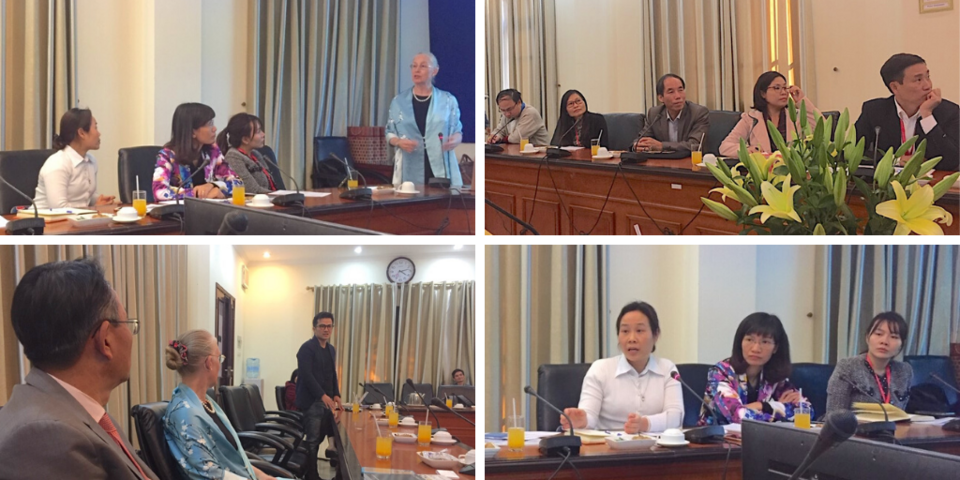
Collage of four images showing participants at a roundtable held at Hanoi Medical University with APARC delegation members

Karen Eggleston and participants at the roundtable held at Hanoi Medical University, December 9, 2019.

Throughout the day, Eggleston presented some of her collaborative research that is part of two projects involving international research teams: one that assesses public-private roles and institutional innovation for healthy aging and another that examines the economics of caring for patients with chronic diseases across diverse health systems in Asia and other parts of the world. We appreciated learning from our counterparts about the health care system and health care delivery in Vietnam.

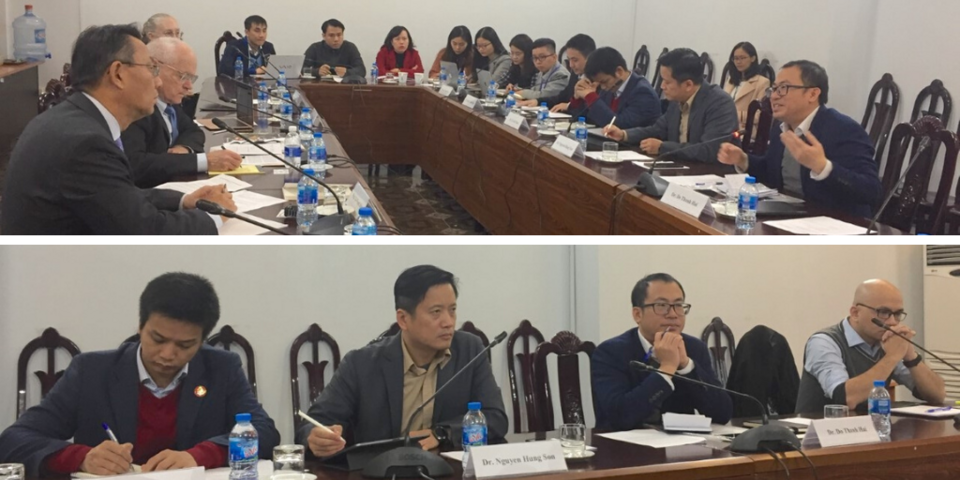
Shifting focus to international relations and regional security, day 2 in Hanoi opened with a roundtable, “The Rise of the Indo-Pacific and Vietnam-U.S. Relations,” held jointly with the East Sea Institute (ESI) of the Diplomatic Academy of Vietnam (DAV). Following a welcome by ESI Director General Nguyen Hung Son, the program continued with remarks by Shin, Emmerson, ESI Deputy Director General To Anh Tuan, and Assistant Director General Do Thanh Hai.

Image
Participants at a roundtable held at the Diplomatic Academy of Vietnam with APARC delegation members

Roundtable at the Diplomatic Academy of Vietnam, December 10, 2019.

The long-ranging conversation with DAV members included issues such as the future of the international order in Asia; the U.S. withdrawal from multilateralism; the concern about a lack of U.S. engagement in Southeast Asia, sparked by President Trump’s absence from the November 2019 summit of the Association of Southeast Asian Nations (ASEAN) at a time when China is bolstering its influence in the region and when ASEAN hopes to set a code of conduct with China regarding disputed waters in the South China Sea; the priorities for Vietnam as it assumes the role of ASEAN chair in 2020; and the challenges for the Vietnam-U.S. bilateral relationship amid the changing strategic environment in Southeast Asia.

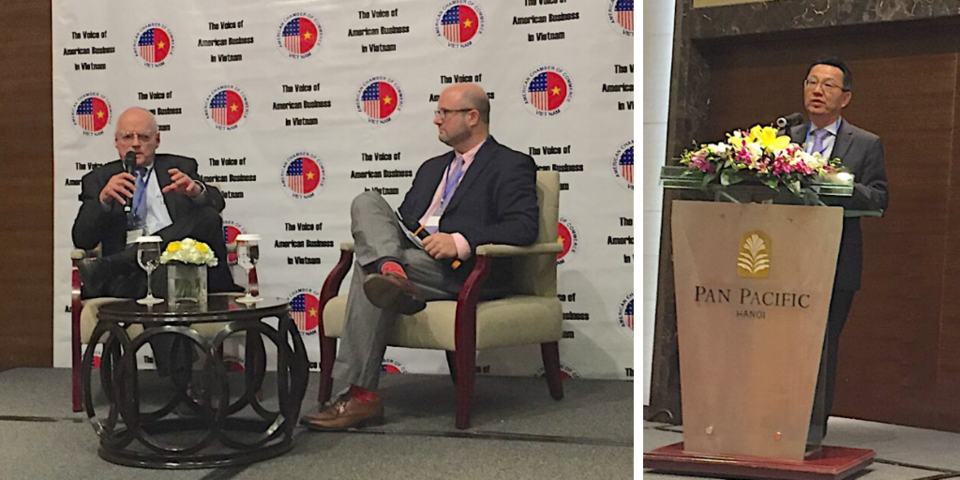
In the afternoon we were joined by members of the American Chamber of Commerce in Hanoi at an AmCham-hosted Lunch ‘n’ Learn session on Vietnam's challenges and opportunities amid the U.S.-China rivalry. The event featured Emmerson in conversation with AmCham Hanoi Executive Director Adam Sitkoff.

Image
Two men in conversation seated on stage and a man speaking at a podium

(Left) Donald Emmerson in conversation with Adam Sitkoff; (right) Gi-Wook Shin welcomes AmCham Hanoi members; December 10, 2019. 

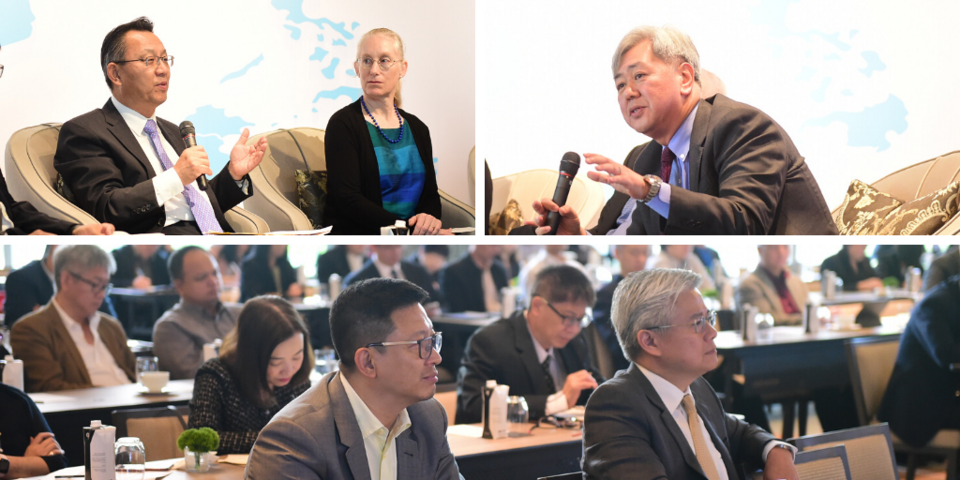
Moving to Bangkok, delegation members Shin, Eggleston, Emmerson, and Kim spoke on a panel for executives of the Charoen Pokphand Group (C.P. Group), one of Thailand’s largest private conglomerates, addressing some of the core issues that lie ahead for Southeast Asia in 2020 and beyond in the areas of geopolitics, innovation, and health.

Image
Participants at a panel discussion with APARC delegation hosted by the C.P. Group, Thailand

Top, from left to right: Gi-Wook Shin, Karen Eggleston, Andrew Kim; bottom: C.P. Group executive listening to the panel, December 12, 2019.

We also enjoyed a tour at True Digital Park, Thailand’s first startup and tech entrepreneur’s campus. Developed by the C.P. Group, True Digital Park aspires to be an open startup ecosystem that powers Thailand to become a global hub for digital innovation.

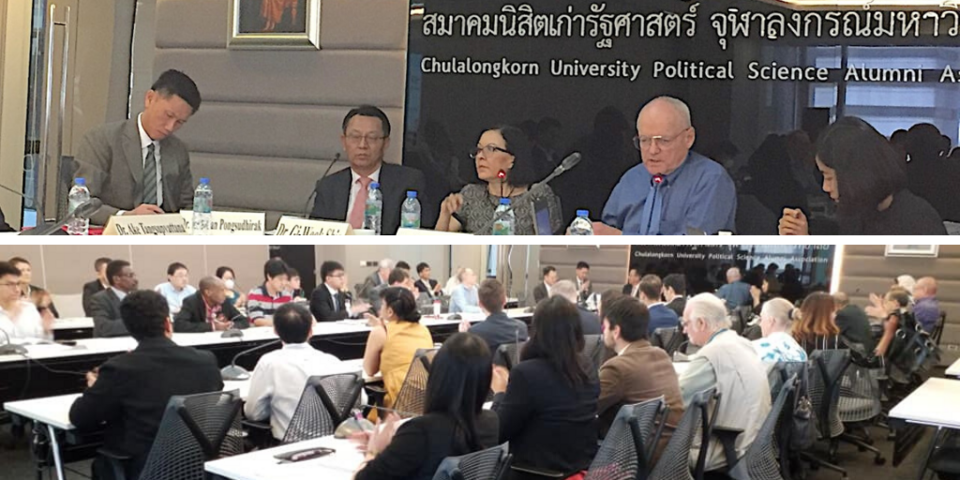
The following day, Shin and Emmerson participated in a public forum hosted by Chulalongkorn University’s Institute of Security and International Studies (ISIS Thailand), "Where Northeast Asia Meets Southeast Asia: The Great Powers, Global Disorder and Asia’s Future.” They were joined by ISIS Thailand Director Thitinan Pongsudhirak and Chulalongkorn University Faculty of Political Science Associate Dean for International Affairs and Graduate Studies Kasira Cheeppensook. The panel was moderated by Ms. Gwen Robinson, ISIS Thailand senior fellow and editor-at-large of the Nikkei Asian Review.

Image
Panelists and participants at a public forum held at Chulalongkorn University

ISIS Thailand forum participants and panelists, from left: Pngsukdhirak, Shin, Robinson, Emmerson, Cheeppensook; December 13, 2019.

As part of that discussion, Emmerson speculated that – driven by deepening Chinese economic and migrational involvement in Southeast Asia’s northern tier – Cambodia and Laos, less conceivably Myanmar, and still less conceivably Thailand could become incorporated de facto into an economically integrated “greater China” that could eventually reduce ASEAN to a more-or-less maritime membership in the region’s southern tier. Emmerson’s speculation was made in the context of his critique of ASEAN’s emphasis on its own “centrality” to the neglect of its lack of the proactivity that would serve as evidence of centrality and of a desire not to be rendered peripheral by the growing centrality-cum-proactivity of China. The event was covered by the Bangkok Post (although that report’s headline and quote of Emmerson are inaccurate, as neither the panel nor Emmerson predicted the “break-up of ASEAN.”)

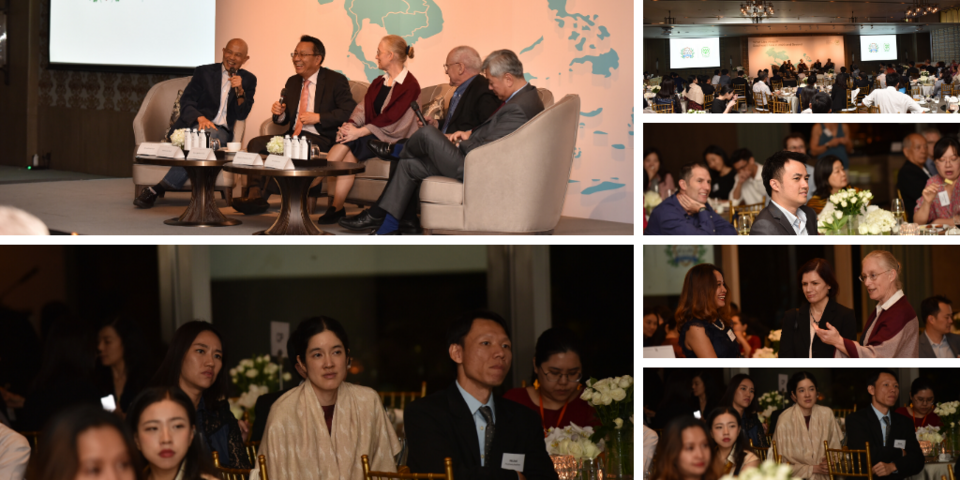
Our delegation visit in Bangkok concluded with a buffet dinner reception and panel discussion jointly with the Stanford Club of Thailand.

Image
alumni event

Stanford and IvyPlus alumni listening to the panel, December 13, 2019.

Moderated by Mr. Suthichai Yoon, a veteran journalist and founder of digital media outlet Kafedam Group, the conversation focused on the changing geopolitics of Southeast Asia, innovation and health in the region, and the opportunities and challenges facing Thailand-U.S. relations. It was a pleasure to meet many new and old friends from the Stanford and IvyPlus alumni communities.

APARC would like to thank our partners and hosts in Hanoi and Bangkok for their hospitality, collaboration, and the stimulating discussions throughout our visit. We look forward to keeping in touch!

Hero Image
APARC delegation speaking to Stanford and IvyPlus alumni, Bangkok
All News button
1
Paragraphs

Shorenstein APARC's annual overview for academic year 2018-19 is now available.

Learn about the research, events, and publications produced by the Center's programs over the last twelve months. Feature sections look at U.S.-China relations and the diplomatic impasse with North Korea, and summaries of current Center research on the socioeconomic impact of new technologies, the success of Abenomics, South Korean nationalism, and how Southeast Asian countries are navigating U.S.-China competition. Catch up on the Center's policy work, education initiatives, and outreach/events.

Read online:

All Publications button
1
Publication Type
Annual Reports
Publication Date
-

Japan faces a rapid population decrease and aging. Workers’ aging is negatively associated with labor productivity. For instance, a 10% increase in the fraction of workers aged 55 and above is associated with a 3% decrease in labor productivity. Kawaguchi will present his recent research that assesses the impact of population aging on labor productivity. He will also address whether the adoption of a new technology, such as purchases of industrial robot or information and communications technology (ICT) equipment, can mitigate the negative impact of worker’ aging on labor productivity and what impact, if any, it has on Japan moving forward in addressing its aging population, adoption of new technology, and increasing labor shortage.

SPEAKER

Image
Portrait of Daiji Kawaguchi

Daiji Kawaguchi is Professor of Economics at the University of Tokyo. Dr. Kawaguchi graduated from Waseda University (B.A., 1994), Hitotsubashi University, (M.A., 1996) and Michigan State University (Ph.D., 2002). In addition to his position at U of Tokyo, Kawaguchi is a Research Associate of Tokyo Center for Economic Research. Before joining University of Tokyo faculty in 2016, Kawaguchi was Assistant Professor of Economics at Osaka University (2002-03) and University of Tsukuba (2003-05), and Associate and full Professor at Hitotsubashi University (2005-2016).

Daiji Kawaguchi, Professor of Economics, University of Tokyo
Seminars
Authors
Noa Ronkin
News Type
News
Date
Paragraphs

The annual award, which carries a US $10,000 cash prize, is sponsored by Stanford University’s Walter H. Shorenstein Asia-Pacific Research Center. It recognizes outstanding journalists and journalism organizations for excellence in coverage of the Asia-Pacific region. News editors, publishers, scholars, journalism associations, and organizations focused on Asia research and analysis are invited to submit nominations for the 2020 award through Friday, February 14.

STANFORD, CA, December 3, 2019 — The Walter H. Shorenstein Asia-Pacific Research Center (APARC), Stanford University’s hub for interdisciplinary research, education, and engagement on contemporary Asia, invites nominations for the 2020 Shorenstein Journalism Award. The award recognizes outstanding journalists who have spent their careers helping audiences around the world understand the complexities of   the Asia-Pacific region. The 2020 award will honor a journalist whose work has mostly been conveyed through American news media. The deadline for nomination submissions is Friday, February 14, 2020.

An annual tradition since 2002, the Shorenstein Journalism Award is sponsored by APARC and carries a cash prize of US $10,000. It honors the legacy of APARC benefactor, Mr. Walter H. Shorenstein, and his twin passions for promoting excellence in journalism and understanding of Asia. “In the face of a shifting geopolitical landscape and amid global declines of democracy, political rights, and civil liberties, it is more crucial than ever before to support independent journalism that seeks accuracy, deep reporting, and nuanced U.S.-Asia dialogue,” said APARC Director Gi-Wook Shin.

Over the course of its history, the award has recognized world-class journalists who push the boundaries of coverage of the Asia-Pacific region and help advance mutual understanding between audiences in the United States and their Asian counterparts. Recent honorees include Maria Ressa, Anna Fifield, Siddharth Varadarajan, Ian Johnson, and Caixin Media. The award alternates between recipients whose work has mostly been published through Asian news media and those whose work has mostly been conveyed through American news media. The 2020 award will recognize a recipient from the latter category.

For the award, the Asia-Pacific region is defined broadly to include Northeast, Southeast, South, and Central Asia and Australasia. Both individual journalists with considerable body of work and journalism organizations are eligible for the award. Nominees’ work may be in traditional forms of print or broadcast journalism and/or in new forms of multimedia journalism. The Award Selection Committee, whose members are experts in journalism and Asia research and policy, presides over the judging of nominees and is responsible for the selection of honorees.

APARC is seeking 2020 award nomination submissions from news editors, publishers, scholars, journalism associations, and entities focused on researching and interpreting the Asia-Pacific region. The Center will announce the winner by April 2020 and present the award at a public ceremony at Stanford in autumn quarter of 2020.

Nominations are accepted electronically through Friday, February 14, 2020 at 11:59 PM PST. For information about the nomination procedures and to submit nominations please visit the award nomination entry page.

Please direct all inquiries to aparc-communications@stanford.edu.


About the Walter H. Shorenstein Asia-Pacific Research Center
The Walter H. Shorenstein Asia-Pacific Research Center (Shorenstein APARC) addresses critical issues affecting the countries of Asia, their regional and global affairs, and U.S.-Asia relations. As Stanford University’s hub for the interdisciplinary study of contemporary Asia, APARC produces policy-relevant research, provides education and training to students, scholars, and practitioners, and strengthens dialogue and cooperation between counterparts in the Asia-Pacific and the United States. Founded in 1983, APARC today is home to a scholar community of distinguished academics and practitioners in government, business, and civil society, who specialize in trends that cut across the entire Asia-Pacific region. Learn more about APARC and about the Shorenstein Journalism Award.

Hero Image
Announcement of open nominations for the 2020 Shorenstein Journalism Award with a background image of Stanford main quad.
All News button
1
Authors
Noa Ronkin
News Type
News
Date
Paragraphs

Around the world, democracy is in retreat. In its Freedom in the World 2019 report, the independent watchdog organization Freedom House records the 13th consecutive year of global declines in political rights and civil liberties. “More authoritarian powers are now banning opposition groups or jailing their leaders, dispensing with term limits, and tightening the screws on any independent media that remain,” and “even long-standing democracies have been shaken by populist political forces,” shows the annual study. Internet freedom, too, continues to decline globally amid the crisis of social media, unveils Freedom House’s newly released Freedom on the Net 2019 report. Social media platforms – once considered liberation technologies – have become a conduit for surveillance, disinformation, and electoral manipulation, and “are now tilting dangerously toward illiberalism, exposing citizens to an unprecedented crackdown on their fundamental freedoms.”

These troubling developments are also manifested throughout the Asia-Pacific, where continuous scaling back in U.S. engagement and leadership is raising doubts about American power and purpose in the region, thus empowering forces that undermine democratic norms and processes.

At Shorenstein APARC, we are committed to building a solid foundation of education, knowledge, and dialogue about the critical challenges facing Asian nations and U.S.-Asia relations. That’s why we are dedicating a major portion of our programming this fall quarter and throughout the entire year to elucidating the threats to rights and liberties in the Asia-Pacific region.


The Battle for Truth and Press Freedom in the Philippines

“This is an existential moment for global power structures, turned upside down by technology. When journalists globally are under attack, democracy is under attack.” With these words, the internationally-esteemed investigative journalist and press freedom champion Maria Ressa opened her keynote address upon receiving the 2019 Shorenstein Journalism Award.

As CEO and executive editor of Rappler, she has led the Philippine independent news platform in shining critical light on the Duterte administration's drug war and unprecedented number of killings in the country. President Duterte in turn has made no secret of his dislike for Ressa and Rappler, accusing the platform for carrying "fake news." Ressa has been arrested twice this year, accused of corporate tax evasion and of violating security laws, and slapped with charges of cyber libel for a report that was published before the libel law came into effect. Since Duterte’s election in summer 2016, the Philippine government has filed at least 11 cases and investigations against Ressa and Rappler. “And all because I’m a journalist,” she says.

Ressa detailed the devastating effects that disinformation has had on press freedom, democracy, and civic discourse in the Philippines. “Our dystopian present is your dystopian future if nothing significant is done,” she cautioned. She was joined on the 18th annual Journalism Award panel by Stanford’s Larry Diamond, senior fellow at FSI and the Hoover Institution, and Raju Narisetti, director of the Knight-Bagehot Fellowship in Economics and Business Journalism and professor of professional practice at Columbia Journalism School.

Watch Ressa’s keynote and the entire panel proceedings:

You can also listen to Ressa’s keynote on our SoundCloud channel and read our complete event recap.


The North Korean Human Rights Problem

North Korea continues to be one of the world’s worst human rights violators, ranking at the bottom of Freedom House’s list of countries designated as Not Free with the worst aggregate scores for political rights and civil liberties. Although North Korea has experienced some degree of social and economic change in recent years, the Kim Jong Un regime continues to tightly control access to information, suppress all dissent, heavily surveil residents, and subject political prisoners to torture, forced labor, and other atrocities.

As momentum for U.S.-DPRK diplomatic negotiations has ebbed and flowed since summer 2018, all eyes have been on the questions surrounding the North Korean nuclear problem, while the human rights problem has received little attention. However, argues APARC’s Koret Fellow in Korean Studies Robert R. King, addressing the North Korean human rights problem is essential to moving the country on denuclearization and security issues.

Ambassador King, former special envoy for North Korean human rights issues at the Department of State, recently spoke at a seminar hosted by APARC’s Korea Program. Creating pressure on the North Korean government from within by its own people is the only way we’re going to make progress on the security front, he claimed. “If we can help generate greater interest on the part of the people in what is happening with their own government, we can create the kind of constraints that democracy imposes on its leadership […] and that is why we need to focus attention, as well as on negotiating with North Korea, on access to information and human rights.”

Listen to highlights from Ambassador King’s talk:


Hong Kong: City in Turmoil

In Hong Kong, millions of people have been protesting for months against rights violations and increasing interference by the Chinese government in local affairs. On October 1, while the People’s Republic of China celebrated its 70th anniversary with a massive National Day parade in Beijing, on the other side of the border, Hong Kong experienced one of its most violent and chaotic days.

With those contrasting images still fresh on everyone’s minds, APARC and the China Program, along with FSI And the Center for East Asian Studies, co-hosted an expert panel that explained the root causes of Hong Kong’s unremitting protests, examined the future of “one country, two systems,” and considered how the United States and the international community should best respond.

Former Chief Secretary for Administration of the Hong Kong Government (1993-2001), the Honorable Anson Chan, delivered a piercing keynote address, followed by a discussion featuring Harry Harding, Professor of Public Policy at the University of Virginia, David M. Lampton, APARC/FSI Oksenberg-Rohlen Fellow, and Professor Ming Sing of Hong Kong University of Science and Technology.

Since 1997, Chan asserted, Hong Kong SAR’s successive chief executives have progressively failed to reassure the Hong Kong people that they would do their utmost to uphold “one country, two systems” and to defend Hong Kong’s autonomy. Instead, she argued, they have increasingly come across as “mouthpieces of the central government, towing the Beijing line.” Chan also suggested that “some years back, Beijing began to both lose confidence in the judgment and competence of the Hong Kong administration and to fear that growing sense of people’s identity as ‘Hong Kongers’ rather than Chinese citizens could pose a threat to the long-term, successful integration of Hong Kong into the motherland.” She closed her speech urging the Beijing leadership “to act with greater confidence and to trust us more completely with stewardship of our own future by allowing us to elect our own leaders.”

Watch the proceedings from this special panel:

You can also listen to Chan’s keynote and panelists’ remarks on our SoundCloud channel and read our complete event recap.


The Assault on Non-Chinese Culture in Xinjiang

China’s mass internment of Uighurs and other Muslims in “reeducation” camps and detention facilities and its deployment of high-tech surveillance and police tactics in Xinjiang Uyghur Autonomous Region have been interpreted as a superpower’s attempt to annihilate the distinct identities of minority groups. Approximately ten million Muslim minorities in the region are under tight control, and over one million Uyghurs and other Turkic Muslims have allegedly disappeared into internment camps. While Beijing characterizes the camps as vocational training centers and has claimed that most of the detainees have been released, evidence for these claims is difficult to verify, as information dissemination regarding the region to the outside world is closely guarded.

To shed light into the crisis in Xinjiang, APARC convened a multidisciplinary panel of experts who provided historical context and critical social scientific analysis of the events unfolding in the region.

Image
From top left, clockwise: Lauren Hansen Restrepo, James Millward, Darren Byler and Gardner Bovingdon speaking at a panel at APARC.

From top left, clockwise: Lauren Hansen Restrepo, James Millward,, Darren Byler and Gardner Bovingdon.

James Millward, professor of Inter-societal history at Georgetown University’s Walsh School of Foreign Service, reviewed the historical background for the PRC assault on non-Han or non-Chinese culture in Xinjiang. Beginning in the early 2000s, the assault has included the razing of old Kashgar; the discouraging and then illegalizing of Muslim symbols such as head gear, prayer, and fasting in Ramadan; the disappearance of Uyghur script; and the securitization of the province by using police patrol, surveillance technologies, facial recognition, and biodata monitoring. The PRC hasn’t applied a single, top-down ethnic policy in Xinjiang, said Millward, but rather has rolled out different tactics it experimented with on local levels in different areas.

Lauren Hansen Restrepo, assistant professor in growth and structure of cities at Bryn Mawr College and an expert on Chinese development planning and urbanization in Xinjiang, explained how we got to the current crisis in the region by connecting seemingly disparate phenomena. She described the shifts in state power in Xinjiang and how, since 2014, “regional planning has broken every logic of urban planning in China,” resulting in the isolation and subordination of Uyghur-dominated urban centers and in the ossification of cities, as control has been seized from local governments and given to socialist land masters.

Anthropologist Darren Byler, whose research focuses on Uyghur dispossession and "terror capitalism" in the city of Ürümchi, the capital of Xinjiang, explained how, amid mass migration of Han people into the resource-rich region, Uyghurs had mostly been excluded from the new economy and how their identity as contemporary Muslims supported a vibrant public sphere not controlled by the state. The Chinese state, in turn, has merged Islamism with radicalism extremism. From the Chinese state and industry perspective, Byler said, the repression of Xinjiang’s Muslims promises stability and the detention camps are used as carriers of economy and new sources of cheap labor.

Indiana University’s Gardner Bovingdon, whose research focuses on politics in contemporary Xinjiang and the region’s modern history, reverted to the question of how we got to the current crisis, which he characterized as “one of the great state-engineered human rights disasters of our time.” He argued that, in the case of Xinjiang, the Chinese party transported and exacerbated a set of policies that had previously been applied to dealing with the Tibet problem. These policies, Bovingdon suggested, “are signs of a flailing, terrified party that doesn’t know what to do with Uighurs, but also feels no constraints from the international community on its behavior. And so the biggest problem now is to find a way to put constraints on a system that has operated untrammeled with devastating consequences.”

The panel "Xinjiang’s Muslims and the PRC" was cosponsored with the Center for Democracy, Development and the Rule of Law.

Hero Image
Relatives of alleged extrajudicial killings protest against the drug war in Manila; workers pass propaganda posters in North Korea; pro-democracy protesters in Hong Kong; ethnic Uyghur and Han shopkeepers are trained in security measures next to Kashgar.
Clockwise from upper left: Relatives of alleged extrajudicial killings wear veils as they take part in a protest versus the drug war killings outside the military and police headquarters on July 17, 2019 in Manila, Philippines (Photo credit: Ezra Acayan/Getty Image); Workers pass propaganda posters as they cycle through Hungnam Fertilizer Complex on February 4, 2019 in Hamhung, North Korea (Photo credit: Carl Court/Getty Images); Pro-democracy protesters react as police fire tear gas during a demonstration on October 20, 2019 in Hong Kong (photo credit: Anthony Kwan/Getty Images); A mix of ethnic Uyghur and Han shopkeepers hold large wooden sticks as they are trained in security measures on June 27, 2017 next to the old town of Kashgar, in the far western Xinjiang province, China (photo credit: Kevin Frayer/Getty Images).
All News button
1
-

This event is at full capacity and we are no longer accepting registrations.

Image
Brigadier General Robert Spalding (US Air Force, Retired)

Robert Spalding is a national security policy strategist, and globally recognized for his knowledge of Chinese economic competition and influence, as well as for his ability to forecast global trends and develop innovative solutions. He has served in senior positions of strategy and diplomacy within the Defense and State Departments for more than 26 years, retiring as brigadier general.

He was the chief architect for the Trump Administration’s widely praised National Security Strategy (NSS), and the Senior Director for Strategy to the President at the National Security Council.
 
Dr. Spalding is a skilled combat leader, and a seasoned diplomat. Under Dr. Spalding’s leadership, the 509th Operations Group—the nation’s only B-2 Stealth Bomber unit—experienced unprecedented technological and operational advances. Dr. Spalding’s demonstrated acumen for solving complex technological issues to achieve operational success, was demonstrated when he led a low-cost rapid-integration project for a secure global communications capability in the B-2, achieving tremendous results at almost no cost to the government. As commander, he led forces in the air and on the ground in Libya and Iraq. He is a former China strategist for the chairman of the Joint Chiefs of Staff and the Joint Staff at the Pentagon, as well as having served as the senior defense official and defense attaché in Beijing. During the UUV Incident of 2016, Dr. Spalding averted a diplomatic  crisis by negotiating with the Chinese PLA for the return of the UUV, without the aid of a translator.
 
Image
Stealth War Book Cover
Dr. Spalding has written extensively on national security matters. His book, Stealth War: How China Took Over While America’s Elite Slept (Portfolio; 2019) is an executive summary of his almost decade-long work countering Chinese Communist Party influence. It is being translated into additional languages. His work has been published in The Washington Post, The Washington Times, Foreign Affairs, The American Interest, War on the Rocks, FedTech Magazine, Defense One, The Diplomat, and other edited volumes. His Air Power Journal article on America’s Two Air Forces is frequently used in the West Point curriculum. He has been interviewed on FOX News and CNBC, as well as numerous radio and YouTube channels, both nationally and internationally.
Brigadier General Robert Spalding (US Air Force, Retired)
Seminars
Date Label
-

Image
pontianak original image

The pontianak, or female vampire, is one of the most significant supernatural creatures, or hantu, in Malay cinema. A series of pontianak films were among the most successful made in the studio system in Singapore between 1957 and the city-state’s independence in 1965. Although the pontianak appeals to discourses of Malay cultural identity in particular, the films achieved something rare: they were popular across different races in late-colonial Singapore. In the 21st century, the pontianak genre has regained popularity in film and television by returning to the racialized politics of belonging in Malaysia and Singapore. The pontianak registers intersecting anxieties about femininity and modernity, race and nation, local and transnational cultural influences, and Islam in relation to indigenous beliefs. Prof. Galt’s talk will analyze the pontianak in recent Malaysian and Singaporean cinema and explore what the figure tells us about the role of film culture in shaping and contesting ideas of postcolonial Malay identity.

Image
galt pic
Rosalind Galt is Professor of Film Studies at King’s College London. She studies how geopolitics, cinematic style, history, and sexuality interact. She is the co-author with Karl Schoonover of Queer Cinema in the World (2016); the author of Pretty: Film and the Decorative Image (2010) and The New European Cinema: Redrawing the Map (2006); and co-editor of Global Art Cinema: New Theories and Histories (2010). Her advanced degrees are from Brown University (PhD) and the University of Glasgow (MA with Honours).

Rosalind Galt 2019-2020 NUS-Stanford Lee Kong Chian Fellow on Contemporary Southeast Asia
Seminars
Authors
Noa Ronkin
News Type
News
Date
Paragraphs

“Our dystopian present is your dystopian future if nothing significant is done,” cautioned Ressa, urging the Stanford community to pressure technology platforms and social media to stop disinformation spread.

“This is an existential moment for global power structures, turned upside down by technology. When journalists globally are under attack, democracy is under attack.” With these words, the internationally-esteemed investigative journalist and press freedom champion Maria Ressa, winner of the 2019 Shorenstein Journalism Award, opened her keynote address at a lunchtime ceremony, held at Stanford on October 21.

Ressa knows first-hand the terrifying reality of continuously being subject to online attacks and politically motivated attempts by the government to silence and intimidate. As CEO and executive editor of Rappler, she has led the Philippine independent news platform in shining critical light on the Duterte administration's policies and actions. President Duterte in turn has made no secret of his dislike for Ressa and Rappler, accusing the platform for carrying "fake news." Ressa has been arrested twice this year, accused of corporate tax evasion and of violating security laws, and slapped with charges of cyber libel for a report that was published before the libel law came into effect. Since Duterte’s election in summer 2016, the Philippine government has filed at least 11 cases and investigations against Ressa and Rappler.

“And all because I’m a journalist,” she says.

Speaking at the Shorenstein Award’s eighteenth annual panel discussion, Ressa detailed the devastating effects that disinformation has had on democracy and societal cohesion in the Philippines. She vividly explained why each and every one of us should be gravely concerned about the breaking down of the information ecosystem in a country halfway around the world. The Philippines, she said, is a case study of how attacks on truth and facts rip the heart out of civic engagement and gradually kill democracy, “a death by a thousand cuts.”

Ressa was joined on the panel by Stanford’s Larry Diamond, senior fellow at the Hoover Institution and the Freeman Spogli Institute for International Studies, and Raju Narisetti, director of the Knight-Bagehot Fellowship in Economics and Business Journalism and professor of professional practice at Columbia Journalism School, who also serves on the selection committee for the Shorenstein Journalism Award. Shorenstein APARC’s Southeast Asia Program Director Donald K. Emmerson chaired the discussion.

[To get more stories like this delivered directly to your inbox sign up to receive our newsletters.] 

A Cautionary Tale

Modern authoritarians follow a familiar playbook, noted Ressa, for they know well that “If you can make people believe lies are the facts, then you can control them.” Their first step is to lie all the time. The second is to argue their opponents and the journalists are the ones who lie. Then finally everyone looks around and says, "What's truth?" And when there is no truth resistance is impossible.

Ressa went on to describe detailed examples of patriotic trolling in the Philippines, that is, how state-sponsored online hate and harassment campaigns silence and intimidate journalists and others who voice criticism of the Duterte administration. Instead of censoring, she said, state agents now flood the information ecosystem with lies, blurring the line between fact and fiction. These information operations are conducted through the weaponization of technology and social media platforms, first and foremost Facebook. Ressa’s team at Rappler uses network analysis methods to unveil the flow and spread of online disinformation and harassment campaigns on Facebook and from there to other platforms as well as traditional and state media.

Ressa urged the packed audience of campus and community members to remember that “Without facts you cannot have truth, without truth you cannot have trust, and without any of these three democracy as we know it is dead. The public sphere is dead […] our Philippine dystopian present is your dystopian future, if nothing significant is done.”

She closed her keynote by pleading: “Please push tech platforms and social media to do something to stop the lies from spreading. Lies laced with anger and hate spread faster than facts. Fight  for your rights.”

Watch Ressa’s keynote and the entire panel proceedings here or on our YouTube channel. You can also listen to Ressa’s keynote below and on our SoundCloud channel. A transcript of the keynote address is available below.

No Ministry of Truth

Is the attack on truth a technological problem, and can it have a technological solution? It's naïve, said Diamond, to think that there is a purely technological solution or that we can rein in the alarming developments in the Philippines and elsewhere without addressing their technological elements and the economic incentives underlying these elements. “There has to be a macro political element of response,” argued Diamond, “which obviously has to involve advanced liberal democracies condemning and drawing boundaries around the murderous authoritarianism of Rodrigo Duterte.”

Image
2019 Shoresntein Journalism panelists, from left to right: Donald K. Emmerson, Maria Ressa, Raju Narisetti, Larry Diamond.

Left to right: Donald K. Emmerson, Maria Ressa, Raju Narisetti, Larry Diamond.

Narisetti emphasized the need to look at the problem and its potential solutions holistically and bear in mind that solutions must come from multiple areas. “We must remember that technology has value, but it has no values. It's a matter of who is using it and how they're using it.” And while we certainly don't want Facebook to be the Ministry of Truth, continued Narisetti, by no means do we want Congress to take on that role. He pointed to specific possible regulatory solutions, such as insisting Facebook enable its users to port their complete data outside of the platform if they wish to do so, or establishing a system of data and privacy courts.

Commitment to Journalism that Courageously Seeks Accuracy

The Shorenstein Journalism Award, which is sponsored by APARC, was presented to Ressa at a private evening ceremony. “You would be hard pressed to find a person whose work more fully embodies the ideals that define journalism than Maria Ressa,” said James Hamilton, Stanford’s Hearst Professor of Communication, Chair of the Department of Communication, Director of the Stanford Journalism Program, who also serves on the selection committee for the award. Shorenstein APARC Director Gi-Wook Shin joined Hamilton in co-presenting Ressa the award.

The Shorenstein Award, which carries a cash prize of $10,000, recognizes accomplished journalists committed to critical reporting on and exploring the complexities of Asia through their writing. It alternates between honoring recipients from the West, who mainly address American audiences, and recipients from Asia, who often work on the frontline of the battle for freedom of the press in their countries. Established in 2002, the award honors the legacy of APARC benefactor Mr. Walter H. Shorenstein, who was passionate about promoting both excellence in journalism and a deeper understanding of Asia.

Hero Image
Maria Ressa speaking at Stanford Rod Searcey
All News button
1
Subscribe to Society