Society

FSI researchers work to understand continuity and change in societies as they confront their problems and opportunities. This includes the implications of migration and human trafficking. What happens to a society when young girls exit the sex trade? How do groups moving between locations impact societies, economies, self-identity and citizenship? What are the ethnic challenges faced by an increasingly diverse European Union? From a policy perspective, scholars also work to investigate the consequences of security-related measures for society and its values.

The Europe Center reflects much of FSI’s agenda of investigating societies, serving as a forum for experts to research the cultures, religions and people of Europe. The Center sponsors several seminars and lectures, as well as visiting scholars.

Societal research also addresses issues of demography and aging, such as the social and economic challenges of providing health care for an aging population. How do older adults make decisions, and what societal tools need to be in place to ensure the resulting decisions are well-informed? FSI regularly brings in international scholars to look at these issues. They discuss how adults care for their older parents in rural China as well as the economic aspects of aging populations in China and India.

News Type
News
Date
Paragraphs

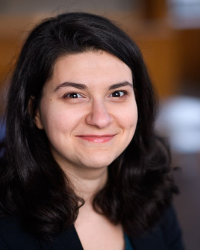
APARC is pleased to announce the appointment of political scientist Dr. Diana Stanescu and doctoral candidate in sociology Mary-Collier Wilks as our 2021-22 Shorenstein postdoctoral fellows on contemporary Asia. They will begin their appointments at Stanford in autumn 2021.

The Shorenstein Postdoctoral Fellowship on Contemporary Asia supports recent doctoral graduates dedicated to research and writing on contemporary Asia, primarily in the areas of political, economic, or social change in the Asia-Pacific, or international relations in the region.

Fellows develop their dissertations and other projects for publication, present their research, and participate in the intellectual life of APARC and Stanford at large. Our postdoctoral fellows often continue their careers at top universities and research organizations around the world and remain involved with research and publication activities at APARC.

Meet our new postdoctoral scholars:


Diana Stanescu

Research Project: Do Bureaucratic Networks Matter for Market Access? The Effect of Informal Connections on Trade and FDI of Japanese Firms.

Image
Portrait of Diana Stanescu
Diana Stanescu is a postdoctoral fellow with the Program on U.S.-Japan Relations at Harvard University’s Weatherhead Center for International Affairs. She holds a B.A. in International Relations and Asian Studies from Mount Holyoke College and an M.A. and Ph.D. in Political Science from Princeton University. She is a former pre-doctoral exchange scholar in the Department of Government at Harvard.

Dr. Stanescu’s research interests include international trade, regulation, and lobbying with a focus on Japan. Using formal and quantitative methods, her research addresses the overarching question of how bureaucracies shape global economic governance, from a structural and agent-driven perspective. Her dissertation, “The Bureaucratic Politics of Foreign Economic Policymaking,” explains the mechanisms by which stakeholders shape international economic policy through bureaucratic channels of influence. Additional work looks at the micro-foundations of bureaucratic structure and its consequences for policy, examines the role of individual bureaucrats within domestic and international institutions, and develops micro-level data on bureaucratic careers and appointments.

At APARC, Stanescu will further assess how politicians and interest group representatives maneuver within bureaucratic channels to have influence over foreign economic policy. In particular, she will examine how bureaucratic-interest group networks help firms obtain market access abroad, with evidence from trade and foreign direct investment in Japan.

Mary-Collier Wilks

Research project: How do conceptions of gender, sexuality, and women’s advancement shape the construction of development knowledge and foreign aid?

Image
Portrait of Mary-Collier Wilks
Mary-Collier Wilks is currently a doctoral candidate in Sociology at the University of Virginia. Her research agenda centers on meaning-making and power dynamics in international organizations, with a particular focus on the ways in which people encounter international development in everyday lives and the gendered meanings, divisions, and struggles that arise from such encounters.

It was Wilk’s work as a grant writer at a local NGO, Social Services of Cambodia, that first sparked her interests in globalization, gender, and the politics of international development. Having seen how resources and ideas from all over the world flow through NGOs to affect the lives of people in Cambodia, she began thinking about the complicated process of foreign aid and international development. She also gained experience as a consultant in the development sector, performing a gender analysis for a USAID health project and serving as a trainer for a USAID Women’s Leadership Conference.

For her dissertation, which is funded by the National Science Foundation and the Fulbright IIE, Wilks conducted a multi-sited ethnography comparing U.S. and Japanese international NGOs that advance women's health in Cambodia. Her work contributes to scholarly theories of global civil society and international development, contending that to adequately analyze and improve development outcomes, we must attend to national variation in international NGO programs and practices.

At APARC, Wilks will transform her dissertation manuscript into a book and extend her comparative research agenda to investigate how NGO practices are shaped by the business cultures in which their donors are embedded.

Read More

Oriana Skylar Mastro testifies to the U.S.-China Economic and Security Review Commission on Taiwan deterrence.
News

Oriana Skylar Mastro Testifies on Deterring PRC Aggression Toward Taiwan to Congressional Review Commission

China may now be able to prevail in cross-strait contingencies even if the United States intervenes in Taiwan’s defense, Chinese security expert Oriana Skylar Mastro tells the U.S.-China Economic and Security Review Commission. Changes must be made to U.S. military capabilities, not U.S. policy, she argues.
Oriana Skylar Mastro Testifies on Deterring PRC Aggression Toward Taiwan to Congressional Review Commission
[Left] Radhika Jain, [Right] Postdoc Spotlight, Radhika Jain, Asia Health Policy Program
Blogs

Postdoctoral Fellow Spotlight: Radhika Jain on Reducing Inequalities in Health Care and Outcomes

Radhika Jain, a postdoctoral fellow with the Asia Health Policy Program, shares insights on her research into India’s health care system and how it is responding to both the COVID-19 pandemic and standard healthcare needs of citizens.
Postdoctoral Fellow Spotlight: Radhika Jain on Reducing Inequalities in Health Care and Outcomes
[Left] Postdoc Spotlight, Jeffrey Weng, Shorenstein Postdoctoral Fellow in Contemporary Asia, [Right] Jeffrey Weng
Q&As

Postdoc Spotlight: Jeffrey Weng on Language and Society

Shorenstein Postdoctoral Fellow in Contemporary Asia Jeffrey Weng shares insights from his research into how language and society shape one another, particularly how the historical use of Mandarin affects contemporary Chinese society and linguistics.
Postdoc Spotlight: Jeffrey Weng on Language and Society
Hero Image
Spring blooms in the courtyard near History Corner, Stanford University. L.A. Cicero
All News button
1
Subtitle

Political scientist Dr. Diana Stanescu and sociologist Mary-Collier Wilks will join APARC as Shorenstein postdoctoral fellows on contemporary Asia for the 2021-22 academic year.

Authors
Noa Ronkin
News Type
News
Date
Paragraphs

China and the United States are usually cast as fierce rivals, but there are broad areas of society where the two nations share profound similarities. As they confront growing demands to provide their citizens with goods and services such as healthcare, education, housing, and transportation, both the Chinese and U.S. governments engage the private sector in the pursuit of public value, although they do so in different ways.

This type of engagement, in which the government calls on the private sector to meet public goals, is known as collaborative governance and it is becoming an increasing share of the economy in both China and the United States. A new book, The Dragon, the Eagle, and the Private Sector (Cambridge University Press), analyzes the application of collaborative governance in a wide range of policy arenas in China and the United States.

The book itself is the result of collaborative research by three co-authors: APARC Deputy Director Karen Eggleston, Harvard Kennedy School Raymond Vernon Senior Lecturer in Public Policy John Donahue, and Harvard Kennedy School’s Frank P. Ramsey Professor of Political Economy Richard Zeckhauser. On March 5, 2021, the three co-authors gathered for a virtual book launch, an event co-sponsored by Shorenstein APARC and the Mossavar-Rahmani Center for Business and Government at the Harvard Kennedy School.

[Sign up for APARC newsletters to receive the latest updates from our experts.]

Introducing the new book, Lawrence H. Summers, president emeritus of Harvard University and the Charles W. Eliot University Professor at the Kennedy School, called the co-authors’ analysis of collaborative governance “micro microeconomics” that shows how particular tasks and particular commitments of resources, once decided on, are going to be best accomplished. This work, Summers noted, sheds light on situations involving both cooperation and competition — aspects that affect almost any complex problem yet are rarely considered by economists.

A key element of collaborative governance, noted Zeckhauser, is the sharing of discretion. Rather than contracting at one pole and complete laissez-faire at the opposite pole, in a collaborative governance process, the two parties involved play a role in determining what is produced and how it is produced. It is a process that calls on the best capabilities of both the private and public sectors and that grants each of them an element of control. Sometimes that process results in triumphs, sometimes in tragedies, and other times in outcomes that are “in-between.” The book analyses cases of this entire gamut. “We hope that this volume provides guidance on how the triumphs can become more common, the tragedies more scarce, and the in-between outcomes improved,” said Zeckhauser.

This book provides a key to understanding how to achieve [...] quality-public-private collaboration, done right. Delving deep into two very different societies, the US and China, the authors provide lessons that illuminate and should inform scholars and policymakers alike.
Fareed Zakaria
Journalist and Author

Collaborative Governance in the Time of COVID-19

The unfolding of the COVID-19 pandemic provides dramatic current illustrations of collaborative governance. The urgent need for an effective vaccine created the conditions for a successful partnership between the U.S. government and the pharmaceutical sector, with the former offering both regulatory processes and significant financing, the latter its innovation. Consider the Moderna vaccine, which, based on evidence from clinical trials, is over 90% effective at preventing laboratory-confirmed COVID-19 illness. The vaccine was created within less than a year using a new approach, based on Messenger RNA technology, by a company that had never before produced a commercial product. “This is a triumph of collaborative governance,” said Zeckhauser.

The vaccine distribution process in the United States, however, has proved to be challenging and chaotic. Zeckhauser contrasted this experience with China’s activation of technology giant Tencent, which is using its ubiquitous WeChat application to allow individuals to easily find where the vaccine is distributed and sign up for vaccination appointments. “There is probably a lesson here in the way these two outcomes came about. We hope that individuals in both China and the United States will examine the lessons in this volume to see how they can achieve outcomes for their citizens that produce public benefits more effectively.”

A Spectrum of Policy Domains

The book details how China and the United States grapple with the complexity of producing the goods and services they need to meet a broad array of public goals. Eggleston surveyed the five broad policy domains she and her co-authors examine in the book through detailed historical legacies and case studies of the application of collaborative governance in both countries.

These domains include the railroads that build the nation historically in both countries and China’s high-speed rail network; real estate's intricate tangle of public and private partnerships; hosting the Olympic Games and the experience of the public and private sectors in that endeavor in both countries; education provision; and state and market in population health and health care in both countries. The book spotlights the different ways in which both countries produce public goods and services in these broad policy domains.

It is crucial for China to embrace the transparency imperative because the evil twin of collaborative governance is cronyism or corruption.
John Donahue
Harvard University

East and West

Professor Yijia Jing of Fudan University, an expert on privatization, governance, and collaborative service delivery, participated in the discussion with the book co-authors and shared insights on public-private relationships in China. Collaborative governance in the country, he said, has undergone a gradual process of institutionalization. He observed that Chinese local governments apply different strategies in collaborating with private companies. For example, local governments like Guangdong and Shanghai partner in different ways with digital giants Tencent and Alibaba to build up their digital capacities — collaborations through which they have been learning how to balance their multiple roles as partners, policymakers, and market regulators.

Jing noted that China uses collaborative governance not only in domestic arenas but also in areas of international development, through entities such as the BRICS Development Bank and the Asian Infrastructure Investment Bank. China is also promoting collaborative governance as part of its Belt and Road initiative.

A Call for Transparency

The Dragon, the Eagle, and the Private Sector helps decision-makers apply the principles of collaborative governance to effectively serve the public. The book's overarching conclusion is that transparency is the key to the legitimate growth of collaborative governance. In the United States, said Donahue, the principle of governmental transparency is widely accepted as a broad-spectrum accountability device. He recognized that he and his co-authors do not expect China to adopt the U.S. approach to transparency, but expressed their hope to see more transparency “with Chinese characteristics.” “It is crucial for China to embrace the transparency imperative because the evil twin of collaborative governance is cronyism or corruption,” Donahue argued.

In many countries and policy arenas, collaborative governance could effectively increase innovation but is not available because the populace is convinced that any interaction between the public and private sectors amounts to corruption on the part of elites against the public interest. The potential in China to create public value through interaction between its public and private sectors is enormous, concluded Donahue. ”It would be a shame to squander that.”

Read More

Demographics and Innovation in the Asia-Pacific
News

New Book Explores the Intersection of Demographic Shifts and Innovation, Offering Lessons from Asian Nations

Contributing authors to the new volume 'Demographics and Innovation in the Asia-Pacific' convened for a virtual book launch and discussion of the challenges facing aging societies in East Asia and the roles technology and innovation may play in rebalancing them.
New Book Explores the Intersection of Demographic Shifts and Innovation, Offering Lessons from Asian Nations
[Left] A nurse assists an elderly woman in a wheel chair; [Right] Oliver Hart
News

Public-Private Partnerships for Effective Healthcare: Theory and Practice

In its 2020-21 colloquium series, the Asia Health Policy Program weighs the balance, benefits, and considerations in providing health services through national governments and contracting with private organizations.
Public-Private Partnerships for Effective Healthcare: Theory and Practice
A Japanese robot prototype lifts a dummy patient
News

Robot Adoption Brings Benefits to Japan’s Aging Society

In one of the first studies of service sector robotics, APARC scholars examine the impacts of robots on nursing homes in Japan. They find that robot adoption may not be detrimental to labor and may help address the challenges of rapidly aging societies.
Robot Adoption Brings Benefits to Japan’s Aging Society
Hero Image
3D mockup of the book 'The Dragon, the Eagle, and the Private Sector'
All News button
1
Subtitle

In their new book, APARC Deputy Director Karen Eggleston and co-authors John Donahue and Richard Zeckhauser of Harvard University seek to empower decision-makers to more wisely engage the private sector in the pursuit of public value by analyzing how China and the United States use collaborative governance strategies to meet growing demands for public services.

-

This is a virtual event. Please click here to register and generate a link to the talk. 
The link will be unique to you; please save it and do not share with others.


This event is co-sponsored by the Center on Democracy, Development, and the Rule of Law.

How does autocratic lobbying affect political outcomes and media coverage in democracies? This talk focuses on a dataset drawn from the public records of the US Foreign Agents Registration Act. It includes over 10,000 lobbying activities undertaken by the Chinese government between 2005 and 2019. The evidence suggests that Chinese government lobbying makes legislators at least twice as likely to sponsor legislation that is favorable to Chinese interests. Moreover, US media outlets that participated in Chinese-government sponsored trips subsequently covered China as less threatening. Coverage pivoted away from US-China military rivalry and the CCP’s persecution of religious minorities and toward US-China economic cooperation. These results suggest that autocratic lobbying poses an important challenge to democratic integrity.


Portrait of Erin Baggott CarterErin Baggott Carter is an Assistant Professor at the Department of Political Science and International Relations at the University of Southern California. There, she is also a Co-PI at the Lab on Non-Democratic Politics. She received a Ph.D. in Government from Harvard University, is currently a visiting scholar at the Stanford Center on Democracy, Development and the Rule of Law, and was previously a Fellow at the Stanford Center for International Security and Cooperation.

Dr. Carter's research focuses on Chinese politics and propaganda. She recently completed a book on autocratic propaganda based on an original dataset of eight million articles in Arabic, Chinese, English, French, Russian, and Spanish drawn from state-run newspapers in nearly 70 countries. She is currently working on a book on how domestic politics influence US-China relations. Her other work has appeared or is forthcoming in the British Journal of Political ScienceJournal of Conflict Resolution, and International Interactions. Her work has been featured by the New York Times, the Brookings Institution, and the Washington Post Monkeycage Blog.


Image
American and Chinese flags
This event is part of the 2021 Winter/Spring Colloquia series, Biden’s America, Xi’s China: What’s Now & What’s Next?, sponsored by APARC's China Program.


Via Zoom Webinar. Register at: https://bit.ly/3beG7Qz

Erin Baggott Carter Assistant Professor, Department of Political Science and International Relations, University of Southern California; Visiting Scholar, Center on Democracy, Development and the Rule of Law, Stanford University
Seminars
-

This event is co-sponsored with the generous support of the Japan External Trade Organization (JETRO), the Japan Society of Northern California, and the Japanese Chamber of Commerce of Northern California.

Simultaneous interpretation (English <=> Japanese) will be offered. 同時通訳があります。

Ten years have passed since the Great East Japan Earthquake devastated Japan’s northeast. As a country that has experienced a variety of natural disasters throughout its history, Japan has developed various preventive and remedial technologies and social mechanisms, especially since the 1995 Hanshin Earthquake and the 2011 Great East Japan Earthquake. California has had similar experiences with natural disasters, particularly earthquakes, and it has developed its own preventive measures. On the occasion of the tenth anniversary of the Great East Japan Earthquake, this conference features two keynote speakers who have directly dealt with the aftermaths of recent earthquakes in Japan – Makoto Iokibe, who was the Chairman of the Reconstruction Design Council in Response to the Great East Japan Earthquake and is the author of The Era of Great Disasters, and Ikuo Kabashima, who as the Governor of Kumamoto led the recovery efforts from a major earthquake in 2016 and flooding in 2020. The conference will also provide a forum for speakers from Japan and California to learn from each other the cutting-edge approaches toward reducing the damages of natural disasters. 

大災害の時代における防災の最前線:東日本大震災から10年を経て

東日本大震災が関東・東北地方に大被害をもたらしてからすでに10年が経とうとしている 。その歴史の中で、多くの自然災害を経験してきた日本は、特に1995年の阪神大震災と2011年の東日本大震災以来、様々な防災・減災のための技術やシステムの開発に取り組んできた。一方で、地震など同じような自然災害を多く経験してきたカリフォルニアでも、独自の災害対策が進められてきた。東日本大震災から10年の節目に当たって、このコンフェレンスでは、東日本大震災復興会議議長として、復興への道のりをリードしてきた五百旗頭真氏(近著「大災害の時代」)と、熊本県知事として、2016年の地震と2020年の水害という大きな災害からの復興を指揮してきた蒲島郁夫氏の二人に基調講演をお願いし、日本の災害と復興の歩みについてご報告いただく。さらには、日本とカリフォルニアそれぞれから防災・減災の最前線で活躍する識者を招き、双方の取り組みについての理解を深め、新たな災害対策の道筋を探ることを目指す。

AGENDA (Pacific Time)

4:00 – 4:15 PM Opening remarks and Greetings from Gi-Wook Shin (Director of Shorenstein APARC, Stanford University), Ambassador Eleni Kounalakis (Lieutenant Governor of California) and Toru Maeda (Consul General of Japan, San Francisco)

4:15 – 5:00 PM Presentation from Cal OES, Keidanren, Fujitsu Laboratories, Research Institute for Earth Science Visualization Technology and JETRO

5:00 – 6:30 PM Keynote speakers: Kumamoto Governor, Ikuo Kabashima

Talk title: Dreams in Adversity & Making the Impossible Possible: The Politics of Disaster Response. 逆境の中にこそ夢がある ~不可能を可能に 災害対応の政治~

Makoto Iokibe, Chairman of the Reconstruction Design Council in Response to the Great East Japan Earthquake

Talk title: On Reconstruction from the Great East Japan Earthquake. 東日本大震災の復興について

6:30 – 7:00 PM Q&A Session 

SPEAKERS

Image
Ikuo Kabashima
Ikuo Kabashima, previously a Professor of Law at the University of Tokyo, became the Governor of Kumamoto Prefecture in 2008 and is currently serving in his fourth term. He displayed his leadership and creative thinking skills when he led the recovery efforts following both the 2016 Kumamoto Earthquake and the 2020 Kyushu Flooding disasters. After graduating from high school in Kumamoto he worked at a local agricultural cooperative. Ikuo Kabashima moved to the United States in 1968 as an agricultural research student and enrolled in the faculty of agriculture at the University of Nebraska in 1971, where he researched preservation techniques for pig semen. He entered a Master’s program at the University of Nebraska in 1974. Following this he pursued a Ph.D in Political Economy at Harvard University. After returning to Japan he became a professor at the Institute of Policy and Planning Sciences at Tsukuba University, and eventually became a Professor of Law at the University of Tokyo in 1997 where he specialized in political process theory and quantitative methods in political science. He was named a Professor Emeritus of the University of Tokyo in 2008. Kabashima has also served as the chairman of the Japanese Association of Electoral Studies and the vice-president of the International Political Science Association (IPSA). Under the guidance of Samuel P. Huntington, he is also credited with achievements for his empirical research on voting behavior and political development theory surrounding political participation in the United States. 

2008年4月、東京大学法学部教授から熊本県知事に就任し、現在4期目。2016年の熊本地震、2020年の豪雨災害などで、災害対応の陣頭指揮を執り、創造的復興に手腕を発揮。熊本県の高校を卒業後、地元農協に勤務。1968年に農業研究生として渡米し、1971年ネブラスカ大学農学部に入学。豚の精子の保存方法を研究し、1974年、ネブラスカ大学大学院修士課程に進学。その後、ハーバード大学大学院博士課程に入学。政治経済学を研究し、博士号を取得。帰国後、筑波大学社会工学系教授などを歴任した後、1997年から東京大学法学部教授に着任。専門は、政治過程論、計量政治学。2008年、東京大学名誉教授。日本選挙学会理事長、世界政治学会副会長などを歴任。アメリカではサミュエル・ハンチントンなどの指導を受け、投票行動の実証的研究や政治参加に関する政治発展理論において業績をあげる。

Image
Iokibe
Makoto Iokibe is Chancellor of the University of Hyogo and President of the Hyogo Earthquake Memorial 21st Century Research Institute. He is also Professor Emeritus of Japanese political and diplomatic history, Kobe University and Former President of the National Defense Academy of Japan. After the 2011 Great East Japan Earthquake, Professor Iokibe was appointed Chairperson of the Reconstruction Design Council in Response to the Great East Japan Earthquake, a government-established advisory panel of scholars and experts for formulating governmental reconstruction guidelines. Following the 2016 Kumamoto Earthquake, he served as Chairperson of the Expert Group for Reconstruction and Recovery from the Kumamoto Earthquake. Among his many publications, his volume Nichibeikankeishi (Yuhikaku, 2008) has recently been translated by the Japan Library and published as “The History of US-Japan Relations: From Perry to the Present” (Palgrave Macmillan, 2017). His most recent book is “The Era of Great Disasters: Japan and Its Three Major Earthquakes” (University of Michigan Press 2020), a translation of Daisaigai no Jidai(Mainichi Shinbun Shuppan 2016).

1943年兵庫県西宮市生まれ。京都大学法学部卒業。同大学院法学研究科修士課程修了。法学博士。専門は日本政治外交史。神戸大学法学部教授、防衛大学校長、熊本県立大学理事長などを経て、現在(公財)ひょうご震災記念21世紀研究機構理事長、兵庫県立大学理事長。この間、日本政治学会理事長、政府の東日本大震災復興構想会議議長、くまもと復旧・復興有識者会議座長なども歴任。文化功労者。主な著書に「米国の日本占領政策」上下(中央公論社、サントリー学芸賞受賞)、「日米戦争と戦後日本」(講談社学術文庫、吉田茂賞受賞)、「大災害の時代」(毎日新聞出版)ほか多数。

PRESENTERS 

Image
Gi-Wook Shin
Gi-Wook Shin, (Stanford University), is the William J. Perry Professor of Contemporary Korea in Sociology and Senior Fellow at the Freeman Spogli Institute for International Studies.  He established Stanford’s Korea Program in 2001 and has been directing the Walter H. Shorenstein Asia-Pacific Research Center at Stanford since 2005.  His research concentrates on social movements, nationalism, development, and international relations, with focus on Korea and broader Asia. Shin is the author/editor of over 20 books and numerous articles, including Divergent Memories: Opinion Leaders and the Asia-Pacific WarOne Alliance, Two Lenses: U.S.-Korea Relations in a New EraCross Currents: Regionalism and Nationalism in Northeast Asia; and Ethnic Nationalism in Korea.  Shin’s current research initiatives include Global Talent Flows and Rise of Populism and Nationalism. Before coming to Stanford, Shin taught at the University of Iowa and the University of California, Los Angeles. He holds a B.A from Yonsei University in Korea and M.A and Ph.D from the University of Washington.

Image
Eleni-Kounalakis
Ambassador Eleni Kounalakis, (Lieutenant Governor of California) was sworn in as the 50th Lieutenant Governor of California by Governor Gavin Newsom on January 7th, 2019. She is the first woman elected to the post. From 2010 to 2013, Kounalakis served as US Ambassador to the Republic of Hungary and in 2015 published her acclaimed memoir, “Madam Ambassador, Three Years of Diplomacy, Dinner Parties and Democracy in Budapest” (The New Press). Prior to her service, Kounalakis spent 18 years as an executive at one of California’s most respected housing development firms, AKT Development. Throughout her career, she served on numerous boards and commissions including California’s First 5 Commission, the San Francisco War Memorial, San Francisco Port Commission and the Association of American Ambassadors. Eleni Kounalakis graduated from Dartmouth College in 1989, earned her MBA from U.C. Berkeley’s Haas School of Business in 1992 and holds an Honorary Doctorate of Laws from the American College of Greece. She is married to Dr. Markos Kounalakis and the couple has two teenage sons, Neo and Eon.

Image
Toru Maeda
Toru Maeda, (Consul General of Japan in San Francisco), began his career at the Ministry of Foreign Affairs of Japan in 1985 and has been in the foreign service for the last 35 years. Prior to his arrival in San Francisco in February 2020, he served as Minister / Deputy Chief of Mission of the Embassy of Japan in Myanmar. Over the past decade, he has held several senior positions in both overseas and domestic assignments, including Director General and subsequently Senior Vice President of the Japan International Cooperation Agency (JICA), Minister / Head of Chancery of the Permanent Mission of Japan in Geneva, and Minister in charge of economic affairs of the Embassy of Japan in Indonesia. His other postings in the Ministry of Foreign Affairs include Director positions in the International Cooperation Bureau and Intelligence and Analysis Service. He received his B.A. in Law from the University of Tokyo and M.S. in Foreign Service from Georgetown University.

Image
Ichiro Sone
Ichiro Soné, (Executive Vice President, JETRO), was appointed Executive Vice President of the Japan External Trade Organization in October 2019. Previously, Mr. Soné served as Director-General of JETRO Osaka, overseeing the Kansai and Hokuriku regions. Before Osaka, he served as Chief Executive Director of JETRO Chicago, where he oversaw the office’s activities designed to facilitate trade and investment between Japan and 12 Midwestern states. Mr. Soné  joined JETRO in 1988 after graduating Doshisha University in Kyoto with a bachelor’s degree in art and aesthetics. He has a deep knowledge in international business through working in the Trade Fair Department and Invest Japan Department at JETRO Headquarters in Tokyo, and the North America Bureau of the Ministry of Foreign Affairs. His previous overseas postings were JETRO offices in Los Angeles, San Francisco and Chicago.

Yasuhiro Uozumi, (Executive Director of Keidanren USA), 

Image
Yasuhiro Uozumi
has been Executive Director of Keidanren USA since June 2018. Mr. Uozumi joined Keidanren more than two decades ago. In the course of his career there, he is noted for his expertise on such issues as accounting, taxation, industrial policies, transportation and emerging markets, especially in Southeast Asia and Latin America. He also served as Secretary to the Keidanren Chairman. Mr. Uozumi earned his B.A. in Economics at the University of Tokyo and his MBA from Said Business School at the University of Oxford. He also conducted research on accounting at the Program on U.S.-Japan Relations of the Weatherhead Center for International Affairs at Harvard University. He is a Certified Public Accountant. Keidanren is committed to the realization of Society 5.0 for SDGs. 

Image
Lori Nezhura
Lori Nezhura, (Cal OES Deputy Director of Planning, Preparedness, and Prevention), has worked for the State of California since 2006. She is currently the Deputy Director of Planning, Preparedness, and Prevention, a role which includes oversite of the agency’s seismic hazards branch, dam safety, radiological preparedness, and statewide all-hazards emergency and continuity planning efforts. Additionally, she oversees the California Specialized Training Institute, a statewide enterprise with responsibility for supporting training, exercises, and education in wide variety of areas including, but not limited to, emergency management, public safety, homeland security, hazardous materials, disaster recovery, and crisis communications. Prior to her current role, Lori spent almost six years as the Legislative Coordinator at the California Governor’s Office of Emergency Services and nine years at the California Student Aid Commission as Legislative Director, Program Manager, and various Analyst roles. Lori received her baccalaureate degree from Arizona Christian University in Phoenix and her post-baccalaureate teacher certification at Arizona State University in Tempe. After receiving her teaching credential, she moved to Saitama Prefecture in Japan for two years to teach English as a Second Language. Upon her return to the United States, she taught elementary classes at Carden Christian Academy for ten years before going into state service.

Image
Akihiro Shibahara
Dr. Akihiko Shibahara, (CEO, Research Institute for Earth Science Visualization Technology Co.,), is a geologist, paleontologist, and 3D-CAM (computer-aided manufacturing) engineer. He received a Doctorate degree of Science from Tsukuba University, and he worked as a curator at the Geological Museum in AIST.  His recent research has focused on the visualization of earth science, such as underground data or hazard maps using 3D modeling techniques.  In 2016, he established the Institute for Earth Science Visualization Technology as an AIST Start-ups to implement his research activity. He is also working at the Institute of Dinosaur Research Investigation in Fukui Prefectural University as a Visiting Professor to visualize the spatial relationship between geology and paleontology. Earth Science Visualization Technology established several techniques of building up finely-detailed 3D miniatures to visualize geological information and hazard maps. 

Image
Yusuke Oishi
Dr. Yusuke Oishi​, (Fujitsu Laboratories LTD.), is a project director of Artificial Intelligence Laboratory at Fujitsu Laboratories LTD. Since 2014 he has also been a specially appointed associate professor of International Research Institute of Disaster Science (IRIDeS), Tohoku University. He joined Fujitsu Laboratories Ltd. in 2007 and has been engaged in research on simulation, high performance computing, and artificial intelligence. From 2010 to 2014, he was a visiting researcher at Imperial College London, where he was engaged in tsunami research using 3D fluid simulation. In collaboration with Tohoku University, the University of Tokyo, and Kawasaki City, he and his collaborators started a joint project in 2017 for disaster mitigation utilizing cutting-edge ICT such as artificial intelligence and supercomputing. The project aims to realize effective disaster mitigation by repeatedly implementing technology development, technology evaluation by citizens, and technology improvement.

MODERATOR 

Image
Kiyoteru Tsutsui
Kiyoteru Tsutsui, (Stanford University), is Henri H. and Tomoye Takahashi Professor and Senior Fellow in Japanese Studies at the Walter H. Shorenstein Asia-Pacific Research Center at Stanford University, where he is also Director of the Japan Program, a Senior Fellow of the Freeman Spogli Institute for International Studies, and a Professor of Sociology. He is the author of Rights Make Might: Global Human Rights and Minority Social Movements in Japan (Oxford University Press, 2018), co-editor of Corporate Responsibility in a Globalizing World (Oxford University Press, 2016) and co-editor of The Courteous Power: Japan and Southeast Asia in the Indo-Pacific Era (University of Michigan Press, forthcoming 2021). 

This event is being held virtually via Zoom. Please register for the webinar via the following link/登録はこちらから​: https://bit.ly/3s7hAnl


Ikuo Kabashima <br><I>Governor of Kumamoto Prefecture</i><br><br>
Makoto Iokibe <br><I>Chairman of the Reconstruction Design Council in Response to the Great East Japan Earthquake</i><br><br>
Gi-Wook Shin <br><I>Stanford University</i><br><br>
Ambassador Eleni Kounalakis <br><I>Lieutenant Governor of California</i><br><br>
Toru Maeda <br><I>Consul General of Japan, San Francisco</i><br><br>
Ichiro Sone <br><I>Executive Vice President, JETRO</i><br><br>
Yasuhiro Uozumi <br><I>Executive Director of Keidanren USA</i><br><br>
Lori Nezhura <br><I>Cal OES Deputy Director of Planning, Preparedness, and Prevention</i><br><br>
Akihiro Shibahara <br><I>Research Institute for Earth Science Visualization Technology</i><br><br>
Yusuke Oishi​ <br><I>Fujitsu Laboratories</i><br><br>
Authors
News Type
News
Date
Paragraphs

Of the many issues that the COVID-19 pandemic has brought into focus, foremost in the spotlight is the vital role that healthcare systems play in societal wellbeing and security. Around the world, health systems of all types have had to rapidly adapt, reassess, and react to constantly changing needs.

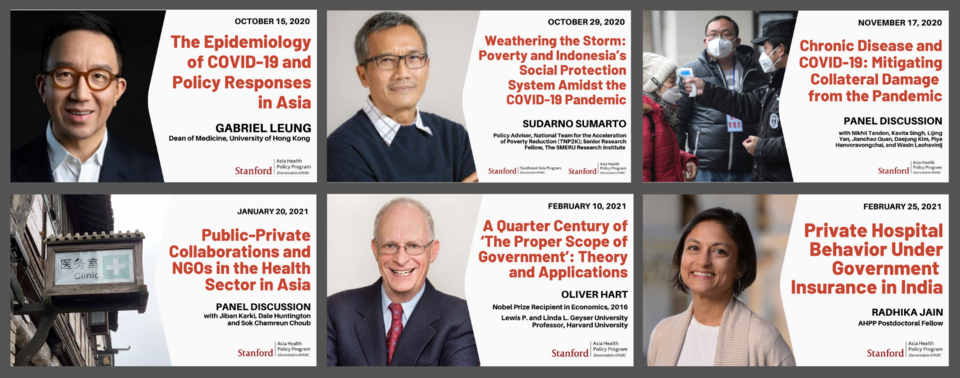
The 2020-21 Asia Health Policy Program (AHPP) colloquium series, “Health, Medicine, and Longevity: Exploring Public and Private Roles,” brings together academics, theorists, on-the-ground NGO leaders, and government advisors to explore how partnerships between public providers and private organizations affect the quality and access to healthcare the world over.

The series recently featured a keynote address by Harvard economist Oliver Hart, the 2016 co-recipient of the Nobel Prize in Economics for his work on contract theory — a framework known as ‘The Proper Scope of Government.’ Hart joined AHPP Director and APARC Deputy Director Karen Eggleston to reflect on the impact his theory has had across disciplines in the 25 years since its publication and on the future of research into contract theory. Watch the conversation with Hart below.

[Subscribe to our newsletters to stay informed on research happening at APARC.]

Oliver Hart and the ‘Proper Scope of Government’

Hart’s seminal economic theory, ‘The Proper Scope of Government,” underpins much of the research into public-private partnerships in healthcare. Hart developed this touchstone framework jointly with Andrei Shleifer and Robert W. Vishny to better evaluate when a government should provide a service itself and when it should contract with a private provider for support and execution of services.

The model outlined in Hart, Shleifer, and Vishny’s original 1996 working paper is designed to help providers and contractors consider the costs and benefits of a proposed contractual service agreement. While this model was originally applied to the case of prison privatization, the framework has served as an invaluable tool for researchers in multiple sectors including health policy and provision.

Reflections and Updates to the Theory

In reflecting on ‘The Proper Scope of Government,’ there are things Hart would like to see more fully incorporated into the theory to enrich its real-world applicability. Chiefly among these is better accounting for contractual incompleteness or the reality that a contract cannot anticipate and outline every possible unforeseen event or area of ambiguity. However, modeling contractual incompleteness is notoriously difficult given the almost-limitless factors of variability.

Some of Hart’s recent work on guiding principles responds to this challenge. Rather than trying to predict every aspect of a contractual relationship within the framing and language of a standard contract model, Hart argues that mutually agreed-upon guiding principles —such as equity, loyalty, and honesty — can serve as a foundation for navigating inevitable areas of ambiguity and potential conflict that a contract does not specifically state or that the original theory does not fully account for.

These guiding principles also help preserve space for renegotiation and innovation, which are necessary in an era of rapid technological advances and explosion of measurable data. In this context, Hart cautions against the mentality of ‘more is more:’

“If you put more and more things into the contract and then something happens that wasn’t in the contract, the fact that you put so much more in may make it more difficult to negotiate about the thing that you didn’t put in.”

 Applying ‘The Proper Scope of Government’

Hart shared a prime example of his theory at work in health systems in a case study of the Vancouver Island Health Authority. Traditionally, family physicians would continue as the primary care provider for their patients even if a patient needed hospitalization. But a change of law in 2006 required all specialized in-hospital care be contracted to hospitalists with little to no crossover with care provided by family practice physicians.

The result was a rise in caseload and stress levels amongst hospital specialists and repeated failed negotiations of the standard contract. The addition of guiding principles to the contract, however, provided avenues where reasonable solutions and additional communications could happen beyond the limits of the formal contract.

This is just one case of innumerable where Hart’s work has helped inform and contextualize how policymakers consider relationships between the public and private spheres of healthcare. Responding to the praise and input from fellow economists presented in a tribute documentary to the impact of his framework, Hart remarked:

“I hadn't realized how many people have been influenced by this paper and how they've been using it in different contexts. I knew some of the applications, but there were others I didn't, and it’s been truly amazing to see that.”

Looking Toward the Future

The tradeoffs between public and private partnerships in healthcare systems across the world will continue to be a dynamic and evolving area of research that will rely on theories such as ‘The Proper Scope of Government’ for framing and application. Looking towards the future, Hart was hopeful but cautious about the vitality of the kind of theoretical tradition which allowed for the development of his original theory. He recognizes that specialties such as contract theory and contractual incompleteness are inherently “messy” and somewhat out of vogue with current trends in economics which tend to favor theories that are “impressive, clever, and non-obvious,” regardless of whether they address important questions.

As he iterated in his Nobel Prize lecture, the incomplete world of contracts nonetheless “underlies numerous significant phenomena, some of which have great policy relevance,” and therefore fully deserving of upcoming economists’ time and efforts.

Further Research into Public-Private Partnerships

The Asia Health Policy Program’s 2020-21 colloquium series focuses on the roles and impacts of public-private partnerships in healthcare and the tradeoffs in equity, accessibility, and cost that come with contracted agreements in health systems. All of the events from the colloquium series are available on our YouTube channel. Click the thumbnails below to start exploring.

Collaborative governance — that is, relationships involving both the private and public sectors in the pursuit of public value — is part of ongoing research by Karen Eggleston. Her forthcoming book, The Dragon, the Eagle, and the Private Sector (Cambridge University Press), co-authored with Harvard’s John D. Donahue and Richard J. Zeckhauser, examines the ways in which collaborative governance works across a wide range of policy arenas in China and the United States, with the goal of empowering public decisionmakers to more wisely engage the private sector. Join us for the book launch event, which will be held jointly with the Harvard Kennedy School on March 5 


Image
Thumbnail images for the webinar events in the AHPP's 2020-21 colloquium series, "Health, Medicine, and Longevity: Exploring Public and Private Roles."

Read More

Male Japanese doctor showing senior patient records on a clipboard
News

Health Signals Increase Preventive Care, Improve Health Outcomes for Individuals at High Risk of Diabetes, Evidence from Japan Shows

Among the general population, however, researchers including Asia Health Policy Program Director Karen Eggleston find no evidence that additional care improves health outcomes.
Health Signals Increase Preventive Care, Improve Health Outcomes for Individuals at High Risk of Diabetes, Evidence from Japan Shows
An elderly individual travels in a cart up a street.
News

Researchers Develop New Method for Projecting Future Wellness of Aging Populations

Asia Health Policy Director Karen Eggleston and her colleagues unveil a multistate transition microsimulation model that produces rigorous projections of the health and functional status of older people from widely available datasets.
Researchers Develop New Method for Projecting Future Wellness of Aging Populations
A communications robot named Pepper by Softbank
Q&As

Robots May Be the Right Prescription for Struggling Nursing Homes

Karen Eggleston and Yong Suk Lee speak to the Oliver Wyman Forum on how robotics and advancing technologies are helping staff in Japanese nursing homes provide better and safer care to their patients.
Robots May Be the Right Prescription for Struggling Nursing Homes
Hero Image
[Left] A nurse assists an elderly woman in a wheel chair; [Right] Oliver Hart
The AHPP 2020-21 colloquium series explores the roles of the public and private sectors in providing equitable and accessible health services. The keynote address was given by Nobel laureate Oliver Hart.
Getty Images
All News button
1
Subtitle

In its 2020-21 colloquium series, the Asia Health Policy Program weighs the balance, benefits, and considerations in providing health services through national governments and contracting with private organizations.

Authors
Donald K. Emmerson
News Type
Commentary
Date
Paragraphs

This op-ed by Donald K. Emmerson first appeared in The Jakarta Post.

Above all, Trump wanted to be a winner. History granted his wish. He is the first president in the 245-year life of his country to have been impeached twice. By that standard, he won the title of America’s Worst President (AWP)—worse than any of the 44 presidents who preceded him.

AWP rhymes with 'gawp,' and that’s what he also wanted: to be stared at, talked about, catered to, the center of fawning attention, unforgettably present, dominating the news, astride the world in which the news is made. He wanted applause. His ravenous insecurity—narcissism—inflated his ego to continental size. In effect, in his authoritarian imagination, the “extremely stable genius” that he called himself deserved to be the indispensable “me” in “America,” without which the country’s name and the country itself would crumble.

The roars and chants of Trump’s crowds slaked his thirst for veneration. But they imprisoned him in his “base.” By satisfying his craving to be idolized, they gave him no reason to convince the unimpressed. How much more gratifying it must have been for him to bask in mass flattery at rallies than to engage in the difficult business of persuading the uncommitted. That would have taken assets he lacked: empathy, knowledge, intelligence, and a willingness not to lie.

[Subscribe to APARC's newsletters to get regular updates on our scholars.]

So how could Americans have elected such a demagogue? Trump was corrupt but charismatic. He broke the rules. He said whatever was on his mind. He appealed to the streak of individualism in American culture. He ran his campaign and his presidency as a mass entertainment featuring a lone patriot fighting a “deep state” controlled by globalist elites. Especially in rural areas between Silicon Valley and the Boston-to-Washington corridor, millions of white Americans felt threatened by the transfer of jobs from physical toward mental labor in a computerized society whose racial make-up was increasingly non-white. Globalization fed those anxieties. Trump stoked them. He promised to end them and “make America great again.”

Joe Biden defeated Trump in both the popular vote and the Electoral College—respectively by 4.4 and 13.7 percent. Biden’s margins were narrower than one might have wished, given the blatant flaws in Trump’s character, including the 30,573 false or misleading claims that he made during his presidency as tracked and noted by The Washington Post . The egregiousness of his behavior is, however, a double testament to America’s democratic system: to its failure to select a less despicable leader, yes, but also to its success in providing the lawful framework within which his desperate effort to stage what in Latin America would be called an autogolpe or “self-coup” could be and was overcome.

On 1 February 2021, watching television at his 126-room estate in Palm Beach, Florida, ex-president Trump would have learned of the coup in Myanmar and might have envied Senior General Min Aung Hlaing. Both men had been banned by Facebook for inciting violence in their respective countries—Trump in 2021, the general in 2018. Both had suffered defeats in elections held just five days apart in 2020—3 November in the US, 8 November in Myanmar. Both had rejected the voters’ verdict, claiming fraud. But whereas Trump’s frantic and deadly effort to subvert the US election and retain power failed, Min Aung Hlaing’s self-coup has succeeded, at least for now. The general quickly seized full power despite his party’s massive embarrassment at the polls in November, Aung San Suu Kyi’s party having won 83 percent of the available seats. In contrast, Trump could not reverse his exit from power despite a far slimmer margin of electoral defeat. To the extent that the ex-president was even aware of the difference, it could have fanned what angry envy of the general he may have felt.

Trump failed mainly due to the checks and balances that generally call government to account in America. Min Aung Hlaing succeeded in no small part thanks to the checks and balances in the bank accounts of the generals who have compromised Myanmar’s transition to democracy and helped make it the second most corrupted country in Southeast Asia (after Cambodia) as measured by the Corruption Perceptions Index.

Among the many reactions to the Burmese coup, several stand out for their courage and creativity. UN Secretary General António Guterres was unequivocal. "It's absolutely unacceptable,” he said, “to reverse the result of the elections and the will of the people.” Presumably speaking on behalf of the UN, its secretariat, or himself, or all three, he went further: "We'll do everything we can to mobilize all the key actors of the international community to put enough pressure on Myanmar to make sure that this coup fails." 

This notable response came from Indonesia’s former foreign minister Marty Natalegawa: “Deafening silence in the face of assaults against democratic principles [has] increasingly become the norm,” he said. He urged ASEAN to “demonstrate its relevance: It must speak urgently for the respect of constitutional process and rule of law in Myanmar, and call for the immediate release of those unlawfully detained.”

In the days immediately following the coup, ASEAN’s Bruneian secretary general said nothing about it, preferring to remain, in the Indonesian expression, “silent in a thousand tongues.” Speaking for ASEAN as its current chair, however, Brunei’s government did at least encourage a “return to normalcy in accordance with the will and interests of the people of Myanmar,” noting that the group charter’s called for adherence to “democracy, the rule of law” and “human rights and fundamental freedoms.”

As for ASEAN’s next chair, Cambodia, its strongman Hun Sen did speak, but only to say that "Cambodia does not comment on the internal affairs of any country at all.” Hun Sen’s restraint made historical sense. Had Cambodia’s old despot chosen to criticize Myanmar’s new despot, observers could have noted that Min Aung Hlaing had only done what Hun Sen himself had bloodily accomplished in 1997 by seizing full control over Cambodia in a self-coup of his own that had enabled him to become the longest-serving prime minister in the world.

Critical Southeast Asian voices, unconstrained by look-the-other-way diplomacy, have been heard. The chairman of the ASEAN Parliamentarians for Human Rights, Charles Santiago, has urged ASEAN to send a high-level delegation to Myanmar to tell Min Aung Hlaing that his coup “violates ASEAN principles and the ASEAN charter” and is “not acceptable.” “If Myanmar does not turn around,” he added, “there should be proceedings to expel Myanmar out of ASEAN.”

Who is better positioned to deal with this crisis than ASEAN’s largest and debatably least authoritarian member country? It was Indonesia’s Natalegawa who patched up ASEAN’s consensus after Hun Sen damaged it on China’s behalf in 2012. And it is Natalagewa who believes, with the Myanmar coup in mind, that “at this critical juncture for the region, Indonesia must demonstrate its leadership within ASEAN.”

Indonesia’s president Jokowi, rather than trying to rally the region against the coup, will likely continue to focus on domestic economic growth. Not to mention the existential priority that COVID-19 also warrants on his agenda.

So why not task Natalegawa with a damage-control trip around the region comparable the one he took with some success in 2012? He could start with fact-finding in Myanmar. He could then explore an intra-ASEAN understanding that would reassert the core democratic values in the ASEAN Charter while lessening, if possible, the chance that Myanmar will revert to entrenched and fully authoritarian rule. That may be a lost cause. But nothing ventured, nothing gained.

Although Donald Trump is no longer in office, America is still not safe from Trumpism. But America’s system—democracy—is working as it should. Is ASEAN really a dictators’ club? Or does it, too, when threatened from within, have a system that can at least manage and minimize the damage that is, in Myanmar as I write this, being done?

Read More

Protesters opposing the February 1 coup in Myanmar
Q&As

The Myanmar Coup Is a Major Setback, but the Story of Myanmar's Struggle for Democracy Is Not Over

According to Scot Marciel, former U.S. ambassador to Myanmar and Stanford visiting scholar at APARC, building a democracy is a difficult process that can be upended, particularly when the military is politicized and has its own agenda.
The Myanmar Coup Is a Major Setback, but the Story of Myanmar's Struggle for Democracy Is Not Over
President Biden walks past a row of Chinese and American flags.
News

APARC Experts on the Outlook for U.S.-Asia Policy Under the Biden Administration

Ahead of President-elect Biden’s inauguration and on the heels of the attack on the U.S. Capitol by a pro-Trump mob that has left America shaken, an APARC-wide expert panel provides a region-by-region analysis of what’s next for U.S. policy towards Asia and recommendations for the new administration.
APARC Experts on the Outlook for U.S.-Asia Policy Under the Biden Administration
Barack Obama addresses a crowd of young leaders from ASEAN nations.
Commentary

A Global Town Hall Welcomes America Back

Despite the reversals of the Trump era, a flurry of online diplomacy served as a reminder that the U.S. is welcome in Southeast Asia writes Donald K. Emmerson in The Diplomat.
A Global Town Hall Welcomes America Back
Hero Image
Protesters in Myanmar stand on a picture of General Min Aung Hlaing
Chung Sung-Jun, Getty Images
All News button
1
Subtitle

Southeast Asia Program Director Donald K. Emmerson compares responses across Southeast Asia to the February coup in Myanmar and reflects on the parallels and differences between the state of democracy there and in the United States.

-


4:00-5:00pm California, 18-February 2021
7:00-8:00pm Washington DC, 18-February 2021
3:00-4:00am  Kenya, 19-February 2021
11:00am-12:00pm Sydney, Australia 19-February 2021


The Bay of Bengal, while split by national boundaries and even our concepts of distinct South and Southeast Asian regions, is re-emerging as a connected geographic and demographic space. Some of Asia’s most consequential transnational policy challenges will be most starkly presented here, across the borders of India, Bangladesh, and Burma – and traditional policy-making structures are already struggling to cope with environmental disasters, the mass movement of people, and the yawning need for economic connectivity. This webinar will examine these policy challenges, from the fragility of the Sundarbans ecosystem to the transnational implications of the Burma coup, and whether existing state and multilateral institutions are capable of addressing them.

SPEAKERS:

Image
Kelley Eckels Currie
Kelley Eckels Currie served as U.S. Ambassador-at-Large for Global Women’s Issues and the U.S. Representative at the United Nations Commission on the Status of Women.  Prior to her appointment, she led the Department of State’s Office of Global Criminal Justice (2019) and served under Ambassador Nikki Haley as the United States’ Representative to the UN Economic and Social Council and Alternative Representative to the UN General Assembly (2017-2018).  Throughout her career, Ambassador Currie has specialized in human rights, political reform, development and humanitarian issues, with a focus on the Asia-Pacific region. She has held senior policy positions with the Department of State, the U.S. Congress, the Project 2049 Institute, and several international and non-governmental human rights and humanitarian organizations.  Ambassador Currie holds a Juris Doctor from Georgetown University Law Center.

Image
Tanaya D Gupta
Tanaya Dutta Gupta is a PhD Candidate in Sociology at the University of California, Davis. Tanaya’s dissertation research focuses on climate change, (im)mobilities and borders in the Bengal delta region of Bangladesh and India. Her educational background includes MA in Sociology and Geography. As visiting researcher with the International Centre for Climate Change and Development and collaborator with the Observer Research Foundation, Tanaya participates in policy conversations through her research. Her research has been funded by the National Geographic Society and UC Davis Graduate Program Fellowships. 

Image
Constantin Xavier
Constantino Xavier is a Fellow in Foreign Policy and Security Studies at the Centre for Social and Economic Progress, in New Delhi, where he leads the Sambandh Initiative on regional connectivity. He is also a non-resident fellow in the Foreign Policy program at the Brookings Institution. His research and publications focus on India’s changing role as a regional power, and the challenges of security, connectivity and democracy across South Asia and the Indian Ocean. Dr. Xavier regularly lectures at various Indian, European and American universities, as well as at civilian and military training institutions in India. He holds a Ph.D. in South Asian studies from the Johns Hopkins University, School of Advanced International Studies, and an M.A. and M.Phil. from Jawaharlal Nehru University.  

MODERATOR:

Image
Arzan Tarapore
Arzan Tarapore is the South Asia research scholar at the Shorenstein Asia-Pacific Research Center at Stanford University, where he leads the newly-restarted South Asia research initiative. He is also a senior nonresident fellow at the National Bureau of Asian Research. His research focuses on Indian military strategy and contemporary Indo-Pacific security issues. He previously held research positions at the RAND Corporation, the Observer Research Foundation, and the East-West Center in Washington. Prior to his scholarly career, he served as an analyst in the Australian Defence Department, which included operational deployments as well as a diplomatic posting to Washington, DC. Arzan holds a PhD in war studies from King’s College London.


This event is co-sponsored by: Center for South Asia 


This is a virtual event via Zoom.  Please  Register at: https://bit.ly/3txBBVq
Kelley Eckels Currie former Ambassador-at-Large for Global Women's Issues
Tanaya Dutta Gupta University of California, Davis
Constantino Xavier Centre for Social and Economic Progress- New Delhi
Seminars
Authors
News Type
Q&As
Date
Paragraphs

This article was originally written by Melissa De Witte on behalf of Stanford News.

As Monday’s coup in Myanmar demonstrates, democracy is often fragile and subject to setbacks, says former U.S. ambassador to Myanmar and Stanford visiting scholar, Scot Marciel.

Here, Marciel discusses how in a country like Myanmar (formerly Burma), which was under military rule from 1962 to 2011, establishing a democracy takes time. Despite democratic reforms over the past decade, the military in Myanmar has held onto a considerable amount of power, said Marciel, noting that it is difficult to build not only a representative parliament but other democratic institutions including an independent judicial system, a fair police force and a free press.

While Monday’s coup is a major setback in Myanmar’s fight for democracy, Marciel said that there are many people in the country who will do what they can to restore their elected government and build the foundations of democracy.

Marciel is a visiting scholar at the Walter H. Shorenstein Asia-Pacific Research Center (APARC), Stanford’s hub for interdisciplinary research, education and engagement on contemporary Asia that is run under the auspices of the Freeman Spogli Institute for International Studies. Marciel served as U.S. Ambassador to Myanmar from March 2016 through May 2020. From 2010 to 2013, Scot Marciel served as U.S. Ambassador to Indonesia.

[Subscribe to APARC's newsletters to get the latest updates from our scholars.]


What do people who have not spent extensive time studying or living in Myanmar need to know about its history to better understand Monday’s coup?

A couple of things. First, as historian Thant Myint-U has written, Myanmar is an unfinished nation, in the sense that the diverse communities that make up the country have never truly solidified as a unified nation. The country has been in near-constant conflict, mostly between the majority Bamar ethnic group and the many ethnic minority communities that inhabit much of Myanmar’s border areas. Second, the military staged a coup in 1962 and ran the country for nearly 50 years before allowing some movement toward representative democracy beginning in 2011-2012. So the military has long been a dominant force in the country, and – even after the reforms of the past decade – retained substantial power.

Is there anything that is often misunderstood about its history and its people?

In the West, many people have tended to view Myanmar mostly through the prism of a struggle for democracy between the military and the civilian opposition, led by Aung San Suu Kyi. That is a critically important part of the story, for sure. Perhaps equally important, however, has been the struggle of the many ethnic minority communities for equality, a degree of autonomy, and respect for their own histories, cultures and languages. This struggle has produced widespread conflict, significant human rights abuses, and large numbers of refugees and displaced people for decades.

What are some of the difficulties in establishing, and maintaining, democratic rule in a country like Myanmar?

First, persuading the military to give up power, depart from politics, and play a more appropriate role in the country. Second, it is very difficult to build the institutions of democracy, including not only parliament, but also a strong, independent judicial system, an effective and fair police force, and respect for the critical role of civil society and the independent media. In Myanmar, another essential aspect is to shift from historically centralized rule to a federal structure that would allow the various communities across the country to have more of a say in how they are governed.

As ambassador to Myanmar, what was it like working with not only the country’s policymakers but also its people? What did you learn from them about how democracy is established? And how did those experiences shape your perspective?

In Myanmar, I met so many people, all over the country, from many different walks of life, who had sacrificed and continued to sacrifice to try to build democracy and respect for human rights. Some operated at the national level, others at the local level. It was a good reminder that democracy isn’t just imposed from the top; it requires careful building at the community and state level, with intensive involvement by the various communities. It also takes time and, as we have seen this week, is often fragile and subject to setbacks. In other words, it is a long-term effort that requires persistence, courage, and participation by large numbers of people. Establishing a democracy is a lengthy, painstaking effort that can be upended, particularly if the armed forces are politicized and pursue their own agenda.

Is there anything else you would like to add? 

This week’s military takeover constitutes a major setback, but the story of Myanmar’s struggle for democracy is not over. Many people there will continue to do what they can to restore elected government and build, brick by brick, the foundations of democracy.

Read More

Portrait of Paul Schuler and the cover of his book, 'United Front'
Q&As

A Balance of Power: The Role of Vietnam’s Electoral and Legislative Institutions

As the 13th National Congress of Vietnam's Communist Party is selecting a new leadership team that will set the country’s course for the next five years, Vietnamese politics expert Paul Schuler discusses his new book on the state’s single-party legislature.
A Balance of Power: The Role of Vietnam’s Electoral and Legislative Institutions
President Biden walks past a row of Chinese and American flags.
News

APARC Experts on the Outlook for U.S.-Asia Policy Under the Biden Administration

Ahead of President-elect Biden’s inauguration and on the heels of the attack on the U.S. Capitol by a pro-Trump mob that has left America shaken, an APARC-wide expert panel provides a region-by-region analysis of what’s next for U.S. policy towards Asia and recommendations for the new administration.
APARC Experts on the Outlook for U.S.-Asia Policy Under the Biden Administration
Stanford campus, main quad with cloudy sky
News

APARC Offers Fellowship and Funding Opportunities to Support, Diversify Stanford Student Participation in Contemporary Asia Research

The Center has launched a suite of offerings including a predoctoral fellowship, a diversity grant, and research assistant internships to support Stanford students interested in the area of contemporary Asia.
APARC Offers Fellowship and Funding Opportunities to Support, Diversify Stanford Student Participation in Contemporary Asia Research
Hero Image
Protesters opposing the February 1 coup in Myanmar
People protest the February 1 coup in Myanmar outside the Myanmar embassy in Bangkok, Thailand.
Lauren DeCicca, Getty
All News button
1
Subtitle

According to Scot Marciel, former U.S. ambassador to Myanmar and Stanford visiting scholar at APARC, building a democracy is a difficult process that can be upended, particularly when the military is politicized and has its own agenda.

-

To watch the recording of the event, click here.

While many countries around the world have slipped toward authoritarianism, South Korea has won praise for exhibiting democratic resilience through “candlelight protests” and a presidential impeachment. But Korea's democracy has likewise begun to show signs of decay, as democratic norms and spirits have been violated under the guise of rule of law. Troublingly, this trend has been growing under the government led by former pro-democracy activists. In this panel, scholars of Korean democracy, including a former activist, will discuss whether concerns about Korea's democratic decline are warranted and whether Korean liberals are truly liberal.

Panelists:

Image
Byoungjin Ahn
Byongjin Ahn is a professor of American Studies at Kyung Hee University, where he was the rector of the Global Academy for Future Civilization. His main research area includes American presidency and its implications on Korean politics. He is currently writing a book on the rise and decline of Korean liberalism. He holds a Ph.D. from the New School for Social Research where he received Hannah Arendt Award for his doctoral dissertation, “Learning to Speak American: The Use of Values Appeals in the 1984 and 1996 Presidential Elections.” He has published several books in Korean, including The Roots of Crisis in Democracy and Conservatism after Democratization (pulbit press, 2008).

Image
Aram Hur
Aram Hur is an assistant professor of political science at the University of Missouri, where she also serves as Co-Director for the MU Institute for Korean Studies. Her research focuses on national politics and democracy, with particular focus on issues of national identity change, integration, and democratic support in East Asia. Her work is published in academic journals such as the British Journal of Political ScienceComparative Politics, and Journal of East Asian Studies, and has been cited in media outlets such as the New York Times, Washington Post, and Foreign Policy. She holds a Ph.D. from Princeton University, M.P.P. from the Harvard Kennedy School, and B.A. from Stanford University. 

Image
Gi-Wook Shin
The discussion will be led by Gi-Wook Shin, William J. Perry Professor of Contemporary Korea and director of Shorestein Asia-Pacific Research Center at Stanford University.

Via Zoom: Register at https://bit.ly/3aceTJM

Byong Jin Ahn <I>Kyung Hee University</i>
Aram Hur <I> University of Missouri</I>
Gi-Wook Shin <I>Stanford University</I>
Panel Discussions
Authors
Noa Ronkin
News Type
News
Date
Paragraphs

The Walter H. Shorenstein Asia-Pacific Research Center (APARC) has broadened its fellowship and funding opportunities to support Stanford students working in the area of contemporary Asia. The Center introduced these expanded offerings in response to the harsh impacts of the COVID-19 pandemic on student’s academic careers and their access to future jobs and valuable work experience, and in recognition of the critical need to make the field of Asian Studies more diverse and inclusive.

APARC’s diversity grant aims to encourage Stanford students from underrepresented minorities (URM) to engage in the study and research of topics related to contemporary Asia and U.S.-Asia relations, including economic, health, foreign policy, social, political, and security issues. The grant, which was first announced in June 2020, is now an ongoing offering. APARC will award a maximum of $10,000 per grant. Current  Stanford undergraduate and graduate students in the URM category from any major or discipline are eligible and encourage to apply.

APARC also invites Stanford Ph.D. candidates specializing in topics related to contemporary Asia to apply for its 2021-22 predoctoral fellowship. Up to three fellowships are available and the application deadline is May 1, 2021.

In addition, APARC continues to offer an expanded array of research assistant internships. The Center is currently seeking highly motivated Stanford undergraduate- and graduate-level students to join our team as paid research assistant interns for the spring and summer quarters of 2021. Applications for spring 2021 research assistant assignments are due on February 22, for summer 2021 assignments on March 8.

Read More

President Biden walks past a row of Chinese and American flags.
News

APARC Experts on the Outlook for U.S.-Asia Policy Under the Biden Administration

Ahead of President-elect Biden’s inauguration and on the heels of the attack on the U.S. Capitol by a pro-Trump mob that has left America shaken, an APARC-wide expert panel provides a region-by-region analysis of what’s next for U.S. policy towards Asia and recommendations for the new administration.
APARC Experts on the Outlook for U.S.-Asia Policy Under the Biden Administration
View of building roof in the Forbidden City complex and the Beijing skyline in the background
News

New Fellowship on China Policy Seeks to Strengthen U.S.-China Relations

Stanford University’s Shorenstein Asia-Pacific Center invites applications for the inaugural 2021-22 China Policy Fellowship from experts with research experience on issues vital to the U.S. China policy agenda and influence in the policymaking process.
New Fellowship on China Policy Seeks to Strengthen U.S.-China Relations
National Guard at the US Capitol
Commentary

The Soft War That America Is Losing

The US depends far more on its soft power than authoritarian China does. Once it is lost, it is hard to get back.
The Soft War That America Is Losing
Hero Image
Stanford campus, main quad with cloudy sky
All News button
1
Subtitle

The Center has launched a suite of offerings including a predoctoral fellowship, a diversity grant, and research assistant internships to support Stanford students interested in the area of contemporary Asia.

Subscribe to Society