Diplomacy
Authors
News Type
Q&As
Date
Paragraphs

In the wake of the recent historic meeting of the leaders of China and Taiwan, the Stanford News Service asked two of the university's Asia experts about the aftermath of that meeting and its possible effects on political relations between the two countries, the military situation and Taiwan's Jan. 16 presidential and parliamentary elections.

The first presidential meeting between the leaders of the communist mainland and the democratic island, split by civil war in 1949, was held in early November on neutral territory in Singapore.

Kharis Templeman is the Taiwan Democracy program manager at Stanford's Center on Democracy, Development, and the Rule of Law at the Freeman Spogli Institute for International Studies. He recently wrote about why Taiwan's defense spending has fallen as China's has risen. Thomas Fingar is a distinguished fellow at Stanford's Walter H. Shorenstein Asia-Pacific Research Center. He served as the chairman of the National Intelligence Council and in other key positions in Washington. 

Do you anticipate any lasting effects from the face-to-face meeting of Chinese leader Xi Jinping and Taiwanese President Ma Ying-jeou?

Thomas Fingar: At a minimum, the meeting appears intended by both sides to validate and lock in the much-improved cross-Taiwan Strait relationship that has evolved over the past several years.

Kharis Templeman: I do think the Ma-Xi meeting itself will have one lasting legacy: it has created a precedent for treating the directly elected president of the Republic of China as an equal and as the rightful representative of Taiwanese interests in cross-strait relations. From now on, leaders in Beijing are going to have a hard time arguing that a non-KMT (the Kuomintang, Taiwan's governing party,) president is illegitimate, as they did during the [former Taiwanese president] Chen Shui-Bian era, or to continue to insist on referring to Taiwan’s leaders as provincial-level officials. So, the next president will come into office somewhat strengthened by that precedent.   

Will the meeting have any effect on the January elections in Taiwan?

Templeman: I don’t think it will make much, if any, difference. Taiwanese public opinion is deeply divided about Ma Ying-Jeou’s meeting with Xi. Ma himself remains quite unpopular, the economy is barely growing, and the KMT presidential candidate remains at least 20 points behind in the polls. There’s little indication that this meeting has shaken up what has been a large and steady lead for DPP (Democratic Progressive Party) presidential candidate Tsai Ing-Wen, and I would be shocked if she didn’t win a comfortable victory in January.

Fingar: Probably not. Beijing seems to have learned that its past attempts to influence elections on Taiwan have been ineffectual or counterproductive, and the meeting is unlikely to change minds or votes on the island. 

How might the elections affect military spending on either sides, or China's aggressive island-building for military bases?

Fingar: The meeting will not have any effect on military spending or the building of artificial islands in the South China Sea, but Beijing may have hoped that agreeing to meet with Ma to demonstrate how "good" the relationship is might persuade Washington not to approve another round of arms sales to Taiwan.  Regardless of who wins the election on Taiwan, the next administration is likely to seek another round of U.S. arms sales in order to prove that it has the support of the United States.

Templeman: The meeting will have no impact on the security balance in the region. Ma reportedly raised the issue of PRC (People's Republic of China) missiles within easy range of Taiwan, but Xi claimed, implausibly, that they were not targeted at Taiwan, and that was the end of it. The broader trends are unchanged: the PRC’s military budget is growing annually by double-digit rates while Taiwan’s remains essentially flat. The consequence is that the PRC’s capacity to take coercive measures against Taiwan continues to expand, even as cross-strait cooperation has been improved and institutionalized.

Dan Stober is at the Stanford News Service.

Hero Image
22655287560 9d34c4bd69 o
Taiwanese President Ma Ying-jeou meets with Chinese President Xi Jinping in Singapore on Nov. 7, 2015.
Flickr/Office of the President Republic of China (Taiwan)
All News button
1
News Type
News
Date
Paragraphs

South Korea must stand with the United States in the event of escalated tensions between China and the United States in the South China Sea, Stanford professor Gi-Wook Shin advised at a forum in Seoul on November 19th.

"Flexibility is necessary, but what's more important is…principle," said Shin, emphasizing the importance of South Korea’s alliance with the United States over its strategic partnership with China.

The full article (in English) may be viewed on the Yonhap News website.

Hero Image
14358811168 6d39e1f78a o
The U.S. and Philippine navies conduct a bilateral exercise in the South China Sea, June 2014.
Flickr/U.S. Navy
All News button
1
News Type
News
Date
Paragraphs

The leader of U.S. Pacific Command, Adm. Harry B. Harris, Jr., addressed U.S. nautical movements in the South China Sea while also calling for sustained military cooperation between China and the United States in a speech at Stanford Center at Peking University (SCPKU) on Tuesday.

Led by Ambassador Karl Eikenberry, a group of Stanford faculty and scholars from the Walter H. Shorenstein Asia-Pacific Research Center (APARC) listened to the speech from Stanford via an interactive, live videoconference at the Graduate School of Business. The speech was followed by a question and answer session, co-facilitated by Stanford professor Jean Oi in Beijing.

The admiral’s visit to SCPKU was part of a larger trip to China, which included discussions between senior Chinese and American military officials.

News media covered Admiral Harris’ remarks delivered at the SCPKU, which co-sponsored the event with Shorenstein APARC's U.S.-Asia Security Initiative. Articles appeared in the New York Times and Wall Street Journal (subscription may be required to view), among other publications.

Hero Image
image2
A group of faculty and scholars at Stanford participate in a videoconference with the leader of U.S. Pacific Command, Adm. Harry B. Harris, Jr., in Beijing on Nov. 3, 2015.
Ryan Blake
All News button
1
Authors
Lisa Griswold
News Type
News
Date
Paragraphs


A podcast from the book event on Jan. 15 is available at the link above. An earlier interview with author Michael Armacost was first published in Oct. 2015 and is reposted below.

When it comes to elections, politics can supersede strategy. But what is often overlooked is the process through which the United States selects their commander in chief and its impact on policy – particularly, foreign policy.

What then shapes foreign policy during that time? “Events, my dear boy, events,” Harold Macmillan, a former British prime minister, famously replied when asked what could change a government's directions. To which Michael Armacost agrees and explores the interplay between campaign politics and foreign policy in his new book.

“Since World War II, the United States has consistently pursued a global role, but the tempo of its engagement with the world has been repeatedly adjusted to reflect circumstances and domestic moods,” Armacost wrote.

A veteran scholar, former ambassador and undersecretary of state for political affairs, Armacost is an expert on the U.S. government system and policy process. In the book, he examines ideology and the struggle for power in the six elections that have taken place since 1948, ending with Barack Obama’s re-election in 2012.

The book, which reads somewhat like a guide, largely began as a project for students, he said. 

Armacost initially came to Stanford in 1994, and in 2002, returned as a distinguished fellow at the Walter H. Shorenstein Asia-Pacific Research Center. He co-teaches a graduate course on U.S. policy in Northeast Asia.

“When I left government, I found a lot of literature on how foreign policy affects elections but little in the reverse,” Armacost said. “So my aim behind the research was to not only satisfy my own curiosity but to offer a comprehensive and accessible analysis for students.”

Armacost’s career in government began in 1983 when an advisor encouraged him to apply for a White House fellowship. His fellowship in the deputy secretary of state’s office – which was only set to be a single year in Washington – led to 24 years of public service.

He went on to serve as the U.S. ambassador to Japan from 1989 to 1993 and the Philippines from 1982 to 1984, and was a member of the National Security Council.

Armacost said he remains positive about the electoral system, while also suggesting a few reforms. The system ensures a cyclical chance to step back and assess where America stands in the world, he said.

“Our system provides regular opportunities to put the spotlight on troubling foreign policy problems,” he wrote. “And supplies an incentive to consider course corrections for costly, inconclusive foreign as well as domestic policies, or offers a chance to select new management to fix them.”

Shorenstein APARC asked him a few questions about his research in the context of the 2016 election cycle. His answers are posted below.

Will Obama attempt a “sprint to the finish line” on foreign policy?

He is well embarked on that sprint. In the fourth quarter of his presidency, he is eager to burnish his foreign policy legacy. President Obama’s agenda is clear. It includes the normalization of relations with Cuba, implementation of the Iran nuclear agreement, ratification of the Trans-Pacific Partnership free trade agreement, and promotion of further international cooperation on climate change. He will also seek to avoid losing ground in geopolitical competition with ISIS in Iraq and Syria, the Russians in the Ukraine and elsewhere, and China in the South China Sea.

A president’s power to effectively undertake controversial initiatives at home and abroad tends to ebb as his tenure runs out. Those requiring Congressional support are particularly problematic. And events will play a large role in determining the problems and opportunities that come his way before Jan. 20, 2017.

Does the Trans-Pacific Partnership (TPP) stand a chance of getting ratified?

It stands a chance, but it will not be easy. Fortunately, Trade Promotion Authority has been secured from the Congress. Hence, it will be limited to an up or down vote without amendments.

Opposition from labor unions and environmental groups assures that there will be very limited Democratic support for the TPP, and Hillary Clinton, Bernie Sanders and Martin O’Malley have publicly expressed their opposition. There has also been some erosion of support for free trade among the Republicans, whose leaders have mostly expressed misgivings about some of the TPP’s provisions.

I believe the TPP will advance U.S. economic and strategic interests, but whether its ratification will be achieved before or after the 2016 election is at this point uncertain.

How do the politics of the TPP differ from that of George H.W. Bush’s pursuit of the NAFTA agreement in 1992?

In 1992 President Bush didn’t hesitate to push hard for NAFTA throughout his campaign. And the Mexican and Canadian governments also regarded the U.S. election day as a convenient deadline for getting the agreement finished. The president’s GOP Party believed in free trade, and considered the push for an embryonic hemispheric market a worthy and historic objective. A NAFTA accord could be portrayed as extending a helping hand to a friendly neighbor. The Party’s business constituency was supportive; the bulwark of opposition to the deal were labor and environmental groups, which were unlikely to vote for Bush anyway.

Promoting NAFTA also offered the president a chance to put the Democratic candidate, Bill Clinton, who had made public remarks supporting such an agreement, on the spot. If he reversed his position and opposed the accord, he could be accused of “waffling;” if he didn’t, he would risk alienating his labor and environmental constituencies. Bush nearly got the deal finished, but side letters on labor and environmental issues remained to be completed after Clinton won the election.

This year, a Democratic president is confronting major opposition from his own party, and widespread support from Congressional Republicans is therefore indispensable to his chances of ratifying the agreement. A number of Republican leaders who are generally supportive of free trade, however, contend that President Obama was so eager to wrap up the deal on his own watch, that he missed a chance to drive a harder bargain. Others are reluctant to hand the president a foreign policy victory during a presidential campaign.

And as November 2016 nears, the Democratic candidate is likely to be reluctant to buck unions and environmental groups who not only provide much needed financial support, but supply the volunteers who perform crucial “get out the vote” duties on election day.

Where does foreign policy fit into the 2016 campaign? 

Foreign policy is likely to feature very prominently in the coming election, particularly if the economy continues its steady, if modest, rate of growth. The reason is simple. The United States faces serious challenges in the Middle East, the Ukraine, South Asia and the South China Sea. And many voters who favored retrenchment in 2008, now fear it is now perceived increasingly by friends and adversaries as weakness and/or retreat.

One should not, however, expect the presidential campaign to illumine the strategic choices we face abroad. Presidential contenders typically articulate a wide range of aspirational foreign policy goals. But they rarely outline priorities among these declared aims, let alone their potential costs and risks, or the trade-offs among them. To address these core elements of strategy might offend one or another potential voting bloc. Candidates, therefore, tend to focus upon the appeal of their foreign policy objectives at home, rather than their efficacy abroad.

A wide field of candidates has emerged early on. What foreign policy issues are not being addressed that should figure in the debates?

It’s a bit early to say. The first primaries are still three months away. Few debates have yet been held. The election is likely in any event to be in part a referendum on President Obama’s record. But Hillary Clinton, who served for four years as the Secretary of State, is differentiating her position from that of Obama’s on a number of foreign policy matters. And as I noted above, the focus in most campaigns is on laudable goals rather than the key elements of strategy, i.e. the operational tests of foreign policy for anyone who occupies the Oval Office.

What will happen to the U.S. “pivot back to Asia” strategy?

President Obama performed a useful service in underlining America’s growing stake in Asia. I would expect the candidates of both major parties to affirm their intent to devote more time, attention and resources to the Asia-Pacific region. The problems the current administration has experienced in Asia are a by-product of the policy’s implementation. Many Asian leaders wonder whether the policy has been forgotten or overtaken by events. Adjustments in our regional security policy have been essentially symbolic.

With China, we are still looking for a sustainable balance between constructive engagement and prudent hedging. The diplomatic opening to Myanmar was timely, but progress has been complicated by ethnic struggles in that country. American leaders visit Asia periodically, but the United States is still perceived as primarily preoccupied with problems in the Middle East. Conclusion of the TPP will lend credibility to the policy, but only if the agreement is ratified. So it will be up to the next president to put some meat on the bones of this strategic initiative.

How do election cycles in the United States and South Korea mesh, and what might the coming cycle mean for U.S.-Korean relations?

America has a four-year election cycle for the presidency. The Republic of Korea elects its presidents for a five-year term. We have experienced several occasions when our cycles appeared out of sync, i.e. when the United States elected more conservative candidates to the White House as the Koreans chose more liberal contenders for the Blue House. George W. Bush, a conservative, served during a period when the South Korean presidents – Kim Dae Jung and Roh Moo-Hyun – were both liberals or progressives. American and South Korean perspectives on policy toward North Korea diverged sharply. Nonetheless, they joined hands in launching the U.S.-Korea Free Trade Agreement, and formulated plans for a major redeployment of U.S. military forces away from the Seoul metropolis to bases further south. And President Obama, a liberal, fashioned a close relationship with Presidents Lee Myung-bak and Park Geun-hye, both conservatives.

Thus, shared national interests have a way of tempering the ideological predilections of our respective leaders, enabling them to collaborate when dangers loom or when opportunities beckon.

South Korea now trades twice as much with China as it does with the United States and Japan combined. So its economy is tied more closely to China now, though it still looks to Washington for protection. Seoul will not want to choose between its economic interests and its strategic concerns. The United States has no reason to force such a choice on its ally, but it is clear that Beijing hopes to use its economic leverage to influence the Republic of Korea’s strategic decisions, for example, its readiness to deploy a THAAD, high altitude ballistic missile defense system. This is the kind of issue that could feed back into our election-year politics.

Related links

WNYC Brian Lehrer Show (Audio): How Elections Derail Foreign Policy (Aug. 4, 2015)

Hero Image
rtr3a3uf
Confetti on stage as U.S. President Barack Obama celebrates after winning the U.S. presidential election in Chicago, Illinois, Nov. 7, 2012.
Reuters/Phillip Scott
All News button
1
Date Label
Authors
Lisa Griswold
News Type
News
Date
Paragraphs

South Korea and the United States are “completely aligned” on North Korea strategy, the chief American diplomat in South Korea said to a Stanford audience on Monday.

Mark Lippert, who assumed the role of U.S. ambassador to the Republic of Korea in 2014, delivered remarks at a public seminar, “Perspectives on the U.S.-Korea Alliance,” organized by the Korea Program at the Walter H. Shorenstein Asia-Pacific Research Center.

Arriving from the Washington summit of President Obama and Korean President Park Geun-hye, Lippert spoke of the success of the state visit. The U.S.-Korea relationship is in “as good a shape as it’s ever been,” and that secure foundation is allowing the two countries to forge ahead on shared challenges, including North Korea, trade and global health.

img 6102 Mark Lippert expressed optimism about the U.S.-ROK alliance at a Stanford talk on Oct. 19, 2015.
“We want to get back to credible and authentic negotiations towards a denuclearized Korea,” Lippert said, explaining that U.S.-Korea strategy toward North Korea aligns in three main areas: diplomacy, economics and deterrence.

He said the United States and South Korea are invested in getting to a place where the North Koreans will “come back to the table” for discussions on ending their nuclear program, noting the continuing viability of the Six Party Talks mechanism which has been stalled for more than five years.

Lippert also cited U.S.-Korea strategic cooperation on sanctions against North Korea, and defense capabilities aimed to deter the threat of a North Korea with nuclear and long-range missile capacity.

Looking ahead, “The United States strongly supports calls for reunification of the Korean Peninsula,” he said. Human rights, a free economy and a democratically elected government in the North would be a priority in that pursuit.

Lippert said the United States is supportive of inter-Korean talks and reunions for families separated by the Korean War, both announced earlier this year. On Tuesday, hundreds of South Koreans crossed the border to meet with North Korean relatives, who have been separated for more than six decades.

Partnering on the economic level was another key aspect of the summit, Lippert said, and the Trans-Pacific Partnership (TPP) was among items discussed. The United States, as one of 12 TPP member nations, would welcome an application from South Korea should they choose to pursue it, he said.

Lippert acknowledged that South Korea already has bilateral trade agreements with 10 out of the 12 TPP member nations, including one with the United States. The U.S.-Korea Free Trade Agreement (KORUS) came into force in 2012 and is moving toward full implementation, he said. The United States’ sixth largest trading partner is South Korea.

Following his formal remarks, Lippert took questions from the audience.

Michael Armacost, a Shorenstein Distinguished Fellow, asked Lippert how Japan and China figured into the summit discussions following recent developments. In September, President Park attended a military parade in Beijing that marked the 70th anniversary of the end of World War II. She was the only leader from a democratic country at the event.

Responding on China, Lippert said the United States is supportive of South Korea engaging with China. “We don’t view this as a zero-sum game,” he said, likening South Korea’s regional relationships to a situation where “all boats rise” together.

Dafna Zur, a professor of Korean culture and literature, asked Lippert to talk about how his education informed his career in public service.

Lippert attended Stanford and studied political science and international policy studies.

His education, he said, was invaluable in preparing him for the diverse situations and people that a diplomatic career brings.

Lippert encouraged students to savor conversation and debate in the classroom. Participating in that kind of forum not only “makes you a more informed person” but also “sharpens your analytic skills,” he said.

Prior to becoming ambassador, Lippert held senior positions in the Department of Defense and the White House and served in the U.S. Navy.

Following the event, Lippert met with faculty members of Shorenstein APARC and the Freeman Spogli Institute for International Studies for a roundtable discussion, chaired by Kathleen Stephens, a distinguished fellow at Shorenstein APARC and former U.S. ambassador to the Republic of Korea (2008-11).

Embedded photo: Mark Lippert speaks at Stanford on Oct. 19, 2015. Photo credit: Heather Ahn.

Hero Image
8722114465 9d3d8afc0e o
Korean President Park Geun-hye (left) and U.S. President Barack Obama have an in-depth discussion at a White House summit. This picture is from their first summit in Washington in May 2013. Their second summit took place in October 2015.
Flickr/Korea.net - Cheong Wa Dae (crop applied)
All News button
1
News Type
News
Date
Paragraphs

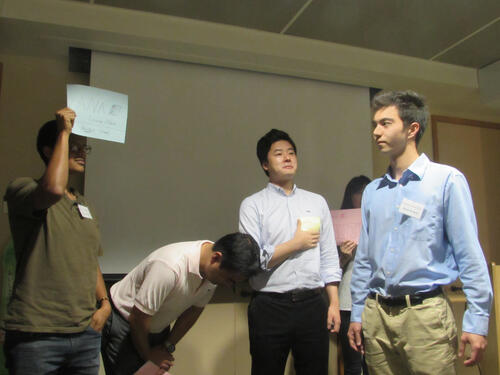
Stanford students worked together to pitch marketing ideas to a major Japanese airline at an event last Tuesday. The event, called an “ideathon,” is part of a series of events seeking to strengthen the U.S.-Japan relationship through exchange of ideas.

The ideathon was the first of its kind at the Shorenstein Asia-Pacific Research Center, led by the Japan Program under the rubric of the Stanford Silicon Valley-New Japan Project (SV-NJ). The project is supported in part by All Nippon Airways (ANA), the Japanese airline featured at the event.

Nineteen students participated, from both undergraduate and graduate levels and across disciplines – including students from the Graduate School of Business, and other majors including economics, mathematics, computer science, philosophy and East Asian studies.

Placed on a team with others they had just met, students were encouraged to assemble quickly and generate solutions to the challenge: how can ANA strengthen its brand awareness in the United States?

ANA is seeking to double in size in the next three years, yet it faces a few obstacles in this endeavor, including a customer base that is mostly in Japan and low brand visibility internationally, according to a senior employee that presented at the event.

“Who had heard of ANA before this event?” asked Hiroyuki Miyagawa, a marketing executive at ANA. Few hands raised in the audience.

Organized into four teams, each student team was joined by an ANA employee who listened in and offered guidance and a chance to learn from a longtime practitioner.

One and a half hours later, with Post-it notes and scribbled diagrams sprinkled across tables, each team emerged ready to present their 3-minute pitch to a panel of judges. The panel included executives from ANA, the World Innovation Lab (WiL), a venture capital firm in Palo Alto, and bTrax, a San Francisco based design firm.

Below are a few pictures from the event.


Image
ideathon team three

Team Three acts out a skit.  |  They proposed that ANA establish lounges for the general public to gather in and purchase goods from Uniqlo and Muji, two Japanese lifestyle retailers. The lounges would offer a place to reinforce ANA's brand outside of the airport, they said.


Image
ideathon team four

Team Four puts their heads together to generate ideas.  |  In their pitch, the team noted that baseball is a popular sport among Americans and Japanese. They recommended baseball be a focus of the marketing campaign, and said television and social media would best reach the target audience.


Image
ideathon team five

Team Five explains their marketing approach.  |  Flying can lead to some unpleasant experiences, and a way ANA can set itself apart is to make those experiences manageable, and even enjoyable, they said. Their proposal was to bring new amenities to the in-flight experience such as a care package for people who sit in the middle seat.


Image
ideathon team one

Team One poses for a picture after their presentation.  |  In their pitch, they recommended using ANA’s association with Japan to differentiate from other global airlines. Their approach included creating a film that features an American celebrity traveling on ANA.


The winning team was Team One whose concept was to use a celebrity figure – Ellen DeGeneres – in their advertising. They said that the target audience could relate to DeGeneres, and her already-established following would be an advantage.

The judges commended Team One for the creativity of their idea and its level of feasibility. Team One consisted of students Yaqian Fan, Michael Hong, Sam Ide, Lu Li and Adelbert Tan.

Kenji Kushida, a Stanford alumnus and project leader of SV-NJ, said:

“When I was a student, I craved for an opportunity to brainstorm solutions to real-world challenges and to do it in an environment that provided instant feedback,” he said, “We were able to make that happen here with the support of ANA and WiL, and are thrilled with the outcome."

Hero Image
ideathon headline cropped
All News button
1
-

Image
amb lippert2014
In the wake of South Korean President Park Geun-hye's meeting with President Obama in Washington, D.C. on October 16, Mark Lippert, the American Ambassador to Korea, will offer his thoughts about U.S.-Korean relations and the challenges and opportunities the alliance may face in coming years.

Ambassador Lippert previously held senior positions in the Department of Defense from May 2012 until September 2014. This included Chief of Staff to the Secretary of Defense, Chuck Hagel, and Assistant Secretary of Defense for Asian and Pacific Security Affairs, where he was the principal advisor to the Secretary of Defense on all international security strategy and policy issues related to the nations and international organizations of Asia and the Pacific. Prior to being confirmed in April 2012, he completed a two-year mobilization on active duty in the United States Navy. During that time, which included a deployment to Afghanistan, he served as an Intelligence Officer for the Naval Special Warfare Development Group in Virginia Beach, Virginia from 2009 to 2011.

Ambassador Lippert served as Deputy Assistant to the President and Chief of Staff for the National Security Council in 2009.  In 2008, he served as Deputy Director for Foreign Policy on the Obama-Biden Transition Team, and Senior Foreign Policy Advisor on the Obama for America campaign. Previously, he worked as the Foreign Policy Advisor for then-Senator Obama from 2005 to 2008, where he managed the Senator's work on the Senate Foreign Relations Committee. From 2007 to 2008, he took a leave of absence from this position to deploy on active duty as an Intelligence Officer with Seal Team One in support of Operation Iraqi Freedom. From 2000 to 2005, he was a Professional Staff Member on the Senate Appropriations Committee, State-Foreign Operations Subcommittee, advising Senator Patrick Leahy on a range of foreign aid and security assistance issues. From 1999 to 2000, he served as the Foreign and Defense Policy Advisor to Senator Tom Daschle and the Senate Democratic Policy Committee.

Ambassador Lippert’s military awards and decorations include the Bronze Star Medal for his service in Iraq, the Defense Meritorious Service Medal, and the Basic Parachutist Badge. He is also the recipient of the Department of Defense’s Distinguished Public Service Award and the Department of the Navy’s Distinguished Public Service Award.

Ambassador Lippert graduated Phi Beta Kappa from Stanford University with a B.A. in Political Science and holds an M.A. in International Policy Studies from the same institution. He also studied Mandarin Chinese at Beijing University.


Mark W. Lippert <i>U.S. Ambassador to Republic of Korea</i>
Seminars
Subscribe to Diplomacy