


Divided Lenses: Screen Memories of War in East Asia
Paragraphs
Divided Lenses: Screen Memories of War in East Asia is the first attempt to explore how the tumultuous years between 1931 and 1953 have been recreated and renegotiated in cinema. This period saw traumatic conflicts such as the Sino-Japanese War, the Pacific War, and the Korean War, and pivotal events such as the Rape of Nanjing, Pearl Harbor, the Battle of Iwo Jima, and the bombings of Hiroshima and Nagasaki, all of which left a lasting imprint on East Asia and the world. By bringing together a variety of specialists in the cinemas of East Asia and offering divergent yet complementary perspectives, the book explores how the legacies of war have been reimagined through the lens of film.
This turbulent era opened with the Mukden Incident of 1931, which signaled a new page in Japanese militaristic aggression in East Asia, and culminated with the Korean War (1950–1953), a protracted conflict that broke out in the wake of Japan's post–World War II withdrawal from Korea. Divided Lenses explores how the intervening decades have continued to shape politics and popular culture throughout East Asia and the world. Essays in part I examine historical trends at work in various "national" cinemas, including China, Taiwan, Japan, Korea, and the United States. Those in part 2 focus on specific themes such as comfort women in Chinese film, the Nanjing Massacre, or nationalism, and how they have been depicted or renegotiated in contemporary films. Of particular interest are contributions drawing from other forms of screen culture, such as television and video games.
This book is an outcome of the conference, Divided Lenses: Film and War Memory in Asia, that the Shorenstein Asia-Pacific Research Center hosted in December 2008, part of the Divided Memories and Reconciliation research project.
All Publications button
1
Publication Type
Books
Publication Date
Journal Publisher
University of Hawai'i Press
Rival Reputations: Coercion and Credibility in US-North Korea Relations
-
Image
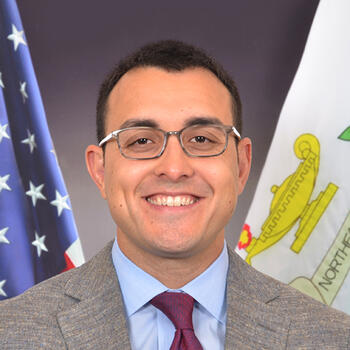
Dr. Van Jackson is an associate professor in the College of Security Studies at the Daniel K. Inouye Asia-Pacific Center for Security Studies, specializing in East Asian security, U.S. foreign policy, defense strategy, historical institutionalism, and international relations theory. He is also an adjunct senior fellow at the Center for a New American Security (CNAS) in Washington, as well as a senior editor for the online defense daily, War on the Rocks. From 2009 to 2014, Dr. Jackson held positions in the Office of the Secretary of Defense as a strategist and policy adviser focused on the Asia-Pacific, senior country director for Korea, and working group chair of the U.S.–Republic of Korea Extended Deterrence Policy Committee. He has previously taught at Georgetown University and the Catholic University of America, and has held fellowships with the Council on Foreign Relations, CNAS, and Pacific Forum CSIS. He is also widely published in leading disciplinary and area studies journals.
Van Jackson
<i>College of Security Studies, Daniel K. Inouye Asia-Pacific Center for Security Studies</i>
Seminars
How Japan and South Korea reached the "comfort women" deal
News Type
Commentary
Date
Paragraphs
Daniel Sneider, associate director for research at the Walter H. Shorenstein Asia-Pacific Research Center, provides an in-depth analysis of how the agreement on the “comfort women” issue between Japan and South Korea was reached late last year. In Japanese publication Toyo Keizai Online, Sneider writes that – after at least four years of negotiations between the two governments – political leadership in Seoul and Tokyo as well as pressure from the Obama administration can be credited for the breakthrough.
Read the article in English and Japanese.
Earlier in December, David Straub, associate director for the Korea Program, said the agreement is a sign of progress. He said it vindicates the victims and is a positive development for Korea-Japan relations.
Read his comments in reporting done by Yonhap News and Voice of America.
Hero Image

South Korean Foreign Minister Yun Byung-Se (Right) shakes hands with his Japanese counterpart Fumio Kishida (Left) during their meeting at the Foreign Ministry in Seoul Dec. 28, 2015.
Reuters/Jung Yeon-je/Pool
All News button
1
Behind the Comfort Women Agreement
Paragraphs
The breakthrough agreement on the comfort women issue between Japan and South Korea on Dec. 28, 2015, was the culmination of at least four years of negotiations between the two governments. South Korean President Park Geun-hye and Japanese Prime Minister Shinzo Abe pushed for the agreement; the Obama administration provided persistent pressure while resisting a mediation role. The danger of the agreement falling apart is apparent to officials in Washington and Seoul, and hopefully Tokyo too, writes Sneider.
All Publications button
1
Publication Type
Commentary
Publication Date
Journal Publisher
Toyo Keizai Online
Stanford scholars assess North Korea's nuclear test
News Type
Commentary
Date
Paragraphs
North Korea claimed it successfully tested a hydrogen bomb on Jan. 6, according to a broadcast from the nation’s Korean Central Television. Experts at the Freeman Spogli Institute for International Studies offered their analyses to media.
Scholars from the Walter H. Shorenstein Asia-Pacific Center (APARC) and the Center for International Security and Cooperation (CISAC) contributed to a Stanford news release. Although the scholars said they are skeptical of North Korea’s claim, they also said the test would have a destabilizing effect on the region.
In a Q&A, Siegfried Hecker answered nine questions, offering perspective on the situation and how the United States should respond. Hecker, a CISAC senior fellow, is a former director of the Los Alamos National Laboratory and has visited North Korea seven times since 2004.
David Straub, associate director of the Korea Program, commented on the North Korean nuclear program in an NK News article. He said the timing of the nuclear test, now the nation’s fourth, was likely only marginally influenced by external factors such as Kim Jong-un’s birthday. The primary factor is technical, he said. Straub also spoke with Yonhap News on Feb. 12. In the interview, Straub said "although the United States and the People's Republic of China certainly have differences [in dealing with the North Korean nuclear issue], they pale in comparison to U.S.-Soviet differences."
Straub also offered, in an extended interview with South Korea's Segye Ilbo newspaper, his thoughts on Pyongyang's motivations for pursuing nuclear weapons. He argued that the appropriate policy response is to continue to increase pressure on the regime. Pressure applied by Washington is meant to convince Pyongyang that nuclear weapons will bring more cost than benefit, while holding open the door to good-faith negotiations to resolve peninsular issues.
Shorenstein APARC Associate Director for Research Daniel Sneider talked with Al Jazeera America and Slate about the developments. He said the nuclear test signified North Korea’s uneasiness and was largely an accommodation of domestic politics.
In early February, South Korea announced temporary closure of Kaesong Industrial Complex (KIC), a jointly held project with North Korea. In Chosun Ilbo newspaper, Straub argued that South Korea's closure of KIC was a necessary response to North Korea's fourth nuclear test and latest satellite rocket launch. Two articles were published in Korean; the first is available here and the second here.
Hero Image

North Korean leader Kim Jong Un provides field guidance at the newly built National Space Development General Satellite Control and Command Centre in this undated photo released by North Korea's Korean Central News Agency (KCNA) in Pyongyang, May 3, 2015.
Reuters/KCNA
All News button
1
The January Taiwan Elections and the Implications for Cross-Strait Relations
-
Abstract
Taiwan’s domestic politics, particularly presidential elections, has been the main driver of the island’s relations with China for two decades. The 2016 elections, in which the Democratic Progressive Party, led by Dr. Tsai Ing-wen, won both the presidency and majority control of the Legislative elections, promises to be no exception. Although PRC intentions under President Xi Jinping are far from certain, some change from the state of play under the current Ma Ying-jeou administration seems fairly certain, with implications for U.S. policy.
Bio
Richard Bush is a Senior Fellow at the Brookings Institution and Director of its Center for Northeast Asian Policy Studies, and the Chen-Fu and Cecilia Yen Koo Chair in Taiwan Studies. He came to Brookings in July 2002 after nineteen years working in the US government, including five years as the Chairman and Managing Director of the American Institute in Taiwan. He is the author of a number of articles on U.S. relations with China and Taiwan, and of At Cross Purposes, a book of essays on the history of America’s relations with Taiwan, published in March 2004 by M. E. Sharpe. In the spring of 2005, Brookings published his study on cross-Strait relations, entitled Untying the Knot: Making Peace in the Taiwan Strait. In 2013, Brookings published his Uncharted Strait: The Future of China-Taiwan Relations.
This talk is co-sponsored by the Taiwan Democracy Project in the Center on Democracy, Development, and the Rule of Law and the U.S.-Asia Security Initiative in the Walter H. Shorenstein Asia-Pacific Research Center.
Image
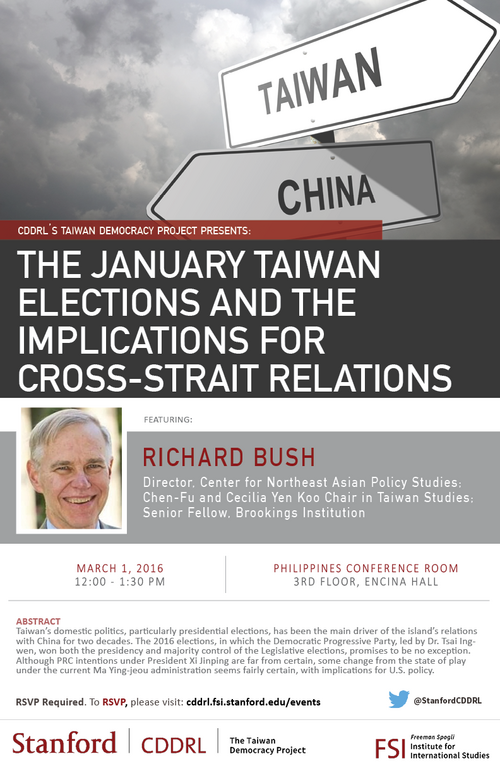
Richard C. Bush
Senior Fellow and Director, Center for East Asian Policy Studies
Brookings Institution
Seminars
Straub says "Comfort Women" agreement should be good for overall Korea-Japan relations
News Type
Commentary
Date
Paragraphs
David Straub, associate director of the Korea Program, says that the recent "Comfort Women" agreement vindicates the victims and should be good for overall Korea-Japan relations.
All News button
1
Fifteenth Korea-U.S. West Coast Strategic Forum
Paragraphs
The fifteenth session of the Korea-U.S. West Coast Strategic Forum, held in Korea on November 17, 2015, convened senior South Korean and American policymakers, scholars and regional experts to discuss North Korea policy and recent developments on the Korean Peninsula. Hosted by the Korea Program at the Walter H. Shorenstein Asia-Pacific Research Center at Stanford University, the Forum is also supported by the Sejong Institute.
All Publications button
1
Publication Type
Policy Briefs
Publication Date
Next steps in Indonesia-US relations
News Type
Commentary
Date
Paragraphs
Indonesian President Joko “Jokowi” Widodo was recently in Washington, D.C., for his first-ever presidential visit to the United States. In an op-ed for the East Asia Forum, Stanford scholar Donald Emmerson examines what the two countries can do to continue to build cooperation gained on the trip.
The op-ed can be viewed by clicking here, and an archive of Emmerson’s editorials on the East Asia Forum can be found by clicking here.
Hero Image

U.S. President Barack Obama and Indonesia's President Joko Widodo shake hands after their meeting at the White House, Oct. 26, 2015.
Reuters/Jonathan Ernst
All News button
1