


Taiwan's 2016 Presidential and Legislative Elections
Related Multimedia


Ballots, Bullets, and Bargains: American Foreign Policy and Presidential Elections
Related Multimedia
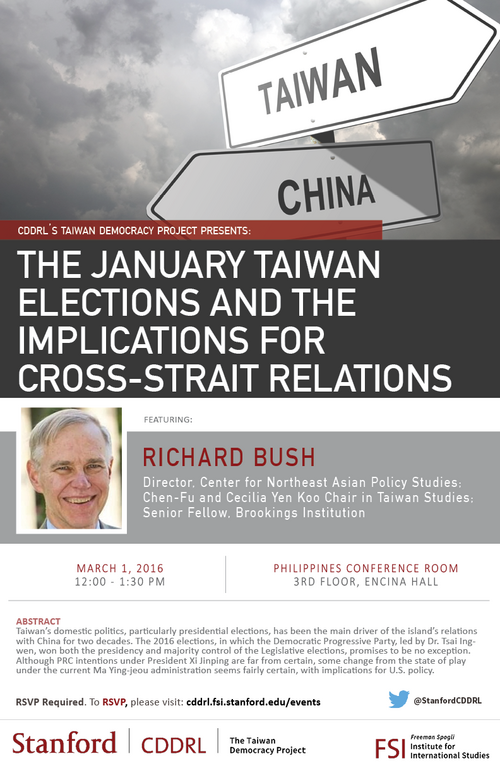
The January Taiwan Elections and the Implications for Cross-Strait Relations
-
Abstract
Taiwan’s domestic politics, particularly presidential elections, has been the main driver of the island’s relations with China for two decades. The 2016 elections, in which the Democratic Progressive Party, led by Dr. Tsai Ing-wen, won both the presidency and majority control of the Legislative elections, promises to be no exception. Although PRC intentions under President Xi Jinping are far from certain, some change from the state of play under the current Ma Ying-jeou administration seems fairly certain, with implications for U.S. policy.
Bio
Richard Bush is a Senior Fellow at the Brookings Institution and Director of its Center for Northeast Asian Policy Studies, and the Chen-Fu and Cecilia Yen Koo Chair in Taiwan Studies. He came to Brookings in July 2002 after nineteen years working in the US government, including five years as the Chairman and Managing Director of the American Institute in Taiwan. He is the author of a number of articles on U.S. relations with China and Taiwan, and of At Cross Purposes, a book of essays on the history of America’s relations with Taiwan, published in March 2004 by M. E. Sharpe. In the spring of 2005, Brookings published his study on cross-Strait relations, entitled Untying the Knot: Making Peace in the Taiwan Strait. In 2013, Brookings published his Uncharted Strait: The Future of China-Taiwan Relations.
This talk is co-sponsored by the Taiwan Democracy Project in the Center on Democracy, Development, and the Rule of Law and the U.S.-Asia Security Initiative in the Walter H. Shorenstein Asia-Pacific Research Center.
Image
Richard C. Bush
Senior Fellow and Director, Center for East Asian Policy Studies
Brookings Institution
Seminars
Myanmar: New government, better health?
News Type
News
Date
Paragraphs
Myanmar’s historic election last year brought an end to more than 50 years of military rule, ushering in the National League for Democracy party led by Aung San Suu Kyi. A new administration brings with it an opportunity to rehabilitate the country’s fragile health system, experts wrote in the Lancet.
In the editorial, Stanford health economist Karen Eggleston and co-authors Thant Sun Htoo, Ngoc Minh Pham and Phyu Phyu Thin Zaw call for innovative leadership in Myanmar’s public healthcare system, which is currently facing substantial challenges and inequalities. Creating policies that equitably allocate health resources should be a key goal of the administration that has set out to achieve universal health coverage by 2030. This would not only work to raise public health but also build much-needed trust between the population and government, they said.
Pham and Zaw are both former visiting fellows of the Asia Health Policy Program, who spent the 2014-15 academic year working on research activities at the Walter H. Shorenstein Asia-Pacific Research Center. Last July, Zaw wrote an op-ed in The Diplomat highlighting a doctor-led campaign against the “militarization” of the Ministry of Health called the “Black Ribbon Movement.” The movement is comprised of doctors and healthcare staff who are protesting the appointment of military staff to top health administration positions.
The Lancet's focus on healthcare in Myanmar coincided with the global commemoration of Universal Health Coverage Day, an annual day that urges greater action toward ensuring equal access to essential health services worldwide: http://universalhealthcoverageday.org/.
The Stanford Program on International and Cross-Cultural Education also interviewed Zaw while at Stanford. In this video released on March 10, Zaw highlights the changes Myanmar has already undertaken to reform its healthcare sytem and the challenges the country still faces.
Hero Image

All News button
1
FSI scholars offer insight on historic China-Taiwan talks
News Type
Q&As
Date
Paragraphs
In the wake of the recent historic meeting of the leaders of China and Taiwan, the Stanford News Service asked two of the university's Asia experts about the aftermath of that meeting and its possible effects on political relations between the two countries, the military situation and Taiwan's Jan. 16 presidential and parliamentary elections.
The first presidential meeting between the leaders of the communist mainland and the democratic island, split by civil war in 1949, was held in early November on neutral territory in Singapore.
Kharis Templeman is the Taiwan Democracy program manager at Stanford's Center on Democracy, Development, and the Rule of Law at the Freeman Spogli Institute for International Studies. He recently wrote about why Taiwan's defense spending has fallen as China's has risen. Thomas Fingar is a distinguished fellow at Stanford's Walter H. Shorenstein Asia-Pacific Research Center. He served as the chairman of the National Intelligence Council and in other key positions in Washington.
Do you anticipate any lasting effects from the face-to-face meeting of Chinese leader Xi Jinping and Taiwanese President Ma Ying-jeou?
Thomas Fingar: At a minimum, the meeting appears intended by both sides to validate and lock in the much-improved cross-Taiwan Strait relationship that has evolved over the past several years.
Kharis Templeman: I do think the Ma-Xi meeting itself will have one lasting legacy: it has created a precedent for treating the directly elected president of the Republic of China as an equal and as the rightful representative of Taiwanese interests in cross-strait relations. From now on, leaders in Beijing are going to have a hard time arguing that a non-KMT (the Kuomintang, Taiwan's governing party,) president is illegitimate, as they did during the [former Taiwanese president] Chen Shui-Bian era, or to continue to insist on referring to Taiwan’s leaders as provincial-level officials. So, the next president will come into office somewhat strengthened by that precedent.
Will the meeting have any effect on the January elections in Taiwan?
Templeman: I don’t think it will make much, if any, difference. Taiwanese public opinion is deeply divided about Ma Ying-Jeou’s meeting with Xi. Ma himself remains quite unpopular, the economy is barely growing, and the KMT presidential candidate remains at least 20 points behind in the polls. There’s little indication that this meeting has shaken up what has been a large and steady lead for DPP (Democratic Progressive Party) presidential candidate Tsai Ing-Wen, and I would be shocked if she didn’t win a comfortable victory in January.
Fingar: Probably not. Beijing seems to have learned that its past attempts to influence elections on Taiwan have been ineffectual or counterproductive, and the meeting is unlikely to change minds or votes on the island.
How might the elections affect military spending on either sides, or China's aggressive island-building for military bases?
Fingar: The meeting will not have any effect on military spending or the building of artificial islands in the South China Sea, but Beijing may have hoped that agreeing to meet with Ma to demonstrate how "good" the relationship is might persuade Washington not to approve another round of arms sales to Taiwan. Regardless of who wins the election on Taiwan, the next administration is likely to seek another round of U.S. arms sales in order to prove that it has the support of the United States.
Templeman: The meeting will have no impact on the security balance in the region. Ma reportedly raised the issue of PRC (People's Republic of China) missiles within easy range of Taiwan, but Xi claimed, implausibly, that they were not targeted at Taiwan, and that was the end of it. The broader trends are unchanged: the PRC’s military budget is growing annually by double-digit rates while Taiwan’s remains essentially flat. The consequence is that the PRC’s capacity to take coercive measures against Taiwan continues to expand, even as cross-strait cooperation has been improved and institutionalized.
Dan Stober is at the Stanford News Service.
Hero Image

All News button
1
Stanford scholar explores how the US election system shapes foreign policy
News Type
News
Date
Paragraphs
A podcast from the book event on Jan. 15 is available at the link above. An earlier interview with author Michael Armacost was first published in Oct. 2015 and is reposted below.
When it comes to elections, politics can supersede strategy. But what is often overlooked is the process through which the United States selects their commander in chief and its impact on policy – particularly, foreign policy.
What then shapes foreign policy during that time? “Events, my dear boy, events,” Harold Macmillan, a former British prime minister, famously replied when asked what could change a government's directions. To which Michael Armacost agrees and explores the interplay between campaign politics and foreign policy in his new book.
“Since World War II, the United States has consistently pursued a global role, but the tempo of its engagement with the world has been repeatedly adjusted to reflect circumstances and domestic moods,” Armacost wrote.
A veteran scholar, former ambassador and undersecretary of state for political affairs, Armacost is an expert on the U.S. government system and policy process. In the book, he examines ideology and the struggle for power in the six elections that have taken place since 1948, ending with Barack Obama’s re-election in 2012.
The book, which reads somewhat like a guide, largely began as a project for students, he said.
Armacost initially came to Stanford in 1994, and in 2002, returned as a distinguished fellow at the Walter H. Shorenstein Asia-Pacific Research Center. He co-teaches a graduate course on U.S. policy in Northeast Asia.
“When I left government, I found a lot of literature on how foreign policy affects elections but little in the reverse,” Armacost said. “So my aim behind the research was to not only satisfy my own curiosity but to offer a comprehensive and accessible analysis for students.”
Armacost’s career in government began in 1983 when an advisor encouraged him to apply for a White House fellowship. His fellowship in the deputy secretary of state’s office – which was only set to be a single year in Washington – led to 24 years of public service.
He went on to serve as the U.S. ambassador to Japan from 1989 to 1993 and the Philippines from 1982 to 1984, and was a member of the National Security Council.
Armacost said he remains positive about the electoral system, while also suggesting a few reforms. The system ensures a cyclical chance to step back and assess where America stands in the world, he said.
“Our system provides regular opportunities to put the spotlight on troubling foreign policy problems,” he wrote. “And supplies an incentive to consider course corrections for costly, inconclusive foreign as well as domestic policies, or offers a chance to select new management to fix them.”
Shorenstein APARC asked him a few questions about his research in the context of the 2016 election cycle. His answers are posted below.
Will Obama attempt a “sprint to the finish line” on foreign policy?
He is well embarked on that sprint. In the fourth quarter of his presidency, he is eager to burnish his foreign policy legacy. President Obama’s agenda is clear. It includes the normalization of relations with Cuba, implementation of the Iran nuclear agreement, ratification of the Trans-Pacific Partnership free trade agreement, and promotion of further international cooperation on climate change. He will also seek to avoid losing ground in geopolitical competition with ISIS in Iraq and Syria, the Russians in the Ukraine and elsewhere, and China in the South China Sea.
A president’s power to effectively undertake controversial initiatives at home and abroad tends to ebb as his tenure runs out. Those requiring Congressional support are particularly problematic. And events will play a large role in determining the problems and opportunities that come his way before Jan. 20, 2017.
Does the Trans-Pacific Partnership (TPP) stand a chance of getting ratified?
It stands a chance, but it will not be easy. Fortunately, Trade Promotion Authority has been secured from the Congress. Hence, it will be limited to an up or down vote without amendments.
Opposition from labor unions and environmental groups assures that there will be very limited Democratic support for the TPP, and Hillary Clinton, Bernie Sanders and Martin O’Malley have publicly expressed their opposition. There has also been some erosion of support for free trade among the Republicans, whose leaders have mostly expressed misgivings about some of the TPP’s provisions.
I believe the TPP will advance U.S. economic and strategic interests, but whether its ratification will be achieved before or after the 2016 election is at this point uncertain.
How do the politics of the TPP differ from that of George H.W. Bush’s pursuit of the NAFTA agreement in 1992?
In 1992 President Bush didn’t hesitate to push hard for NAFTA throughout his campaign. And the Mexican and Canadian governments also regarded the U.S. election day as a convenient deadline for getting the agreement finished. The president’s GOP Party believed in free trade, and considered the push for an embryonic hemispheric market a worthy and historic objective. A NAFTA accord could be portrayed as extending a helping hand to a friendly neighbor. The Party’s business constituency was supportive; the bulwark of opposition to the deal were labor and environmental groups, which were unlikely to vote for Bush anyway.
Promoting NAFTA also offered the president a chance to put the Democratic candidate, Bill Clinton, who had made public remarks supporting such an agreement, on the spot. If he reversed his position and opposed the accord, he could be accused of “waffling;” if he didn’t, he would risk alienating his labor and environmental constituencies. Bush nearly got the deal finished, but side letters on labor and environmental issues remained to be completed after Clinton won the election.
This year, a Democratic president is confronting major opposition from his own party, and widespread support from Congressional Republicans is therefore indispensable to his chances of ratifying the agreement. A number of Republican leaders who are generally supportive of free trade, however, contend that President Obama was so eager to wrap up the deal on his own watch, that he missed a chance to drive a harder bargain. Others are reluctant to hand the president a foreign policy victory during a presidential campaign.
And as November 2016 nears, the Democratic candidate is likely to be reluctant to buck unions and environmental groups who not only provide much needed financial support, but supply the volunteers who perform crucial “get out the vote” duties on election day.
Where does foreign policy fit into the 2016 campaign?
Foreign policy is likely to feature very prominently in the coming election, particularly if the economy continues its steady, if modest, rate of growth. The reason is simple. The United States faces serious challenges in the Middle East, the Ukraine, South Asia and the South China Sea. And many voters who favored retrenchment in 2008, now fear it is now perceived increasingly by friends and adversaries as weakness and/or retreat.
One should not, however, expect the presidential campaign to illumine the strategic choices we face abroad. Presidential contenders typically articulate a wide range of aspirational foreign policy goals. But they rarely outline priorities among these declared aims, let alone their potential costs and risks, or the trade-offs among them. To address these core elements of strategy might offend one or another potential voting bloc. Candidates, therefore, tend to focus upon the appeal of their foreign policy objectives at home, rather than their efficacy abroad.
A wide field of candidates has emerged early on. What foreign policy issues are not being addressed that should figure in the debates?
It’s a bit early to say. The first primaries are still three months away. Few debates have yet been held. The election is likely in any event to be in part a referendum on President Obama’s record. But Hillary Clinton, who served for four years as the Secretary of State, is differentiating her position from that of Obama’s on a number of foreign policy matters. And as I noted above, the focus in most campaigns is on laudable goals rather than the key elements of strategy, i.e. the operational tests of foreign policy for anyone who occupies the Oval Office.
What will happen to the U.S. “pivot back to Asia” strategy?
President Obama performed a useful service in underlining America’s growing stake in Asia. I would expect the candidates of both major parties to affirm their intent to devote more time, attention and resources to the Asia-Pacific region. The problems the current administration has experienced in Asia are a by-product of the policy’s implementation. Many Asian leaders wonder whether the policy has been forgotten or overtaken by events. Adjustments in our regional security policy have been essentially symbolic.
With China, we are still looking for a sustainable balance between constructive engagement and prudent hedging. The diplomatic opening to Myanmar was timely, but progress has been complicated by ethnic struggles in that country. American leaders visit Asia periodically, but the United States is still perceived as primarily preoccupied with problems in the Middle East. Conclusion of the TPP will lend credibility to the policy, but only if the agreement is ratified. So it will be up to the next president to put some meat on the bones of this strategic initiative.
How do election cycles in the United States and South Korea mesh, and what might the coming cycle mean for U.S.-Korean relations?
America has a four-year election cycle for the presidency. The Republic of Korea elects its presidents for a five-year term. We have experienced several occasions when our cycles appeared out of sync, i.e. when the United States elected more conservative candidates to the White House as the Koreans chose more liberal contenders for the Blue House. George W. Bush, a conservative, served during a period when the South Korean presidents – Kim Dae Jung and Roh Moo-Hyun – were both liberals or progressives. American and South Korean perspectives on policy toward North Korea diverged sharply. Nonetheless, they joined hands in launching the U.S.-Korea Free Trade Agreement, and formulated plans for a major redeployment of U.S. military forces away from the Seoul metropolis to bases further south. And President Obama, a liberal, fashioned a close relationship with Presidents Lee Myung-bak and Park Geun-hye, both conservatives.
Thus, shared national interests have a way of tempering the ideological predilections of our respective leaders, enabling them to collaborate when dangers loom or when opportunities beckon.
South Korea now trades twice as much with China as it does with the United States and Japan combined. So its economy is tied more closely to China now, though it still looks to Washington for protection. Seoul will not want to choose between its economic interests and its strategic concerns. The United States has no reason to force such a choice on its ally, but it is clear that Beijing hopes to use its economic leverage to influence the Republic of Korea’s strategic decisions, for example, its readiness to deploy a THAAD, high altitude ballistic missile defense system. This is the kind of issue that could feed back into our election-year politics.
Related links
WNYC Brian Lehrer Show (Audio): How Elections Derail Foreign Policy (Aug. 4, 2015)
Hero Image

All News button
1
Liberal Taiwan versus Illiberal South Korea: The Divergent Paths of Electoral Campaign Regulation
-
Abstract:
Both South Korea and Taiwan are considered consolidated democracies, but the two countries have developed very different sets of electoral campaign regulations. While both countries had highly restrictive election laws during their authoritarian eras, they have diverged after democratic transition. South Korea still restricts campaigning activities, including banning door-to-door canvassing, prohibiting pre-official period campaigning, and restricting the quantity and content of literature. Taiwan has removed most campaigning restrictions, except for finance regulations. This study explores the causes of these divergent trajectories through comparative historical process tracing, using both archival and secondary sources. The preliminary findings suggest that the incumbency advantage and the containment of the leftist or opposition parties were the primary causes of regulation under the soft and hard authoritarian regimes of South Korea and Taiwan. The key difference was that the main opposition party as well as the ruling party in South Korea enjoyed the incumbency advantage but that opposition forces in Taiwan did not. As a result, the opposition in Taiwan fought for liberalization of campaign regulations, but that in South Korea did not. Democratization in Taiwan was accompanied by successive liberalizations in campaign regulation, but in South Korea the incumbent legislators affiliated with the ruling and opposition parties were both interested in limiting campaigning opportunities for electoral challengers.
Bio:
Dr. Jong-sung You is a senior lecturer in the Department of Political and Social Change, Australian National University. His research interests include comparative politics and the political economy of inequality, corruption, social trust, and freedom of expression. He conducts both cross-national quantitative studies and qualitative case studies, focusing on Korea and East Asia. He recently published a book entitled Democracy, Inequality and Corruption: Korea, Taiwan and the Philippines Compared with Cambridge University Press. His publications have appeared at American Sociological Review, Political Psychology, Journal of East Asian Studies, Journal of Contemporary Asia, Asian Perspective, Trends and Prospects, and Korean Journal of International Studies. He obtained his Ph.D. in Public Policy from Harvard University and taught at UC San Diego. Before pursuing an academic career, he fought for democracy and social justice in South Korea.
Jong-sung You
Senior Lecturer
College of Asia and the Pacific, Australia National University
Seminars
Nico Ravanilla
Encina Hall E301616 Serra StreetStanford, CA94305-6055
(650) 724-5579
(650) 723-6530
0
rnico@stanford.edu
nico_ravanilla.jpg
Ph.D.
Nico Ravanilla joins the Walter H. Shorenstein Asia-Pacific Research Center as Shorenstein Postdoctoral Fellow for the 2015-16 year. His research interests are political economy and governance, comparative politics and Southeast Asia. While at Shorenstein APARC, Ravanilla will research how political selection impacts governance, and evaluate possible routes for incentivizing capable and virtuous citizens to run for public office.
His project titled “Nudging Good Politicians” looks at the case of the Sangguniang Kabataan, a governing body in the Philippines comprised of elected youth leaders. Ravanilla aims to apply his research to develop and scale up programs for politicians, especially those at the onset of their careers, which would include specialized leadership training and merit-based endorsement.
Ravanilla is also a Southeast Asia Research Group (SEAREG) Young Southeast Asia Fellow for 2015-16. He received his Ph.D. in political science and public policy from the University of Michigan in summer 2015.
2015-16 Shorenstein Postdoctoral Fellow
Ballots, Bullets, and Bargains: American Foreign Policy and Presidential Elections
Paragraphs
Drawing on twenty-four years of experience in government, Michael H. Armacost explores how the contours of the U.S. presidential election system influence the content and conduct of American foreign policy. He examines how the nomination battle impels candidates to express deference to the foreign policy DNA of their party and may force an incumbent to make wholesale policy adjustments to fend off an intra-party challenge for the nomination. He describes the way reelection campaigns can prod a chief executive to fix long-neglected problems, kick intractable policy dilemmas down the road, settle for modest course corrections, or scapegoat others for policies gone awry.
Armacost begins his book with the quest for the presidential nomination and then moves through the general election campaign, the ten-week transition period between Election Day and Inauguration Day, and the early months of a new administration. He notes that campaigns rarely illuminate the tough foreign policy choices that the leader of the nation must make, and he offers rare insight into the challenge of aligning the roles of an outgoing incumbent (who performs official duties despite ebbing power) and the incoming successor (who has no official role but possesses a fresh political mandate). He pays particular attention to the pressure for new presidents to act boldly abroad in the early months of his tenure, even before a national security team is in place, decision-making procedures are set, or policy priorities are firmly established. He concludes with an appraisal of the virtues and liabilities of the system, including suggestions for modestly adjusting some of its features while preserving its distinct character.
All Publications button
1
Publication Type
Books
Publication Date
Journal Publisher
Columbia University Press