Health and Medicine

FSI’s researchers assess health and medicine through the lenses of economics, nutrition and politics. They’re studying and influencing public health policies of local and national governments and the roles that corporations and nongovernmental organizations play in providing health care around the world. Scholars look at how governance affects citizens’ health, how children’s health care access affects the aging process and how to improve children’s health in Guatemala and rural China. They want to know what it will take for people to cook more safely and breathe more easily in developing countries.

FSI professors investigate how lifestyles affect health. What good does gardening do for older Americans? What are the benefits of eating organic food or growing genetically modified rice in China? They study cost-effectiveness by examining programs like those aimed at preventing the spread of tuberculosis in Russian prisons. Policies that impact obesity and undernutrition are examined; as are the public health implications of limiting salt in processed foods and the role of smoking among men who work in Chinese factories. FSI health research looks at sweeping domestic policies like the Affordable Care Act and the role of foreign aid in affecting the price of HIV drugs in Africa.

Authors
Noa Ronkin
News Type
Q&As
Date
Paragraphs

Organizational sociology may not be the first academic field people tend to look to for an explanation of the origins of a public health crisis such as the spreading Wuhan coronavirus, but from the perspective of Stanford sociologist and APARC faculty member Xueguang Zhou, who specializes in institutional change in contemporary Chinese society, the writing on the wall has long been there for all to see. Zhou, who is also Kwoh-Ting Li Professor in Economic Development and senior fellow at FSI, studies Chinese organizations, Chinese state building, and Chinese bureaucracy. His work sheds light on the characteristics of and tensions in governing China, and is pertinent to understanding the unfolding of the coronavirus crisis and the Chinese government’s response to it.

In the following interview, Zhou talks about these issues, his research into the institutional foundations of governance in China, and some of the challenges the country now faces. The conversation has been edited for length and clarity.

Q: The death toll from the coronavirus continues to rise in mainland China along with anger over the government’s response to the outbreak. What are the implications of this crisis for Chinese governance?

This is not only an outbreak of a novel virus, it's also a manifestation of the breakdown of China’s governance structures. The crisis has exposed the cracks in the system. Granted, any government might be underprepared to handle an outbreak of a new epidemic. However, based on what we now know, the new virus strain was detected in Wuhan some weeks before the beginning of the outbreak, yet the bureaucracies at several levels didn’t work and the authorities involved were not put into high alert.

I wouldn’t place the blame on the local officials, who have followed the same old pattern of crisis response. For both cultural and political reasons, their primary concern was to lie low and keep things stable just weeks before the Chinese New Year and in the lead-up to the annual gatherings of the Provincial People’s Congress. That pattern of response has been built into the Chinese bureaucracy for years. But in this case, the default behavior exposed the weaknesses of the central and local governments. We can imagine similar scenes of health crises and other problems happening in other Chinese provinces and cities, because the officials have similar mentalities. The problem is not with individual officials here or there, but rather that the general bureaucracy has been tamed to respond to such dissonant information in this manner.

I hope that this crisis becomes a turning point; that the gravity of the situation touches people's lives deeply enough to make them aware of the kind of conditions that need to be transformed. I hope it makes them realize that the government must improve its decision-making process, transparency, and openness to societal input. The present system of governance in China is designed for top-down decision implementation, not bottom-up information pooling and transmission. Therefore, even though information is abundant — as has been the case with the coronavirus — there is no efficient information transfer from localities to the upper levels. And the latter cannot deal with the load of information coming from the country’s vast territory and huge, heterogeneous population. In fact, top officials tried to shield themselves and filter information instead of open up to input the scale of which they cannot deal with.

[To get more stories like this delivered directly to your inbox sign up to receive our newsletters.] 

Q: Since the coronavirus broke out, there has been a surge of interest in your research on Chinese governance. Tell us more about that.  

For more than ten years, I have been doing fieldwork in China and publishing my writings on that topic in Chinese. In 2017, I published a collection of essays in a volume whose English translation is The Institutional Logic of Governance in China: An Organizational Approach. The book’s theme is the relationship between China’s central government and different levels of local government with regards to various governance issues. That relationship is fraught with frictions in and challenges for governing China, which the coronavirus crisis has now exposed.

Within six months of publication, the book was “unshelved” in China and reprint was prohibited. The publisher returned the copyrights to me. So I made a digital version of it available for free download. Since the coronavirus broke out, within a few days, references to the book have been shared on Chinese social media platform Weibo nearly 4,000 times. This set of issues that I have been discussing for more than a decade has suddenly become highly relevant. On the one hand, I am sad about this turn of events: sometimes you don't want your predictions to come true. Yet I also feel vindicated. That is to say, for the longest time, I have been studying something that I thought was fundamental yet never fully understood, and now suddenly the lines of argument I developed over the years are circulating broadly and having impact. I am working on an English translation of the book.

Q: You describe a fundamental tension in governing China. What is this tension and how is it manifested?

Given the formidable scale of governance in China, the centralization of authority inevitably introduces a separation between policymaking at the center and policy implementation at local levels. This separation gives rise to a fundamental tension between the centralization of authority and effective, local governance. The source of the tension is this: the extent of the centralization of authority is achieved at the expense of the effectiveness in local governance. That is, the centralization of authority places decision rights and resources further away from those levels that have more accurate information and capacities in problem solving. Conversely, the strengthening of local governance capacities implies the expansion of local authority, which often leads to (or is interpreted as) deviation from the center, thereby becoming an acute threat to the central authority.

Over the last several years under the new leadership, China has undergone tremendous consolidation and centralization of political power. And that's what made local governments paralyzed. They lack autonomy and initiative and shun responsibility. One outcome is that information is filtered or being blocked from one level of governance to another. Problems arise every day and never make it into media or public attention: there are accidents, crimes, corruption, and people protest, but we never hear of that. The coronavirus outbreak is one extreme case that the authorities simply cannot hide, and, temporarily, we hear more voices and criticism via social media and other informal channels.

It is my hope that this crisis will be a turning point and make Chinese society realize that information, and efficient information sharing is critical for its well-being. From time to time, I post book reviews, commentary, and my thoughts on various topics via a personal page on Weibo. A while ago, I posted my reflections after watching the HBO miniseries Chernobyl, considering the failures that caused the Chernobyl disaster from the perspective of organizational sociology. And those are all information failures. There are many parallels to what has now happened in Wuhan. Since the virus outbreak, this post of mine has been shared many times in China, in social media and various other channels.

Q: What are the implications of this fundamental tension between the centralization of authority and effective governance for China’s future?

This tension creates cycles of centralization and decentralization over time. Decentralization gives rise to diverse interests and propels economic developments in different parts of the country. Indeed, China’s decades of economic rise and reforms were marked by tremendous decentralization. It’s what made China so successful. But decentralization poses a threat to the central authority, so it reverts back to power consolidation, such as we have observed over the last several years under the new leadership.

Then again, the more resources and decision rights are centralized upward, the lower is the effectiveness of governance at local levels. This is manifested in the form of lack of initiative by local governments, which, in turn, creates burden on the central government. China’s economic slowdown has already been putting tremendous pressure on the central government and now, with the scramble to contain the spread of the coronavirus, China’s economy is virtually grinding to a halt. Economic stagnation is almost inevitable, the questions are how severe it will be and how long it will take to recover from it.

I therefore believe it is only a matter of time until China goes through yet another phase of decentralization, but that will most likely be merely another part of a perpetual cycle. The cycle will continue unless China’s challenges are translated into political action and fundamental changes are made to the institutional foundations of governance. Such changes, however, will involve the Chinese bureaucracy and official ideology and are unlikely to happen in the foreseeable future.

Q: What are some of the findings from your research into the Chinese bureaucracy?

Over the last decade, I have been conducting fieldwork and studying the inner workings of the Chinese bureaucracy in action: observing how local officials behave in problem solving, crises management, policy implementation, and interact with both higher authorities and lower-ranking bureaucrats. I have developed theoretical models and arguments about how the Chinese state has been organized and how it operates both at the local levels (bottom-up perspective) and central level (top-down perspective).

As part of that project, I have been studying patterns of career mobility among bureaucrats in the Jiangsu Province, which has the second largest economy in China, just behind Shanghai. I now have a dataset encompassing half a million records on more than 40,000 officials, detailing their career flows from 1990 to 2013. This project sheds light on many important issues related to the Chinese bureaucracy and governance in China. For example, the dual authority between the party and government lines is a defining feature of the party-state in China. We can examine the key characteristics of this phenomenon through the lens of personnel management, that is, how officials are moving through different positions between the party and government. We have a paper forthcoming on this topic.

Another line of research in this project is what I call “stratified spatial mobility,” meaning a pattern whereby just a handful of officials are able to move beyond the administrative jurisdiction along the bureaucratic ladder into the immediate next higher-level administrative jurisdiction, whereas most officials stay within their own jurisdiction for life. It’s polarized mobility, in stark contrast between spatial mobility and local mobility. That’s why in each locality there are dense social networks and strong boundaries. This type of stratified mobility in the Chinese bureaucracy has huge consequences for understanding how China is governed. For example, local networks fiercely protect each other and have strong ties with those officials at an immediate authority, resulting in collusion among local governments when they respond to crises or interact with higher authorities. The failure to keep the Wuhan coronavirus outbreak from becoming an epidemic is a case in point. So we opened this conversation with the coronavirus and end it with the same topic.


Hero Image
A security guard sits outside a closed market in Wuhan, China.
A security guard sits outside the closed Huanan Seafood Wholesale Market, which has been linked to cases of Coronavirus, on January 17, 2020 in Wuhan, Hubei province, China.
Getty Images
All News button
1
Date Label
-

More than 80% of cardiovascular diseases (CVD) and diabetes mellitus (DM) burden now lies in low and middle-income countries. Thus, there is an urgent need to identify and implement the most cost-effective interventions, particularly in the resource-constraint South Asian settings. A 2018 systematic review evaluated the cost-effectiveness of individual-level, group-level and population-level interventions to control CVD and DM in South Asia. Of the 2949 identified studies through a search of 14 electronic databases up to 2016, 42 met full inclusion criteria. Critical appraisal of studies revealed 15 excellent, 18 good and 9 poor quality studies. Most studies were from India (n=37), followed by Bangladesh (n=3), Pakistan (n=2) and Bhutan (n=1). The economic evaluations were based on observational studies (n=9), randomised trials (n=12) and decision models (n=21). Together, these studies evaluated 301 policy or clinical interventions or combination of both. We found a large number of interventions were cost-effective aimed at primordial prevention (tobacco taxation, salt reduction legislation, food labelling and food advertising regulation), and primary and secondary prevention (multidrug therapy for CVD in high-risk group, lifestyle modification and metformin treatment for diabetes prevention, and screening for diabetes complications every 2–5 years). Significant heterogeneity in analytical framework and outcome measures used in these studies restricted meta-analysis and direct ranking of the interventions by their degree of cost-effectiveness. The cost-effectiveness evidence for CVD and DM interventions in South Asia is growing, but most evidence is from India and limited to decision modelled outcomes. There is an urgent need for formal health technology assessment and policy evaluations in South Asia and other low- and middle- income countries using local research data.

Image
kavita
I am Dr. Kavita Singh, interested in global cardiometabolic disease epidemiology and economic evaluations of interventions for prevention and control of chronic diseases in low- and middle- income countries. I am an Epidemiologist by training, and work as a research scientist at the Public Health Foundation of India. My research work has primarily focused on evaluating the long-term effectiveness and cost-effectiveness of a multicomponent quality improvement intervention (consisting of decision-support electronic health records to enhance physician’s responsiveness and care coordinators to improve patient’s adherence to therapy) in 1,146 patients with type 2 diabetes attending 10 tertiary care clinics in India and Pakistan as part of the National Heart Lung Blood Institute funded CARRS Trial. Recently, I have been awarded the Emerging Global Leader Award (K43 grant, 2019-2024), funded by the National Institutes of Health, Fogarty International Centre to conduct a research project that aims to develop and test the feasibility of a multicomponent cardiovascular quality improvement strategy for patients with established cardiovascular diseases (CVD) in India.

Kavita Singh 2019-2020 Walter H. Shorenstein Asia-Pacific Research Center Visiting Scholar
Seminars
-

Given the significant health risks faced by households in developing countries, publicly provided health insurance may confer important benefits. Yet, demand for formal insurance is often found to be low. Since health insurance may be relatively unfamiliar to many households, understanding the factors that shape households’ demand for, and ability to utilize, insurance is important for research and policy. It is also important to understand the health and financial impacts of health insurance. We shed light on these questions using a two-stage randomized control trial in Karnataka, India. Many households are willing to pay for insurance. Households’ ability to successfully utilize the insurance is limited, however, especially when only a small fraction of the community has access to insurance. When a higher share of the community has access, households are more able to benefit, suggesting that harnessing community learning is important in designing the rollout of health insurance.

Image
kinnan photo 4x4
Cynthia Kinnan is an assistant professor of economics at Tufts University and a Research Associate of the NBER. She holds a Ph.D. in economics from MIT. Her research lies in the areas of economic development and social networks, with emphasis on understanding linkages between formal finance (including insurance and microcredit) and informal networks. She has been a recipient of research grants from the International Growth Centre, the Tata Centre for Development, and others. Her work has been featured in outlets including the Economist and the NBER Digest and been published in journals including the American Economic Review and the American Economic Journal – Applied Economics.

Advisory on Novel Coronavirus (COVID-19)

In accordance with university guidelines, if you (or a spouse/housemate) have returned from travel to mainland China in the last 14 days, we ask that you DO NOT come to campus until 14 days have passed since your return date and you remain symptom-free. For more information and updates, please refer to the Stanford Environmental Health & Safety website: https://ehs.stanford.edu/news/novel-coronavirus-covid-19

Cynthia Kinnan Assistant Professor of Economics, Tufts University and Research Associate of the NBER.
Seminars
Authors
Noa Ronkin
News Type
News
Date
Paragraphs

Southeast Asia, home to over 640 million people across 10 countries, is one of the world’s most dynamic and fastest growing regions. APARC just concluded the year 2019 with a Center delegation visit to two Southeast Asian capital cities, Hanoi and Bangkok, where we spent an engaging week with stakeholders in the academic, policy, business, and Stanford alumni communities.

Led by APARC Director Gi-Wook Shin, the delegation included APARC Deputy Director and Asia Health Policy Program Director Karen Eggleston, Southeast Asia Program Director Donald Emmerson, and APARC Associate Director for Communications and External Relations Noa Ronkin. Visiting Scholar Andrew Kim joined the delegation in Bangkok.

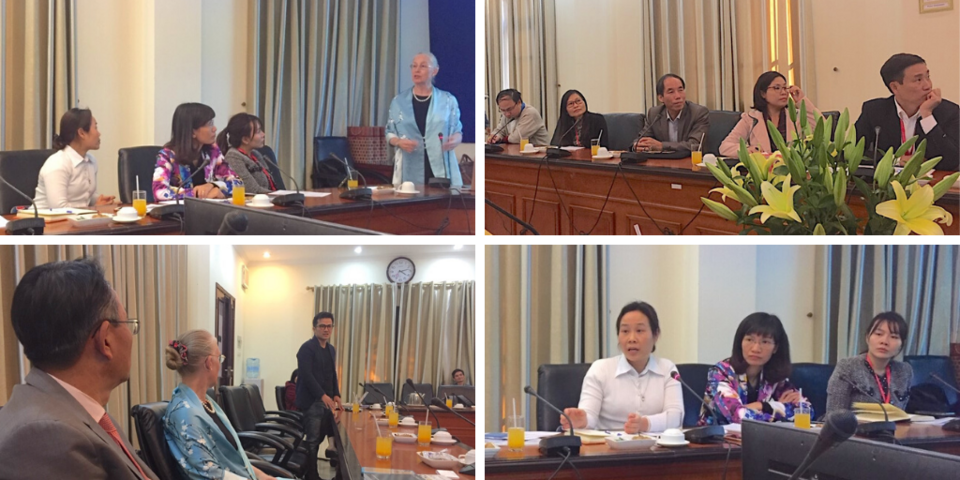
With a focus on health policy, our first day in Hanoi included a visit to Thai Nguyen University, a meeting with government representatives at the Vietnam Ministry of Health, and a seminar on healthy aging and innovation jointly with Hanoi Medical University.

Image
Collage of four images showing participants at a roundtable held at Hanoi Medical University with APARC delegation members

Karen Eggleston and participants at the roundtable held at Hanoi Medical University, December 9, 2019.

Throughout the day, Eggleston presented some of her collaborative research that is part of two projects involving international research teams: one that assesses public-private roles and institutional innovation for healthy aging and another that examines the economics of caring for patients with chronic diseases across diverse health systems in Asia and other parts of the world. We appreciated learning from our counterparts about the health care system and health care delivery in Vietnam.

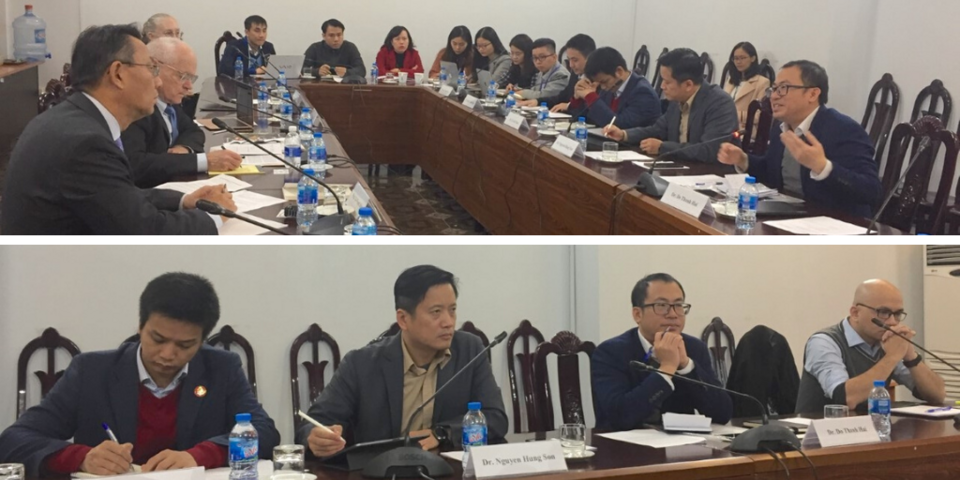
Shifting focus to international relations and regional security, day 2 in Hanoi opened with a roundtable, “The Rise of the Indo-Pacific and Vietnam-U.S. Relations,” held jointly with the East Sea Institute (ESI) of the Diplomatic Academy of Vietnam (DAV). Following a welcome by ESI Director General Nguyen Hung Son, the program continued with remarks by Shin, Emmerson, ESI Deputy Director General To Anh Tuan, and Assistant Director General Do Thanh Hai.

Image
Participants at a roundtable held at the Diplomatic Academy of Vietnam with APARC delegation members

Roundtable at the Diplomatic Academy of Vietnam, December 10, 2019.

The long-ranging conversation with DAV members included issues such as the future of the international order in Asia; the U.S. withdrawal from multilateralism; the concern about a lack of U.S. engagement in Southeast Asia, sparked by President Trump’s absence from the November 2019 summit of the Association of Southeast Asian Nations (ASEAN) at a time when China is bolstering its influence in the region and when ASEAN hopes to set a code of conduct with China regarding disputed waters in the South China Sea; the priorities for Vietnam as it assumes the role of ASEAN chair in 2020; and the challenges for the Vietnam-U.S. bilateral relationship amid the changing strategic environment in Southeast Asia.

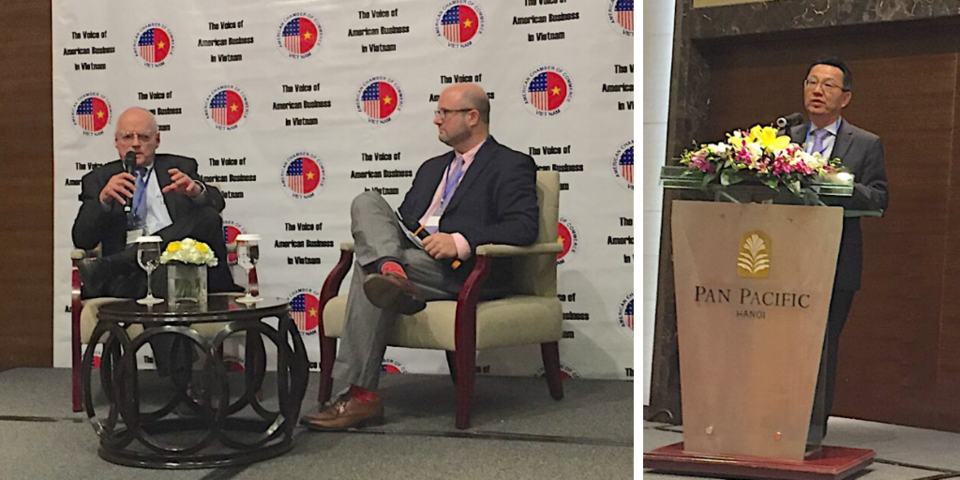
In the afternoon we were joined by members of the American Chamber of Commerce in Hanoi at an AmCham-hosted Lunch ‘n’ Learn session on Vietnam's challenges and opportunities amid the U.S.-China rivalry. The event featured Emmerson in conversation with AmCham Hanoi Executive Director Adam Sitkoff.

Image
Two men in conversation seated on stage and a man speaking at a podium

(Left) Donald Emmerson in conversation with Adam Sitkoff; (right) Gi-Wook Shin welcomes AmCham Hanoi members; December 10, 2019. 

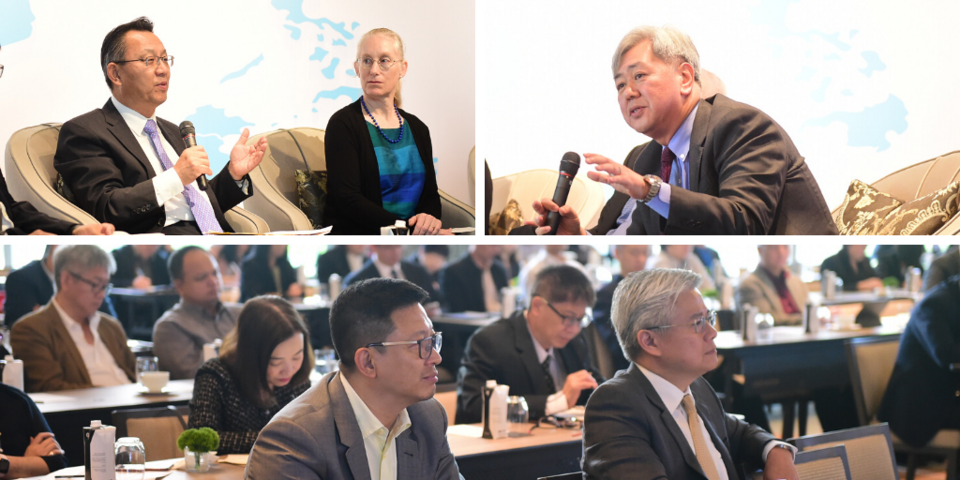
Moving to Bangkok, delegation members Shin, Eggleston, Emmerson, and Kim spoke on a panel for executives of the Charoen Pokphand Group (C.P. Group), one of Thailand’s largest private conglomerates, addressing some of the core issues that lie ahead for Southeast Asia in 2020 and beyond in the areas of geopolitics, innovation, and health.

Image
Participants at a panel discussion with APARC delegation hosted by the C.P. Group, Thailand

Top, from left to right: Gi-Wook Shin, Karen Eggleston, Andrew Kim; bottom: C.P. Group executive listening to the panel, December 12, 2019.

We also enjoyed a tour at True Digital Park, Thailand’s first startup and tech entrepreneur’s campus. Developed by the C.P. Group, True Digital Park aspires to be an open startup ecosystem that powers Thailand to become a global hub for digital innovation.

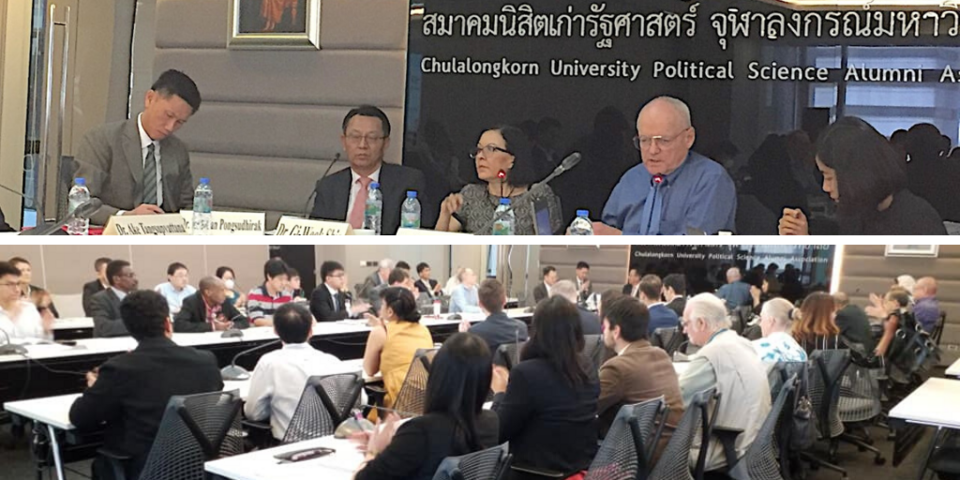
The following day, Shin and Emmerson participated in a public forum hosted by Chulalongkorn University’s Institute of Security and International Studies (ISIS Thailand), "Where Northeast Asia Meets Southeast Asia: The Great Powers, Global Disorder and Asia’s Future.” They were joined by ISIS Thailand Director Thitinan Pongsudhirak and Chulalongkorn University Faculty of Political Science Associate Dean for International Affairs and Graduate Studies Kasira Cheeppensook. The panel was moderated by Ms. Gwen Robinson, ISIS Thailand senior fellow and editor-at-large of the Nikkei Asian Review.

Image
Panelists and participants at a public forum held at Chulalongkorn University

ISIS Thailand forum participants and panelists, from left: Pngsukdhirak, Shin, Robinson, Emmerson, Cheeppensook; December 13, 2019.

As part of that discussion, Emmerson speculated that – driven by deepening Chinese economic and migrational involvement in Southeast Asia’s northern tier – Cambodia and Laos, less conceivably Myanmar, and still less conceivably Thailand could become incorporated de facto into an economically integrated “greater China” that could eventually reduce ASEAN to a more-or-less maritime membership in the region’s southern tier. Emmerson’s speculation was made in the context of his critique of ASEAN’s emphasis on its own “centrality” to the neglect of its lack of the proactivity that would serve as evidence of centrality and of a desire not to be rendered peripheral by the growing centrality-cum-proactivity of China. The event was covered by the Bangkok Post (although that report’s headline and quote of Emmerson are inaccurate, as neither the panel nor Emmerson predicted the “break-up of ASEAN.”)

Our delegation visit in Bangkok concluded with a buffet dinner reception and panel discussion jointly with the Stanford Club of Thailand.

Image
alumni event

Stanford and IvyPlus alumni listening to the panel, December 13, 2019.

Moderated by Mr. Suthichai Yoon, a veteran journalist and founder of digital media outlet Kafedam Group, the conversation focused on the changing geopolitics of Southeast Asia, innovation and health in the region, and the opportunities and challenges facing Thailand-U.S. relations. It was a pleasure to meet many new and old friends from the Stanford and IvyPlus alumni communities.

APARC would like to thank our partners and hosts in Hanoi and Bangkok for their hospitality, collaboration, and the stimulating discussions throughout our visit. We look forward to keeping in touch!

Hero Image
APARC delegation speaking to Stanford and IvyPlus alumni, Bangkok
All News button
1
Paragraphs

Shorenstein APARC's annual overview for academic year 2018-19 is now available.

Learn about the research, events, and publications produced by the Center's programs over the last twelve months. Feature sections look at U.S.-China relations and the diplomatic impasse with North Korea, and summaries of current Center research on the socioeconomic impact of new technologies, the success of Abenomics, South Korean nationalism, and how Southeast Asian countries are navigating U.S.-China competition. Catch up on the Center's policy work, education initiatives, and outreach/events.

Read online:

All Publications button
1
Publication Type
Annual Reports
Publication Date
-

The extraordinary achievement of Chinese poverty reduction practice has been well acknowledged. Meanwhile, in similar practices throughout the world, microfinance, as the most widely adopted policy tool, has recently been documented to generate almost nil impacts, a frustrating puzzle for both the academia and policy practitioners. By employing the micro-level data of Chinese households from 2005 to 2010, we investigate the effects of poverty fund injection on incomes and expenditures. The empirical results show that the increased income observed afterwards mainly comes from the fund itself, rather than any increases in households’ business and/or labor income. Next, in order to rule out the possibility that the weak impacts on income comes from the decreased prices as a result of increased supply of agricultural markets, we study the treatment effects on the quantities of 122 agricultural products that households produce and their selling prices, and find that those quantities and prices barely change after the poverty fund injects.

Image
zhang jing 111519
Jing Zhang, Associate Professor, graduated from Peking University (BA, MA) in 2005 and received her PhD in economics from University of Maryland in 2011. After that, she has been working in School of Finance at Renmin University of China. The focus of her research lies in health economics and public finance. Her research has been published in the leading international and Chinese academic journals, including Journal of Development Economics, Journal of Health Economics, China Economic Review, The Journal of World Economy (in Chinese) etc. She was invited to present at many prestigious universities and research institutes, such as Stanford University, the World Bank, the Asian Development Bank, Peking University. She also worked as a consultant at the World Bank (Washington, D.C.) from 2010 to 2011 and in 2015.

Jing Zhang Associate Professor, School of Finance, Renmin University of China
Seminars
-

Diabetes is a significant problem worldwide and especially for developing countries including Thailand, where the disease has increased in prevalence rapidly, resulting in high healthcare expenditure and loss of productivity due to illness and premature death. Thailand has adopted multiple policies to control diabetes, such as screening through annual health checkups for people aged 35 and over, increasing healthcare access in rural communities, and developing diabetes clinical practice guidelines to improve the quality of care. However, multiple national health surveys still showed a rising pattern of diabetes in the country. To help understand and tackle the problem, we created a 10-year cohort using data from the national health exam survey (NHES) as a starting point and followed the population by linking to healthcare utilization and expenditure data from the universal health coverage scheme, the main health insurance program in Thailand. With this cohort, we study 3 topics. The first is to understand the burden of diabetes in the Thai health service system by calculating incidence of diabetes and its complications. Furthermore, we will identify factors which affect diabetes incidence and therefore can be used to create evidence-based control policies. Second, we seek to identify the bottleneck between each step in the “cascade of care” (screening, starting and adhering to treatment, and controlling disease). Finally, we will compare healthcare utilization patterns, expenditure, and outcomes related to diabetes between the overall population and vulnerable subgroups to identify factors that prevent vulnerable populations from obtaining better health outcomes.

Image
laohavinij 4x4
Wasin Laohavinij is a physician at King Chulalongkorn Memorial Hospital and a research assistant at Department of Preventive Medicine, Faculty of Medicine, Chulalongkorn University. His research focus on non-communicable disease prevention policies and economic evaluation of health promotion and prevention. Wasin Laohavinij completed his MD at Chulalongkorn University.

Wasin Laohavinij 2019-2020 Walter H. Shorenstein Asia-Pacific Research Center Visiting Scholar
Seminars
Paragraphs

China’s national health reforms over the past two decades have brought the system closer to the modern, safe, reliable and accessible health system that is commensurate with China’s dramatic economic growth, improvement in living standards, and high hopes for the next generation. Celebrating a decade this year, China’s national health reforms of 2009 consolidated a system of social health insurance covering the entire population for basic health services, contributing to a surge in healthcare utilization while reducing out-of-pocket costs to patients – which declined from 56% to 28% of total health expenditures between 2003 and 2017. An expanded basic public health service package, funded by per capita government budget allocations that include a higher central government subsidy for lower income provinces, provides basic population health services to all Chinese. A higher percentage of Chinese accessed hospital admissions in 2017 than in the average high-income (OECD) country – a large increase from the turn of the 21st century.i A recent re-shuffle of the governance structure consolidates the purchaser role for social health insurance schemes under the newly created National Healthcare Security Administration, with most other health sector functions under the re-christened National Health Commission, among other changes. China’s world-leading technological prowess in multiple fields spanning digital commerce to artificial intelligence—and accompanying innovative business models such as WeDoctor that have not yet been fully integrated into the health system—hold promise for supporting higher quality and more convenient healthcare for China’s 1.4 billion.

Keywords: China; Health System

Published:   Healing-one-fifth-of-humanity

All Publications button
1
Publication Type
Working Papers
Publication Date
Journal Publisher
Asia Health Policy Program working paper # 56
Authors
Karen Eggleston
-

This seminar will present empirical evidence about policies to promote healthy lifestyles in China from a professor and a policymaker from the PRC.

As a result of economic growth, urbanization, lifestyle change, and population aging, Noncommunicable Diseases (NCDs) have become China’s leading cause of death, accounting for 86.6% of annual deaths. Almost two-thirds of NCDs can be prevented by reducing unhealthy lifestyle choices such as tobacco use, physical inactivity, harmful use of alcohol, and unhealthy diets. In particular, dietary risk factors and insufficient physical activity increasingly contribute to the surging burden of obesity in China and globally.

In 2016, President Xi Jinping announced the “Healthy China 2030” Blueprint. Three years later, a corresponding action plan was released and encompassed 15 goals, including reducing obesity, increasing overall physical activity, and preventing NCDs. The presenters will discuss results of research on the determinants of healthy diet, physical activity, obesity, and noncommunicable diseases, and provide evidence for implementation of Healthy China 2030. Their research includes aspects on (1) unhealthy food and beverage marketing to children; (2) the link between green space, physical activity, and health outcomes; (3) a strategy to involve government and non-health sectors in the prevention and control of NCDs in China; and (4) preventive vaccinations and primary care management for individuals living with NCDs like diabetes.

Image
bai di
Juan Zhang is Associate Professor at School of Public Health, Peking Union Medical College (PUMC) & China Academy of Medical Science (CAMS). She conducts research on risk factors of noncommunicable disease (NCD), such as obesity, hypertension, diabetes, nutrition, physical activity, using policy, socio-ecological, and behavioral approaches. She currently is principal investigators to (1) assessing mass media (mainly television) food advertisement, (2) investigate underlying family environment, school policy and environment of preschool children overweight and obesity, (3) evaluate the implementation and impact of government-led programs to prevent and control NCD. Prior to joining PUMC, Dr. Zhang has had diverse working experience over 10 years across national government agency, WHO, academic institutions, and multinational pharmaceutical company.

Dr. Juan ZHANG holds a Ph.D. in Health Behavior from the Indiana University Bloomington. She has published in the areas of chronic disease epidemiology, economic cost and behavioral determinants of obesity, and public health program evaluation. She serves as members of several professional societies, like Committee of Diabetes Prevention and Control of Chinese Preventive Medicine Association (CPMA), Committee of NCD Disease Prevention and Control of CPMA, Committee of Health Communication of China Health Education Association, and Committee of Student Nutrition and Health, Chinese Student Nutrition and Health Promotion Federation.

Image
photo of xiangyuchen 4x6
Xiangyu Chen is a working staff from Non-communicable Disease (NCDs) Control and Prevention Department in Zhejiang Provincial Center for Disease Control and Prevention. He is a public health physician and his ongoing areas of research include development of risk prediction models using health check-up data, and cost-effectiveness evaluation for flu shots among the diabetes. He completed his MS in Epidemiology and BA in Preventive Medicine at Soochow University.

Juan Zhang Associate Professor, School of Public Health, Peking Union Medical College (PUMC) & China Academy of Medical Science (CAMS)
Xiangyu Chen Non-communicable Disease (NCDs) Control and Prevention Department, Zhejiang Provincial Center for Disease Control and Prevention
Seminars
-

Co-sponsored by Asia Health Policy Program (AHPP) and Center for South Asia (CSA).

One-third of our time is dedicated to sleep, yet little is known about the levels and consequences of sleep deprivation, especially in the developing world. To begin to address this gap, we randomized treatments to increase sleep among 452 adults in urban India for a month each, measured their sleep objectively, and gathered fine-grained data on multiple outcomes.  We present five sets of results. First, individuals sleep little -- only 5.6 hours per night, despite spending 8 hours in bed -- and poorly. Second, sleep can be improved; providing devices, encouragement, (and for some) financial incentives, increased night sleep by over 30 minutes. Short naps in the afternoon also increased daily sleep significantly. Third, contrary to the expert predictions, increased night sleep did not increase earnings: while productivity did increase, especially due to naps, countervailing reductions in labor supply counterbalanced the productivity increases. Fourth, increased night sleep had no impacts on cognition, well-being, physical health, or decision-making. In contrast, naps had only suggestive on physical health but significantly improved elements of cognition and well-being. Finally, naps altered decision-making in meaningful ways, increasing savings by up to 14 percent, enhancing attention to non-salient incentives, and reducing present-bias. Taken together, we find strikingly low levels of sleep in an urban population in India and little evidence of increased night sleep impacting short-run economic outcomes but more noticeable short run economic impacts of naps. The results provide a possible explanation for the persistence of widespread sleep deprivation and the relatively high prevalence of afternoon naps in many developing countries.

Image
pennmedeth 011817 99 4x4

Dr. Heather Schofield is an Assistant Professor in the Perelman School of Medicine and The Wharton School. Dr. Schofield is an economist studying development, health, and behavioral economics. Two primary ongoing areas of research include the role of health human capital (nutrition, pain management, adequate sleep) in economic productivity, cognitive function, and decision-making and the role of financial and social incentives in promoting healthy behaviors. Dr. Schofield completed her Ph.D. in Business Economics, MS in Global Health and Population, and BA in Economics at Harvard University. 

<!-- /* Font Definitions */ @font-face {font-family:"Cambria Math"; panose-1:2 4 5 3 5 4 6 3 2 4; mso-font-charset:0; mso-generic-font-family:roman; mso-font-pitch:variable; mso-font-signature:3 0 0 0 1 0;} @font-face {font-family:DengXian; panose-1:2 1 6 0 3 1 1 1 1 1; mso-font-alt:等线; mso-font-charset:134; mso-generic-font-family:modern; mso-font-pitch:fixed; mso-font-signature:1 135135232 16 0 262144 0;} @font-face {font-family:Calibri; panose-1:2 15 5 2 2 2 4 3 2 4; mso-font-charset:0; mso-generic-font-family:swiss; mso-font-pitch:variable; mso-font-signature:-536859905 -1073732485 9 0 511 0;} @font-face {font-family:"\@DengXian"; panose-1:2 1 6 0 3 1 1 1 1 1; mso-font-charset:134; mso-generic-font-family:auto; mso-font-pitch:variable; mso-font-signature:-1610612033 953122042 22 0 262159 0;} /* Style Definitions */ p.MsoNormal, li.MsoNormal, div.MsoNormal {mso-style-unhide:no; mso-style-qformat:yes; mso-style-parent:""; margin:0in; margin-bottom:.0001pt; mso-pagination:widow-orphan; font-size:12.0pt; font-family:"Calibri",sans-serif; mso-ascii-font-family:Calibri; mso-ascii-theme-font:minor-latin; mso-fareast-font-family:DengXian; mso-fareast-theme-font:minor-fareast; mso-hansi-font-family:Calibri; mso-hansi-theme-font:minor-latin; mso-bidi-font-family:"Times New Roman"; mso-bidi-theme-font:minor-bidi;} p {mso-style-noshow:yes; mso-style-priority:99; mso-margin-top-alt:auto; margin-right:0in; mso-margin-bottom-alt:auto; margin-left:0in; mso-pagination:widow-orphan; font-size:12.0pt; font-family:"Times New Roman",serif; mso-fareast-font-family:"Times New Roman";} .MsoChpDefault {mso-style-type:export-only; mso-default-props:yes; font-family:"Calibri",sans-serif; mso-ascii-font-family:Calibri; mso-ascii-theme-font:minor-latin; mso-fareast-font-family:DengXian; mso-fareast-theme-font:minor-fareast; mso-hansi-font-family:Calibri; mso-hansi-theme-font:minor-latin; mso-bidi-font-family:"Times New Roman"; mso-bidi-theme-font:minor-bidi;} @page WordSection1 {size:8.5in 11.0in; margin:1.0in 1.0in 1.0in 1.0in; mso-header-margin:.5in; mso-footer-margin:.5in; mso-paper-source:0;} div.WordSection1 {page:WordSection1;} -->

Heather Schofield Assistant Professor, the Perelman School of Medicine and the Wharton School
Seminars
Subscribe to Health and Medicine