
FSI's research on the origins, character and consequences of government institutions spans continents and academic disciplines. The institute’s senior fellows and their colleagues across Stanford examine the principles of public administration and implementation. Their work focuses on how maternal health care is delivered in rural China, how public action can create wealth and eliminate poverty, and why U.S. immigration reform keeps stalling.
FSI’s work includes comparative studies of how institutions help resolve policy and societal issues. Scholars aim to clearly define and make sense of the rule of law, examining how it is invoked and applied around the world.
FSI researchers also investigate government services – trying to understand and measure how they work, whom they serve and how good they are. They assess energy services aimed at helping the poorest people around the world and explore public opinion on torture policies. The Children in Crisis project addresses how child health interventions interact with political reform. Specific research on governance, organizations and security capitalizes on FSI's longstanding interests and looks at how governance and organizational issues affect a nation’s ability to address security and international cooperation.


Third Annual Stanford Summer Juku on Japanese Political Economy
News Type
News
Date
Paragraphs
The Japan Program held the third annual Stanford Summer Juku on Japanese Political Economy from August 10-13. Over 40 scholars from various parts of the US and Japan participated in the conference, which took place at the Bechtel Conference Center at Encina Hall. The first two days focused on political science and the second day on economics. Distinctive features of the Summer Juku are the long times allotted to each paper to allow for two in-depth discussants and discussion among participants, as well as ample time for informal discussions and interactions among participants allowing for collaborations and expansion of the network of researchers on Japan in political science and economics. Particularly notable this year was a large number of cross-disciplinary and cross-national collaborations between scholars ranging from political science, economics, management, infomatics, and medicine.
The first day included four papers in political science. Amy Catalinac from New York University presented her paper, "Positioning Under Alternative Electoral Systems: Evidence from 7,497 Japanese Candidate Election Manifestos", with discussants Gary Cox (Stanford) and Harukata Takenaka (National Graduate Institute for Policy Studies, Japan).
Daniel Smith (Harvard University) presented a paper co-authored by Yusaku Horiuchi (Dartmouth College) and Teppei Yamamoto (MIT) entitled "Identifying Multidimensional Policy Preferences of Voters in Representative Democracies: A Cojoint Field Experiment in Japan". The Discussants for the paper were Kay Shimizu (Columbia University) and Karen Jusko (Stanford).
Harukata Takenaka from the National Graduate Institute for Policy Studies presented his paper on “Changes in Power of Japanese Prime Minister: Still Away from a Westminster Model.” Tsuneo Akaha (Middlebury Institute of International Studies at Monterey) and Kenji Kushida (Stanford University) were the discussants.
The fourth paper was “Territorial Issues and Support for the Prime Minister: A survey Experiment on Rally-‘Round-the Flag Effect in Japan” by Tetsuro Kobayashi (National Institute of Informatics, Japan) and Azusa Katagiri (Stanford), discussed by Tsuneo Akaha (Middlebury Institute of International Studies at Monterey) and Daniel Smith (Harvard).
The second day focused on political economy and international relations. Gene Park (Loyola Marymount University, and former Shorenstein Fellow at APARC) presented his paper co-authored with Saori Katada (University of Southern California) and Giacomo Chiozza (Vanderbilt University) entitled “Policy ideas and monetary policy: The Bank of Japan's delayed break with the monetary orthodoxy". Discussants were Azusa Katagiri (Stanford) and Ayako Saiki (De Netherlandsche Bank).
The second paper of the day was "The Political Economy of the Trans-Pacific Partnership: Implications beyond Economics" by Hiroki Takeuchi (Southern Methodist University), discussed by Kay Shimizu (Columbia University) and Gene Park (Loyola Marymount University).
After lunch, Llewelyn Hughes (Australian National University) presented "Lead Markets, Vertical Specialization, and Standards Competition in Electric Vehicles" with discussants Kenji Kushida (Stanford University) and Phillip Lipscy (Stanford University). The final session was "Renegotiating the World Order: Institutional Change in International Relations” which were select chapters from a book manuscript by Phillip Lipscy (Stanford University). The discussants were Amy Catalinac (New York University) and Llewelyn Hughes (Australian National University). A group dinner followed the second day.
The third day was the kick-off for economics papers, where we also saw cross-disciplinary collaborations with colleagues from the US and Japan.
Karen Eggleston (Stanford University) presented “Medical spending and health care utilization in Japan, 2010-2014: Projections from Future Elderly Model microsimulation”, which was co-authored by Hawre Jajal (Stanford University), Brian K. Chen (University of Southern California), Hideki Hashimoto (University of Tokyo), Toshiaki Iizuka (University of Tokyo), Lena Shoemaker (Stanford University), and Jay Bhattacharya (Stanford University). Yong Suk Lee (Stanford University) was the discussant.
The second paper, "The adverse effects of value-based purchasing in health care: dynamic quantile regression with endogeneity" by Galina Besstremyannaya (Visiting Scholar, Stanford University), was discussed by Jay Battacharya (Stanford University) and Takeo Hoshi (Stanford University).
The third paper was ""How Do Agricultural Markets Respond to Radiation Risk? Evidence from the 2011 Disaster in Japan" by Kayo Tajima (Rikkyo University), Masashi Yamamoto (University of Toyama), and Daisuke Ichinose (Rikkyo University). Discussants for the paper presented by Tajima were Satoshi Koibuchi (Chuo University and Visiting Scholar, Stanford University) and Yong Suk Lee (Stanford University).
The final paper for the third day was "Shocks and Shock Absorbers in Japanese Bonds and Banks During the Global Financial Crisis" by Hyonok Kim (Tokyo Keizai University), Yukihiro Yasuda (Hitotsubashi University), and James A. Wilcox (University of California, Berkeley). Discussants were Sabrina Howell (New York University) and Suparna Chakraborty (University of San Francisco).
The final day included two papers. The first was "Impact of Financial Intermediary's Information Production on Market Value of Firm: Case Studies on the DBJ's Liquidity Providing During the Financial Crisis and the Environmental Rating of Firm" by Hiroaki Suzuoka (Development Bank of Japan), Atsushi Motohashi (Development Bank of Japan), Shinya Nakamura (Development Bank of Japan), Tomoya Maruoka (Development Bank of Japan), and Takamasa Uesugi (Development Bank of Japan), presented by Takamasa Uesugi. Discussants were Jess Diamond (Hitotsubashi University) and Masami Imai (Wesleyan University). The final paper was "Selective Disclosure: The Case of Nikkei Preview Articles" by William N. Goetzmann (Yale School of Management), Yasushi Hamao (University of Southern California), and Hidenori Takahashi (Kobe University), presented by Yasushi Hamao. Eiichiro Kazumori (University of Buffalo) was the discussant.
After the completion of four days of Summer Juku, participants who had enough time before their flights held an “uchiage” (completion celebration) gathering—a tradition at the conclusion of the Summer Juku—at “The Patio” in downtown Palo Alto for further informal exchange over drinks and appetizers.
Hero Image

All News button
1
Capital Market Regulation in Japan after the Global Financial Crisis
Paragraphs
This paper is examines the evolution of Japan’s capital markets and the related regulatory reforms after the Global Financial Crisis. We start by looking at the importance of capital markets in the Japanese financial system. We study how the size of financial flows through capital markets relative to those through the banking sector changed since the 1980s in Section 2. Then, in Section 3, we look at how Japan’s financial system responded to the Global Financial Crisis. We find that the disruption of the financial system in Japan was small. Section 4 then surveys the financial regulatory changes in Japan since the Global Financial Crisis. While the Japanese regulators tightened the regulation to improve the financial stability as the regulators in the U.S. and Europe did, they also continued the efforts to develop capital markets in Japan. The efforts continue and receive strong endorsement from Abenomics, which put an emphasis on economic structural reform to restore growth in Japan. We examine the capital market policies in Abenomics in Section 5. Section 6 concludes.
All Publications button
1
Publication Type
Journal Articles
Publication Date
Journal Publisher
World Scientific in International Economics
Capital Market Regulation in Japan after the Global Financial Crisis (Working Paper)
- Read more about Capital Market Regulation in Japan after the Global Financial Crisis (Working Paper)
Paragraphs
This paper examines the evolution of Japan’s capital markets and the related regulatory reforms after the Global Financial Crisis. We start by looking at the importance of capital markets in the Japanese financial system. We study how the size of financial flows through capital markets relative to those through the banking sector changed since the 1980s in Section 2. Then, in Section 3, we look at how Japan’s financial system responded to the Global Financial Crisis. We find that the disruption of the financial system in Japan was small. Section 4 then surveys the financial regulatory changes in Japan since the Global Financial Crisis. While the Japanese regulators tightened the regulation to improve the financial stability as the regulators in the U.S. and Europe did, they also continued the efforts to develop capital markets in Japan. The efforts continue and receive strong endorsement from Abenomics, which put an emphasis on economic structural reform to restore growth in Japan. We examine the capital market policies in Abenomics in Section 5. Section 6 concludes.
The published version of this paper is available in The New International Financial System: Analyzing the Cumulative Impact of Regulatory Reform (World Scientific, 2016), please click here for more information on how to obtain a copy.
All Publications button
1
Publication Type
Working Papers
Publication Date
Does Money Matter? Education Enrollment and Attainment in Rural China
-
In 2006, the Chinese Government introduced a massive block grant program for rural compulsory education, similar to that of Title I grant in the United States. Central government provided block grants with add-on requirement to provincial governments based on total number of pupils, average per pupil spending in that province, and a cost-sharing plan that favors the economically backward provinces. Provincial governments then distributed the grants along with its own share to county government using a similar formula to cover school operating expenditures, free tuitions, and conditional cash transfers for boarding students.
While there have been plenty research on whether the program has buttressed the financing of rural education or crowded out local financing, little is known about its effects on the enrollment and education attainment of rural children after a decade (Shi, 2012; Chyi & Zhou, 2014; Lü, 2014). This paper fills this glaring gap by using matched household survey data and county school expenditure data between 2000-2011 that were made available to researchers for the first time.
Our identification strategies are composed of three parts. First, we take advantage of the exogenous variation in the rates of cost-sharing in the two-step allocation process of the block grants to estimate “Intention to Treatment” effects of the whole program. Secondly, we compare counties receiving different proportion of subsidies from central government in a difference-in-difference framework. Thirdly, we use the IV-DID strategy that instruments the county-level education spending with the exogenous variation in the planned allocation of the grants.
Dr. Wei HA is currently Research Professor in Education Policy and Leadership at the Graduate School of Education and a faculty associate at the Institute of Education Economics at Peking University. Prior to joining the Peking University, he worked as policy specialists at UNICEF and UNDP for seven years in the United States and Africa. During his doctoral study at the Harvard University, he also served as a consultant at the World Bank. He has conducted research in a wide-range of fields including education economics, public health, migration, and development economics. His current research focuses on the impact evaluation of key national education policies in China such as the Rural Compulsory Education Finance Reform, and China’s efforts to build “World Class Universities” through the 211 and 985 Projects. He also examines the interaction between education and major social transformations in China such as the massive labor retrenchments at State-Owned Enterprises in the late 1990s and rising housing prices in urban China. Dr. Ha received a dual BA in Economics and Political Science and MA in Education Economics from Peking University and his PhD in Public Policy from Harvard University.
This event is cosponsored by the Rural Education Action Program (REAP).
Does Money Matter? The Effects of Block Grants on Education Enrollment and Attainment in Rural China
Wei HA
Education Policy and Leadership at the Graduate School of Education and Institute of Education Economics at Peking University
Seminars
Stanford Summer Juku 2015
-
Stanford Summer Juku on Japanese Political Economy (SSJ-JPE)
August 10-13, 2015
Oksenberg Conference Room
Stanford Japan Program at Shorenstein Asia-Pacific Research Center
The Japan Program at the Walter H. Shorenstein Asia-Pacific Research Center (S-APARC) at Stanford University started Stanford Summer Juku (SSJ) in 2013. In SSJ, researchers on Japanese politics and Japanese economy get together and discuss their research in a relaxed setting. The third annual meeting is held at Stanford on August 10-13, 2015. The first two days again focus on research in political science/political economy and international relations, and the latter two days focus on research in economics and business.
Takeo Hoshi, Kenji E. Kushida, Phillip Lipscy
Report - Stanford Summer Juku 2015
Program
8/10/2015
8:30-9:00 Breakfast
9:00-10:15 Session I:
"Positioning Under Alternative Electoral Systems: Evidence from 7,497 Japanese Candidate Election Manifestos", Amy Catalinac (Harvard University)
Discussants:
Gary Cox (Stanford University)
Harukata Takenaka (National Graduate Institute for Policy Studies)
10:15-10:45 Break
10:45-12:00 Session II:
"Identifying Multidimensional Policy Preferences of Voters in Representative Democracies: A Cojoint Field Experiment in Japan", Yusaku Horiuchi (Dartmouth College), Daniel Smith (Harvard University), and Teppei Yamamoto (Massachusetts Institute of Technology)
Discussants:
Kay Shimizu (Columbia University)
Karen Jusko (Stanford University)
12:00-1:00 Lunch
1:00-2:15 Session III:
"Changes in Power of Japanese Prime Minister: Still Away from a Westminster Model", Harukata Takenaka (National Graduate Institute for Policy Studies)
Discussants:
Tsuneo Akaha (Middlebury Institute of International Studies at Monterery)
Kenji Kushida (Stanford University)
2:15- 3:30 Session IV:
"Territorial Issues and Support for the Prime Minister: A Survey Experiment on Rally-‘Round-the Flag Effect in Japan", Tetsuro Kobayashi (National Institute of Informatics, Japan), Azusa Katagiri (Stanford University)
Discussants:
Tsuneo Akaha (Middlebury Institute of International Studies at Monterery)
Daniel Smith (Harvard University)
8/11/2015
8:30-9:00 Breakfast
9:00-10:15 Session I:
"Institutions and central bank norm diffusion: The Bank of Japan's delayed break with the monetary orthodoxy", Gene Park (Loyola Marymount University), Saori Katada (University of Southern California), Giacomo Chiozza (Vanderbilt University)
Discussants:
Azusa Katagiri (Stanford University)
Ayako Saiki (De Netherlandsche Bank)
10:15-10:45 Break
10:45-12:00 Session II:
"The Political Economy of the Trans-Pacific Parternship: Implications beyond Economics", Hiroki Takeuchi (Southern Methodist University)
Discussants:
Kay Shimizu (Columbia University)
Gene Park (Loyola Marymount University)
12:00-1:00 Lunch
1:00-2:15 Session III:
"Lead Markets, Vertical Specialization, and Standards Competition in Electric Vehicles", Llewelyn Hughes (George Washington University)
Discussants:
Kenji Kushida (Stanford University)
Phillip Lipscy (Stanford University)
2:15-3:30 Session IV:
"Renegotiating the World Order: Institutional Change in International Relations (select chapters from book manuscript)", Phillip Lipscy (Stanford University)
Discussants:
Amy Catalinac (Harvard University)
Llewelyn Hughes (George Washington University)
6:30 Group Dinner at Gravity Bistro and Wine Bar (544 Emerson St, Palo Alto, CA 94301)
8/12/2015
8:30-9:00 Breakfast
9:00-10:15 Session I:
"Medical spending and health care utilization in Japan, 2010-2040: Projections from a Future Elderly microsimulation", Hawre Jajal (Stanford University), Brian K. Chen (University of Southern California), Karen Eggleston (Stanford University), Hideki Hashimoto (University of Tokyo), Toshiaki Iizuka (University of Tokyo), Lena Shoemaker (Stanford University), and Jay Bhattacharya (Stanford University)
Discussants:
Yong Suk Lee (Stanford University)
TBD
10:15-10:45 Break
10:45-12:00 Session II:
"The adverse effects of value-based purchasing in health care: dynamics quantile regression with endogeneity", Galina Besstremyannaya (Visiting Scholar, Stanford University)
Discussants:
Jay Battacharya (Stanford University)
Takeo Hoshi (Stanford University)
12:00-1:00 Lunch
1:00-2:15 Session III:
How Do Agricultural Markets Respond to Radiation Risk? Evidence from the 2011 Disaster in Japan", Kayo Tajima (Rikkyo University), Masashi Yamamoto (University of Toyama), and Daisuke Ichinose (Rikkyo University)
Discussants:
Satoshi Koibuchi (Chuo University and Visiting Scholar, Stanford University)
Yong Suk Lee (Stanford University)
2:15-3:30 Session IV:
"Shocks and Shock Absorbers in Japanese Bonds and Banks During the Global Financial Crisis", Hyonok Kim (Tokyo Keizai University), Yukihiro Yasuda (Hitotsubashi University), and James A. Wilcox (University of California, Berkeley)
Discussants:
Sabrina Howell (New York University)
Suparna Chakraborty (University of San Francisco)
8/13/2015
8:30-9:00 Breakfast
9:00-10:15 Session I:
"Impact of Financial Intermediary's Information Production on Market Value of Firm: Case Studies on the DBJ's Liquidity Providing During the Financial Crisis and the Environmental Rating of Firm", Hiroaki Suzuoka (Development Bank of Japan), Atsushi Motohashi (Development Bank of Japan), Shinya Nakamura (Development Bank of Japan), Tomoya Maruoka (Development Bank of Japan), and Takamasa Uesugi (Development Bank of Japan)
Discussants:
Jess Diamond (Hitotsubashi University)
Masami Imai (Wesleyan University)
10:15-10:45 Break
10:45-12:00 Session II:
"Selective Disclosure: The Case of Nikkei Preview Articles", William N. Goetzmann (Yale School of Management), Yasushi Hamao (University of Southern California), and Hidenori Takahashi (Kobe University)
Discussants:
Eiichiro Kazumori (University of Buffalo)
TBD
12:00-1:00 Lunch
Remembering Henry Rowen: Public Servant, Scholar, Leader and Innovator
-

Henry S. Rowen, a Stanford economist and professor emeritus of public policy and management, died in Palo Alto on Nov. 12, 2015. He was 90. Rowen, known affectionately as “Harry” to colleagues and friends, led a long, notable career in academia and public service. Having served in three U.S. administrations, he shaped the construction of American policy on a range of issues from entrepreneurship to intelligence. He was the Edward B. Rust Professor of Public Policy and Management, emeritus, at Stanford’s Graduate School of Business, a senior fellow at the Hoover Institution, a senior fellow, emeritus, at the Freeman Spogli Institute for International Studies (FSI), and a director emeritus of the Walter H. Shorenstein Asia-Pacific Research Center (APARC).
Over the course of his career, Rowen twice held positions at the RAND Corporation, first as an economist, and later as its president for five years from 1967 to 1972.
In Washington, he held several prominent positions in the Kennedy, Reagan and George H. W. Bush administrations. From 1981 to 1983, he was the chairman of the U.S. National Intelligence Council (NIC), and the assistant secretary of defense for international security affairs from 1989 to 1991.
Rowen’s interdisciplinary experiences yielded a deep knowledge of the social and political factors in nations struggling with a sustainable peace, weighing nuclear proliferation issues, and considering new forms of governance.
Please join us for a special celebration of Professor Rowen’s life with remarks and memories shared by a distinguished group of Harry’s professional colleagues and personal friends, including:
William Perry, 19th U.S. Secretary of Defense, Director of the Preventive Defense Project,CISAC, Stanford University
Francis Fukuyama, Director, Center on Democracy, Development, and the Rule of Law, Senior Fellow FSI, Stanford University
Thomas Fingar, Shorenstein APARC Distinguished Fellow, Stanford University
Alain Enthoven, Professor of Public and Private Management, Emeritus, Graduate School of Business, Stanford University
William Miller, Professor of Public and Private Management, Emeritus, Professor of Computer Science, Emeritus, School of Engineering, Senior Fellow Emeritus, FSI, Stanford University
Kenneth Arrow, Professor of Economics and Professor of Operations Research, Emeritus
Michael Armacost, (moderator) Shorenstein APARC Distinguished Fellow, Stanford University
A reception will follow in the Encina Hall Lobby
Conferences
Stanford economist warns of Japan's youth employment deficit
News Type
News
Date
Paragraphs
In Nikkei Shimbun, Takeo Hoshi addresses the youth employment issues in today's Japan. Hoshi emphasizes Japan's shrinking number of younger people in the workforce and demands of a fair system for both old and new generations.
Hero Image

All News button
1
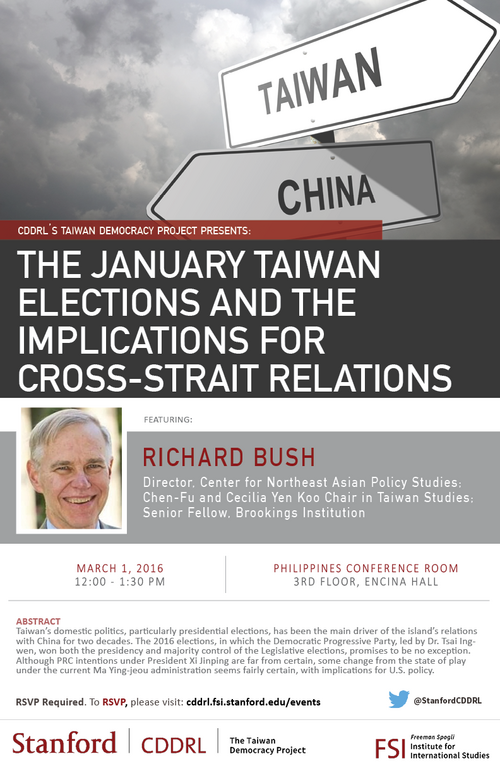
The January Taiwan Elections and the Implications for Cross-Strait Relations
-
Abstract
Taiwan’s domestic politics, particularly presidential elections, has been the main driver of the island’s relations with China for two decades. The 2016 elections, in which the Democratic Progressive Party, led by Dr. Tsai Ing-wen, won both the presidency and majority control of the Legislative elections, promises to be no exception. Although PRC intentions under President Xi Jinping are far from certain, some change from the state of play under the current Ma Ying-jeou administration seems fairly certain, with implications for U.S. policy.
Bio
Richard Bush is a Senior Fellow at the Brookings Institution and Director of its Center for Northeast Asian Policy Studies, and the Chen-Fu and Cecilia Yen Koo Chair in Taiwan Studies. He came to Brookings in July 2002 after nineteen years working in the US government, including five years as the Chairman and Managing Director of the American Institute in Taiwan. He is the author of a number of articles on U.S. relations with China and Taiwan, and of At Cross Purposes, a book of essays on the history of America’s relations with Taiwan, published in March 2004 by M. E. Sharpe. In the spring of 2005, Brookings published his study on cross-Strait relations, entitled Untying the Knot: Making Peace in the Taiwan Strait. In 2013, Brookings published his Uncharted Strait: The Future of China-Taiwan Relations.
This talk is co-sponsored by the Taiwan Democracy Project in the Center on Democracy, Development, and the Rule of Law and the U.S.-Asia Security Initiative in the Walter H. Shorenstein Asia-Pacific Research Center.
Image
Richard C. Bush
Senior Fellow and Director, Center for East Asian Policy Studies
Brookings Institution
Seminars
The Failure of Political Institutionalization in China
-
Less than four years after Mao Zedong’s death, Deng Xiaoping declared that China needed to move away from an “over-concentration of power” by an individual leader to establish a more institutionalized system of governance. Xi Jinping’s ascension to power in 2013 promised a new era of reform of the Communist Party of China (CCP), specifically intended to preserve the party’s power. Rather than addressing governance issues, however, Xi’s actions, such as the anti-corruption campaign, have served to concentrate power in his hands, showing the weakness of political institutionalization in China after decades of collective leadership. While decision-making processes continue to be a black box, by reclaiming the CCP’s authority over policy-making, and by chairing CCP small leading groups, Xi appears to have moved China back to Mao-style personalistic rule. The puzzles that remain are how personalistic authoritarian rule has returned to a country characterized by a growing middle class and a modern open market economy; and what this reversion to personalistic leadership tells us about the ambiguities of institutions in communist ruling parties.
Susan Shirk is the Chair of the 21st Century China Program and Research Professor at the School of Global Policy and Strategy at the University of California - San Diego. She is also director emeritus of the University of California’s Institute on Global Conflict and Cooperation (IGCC). Susan Shirk first visited China in 1971 and has been teaching, researching and engaging China diplomatically ever since.
From 1997-2000, Shirk served as Deputy Assistant Secretary of State in the Bureau of East Asia and Pacific Affairs, with responsibility for China, Taiwan, Hong Kong and Mongolia.
In 1993, she founded, and continues to lead, the Northeast Asia Cooperation Dialogue (NEACD), a Track II forum for discussions of security issues among defense and foreign ministry officials and academics from the U.S., Japan, China, Russia, South Korea and North Korea.
Shirk's publications include her books, China: Fragile Superpower; How China Opened Its Door: The Political Success of the PRC's Foreign Trade and Investment Reforms; The Political Logic of Economic Reform in China; Competitive Comrades: Career Incentives and Student Strategies in China; and her edited book, Changing Media, Changing China.
Shirk served as a member of the U.S. Defense Policy Board, the Board of Governors for the East-West Center (Hawaii), the Board of Trustees of the U.S.-Japan Foundation, and the Board of Directors of the National Committee on United States-China Relations. She is a member of the Trilateral Commission, the Council on Foreign Relations, and an emeritus member of the Aspen Strategy Group. Dr. Shirk received her BA in Political Science from Mount Holyoke College, her MA in Asian Studies from the University of California, Berkeley, and her PhD in Political Science from the Massachusetts Institute of Technology.
This event is off the record.
Feb 19, 2016 Event Flyer
Download pdf
Susan Shirk, UC San Diego
Seminars