International Development

FSI researchers consider international development from a variety of angles. They analyze ideas such as how public action and good governance are cornerstones of economic prosperity in Mexico and how investments in high school education will improve China’s economy.

They are looking at novel technological interventions to improve rural livelihoods, like the development implications of solar power-generated crop growing in Northern Benin.

FSI academics also assess which political processes yield better access to public services, particularly in developing countries. With a focus on health care, researchers have studied the political incentives to embrace UNICEF’s child survival efforts and how a well-run anti-alcohol policy in Russia affected mortality rates.

FSI’s work on international development also includes training the next generation of leaders through pre- and post-doctoral fellowships as well as the Draper Hills Summer Fellows Program.

Authors
Callista Wells
News Type
News
Date
Paragraphs

The Stanford Center at Peking University (SCPKU), the Center on Democracy, Development and the Rule of Law (CDDRL), and the APARC China Program jointly hosted a workshop on China’s Belt and Road Initiative (BRI) in early March. The workshop, held on March 2 and 3, welcomed researchers from around the world with expertise in the Initiative. Unfortunately, because of the rapidly developing health emergency related to the coronavirus, participants from not only China, but also Japan, were prevented from attending. As described by Professor Jean Oi, founding director of SCPKU and the China Program, and Professor Francis Fukuyama, director of CDDRL and the Ford Dorsey Master's in International Policy, who co-chaired the workshop, the meeting aimed to provide a global perspective on the BRI, consolidate knowledge on this opaque topic, and determine the best method and resources for future research.  

The workshop began with presentations from several of the invited guests. Dr. Atif Ansar from the University of Oxford’s Saïd Business School kicked off the first day by describing not only the tremendous opportunity that the BRI presents to developing economies, but also the serious pitfalls that often accompany colossal infrastructure projects. Pointing out the poor returns on investment of mega infrastructure projects, Ansar examined the frequest cost and schedule overruns, random disasters, and environmental degradation that outweigh the minimal benefits that they generally yield. China’s own track record from domestic infrastructure projects does little to mitigate fear of these risks, Ansar claimed. In response, he urged professional management of BRI investments, institutional reforms, and intensified deployment of technology in BRI projects. Dr. Ansar was followed by Dr. Xue Gong of the S. Rajaratnam School of International Studies, Nanyang Technological University, Singapore. Dr. Gong’s analysis centered on the extent to which China’s geopolitical motivations influenced its outward foreign direct investments (OFDI). Although her research was still in the early stages, her empirical analysis of China’s OFDI inflows into fifty BRI recipient countries from 2007-2018 nevertheless revealed that geopolitical factors often outweigh economic factors when it comes to China’s OFDI destinations.

Image
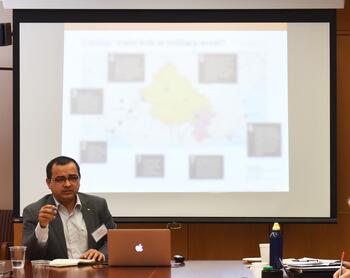
Amit Bhandari of Gateway House: Indian Council on Global Relations presents his research at the Belt and Road Workshop.
Participants then heard presentations from Amit Bhandari of Gateway House: Indian Council on Global Relations and Professor Cheng-Chwee Kuik of the National University of Malaysia. Mr. Bhandari’s talk focused on Chinese investments in India’s six neighboring countries, which tend to center more on energy rather than connectivity projects. He first found that the investments are generally not economical for the host countries because they come with high costs and high interest rates. Secondly, he argued that these projects often lacked a clear economic rationale, appearing instead to embed a geopolitical logic not always friendly to India. Professor Kuik, by contrast, provided a counterexample in his analysis of BRI projects in Southeast Asia. He described how, in Southeast Asia, host countries’ reception of the BRI has varied substantially; and how various stakeholders, including states, sub-states and other entities, have used their leverage to shape outcomes more or less favorable to themselves. Kuik’s analysis injected complexity into the often black-and-white characterizations of the BRI. He highlighted the multidimensional dynamics that play out among local and state-level players in pursuit of their goals, and in the process of BRI implementation.

Professor Curtis J. Milhaupt and Scholar-in-Residence Jeffrey Ball, both at Stanford Law School, followed with individual presentations on the role of State-Owned Enterprises (SOEs) in the BRI and the emissions impact of the BRI on climate change, respectively. Professor Milhaupt  characterized Chinese SOEs as both geopolitical and commercial actors, simultaneously charged with implementing Party policies and attaining corporate profits. Chinese SOEs are major undertakers of significant overseas BRI projects, acting not only as builders but also as investors, partners, and operators. This situation, Milhaupt asserted, carries significant risks for SOEs because these megaprojects often provide dismal returns, have high default rates, and can trigger political backlash in their localities. Milhaupt highlighted the importance of gathering firm-level data on businesses actually engaged in BRI projects to better infer geostrategic, financial, or other motivations. Jeffrey Ball turned the discussion to carbon emissions from BRI projects and presented preliminary findings from his four-country case studies. He concluded that, on aggregate, the emissions impact of the BRI is still “more brown than green.” Twenty-eight percent of global carbon emissions may be accounted for by BRI projects, Ball asserted, underscoring the importance of the BRI to the future of global climate change.

The day concluded with presentations by  Michael Bennon, Managing Director at the Stanford Global Projects Center, and Professor David M. Lampton, Oksenberg-Rohlen Fellow at the Freeman Spogli Institute for International Studies. Bennon first presented findings from two empirical case studies of BRI projects and then went on to describe how the BRI is now practically the “only game in town” for infrastructure funding for developing countries. Lengthy environmental review processes at Western multilateral banks have turned the World Bank, for example, from a lending bank into a “knowledge bank,” he argued. He also highlighted that, in general, economic returns on BRI projects for China are very poor, even though recipient countries may accrue macroeconomic benefits from these projects. Finally, Professor Lampton turned the discussion back to Southeast Asia, where China is currently undertaking massive cross-border high-speed rail projects through eight ASEAN countries. He described how each host country had varying capacity to negotiate against its giant neighbor, and how the sequential implementation of these cross-border rail projects also had varying impacts on the negotiating positions of these host countries. BRI played out differently in each country, in other words, eliciting different reactions, push-backs and negotiated terms.

The second day of the workshop was dedicated to working toward a collaborative approach to future BRI research. The group discussed the key gaps in the existing research, including how to know what China’s true intentions are, how to measure those intentions, who the main players and their interests in both China and the host countries are, and even what the BRI is, exactly. Some cautioned that high-profile projects may not be representative of the whole. Participants brainstormed about existing and future sources of data, and stressed the importance of diversifying studies and seeking empirical evidence.

Hero Image
Participants in the Belt and Road Initiative Workshop at Stanford University, March 2-3, 2020.
All News button
1
News Type
News
Date
Paragraphs

When economists, policymakers, and media commentators discuss growth or compare living standards across countries, they typically turn to a single measure: Gross Domestic Product (GDP). In layman’s terms, GDP is the monetary value of all goods and services made or exchanged in a country during a specific period of time. The calculation of a nation’s GDP is complex and takes in a multitude of country-specific caveats, but the final figure per capita is supposedly a proxy for a nation’s economic health.

Image
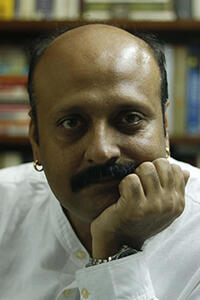
Amit Kapoor

Using GDP as a measure of welfare, however, has multiple problems. Just ask Dr. Amit Kapoor, an expert in economic development and business strategy, who rebuts the focus often placed on the importance of GDP. As the chair of the Shared Value Institute of India, president and CEO of the India Council on Competitiveness, and as an affiliate faulty member with the Institute of Strategy and Competitiveness of the Harvard Business School, Kapoor has spent a great deal of time and effort working with the governments of India and other countries on measuring social progress and developing living standards, performance, and progress indices. In a recent lecture as part of APARC’s South Asia Colloquia, Kapoor made his case for looking past GDP when considering the overall well-being of nations.

GDP, says Kapoor, originated in the 1940s as a wartime estimate to provide a window into a region’s economic situation and is based on the paradigm that economic objectives equal social objectives. Yet economic development doesn’t always lead to advancements in social progress and human prosperity. To gain a complete understanding of a nation’s growth, he argued, it is important directly to measure social progress, which includes indicators of human well-being such as access to education, equal opportunity, health services, sanitation and clean water, social inclusion, and even tolerance.

 Our world as we know it is facing multiple threats, Kapoor reminds us, from environmental extinction to the rise of populism and to the crisis of capitalism. We can only address these issues “by creating alternate measures of how we assess human well-being.”

Kapoor points to the apparent growing gap between economic gains and social parity as evidence that GDP-centricity gives a very pixelated, partial picture of national development. In the past 80 years, economies as a whole have gained exponentially, as indeed reflected in GDP measurements, but progress on issues such as basic human needs, personal well-being, and opportunities for individual fulfillment have seemed to lag.

Kapoor’s issue with GDP is that it fails to account for these other kinds of social, environmental, and cultural factors. To this end, he advocates considering other means of measuring success and development, such as the Human Development Index, or his research to gauge and codify “ease of living” measurements in his home country of India.

Image
Data from the Human Development Index

That research, says Kapoor, shows there exists a non-linear relationship between ease of living and per capita GDP. Therefore, the impact of economic development on a population’s ease of living will depend on where the region is placed. Moreover, if one is at a lower level of economic development, then investing in economic well-being will translate into social well-being, but after the cutoff is reached, higher economic development will lead to a fall in the ease of living.    

“In an economy with well-being at its heart, economic growth will simply be another tool to guide it in the direction that the society chooses. In such an economy, the percentage points of GDP, which are rarely connected with the lives of average citizens, will cease to take the center stage. The focus would instead shift towards more desirable and actual determinants of welfare.”

You can read more of Amit Kapoor’s perspectives and learn more about his work to redefine development in India in his Harvard Business Review article, “GDP Is Not a Measure of Human Well-Being.

Hero Image
An ice cream vendor pushes his cart in front of Lodhi Gardens in New Delhi, India. Daniel Berehulak / Getty Images
All News button
1
-

Many observers, and many investors, believe that young people are especially likely to produce the most successful new firms. Integrating administrative data on​ firms, workers, and owners, we study startups systematically in the U.S. and find​ that successfull entrepreneurs are middle-aged, not young. The mean age at​ founding for the 1-in-1,000 fastest growing new ventures is 45.0. The findings are​ similar when considering high-technology sectors, entrepreneurial hubs, and​ successful firm exits. Prior experience in the specific industry predicts much greater​ rates of entrepreneurial success. These findings strongly reject common hypotheses​ that emphasize youth as a key trait of successful entrepreneurs.

Speaker:

Image
dsc 0355 javier miranda

Javier Miranda, Principal Economist, Economy-Wide Statistics Division, US Census Bureau

Bio:

Javier Miranda is Principal Economist at the U.S. Census Bureau where he began his career in 1998. Javier received his Ph.D. in Economics from American University in 2004. Previous to joining the Census Javier was a research consultant at the World Bank and the Urban Institute. Javier has published papers in the areas of industrial organization, technological change, job creation, entrepreneurship and firm financing. Among his publications are articles in the American Economic Review, Journal of Economic Literature, American Economic Journal Macroeconomics, Review of Economic and Statistics, IMF Review, World Bank Economic Review, Journal of Business Valuation and Economic Loss, NBER Macroeconomics Annual, and multiple books and chapters.  Javier received the Director's Award for Innovation (2007) and the U.S. Department of Commerce Bronze Medal (2011). His contributions to data infrastructure are notable. Javier Miranda is responsible for the development of the Longitudinal Business Database and the Business Dynamics Statistics and is the Synthetic Longitudinal Business Database v3. Together with the USPTO Javier has led the development the Business Dynamics Statistics of Innovative Firms a longitudinal database of firms, patents, and inventors. Javier Miranda is also President of the Board of SEM an adult education and job readiness program designed to address the root causes of poverty, illiteracy, and violence in Washington DC.

Advisory on Novel Coronavirus (COVID-19)

In accordance with university guidelines, if you (or a spouse/housemate) have returned from travel to mainland China or South Korea in the last 14 days, we ask that you DO NOT come to campus until 14 days have passed since your return date and you remain symptom-free. For more information and updates, please refer to the Stanford Environmental Health & Safety website: https://ehs.stanford.edu/news/novel-coronavirus-covid-19.


Javier Miranda, Principal Economist, Economy-Wide Statistics Division, US Census Bureau
Seminars
-

IMPORTANT EVENT UPDATE: 

In keeping with Stanford University's March 3 message to the campus community on COVID-19 and current recommendations of the CDC, the Asia-Pacific Research Center is electing to postpone this event until further notice. We apologize for any inconvenience this may cause, and appreciate your understanding and cooperation as we do our best to keep our community healthy and well. 


Data-intensive technologies such as AI may reshape the modern world. We propose that two features of data interact to shape innovation in data-intensive economies: first, states are key collectors and repositories of data; second, data is a non-rival input in innovation. We document the importance of state-collected data for innovation using comprehensive data on Chinese facial recognition AI firms and government contracts. Firms produce more commercial software and patents, particularly data-intensive ones, after receiving government public security contracts. Moreover, effects are largest when contracts provide more data. We then build a directed technical change model to study the state's role in three applications: autocracies demanding AI for surveillance purposes, data-driven industrial policy, and data regulation due to privacy concerns. When the degree of non-rivalry is as strong as our empirical evidence suggests, the state's collection and processing of data can shape the direction of innovation and growth of data-intensive economies.

Image
Portrait of David Yang
David Yang’s research focuses on political economy, behavioral and experimental economics, economic history, and cultural economics. In particular, David studies the forces of stability and forces of changes in authoritarian regimes, drawing lessons from historical and contemporary China. David received a B.A. in Statistics and B.S. in Business Administration from University of California at Berkeley, and PhD in Economics from Stanford. David is currently a Prize Fellow in Economics, History, and Politics at Harvard and a Postdoctoral Fellow at J-PAL at MIT. He also joined Harvard’s Economics Department as an Assistant Professor as of 2020.

David Yang Prize Fellow in Economics, History, and Politics; Department of Economics, Harvard University
Seminars
-

Richard Heydarian in conversation with Don Emmerson

In this seminar, scholar/journalist Richard Heydarian will discuss the principal arguments and ideas in his just-published book on the Indo-Pacific.  He will do so in conversation with Southeast Asia Program director Don Emmerson.  Propositions to be discussed will include:  The 21st century will not belong to China. There will be no Pax Sinica in the Indo-Pacific. China’s bid for primacy will fail due to its overbearing hubris abroad and its massive challenges at home.  Its effort to create a “neo-tributary” system in East Asia will not succeed, as evidenced by pushback regarding the Belt and Road Initiative and the South China Sea.  Neither China nor America will dominate the Indo-Pacific.  More likely to develop there is “an uneasy, fluid network of interlocking alliances, partnerships, and rivalries” in which middle powers such as Japan will figure prominently in efforts to address urgent and visceral challenges such as global warming and information war.  Most needed in the longer run will be a coalition of powers able jointly to “hold the line against the coming anarchy that will sweep the Indo-Pacific mega-region” if nothing is done to rescue it from the political, socioeconomic, environmental, and technological risks and dangers that lie ahead.  Copies of his latest book, from which these arguments are drawn, will be available for sale.

Image
heydarian
Richard Javad Heydarian’s latest book is The Indo-Pacific: Trump, China, and the New Struggle for Global Mastery (2020). Earlier publications include Asia’s New Battlefield (2015), How Capitalism Failed the Arab World (2014), and articles and interviews in many outlets including The Atlantic, The Economist, Foreign Affairs, The New York Times, The Guardian, The Wall Street Journal, and The Washington Post. He has interviewed heads of state and senior policy-makers across the Indo-Pacific, and has taught political science at Ateneo de Manila University and De La Salle University in the Philippines, and most recently was a visiting research Fellow at National Chengchi University in Taiwan. He is an opinion contributor to South China Morning Post, The Straits Times, and Nikkei Asian Review, and is a columnist at the Philippine Daily Inquirer and television host at GMA Network.


Richard Javad Heydarian Independent Scholar, Author, and Columnist for Philippines Daily Inquiries
Panel Discussions
-

President Xi Jinping is scheduled to pay a state visit to Japan this spring. How have the relations between Japan and China been evolving during the last several years? How has the U.S.-China “trade war” been affecting the Japan-China relations? What is the best way for us to address China’s trade issues? The U.S. and Japan have been promoting cooperation under the Free and Open Indo Pacific (FOIP). Will Japan cooperate with China’s Belt and Road Initiative? How can the U.S. and Japan expand the cooperation under the FOIP?

Image
shitaka headshot

Speaker:

Noriyuki Shikata, Former Envoy Extraordinary and Minister Plenipotentiary, Deputy Chief of Mission, Embassy of Japan in Beijing

Bio:

Noriyuki Shikata holds a B.A. in Law from Kyoto University and Master of Public Policy (MPP) from Harvard Kennedy School of Government. Most recently, he was the Envoy Extraordinary and Minister Plenipotentiary, Deputy Chief of Mission, Embassy of Japan in China. His other prior positions include: Deputy Director General, Asian and Oceanian Affairs Bureau; Director, Economic Treaties Division, International Legal Affairs Bureau; and Director, Second North America Division, North America Bureau. Mr. Shikata has also been a Visiting Professor at Kyoto University’s Graduate School of Law/Public Policy. He is currently at Harvard conducting research on an emerging U.S. policy toward China and the Indo-Pacific region. His Twitter handle is: @norishikata.

Noriyuki Shikata, Former Envoy Extraordinary and Minister Plenipotentiary, Deputy Chief of Mission, Embassy of Japan in Beijing
Seminars
-

In the eyes of China’s neo-authoritarian reformers, Singapore, despite being a tiny city-state, long exemplified a state of affairs for which the PRC should strive: resilient authoritarianism alongside but unweakened by liberalizing steps conducive to economic growth.  On behalf of Beijing’s effort to learn from Singapore, tens of thousands of officials visited the city-state and thousands of articles and books were written about it. Today, however, Xi Jiinping has derided foreign templates and relegated adopting the “Singapore model” to a path not taken by China’s current hard-line leadership and unavailable for authoritarian reformers to pursue. Although the demotion was triggered by Xi’s anti-reformism and China’s rise, Singapore’s loss of “model” character was also path-dependent. Chinese academics studying Singapore had long misunderstood fundamental institutional differences between the two countries that went back to the city-state’s colonial past and China’s Stalinist-Maoist revolution. Efforts to model reforms on the Singaporean “state-party” ran into the prerogatives of the Chinese party-state. Proposals to strengthen market forces, impose limited legal constraints on the party, and introduce semi-competitive elections were seen as threatening the institutional foundations of the CPC. Moreover, despite a (partial) revival of Confucianism in China that imitated the city-state’s attraction to “Asian values,” Singapore’s neo-liberal “pragmatism” and multi-racialism contradicted the CPC’s self-portrayal as an engine of Marxist socialism embodying the Han-Chinese nation.

Image
mark thompson 0120
Mark R. Thompson heads the Southeast Asia Research Centre at the City University of Hong Kong. He is president of the Hong Kong Political Science Association (HKPSA) and a former president of the Asian Political and International Studies Association (2013-14). A comparativist specializing in Southeast Asian politics, his publications include China’s “Singapore Model” and Authoritarian Learning, ed. with Stephan Ortmann (forthcoming 2020); Authoritarian Modernism in East Asia (2019); The Routledge Handbook of the Contemporary Philippines, ed. with Eric Batalla (2018); Dynasties and Female Political Leaders in Asia, ed. with Claudia Derichs (2014); Democratic Revolutions: Asia and Eastern Europe (2004); and The Anti-Marcos Struggle (1995).

Shorenstein APARC
Stanford University
Encina Hall E301
Stanford, CA 94305-6055

(650) 725-6459 (650) 723-6530
0
MarkThompson[1].JPG PhD

Professor Thompson builds on Barrington Moore's insight that there are different "paths to the modern" world. Thompson's manuscript explores alternatives to the familiar South Korean-and Taiwan-based model of "late democratization." According to that model, political pluralism follows a formative period of economic growth during which labor is demobilized and big business, religious leaders, and professionals depend upon and are co-opted by the state.

Thompson argues that even when these preconditions are in place, democratization need not follow. Singapore is an illuminating case in point. The autocratic growth model pays insufficient attention to politics, including the sometimes crucial role of student activists in challenging developmental authoritarianism and triggering a democratic transition, as in Indonesia. As political actors, students (rather than a progressive bourgeoisie) may fill the oppositional vacuum created by the preconditions that characterized predemocratic South Korean and Taiwan.

In his critique of Northeast Asian-style, post-authoritarian "late democratization" and its emphasis on economic growth as the driver of political change, Professor Thompson uses evidence drawn from paired comparisons of Vietnam with China, Hong Kong with Singapore, and between South Korea and Taiwan on the one hand and other major Southeast Asian cases on the other.

Mark R. Thompson is a professor of political science at the University of Erlangen-Nuremberg in Germany.  A Chicago native, he took his first degree in religious studies at Brown University followed by postgraduate work at Cambridge University and the University of the Philippines.  Fascinated by Philippine people power, he wrote his dissertation at Yale University on the anti-Marcos struggle (Yale University Press, 1996). After moving to Germany, he witnessed popular uprisings in East Germany and Eastern Europe, inspiring him to conceptualize democratic revolutions in essays later published as a book (Routledge, 2004).  He is in residence at Stanford as Lee Kong Chian Distinguished Fellow in Southeast Asian Studies from February through April 2009.

Lee Kong Chian NUS-Stanford Distinguished Fellow on Southeast Asia
Head and Professor of Politics, Department of Asian and International Studies, City University of Hong Kong
Seminars
-

WE HAVE REACHED VENUE CAPACITY AND ARE NO LONGER ACCEPTING RSVPS


Image
Portrait of Nicholas Lardy
China has grown faster for longer than any country in recorded history.  Is it market-oriented reform, state industrial policy, or some sophisticated blend of the two that explains this success?  In this talk, Dr. Nicholas Lardy will also further examine what might explain China’s slowdown of recent years.  Is China falling into the frequently fatal middle-income trap?  Or have domestic policy choices led to the slowdown?  Have trade frictions with the United States also contributed to China’s slowing growth?  In addition, what should U.S. policy stance be towards China?  Should the United States continue to ramp up restrictions on two-way flows of technology to try to further slow China’s growth?  How successful is such a strategy likely to be and what costs to the United States would be inherent in such an approach?

Nicholas R. Lardy is the Anthony M. Solomon Senior Fellow at the Peterson Institute for International Economics.  He joined the Institute in March 2003 from the Brookings Institution, where he was a senior fellow from 1995 until 2003.  Before Brookings, he served at the University of Washington, where he was the director of the Henry M. Jackson School of International Studies from 1991 to 1995.  From 1997 through the spring of 2000, he was also the Frederick Frank Adjunct Professor of International Trade and Finance at the Yale University School of Management.  He is an expert on the Chinese economy.  Lardy's most recent books are The State Strikes Back: The End of Economic Reform in China? (2019), Markets over Mao: The Rise of Private Business in China (2014), Sustaining China's Economic Growth after the Global Financial Crisis (2012), The Future of China's Exchange Rate Policy (2009), and China's Rise: Challenges and Opportunities (2008). 


Image of red flag over the Shanghai Bund

This event is part of the 2020 Winter/Spring Colloquia series, The PRC at 70: The Past, Present – and Future?, sponsored by APARC's China Program.


Nicholas Lardy Anthony M. Solomon Fellow Peterson Institute for International Economics
Seminars
-

IMPORTANT EVENT UPDATE: 

In keeping with Stanford University's March 3 message to the campus community on COVID-19 and current recommendations of the CDC, the Asia-Pacific Research Center is electing to make this event available through live stream only. We appreciate your understanding and cooperation as we do our best to keep our community healthy and well. 

Please join the live stream via Zoom by clicking here at the scheduled time, 4:30 PM, on March 4 to view Adam Segal's talk.


Analysts on both sides of the Pacific have described an escalating “technology cold war” between Beijing and Washington. Chinese hackers attack American technology companies and Beijing is reportedly planning on the removal of foreign software and hardware from government offices. Washington is blocking Chinese investments, using punitive measures against Huawei and Chinese surveillance companies, and scrutinizing research collaboration with Chinese universities as well as scientists and students. Both sides believe they are in and have to win a race to dominate 5G, AI, quantum, and other emerging technologies. What are the weapons of the tech cold war, and are the US and China doomed to ever more competition, or can they find common ground for cooperation? What does increasing competition between China and the United States mean for the rest of the world?

Image
Portrait of Adam Segal
Adam Segal is the Ira A. Lipman Chair in emerging technologies and national security and Director of the Digital and Cyberspace Policy Program at the Council on Foreign Relations (CFR). An expert on security issues, technology development, and Chinese domestic and foreign policy, Segal was the project director for the CFR-sponsored Independent Task Force reports titled Innovation and National Security: Keeping Our Edge. His most recent book, The Hacked World Order: How Nations Fight, Trade, Maneuver, and Manipulate in the Digital Age (PublicAffairs, 2016), describes the increasingly contentious geopolitics of cyberspace. His work has appeared in the Financial Times, the New York Times, Foreign Policy, the Wall Street Journal, and Foreign Affairs, among others. He currently writes for the blog, “Net Politics.”


Image
Image of red flag over the Shanghai Bund
This event is part of the 2020 Winter/Spring Colloquia series, The PRC at 70: The Past, Present – and Future?, sponsored by APARC's China Program.


Adam Segal Director Digital and Cyberspace Policy Program, Council on Foreign Relations
Seminars
Subscribe to International Development