Foreign Policy
Authors
Callista Wells
News Type
News
Date
Paragraphs

On February 24, 2021, the China Program at Shorenstein APARC hosted Dr. Thomas Wright, director of the Center on the United States and Europe and a senior fellow in the Project on International Order and Strategy at the Brookings Institution. Professor Jean Oi, William Haas Professor of Chinese Politics and director of the APARC China Program, moderated the event.

The program, entitled "U.S.-China Relations in the Biden Era," explored the future of US-China relations based on experience from past administrations. Under former President Trump, U.S. relations with China evolved into outright rivalry. In his talk, Dr. Wright discussed whether this rivalry will continue and evolve during a Biden administration by analyzing the roots of strategic competition between the two countries and various strands of thinking within the Biden team. According to Wright, the most likely outcome is that the competition between the two countries will evolve into a clash of governance systems and the emergence of two interdependent blocs where ideological differences become a significant driver of geopolitics. Cooperation is possible but it will be significantly shaped by conditions of rivalry. Watch now:

Read More

Min Ye speaking
News

Domestic or International? The Belt and Road Initiative Is More Internally Focused Than We Think, Says Expert Min Ye

Domestic or International? The Belt and Road Initiative Is More Internally Focused Than We Think, Says Expert Min Ye
Banner of Hau L. Lee
News

The Pandemic, U.S.-China Tensions and Redesigning the Global Supply Chain

The Pandemic, U.S.-China Tensions and Redesigning the Global Supply Chain
Photograph of Xi Jinping and Vladmir Putin walking in front of two lines of armed Chinese soldiers
News

Military Competition with China: Harder to Win Than During the Cold War?

On February 10th, the APARC China Program hosted Professor Oriana Mastro to discuss military relations between the US and China, and why deterrence might be even more difficult than during the Cold War.
Military Competition with China: Harder to Win Than During the Cold War?
Hero Image
American and Chinese flags
All News button
1
Subtitle

Dr. Thomas Wright examines the recent history of US-China relations and what that might mean for the new administration.

-

This is a virtual event. Please click here to register and generate a link to the talk. 
The link will be unique to you; please save it and do not share with others.

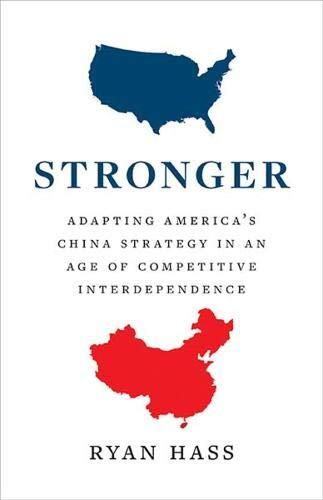
How can the U.S. best manage its relationship with China? The country is at once a major and increasingly hostile competitor to the U.S., a formidable challenger to U.S.’ regional and global leadership, and an important partner on a range of transnational challenges. Will it be possible for both sides to coexist amidst intensifying competition? How great is the risk of US-China conflict, including over Taiwan? Ryan Hass, author of Stronger: Adapting America’s China Strategy in an Age of Competitive Interdependence, will address these questions and more in opening comments before engaging in an open Q&A on the future of the world’s most consequential bilateral relationship.


Image
Portrait of Ryan Hass
Ryan Hass is a senior fellow and the Michael H. Armacost Chair in the Foreign Policy program at Brookings, where he holds a joint appointment to the John L. Thornton China Center and the Center for East Asia Policy Studies. He is also the Interim Chen-Fu and Cecilia Yen Koo Chair in Taiwan Studies. Hass focuses his research and analysis on enhancing policy development on the pressing political, economic, and security challenges facing the United States in East Asia. He is the author of Stronger: Adapting America’s China Strategy in an Age of Competitive Interdependence, published by Yale University Press.

Image
"Stronger" Book Cover
From 2013 to 2017, Hass served as the director for China, Taiwan and Mongolia at the National Security Council (NSC) staff. In that role, he advised President Obama and senior White House officials on all aspects of U.S. policy toward China, Taiwan, and Mongolia, and coordinated the implementation of U.S. policy toward this region among U.S. government departments and agencies. He joined President Obama’s state visit delegations in Beijing and Washington respectively in 2014 and 2015, and the president’s delegation to Hangzhou, China, for the G-20 in 2016, and to Lima, Peru, for the Asia-Pacific Economic Cooperation (APEC) Leaders Meetings in 2016. Prior to joining NSC, Hass served as a Foreign Service Officer in U.S. Embassy Beijing, where he earned the State Department Director General’s award for impact and originality in reporting. Hass also served in Embassy Seoul and Embassy Ulaanbaatar, and domestically in the State Department Offices of Taiwan Coordination and Korean Affairs. 


Image
American and Chinese flags
This event is part of the 2021 Winter/Spring Colloquia series, Biden’s America, Xi’s China: What’s Now & What’s Next?, sponsored by APARC's China Program.


Via Zoom Webinar. Register at: https://bit.ly/3c3v10W

Ryan Hass Senior Fellow, Michael H. Armacost Chair in Foreign Policy Studies, Brookings Institution
Seminars
Authors
Oriana Skylar Mastro
News Type
Commentary
Date
Paragraphs

This article by Oriana Skylar Mastro was originally published in The Interpreter, a publication by the Lowy Institute.

When China began three days of military exercises in the South China Sea’s Gulf of Tonkin back in January, some observers speculated that Beijing was testing the new Biden administration. Harsh words from Beijing accompanied the exercises, with China’s foreign ministry spokesperson Wang Wenbin declaring the drills were “necessary measures to resolutely safeguard national sovereignty and security”.

Even against this backdrop, China’s official position is that it remains committed to a peaceful resolution of the South China Sea issue. And the rhetoric China employs at different times does make for a fascinating contrast. For example, China’s Foreign Ministry asserted in July 2020 that “China is not seeking to become a maritime empire” and that it “treats its neighboring nations on an equal basis and exercises the greatest restraint.”

[Subscribe to our newsletters to get the latest from our researchers.]

How then should we make sense of the mixed messages coming from Beijing? Most China experts find discourse to be informative – if not about China’s intentions, then at least about its aspirations. But which statements are indicative of China’s true position?

I argued recently in research for the Wilson Center that scholars need to evaluate the content and specificity of Chinese national discourse in addition to the position of the author or speaker involved. To that end, I analyzed all public speeches made by members of the Politburo of the Chinese Communist Party from 2013 to 2018. Xi Jinping led both of the Politburos I studied, and each had 25 members. Since some members served in both, this yields speeches by 39 unique individuals.

The speeches related to the South China Sea could be separated into those that mentioned cooperative themes and those with competitive themes. Cooperative themes have two subcategories, cooperation, and political solutions. Competitive themes have five subcategories: sovereignty, military, freedom, tension, and non-regional countries/the United States.

In what might appear good news for regional stability, China’s leaders used more cooperative discourse in public statements about the South China Sea than competitive themes. This might be taken to indicate a willingness to compromise with other claimants – a feature that is especially evident during the first year of each new Party Congress, namely 2013 and 2018.

However, one of the tenets of deriving intentions from discourse is that not all leadership statements are created equal. We need to consider personal power, accountability, and reputation for honesty. This means that statements by Xi, who is described as having “more power and more personal authority than any post-Mao leader”, take precedent.

Ambiguity suggests the leadership wants to have maximum flexibility and avoid being boxed in by its aggressive rhetoric.
Oriana Skylar Mastro
FSI Center Fellow

So here is the bad news. My analysis showed that Xi’s statements accounted for 42.7% of the competitive themes mentioned, even though he is only one of 39 leaders during this period.

There are additional reasons to discount Xi’s cooperative statements: his reputation for dishonesty.

In September 2015, Xi made a public statement at the White House promising not to “militarise” the artificial islands China had been building in the South China Sea. Xi stated that “relevant construction activities that China is undertaking … do not target or impact any country, and China does not intend to pursue militarisation”. While the language at the time was deemed “new”, the pledge remained unclear. Then and subsequently, Xi did not promise to freeze dredging, island-building or activities in the region, nor did he offer any clarity about what “militarisation” meant. In May 2019, then–Chairman of the Joint Chiefs of Staff General Joseph Dunford said that China had “clearly … walked away from that commitment” given the “10,000-foot runways, ammunition storage facilities, routine deployment of missile defence capabilities, aviation capabilities and so forth” on the islands. My analysis in a previous Interpreter article shows that China has indeed militarised these islands to establish control over the islands and the surrounding waters.

Interestingly, China’s foreign ministry also makes more competitive statements than cooperative statements, contrary to what might be the expectation that professional diplomats would lean towards negotiations and reassurance. If soothing language was supposed to mask China’s intentions, ministry statements would be the most likely source. But instead, China seems to prioritise articulating its position on sovereignty and issuing threats to those who violate it over reassurance.

None of this means China will use force in the South China Sea. Xi’s statements calling for a tough stance to protect China’s perceived sovereignty in the South China sea lack specificity – there are no allusions to a timeline or preferred methods. Such ambiguity suggests the leadership wants to have maximum flexibility and avoid being boxed in by its aggressive rhetoric, even if it is popular with the Chinese public. And the Chinese leadership undoubtedly prefers to use diplomatic, legal and economic tools to establish sovereignty over these waters.

But my analysis suggests that China will be unlikely to make the compromises necessary on its expansive territorial claims in these waters to facilitate a viable diplomatic resolution. Instead, China’s leaders hope that political, economic and military power will convince other countries to accommodate China’s position without a fight. And if the other claimants concede to Beijing, it will be harder for the United States or Australia to push back on China’s position.

Read More

Oriana Skylar Mastro testifies to the U.S.-China Economic and Security Review Commission on Taiwan deterrence.
News

Oriana Skylar Mastro Testifies on Deterring PRC Aggression Toward Taiwan to Congressional Review Commission

China may now be able to prevail in cross-strait contingencies even if the United States intervenes in Taiwan’s defense, Chinese security expert Oriana Skylar Mastro tells the U.S.-China Economic and Security Review Commission. Changes must be made to U.S. military capabilities, not U.S. policy, she argues.
Oriana Skylar Mastro Testifies on Deterring PRC Aggression Toward Taiwan to Congressional Review Commission
Aircraft assigned to the Theodore Roosevelt Carrier Strike Group fly over the South China Sea
Commentary

How China is Bending the Rules in the South China Sea

Beijing’s misapplication of international law in the disputed waters is more complex than it seems on the surface.
How China is Bending the Rules in the South China Sea
Photograph of Xi Jinping and Vladmir Putin walking in front of two lines of armed Chinese soldiers
News

Military Competition with China: Harder to Win Than During the Cold War?

On February 10th, the APARC China Program hosted Professor Oriana Mastro to discuss military relations between the US and China, and why deterrence might be even more difficult than during the Cold War.
Military Competition with China: Harder to Win Than During the Cold War?
Hero Image
A naval ship in the South China Sea in the background fo two officers.
China’s leaders are using cooperative discourse in public statements about the South China Sea than competitive themes, but signalling more competitive actions.
Getty Images
All News button
1
Subtitle

The rhetoric weaves between cooperative and competitive, leaving the question of what – and who – to believe.

Authors
News Type
News
Date
Paragraphs

There are strong indications that the Biden administration intends to continue strengthening U.S.-Taiwan ties. The Biden team invited Taiwan's representative Bi-khim Hsiao to the presidential inauguration, supporters of Taiwan now hold senior roles in the administration, and officials have pledged "rock-solid" U.S. commitment to Taiwan, warning that PRC military pressure against Taiwan threatens regional peace and stability. But Cross-strait deterrence is arguably weaker today than at any point since the Korean War, according to Chinese military and security expert Oriana Skylar Mastro, FSI Center Fellow at APARC.

On February 18, 2021, Mastro testified to the U.S.-China Economic and Security Review Commission at a hearing on Deterring PRC Aggression Toward Taiwan. Her testimony on the political and strategic dynamics underpinning deterrence across the Taiwan Strait is available to watch below.

[Subscribe to APARC's newsletters for the latest analysis from our experts.]

Beijing has turned to increasingly hostile and combative rhetoric and actions since the democratic election of Taiwan’s president, Tsai Ing-wen. PLA air and water operations around Taiwan, particularly in the Taiwan Strait, have increased significantly in the past year, and concern is growing that the Chinese Communist Party is imminently planning to use force to compel Taiwan to accept unification with mainland China.

Drawing on her expertise in both policy and military security, Mastro explains why deterrence in Taiwan must be based on military capabilities rather than signaling through policy.

Catalysts to Conflict

Foremost, Mastro argues that the basic circumstances of aggression towards Taiwan have changed. In years past, it was accepted that China would launch military operations against Taiwan in response to actions or policy positions taken there or in the United States. However, Mastro believes that China is now primed to force a campaign of reunification regardless of either Taiwan’s or the U.S.’s policies moving forward.

By Mastro’s assessment, China is now in a position where it could prevail in cross-strait military contingencies even if the U.S. intervenes in Taiwan’s defense. The reform overhaul and modernization of China’s military have vastly improved the quality it equipment and confidence in its capability. China now possesses offensive weaponry, including ballistic and cruise missiles, which if deployed, could destroy U.S. bases in the Western Pacific. Sophisticated cyber attacks on domestic infrastructure both in Taiwan and the United States are also a credible threat and viable form of retaliation.

As long as President Xi is confident that the PLA can successfully back a forced unification in Taiwan, Mastro argues that action of some kind against Taiwan is not a matter of if, but of when, and what severity.

Types of Escalation

Failure to reunify Taiwan is too high a political and military cost for the PRC to risk, but there is also growing agitation amongst the mainland Chinese population for a resolution on the half-baked status of the island and its governance. Mastro believes that this pressure will ensure that action will be taken on Taiwan in the next 3 to 5 years.

Since Taiwan cannot withstand a sustained, active assault from China on its own, the deciding factor in when and how China moves against Taiwan is largely dependent on the signals the U.S. sends. And since China is increasingly confident in its own military, the signals the U.S. sends must likewise be ground in military capability, not policy, says Mastro.  

As long as the U.S. does not make significant changes to improve its force posture in the region, China can afford to wait. Until Beijing is ready to take Taiwan by force, its leadership will carefully calibrate responses to U.S. or Taiwan actions so as not to escalate to war.
Oriana Skylar Mastro
FSI Center Fellow

If China believes there will be little or no intervention or support from the U.S., it is likely to follow a graduated plan of attack, using economic blockages and targeted military action to bring about capitulation. If, however, it appears the U.S. will intervene, China is much more likely to move quickly and escalate violence and force rapidly to maximize damage before a full U.S. defense response can be coordinated.

Policy Recommendations

To effectively counter China on Taiwan, Mastro recommends crafting policy that creates doubt over China’s ability to successfully absorb Taiwan through military means. To do this, the United States needs to focus forces and develop operational plans that credibly off-set China’s goals while not triggering a panicked response from Beijing that could escalate into rapid conflict.

Mastro also urges the allocation of more resources toward intelligence, surveillance, and reconnaissance (ISR), base development, and firepower in the Asia-Pacific region. Investing in these signals U.S. commitment to determent and the capacity to follow through if need be.

Finally, Mastro urges additional research into U.S. war termination behavior. Any involvement in Taiwan must be as limited and without the possibility for escalating levels of violence and long term unsustainable, unwinnable commitments. In preparing to potentially fight a war, she reminds policymakers that they need to know how to end one as well.

A recording of the full hearing is available courtesy of the U.S.-China Economic and Security Review Commission.

Read More

Aircraft assigned to the Theodore Roosevelt Carrier Strike Group fly over the South China Sea
Commentary

How China is Bending the Rules in the South China Sea

Beijing’s misapplication of international law in the disputed waters is more complex than it seems on the surface.
How China is Bending the Rules in the South China Sea
A warship sailing in the South China Sea and a photo of three soldiers standing guard in front of a Chinese traditional building
News

China’s South China Sea Strategy Prioritizes Deterrence Against the US, Says Stanford Expert

Analysis by FSI Center Fellow Oriana Skylar Mastro reveals that the Chinese military has taken a more active role in China’s South China Sea strategy, but not necessarily a more aggressive one.
China’s South China Sea Strategy Prioritizes Deterrence Against the US, Says Stanford Expert
Karen Eggleston speaking to an online panel.
News

Karen Eggleston Testifies on China’s Healthcare System to Congressional Review Commission

Asia health policy expert Karen Eggleston provides testimony for a U.S.-China Economic and Security Review Commission hearing on China's domestic healthcare infrastructure and the use of technology in its healthcare system amid COVID-19.
Karen Eggleston Testifies on China’s Healthcare System to Congressional Review Commission
Hero Image
Oriana Skylar Mastro testifies to the U.S.-China Economic and Security Review Commission on Taiwan deterrence.
All News button
1
Subtitle

China may now be able to prevail in cross-strait contingencies even if the United States intervenes in Taiwan’s defense, Chinese security expert Oriana Skylar Mastro tells the U.S.-China Economic and Security Review Commission. Changes must be made to U.S. military capabilities, not U.S. policy, she argues.

-

This is a virtual event. Please click here to register and generate a link to the talk. 
The link will be unique to you; please save it and do not share with others.


This event is co-sponsored by the Center on Democracy, Development, and the Rule of Law.

How does autocratic lobbying affect political outcomes and media coverage in democracies? This talk focuses on a dataset drawn from the public records of the US Foreign Agents Registration Act. It includes over 10,000 lobbying activities undertaken by the Chinese government between 2005 and 2019. The evidence suggests that Chinese government lobbying makes legislators at least twice as likely to sponsor legislation that is favorable to Chinese interests. Moreover, US media outlets that participated in Chinese-government sponsored trips subsequently covered China as less threatening. Coverage pivoted away from US-China military rivalry and the CCP’s persecution of religious minorities and toward US-China economic cooperation. These results suggest that autocratic lobbying poses an important challenge to democratic integrity.


Portrait of Erin Baggott CarterErin Baggott Carter is an Assistant Professor at the Department of Political Science and International Relations at the University of Southern California. There, she is also a Co-PI at the Lab on Non-Democratic Politics. She received a Ph.D. in Government from Harvard University, is currently a visiting scholar at the Stanford Center on Democracy, Development and the Rule of Law, and was previously a Fellow at the Stanford Center for International Security and Cooperation.
Dr. Carter's research focuses on Chinese politics and propaganda. She recently completed a book on autocratic propaganda based on an original dataset of eight million articles in Arabic, Chinese, English, French, Russian, and Spanish drawn from state-run newspapers in nearly 70 countries. She is currently working on a book on how domestic politics influence US-China relations. Her other work has appeared or is forthcoming in the British Journal of Political ScienceJournal of Conflict Resolution, and International Interactions. Her work has been featured by the New York Times, the Brookings Institution, and the Washington Post Monkeycage Blog.


Image
American and Chinese flags
This event is part of the 2021 Winter/Spring Colloquia series, Biden’s America, Xi’s China: What’s Now & What’s Next?, sponsored by APARC's China Program.


Via Zoom Webinar. Register at: https://bit.ly/3beG7Qz

Erin Baggott Carter Assistant Professor, Department of Political Science and International Relations, University of Southern California; Visiting Scholar, Center on Democracy, Development and the Rule of Law, Stanford University
Seminars
-

To watch the recording of the event, click here.

The Biden administration has yet to announce its North Korea policy, and it remains unclear whether it will try to forge a new path in U.S. dealings with North Korea or retread the steps of previous administrations. In this webinar, four experts with extensive experience with North Korea will assess the current situation on the Korean Peninsula and provide recommendations to the new administration.

Gi-Wook Shin, director of the Shorenstein Asia-Pacific Research Center and Korea Program, will moderate the conversation with panelists Robert Carlin, a visiting scholar at the Center for International Security and Cooperation, Victor Cha, professor of government at Georgetown University and Korea Chair at the Center for Strategic and International Studies, Siegfried Hecker, senior fellow emeritus at FSI and professor emeritus in the Department of Management Science and Engineering, and Oriana Mastro, an FSI Center Fellow.

Via Zoom: Register at https://bit.ly/3tPcfml

Panel Discussions
Authors
Callista Wells
News Type
News
Date
Paragraphs

On February 10, 2021, the China Program at Shorenstein APARC hosted Professor Oriana Skylar Mastro, Center Fellow at the Freeman Spogli Institute for International Studies​ for the virtual program "Military Competition with China: Harder to Win Than During the Cold War?" Professor Jean Oi, William Haas Professor of Chinese Politics and director of the APARC China Program, moderated the event.

As US-China competition intensifies, experts debate the degree to which the current strategic environment resembles that of the Cold War. Those that argue against the analogy often highlight how China is deeply integrated into the US-led world order. They also point out that, while tense, US-China relations have not turned overtly adversarial. But there is another, less optimistic reason the comparison is unhelpful: deterring and defeating Chinese aggression is harder now than it was against the Soviet Union. In her talk, Dr. Mastro analyzed how technology, geography, relative resources and the alliance system complicate U.S. efforts to enhance the credibility of its deterrence posture and, in a crisis, form any sort of coalition. Mastro and Oi's thought-provoking discussion ranged from the topic of why even US allies are hesitant to take a strong stance against China to whether or not Taiwan could be a catalyst for military conflict. Watch now: 

Read More

Min Ye speaking
News

Domestic or International? The Belt and Road Initiative Is More Internally Focused Than We Think, Says Expert Min Ye

Domestic or International? The Belt and Road Initiative Is More Internally Focused Than We Think, Says Expert Min Ye
Concept of U,S.-China technology competition: brain-shaped boxing gloves covered in U.S. and China flags facing against each other on a background of a motherboard
News

Caught in the Crossfire: The Future Of U.S.-China Science Collaboration and Its Impact on University Education

Caught in the Crossfire: The Future Of U.S.-China Science Collaboration and Its Impact on University Education
Banner of Hau L. Lee
News

The Pandemic, U.S.-China Tensions and Redesigning the Global Supply Chain

The Pandemic, U.S.-China Tensions and Redesigning the Global Supply Chain
Hero Image
Photograph of Xi Jinping and Vladmir Putin walking in front of two lines of armed Chinese soldiers Getty Images
All News button
1
Subtitle

On February 10th, the APARC China Program hosted Professor Oriana Mastro to discuss military relations between the US and China, and why deterrence might be even more difficult than during the Cold War.

-

This is a virtual event. Please click here to register and generate a link to the talk. 
The link will be unique to you; please save it and do not share with others.


U.S. relations with China evolved into outright rivalry during the Trump administration. In this talk, Thomas Wright will look at whether this rivalry will continue and evolve during a Biden administration. To answer this question, he will look at the roots of strategic competition between the two countries and various strands of thinking within the Biden team. The most likely outcome is that the competition will evolve into a clash of governance systems and the emergence of two interdependent blocs where ideological differences become a significant driver of geopolitics. Cooperation is possible but it will be significantly shaped by conditions of rivalry.


Image
Portrait of Thomas Wright
Thomas Wright is the director of the Center on the United States and Europe and a senior fellow in the Project on International Order and Strategy at the Brookings Institution. He is also a contributing writer for The Atlantic and a nonresident fellow at the Lowy Institute for International Policy. He is the author of “All Measures Short of War: The Contest For the 21st Century and the Future of American Power” which was published by Yale University Press in May 2017. His second book "Aftershocks: Pandemic Politics and the End of the Old International Order" will be published by St Martin's Press in 2021. Wright also works on U.S. foreign policy, great power competition, the European Union, Brexit, and economic interdependence.

Wright has a doctorate from Georgetown University, a Master of Philosophy from Cambridge University, and a bachelor's and master's from University College Dublin. He has also held a pre-doctoral fellowship at Harvard University's Belfer Center for Science and International Affairs and a post-doctoral fellowship at Princeton University. He was previously executive director of studies at the Chicago Council on Global Affairs and a lecturer at the University of Chicago's Harris School for Public Policy.


Image
American and Chinese flags
This event is part of the 2021 Winter/Spring Colloquia series, Biden’s America, Xi’s China: What’s Now & What’s Next?, sponsored by APARC's China Program.


Via Zoom Webinar. Register at: https://bit.ly/3r1glp7

Thomas Wright Director, Center on the United States and Europe, Brookings Institution; Senior Fellow, Foreign Policy, Project on International Order and Strategy, Brookings Institution
Seminars
Authors
News Type
News
Date
Paragraphs

In the last four years of the Trump presidency, there has been no shortage of inflammatory rhetoric directed towards both partners and competitors in the Asia-Pacific. With the Biden administration now about to take office, APARC convened a center-wide panel to discuss how different regions of the Asia-Pacific are responding to the incoming presidency and recent events in the United States, and what issues the new administration should consider as it moves into a new era of U.S.-Asia policies. The panelists included APARC Director Gi-Wook Shin, FSI Center Fellow Oriana Skylar Mastro, Japan Program Director Kiyoteru Tsutsui, Southeast Asia Program Director Donald K. Emmerson, and Shorenstein Fellow Thomas Fingar. Watch the full discussion below:

[Subscribe to APARC’s newsletters to get our latest commentary and analysis]

Soft Power and U.S.-China Competition

One thing the Trump administration has identified correctly and managed to get consensus on, says Chinese military and security expert Oriana Skylar Mastro, is that the United States is in a great-power competition with China. Biden now accepts this framework, and Mastro expects him to maintain the basic principles of U.S. Asia policy, such as strategic ambiguity and ensuring Taiwan’s defense through arms sales. The difference will be in Biden’s approach, which is based on “multilateralism, strengthening partnerships, and not trying to provoke Beijing for the sake of provoking Beijing.” This approach, believes Mastro, is going to improve the U.S. position in terms of competition.

Beijing has never built its attractiveness on its political system. But the Trump administration has made political values the core of its soft power strategy. So when you have hits against political values, those hurt the United States much more than it hurts China.
Oriana Skylar Mastro
FSI Center Fellow

A core component of the U.S.-China great-power competition, however, is soft power — the ability of countries to get what they want through persuasion or attraction in the form of culture, values, and policies. Soft power, argues Mastro, is an area that is very hard for a president to have control over and rebuild, and American soft power has taken a tremendous hit with the breach of the U.S. Capitol on January 6. Demonstrating the decline of American democracy, the scenes from the pro-Trump mob attack have been a win for China and are hardly encouraging for U.S. partners and allies.

Biden can do a lot to tackle U.S. domestic problems and improve the political image of America abroad. But soft power, concludes Mastro, is organic. “I fear that President-elect Biden is going to learn that soft power, once lost, is very difficult to regain.”

The U.S.-Japan Alliance and Security in the Asia-Pacific

In shifting to relations between the United States and Japan, Kiyoteru Tsutsui focuses on how the traditional aspects of the Japan-U.S. alliance are playing out in the current geopolitical theater. In Tsutsui’s view, Japan’s early brushes with Chinese might in the 2010s has left the country particularly keen on ensuring that a strong counterbalance exists to China’s strategic advantage.

To that end, Japan has proactively partnered with other nations on trade deals such as the Regional Comprehensive Economic Partnership (RCEP) and Comprehensive and Progressive Agreement for Trans-Pacific Partnership (CPTPP). The fact that both of these major free trade agreements were concluded without U.S. involvement is significant, and whether President Biden makes any response will be “one the more closely watched issues among foreign policy experts in the coming years,” by Tsutsui’s measure.

The reemergence of ‘the Quad,’ and even discussions of a ‘Quad+’ that includes nations such as South Korea, is of particular interest to Tsutsui. Such groups provide additional avenues for further developing the ‘free and open Indo-Pacific’ strategy originally envisioned by Prime Minister Abe. But Tsutsui is also not opposed to the idea of engaging China directly in multilateral efforts as long as China understands the U.S. and Japan’s resolve in countering Chinese aggression and non-peaceful ambitions.

The Korean Peninsula in the Spotlight

When it comes to engagement on the Korean peninsula, Gi-Wook Shin hopes the new administration will avoid a reactionary response and backsliding into old habits. The temptation to respond with an “anything but Trump’s” approach to handling relations with North Korea may be strong, particularly given the president’s unusually forward relationship with North Korean leader Kim Jong Un, but Shin counsels to not set aside everything Trump did in regards to the DPRK.

It is important for Biden to send Kim Jong Un a clear message that if North Korea is willing to negotiate again with the United States, then they should not try to make any provocation but wait until his team is ready to reengage.
Gi-Wook Shin
Director of APARC and the Korea Program

“Bringing North Korea and Kim Jong Un more into the international community was an important step that no other president has made,” he says. Shin strongly cautions against a return to the strategic patience typical of the Obama era. With Kim’s consolidated control and North Korea’s wielding far more advanced nuclear capabilities and significantly strengthened ties to China than it did eight years ago, a return to previous patterns of diplomacy would fail to address the present circumstances on the Korean peninsula. Shin urges the Biden administration to reemphasize human rights and deepening dialogues with its diplomatic counterparts in Seoul. He foresees an improvement in U.S.-ROK relations but warns that North Korea can be a source of tension between the two allies.

Opportunities for Allies in Southeast Asia

Donald Emmerson also recommends strengthening diplomatic ties to the nations of Southeast Asia and the Association of Southeast Asian Nations (ASEAN). By his assessment, “ASEAN needs creativity. It needs new ideas rather than simply following the path of least resistance.” Emmerson envisions this well-spring of creativity coming in part from robust new efforts by the United States to engage with the region diplomatically and academically.

Existing forums such as the Bali Democracy Forum can provide a ready-made platform for engagement, while active participation in gatherings such as the Global Town Hall organized earlier this year by the Foreign Policy Community of Indonesia (FPCI) provide easy opportunities for the United States to meaningfully engage with Southeast Asia.

An Outlook on the Broader Asia-Pacific

Closing out the panel’s remarks, Thomas Fingar offers measured optimism for the future. “I think the incoming U.S. approach to the countries in Asia, China included, is going to be pragmatic and instrumental, not transactional. Every nation who thinks they can contribute, does contribute, and is willing to play by a rules-based order can be part of the solution.”

Fingar expects the Biden administration’s foreign policy to be “focused on problems, not places” — to be driven less by particular animosity or affection for certain countries and more by addressing global issues that promote American interests, such as climate change, the impediments in the international system to advancing American economy, and preserving security.

By consensus, the incoming Biden administration’s most immediate concerns are overwhelmingly domestic. But as Mastro articulated, the effects of the United States’ domestic policies directly impact its perception, standing, and sphere of influence around the globe.

Effective relationships between the United States and the Asia-Pacific cannot be sustained in the long term with an ongoing ‘America first’ agenda or by pursuing zero-sum goals. Rather, the Biden administration must focus on finding solutions to multilateral needs by working side-by-side with Asian nations as co-sponsors and co-leaders.

Read More

President-elect Joe Biden and Chinese President Xi Jinping
News

Biden Administration Will Rely On U.S. Allies for Support as Tensions with China Continue to Rise

On the World Class Podcast, international security expert Oriana Skylar Mastro says conflict between China and Taiwan is plausible within the next 15 years, and the U.S. will likely be involved.
Biden Administration Will Rely On U.S. Allies for Support as Tensions with China Continue to Rise
A man walks past a digital screen showing images of President-elect Joe Biden in a news program.
Commentary

Japan's Role Could Redefine Asia-Pacific Relations Under Biden and Suga

President-elect Biden's early conversations with Japan's prime minister Yoshihide Suga seem to signal a renewed commitment to coordination on issues of security, environmentalism, human rights, and China's influence.
Japan's Role Could Redefine Asia-Pacific Relations Under Biden and Suga
An Asian woman waring a face mask standing among a crowd gesturing with her hands
Commentary

Biden Will Speak Softer but Act Stronger on Taiwan

U.S. support will be strengthened, but Trump’s provocations will disappear.
Biden Will Speak Softer but Act Stronger on Taiwan
Hero Image
President Biden walks past a row of Chinese and American flags.
Joe Biden at an appearance at Sichuan University in Chengdu, Sichuan Province of China in 2011.
Getty Images / Stringer
All News button
1
Subtitle

Ahead of President-elect Biden’s inauguration and on the heels of the attack on the U.S. Capitol by a pro-Trump mob that has left America shaken, an APARC-wide expert panel provides a region-by-region analysis of what’s next for U.S. policy towards Asia and recommendations for the new administration.

-

This is a virtual event. Please click here to register and generate a link to the talk. 
The link will be unique to you; please save it and do not share with others.

As US-China competition intensifies, experts debate the degree to which the current strategic environment resembles that of the Cold War. Those that argue against the analogy often highlight how China is deeply integrated into the US-led world order. They also point out that, while tense, US-China relations have not turned overtly adversarial. But there is another, less optimistic reason the comparison is unhelpful: deterring and defeating Chinese aggression is harder now than it was against the Soviet Union. In this talk, Dr. Mastro analyzes how technology, geography, relative resources and the alliance system complicate U.S. efforts to enhance the credibility of its deterrence posture and, in a crisis, form any sort of coalition.


Photo of Oriana MastroOriana Skylar Mastro is a Center Fellow at Stanford University’s Freeman Spogli Institute for International Studies (FSI). Within FSI, she works primarily in the Shorenstein Asia-Pacific Research Center (APARC) and the Center for International Security and Cooperation (CISAC) as well. She is also a fellow in Foreign and Defense Policy Studies at the American Enterprise Institute and an inaugural Wilson Center China Fellow.

Mastro is an international security expert with a focus on Chinese military and security policy issues, Asia-Pacific security issues, war termination, and coercive diplomacy. Her research addresses critical questions at the intersection of interstate conflict, great power relations, and the challenge of rising powers. She has published widely, including in Foreign Affairs, International Security, International Studies Review, Journal of Strategic Studies, The Washington Quarterly, The National Interest, Survival, and Asian Security, and is the author of The Costs of Conversation: Obstacles to Peace Talks in Wartime (Cornell University Press, 2019).

She also continues to serve in the United States Air Force Reserve, for which she works as a Strategic Planner at INDOPACOM. Prior to her appointment at Stanford in August 2020, Mastro was an assistant professor of security studies at the Edmund A. Walsh School of Foreign Service at Georgetown University. She holds a B.A. in East Asian Studies from Stanford University and an M.A. and Ph.D. in Politics from Princeton University.


Image
American and Chinese flags
This event is part of the 2021 Winter/Spring Colloquia series, Biden’s America, Xi’s China: What’s Now & What’s Next?, sponsored by APARC's China Program.


Via Zoom Webinar. Register at: bit.ly/2MYJAdw

Oriana Skylar Mastro Center Fellow at the Freeman Spogli Institute for International Studies
Seminars
Subscribe to Foreign Policy