Institutions and Organizations
Authors
Scot Marciel
News Type
Commentary
Date
Paragraphs

This commentary was first published by Nikkei Asia.


The White House has styled the Partnership for Global Infrastructure and Investment announced by U.S. President Joe Biden in June as a $40 billion pathway to work with allies, partners and the private sector to offer sustainable, green infrastructure alternatives.

This marks the latest American effort to offer an infrastructure alternative to China's Belt and Road Initiative. But given the disappointing results seen with previous such programs, it is imperative that Washington look for lessons in the successes of other more creative efforts in recent years.

Experience shows that the U.S. and its allies can win important infrastructure victories by being strategic, proactive and persistent, and by building close partnerships between government and private business.


Subscribe to APARC newsletters to receive our experts' commentary and analysis.


Consider the deal under which U.S. private equity group Cerberus Capital acquired a bankrupt shipyard in the Philippines last April, keeping it out of Chinese hands.

The U.S. embassy in Manila had alerted Washington to the business' failure in 2019, noting that its Subic Bay location provided the closest deep-water port access and ship supply and repair facilities to the disputed South China Sea and that Philippine officials were concerned about the prospect of Chinese companies moving in. Some in Washington showed interest, but the bureaucracy initially struggled to translate this into action. Fortunately, key players in the government persisted.

Working closely with Cerberus executives to overcome delays and a decision by the U.S. International Development Finance Corp. (DFC) not to participate in the project, these officials developed a creative solution: obtaining commitments from the U.S. Army and the Philippine Navy to lease parts of the project area, thereby guaranteeing Cerberus the steady revenue stream it required to proceed. The deal was a big win but happened only through the ad hoc efforts of a few people.

The Australian government took a more proactive approach toward the sale of the Pacific arm of Digicel Group, which controlled much of the communications and internet infrastructure in six island nations, including Papua New Guinea. Two Chinese state-owned companies had immediately expressed interest in the assets when Irish billionaire Denis O'Brien put them up for sale in 2020.

While Digicel Pacific was profitable, private companies were reluctant to bid because of concerns about political stability in some host countries, and bankers were unwilling to bankroll the $1.52 billion in new debt required to complete a deal.

Canberra overcame these challenges by working with Australian telecom operator Telstra to buy the assets. The Australian government is now reportedly seeking to lay off some of the debt it incurred to the DFC and the Japan Bank for International Cooperation.

The key to getting the deal done was the Australian government's willingness to essentially de-risk the transaction for Telstra speedily and creatively. It moved quickly with international partners to fund cheap debt and guarantee regulatory, foreign exchange and sovereign risk while giving Telstra full equity ownership.

The U.S. and its allies can, when they focus imaginatively, offer countries in the region viable infrastructure options that reduce their dependence on Chinese investments. [But] this process remains ad hoc and needs substantial improvement.

The U.S. took a different but equally strategic approach toward a third infrastructure development of strategic importance: China's building of a deep-water port at Kyaukphyu on the Bay of Bengal in Myanmar.

CITIC Group, the Chinese state-owned lead investor, had initially proposed a $7.3 billion port complex which would have made Kyaukphyu as big as Southern California's massive Long Beach freight hub.

Some U.S. and Myanmar officials were concerned that Naypyidaw could be saddled with sizable debt for a project of questionable commercial viability as the Chinese proposal included loans worth hundreds of millions of dollars for Myanmar to finance its 15% stake. CITIC was to take 85%.

In response to a request from the National League for Democracy-led government, Washington's embassy in Yangon used funds from an existing U.S. Agency for International Development program to hire independent experts to conduct due diligence on the project.

They succeeded in downsizing the project to $1.3 billion and doubling Myanmar's equity participation to 30%, thus avoiding the need for borrowing from China. Going ahead on a smaller scale then greatly reduced concerns about potential repercussions.

These three efforts demonstrate that the U.S. and its allies can, when they focus imaginatively, offer countries in the region viable infrastructure options that reduce their dependence on Chinese investments.

They also highlight, however, that this process remains ad hoc and needs substantial improvement. For the Partnership for Global Infrastructure and Investment to be successful, the U.S. and its partners must adopt a more systematic strategic approach.

This approach should include three components. First, the U.S. should build on its recent appointment of a global infrastructure coordinator at the State Department by moving that position to the White House. It should give the coordinator authority to bring together personnel from different agencies and ample staff of his or her own and provide a clear mandate to identify and pursue priority infrastructure projects aggressively.

Second, the U.S. must make better use of existing tools by bolstering the DFC's flexibility, requiring each embassy to assign an officer to identify potential projects and ensuring senior officials match Beijing's aggressive lobbying efforts.

Third, the U.S. infrastructure team should forge partnerships with private companies on specific infrastructure projects and redouble efforts to overcome the obstacles that have hindered cooperation with allies, including Japan, which on its own has achieved success on the infrastructure front, to co-finance and coordinate so as to avoid needless competition.

These recommendations will take commitment, political will and resourcing. But if Washington wants PGII to succeed, it will require the White House's strong commitment and a willingness to be nimble and creative in responding to opportunities.

The U.S. has made many promises in a variety of programs on global infrastructure development and consistently under-delivered. PGII must prove it can get things done.


James Carouso leads the advisory board to the Australia chair of the Center for Strategic and International Studies in Washington. Scot Marciel is the Oksenberg-Rohlen Fellow at the Shorenstein Asia-Pacific Research Center of Stanford University and a former U.S. ambassador to ASEAN, Indonesia and Myanmar. Both are senior advisers at strategic advisory firm BowerGroupAsia.

Read More

Flanked by Sultan of Brunei Haji Hassanal Bolkiah (L) and President of Indonesia Joko Widodo (R), U.S. President Joe Biden points towards the camera.
Commentary

In Southeast Asia, the United States Needs to Up its Economic Game

The harsh reality is that, even with still-strong security partnerships, it is hard to imagine the US being able to sustain its overall influence in the region if it continues to lose ground economically.
In Southeast Asia, the United States Needs to Up its Economic Game
Stanford Arcade
News

2022-23 Lee Kong Chian National University of Singapore-Stanford Fellows to Explore Legacies of War in Southeast Asia, Islamic Law in Indonesia

Political scientist Jacques Bertrand and social anthropologist Reza Idria will join APARC as Lee Kong Chian NUS-Stanford Fellows on Southeast Asia for the 2022-23 academic year.
2022-23 Lee Kong Chian National University of Singapore-Stanford Fellows to Explore Legacies of War in Southeast Asia, Islamic Law in Indonesia
Hero Image
 U.S. President Joe Biden speaks during the G7 summit at Schloss Elmau on June 26, 2022.
President Joe Biden speaks about the Partnership for Global Infrastructure and Investment during the G7 summit at Schloss Elmau on June 26, 2022.
Sean Gallup/ Getty Images
All News button
1
Subtitle

Biden's Partnership for Global Infrastructure and Investment can take lessons from successes involving the private sector.

Authors
Noa Ronkin
News Type
News
Date
Paragraphs

Throughout her career reporting on China, first for the Financial Times and, since 2019, for NPR, Beijing correspondent Emily Feng has had the opportunity to cover a broad range of topics. She unveiled the torment Uyghur children endured after being forcibly separated from their parents; exposed the Chinese government's efforts to mute opposition from the diaspora; and recounted how snail noodles had gone viral in China during the pandemic — a seemingly delightful human tale that generated a vitriolic backlash. This kind of reporting on and from China may no longer be possible for the next generation of foreign correspondents, says Feng, winner of the 2022 Shorenstein Journalism Award.

In her keynote address at the award ceremony, she discussed the increasingly dangerous environment for foreign correspondents in China and the challenges hindering access to information: journalists expelled, local staff harassed, sources threatened, reporting trips heavily surveilled, and a country locked down by COVID controls. Feng managed to dodge expulsions, government audits, and other interference in her reporting, but she, too, is now out of China and uncertain if she would be allowed to re-enter and continue her work from inside the country. She shared her reflections on the costs of China’s information vacuum and where China reporting is headed:

Subscribe to APARC's newsletters to receive updates from our guest speakers and experts.


Feng is recognized by the Shorenstein Journalism Award for her stellar reporting on China under strenuous conditions. She was joined by two other China experts on a panel about the future of China reporting: Stanford’s Jennifer Pan, a professor of communication and senior fellow at the Freeman Spogli Institute for International Affairs (FSI), whose research focuses on political communication and authoritarian politics, and Louisa Lim, an award-winning journalist who reported from China for a decade for NPR and the BBC, and who also serves on the selection committee for the Shorenstein Journalism Award. FSI Senior Fellow Andrew Walder, the Denise O'Leary and Kent Thiry Professor at Stanford, chaired the discussion. 

The Appearance of Foreign Media Coverage 

As China has grown into a geopolitical superpower, understanding Beijing’s decision-making is more crucial than ever. Yet under Xi Jinping’s leadership, the number of foreign correspondents on the ground has atrophied, digital surveillance has intensified, and online censorship of sources has tightened. Being tailed constantly during reporting trips is now the norm, says Feng, and many sources are running dry, no longer willing to talk to reporters. “This kind of digital surveillance not only stymies public discourse and civil society in China but also inhibits our understanding of the country,” Feng notes.  

More worrisome still is the rise of harassment, in person and online, of foreign correspondents and the portrayal of their work as intelligence gathering for foreign governments. Feng described how Chinese state media outlets, local government officials, and security personnel have been gradually laying the ground to cast foreign reporters as agents of foreign influence — accusations that carry physical danger and legal costs for reporters. “That kind of language is particularly tough on ethnic Chinese reporters like me,” says Feng, who has personally confronted race-based harassment and xenophobic nationalism. A year ago, for example, she discovered she had been unknowingly subject to a national security investigation related to a story she had done half a year earlier.

Opacity about a country as big as China breeds suspicion and mistrust.
Emily Feng

In addition to whittling down the number of foreign correspondents on the ground and increasing the pressure on those who remain in the country, China’s COVID restrictions have been detrimental to press freedom. The foundations of journalistic work — talking to people, fact-checking, traveling to gather information — have become nearly impossible. 

These increasingly challenging conditions have forced Feng and other China reporters to sacrifice the kind of stories they tell about the country, often filing dry reports that diminish global interest in China. “The result,” says Feng, “is a growing opacity, and opacity about a country as big as China breeds suspicion and mistrust. But it seems to be what China wants: the appearance of foreign media coverage without truly getting to the heart of what is going on in the country and without access to the people making the stories happen.”

A Vehicle for the CCP

In her remarks, Professor Pan described China’s changing media landscape and the rise of digital repression. Fundamentally, she explains, media in all its forms in China is a vehicle for the Chinese Communist Party (CCP) to preserve its staying power. But while the Chinese government has always worked hard to control the domestic information environment, it is now increasingly limiting what the world can know about the country. “The Chinese government thinks it can tell the China story better.”

Altogether, Pan notes, these recent trends — the rise of digital censorship in all its forms, the government’s ability to influence the production and consumption of information, cyber harassment, and undermining of journalists and their work — indicate that the Chinese government has many levers at its disposal to constrain not only the activity of journalists but also limit their reach and influence.

It remains to be seen, however, whether all these efforts will produce the outcomes the Chinese regime wants. Clearly, by eliminating access to foreign correspondents, the world will know less about China, Pan says. “It’s less clear whether this will be advantageous in the long term for the CCP.”

Reshaping the World’s Media

What is filling China’s information vacuum? Since she left the country after reporting from China for a decade for the BBC and NPR, Lim has been interested in this question, or what she calls “the other side of the campaign to marginalize foreign journalists and to cut down on the coverage from China.” 

You can see how foreign journalists are being used to legitimize and validate China’s tactics.
Louisa Lim

Jointly with the International Federation of Journalists, Lim has examined how China is trying to shape a singular story from its perspective by bypassing resident correspondents who speak Chinese, study China, and are savvy about Chinese history, culture, and politics. Her investigations reveal that the Chinese government targets journalists — particularly local journalists from countries in China’s periphery, like Pakistan or Bangladesh — offering them paid tours in China and other enticements in exchange for pro-China reports that it then features in state media. For example, in these pro-China reports, the political indoctrination camps in Xinjiang are portrayed as vocational training camps designed to combat extremism.

“You can see how foreign journalists are being used to legitimize and validate China’s tactics,” says Lim. “That’s why it’s so important that we have sources on the ground telling other stories, but also why that work has become harder. It speaks to the importance of the media and of what China calls ‘discourse power,’ how important it is to China to tell the China story in a particular way.”

Reconfiguring Our Knowledge of China

What is the future of China reporting? There has been a noticeable shift to remote reporting, Feng explains: not only in the sense of reporting on China outside of the country but also in relying on different sources of information. “Traditionally, in journalism, we travel and meet people, but I find more and more that reporting relies on data. The advantage is obvious: you might be blocked from accessing a detention center in Xinjiang, but it’s hard to block satellite images of these camps. This opens up a whole new area of China reporting that relies on data journalism.”

In this vacuum of explanatory, investigative, or simply empathetic reporting on the country, I fear we begin to accelerate toward more misunderstanding, mistrust, and perhaps even conflict.
Emily Feng

Another development, notes Feng, is the emerging beat of “China and the rest of the world.” Foreign correspondents now increasingly report from outside of China on the perceptions of China around the world and tell stories about how China influences all manners of countries and sectors. However, there are costs to this process of reconfiguring our knowledge of China without being in the country, Feng says. “The cultural context and the human reporting are lost, and it is that kind of in-country reporting that helped us make sense of the facts and figures that come out of this massive country.”

Feng, therefore, worries about the future of China reporting. “I don’t worry that China is about to take over the world or invade Taiwan, but I do worry that in the off-chance that this does happen, we won't have enough correspondents on the ground to make sense of that.”

She also cautions that there is no next generation of China correspondents building experience to replace those who are leaving the country and to take up reporting when she and others move on. “There are no new young academics or journalists who want to come to the country, and those who want to are unable to do so. In this vacuum of explanatory, investigative, or simply empathetic reporting on the country, I fear we begin to accelerate toward more misunderstanding, mistrust, and perhaps even conflict.”

“I look forward to returning to China and reporting again if I can, but I hope other people take up the mantle soon,” she concluded.

Read More

Portrait of Emily Feng with text about her winning the 2022 Shorenstein Journalism Award.
News

NPR's Beijing Correspondent Emily Feng Wins 2022 Shorenstein Journalism Award

Feng, whose compelling and bold reporting has amplified the voices of Chinese citizens amid rapidly deteriorating press freedom in the country, is the recipient of the 21st Shorenstein Journalism Award.
NPR's Beijing Correspondent Emily Feng Wins 2022 Shorenstein Journalism Award
Chinese soldier
Commentary

China Hasn’t Reached the Peak of Its Power

Why Beijing can afford to bide Its time
China Hasn’t Reached the Peak of Its Power
Government building in China
News

Problems with Revisionism: A Conceptual Framework for Assessing Chinese Intentions

Deciphering China’s intentions is a pressing task for U.S. scholars and policymakers, yet there is a lack of consensus about what China plans to accomplish. In a new study that reviews the existing English and Chinese language literature on intentions and revisionism, Center Fellow Oriana Skylar Mastro offers five propositions to allow for a more productive and data-driven approach to understanding Beijing’s intentions.
Problems with Revisionism: A Conceptual Framework for Assessing Chinese Intentions
Hero Image
Emily Feng speaking at the 2022 Shorenstein Journalism Award.
Emily Feng speaking at the 2022 Shorenstein Journalism Award, October 11, 2022.
All News button
1
Subtitle

The challenges facing foreign correspondents in China are forcing the West to reconfigure its understanding of the country, creating opacity that breeds suspicion and mistrust, says Emily Feng, NPR’s Beijing correspondent and recipient of the 2022 Shorenstein Journalism Award. But China seems to want the appearance of foreign media coverage without getting to the heart of what happens in the country.

-
Event flyer with portrait of speaker Daniel Leese.

This event is co-sponsored by the German Historical Institute, Pacific Office Berkeley and the ZEIT-Stiftung Ebelin und Gerd Bucerius. 

After the founding of the People’s Republic of China, the Chinese Communist Party (CCP) faced a major predicament. Since the new leadership did not allow a free exchange of opinions, the problem was how to obtain reliable information and prevent the circulation of rumors and “fake news.” To deal with this “dictator’s dilemma,” the CCP developed a two-pronged approach. Besides public news items that catered to the mobilizational aspects of party policies, it established secret feedback channels, the so-called neican, or internal reference, bulletins. These were strictly tasked with separating facts from opinion to provide the leadership with an objective account of developments in China and abroad. Over time, a distinct system for the controlled circulation of intelligence, an “information order,” took shape. In this talk, Leese will outline some general features of this information order and comment on whether it was able to circumvent the problem of information bias in authoritarian systems.

Speaker

Image
Daniel Leese Headshot
Daniel Leese is professor of Chinese history and politics at the University of Freiburg, Germany. He is, among others, the author of Mao cult. Rhetoric and Ritual during China’s Cultural Revolution (CUP 2011) and Mao’s Long Shadow: How China dealt with its Past (in German), which won the ICAS Best Book Award and was shortlisted for the German Non-Fiction Award. He currently works on a new project that traces what the party leadership knew about domestic and international affairs through secret communication channels.

Andrew G. Walder

In-Person at Okimoto Room, Encina Hall 3rd Floor

Daniel Leese
-
Event flyer with portraits of speakers Jude Blanchette, Emily Feng, Qingguo Jia, Alice L. Miller, and moderator Jean Oi.

The 20th National Congress of the Chinese Communist Party is scheduled to begin on October 16, 2022. Its outcomes will determine the country’s trajectory for years to come. Join APARC’s China Program for an expert panel covering the Congresses’ context, coverage, and policy implications for the future. This panel discussion will provide expert analyses of what was expected, what was unexpected, how the policies announced may play out over the coming years, and some lesser-covered policy changes that may herald implications for China and the world.

Speakers 


Jude Blanchette holds the Freeman Chair in China Studies at the Center for Strategic and International Studies (CSIS). Previously, he was engagement director at The Conference Board’s China Center for Economics and Business in Beijing, where he researched China’s political environment with a focus on the workings of the Communist Party of China and its impact on foreign companies and investors. Prior to working at The Conference Board, Blanchette was the assistant director of the 21st Century China Center at the University of California, San Diego. 


Emily Feng is NPR’s Beijing correspondent. Feng joined NPR in 2019. She roves around China, through its big cities and small villages, reporting on social trends as well as economic and political news coming out of Beijing. Feng contributes to NPR’s news magazines, newscasts, podcasts, and digital platforms. Emily is the recipient of the 2022 Shorenstein Journalism Award for excellence in coverage of the Asia-Pacific region. 


Qingguo Jia is professor of the School of International Studies of Peking University. Currently, he is a Payne Distinguished Fellow at the Freeman Spogli Institute for International Studies at Stanford University. He received his Ph.D. from Cornell University in 1988. He is a member of the Standing Committee of the National Committee of the Chinese People’s Political Consultative Conference. He is vice president of the China American Studies Association,vice president of the China Association for International Studies, and vice president of the China Japanese Studies Association. He has published extensively on US-China relations, relations between the Chinese mainland and Taiwan and Chinese foreign policy.


Alice L. Miller is a historian and a research fellow at the Hoover Institution. From 2001 to 2018, she was editor and contributor to Hoover’s China Leadership Monitor

Jean C. Oi

Virtual event via Zoom

Jude Blanchette
Emily Feng
Qingguo Jia
Alice L. Miller
Panel Discussions
-
CP_Nov2_Bill Kirby

America’s preeminence in higher education is relatively new, and there is no reason to assume that U.S. schools will continue to lead the world a century from now. Will China challenge its position in the twenty-first? The modern university was born in Germany. In the twentieth century, the United States leapfrogged Germany to become the global leader in higher education. Today, American institutions dominate nearly every major ranking of global universities. However, America’s supremacy in higher education is under great stress, particularly at its public universities. At the same time Chinese universities are on the ascent. Thirty years ago, Chinese institutions were reopening after the catastrophe of the Cultural Revolution; today they are some of the most innovative educational centers in the world. Will China threaten American primacy?

Please join us for the China Program’s Author Series.

The book is available for purchase here

Speaker

Image
William Kirby.jpg
William C. Kirby is T. M. Chang Professor of China Studies at Harvard University and Spangler Family Professor of Business Administration at Harvard Business School. He is a University Distinguished Service Professor. Professor Kirby serves as Chairman of the Harvard China Fund and Faculty Chair of the Harvard Center Shanghai. At Harvard he has served as Director of the Fairbank Center for Chinese Studies, Chairman of the History Department, and Dean of the Faculty of Arts and Sciences. His current projects include case studies of trend-setting Chinese businesses and a comparative study of higher education in China, Europe, and the United States. His recent books include Can China Lead? (Harvard Business Review Press) and China and Europe on the New Silk Road (Oxford University Press). His latest book, Empires of Ideas: Creating Modern Universities from Germany to America to China (Harvard University Press), is now available.

Discussant

Image
Andrew G. Walder
Andrew G. Walder is the Denise O'Leary and Kent Thiry Professor at Stanford University, where he is also a senior fellow in the Freeman Spogli Institute for International Studies. Previously, he served as chair of the Department of Sociology, and as director of the Walter H. Shorenstein Asia-Pacific Research Center and of the Division of International, Comparative and Area Studies in the School of Humanities and Sciences.

Jean C. Oi

In-Person at Philippines Room, Encina Hall 3rd Floor

William C. Kirby
Seminars
-

Image
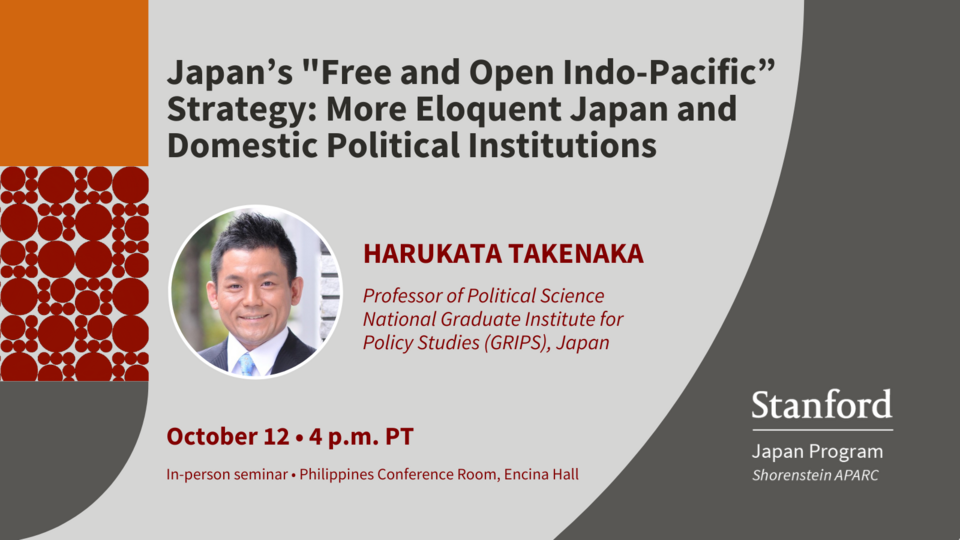
Visually banner card with the event title "Japan’s "Free and Open Indo-Pacific” Strategy: More Eloquent Japan and Domestic Political Institutions", and featuring a circle photo portrait of speaker Professor Harukata Takenaka

Since Prime Minister Shinzo Abe has advocated “Free and Open Indo-Pacific (FOIP)” Vision in 2016, various scholars have analyzed policy formulation process of FOIP. Most of them refer to the rise of China as an influential power in the Indo-Pacific region with its own initiative, namely, the Belt and Road Initiative as a major factor which prompted the Second Abe Administration to launch FOIP.

It is the contention of this presentation that the current configuration of the Japanese political institutions has made it possible for the Second Abe administration to launch and pursue such a comprehensive strategy while an international factor is important. It demonstrates that a series of political reforms since 1990s have strengthened the power of the prime minister as an institution to initiate key cabinet policies and coordinate policy formulation among different ministries. The strong institutional foundation of the Japanese prime ministerial power has made it possible for the Abe administration to effectively pursue such a broad vision, engaging various ministries and organizations.

The existing research on Japan's diplomacy often evaluates Japan as a passive state. It considers that in the past Japan only responded to foreign pressure while it did not proactively push forward its own policies. The presentation suggests that Japan has changed and become more eloquent as a result of changes in domestic political institutions.

Speaker

Image
Square photo portrait of Harukata Takenaka
Harukata Takenaka is a professor at the National Graduate Institute for Policy Studies (GRIPS) in Tokyo. He holds a PhD from Stanford University and a Bachelor of Laws from the University of Tokyo.

His key research areas are the role the prime minister in Japanese politics, changes in Japanese external policy, and democratization in Pre-war Japan.

Prof. Takenaka’s recent publications include: “Kyokoku Chugoku” to Taijisuru Indo-Taiheiyo Shokoku [Indo-Pacific Nations facing China aspiring to be a “Great Country”](edited) (Tokyo: Chikura Shobo, 2022), “Evolution of Japanese security policy and the House of Councilors,” Japanese Journal of Political Science, 22:2, (June 2021), 96-115, Korona Kiki no Seiji [Politics of Covid 19 Crisis](Tokyo: Chuo Koron Shinsha, 2020), “Expansion of the Japanese prime minister’s power in the Japanese parliamentary system: Transformation of Japanese politics and the institutional reforms,”Asian Survey,59:5:844-869 (September 2019); Futatsu no Seiken Kotai [Two Changes of Government] (edited) (Tokyo: Keiso Shobo, 2017); Failed Democratization in Prewar Japan (Stanford University Press 2014),

Harukata Takenaka Professor of Political Science National Graduate Institute for Policy Studies, Japan
Authors
Gi-Wook Shin
News Type
Commentary
Date
Paragraphs

This essay originally appeared in Korean on June 16 in Sindonga (New East Asia), Korea’s oldest monthly magazine (established 1931), as the third in a monthly column, "Shin’s Reflections on Korea." Translated by Raymond Ha. A PDF version of this essay is also available to download.


“I voted for Yoon Suk-Yeol because I just couldn’t vote for Lee Jae-Myung. Do you think Yoon will be a good president?”

“Well, it’s only been a month since he entered office. We should wait at least a year to see how he does.”

When I visited Korea this June, I had this exchange while speaking with friends. Like these friends, there are many Koreans who cast their ballots for Yoon to oust the Democratic Party of Korea (DPK) from power, even though they did not necessarily approve of Yoon. They achieved their goal, and the conservatives regained the presidency. However, these voters looked upon the Yoon administration with a mixture of hope and trepidation.

Their fears were realized only a month later, in late July. The ruling People Power Party (PPP) became paralyzed by an internal power struggle. A mere two months after entering office, Yoon’s approval ratings plummeted below 30%. Some polls even indicate that over half of voters would choose Lee Jae-Myung if the election were to be held again.

There is an uncanny resemblance to the early days of the Biden administration. The conversations I had with my Korean friends in June are reminiscent of those I had with friends in the United States soon after Biden entered the White House. They confessed that they voted for Biden because they could not support Trump, and they were both worried and hopeful about the new administration. Their concerns began to materialize during Biden’s first year in office. Despite a slight rebound in the past two months, Biden’s approval rating remains in the 40s. Those in Democratic circles openly voice their fears about losing both the House and the Senate in November’s midterms.

 
Biden and Yoon could not be more different in terms of ideological orientation or political experience. Nonetheless, they find themselves in a similar political predicament.
Gi-Wook Shin

Just as in Korea, there have been polls in the United States that show that more Americans would vote for Trump than Biden if the election were to be held today. The former president is poised to make another run for the White House in 2024, as the FBI continues its investigation into his potential mishandling of classified documents.

Biden and Yoon could not be more different in terms of ideological orientation or political experience. Nonetheless, they find themselves in a similar political predicament. How can we explain this state of affairs? Some would emphasize the effect of catastrophic events beyond any leader’s control, like the COVID-19 pandemic. Others stress the role of structural factors, including political polarization. Critics in Korea and the United States point to policy failures and shortcomings of political leadership, while both Biden and Yoon insist that their respective predecessors left behind daunting challenges. This essay examines each of these factors as it explores the path ahead for President Yoon Suk-Yeol, who recently marked his 100th day in office.

Is Yoon Korea’s Trump?

Before comparing Yoon with Biden, however, it is necessary to first address another frequently mentioned comparison—that of Yoon with Trump. In the months leading up to Korea’s presidential election this March, foreign journalists and observers often asked if Yoon could be understood as a Trump-like figure in Korean politics. To be sure, there is an overlap: a lack of political experience, strong anti-China rhetoric, and anti-feminist attitudes. Yoon’s unwillingness to foster diversity calls to mind Trump’s white supremacist rhetoric.[1] Both are perceived as “strongmen” who forcefully achieve their goals by any means, not skilled politicians who foster compromise through negotiation. Moreover, both are known for their blunt manner of speaking and their anti-pluralist rhetoric.[2]

However, the differences between the two are arguably more salient. Trump’s doctrine of “America First” rejected an international order built on multilateral cooperation. He showed no hesitation in openly pressuring longstanding allies like Japan and Korea. In contrast, Yoon has voiced support for the liberal international order and has emphasized the importance of the U.S.-Korea alliance. Furthermore, Trump has shown little regard for the rule of law. Instead of condemning those who attacked the Capitol on January 6, 2021, Trump still claims that the election was fraudulent. Yoon, who was trained as a lawyer, has consistently emphasized the rule of law.

Trump was rejected by the Republican establishment as a political maverick. Yoon, on the other hand, is the embodiment of Korea’s elite. He graduated from the Department of Law at Seoul National University, which is regarded as Korea’s most prestigious university. He then became a prosecutor and rose to the position of prosecutor general, overseeing one of Korea’s most powerful institutions. If anything, Yoon brings to mind a different Republican president: George W. Bush.

Yoon and George W. Bush: Striking Similarities

Bush and Yoon both grew up in upper-middle-class households and graduated from prestigious universities. Bush’s father served as president from 1988 to 1992, while Yoon’s father taught at Yonsei University as a professor of applied statistics.[3] Despite their affluent backgrounds, both faced troubles during their youth. Bush struggled with alcohol and was once arrested for a dui violation. He also suffered defeat in his first attempt to run for Congress in 1978. Yoon failed the state bar exam eight times and succeeded on his ninth attempt, only to be relegated to less important positions multiple times in his prosecutorial career for his uncompromising stance in politically sensitive investigations.[4] Bush and Yoon have both overcome difficulties, and they also cultivated down-to-earth, approachable personas as politicians.

The similarities do not end there. As president, Bush and Yoon both relied heavily on well-established figures in the conservative mainstream when making appointments to key positions. Bush chose Dick Cheney, who served as secretary of defense during his father’s administration, to be his running mate. Donald Rumsfeld, who led the Pentagon under President Ford, was once again appointed to the same position. Key figures from the Republican national security establishment, including Condoleezza Rice, played a significant role in shaping the Bush administration’s foreign policy.

The Bush administration followed the traditional Republican stance of emphasizing alliances in foreign policy. It pursued market-friendly policies at home and abroad, lowering taxes and entering into free trade agreements with Korea and other countries. Moreover, it pushed ahead with the invasion of Afghanistan and Iraq and labeled North Korea as part of the “axis of evil,” along with Iraq and Iran. In doing so, the Bush administration raised political tensions by pursuing a so-called ABC policy (“anything but Clinton”), seeking to overturn its predecessor’s legacy.

There are striking similarities in the composition and policy orientation of the Yoon administration. Consider its foreign policy team, for instance. Park Jin, a legislator with extensive foreign policy credentials, was appointed as foreign minister. Kwon Young-Se, a former National Assembly member who was the Park Geun-Hye administration’s first ambassador to Beijing, now leads the Ministry of Unification. Kim Sung-Han, a professor at Korea University who was a vice foreign minister during the conservative Lee Myung-Bak administration, is Yoon’s national security advisor. Kim Tae-Hyo, who played a key role in shaping Lee Myung-Bak’s national security policy and subsequently taught political science at Sungkyunkwan University, has returned to government as Yoon’s deputy national security advisor.

 
The Yoon administration is expected to stress the U.S.-Korea alliance and adopt a hardline stance against Pyongyang. Some expect Yoon to pursue a policy of “anything but Moon,” just as Bush proceeded with “anything but Clinton.”
Gi-Wook Shin

Some observers have noted that this team bears a resemblance to the neoconservatives of the Bush administration. The Yoon administration is expected to stress the U.S.-Korea alliance and adopt a hardline stance against Pyongyang. Some expect Yoon to pursue a policy of “anything but Moon,” just as Bush proceeded with “anything but Clinton.”

In assembling his economic team, Yoon has drawn from well-established career civil servants. His prime minister, Han Duck-Soo, entered the civil service in 1970 and later served as minister of finance and prime minister under President Roh Moo-Hyun. Choo Kyung-Ho, who serves as deputy prime minister and the minister of economy and finance, has nearly three decades of experience in economic and financial policy. The Yoon administration has rolled out a package of market-friendly economic policies focused on eliminating red tape, stimulating innovation, and lowering corporate taxes.

There is more than a passing similarity between the composition and policy objectives of the Yoon and George W. Bush administrations. That said, the political trajectory of Yoon’s presidency seems likely to follow that of Biden, not Bush. Unlike Biden, whose approval ratings have steadily declined after entering office, Bush’s ratings soared to 90% following 9/11 and stayed relatively high during the early days of the War on Terror. Bush was re-elected in 2004, but it remains to be seen whether Biden can do the same.

Yoon faces many of the same challenges as Biden: the COVID-19 pandemic, the war in Ukraine, high inflation, and a society riven by ever-worsening political and economic polarization. Both leaders also have to contend with a ruling party that is far from cohesive. Examining the path that the Biden administration has taken over the past 18 months can thus yield important lessons for the political future of the Yoon administration.

An Early Loss of Support

During Trump’s presidency in the United States and Moon Jae-In’s presidency in Korea, commentators often spoke about a crisis of democracy. The conversation has now shifted to focusing on a crisis of political leadership. Those in the United States and in Korea have sought to understand why Biden and Yoon, who each entered office after a hard-won electoral victory, faced difficulties early on in their terms.

As I noted in a previous essay, both presidents won narrow victories in bruising election campaigns marked by unprecedented levels of mudslinging.[5] In both countries, the ruling parties won important victories shortly after the presidential election. Raphael Warnock won a Senate seat in Georgia for the Democratic Party in January 2021, while the PPP swept Korea’s local elections in June 2022. However, those in the United States and Korea who hoped that the new president would overcome the crisis of democracy and return the country to normalcy have so far been disappointed.

Let us first look at the United States. According to a RealClearPolitics average of multiple polls conducted in July and August, nearly 70% of respondents believe that the country is going in the wrong direction. Only 23.2% stated that the country is headed in the right direction.[6] In its own analysis, FiveThirtyEight notes that Biden had the lowest approval rating (38.6%) of any president 18 months after entering office. (By comparison, Trump recorded 42.1% at the same point in his term.) Biden’s ratings have fallen even among African Americans and Latino Americans, who traditionally make up the Democratic Party’s base. Among youth, who overwhelmingly voted for Biden in 2020 (over 60%), the level of support has fallen by half.[7]

A similar trend is now evident in Korea. In terms of the speed and magnitude of the decline, Yoon has fared much worse than Biden. According to a poll of 1,000 respondents conducted by Gallup Korea from July 26 to 28, only 28% expressed support for Yoon’s job performance. In terms of age groups, those in their 30s and 40s showed the lowest level of support at 17%. Even among respondents in the city of Daegu and North Gyeongsang Province, which are conservative strongholds, negative responses exceeded positive responses by 7 percentage points.[8] If there was a difference between Biden and Yoon in this regard, it was in the main reason for the loss in support. Economic troubles created difficulties for Biden, whereas Yoon went against prevailing public opinion by appointing controversial individuals to key posts.

How might we understand the causes of Biden’s political troubles? In the July 20 New Statesman, Adam Tooze writes that “a combination of bad luck, ineptitude, internal divisions, the structures of U.S. politics and the ruthlessness of their enemies has put not only the future of the Biden administration but the republic itself in danger.”[9] One could reasonably classify the pandemic and high inflation as “bad luck.” Beyond this, Tooze largely points to two causes. Political polarization and “the ruthlessness of. . . enemies” are structural factors. On the other hand, “ineptitude” and “internal divisions” pertain to questions of political leadership. It is debatable whether Biden has already “failed,” as Tooze concludes. However, his frame of analysis provides a useful lens for diagnosing the current political situation in Korea.

Extreme Political Polarization

Structural factors have played an important role in the United States. Trump was skilled in using “divide and conquer” to his political advantage. Political polarization in the United States reached unprecedented levels during Trump’s term in office. The 2020 election came down to the wire, with Arizona, Wisconsin, and Pennsylvania playing a decisive role in the electoral college vote. Trump, along with certain segments of the Republican Party, still refuses to concede defeat.

In such a polarized environment, it is difficult for even the most skilled politician to obtain an approval rating exceeding 50%. Major initiatives that require a broad national consensus, such as FDR’s New Deal and Lyndon Johnson’s Great Society, have become virtually impossible. Biden initially pitched “Build Back Better” as a New Deal for the 21st century, but it encountered significant opposition in Congress. Conflicts over the so-called culture war issues, including abortion rights, have further intensified. Edward Luce, the U.S. national editor of the Financial Times, recently warned that “America is two nations barely on speaking terms.”[10]

Second, critics have raised doubts about the effectiveness of Biden’s political leadership at home. While Biden successfully led the Democratic Party to victory in its battle against Trump in 2020, voters did not necessarily see him as the most attractive candidate at the outset. Even though they did not secure the nomination, candidates such as Sanders and Warren, who openly advocated for progressive policies, drew a great deal of support during the primaries. Once Trump had been defeated, the intra-party alliance loosened. It became a daunting challenge to bring together different factions of the Democratic Party into a cohesive whole. I also raised this point in an interview with the Korean press, noting that Biden could face a lame duck period much sooner than expected. In perhaps the most well-known example, the Build Back Better initiative failed to pass Congress not only because of opposition from Republicans, but also because of pushback from Democratic senators Manchin and Sinema.

Although the recently passed Inflation Reduction Act takes meaningful steps related to climate change, many progressive Democrats were deeply unhappy with Biden for failing to keep his promise to act on the issue. Biden’s loss of support among young voters is partly due to economic difficulties, but it is also related to his reluctance to wholeheartedly adopt key elements of the progressive agenda. On the other side, centrist and conservative-leaning figures in the Democratic establishment, including Larry Summers, are criticizing Biden’s economic policies as being too far to the left. Moreover, Biden met with Mohammed bin Salman in July, despite his strong condemnation of the Saudi prince’s human rights record. This meeting was ostensibly for the purpose of persuading Saudi Arabia to increase its oil production. Biden received criticism from both sides of the aisle after failing to achieve this goal.

The United States is experiencing its worst inflation since the 1980s, with persistent concerns about an impending recession. Furthermore, the chaotic withdrawal from Afghanistan and the ongoing war in Ukraine have raised doubts about the effectiveness of U.S. leadership on the world stage. Biden’s response to Speaker Nancy Pelosi’s visit to Taiwan also raised doubts in some quarters. All of these events have led to growing dismay and disappointment among the American public. It is certainly too early to pronounce Biden as a failed president, as Tooze claims in the New Statesman. If anything, the Dobbs decision and the passage of the Inflation Reduction Act appear to have created momentum among core supporters of the Democratic Party ahead of this year’s midterms.

However, the Democratic Party still faces an uphill battle in its bid to retain the White House. The outcome of several ongoing criminal investigations involving the former president remains an open question, but Trump is all but certain to run again in 2024. If Biden fails, then Trump may well return—with profound consequences for America and the international community.

Tooze’s analysis of Biden’s first 18 months has significant implications for Korea. Both the United States and Korea are exposed to external shocks, including the pandemic and high inflation. The two countries also share structural problems, including political polarization and the lack of toleration and compromise among political actors.[11] Far from steering Korea’s democracy out of troubled waters, Yoon is in danger of losing political momentum altogether due to intra-party strife and incompetence.

Is There a Way Out for Yoon?

Just as Biden has to contend with Trump’s legacy, Yoon also has to deal with everything that Moon Jae-In has left behind. Missteps and complications in economic and foreign policy have surely created a challenge for Yoon, but one cannot keep blaming the Moon administration for ongoing difficulties. The people rendered their judgment when they voted the DPK out of power. Yoon will be judged on his own merits.

 
Biden can rely on a team of trusted aides and advisors. His party also controls both houses of Congress. Yoon, however, is still a newcomer to politics, and the opposition party commands a powerful majority in the National Assembly.
Gi-Wook Shin

In several respects, Yoon finds himself in a much more difficult situation than Biden. With decades of political experience, Biden can rely on a team of trusted aides and advisors with whom he has worked since at least the Obama administration. His party also controls both houses of Congress. Yoon, however, is still a newcomer to politics, and the opposition party commands a powerful majority in the National Assembly. The PPP and the DPK only recently agreed on the division of standing committee chairs, which is required to proceed with a session of the National Assembly.[12] This delay has cost the Yoon administration, which urgently needs support for its legislative priorities.

An approval rating in the 20s only two months into office is a serious warning sign. Every country in the world is being battered by external shocks, but smaller countries like Korea sway more violently when struck by the same wave. President Yoon has rightly said that policies should not waver with every fluctuation in public opinion, but a democratically elected leader must heed the people’s warning. Popular support is a sine qua non for any president.

To find a way out of the current crisis, Yoon must demonstrate leadership as a politician, not as a lawyer or a prosecutor. He must make it a priority to defuse internal strife within the PPP. Like Biden, Yoon was elected as the best candidate to achieve a transfer of power. He was seen, first and foremost, as a leader of disparate political forces who opposed Lee Jae-Myung. There are multiple factions within the PPP that seek to protect their own interests. Yoon’s supporters were united in their opposition to Lee, but it was unclear what they stood in favor of, with no clear goal to coalesce around once the election was over.

The ongoing struggle between Lee Jun-Seok, the suspended chairman of the PPP, and pro-Yoon politicians has taken no one by surprise. President Yoon could have fostered dialogue and compromise, but instead left this conflict to fester. His actions have sometimes exacerbated the situation. One journalist wrote that “Yoon is his own worst enemy.” Yoon must honestly reflect on his role in the ruling party’s crisis and show himself to be a responsible leader with integrity.

Yoon became a politician with a vow to restore fairness and common sense to politics. He also repeatedly emphasized the importance of freedom in his inaugural address. However, it still remains unclear to the Korean people what this means in practice. How does he intend to apply fairness and common sense to his administration’s policies? What concrete steps is he taking to restore and defend liberal democracy in Korea? Even if Yoon and his aides already have something in mind, the Korean people are still waiting for the answers to these questions.

In particular, polls repeatedly indicate that controversial personnel appointments are the main reason behind unfavorable views of Yoon. Put differently, the public believes that Yoon is violating his pledge to apply fairness and common sense when choosing individuals to appoint to key government positions. In the same vein, only criticizing the failures of the Moon administration is not enough to restore and renew Korea’s damaged democracy. The Korean people still await the Yoon administration’s vision for the country, one which would be based on fairness, common sense, and freedom.

How Yoon Can Rebuild Popular Support

Another way out of the current crisis would be to pursue policies that align with the political center. Due to political polarization, no president can hope for approval ratings in the 70s or 80s anymore. For simplicity, let us assume that roughly one-third of Korea’s electorate leans left, a third consists of moderates, and the remaining third is conservative. The most feasible strategy to regain popular support would be to attract around two-thirds of the moderates (22%) in addition to his conservative base (33%), which would yield an approval rating in the mid-50s.

Political polarization is a structural problem that cannot be resolved overnight. Nonetheless, certain steps can be taken to bolster support among moderates. The Yoon administration would do well to keep this in mind as it seeks to implement reforms in education, pensions, and labor policy. The experiences of past governments are instructive in this respect. Kim Dae-Jung entered office in 1998 with a legislative minority, but he joined forces with Kim Jong-Pil’s United Liberal Democrats to build political momentum.[13] Lee Myung-Bak faced a domestic political crisis early on in office, but he was able to regain support by enacting centrist policies that addressed the needs of ordinary citizens.

 
Faulty policies must, of course, be corrected. However, it is excessive and unnecessary to punish those who made a good faith effort to formulate reasonable policies based on the information that was available at the time.
Gi-Wook Shin

Yoon must resist the temptation to pursue “anything but Moon.” The Moon administration openly vowed to “eradicate deep-rooted evils,” rejecting and punishing the policies of its predecessor. Faulty policies must, of course, be corrected. Those who were involved in corrupt or illegal activities should be held to account. However, it is excessive and unnecessary to punish those who made a good faith effort to formulate reasonable policies based on the information that was available at the time. Doing so would make civil servants even more reluctant to do their jobs.

The Moon administration created a task force within every key government agency to pursue its “eradication” agenda. While using the judicial apparatus, it was a politically motivated act to punish those who were involved in the previous conservative administrations’ policy decisions. Yoon must avoid repeating this mistake. He would know better than anyone the pitfalls of going down such a path. Although Yoon was initially part of this effort as a prosecutor, he later became the target of such a political campaign during his time as prosecutor general.

Having a strong base of popular support is critical in conducting foreign policy, an area in which Korea will face formidable challenges. Yoon’s attendance at the NATO summit in Madrid in June demonstrated his resolve to strengthen the U.S.-Korea alliance and uphold the liberal international order. The overarching orientation of Yoon’s foreign policy is commendable. However, managing relations with China will be a demanding task. Yoon’s foreign policy team will soon be put to the test. Pyongyang could engage in a major provocation. Beijing will continue to pressure Seoul to uphold the “three noes” with respect to the THAAD missile defense system.[14] A military clash between China and the United States in the Taiwan Strait is by no means an unlikely possibility. Popular support is critical in responding to any foreign policy crisis. A leader who is weak at home is also constrained abroad.

Finally, Yoon must refrain from turning to the rule of law as the solution to every problem. Respect for laws and principles is a necessary condition for democracy, but it is not a sufficient condition. We have seen all too clearly how the Moon administration weakened Korea’s democracy under the guise of rule of law. Without respect for democratic norms and values and the resolve to defend them, liberal democracy cannot be sustained. To defend freedom, which President Yoon emphasized during his inaugural address, it is vital to show toleration for the other side and forbearance in the exercise of power. He must engage in a sustained dialogue to persuade the people, including the opposition.

In late July, Park Soon-Ae, the education minister, faced intense public opposition after abruptly announcing that the age of entry into elementary school would be lowered from six years to five. She resigned only ten days later. Before pursuing major policy reforms, sufficient time must first be taken to gather a wide range of views through public debate and dialogue. The Yoon administration not only faces a large opposition party, but also must contend with progressive elements of Korea’s civil society. The administration must skillfully conduct negotiations, reconcile opposing views, and foster compromise. The ability to exercise political leadership will be crucial.

In doing so, the administration must acknowledge differences while pursuing shared goals and interests. It is only natural for there to be opposing views in a pluralistic, democratic society. The government must listen to a variety of voices and appoint a diverse group of individuals to key positions. As I noted in a previous essay, ensuring diversity is critical to innovation and organizational effectiveness.[15] Relying heavily on former prosecutors and career civil servants, as the Yoon administration has done, makes it much more difficult for diverse voices and experiences from the full breadth of Korean society to inform policymaking on important issues.

A Global Crisis of Leadership: The Path Ahead for Yoon

We are now experiencing a global crisis of leadership, perhaps as serious as the global crisis of democracy. Trump and Moon are no longer in office, but their respective successors are struggling to unite and lead their countries. In the United Kingdom, the Conservative Party experienced a prolonged leadership vacuum before choosing Liz Truss as the new prime minister. Merkel’s absence is keenly felt in Germany. Macron was re-elected after a difficult election campaign in France, but the ruling party’s approval rating is stalled in the mid-30s. Firm leadership and cohesion among democratic powers—including the United States, the United Kingdom, France, Germany, and Japan—are critical in defending the liberal international order from challenges by authoritarian powers like China or Russia. The current state of affairs is far from encouraging.

Korea is no exception. Its own crisis of leadership is unfolding much more rapidly than those in other major democracies, with serious repercussions. There are structural problems, both domestic and external, that President Yoon cannot immediately resolve. However, it is critical for him to deeply reflect on his effectiveness as a leader so far. If he honestly confronts and learns from his shortcomings and mistakes, the present political crisis could become a turning point. Amidst a global crisis of leadership, Yoon could elevate Korea as a staunch defender of democracy. The choice is his to make.


[1] See, for example, the discussion about the composition of Yoon’s Cabinet in Gi-Wook Shin, “Beyond Representation: How Diversity Can Unleash Korea’s Innovation,” Shorenstein APARC, June 30, 2022. https://aparc.fsi.stanford.edu/news/beyond-representation-how-diversity-can-unleash-korea%E2%80%99s-innovation.
 

[2] This section and the following section expand on a previous discussion of this comparison in Gi-Wook Shin and Kelsi Caywood, “Which Yoon Should Biden Expect at the Upcoming South Korea-US Summit?,” The Diplomat, May 17, 2022. https://thediplomat.com/2022/05/which-yoon-should-biden-expect-at-the-upcoming-south-korea-us-summit/.
 

[3] Together with Seoul National University and Korea University, Yonsei University is widely regarded as one of the most prestigious universities in Korea.
 

[4] The state bar exam was abolished in 2017, as Korea transitioned to a U.S.-style system of law schools. Before 2017, individuals underwent training at the Judicial Research & Training Institute (JRTI) upon passing the bar exam. Only those with the highest grades during this training process could become judges or prosecutors. Although Korean culture stresses seniority by age, the Prosecutors’ Office has an organizational culture that emphasizes the year in which a prosecutor entered the JRTI. Having failed the bar exam eight times, Yoon essentially fell eight years behind his peers and entered the JRTI with individuals who were much younger than him. He also worked under prosecutors who were younger than him. His subsequent demotions set him back even further, until the Moon Jae-In administration appointed him as the head of the Seoul Central District Prosecutors’ Office in 2017 and then as prosecutor general in 2019. The latter appointment was highly unusual, as it skipped five classes at once. Yoon belonged to the JRTI’s 23rd class, while his predecessor as prosecutor general belonged to the 18th class.
 

[5] Gi-Wook Shin, “In Troubled Waters: South Korea’s Democracy in Crisis,” Shorenstein APARC, May 3, 2022. https://aparc.fsi.stanford.edu/news/troubled-waters-south-korea%E2%80%99s-democracy-crisis.
 

[6] “Direction of Country,” RealClearPolitics, accessed September 2, 2022. https://www.realclearpolitics.com/epolls/other/direction_of_country-902.html.
 

[7] Geoffrey Skelley, “What’s Behind Biden’s Record-Low Approval Rating?,” FiveThirtyEight, July 14, 2022. https://fivethirtyeight.com/features/whats-behind-bidens-record-low-approval-rating/.
 

[8] “Daily Opinion no. 505 (4th Week of July 2022)” [in Korean], Gallup Korea, July 28, 2022. https://www.gallup.co.kr/gallupdb/reportContent.asp?seqNo=1314.
 

[9] Adam Tooze, “Why Joe Biden failed,” New Statesman, July 20, 2022, https://www.newstatesman.com/world/americas/north-america/2022/07/adam-tooze-why-joe-biden-failed.
 

[10] Edward Luce, “America is Two Nations Barely on Speaking Terms,” Financial Times, June 8, 2022. https://www.ft.com/content/aa1fe12c-d5a2-4a1a-b6df-70b38894c4fd.
 

[11] See Shin, “In Troubled Waters.”
 

[12] In Korea’s National Assembly, the ruling party and the main opposition party typically divide the appointment of standing committee chairs. For instance, under the agreement between the PPP and the DPK in late July, the ppp appointed the chair of seven standing committees, while the DPK appointed 11.
 

[13] Born in 1926, Kim Jong-Pil graduated from the Korea Military Academy and played a key role in Park Chung-Hee’s coup in May 1961. Kim established the Democratic Republican Party, which was Park’s political base of power during his time as president, and also served as the founding leader of the Korea Central Intelligence Agency. After Korea transitioned to democracy, Kim joined forces with Kim Dae-Jung in 1998 and served as prime minister. This coalition is sometimes referred to as the “DJP alliance,” based on the initials of the two leaders (DJ/Dae-Jung and JP/Jong-Pil). Kim Jong-Pil died in 2018.
 

[14] This refers to China’s three demands: to refrain from deploying additional THAAD batteries, to not participate in the U.S. missile defense system, and to not participate in a trilateral military alliance with Japan and the United States.
 

[15] Gi-Wook Shin, “Beyond Representation: How Diversity Can Unleash Korea’s Innovation,” Shorenstein APARC, June 30, 2022. https://aparc.fsi.stanford.edu/news/beyond-representation-how-diversity-can-unleash-korea%E2%80%99s-innovation.

Download a PDF version of this essay

Read More

South Korean President Yoon Suk-yeol speaks on the government supplementary budget at the National Assembly on May 16, 2022 in Seoul.
Commentary

Beyond Representation: How Diversity Can Unleash Korea’s Innovation

A social and corporate culture that values and enforces conformity surely cannot be a wellspring of creativity and innovation. Korean society must find a new source of vitality. Enhancing diversity to stimulate innovation and change could be the answer.
Beyond Representation: How Diversity Can Unleash Korea’s Innovation
Members of K-pop band BTS speak at a press briefing at the White House.
Commentary

Will Hallyu Swell to a Tidal Wave? Korea's Future as a Cultural Superpower

The Korean Wave, which has unique characteristics and continues to evolve in intriguing directions, could become a first mover on the global cultural scene.
Will Hallyu Swell to a Tidal Wave? Korea's Future as a Cultural Superpower
Stanford campus archway and text about call for applications for APARC 2023-24 fellowships
News

APARC Invites Fall 2023 Asia Studies Fellowship Applications

The Center offers a suite of fellowships for Asia researchers to begin fall quarter 2023. These include postdoctoral fellowships on contemporary Japan and the Asia-Pacific region, inaugural postdoctoral fellowships and visiting scholar positions with the newly launched Stanford Next Asia Policy Lab, and fellowships for experts on Southeast Asia.
APARC Invites Fall 2023 Asia Studies Fellowship Applications
Hero Image
 South Korean President Yoon Suk Yeol waves a national flag during the celebration of the 77th National Liberation Day at Presidential House on August 15, 2022 in Seoul, South Korea.
South Korean President Yoon Suk-Yeol waves a national flag during the celebration of the 77th National Liberation Day at Presidential House on August 15, 2022 in Seoul.
Ahn Young-Joon - Pool/ Getty Images
All News button
1
Subtitle

How Korea’s New President Can Recover from His First 100 Days of Struggles.

Shorenstein APARC
Stanford University
Encina Hall, E301
Stanford,  CA  94305-6055

0
Visiting Scholar at APARC, 2022-23
Ankhbayar_Begz.jpg

Dr. Ankhbayar Begz joined the Walter H. Shorenstein Asia-Pacific Research Center (APARC) as visiting scholar for the fall and winter quarter of the 2022-2023 academic year. Dr. Begz currently serves as researcher at Mongolian University of Science and Technology's Open Education Center. While at APARC, he conducted research regarding democracy, women’s political participation, higher education, and gender equality issues in Mongolia and Asia.

Paragraphs
Portrait of Xueguang Zhou and a 3D mockup cover of his book, 'The Logic of Governance in China'

Drawing on more than a decade of fieldwork, The Logic of Governance in China develops a unified theoretical framework to explain how China's centralized political system maintains governance and how this process produces recognizable policy cycles that are obstacles to bureaucratic rationalization, professionalism, and rule of law. Read our news story and watch our book conversation with Zhou here:

The book is unique for the overarching framework it develops; one that sheds light on the interconnectedness among apparently disparate phenomena such as the mobilizational state, bureaucratic muddling through, collusive behaviors, variable coupling between policymaking and implementation, inverted soft budget constraints, and collective action based on unorganized interests. An exemplary combination of theory-motivated fieldwork and empirically-informed theory development, this book offers an in-depth analysis of the institutions and mechanisms in the governance of China.

All Publications button
1
Publication Type
Books
Publication Date
Subtitle

An Organizational Approach

Authors
Xueguang Zhou
Book Publisher
Cambridge University Press
Authors
Donald K. Emmerson
News Type
Commentary
Date
Paragraphs

An edited version of this opinion piece first appeared in the 14 July 2022 issue of The Jakarta Post.


How preoccupied is America with its own domestic problems? To the point of impairing the ability of President Biden’s administration to give Indonesia and Southeast Asia the foreign-policy attention they deserve?

The Group of Twenty’s meetings are now at or near the top of the Indonesian foreign ministry’s list of things to do. Foreign minister Retno Marsudi has worried, amid talk of boycotts, that Moscow-Washington animosity over Ukraine could ruin the G20 summit in Bali this November, to the embarrassment of its Indonesian host and chair. Presumably to her relief, Secretary of State Antony Blinken flew to Indonesia to attend in person the preparatory G20 foreign ministers meeting that she hosted and chaired in Bali on 7-8 July 2022, and he did so despite the participation of his Russian counterpart Sergey Lavrov.  In addition to holding a one-on-one session with Marsudi, Blinken also met with Chinese foreign minister Wang Yi for a discussion of US-China relations that reportedly lasted five hours. Indonesia can take pride in having made that lengthy interaction possible. 

The foreign ministers’ meeting was not without drama. Twice, in response to criticism of Russia, Lavrov walked out of the room, and he left the conference altogether before it ended. Perhaps he forgot that in democracies, praise is not required.  But things in Bali could have gotten much worse, and in that sense America’s presence throughout the event helped save Indonesia’s face.

Biden’s administration has not neglected Indonesia or Southeast Asia, as recent diplomacy shows. In May he accommodated the priority on economic development favored by Indonesia and other Asian states by traveling to Japan to announce the formation of an Indo-Pacific Economic Framework (IPEF). Its 14 founding partners, including Indonesia and six other ASEAN members, account for 40 percent of global GDP. Earlier in May, in Washington, DC, Biden hosted a special summit with Indonesia and other ASEAN states. Their Joint Vision Statement with the US, as in IPEF, emphasized economic cooperation.

None of this diplomacy, however, could temper the strident political polarization that continues to disrupt America. Understandably, that frenzy of distrust and dissension has led some Indonesians to wonder how reliable a partner the US will turn out to be in years to come.    

The splitting of many Americans into rival partisan camps is in part structural. For example, compared with better-educated urban and suburban dwellers, less well-educated rural and small-town Americans are more likely to hold right-wing Republican views. The reasons why those views have become more extreme include the popularity of Donald Trump and his anti-democratic if not proto-fascistic campaign to re-install himself in the White House after losing the free and fair election of 2020.  His effort, Republican complicity in it, and the backlash against it have widened the separation of often coastal or near-coastal Democratic states from Republican ones more or less clustered in middle and southern America. Political scientist and statistician Simon Jackman goes so far as to argue that the US has not been this divided politically since the Great Depression of the 1930s—or possibly even since the 1860s Civil War.

The Vanderbilt University Project on Unity and American Democracy chooses the longer timeline. “Not since the Civil War,” it concludes, “have so many Americans held such radically opposed views not just of politics but of reality itself.” The project’s own findings, however, undermine the caricature of a country fatally hobbled by national schizophrenia and group delusions. 

The Vanderbilt Unity Index combines quarterly data from 1981 to 2021 on five variables—presidential disapproval, congressional polarization, ideological extremism, social mistrust, and civil unrest—to calculate changes in American national unity across those four decades on a 0-to-100 scale, from least to most unified. Over that period of time, the index has fluctuated in a close to middling zone between 50 and 70 on that 100-point scale. 

The index shows deep plunges in unity only twice since 1981, and both of those dives were linked to the uniquely calamitous presidency of President Trump. In contrast, the average score during the first five quarters of the Biden administration has been 58, a sharp improvement from the average of 51 under Trump. Heartened by that betterment, two of the Vanderbilt scholars surmise that America’s “disharmony may be dissipating.”

That could be an overoptimistic guess. Unity is one thing, victory another. Legislative elections will be held on 8 November this year. As of the end of June, prominent forecaster Nate Silver gave the still largely Trump-beholden Republican Party an 87 percent chance — a near-certainty — of replacing Biden’s Democrats as the majority party in the House of Representatives. The race for a majority in the Senate was too close to call. But even if Republicans control only the House, they will likely use that platform to undermine Biden’s administration during his final two years in office.      

As if likely losses of legislative power were not enough for Biden to worry about, maneuvers by Republicans to stack the Supreme Court with right-wing partisans have tilted that juridical balance steeply in their favor. The court’s new reactionary 6-to-3 majority has already made two shocking decisions. They have, in effect, denied women their long-standing right to abortion and made it easier to carry a concealed gun in public. Republicans claim to support individual rights. But they and their court appointees have deleted the long-standing constitutional right of a pregnant woman to decide whether to give birth or not, thereby depriving her of assured responsibility over her physical body and personal future. 

Regarding gun violence, in barely five months from 1 January through 5 June of this year, America has experienced 246 mass shootings — incidents that kill or wound four or more people. That puts the US on track in 2022 to match or exceed its record of 692 mass shootings in 2021, more than in any year since the Gun Violence Archive began counting them. The Republican-majority court’s unconscionable impulses seem to be to make women make more babies, wanted or not, and to make murders more likely as well.

There is good news. First, a massive popular backlash against these Republican decisions has either begun or is likely. Second, a nationally televised Congressional investigation of the violent attack on the US Capitol on 6 January 2021 has displayed the complicity of Trump, and by association the Trump-infected Republican Party, in an insurrection that killed at least seven people and injured roughly 150 more. Third, although Trump may not end up where he belongs, namely, in jail, at least he faces Republican rivals for the party’s nomination to run for president in 2024. Conceivably those rivals could come to include a candidate who is politically more moderate and personally less criminal, corrupt, and narcissistic than he. 

President Joko Widodo will host the G20 leaders in Indonesia merely one week after the 8 November 2022 midterm legislative election takes place in the US. Will Biden go again to Bali? Not if at that time right-wing fanatics claiming election fraud are destabilizing America. For long-term interactions between Jakarta and Washington relations, however, what will matter is not who will attend the 2022 G20 summit in Bali. It will be the names and plans of the Indonesians and Americans who will run and win in the national elections to be held in their respective countries in 2024.


Donald K. Emmerson heads the Southeast Asia Program at Stanford University's Shorenstein Asia-Pacific Research Center. His recent publications include an edited volume, The Deer and the Dragon: Southeast Asia and China in the 21st Century.

Read More

Flanked by Sultan of Brunei Haji Hassanal Bolkiah (L) and President of Indonesia Joko Widodo (R), U.S. President Joe Biden points towards the camera.
Commentary

In Southeast Asia, the United States Needs to Up its Economic Game

The harsh reality is that, even with still-strong security partnerships, it is hard to imagine the US being able to sustain its overall influence in the region if it continues to lose ground economically.
In Southeast Asia, the United States Needs to Up its Economic Game
Anti-coup protesters hold improvised weapons during a protest in Yangon on April 3, 2021.
News

Shining a Light on Myanmar’s Multidimensional Crises

As the devastating effects of the coup in Myanmar and post-coup conflicts have resulted in escalating humanitarian emergencies, APARC’s Southeast Asia Program and Asia Health Policy Program examine the shifting contours of war and the prospects for a better future for Myanmar’s people.
Shining a Light on Myanmar’s Multidimensional Crises
Enze Han with background of Encina hall colonade
News

Rethinking China’s Influence in Southeast Asia: The Role of Non-State Actors and Unintended Consequences

Departing from international relations scholarship and popular media accounts that tend to portray China as a great power intent on establishing a sphere of influence in Southeast Asia, Lee Kong Chian NUS-Stanford Fellow on Southeast Asia Enze Han argues for conceptualizing China as an unconventional great power whose diverse actors, particularly non-state ones, impact its influence in the region.
Rethinking China’s Influence in Southeast Asia: The Role of Non-State Actors and Unintended Consequences
Hero Image
Abortion rights activists protest
Abortion rights activists protest in the street near the U.S. Supreme Court on the last day of their term on June 30, 2022, in Washington, DC.
Kevin Dietsch/Getty Images
All News button
1
Subtitle

For long-term Jakarta and Washington relations, what will matter is not who will attend the 2022 G20 summit in Bali. It will be the names and plans of the Indonesians and Americans who will run and win in the national elections to be held in their respective countries in 2024.

Subscribe to Institutions and Organizations