Security

FSI scholars produce research aimed at creating a safer world and examing the consequences of security policies on institutions and society. They look at longstanding issues including nuclear nonproliferation and the conflicts between countries like North and South Korea. But their research also examines new and emerging areas that transcend traditional borders – the drug war in Mexico and expanding terrorism networks. FSI researchers look at the changing methods of warfare with a focus on biosecurity and nuclear risk. They tackle cybersecurity with an eye toward privacy concerns and explore the implications of new actors like hackers.

Along with the changing face of conflict, terrorism and crime, FSI researchers study food security. They tackle the global problems of hunger, poverty and environmental degradation by generating knowledge and policy-relevant solutions. 

News Type
Q&As
Date
Paragraphs

We sat down with our 2018-19 Koret Fellow in Korean Studies Andray Abrahamian to discuss North Korea denuclearization and the approaching Trump-Kim second summit in Hanoi; Abrahamian's work with the nonprofit organization Choson Exchange that took him to North Korea nearly thirty times; his book that compares North Korea and Myanmar; and his fellowship experience. Watch: 


Hero Image
Andray Abrahamian sitting down for an interview at Stanford.
All News button
1
Authors
Gi-Wook Shin
News Type
Commentary
Date
Paragraphs

This post was originally published on Axios.

While President Trump and North Korean leader Kim Jong-un’s June 2018 meeting ended with a broad statement — committing to “establish new U.S.-DPRK relations” for “a lasting and stable peace regime on the Korean Peninsula” — they will aim to take more concrete steps forward at their second summit in Hanoi this week.

Between the lines: To keep up the diplomatic momentum, Trump and Kim will need to minimize existing ambiguities and divergences on key issues — including the definition of denuclearization — and produce a comprehensive road map that lays out the specifics of their proclaimed shared vision. Without these agreements, the Hanoi summit could be easily denigrated as “just another show.”

Where it stands: Trump and Kim each face immense pressure, both international and domestic, to make progress.

  • Trump needs to earn political trust back in Washington to continue negotiating with North Korea. His strategy so far has been to convince Kim that North Korea’s denuclearization would bring the country a “bright future.”
  • At the same time, Trump must address Kim’s concerns about whether any agreement reached with his administration will withstand the Democrat-controlled House and survive the post-Trump era.

Between the lines: Successful diplomacy sometimes entails purposeful ambiguities, and the ambiguities of the first Trump-Kim summit might indeed have been strategic. At this critical juncture, however, a failure on Trump’s and Kim’s part to commit to defined objectives could hurt the bilateral relationship.

The bottom line: Trump and Kim need support more than ever to advance their diplomatic endeavors. While spectators have good reason to be skeptical, and one can only be cautiously hopeful with North Korea, a return to confrontation or "strategic patience" is in no one’s interest.

Gi-Wook Shin is the William J. Perry Professor of Contemporary Korea and director of the Walter H. Shorenstein Asia-Pacific Research Center at Stanford University.

Hero Image
Banner welcoming Kim and Trump to Vietnam
A banner hung opposite the Marriott Hotel in Hanoi, Vietnam, where President Trump is expected to stay during his summit with Kim Jong-un, on Feb. 25.
Carl Court via Getty Images
All News button
1
-

Image
vincent brooks 2x3
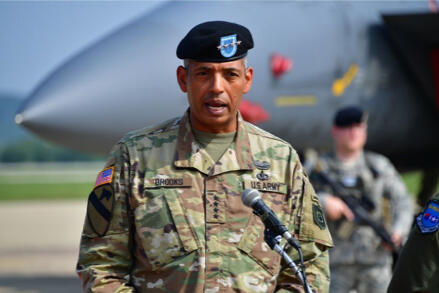
About the speaker: Vincent K. Brooks is a career Army officer who recently retired from active duty as the four-star general in command of all U.S. Forces in Korea, where he concurrently commanded United Nations Command – continuously serving since 1950 and initially commanded by General of the Army Douglas MacArthur; and the Republic of Korea-U.S. Combined  Forces Command comprising over 625,000 Koreans and Americans under arms.

General Brooks, who goes by “Vince,” is a 1980 graduate of the United States Military Academy at West Point, the first class to include women, and he led the 4,000 cadets as the cadet brigade commander or “First Captain.”  He is the first African American to have been chosen for this position, and he was also the first cadet to lead the student body when women were in all four classes (freshman or “plebe” to senior or “first classman”).

General Brooks is from a career military family and claims Alexandria, Virginia as home given the long roots in maternal and paternal branches of the family tree. His areas of expertise are national security, policy, strategy, international relations, military operations, combating terrorism and countering the proliferation of weapons of mass destruction, diversity and inclusion, leadership in complex organizations, crisis leadership, and building cohesive trust-based teams. He is a combat veteran and a member of the Council on Foreign Relations.

Image
karl eikenberry 3x2 crop
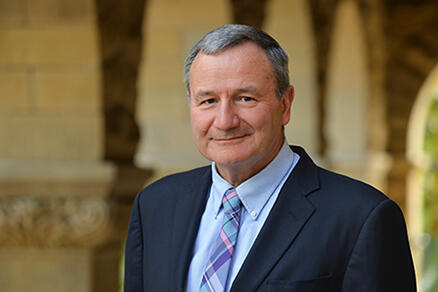
Ambassador Karl Eikenberry, currently director of U.S.-Asia Security Initiative at Stanford's Shorenstein Asia-Pacific Research Center, will moderate the discussion. He served as the U.S. Ambassador to Afghanistan from 2009 until 2011. Before appointment as Chief of Mission on Kabul, Ambassador Eikenberry had a thirty-five year career in the United States Army, retiring in April 2009 with the rank of Lieutenant General.
 

This keynote event is part of the 11th annual Koret Workshop, "North Korea and the World in Flux," and open to the general public with registration.

The event is made possible through the generous support of the Koret Foundation


Oksenberg Conference Room
Encina Hall, 3rd floor
616 Serra Mall, Stanford University
 

General Vincent Brooks <i>former Commander of U.S. Forces Korea</i>
Moderated by Ambassador Karl Eikenberry
Seminars
News Type
Commentary
Date
Paragraphs

What does it take to make progress on the denuclearization of the Korean Peninsula? Five FSI scholars offer their perspective.

Siegfried S. Hecker, FSI Senior Fellow Emeritus, with Elliot A. Serbin, at the Center for International Security and Cooperation (CISAC)
Looking back at 2018, we judge the first Trump-Kim summit in Singapore to have been a step in the right direction and bought time and space for diplomacy. But since the first summit, little progress has been made toward new relations and a peace regime in part because the Trump administration continues to insist on maximum pressure and sanctions until North Korea denuclearizes, in contrast with Pyongyang’s insistence on a step-by-step process requiring corresponding U.S. actions. At the same time, North Korea has not denuclearized, but it has halted key elements of what was a rapidly expanding nuclear and missile program in 2017. This halt represents an important step in the right direction as explained in our recent update on North Korea’s nuclear history, which examines the trade-offs and interplay between key components of the nuclear program. Our findings show that North Korea has been expanding its bomb fuel inventory, allowing it to potentially increase the size of its arsenal. But the end of nuclear and missile testing has reduced the overall threat posed by the North’s arsenal, significantly limiting the potential sophistication, destructive power and reach of the arsenal by impairing the North’s ambitions for hydrogen bombs and nuclear-tipped intercontinental ballistic missiles, both of which are still very much in the developmental stage. At the upcoming summit Washington should push to further reduce the threat posed by North Korea’s arsenal. A key goal is to lock in the end of nuclear and missile testing and have North Korea agree to end the production of bomb fuel in a verifiable manner. Clearly, this will require Washington to move decisively toward normalization, with some form of sanction relief.

Gi-Wook Shin, FSI Senior Fellow, Director of the Walter H. Shorenstein Asia-Pacific Research Center (APARC) and founding Director of the Korea Program
The leaders of the United States and North Korea should use the Vietnam summit as an opportunity to minimize existing ambiguities and divergences in central questions, before they can make any meaningful progress toward denuclearization and whatever measures for the progress of denuclearization. The most basic yet urgent task is to come to a shared understanding of what denuclearization would entail. The ambiguity and obscurity of the term “denuclearization” only exacerbates the skepticism about both the U.S. and North Korean commitments to denuclearization. The future of the U.S.-Republic of Korea (ROK) alliance is another critical issue that needs to be addressed, not avoided, in Hanoi. The Vietnam meeting should leave no ambiguity in its affirmation that the U.S.-ROK alliance is not to be jeopardized in the context of U.S.-DPRK (Democratic People’s Republic of Korea) rapprochement; nor is it to be used as a reward for North Korea’s denuclearization. Lastly, the Trump administration’s vision for a “more stable and peaceful, and ultimately, a more legal peace regime” in Korea will need to be explained fully to, and understood clearly by, the North Korean leadership. Whether the means used to establish this regime will be a peace treaty, a formal end to the armistice, a combination of both, or something yet unknown is an issue that needs to be discussed and agreed upon up front in order to avoid further confusions and complications. Only bold and meaningful moves that resolve these ambiguities will enable a timely, historic breakthrough on the Korean Peninsula and will add much-needed momentum to the diplomatic endeavors of all countries involved.

Yong Suk Lee, SK Center Fellow and Deputy Director of the Korea Program at Shorenstein APARC
To hypothesize about the outcomes of the second Trump-Kim summit and what lies ahead for U.S.-North Korea relations, we should reflect on how the two leaders met in the first place. One could argue that their first meeting was somewhat accidental, an artifact of Trump’s spontaneity following a period of heightened hostility between the U.S. and North Korea. The first summit between the two leaders was historic in its own right and it put on a good show. However, there hasn’t been much progress on denuclearization since then. Despite little progress the two are meeting again, and this second meeting is no accident. After their first meeting Trump and Kim must have struck a chord. In fact, Trump mentioned that the two had “fallen in love” after receiving a “beautiful” letter from Kim last October. What triggers their mutual attraction? Certainly not their distaste for nuclear weapons. The common interest that brings the two together is their desire for development – economic development in the case of Kim Jong Un and property development in the case of Donald Trump. Of the many unconventional aspects in the Trump-Kim relationship, what I find most extraordinary is Trump’s showing of a short film on North Korea’s potential for property development during their first summit meeting. It was truly an unusual diplomatic pitch. I believe that economic and property development will be on their agenda when they meet in Hanoi. There may even be a sequel to that short film. Trump and Kim may emerge with a joint property development agenda, while deferring denuclearization to be sorted out by their diplomatic teams.

Colin Kahl, FSI Senior Fellow and Co-director at CISAC
Diplomacy is essential for resolving the nuclear crisis on the Korean Peninsula, and President Trump should get credit for keeping the high-level dialogue with Kim Jong Un going. However, last year’s Singapore summit, while producing great theater, produced little of substance. North Korea has frozen its missile and nuclear testing, but its program continues to grow. In the eight months since the two leaders met in Singapore, little tangible progress has been made, and the two sides still appear very far apart on basic concepts like the meaning of “denuclearization” and the proper sequencing among nuclear steps, moves toward normalization, the signing of a peace treaty and sanctions relief. The big worry going into the summit is that it will produce either “too little” or “too much.” One fear is that President Trump will accept “too little” – that is, more diplomatic symbolism to continue the appearance of progress while North Korea takes few concrete steps to roll back its nuclear program. Another risk is that President Trump will give “too much” in exchange for North Korean actions, in particular by taking steps that weaken the alliance with South Korea or drastically downsize the U.S. military presence on the Peninsula (which Trump has never liked).

Thomas Fingar, Shorenstein APARC Fellow
The issues dividing the United States and the DPRK are so complicated and our mutual animosity so deep that resolution will take time and require extensive negotiations to build trust and deepen understanding of one another’s concerns and objectives. The most that should be expected from the Hanoi summit is agreement – and commitment – to continue the process of engagement by instructing and empowering subordinates to meet regularly, listen carefully and seek ways to both build a better relationship and to resolve specific issues in the context of transforming the relationship from one of distrust and animosity to one that identifies mutual interests and manages issues that cannot be resolved immediately.

Related: Andrew Kim on North Korea Denuclearization and U.S.-DPRK Diplomacy
Former head of the CIA’s Korea Mission Center Andrew Kim, currently the William J. Perry Visiting Scholar at APARC, provides insights into the process of diplomatic engagement with the DPRK and outlines a roadmap for achieving the U.S. goal of North Korea denuclearization.

This post is based on the Stanford News article What’s next for North Korea? Stanford scholars discuss the diplomacy of denuclearization, published February 25, 2019.

Hero Image
T-shirts with Trump and Kim for sale in Vietnam Linh Pham/Getty Images
All News button
1
-

We are sorry that the registration is now closed. It has reached the limit of the room capacity.

Brent Christensen is the Director of the American Institute in Taiwan’s Taipei office. Mr. Christensen has been in the United States Foreign Service for more than 29 years and has extensive experience in senior positions related to Taiwan and China.  Mr. Christensen previously served as Deputy Director of the American Institute in Taiwan’s Taipei office.  Prior to that, he was Director of the State Department’s Office of Taiwan Coordination, where he had a primary role in formulating U.S. policy toward Taiwan.  He has served three assignments at the U.S. Embassy in Beijing, the most recent being Environment, Science, Technology and Health Counselor.

Mr. Christensen has also served as a Senior Level Career Development Advisor in the State Department’s Human Resources Bureau.  Prior to that assignment, he served as the Foreign Policy Advisor at the Asia-Pacific Center for Security Studies (APCSS).  Other overseas postings include Hong Kong and South Africa.  Mr. Christensen also served as a Congressional Fellow on the staff of Senator Olympia Snowe.  Prior to joining the Foreign Service, he was a captain in the U.S. Air Force.

Mr. Christensen is a career member of the Senior Foreign Service and holds the personal rank of Minister-Counselor.  Mr. Christensen earned an M.A. in East Asian Studies from the George Washington University, a B.A. in Chinese language and literature from Brigham Young University, and a Doctor of Medical Dentistry degree from the Oregon Health and Sciences University.  Mr. Christensen is married to Brenda Barrus Christensen and has three children.  He is a native of Provo, Utah.

Oksenberg Conference Room Encina Hall, 3rd Floor 616 Serra Mall, Stanford, CA 94305
Brent Christensen Director, American Institute in Taiwan
Seminars
Authors
Noa Ronkin
News Type
News
Date
Paragraphs
In her acclaimed book The Third Revolution: Xi Jinping and the New Chinese State, Chinese domestic and foreign policy expert Elizabeth Economy argues that Xi Jinping’s dual-reform trajectories—a more authoritarian system at home and a more ambitious foreign policy abroad—provide Beijing with new levers of influence that the United States must learn to use to protect its own interests.
 
Economy, the C. V. Starr senior fellow and director for Asia studies at the Council on Foreign Relations and a distinguished visiting fellow at Stanford University's Hoover Institution, kicked off the China Program’s 2019 winter colloquia with a discussion of the transformations underway in China today and the future of U.S.-China relations.
 
Speaking to a packed audience, Economy described how, in the process of pursuing his vision of the rejuvenation of the Chinese dream, Xi Jinping has upended much of Deng Xiaoping’s "second revolution" and has put in motion four significant strategic shifts in Chinese domestic and foreign policy.
 
The first shift is a move away from Deng’s consensus- and collective-based decision-making process back toward a more single-man, authoritarian role. The second is a reassertion of the Chinese Communist Party more deeply into the everyday political and economic lives of the Chinese people. The third is a creation of a virtual wall of restrictions and regulations that allows Xi and the rest of the Chinese leadership to control more closely what comes into the country and what goes out. The fourth shift, the most visible one to people outside China, is the move from Deng’s low-profile foreign policy to a far more ambitious foreign policy.
 
This foreign policy shift, said Economy, is especially noteworthy in three areas: first, in Xi’s move from staking claims around Chinese sovereignty to realizing them; second, in his Belt and Road Initiative; and third, in his effort to reform institutions of global governance so that they reflect Chinese values and norms.
 
How should the United States address these changes in China’s domestic and foreign policy? Economy listed four ways of response: first, cooperation, namely, collaborating with China on global problems such as those concerning public health or the environment; second, coordination with U.S. allies; third, countering China by pushing back on, for example, its South China Sea claims and incidents of intellectual property infringement; and finally, competing with China by investing domestically in areas including education and research and technological development.
 
Listen to Economy’s discussion. A transcript is also available below.
 

Hero Image
Elizabeth Economy speaking at a podium Thom Holme
All News button
1
News Type
Commentary
Date
Paragraphs

As tension grows between China and the United States, its effects are felt across Asia. APARC's Southeast Asia Program Director Donald K. Emmerson sat down with Michael McFaul, FSI's Director and host of FSI's podcast World Class, to talk about why Southeast Asia in particular is caught in that rising tension between China and the United States and what can be done to prevent it from becoming a battle ground for a new Cold War between the two superpowers.

Listen to the conversation:


All News button
1
-

The event is sponsored by the Japan Society for Promotion of Science and
the Japan Foundation Center for Global Partnership.


abe 6364 Japanese Prime Minister Shinzo Abe speaks at Stanford about innovation in Japan and Silicon Valley. He was also joined on stage by Stanford President John Hennessy and George Shultz, the former U.S. Secretary of State and a distinguished fellow at the Hoover Institution (below).
When the Liberal Democratic Party in Japan regained the power led by Prime Minister Shinzo Abe in December 2012, Japan’s government embarked on a set of economic policies dubbed “Abenomics.” Abenomics aimed at bringing Japan back from stagnation and restoring its growth potential.  The Abe administration entered its 7th year and Prime Minister Abe looks most likely to become the prime minister with the longest reign in the post war era.  Abenomics looks seemingly successful as well.  Japan’s economy has been in the longest expansion phase in the post war era.  The unemployment rate is so low that many employers claim they cannot find workers.  Yet, the major goals of Abenomics set at the beginning, such as 2% inflation rate and 2% real economic growth, have not been achieved.  Has Abenomics really succeeded?

This panel features four experts who have been closely watching Abenomics’s impacts on the Japanese economy.  They evaluate what Abenomics has accomplished so far in various areas.


Panelists:

Joshua Hausman, Assistant Professor of Public Policy; Assistant Professor of Economics, University of Michigan

Takatoshi Ito, Professor of International and Public Affairs, Columbia University

Nobuko Nagase, Professor of Labor Economics and Social Policy, Ochanomizu University, Japan

Steven Vogel, Professor of Asian Studies; Professor of Political Science; Chair of the Political Economy Program, University of California, Berkeley

Takeo Hoshi (moderator), Director of the Japan Program at the Shorenstein Asia Pacific Research Center, Stanford University


Koret-Taube Conference Center
Gunn-SIEPR Building
366 Galvez Street, Stanford University

Panel Discussions
-

Note:

  • Members of the media interested in covering this event should contact Noa Ronkin at noa.ronkin@stanford.edu by 5:00 pm, Wednesday, February 20, to register. They will also need to present their press credentials for admission. 
  • No recording allowed.
Image
sung andrew kim2

About the speaker: Andrew Kim recently retired as a senior intelligence officer from the Central Intelligence Agency after 28 years of service. He established the CIA's Korea Mission Center in April 2017 in response to a presidential initiative to address North Korea's longstanding threat to global security. As part of his role as head of the Mission Center, he managed and guided CIA Korean analysts in providing strategic and tactical analytic products for a range of policymakers. He accompanied CIA Director and then Secretary of State Mike Pompeo to Pyongyang in meeting with the North Korean leader Kim Jong Un several times. Formerly he served as the Agency's associate deputy director for operations and technology, leading all efforts to update operational technology and incorporate a state-of-the-art doctrine into CIA training curricula.

Earlier in his career, Kim served as the CIA's chief of station in three major East Asian cities, while also managing the intelligence relationship with politically and militarily complicated foreign countries and advancing U.S. interests. He speaks fluent Korean, Japanese, and Mandarin Chinese.


Philippines Conference Room Encina Hall, 3rd Floor 616 Serra Mall, Stanford, CA 94305
0
andrew_kim.jpg

Sung Hyun "Andrew" Kim was a visiting scholar at the Walter H. Shorenstein Asia-Pacific Research Center (APARC) through December 2019. Previously he was William J. Perry visiting scholar at APARC. Kim, who retired from the Central Intelligence Agency in 2018 as a senior intelligence officer after 28 years of service, was assistant director of the CIA's Korea Mission Center, where he helped secure the foundation for the Trump-Kim summit of June 2018.  At Stanford, he will contribute to studies of current North Korea diplomacy in comparison to previous negotiations with the DPRK, a research scope that he refers to as "U.S.-DPRK summit of the century and the tide of history."  Kim will also participate in policy engagement regarding North Korea issues through Shorenstein APARC and its Korea Program.

Kim established the CIA's Korea Mission Center in April 2017 in response to a presidential initiative to address North Korea's longstanding threat to global security. As part of his role as head of the Mission Center, he managed and guided CIA Korean analysts in providing strategic and tactical analytic products for a range of policymakers. He accompanied CIA Director and then Secretary of State Mike Pompeo to Pyongyang in meeting with the North Korean leader Kim Jong Un several times. Formerly he served as the Agency's associate deputy director for operations and technology, leading all efforts to update operational technology and incorporate a state-of-the-art doctrine into CIA training curricula.

Earlier in his career, Kim served as the CIA's chief of station in three major East Asian cities, while also managing the intelligence relationship with politically and militarily complicated foreign countries and advancing U.S. interests. In recognition of his many contributions, Kim was honored by the Agency with the Director's Award (2018), Presidential Rank Award (2012), and the Donovan Award (1990). He speaks fluent Korean, Japanese, and Mandarin Chinese.

Visiting Scholar at APARC
<i>William J. Perry Visiting Scholar, APARC, Stanford University </i>
Seminars
-


EMERGING ISSUES IN CONTEMPORARY ASIA

A Special Seminar Series


RSVP required by February 12, 2019 to: https://goo.gl/forms/h9RRcz4vR9Ybn5cQ2

VALID STANFORD ID CARD MUST BE PRESENTED UPON ARRIVAL


ABSTRACT: Diplomacy plays a critical role in the management and resolution of armed conflict in the international system. After a war breaks out, decision makers see the opening of talks as a constructive step in the conflict’s resolution — dialogue allows for belligerents to broker deals and coordinate the logistics of war termination. However, in modern warfare, states almost always fight initially for period of time without engaging in talks. What factors explain whether states are willing to talk to their enemy while fighting and when might their diplomatic postures change? “Talking to the Enemy” presents a framework to explain variation in countries’ approaches to wartime diplomacy, focusing on the costs of talks and how states mitigate these costs to get to the negotiating table. I test this framework with respect to Chinese decision making in the Korean and Sino-Indian Wars — one in which China was against talks for nine months before opening up and the latter in which China actively pursued talks throughout the whole conflict. The findings have significant implications for crisis management and conflict resolution in U.S.-China relations.  

Image
Oriana Mastro
PROFILE: Oriana Skylar Mastro is an assistant professor of security studies at the Edmund A. Walsh School of Foreign Service at Georgetown University where her research focuses on Chinese military and security policy, Asia-Pacific security issues, war termination, and coercive diplomacy. Dr. Mastro is also a 2017-2019 Jeane Kirkpatrick Scholar at the American Enterprise Institute (AEI) where she is working on a book about China’s challenge to U.S. primacy. Mastro continues to serve in the United States Air Force Reserve for which she works as a Senior China Analyst at the Pentagon. For her contributions to U.S. strategy in Asia, she won the Individual Reservist of the Year Award in 2016. She has published widely, including in Foreign Affairs, International Security, International Studies Review, Journal of Strategic Studies, The Washington Quarterly, The National Interest, Survival, and Asian Security, and is the author of The Costs of Conversation: Obstacles to Peace Talks in Wartime, (Cornell University Press, 2019). She holds a BA in East Asian Studies from Stanford University and an MA.and PhD in Politics from Princeton University. Her publications and other commentary can be found on twitter @osmastro and www.orianaskylarmastro.com.  


Oriana Mastro Assistant Professor of Security Studies Edmund A. Walsh School of Foreign Service, Georgetown University
Seminars
Subscribe to Security