Security

FSI scholars produce research aimed at creating a safer world and examing the consequences of security policies on institutions and society. They look at longstanding issues including nuclear nonproliferation and the conflicts between countries like North and South Korea. But their research also examines new and emerging areas that transcend traditional borders – the drug war in Mexico and expanding terrorism networks. FSI researchers look at the changing methods of warfare with a focus on biosecurity and nuclear risk. They tackle cybersecurity with an eye toward privacy concerns and explore the implications of new actors like hackers.

Along with the changing face of conflict, terrorism and crime, FSI researchers study food security. They tackle the global problems of hunger, poverty and environmental degradation by generating knowledge and policy-relevant solutions. 

Authors
Callista Wells
News Type
News
Date
Paragraphs

The Stanford Center at Peking University (SCPKU), the Center on Democracy, Development and the Rule of Law (CDDRL), and the APARC China Program jointly hosted a workshop on China’s Belt and Road Initiative (BRI) in early March. The workshop, held on March 2 and 3, welcomed researchers from around the world with expertise in the Initiative. Unfortunately, because of the rapidly developing health emergency related to the coronavirus, participants from not only China, but also Japan, were prevented from attending. As described by Professor Jean Oi, founding director of SCPKU and the China Program, and Professor Francis Fukuyama, director of CDDRL and the Ford Dorsey Master's in International Policy, who co-chaired the workshop, the meeting aimed to provide a global perspective on the BRI, consolidate knowledge on this opaque topic, and determine the best method and resources for future research.  

The workshop began with presentations from several of the invited guests. Dr. Atif Ansar from the University of Oxford’s Saïd Business School kicked off the first day by describing not only the tremendous opportunity that the BRI presents to developing economies, but also the serious pitfalls that often accompany colossal infrastructure projects. Pointing out the poor returns on investment of mega infrastructure projects, Ansar examined the frequest cost and schedule overruns, random disasters, and environmental degradation that outweigh the minimal benefits that they generally yield. China’s own track record from domestic infrastructure projects does little to mitigate fear of these risks, Ansar claimed. In response, he urged professional management of BRI investments, institutional reforms, and intensified deployment of technology in BRI projects. Dr. Ansar was followed by Dr. Xue Gong of the S. Rajaratnam School of International Studies, Nanyang Technological University, Singapore. Dr. Gong’s analysis centered on the extent to which China’s geopolitical motivations influenced its outward foreign direct investments (OFDI). Although her research was still in the early stages, her empirical analysis of China’s OFDI inflows into fifty BRI recipient countries from 2007-2018 nevertheless revealed that geopolitical factors often outweigh economic factors when it comes to China’s OFDI destinations.
Image
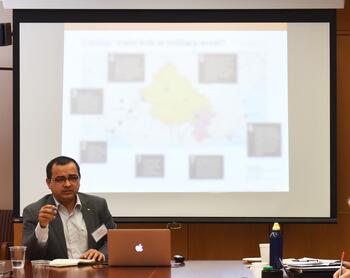
Amit Bhandari of Gateway House: Indian Council on Global Relations presents his research at the Belt and Road Workshop.
Participants then heard presentations from Amit Bhandari of Gateway House: Indian Council on Global Relations and Professor Cheng-Chwee Kuik of the National University of Malaysia. Mr. Bhandari’s talk focused on Chinese investments in India’s six neighboring countries, which tend to center more on energy rather than connectivity projects. He first found that the investments are generally not economical for the host countries because they come with high costs and high interest rates. Secondly, he argued that these projects often lacked a clear economic rationale, appearing instead to embed a geopolitical logic not always friendly to India. Professor Kuik, by contrast, provided a counterexample in his analysis of BRI projects in Southeast Asia. He described how, in Southeast Asia, host countries’ reception of the BRI has varied substantially; and how various stakeholders, including states, sub-states and other entities, have used their leverage to shape outcomes more or less favorable to themselves. Kuik’s analysis injected complexity into the often black-and-white characterizations of the BRI. He highlighted the multidimensional dynamics that play out among local and state-level players in pursuit of their goals, and in the process of BRI implementation.

Professor Curtis J. Milhaupt and Scholar-in-Residence Jeffrey Ball, both at Stanford Law School, followed with individual presentations on the role of State-Owned Enterprises (SOEs) in the BRI and the emissions impact of the BRI on climate change, respectively. Professor Milhaupt  characterized Chinese SOEs as both geopolitical and commercial actors, simultaneously charged with implementing Party policies and attaining corporate profits. Chinese SOEs are major undertakers of significant overseas BRI projects, acting not only as builders but also as investors, partners, and operators. This situation, Milhaupt asserted, carries significant risks for SOEs because these megaprojects often provide dismal returns, have high default rates, and can trigger political backlash in their localities. Milhaupt highlighted the importance of gathering firm-level data on businesses actually engaged in BRI projects to better infer geostrategic, financial, or other motivations. Jeffrey Ball turned the discussion to carbon emissions from BRI projects and presented preliminary findings from his four-country case studies. He concluded that, on aggregate, the emissions impact of the BRI is still “more brown than green.” Twenty-eight percent of global carbon emissions may be accounted for by BRI projects, Ball asserted, underscoring the importance of the BRI to the future of global climate change.

The day concluded with presentations by  Michael Bennon, Managing Director at the Stanford Global Projects Center, and Professor David M. Lampton, Oksenberg-Rohlen Fellow at the Freeman Spogli Institute for International Studies. Bennon first presented findings from two empirical case studies of BRI projects and then went on to describe how the BRI is now practically the “only game in town” for infrastructure funding for developing countries. Lengthy environmental review processes at Western multilateral banks have turned the World Bank, for example, from a lending bank into a “knowledge bank,” he argued. He also highlighted that, in general, economic returns on BRI projects for China are very poor, even though recipient countries may accrue macroeconomic benefits from these projects. Finally, Professor Lampton turned the discussion back to Southeast Asia, where China is currently undertaking massive cross-border high-speed rail projects through eight ASEAN countries. He described how each host country had varying capacity to negotiate against its giant neighbor, and how the sequential implementation of these cross-border rail projects also had varying impacts on the negotiating positions of these host countries. BRI played out differently in each country, in other words, eliciting different reactions, push-backs and negotiated terms.

The second day of the workshop was dedicated to working toward a collaborative approach to future BRI research. The group discussed the key gaps in the existing research, including how to know what China’s true intentions are, how to measure those intentions, who the main players and their interests in both China and the host countries are, and even what the BRI is, exactly. Some cautioned that high-profile projects may not be representative of the whole. Participants brainstormed about existing and future sources of data, and stressed the importance of diversifying studies and seeking empirical evidence.

Hero Image
Participants in the Belt and Road Initiative Workshop at Stanford University, March 2-3, 2020.
All News button
1
News Type
News
Date
Paragraphs

The headlines about the United States and China have been dominated by the spread of COVID-19 and trade deal negotiations. Experts in U.S.-China relations have warned against preemptive disengagement in a time of increased need for international cooperation and coordination, even as tensions between the two countries continue to escalate in the media.

From Adam Segal's perspective, as an expert in security issues, technology development, and Chinese domestic and foreign policy at the Council on Foreign Relations, one of the emerging considerations that will prominently affect the tone and timbre of the relationship between the United States and China in the coming years is how the two nations compete with one another in technological and scientific research and innovation. He delved further into this topic in a lecture as part of the China Program's winter/spring colloquia series.

[To get more stories like this delivered to your inbox, sign up for our newsletters]

As Segal and others describe, both the United States and China benefitted immensely from the globalization of scientific research and collaboration, but in recent years, both have also become wary of sharing talent and resources too broadly or across too many sectors. As a result, each country has taken various measures in an attempt to gain and regain perceived advantages over the other.

As China has tried to move up the so-called economic value chain from being an overwhelmingly manufacturing and heavy industry-based economy to being a leader in tech and digital economies, it has simultaneously tried to wean itself from a dependence on foreign technological infrastructure. In its efforts to create indigenous innovation and technological growth, it has openly tried to court talent and intelligence from overseas. To the United State's rising concern, however, the Chinese government has been less open about the means used to accomplish this aim.

On its part, the United States has upped its efforts to expand cybersecurity research and initiatives. The Trump administration has very vocally critiqued companies such as Huawei and urged allies to step back from business with the telecom and networking giant. Similarly, allegations of espionage against native Chinese and Chinese-American scientists and academics have escalated in recent months.

Segal argues that these simmering tensions signify the growing awareness each country has of the other's increasing capabilities in the cybersphere, as well as a heightened understanding and awareness of the shortcomings of their own systems.

"I think technology, which had usually been a fifth, sixth, seventh on the agenda in the U.S.-China relationship, is going to continue to be one of the defining issues that structure the relationship, and increasingly is one not just about concerns about national security, but about values and how we think about how technology is applied, and governance issues."

To watch Segal's full lecture, click the video below or find it on our YouTube channel. A transcript of his remarks is available

Hero Image
Adam Segal lectures at APARC
All News button
1
Authors
Noa Ronkin
News Type
News
Date
Paragraphs

APARC’s Southeast Asia Program recently hosted the U.S. Ambassador to Vietnam Dan Kritenbrink, who joined faculty members from the Freeman Spogli Institute for International Studies and other Stanford experts for a roundtable discussion about U.S.-Vietnam relations and U.S. strategy in Southeast Asia.

Ambassador Kritenbrink outlined the priorities of the U.S. Mission Vietnam and commended the Vietnamese leadership on its cooperation on a range of issues that span economic development, nuclear nonproliferation, regional security, and people-to-people ties.

The year 2020 marks a quarter of a century since the United States and Vietnam established diplomatic relations. Vietnam is now the fastest-growing economy in Southeast Asia and has emerged as a U.S. partner in pushing back against Beijing's claims in the South China Sea. Yet there are limits to the partnership, as Vietnam is not a democracy and its communist government, having adopted a hedging strategy, is pursuing a multi-country foreign policy, including advancing defense ties with Russia. 

Five men seated at a table in a conference room Roundtable discussion participants listening to Ambassador Kritenbrink..

Roundtable participants listening to Ambassador Kritenbrink. Photo credit: Noa Ronkin.

The issues considered during the roundtable discussion with the Ambassador included some of the challenges and opportunities for Vietnam, which has more leverage to engage the region this year as it serves as chair of the Association of Southeast Asian Nations (ASEAN). It certainly has a full agenda for its chairmanship amid geopolitical tensions in the region, the need to balance the U.S.-China friction, the spread of COVID-19, a slowdown in global trade, and the looming environmental and social impacts posed by the threats to the Mekong river.

Ambassador Kritenbrink began his posting in Vietnam in November 2017 and has served as an American diplomat since 1994. He has completed multiple assignments related to Asia, including the roles of senior advisor for North Korea policy at the Department of State; senior director for Asian affairs at the National Security Council, where he worked on Vietnam and oversaw the negotiation of two Joint Statements regarding the U.S. Comprehensive Partnership with Vietnam; seven years in senior roles in the U.S. Embassy Beijing; and three prior diplomatic postings in Japan.

Hero Image
Ambassador Dan Kritenbrink and Donald Emmerson seated at a conference room during a group discussion
Ambassador Dan Kritenbrink (right) and Southeast Asia Program Director Donald K. Emmerson.
Noa Ronkin
All News button
1
Authors
Noa Ronkin
News Type
News
Date
Paragraphs

Shorenstein APARC is pleased to announce that Arzan Tarapore has been appointed a research scholar supporting the Center’s efforts to promote policy-relevant research, education, and public engagement on contemporary South Asia. In addition to conducting research and providing mentorship on South Asia security and geopolitical issues, Tarapore will organize public programming exploring the trends and challenges shaping the region. He will also cultivate cooperative relationships with stakeholders in the academic and policy communities in South Asia. His appointment is effective September 1, 2020.

Tarapore is currently a non-resident fellow at the National Bureau of Asian Research, as well as an adjunct professor with the Security Studies Program at Georgetown University’s School of Foreign Service and an adjunct researcher at the RAND Corporation. His research focuses on security issues in South Asia and the rapidly evolving strategic landscape of the wider Indo-Pacific. Prior to his scholarly career, he served for thirteen years in the Australian Defence Department in various analytic, management, and liaison positions, including operational deployments and a diplomatic posting to the Australian Embassy in Washington, DC.

“We are delighted to have Arzan join APARC,” said Center Director Gi-Wook Shin. “APARC has more than a decade-long record of South Asia research and publishing activities as part of a previous initiative, which we are keen to revitalize. Arzan’s unique experience, combining scholarship with government service and diplomatic assignments, will be a tremendous asset to our community as we advance policy-relevant research and training on South Asia and U.S. strategy in the larger Indo-Pacific. We look forward to welcoming him to Stanford in September.”

Tarapore’s academic work has been published in the Journal of Strategic Studies, The Washington Quarterly, Asia Policy, and Joint Force Quarterly, among others, and his policy commentary frequently appears on platforms such as the Hindu, the Indian Express, The National Interest, the Lowy Institute's Interpreter, the Brookings Institution’s Lawfare, and War on the Rocks.

"I am enormously excited to join Stanford's world-class community of scholars, and especially to be at the forefront of APARC's renewed focus on South Asia,” said Tarapore. “Our work will center on the opportunity – and the pressing need – to deepen our connections with the region, and to meaningfully inform debates on U.S. policy in the wider Indo-Pacific." 

Tarapore holds a PhD in war studies from King's College London, an MSc from the London School of Economics, and a BA (Hons) from the University of New South Wales. His research experience includes previous roles at the East-West Center in Washington and the Observer Research Foundation in New Delhi.


Media Contact
Noa Ronkin
Associate Director for Communications and External Relations
Shorenstein APARC

Hero Image
Portrait of Arzan Tarapore next to text "APARC Welcomes Arzan Tarapore, Center Research Scholar"
All News button
1
-

IMPORTANT EVENT UPDATE: 

In keeping with Stanford University's March 3 message to the campus community on COVID-19 and current recommendations of the CDC, the Asia-Pacific Research Center is electing to postpone this event until further notice. We apologize for any inconvenience this may cause, and appreciate your understanding and cooperation as we do our best to keep our community healthy and well. 


Data-intensive technologies such as AI may reshape the modern world. We propose that two features of data interact to shape innovation in data-intensive economies: first, states are key collectors and repositories of data; second, data is a non-rival input in innovation. We document the importance of state-collected data for innovation using comprehensive data on Chinese facial recognition AI firms and government contracts. Firms produce more commercial software and patents, particularly data-intensive ones, after receiving government public security contracts. Moreover, effects are largest when contracts provide more data. We then build a directed technical change model to study the state's role in three applications: autocracies demanding AI for surveillance purposes, data-driven industrial policy, and data regulation due to privacy concerns. When the degree of non-rivalry is as strong as our empirical evidence suggests, the state's collection and processing of data can shape the direction of innovation and growth of data-intensive economies.

Image
Portrait of David Yang
David Yang’s research focuses on political economy, behavioral and experimental economics, economic history, and cultural economics. In particular, David studies the forces of stability and forces of changes in authoritarian regimes, drawing lessons from historical and contemporary China. David received a B.A. in Statistics and B.S. in Business Administration from University of California at Berkeley, and PhD in Economics from Stanford. David is currently a Prize Fellow in Economics, History, and Politics at Harvard and a Postdoctoral Fellow at J-PAL at MIT. He also joined Harvard’s Economics Department as an Assistant Professor as of 2020.

David Yang Prize Fellow in Economics, History, and Politics; Department of Economics, Harvard University
Seminars
-

Richard Heydarian in conversation with Don Emmerson

In this seminar, scholar/journalist Richard Heydarian will discuss the principal arguments and ideas in his just-published book on the Indo-Pacific.  He will do so in conversation with Southeast Asia Program director Don Emmerson.  Propositions to be discussed will include:  The 21st century will not belong to China. There will be no Pax Sinica in the Indo-Pacific. China’s bid for primacy will fail due to its overbearing hubris abroad and its massive challenges at home.  Its effort to create a “neo-tributary” system in East Asia will not succeed, as evidenced by pushback regarding the Belt and Road Initiative and the South China Sea.  Neither China nor America will dominate the Indo-Pacific.  More likely to develop there is “an uneasy, fluid network of interlocking alliances, partnerships, and rivalries” in which middle powers such as Japan will figure prominently in efforts to address urgent and visceral challenges such as global warming and information war.  Most needed in the longer run will be a coalition of powers able jointly to “hold the line against the coming anarchy that will sweep the Indo-Pacific mega-region” if nothing is done to rescue it from the political, socioeconomic, environmental, and technological risks and dangers that lie ahead.  Copies of his latest book, from which these arguments are drawn, will be available for sale.

Image
heydarian
Richard Javad Heydarian’s latest book is The Indo-Pacific: Trump, China, and the New Struggle for Global Mastery (2020). Earlier publications include Asia’s New Battlefield (2015), How Capitalism Failed the Arab World (2014), and articles and interviews in many outlets including The Atlantic, The Economist, Foreign Affairs, The New York Times, The Guardian, The Wall Street Journal, and The Washington Post. He has interviewed heads of state and senior policy-makers across the Indo-Pacific, and has taught political science at Ateneo de Manila University and De La Salle University in the Philippines, and most recently was a visiting research Fellow at National Chengchi University in Taiwan. He is an opinion contributor to South China Morning Post, The Straits Times, and Nikkei Asian Review, and is a columnist at the Philippine Daily Inquirer and television host at GMA Network.


Richard Javad Heydarian Independent Scholar, Author, and Columnist for Philippines Daily Inquiries
Panel Discussions
Authors
Noa Ronkin
News Type
News
Date
Paragraphs

Southeast Asia, home to over 640 million people across 10 countries, is one of the world’s most dynamic and fastest growing regions. APARC just concluded the year 2019 with a Center delegation visit to two Southeast Asian capital cities, Hanoi and Bangkok, where we spent an engaging week with stakeholders in the academic, policy, business, and Stanford alumni communities.

Led by APARC Director Gi-Wook Shin, the delegation included APARC Deputy Director and Asia Health Policy Program Director Karen Eggleston, Southeast Asia Program Director Donald Emmerson, and APARC Associate Director for Communications and External Relations Noa Ronkin. Visiting Scholar Andrew Kim joined the delegation in Bangkok.

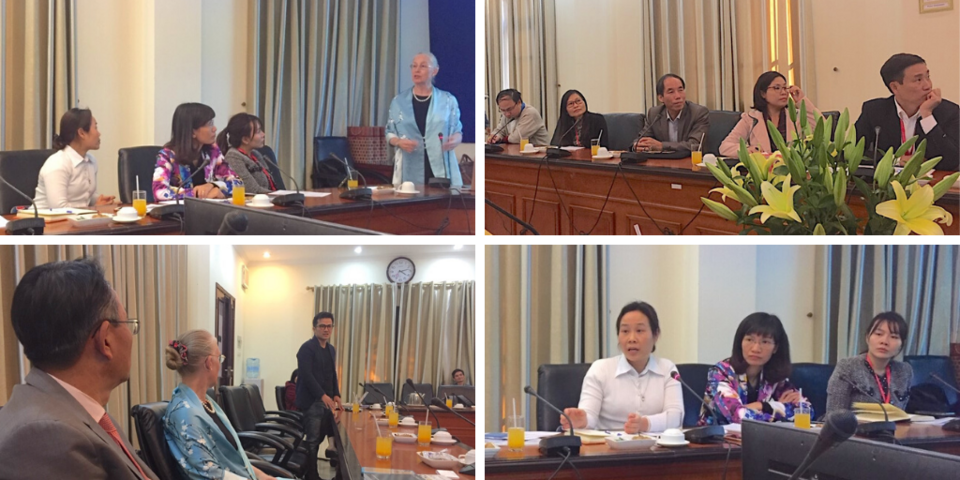
With a focus on health policy, our first day in Hanoi included a visit to Thai Nguyen University, a meeting with government representatives at the Vietnam Ministry of Health, and a seminar on healthy aging and innovation jointly with Hanoi Medical University.

Image
Collage of four images showing participants at a roundtable held at Hanoi Medical University with APARC delegation members

Karen Eggleston and participants at the roundtable held at Hanoi Medical University, December 9, 2019.

Throughout the day, Eggleston presented some of her collaborative research that is part of two projects involving international research teams: one that assesses public-private roles and institutional innovation for healthy aging and another that examines the economics of caring for patients with chronic diseases across diverse health systems in Asia and other parts of the world. We appreciated learning from our counterparts about the health care system and health care delivery in Vietnam.

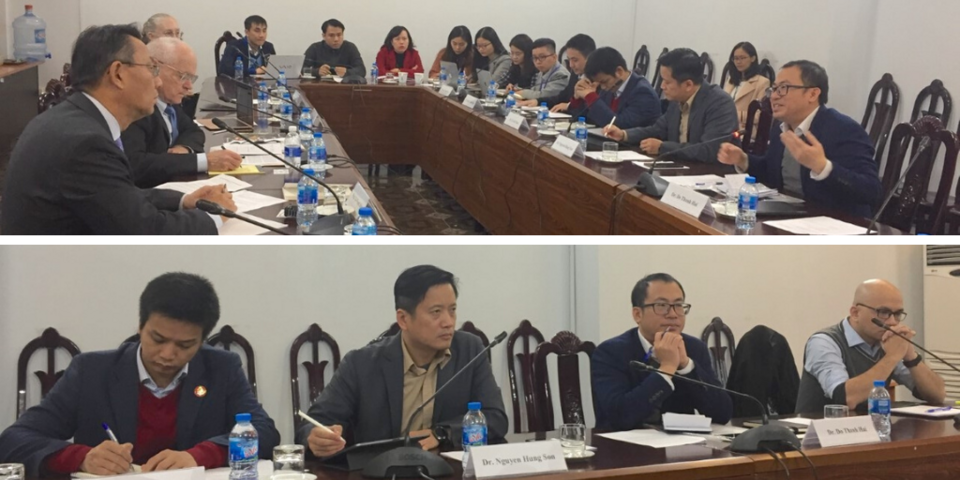
Shifting focus to international relations and regional security, day 2 in Hanoi opened with a roundtable, “The Rise of the Indo-Pacific and Vietnam-U.S. Relations,” held jointly with the East Sea Institute (ESI) of the Diplomatic Academy of Vietnam (DAV). Following a welcome by ESI Director General Nguyen Hung Son, the program continued with remarks by Shin, Emmerson, ESI Deputy Director General To Anh Tuan, and Assistant Director General Do Thanh Hai.

Image
Participants at a roundtable held at the Diplomatic Academy of Vietnam with APARC delegation members

Roundtable at the Diplomatic Academy of Vietnam, December 10, 2019.

The long-ranging conversation with DAV members included issues such as the future of the international order in Asia; the U.S. withdrawal from multilateralism; the concern about a lack of U.S. engagement in Southeast Asia, sparked by President Trump’s absence from the November 2019 summit of the Association of Southeast Asian Nations (ASEAN) at a time when China is bolstering its influence in the region and when ASEAN hopes to set a code of conduct with China regarding disputed waters in the South China Sea; the priorities for Vietnam as it assumes the role of ASEAN chair in 2020; and the challenges for the Vietnam-U.S. bilateral relationship amid the changing strategic environment in Southeast Asia.

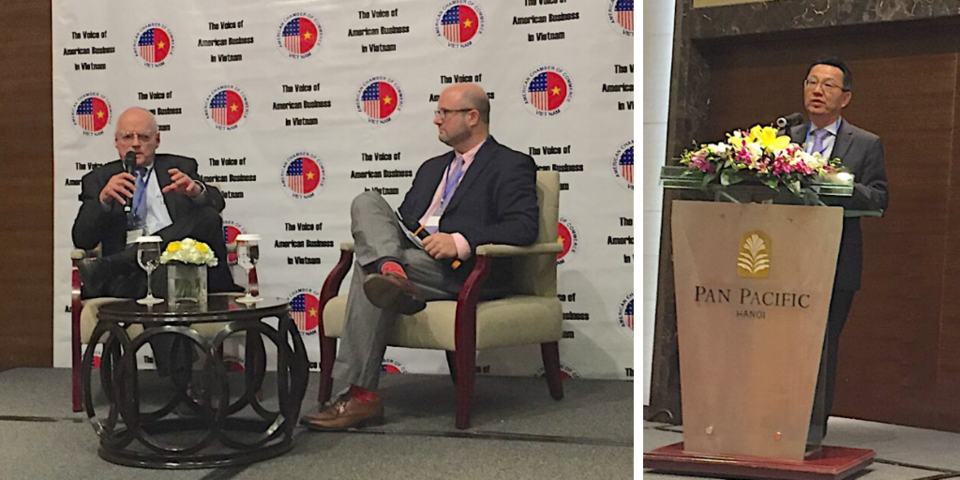
In the afternoon we were joined by members of the American Chamber of Commerce in Hanoi at an AmCham-hosted Lunch ‘n’ Learn session on Vietnam's challenges and opportunities amid the U.S.-China rivalry. The event featured Emmerson in conversation with AmCham Hanoi Executive Director Adam Sitkoff.

Image
Two men in conversation seated on stage and a man speaking at a podium

(Left) Donald Emmerson in conversation with Adam Sitkoff; (right) Gi-Wook Shin welcomes AmCham Hanoi members; December 10, 2019. 

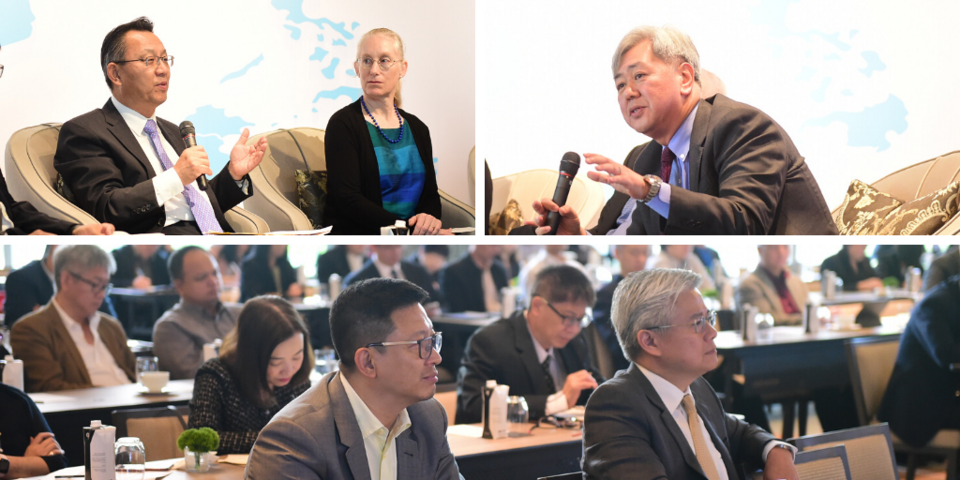
Moving to Bangkok, delegation members Shin, Eggleston, Emmerson, and Kim spoke on a panel for executives of the Charoen Pokphand Group (C.P. Group), one of Thailand’s largest private conglomerates, addressing some of the core issues that lie ahead for Southeast Asia in 2020 and beyond in the areas of geopolitics, innovation, and health.

Image
Participants at a panel discussion with APARC delegation hosted by the C.P. Group, Thailand

Top, from left to right: Gi-Wook Shin, Karen Eggleston, Andrew Kim; bottom: C.P. Group executive listening to the panel, December 12, 2019.

We also enjoyed a tour at True Digital Park, Thailand’s first startup and tech entrepreneur’s campus. Developed by the C.P. Group, True Digital Park aspires to be an open startup ecosystem that powers Thailand to become a global hub for digital innovation.

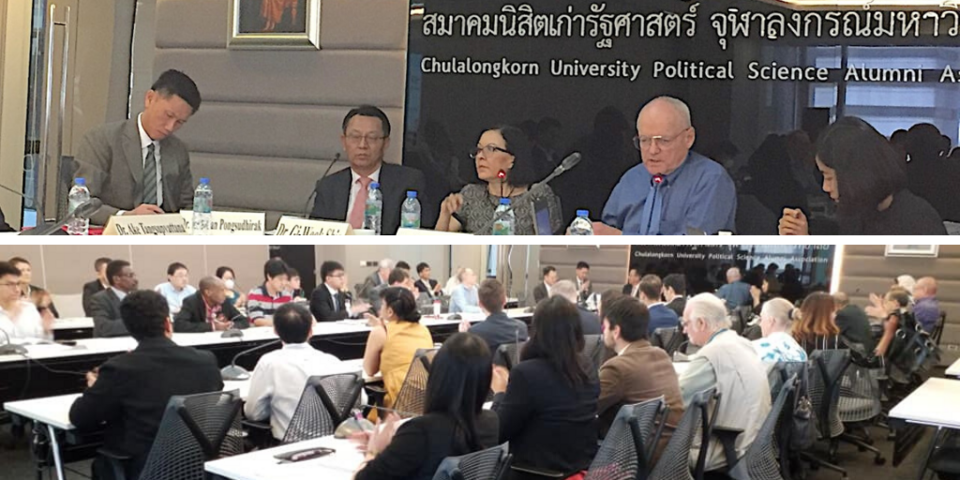
The following day, Shin and Emmerson participated in a public forum hosted by Chulalongkorn University’s Institute of Security and International Studies (ISIS Thailand), "Where Northeast Asia Meets Southeast Asia: The Great Powers, Global Disorder and Asia’s Future.” They were joined by ISIS Thailand Director Thitinan Pongsudhirak and Chulalongkorn University Faculty of Political Science Associate Dean for International Affairs and Graduate Studies Kasira Cheeppensook. The panel was moderated by Ms. Gwen Robinson, ISIS Thailand senior fellow and editor-at-large of the Nikkei Asian Review.

Image
Panelists and participants at a public forum held at Chulalongkorn University

ISIS Thailand forum participants and panelists, from left: Pngsukdhirak, Shin, Robinson, Emmerson, Cheeppensook; December 13, 2019.

As part of that discussion, Emmerson speculated that – driven by deepening Chinese economic and migrational involvement in Southeast Asia’s northern tier – Cambodia and Laos, less conceivably Myanmar, and still less conceivably Thailand could become incorporated de facto into an economically integrated “greater China” that could eventually reduce ASEAN to a more-or-less maritime membership in the region’s southern tier. Emmerson’s speculation was made in the context of his critique of ASEAN’s emphasis on its own “centrality” to the neglect of its lack of the proactivity that would serve as evidence of centrality and of a desire not to be rendered peripheral by the growing centrality-cum-proactivity of China. The event was covered by the Bangkok Post (although that report’s headline and quote of Emmerson are inaccurate, as neither the panel nor Emmerson predicted the “break-up of ASEAN.”)

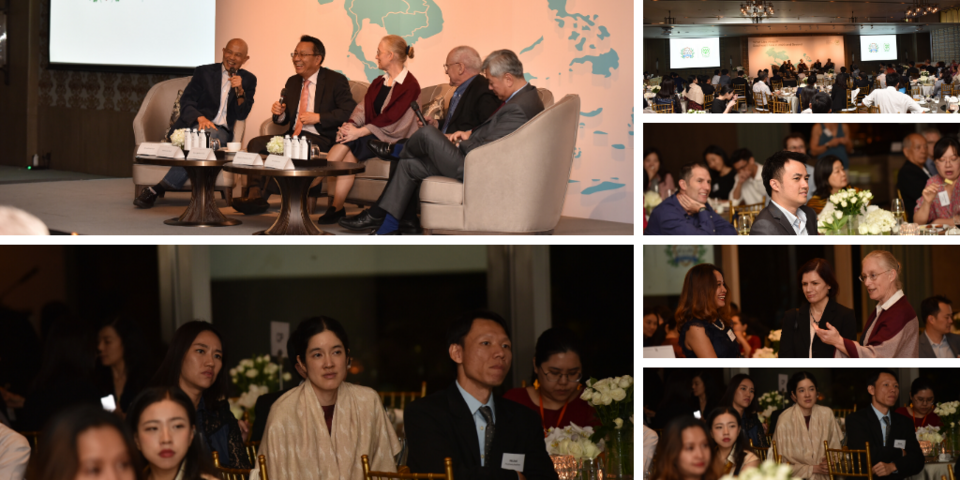
Our delegation visit in Bangkok concluded with a buffet dinner reception and panel discussion jointly with the Stanford Club of Thailand.

Image
alumni event

Stanford and IvyPlus alumni listening to the panel, December 13, 2019.

Moderated by Mr. Suthichai Yoon, a veteran journalist and founder of digital media outlet Kafedam Group, the conversation focused on the changing geopolitics of Southeast Asia, innovation and health in the region, and the opportunities and challenges facing Thailand-U.S. relations. It was a pleasure to meet many new and old friends from the Stanford and IvyPlus alumni communities.

APARC would like to thank our partners and hosts in Hanoi and Bangkok for their hospitality, collaboration, and the stimulating discussions throughout our visit. We look forward to keeping in touch!

Hero Image
APARC delegation speaking to Stanford and IvyPlus alumni, Bangkok
All News button
1
-

Image
Portrait of M Taylor Fravel
Since 1949, China has adopted nine national military strategies, known as “strategic guidelines.” The strategies adopted in 1956, 1980, and 1993 represent major changes in China's military strategy or efforts by the People's Liberation Army to wage war in a new way. This talk examines why major changes in strategy have been pursued at these periods and not at other times, highlighting the role of shifts in the conduct of warfare in the international system and unity among the top leaders of the Chinese Communist Party.

M. Taylor Fravel is the Arthur and Ruth Sloan Professor of Political Science and Director of the Security Studies Program at the Massachusetts Institute of Technology.  Taylor studies international relations, with a focus on international security, China, and East Asia.  His books include Strong Borders, Secure Nation: Cooperation and Conflict in China's Territorial Disputes (Princeton University Press, 2008) and Active Defense: China's Military Strategy Since 1949 (Princeton University Press, 2019).  His other publications have appeared in International SecurityForeign AffairsSecurity StudiesInternational Studies ReviewThe China QuarterlyThe Washington QuarterlyJournal of Strategic StudiesArmed Forces & SocietyCurrent HistoryAsian SurveyAsian SecurityChina Leadership Monitor, and Contemporary Southeast Asia. Taylor is a graduate of Middlebury College and Stanford University, where he received his PhD.  He also has graduate degrees from the London School of Economics and Oxford University, where he was a Rhodes Scholar.  In 2016, he was named an Andrew Carnegie Fellow by the Carnegie Corporation.  Taylor serves on the board of directors of the National Committee on U.S.-China Relations and as the Principal Investigator for the Maritime Awareness Project.


Image
Image of red flag over the Shanghai Bund

This event is part of the 2020 Winter/Spring Colloquia series, The PRC at 70: The Past, Present – and Future?, sponsored by APARC's China Program.
 

M. Taylor Fravel Arthur and Ruth Sloan Professor of Political Science, MIT
Seminars
-

U.S.-China relations have evolved from past templates of  "responsible stakeholder" and "G2" to new ones emphasizing strategic competition.  What is the impact of this competition for broader stability in East Asia?  How does the ongoing U.S.-China trade war impact U.S. allies in Asia?   In particular, how does strategic competition between these two power affect the choices of key allied states like Korea?  Professor Cha will present some research-in-progress on these topics that seeks a broader conceptualization of the costs and benefits behind the latest turn in U.S.-China relations.

Image
victor cha small 1 3x2
Victor Cha is a 2019-20 Koret Fellow at Stanford's Shorenstein Asia-Pacific Research Center during the winter quarter.  He is Vice Dean and holds the D.S. Song-KF Chair in Government and International Relations at Georgetown University, and is also Senior Adviser at the Center for Strategic and International Studies (CSIS) in Washington D.C. He formerly served on the National Security Council staff and as the US Deputy head of delegation for the Six Party talks. Professor Cha received a PhD in political science and a master's in international affairs from Columbia University; an MA in philosophy, politics, and economics from the University of Oxford; and an AB in economics from Columbia University.

Victor Cha <i>Professor of Government, Georgetown University</i>
Seminars
Authors
Noa Ronkin
News Type
News
Date
Paragraphs

The annual award, which carries a US $10,000 cash prize, is sponsored by Stanford University’s Walter H. Shorenstein Asia-Pacific Research Center. It recognizes outstanding journalists and journalism organizations for excellence in coverage of the Asia-Pacific region. News editors, publishers, scholars, journalism associations, and organizations focused on Asia research and analysis are invited to submit nominations for the 2020 award through Friday, February 14.

STANFORD, CA, December 3, 2019 — The Walter H. Shorenstein Asia-Pacific Research Center (APARC), Stanford University’s hub for interdisciplinary research, education, and engagement on contemporary Asia, invites nominations for the 2020 Shorenstein Journalism Award. The award recognizes outstanding journalists who have spent their careers helping audiences around the world understand the complexities of   the Asia-Pacific region. The 2020 award will honor a journalist whose work has mostly been conveyed through American news media. The deadline for nomination submissions is Friday, February 14, 2020.

An annual tradition since 2002, the Shorenstein Journalism Award is sponsored by APARC and carries a cash prize of US $10,000. It honors the legacy of APARC benefactor, Mr. Walter H. Shorenstein, and his twin passions for promoting excellence in journalism and understanding of Asia. “In the face of a shifting geopolitical landscape and amid global declines of democracy, political rights, and civil liberties, it is more crucial than ever before to support independent journalism that seeks accuracy, deep reporting, and nuanced U.S.-Asia dialogue,” said APARC Director Gi-Wook Shin.

Over the course of its history, the award has recognized world-class journalists who push the boundaries of coverage of the Asia-Pacific region and help advance mutual understanding between audiences in the United States and their Asian counterparts. Recent honorees include Maria Ressa, Anna Fifield, Siddharth Varadarajan, Ian Johnson, and Caixin Media. The award alternates between recipients whose work has mostly been published through Asian news media and those whose work has mostly been conveyed through American news media. The 2020 award will recognize a recipient from the latter category.

For the award, the Asia-Pacific region is defined broadly to include Northeast, Southeast, South, and Central Asia and Australasia. Both individual journalists with considerable body of work and journalism organizations are eligible for the award. Nominees’ work may be in traditional forms of print or broadcast journalism and/or in new forms of multimedia journalism. The Award Selection Committee, whose members are experts in journalism and Asia research and policy, presides over the judging of nominees and is responsible for the selection of honorees.

APARC is seeking 2020 award nomination submissions from news editors, publishers, scholars, journalism associations, and entities focused on researching and interpreting the Asia-Pacific region. The Center will announce the winner by April 2020 and present the award at a public ceremony at Stanford in autumn quarter of 2020.

Nominations are accepted electronically through Friday, February 14, 2020 at 11:59 PM PST. For information about the nomination procedures and to submit nominations please visit the award nomination entry page.

Please direct all inquiries to aparc-communications@stanford.edu.


About the Walter H. Shorenstein Asia-Pacific Research Center
The Walter H. Shorenstein Asia-Pacific Research Center (Shorenstein APARC) addresses critical issues affecting the countries of Asia, their regional and global affairs, and U.S.-Asia relations. As Stanford University’s hub for the interdisciplinary study of contemporary Asia, APARC produces policy-relevant research, provides education and training to students, scholars, and practitioners, and strengthens dialogue and cooperation between counterparts in the Asia-Pacific and the United States. Founded in 1983, APARC today is home to a scholar community of distinguished academics and practitioners in government, business, and civil society, who specialize in trends that cut across the entire Asia-Pacific region. Learn more about APARC and about the Shorenstein Journalism Award.

Hero Image
Announcement of open nominations for the 2020 Shorenstein Journalism Award with a background image of Stanford main quad.
All News button
1
Subscribe to Security