Authors
Noa Ronkin
News Type
News
Date
Paragraphs

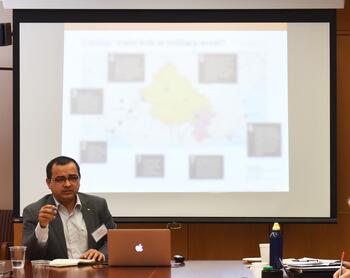
Shorenstein APARC is pleased to announce that Arzan Tarapore has been appointed a research scholar supporting the Center’s efforts to promote policy-relevant research, education, and public engagement on contemporary South Asia. In addition to conducting research and providing mentorship on South Asia security and geopolitical issues, Tarapore will organize public programming exploring the trends and challenges shaping the region. He will also cultivate cooperative relationships with stakeholders in the academic and policy communities in South Asia. His appointment is effective September 1, 2020.

Tarapore is currently a non-resident fellow at the National Bureau of Asian Research, as well as an adjunct professor with the Security Studies Program at Georgetown University’s School of Foreign Service and an adjunct researcher at the RAND Corporation. His research focuses on security issues in South Asia and the rapidly evolving strategic landscape of the wider Indo-Pacific. Prior to his scholarly career, he served for thirteen years in the Australian Defence Department in various analytic, management, and liaison positions, including operational deployments and a diplomatic posting to the Australian Embassy in Washington, DC.

“We are delighted to have Arzan join APARC,” said Center Director Gi-Wook Shin. “APARC has more than a decade-long record of South Asia research and publishing activities as part of a previous initiative, which we are keen to revitalize. Arzan’s unique experience, combining scholarship with government service and diplomatic assignments, will be a tremendous asset to our community as we advance policy-relevant research and training on South Asia and U.S. strategy in the larger Indo-Pacific. We look forward to welcoming him to Stanford in September.”

Tarapore’s academic work has been published in the Journal of Strategic Studies, The Washington Quarterly, Asia Policy, and Joint Force Quarterly, among others, and his policy commentary frequently appears on platforms such as the Hindu, the Indian Express, The National Interest, the Lowy Institute's Interpreter, the Brookings Institution’s Lawfare, and War on the Rocks.

"I am enormously excited to join Stanford's world-class community of scholars, and especially to be at the forefront of APARC's renewed focus on South Asia,” said Tarapore. “Our work will center on the opportunity – and the pressing need – to deepen our connections with the region, and to meaningfully inform debates on U.S. policy in the wider Indo-Pacific." 

Tarapore holds a PhD in war studies from King's College London, an MSc from the London School of Economics, and a BA (Hons) from the University of New South Wales. His research experience includes previous roles at the East-West Center in Washington and the Observer Research Foundation in New Delhi.


Media Contact
Noa Ronkin
Associate Director for Communications and External Relations
Shorenstein APARC

Hero Image
Portrait of Arzan Tarapore next to text "APARC Welcomes Arzan Tarapore, Center Research Scholar"
All News button
1
-

Co-sponsored by Shorenstein Asia-Pacific Research Center (APARC) and US-Asia Technology Management Center

We need alternative metrics to complement GDP in order to get a more comprehensive view of development and ensure informed policy making that doesn’t exclusively prioritize economic growth. As a step in this direction, India is also beginning to focus on the ease of living of its citizens. Ease of living is the next step in the development strategy for India, following the push towards ease of doing business that the country has achieved over the last few years. The Ministry of Housing and Urban Affairs has developed the Ease of Living Index to measuring quality of life of its citizens across Indian cities, as well as economic ability and sustainability. It is as well expected to evolve into a measurement tool to be adopted across districts. The end goal is to have a more just and equitable society that is economically thriving and offering citizens a meaningful quality of life. The talk will focus on how we can bridge the divide between economic objectives and social objectives.

Image
Amit Kapoor
Amit Kapoor, PhD  In addition to the roles listed above, Dr. Kapoor is also president of India Council on Competitiveness, and chair for the Social Progress Imperative & Shared Value Initiative in India. He is also affiliate faculty for the Microeconomics of Competitiveness & Value Based Health Care Delivery courses of Harvard Business School’s Institute of Strategy and Competitiveness, and an instructor with Harvard Business Publishing in the area of Strategy, Competitiveness and Business Models.

Amit is the author of bestsellers Riding the Tiger: How to Execute Business Strategy in India (Random Business) and The Age of Awakening: The Story of the Indian Economy Since Independence (Penguin Books), and editor-in-chief of the quarterly thought leadership magazine Thinkers.

For his full biography, visit amitkapoor.com.

Amit Kapoor, PhD, <i>Honorary Chairman at Institute for Competitiveness, India; Visiting Scholar at Stanford University</i>
Seminars
-

IMPORTANT EVENT UPDATE:

In keeping with Stanford University's March 3 message to the campus community on COVID-19 and current recommendations of the CDC, the Asia-Pacific Research Center is electing to postpone this event until further notice. We appreciate your understanding and cooperation as we do our best to keep our community healthy and well. 


Co-sponsored by Shorenstein Asia-Pacific Research Center (APARC) and Center for South Asia (CSA).

When does mass nonviolent mobilization for political change occur, what prevents it from degenerating into violence, and when does it succeed in extracting concessions? We examine these questions in the context of India's movement for independence from Britain, and point to the key roles played by economic shocks and organization in the success of nonviolence.

Image
Rikhil Bhavnani

Rikhil R. Bhavnani is an Associate Professor in the Department of Political Science at the University of Wisconsin–Madison, and a faculty affiliate at the La Follette School of Public Affairs, the Elections Research Center and the Center for South Asia.

Professor Bhavnani’s research and teaching focus on inequalities in political representation, the political economy of migration, and the political economy of development. His research is particularly concerned with causal identification, and is focused on South Asia. Bhavnani is the co-author, with Bethany Lacina, of a book on the backlash against within-country migration across the developing world, published by Cambridge University Press. His articles have been published or are forthcoming in the American Political Science Review, American Journal of Political Science, Journal of Politics, World Politics, the American Economic Journal: Applied Economics, and other outlets. 

Prior to starting at UW–Madison, Professor Bhavnani was a visiting fellow at the Center for the Study of Democratic Politics at Princeton University. He has worked at the Center for Global Development and the International Monetary Fund, and received a PhD in political science and an MA in economics from Stanford University, and a BA in political science and economics from Yale University.

Rikhil Bhavnani, <i>Associate Professor, Department of Political Science</i> University of Wisconsin–Madison
Seminars
Shorenstein APARCStanford UniversityEncina Hall E301Stanford, CA 94305-6055
0
Visiting Scholar at APARC
Winter 2020
Ph.D.

Kavita Singh joined the Walter H. Shorenstein Asia-Pacific Research Center (APARC) for the winter quarter of 2020 as a visiting scholar from the Public Health Foundation of India, where she serves as a research scientist at the Centre for Chronic Conditions and Injuries.  At APARC, she will be working with Dr. Karen Eggleston conducting research on diabetes management and health economics in South Asia.

Paragraphs

Shorenstein APARC's annual overview for academic year 2018-19 is now available.

Learn about the research, events, and publications produced by the Center's programs over the last twelve months. Feature sections look at U.S.-China relations and the diplomatic impasse with North Korea, and summaries of current Center research on the socioeconomic impact of new technologies, the success of Abenomics, South Korean nationalism, and how Southeast Asian countries are navigating U.S.-China competition. Catch up on the Center's policy work, education initiatives, and outreach/events.

Read online:

All Publications button
1
Publication Type
Annual Reports
Publication Date
Authors
Noa Ronkin
News Type
News
Date
Paragraphs

Type 2 diabetes has become a major public health problem in South Asia in recent decades. The region is now home to an estimated 84 million people suffering from diabetes—approximately one-fifth of the world’s 451 million adults with diabetes—a number that is expected to rise by 78% by 2045. Even more concerning, across South Asia the disease burden increasingly occurs in the most productive midlife period. Among Indians, for example, diabetes is estimated to occur on average 10 years earlier than their western counterparts, and almost half of Indian patients with type 2 diabetes are diagnosed before age 40.

How do South Asian health system influence diabetes care? What is the magnitude of the economic impact of diabetes in South Asia? And what can be done to mitigate that economic burden? These are some of the questions that a team of researchers, including Karen Eggleston, APARC’s deputy director and director of the Asia Health Policy Program, set out to answer in a new study published in the journal Current Diabetes Reports.

Eggleston co-authored the study with Kavita Singh of the Public Health Foundation of India and the Centre for Chronic Disease Control in New Delhi, and with M. Venkat Narayan, Professor of Medicine and Epidemiology and Director of the Global Diabetes Research Center at Emory University. They find that diabetes-related complications lead to enormous treatment costs, causing catastrophic medical spending and illness-induced poverty for many households.

The new study is related to a broader research project led by Eggleston, entitled Net Value in Diabetes Management, that compares health care use, medical spending, and clinical outcomes for patients with diabetes as a lens for understanding the economics of caring for patients with complicated chronic diseases across diverse health systems. This international collaborative research convenes teams of clinicians and health economists in ten countries (and growing) across Asia, as well as the United States and The Netherlands. Together, they analyze big data—detailed, longitudinal patient-level information for large samples from each country, including millions of records of clinical encounters, health-check-up, and medical spending—to compare the health care use and patient outcomes for adults with type 2 diabetes in their health systems.

In the new publication, Eggleston and her co-authors first introduce several unique features that characterize the type 2 diabetes epidemic in South Asia. These include a high risk of developing diabetes even at lower levels of body mass index than observed among western populations; a high prevalence of glucose intolerance, low levels of HDL cholesterol, and high levels of triglycerides; a relationship between impaired fetal nutrition, diabetes, and cardiovascular risk; and the likelihood of rapid urbanization impacting the diabetes burden of the wealthy and the underprivileged differently.

Furthermore, South Asian countries face difficult challenges in delivering diabetes care. The health sector in the region has little organized financing, leading to heavy out-of-pocket spending by patients. Limited availability and affordability of anti-diabetic drugs is a major driver of lower use of such medicines. These factors, combined with a general lack of health care professionals and infrastructural resources and low quality of healthcare governance, all contribute to poor health outcomes.

Eggleston and her co-authors assess the current literature on the economic impact of diabetes in South Asia. They show that, compared with the high prevalence of diabetes in South Asian countries, the total health spending as a percentage of GDP in the region has remained low and fairly constant (3-4% in most countries) over the last two decades, with less than 1% of GDP spent on healthcare by the government, and a miniscule 0.2% by pre-paid private insurance, resulting in a large proportion of out-of-pocket healthcare spending. The financial burden of diabetes and its complications can therefore have catastrophic implications for households that are often driven to sacrifice disastrous proportions of their income to cover treatment costs.

Diabetes causes premature mortality, high morbidity, and disability. To mitigate the economic and social welfare burden of the disease, the researchers conclude, policymakers in South Asia must take urgent action “to increase investment in evaluating cost-effective strategies to manage diabetes and preventative approaches.” The team offers a set of policy recommendations, including monitoring the economic burden of diabetes and the quality of care; focusing on the screening and prevention of diabetes and its risk factors; strengthening government health facilities and primary care services; expanding access to affordable, essential medicines, and more.


Hero Image
People receiving diabetes care in a rural clinic in India Trinity Care Foundation via Flickr (CC BY-NC-ND 2.0)
All News button
1
Paragraphs

With an estimated 84 million people suffering from diabetes in South Asia, the disease imposes substantial economic burdens on individuals, families, and society. Furthermore, since the disease burden increasingly occurs in the most productive midlife period, it adversely affects workforce productivity and macroeconomic development. Diabetes-related complications lead to markedly higher treatment costs, causing catastrophic medical spending for many households, thus underscoring the importance of preventing diabetes-related complications.

This review describes the unique features of the diabetes epidemic in South Asia, critically assesses and identifies the gaps in the current literature on the economic impact of diabetes in South Asia, and finally, offers recommendations on ways to mitigate the economic burden of diabetes.

All Publications button
1
Publication Type
Journal Articles
Publication Date
Journal Publisher
Current Diabetes Reports
Authors
Karen Eggleston
-

EMERGING ISSUES IN CONTEMPORARY ASIA

A Special Seminar Series


RSVP required by Wednesday, April 17, 2019

RSVP Now

ABSTRACT: Why does success in combat sometimes fail to produce a stable and durable peace settlement? In the 1965 war, India successfully repelled a Pakistani invasion of the disputed territory of Kashmir, captured new territory, and launched a massive counter-offensive – but it did not improve the long-term security of Kashmir or deter future Pakistani aggression. This presentation offers an explanation that shows how war can help to establish deterrence between enduring rivals. I argue combat success is important, but must be paired with costly signals of resolve. In 1965, India achieved combat success but failed to deliver such signals of resolve: it did not permanently retain the Kashmiri territory it captured, and it deliberately limited the strategic threat posed by its counter-offensive. As a result, India defended against invasion without establishing post-war deterrence. India’s current military strategy continues to favor ineffective and potentially destabilizing concepts of deterrence. This carries implications not only for regional security, but also U.S. strategy, which increasingly depends on India to maintain a favorable and stable regional balance of power.
 
Image
Arzan Tarapore
PROFILE:
Arzan Tarapore is a nonresident fellow at the National Bureau of Asian Research, an adjunct defense analyst at the RAND Corporation, and from Fall 2019, an adjunct assistant professor at Georgetown University. His research lies at the intersection of South Asian politics and military strategy. His current book project explains the concept of strategic effectiveness, drawing on in-depth historical case studies of India’s war-fighting experience since 1965. Prior to his scholarly career, Arzan served for 13 years in the Australian Defence Department, which included operational deployments and a diplomatic posting to Washington, DC. He holds a PhD in war studies from King’s College London.


Philippines Conference RoomEncina Hall, 3rd Floor, Central616 Serra Street, Stanford, CA 94305
Arzan Tarapore Nonresident fellow at the National Bureau of Asian Research
-

EMERGING ISSUES IN CONTEMPORARY ASIA

A Special Seminar Series


RSVP required by March 6, 2019

VALID STANFORD ID CARD MUST BE PRESENTED UPON ARRIVAL

Oral Democracy studies citizens' voices in civic and political deliberations in India's gram sabhas (village assemblies), the largest deliberative institution in human history. The book analyses nearly three hundred transcripts of gram sabhas, sampled within the framework of a natural experiment, allowing the authors to study how state policy affects the quality of discourse, citizens' discursive performances and state enactments embodied by elected leaders and public officials. By drawing out the varieties of speech apparent in citizen and state interactions, the authors’ analysis shows that citizens' oral participation in development and governance can be improved by strengthening deliberative spaces through policy. Even in conditions of high inequality and illiteracy, gram sabhas can create discursive equality by developing the “oral competence” of citizens and establishing a space in which they can articulate their interests. The authors develop the concept of 'oral democracy' to aid the understanding of deliberative systems in non-Western and developing countries. 

Vijayendra (Biju) Rao, a Lead Economist in the Development Research Group of the World Bank, works at the intersection of scholarship and practice.  He integrates his training in economics with theories and methods from anthropology, sociology and political science to study the social, cultural, and political context of extreme poverty in developing countries. He leads the Social Observatory, an inter-disciplinary lab to improve the conversation between citizens and governments.  His research, published in leading journals in Economics, Political Science and Development Studies has spanned a variety of subjects including dowries in India, domestic violence, the economics of sex work, public celebrations, community development, and deliberative democracy.   He and Ghazala Mansuri co-authored  Localizing Development: Does Participation Work? He is speaking about his latest book (with Paromita Sanyal), Oral Democracy: Deliberation in Rural India (Cambridge University Press, 2019).  It be downloaded for free from here. He was a co-author of the 2006 World Development Report on Equity and Development, and has co-edited Culture and Public ActionHistory, Historians and Development Policy, and, Deliberation and Development.  He serves on the editorial boards of several journals and is a  member of the Successful Societies Program at the Canadian Institute for Advanced Research (CIFAR).
 

Vijayendra (Biju) Rao World Bank
News Type
Commentary
Date
Paragraphs
APARC's Direcror of the Southeast Asia Program Donald K. Emmerson, Center Fellow Thomas Fingar, and Oksenberg-Rohlen Fellow David M. Lampton spoke with The New Silk Road Project as part of a series of conversations that explores China’s Belt and Road Initiative (BRI) from various perspectives. The New Silk Road Project is a student-led research project that aims to better understand and raise awareness of China’s BRI by documenting its land-based component and compiling interviews with leading academics. 
 
Listen to the complete interviews below.
 
Donald K. Emmerson discusses Chinese investment in ASEAN, multilateralism, and the possibility of building the Kra Canal across Thailand to help offset China’s Malacca Dilemma:
 
 
Thomas Fingar discusses how Chinese policies and priorities interact with the goals and actions of other countries in Central and South Asia:
 
 
David M. Lampton discusses China’s development of high-speed railway networks in Southeast Asia:
 

Hero Image
Chinese construction workers in Colombo, Sri Lanka
Chinese Construction workers on site at a shopping mall that is part of the Chinese managed Shangri-La retails and office complex in Colombo, Sri Lanka. For China, the relation with Sri Lanka is a critical link for its Belt and Road Initiative.
Paula Bronstein/Getty Images
All News button
1
Subscribe to South Asia