-


Image
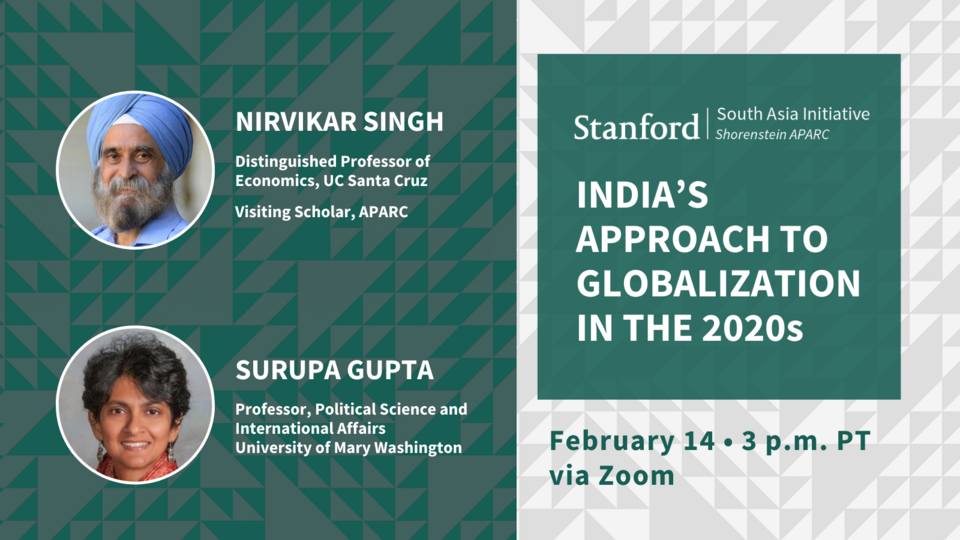
Event card with title "India's Approach to Globalization in the 2020s" featuring photos of spealers Nirvikar Singh and Surupa Gupta


Major economies around the world have re-evaluated their policy approach to globalization in recent years. The devastating pandemic exposed countries to the vulnerabilities of their supply chains, and the dangers of exposure to international markets. India has also begun to adjust its policy settings, with the government prioritizing Atmanirbharta, or self-reliance. Join two of the most insightful scholars of Indian political economy as we explore the feasibility and the implications of India’s policy approach to globalization. How much self-reliance can India realistically achieve, and what will that mean for the Indian economy? How is India applying the principle of “friend-shoring” in its political-economic partnerships? How deeply will India engage in international frameworks like the US-led Indo-Pacific Economic Framework for Prosperity, and what will that mean for its international position?


Speakers:

Image
Square photo portrait of Nirvikar Singh

Dr Nirvikar Singh is a visiting scholar at the Shorenstein Asia-Pacific Research Center at Stanford, and Distinguished Professor of Economics at UC Santa Cruz. He previously directed the UCSC South Asian Studies Initiative, and served as a member of the Advisory Group to the Finance Minister of India on G-20 matters, and Consultant to the Chief Economic Adviser of India. He is currently serving on the Expert Group on post-Covid-19 economic recovery formed by the Chief Minister of Punjab state in India. Professor Singh’s current research topics include entrepreneurship, information technology and development, electronic commerce, business strategy, political economy, federalism, economic growth, the Indian economy, and Sikh and Punjabi studies. He has authored over 100 research papers and co-authored or co-edited six books, and received his PhD from the University of California, Berkeley.


Image
Square photo portrait of Surupa Gupta

Dr Surupa Gupta is a professor of Political Science and International Affairs at the University of Mary Washington in Fredericksburg, Virginia. She also directs the university’s Women’s, Gender, and Sexuality Studies Program. Her current research focuses on the politics of agricultural and trade policies in India as well as India’s engagement with international organizations such as the IMF and WTO. Her most recent research on India’s engagement with the IMF was published in Contemporary South Asia in May 2022. She teaches courses on international political economy, South Asian politics and gender and development. She studied Economics and International Relations in India before getting her PhD in International Relations from the University of Southern California.


Moderator:

Image
Square headshot photograph of Arzan Tarapore

Dr Arzan Tarapore is the South Asia research scholar at the Shorenstein Asia-Pacific Research Center at Stanford University, where he leads the South Asia Initiative. His research focuses on military strategy, Indian defense policy, and contemporary Indo-Pacific security issues. Prior to his scholarly career, he served as an analyst in the Australian Defence Department. Arzan holds a PhD from King’s College London.

Arzan Tarapore

Online via Zoom

Shorenstein APARC
Stanford University
Encina Hall, E301
Stanford,  CA  94305-6055

0
Visiting Scholar at APARC, 2022-23
Nirvikar_Singh.jpg Ph.D.

Professor Nirvikar Singh joined the Walter H. Shorenstein Asia-Pacific Research Center (Shorenstein APARC) as a Visiting Scholar for the 2022-2023 academic year. Singh serves as a Distinguished Professor in Economics at the University of California, Santa Cruz. While at APARC, he researched the political economic dynamics of India and the role of innovation in driving economic growth, especially in Asia.

Nirvikar Singh Visiting Scholar Shorenstein Asia-Pacific Research Center
Surupa Gupta Professor of Political Science and International Affairs, Director, Women’s Gender, and Sexuality Studies Program University of Mary Washington
Paragraphs


Image
Cover of the volume "Routledge Handbook of the International Relations of South Asia"
Edited By Šumit Ganguly and Frank O'Donnell, this handbook offers a comprehensive overview of the international relations of South Asia.

South Asia as a region is increasingly assuming greater significance in global politics for a host of compelling reasons. This volume offers a comprehensive collection of perspectives on the international politics of South Asia, covering an extensive range of issues spanning from inter-state wars to migration in the region. Each contribution provides a careful discussion of the four major theoretical approaches to the study of international politics: Realism, Constructivism, Liberalism, and Critical Theory. In turn, the chapters discuss the relevance of each approach to the issue area addressed in the book. Further, every effort has been made in the chapters to discuss the origins, evolution, and future direction of each issue.

This book will benefit students of South Asian politics, human security, regional security, and International Relations in general.

All Publications button
1
Publication Type
Book Chapters
Publication Date
Subtitle

A chapter in Routledge Handbook of the International Relations of South Asia

Authors
Book Publisher
Routledge
Authors
News Type
Commentary
Date
Paragraphs

This commentary was first published in The Hindu.


India and China appear to be mending fences, gingerly. Relations have been icy since China launched multiple incursions across the Line of Actual Control (LAC) in eastern Ladakh in mid-2020. After years of inconclusive military talks and halting “disengagement” from sites of confrontation, the rivals made inching progress last week. They completed disengagement in an area known as Patrolling Point 15 (PP15), pulling troops back to create a demilitarized buffer zone, and their leaders met in person at the Shanghai Cooperation Organisation summit in Samarkand.

The tentative conciliatory steps between two nuclear-armed rivals are important; but they also carry risks, especially for India.


Sign up for APARC newsletters to receive our experts' commentary and analysis.


Despite the latest round of disengagement, the LAC remains deeply unsettled. Observers have pointed out that the buffer zones produced by the crisis inhibit India’s ability to patrol its own territory. And India and China have tacitly agreed to postpone settlement at two other confrontation sites, including a particularly tactically valuable area known as Depsang. The buffer zones and Depsang’s status both suit China’s objectives because they limit India’s military activities near the LAC, which analysts judge had partly motivated China’s initial incursions in 2020.

Even if future rounds of talks continue “disengagement and de-escalation,” and reduce those forces, returning to the status quo ante is now impossible.
Arzan Tarapore

Similarly, the military threat on the border is not only undiminished, but has actually grown over the course of the crisis. The reinforcements that each side deployed since 2020 have not returned to garrison. Even if future rounds of talks continue “disengagement and de-escalation,” and reduce those forces, returning to the status quo ante is now impossible. Both sides have raced to build permanent military infrastructure near the border, to help them surge forces to the border. Unsurprisingly, China seems to have outpaced India in building these roads, helipads, and communications nodes. 

China still claims Arunachal Pradesh as its own, and just as it has pressed its maritime claims once its growing capabilities permit, its military build-up may portend increasing pressure in coming years. Even without a deliberate attack, the increasing capabilities and mobility on both sides of the border means that a crisis can more quickly escalate to a large military stand-off anywhere on the LAC, and possibly even trigger a conflict.

Strategic implications
 

As vexatious as the tactical picture may be on the border, the strategic implications are more dire. For over two years, the land border has become the overwhelming priority in India’s military competition with China. India has reassigned one of three originally Pakistan-facing Strike Corps to the China front. It has deployed its newest artillery, fighter jets, and drones to the China border. 

With the border crisis, China seems to have successfully fixed India’s gaze to the land border, at the expense of that more consequential competition over the Indian Ocean.
Arzan Tarapore

At the same time, India has not significantly improved its capabilities or posture in the Indian Ocean region. Granted, a suite of impressive new capabilities — from cruise missile-equipped fighters and U.S.-origin naval helicopters to a brand-new indigenously-built aircraft carrier — are inching towards fruition. But these programmes were all initiated before the border crisis, when the Indian military was incrementally modernising its capabilities for the Indian Ocean.

Whether or not by design, this must delight Beijing. As India and China jostle for security and influence in Asia, the contest in the Indian Ocean will inevitably intensify. Their respective capabilities to project military force across the Ocean, to coerce or defend smaller regional States, and to establish an enduring strategic presence there, will determine the Asian balance of power. With the border crisis, China seems to have successfully fixed India’s gaze to the land border, at the expense of that more consequential competition over the Indian Ocean.

Disengagement at PP15, and especially continued “disengagement and de-escalation,” has the potential to ameliorate this strategic trap. A progressively less urgent threat will tempt New Delhi to de-emphasise military readiness on the border. This could be a golden opportunity for Indian planners to work towards long-term military modernisation and political influence across the Indian Ocean region. But a likelier and riskier outcome is that decision makers will prioritise other, more politically salient issues, like gaining quick wins in the campaign for Atmanirbharta in defence industry — which may come at the expense of modernisation.

Paradoxically, then, a cooling crisis on the border may teach India the wrong lesson: that the short-term expedient of greater readiness is enough to see off the Chinese threat. In fact, and especially for the strategic prize of the Indian Ocean region, the challenge posed by China cannot be met without long-term growth in Indian national capacity. That, in turn, requires coherent strategic assessments and the political will to balance readiness with modernisation.

Read More

hands on Iranian flag
News

Fixing Intelligence Failures: The Last Shah, the United States, and the View from Somewhere

Introducing a new conceptual framework for intelligence analysts, South Asia Research Scholar Arzan Tarapore offers an alternative to traditional intelligence-gathering axioms that helps explain the failure of U.S. assessments on the Iranian revolution and may benefit current policymakers in better leveraging intelligence to achieve strategic goals.
Fixing Intelligence Failures: The Last Shah, the United States, and the View from Somewhere
Kari Bingen discusses Indian national security
News

APARC’s South Asia Initiative Sets Forth a New Agenda for Indian Competitiveness

The inaugural conference of APARC's South Asia Initiative convened experts from the public and private sectors to examine the role that critical and emerging technologies can play in India’s national security and generate new pathways for U.S.-India cooperation.
APARC’s South Asia Initiative Sets Forth a New Agenda for Indian Competitiveness
Australian Navy submarine HMAS Sheean
Commentary

AUKUS Is Deeper Than Just Submarines

While the Australia-UK-US security pact shows a seriousness about naval power, the biggest story is the radical integration of leading-edge defense technology and a new approach to alliances, South Asia Research Scholar Arzan Tarapore argues.
AUKUS Is Deeper Than Just Submarines
Hero Image
Soldier of the Indian Army looks upwards Yawar Nazir/Getty
All News button
1
Subtitle

The tentative conciliatory steps between nuclear-armed rivals at the LAC are important, but come with riders for India.

-
Portraits of Sinderpal Singh and Arzan Tarapore with text about a webinar on the implications of the US-China competition for South Asia.

How is India posturing to manage strategic competition in the Indian Ocean? Thus far US-China security competition has been most acute in the western Pacific, but Chinese capability growth and strategic policies suggest that it also seeks a leading role in the northern Indian Ocean, in the not-too-distant future. India has traditionally considered itself the natural dominant power in the Indian Ocean region, but it has never faced the scale and types of competition that China will present. Does India have the wherewithal to maintain its leadership in the region? How will India work with the United States, bilaterally and through groupings such as the Quad, as they seek to maintain the status quo in the face of Chinese challenges? Is the Indian Ocean bound for militarized competition, or can India, the US, and China find a pathway to strategic coexistence?

Panelist

Image
Headshot photograph of Dr. Sinderpal Singh
Dr. Sinderpal Singh is Senior Fellow and Assistant Director, Institute of Defence and Strategic Studies, and concurrently Coordinator of the South Asia Programme at the S. Rajaratnam School of International Studies, Nanyang Technological University, Singapore. In the fall of 2022, he has been appointed as the McCain Fulbright Scholar in Residence at the United States Naval Academy. His research interests include the international relations of South Asia with a special focus on Indian foreign policy, the geopolitics of the Indian Ocean Region, and India-Southeast Asia relations. He is currently writing a book on India’s role in the Indian Ocean since 1992 and is the author of India in South Asia: Domestic Identity Politics and Foreign Policy from Nehru to the BJP (Routledge 2013). He received his Ph.D. from the University of Wales, Aberystwyth, his MA from the Australian National University, and his BA from the National University of Singapore.

Moderator

Image
Square headshot photograph of Arzan Tarapore
Dr. Arzan Tarapore is the South Asia research scholar at the Shorenstein Asia-Pacific Research Center at Stanford University, where he leads the newly-restarted South Asia Initiative. His research focuses on military strategy, Indian defense policy, and contemporary Indo-Pacific security issues. Prior to his scholarly career, he served as an analyst in the Australian Defence Department. Arzan holds a Ph.D. in war studies from King’s College London.

This webinar is co-sponsored by the Center for South Asia

Arzan Tarapore

Virtual via Zoom Webinar

Sinderpal Singh Institute of Defense and Strategic Studies, and South Asia Programme Senior Fellow, Assistant Director S. Rajaratnam School of International Studies, Nanyang Technological University
1
Shorenstein Postdoctoral Fellow on Contemporary Asia, 2022-23
Aidan_Milliff.jpg Ph.D.

Aidan Milliff joined the Walter H. Shorenstein Asia-Pacific Research Center (Shorenstein APARC) as the 2022-2023 Shorenstein Postdoctoral Fellow on Contemporary Asia. 

Milliff obtained his Ph.D. in Political Science at the Massachusetts Institute of Technology, where he was a predoctoral fellow at the Institute for Security and Conflict Studies at George Washington University, and a 2021-2022 USIP/Minerva Peace and Security Scholar. Aidan’s research combines computational social science and qualitative tools to answer questions about the cognitive, emotional, and social forces that shape political violence, migration, post-violence politics, and the politics of South Asia. His work appears or is forthcoming in journals and proceedings including AAAI, Journal of Peace Research, Political Behavior, as well as popular outlets including the Washington Post Monkey Cage Blog, War on the Rocks, and India’s Hindustan Times. Before MIT, Aidan was a James C. Gaither Junior Fellow in the South Asia Program at the Carnegie Endowment for International Peace. He holds a BA in political science and MA in international relations from the University of Chicago. He was born and raised in Colorado.

Aidan’s dissertation asks: in complex political violence scenarios, like inter-communal conflict in South Asia, what determines the strategies that people pursue to keep themselves safe? Aidan develops a political psychology theory, situational appraisal theory, which focuses on variation in individual interpretations of violent environments to explain civilian behavior. The dissertation first uses situational appraisal theory to explain the behavior of Indian Sikhs who encountered violence in rural insurgency and urban pogroms during the 1980s. Pairing original interviews with a novel method for applying multilingual text classification algorithms and automated video-analysis tools to analyze an archive of hundreds of oral history videos, the project shows that situational appraisals of control and predictability explain substantial variation in individuals’ choice of survival strategies when confronting violence.  The dissertation then demonstrates the generalizability of situational appraisal theory to international security domains, using a large survey experiment to show that control and predictability framing influences foreign policy preferences about hypothetical U.S.–China military confrontation.

At APARC, Aidan transformed his dissertation project into a book manuscript, and extend his ongoing research on decision-making, political violence, and Indian politics.


Date Label

Shorenstein APARC
Stanford University
Encina Hall, E301
Stanford,  CA  94305-6055

0
Visiting Scholar at APARC, 2022-23
Erin_Mello.jpg M.A.

Erin Mello joined the Walter H. Shorenstein Asia-Pacific Research Center (Shorenstein APARC) as Visiting Scholar for the 2022-2023 fall quarter. Mello currently serves as analyst for US INDOPACOM and USAF/Hawaii Air National Guard. While at APARC, Mello conducted research on building integrated deterrence in the Indo-Pacific, examining barriers to U.s.-India security cooperation and how to overcome theme.

Authors
Michael Breger
News Type
News
Date
Paragraphs
On January 16, 1979, Mohammad Reza Pahlavi, the last Shah of the Imperial State of Iran, boarded a plane to escape the revolutionary fervor that had escalated into a full-scale regime change. When revolution consumed the U.S.-backed Pahlavi dynasty, policymakers in Washington were caught off-guard. Protests that began a year earlier would culminate in February 1979 with the ascension of Ayatollah Khomeini and a theocratic regime that remains in place today. The U.S. intelligence community, mired in uncertainty, drew criticism for doing little to discourage the unfolding regime shift. The episode and its political fallout stand as one of the most prominent examples of U.S. intelligence estimative failure, in which analysts and policymakers were surprised by imminent change.

In a new article published in Intelligence and National Security, APARC South Asia Research Scholar Arzan Tarapore examines the sources of estimative failure, including the case of the 1979 Iranian revolution, and extends a potential solution to such failures through what he terms “the view from somewhere.” Tarapore suggests that estimative failures are the result of a flawed orthodoxy of intelligence-policymaker relations, which overlook the policymaker’s actual and potential impact on the target.

Sign up for APARC newsletters to receive our experts' research updates.


In contrast, Tarapore’s concept of “the view from somewhere,” which places the intelligence customer’s policy and preferences at the center of the intelligence problem, moves beyond the traditional intelligence-policy orthodoxy. Historically, the intelligence community aspires to a rich and objective understanding of the target, a neutral “view from nowhere,” which prescribes a separation, both institutional and analytic, between producers and consumers of intelligence. Tarapore suggests that some estimative failures – including the Iran case – are the result of “intelligence neglecting a critical variable in the analytic problem: the policymaker’s actual and potential impact on the target.”

In some cases this aspiration to a view from nowhere is itself the impediment to effective estimates.
Arzan Tarapore

Problems with Intelligence Orthodoxy

Using the case of Iran, Tarapore argues that estimates adopting the view from somewhere could have warned Washington of critical decision points while it still had leverage to act, explained how U.S. policy had inadvertently shaped the Shah’s ineffectual response to unrest, and assessed opportunities for effective policy alternatives. For Tarapore, the view from nowhere and its surrounding orthodoxy is driven by “a concern over politicization in its many forms – a concern that is fundamentally sound, but often overblown or applied dogmatically…in some cases this aspiration to a view from nowhere is itself the impediment to effective estimates.”

Tarapore rules out traditional explanations of estimative failure that suggest the fault lies with insufficient data collection, weak analysis, or unreceptive audiences. “While more data and better analysis would always be welcome, they may not materially reduce uncertainty; and explanations centering on the intelligence-policymaker relationship offer no systematic critique of the orthodoxy that keeps intelligence and policymakers at arm’s length,” he writes.

While the intelligence-policy orthodoxy fears that greater integration risks increased politicization, the view from somewhere offers a form of integration that may even reduce the risk that intelligence outputs would be captured by policy interests.
Arzan Tarapore

The danger of dogmatic adherence to a view from nowhere orthodoxy is that estimative assessments of the unfolding events offer little actionable insight to their policy customers when they do not take into account the policymaker’s actual and potential impact on the target. According to Tarapore, “sometimes the problem is not a simple case of customers ignoring intelligence advice, but a more fundamental flaw in the intelligence-policymaker orthodoxy, which limits the types of questions intelligence estimates address.” By explicitly accounting for customer’s actual and potential impact on the situation – in those cases where policymakers had some influence on the target – analysts would have better prepared customers for change.

Limits to the View

As with any intelligence or security concept, there are limits to the view from somewhere. First and foremost, this concept does not reduce uncertainty, Tarpore notes. Data collection and deft analysis using social science methods remain as critical elements of an effective intelligence enterprise. Another caveat is that bringing the customer to the center of the intelligence problem means that intelligence analysts must track two moving objects: the target and the customer. The desired end-states, priorities and other constraints of the customer are also dynamic – they will shift as a function of political evolution, bureaucratic arrangement, or other policy developments.

As with all intelligence advice, the intelligence community can only do so much to shape the customer’s views and prepare them for change.
Arzan Tarapore

As with all intelligence advice, the intelligence community can only do so much to shape the customer’s views and prepare them for change. Policymakers, Tarapore argues, would be unwilling to act solely on the strength of early, uncertain warning signs. The view from somewhere, however, would have been a useful tool to sensitize customers to the risks of not changing course – that failing to even tentatively prepare for change could result in an even costlier policy catastrophe, as with the case of revolutionary Iran.

Read the article by Tarapore

Read More

Kari Bingen discusses Indian national security
News

APARC’s South Asia Initiative Sets Forth a New Agenda for Indian Competitiveness

The inaugural conference of APARC's South Asia Initiative convened experts from the public and private sectors to examine the role that critical and emerging technologies can play in India’s national security and generate new pathways for U.S.-India cooperation.
APARC’s South Asia Initiative Sets Forth a New Agenda for Indian Competitiveness
Government building in China
News

Problems with Revisionism: A Conceptual Framework for Assessing Chinese Intentions

Deciphering China’s intentions is a pressing task for U.S. scholars and policymakers, yet there is a lack of consensus about what China plans to accomplish. In a new study that reviews the existing English and Chinese language literature on intentions and revisionism, Center Fellow Oriana Skylar Mastro offers five propositions to allow for a more productive and data-driven approach to understanding Beijing’s intentions.
Problems with Revisionism: A Conceptual Framework for Assessing Chinese Intentions
USS Key West during during joint Australian-United States military exercises Talisman Sabre 2019 in the Coral Sea.
Commentary

In Defense of AUKUS

This is not only about nuclear-powered submarines; it is about a strengthened US commitment to Australia.
In Defense of AUKUS
Hero Image
hands on Iranian flag
A crowd clutches the Iranian flag during the 38th anniversary of the Iranian revolution in Mashhad.
Mohammad Hossein Taghi/Wikimedia Commons
All News button
1
Subtitle

Introducing a new conceptual framework for intelligence analysts, South Asia Research Scholar Arzan Tarapore offers an alternative to traditional intelligence-gathering axioms that helps explain the failure of U.S. assessments on the Iranian revolution and may benefit current policymakers in better leveraging intelligence to achieve strategic goals.

Authors
News Type
News
Date
Paragraphs

On May 6, APARC’s South Asia Initiative hosted its inaugural conference, on the theme of “A New Agenda for Indian Competitiveness." India faces an intensifying strategic competition with China that will affect not only Indian national security but also the nature of the international system in the Indo-Pacific region. The trajectory of that competition will hinge increasingly on emerging technologies – from artificial intelligence to biotechnology. India’s ability to research, develop, and deploy such technologies will shape not only its military power but also its resilience and self-sufficiency, which the Indian government sees as key national goals in a post-pandemic world. To develop these technologies, India’s national security establishment will need new policy settings — including new relationships with private industry — and new ways of cooperating with key partners, especially the United States.

To that end, the South Asia Initiative’s conference brought together three stakeholder groups that rarely convene in the same forum: academic researchers, government policymakers, and technology industry leaders. The conference’s aim was to create a community of interest among these groups, sensitizing them to the importance of India as a key developer and user of emerging technologies, and conversely, to the importance of those technologies for Indian security and U.S.-India relations.

The conference’s discussions were led and framed by Stanford research scholars and faculty, but they were directed towards addressing policy problems. What role do these technologies play, for example, in military power? How can government and industry best cooperate to foster innovation in defense technology? How can start-up firms navigate this rapidly evolving ecosystem? The conference did not aim to solve any of those problems, but it did seek to start the discussion that might ultimately generate new pathways for U.S.-India cooperation on technology — paths that are better suited to the nature of today’s strategic competition and more rooted in the nature of today’s technology industry.

India’s Defence Secretary, Dr. Ajay Kumar, in the conference’s opening keynote address, laid out some of the challenges facing India. He noted that a handful of large and inefficient Defence Public Sector Undertakings (DPSUs) account for some 90-95% of Indian defense production, but those DPSUs have a negligible presence in the global market. In large part this is because Indian defense production has comprised of licensed manufacturing or simply assembly and integration of foreign-sourced components, traditionally but decreasingly from Russia. To realize the objective of greater national self-reliance in defense, India recognizes the need to cultivate greater private-sector technology development, and harness the economic potential of dual-use (civilian and military) technologies. India could even seek to leapfrog generations of technology, by focusing on developing the digital technologies that lie at the center of much of contemporary defense innovation. This will only be possible if India encourages greater private-sector research and development, reduces onerous government regulations, and fosters a healthier start-up ecosystem.

Dr. Kumar also reflected on the lessons of the ongoing war in Ukraine. He suggested that it underscored to India the importance of national self-reliance; India now sees its dependence on Russia as a challenge. It also revealed the importance of surprise, not only tactically but in the asymmetric or innovative capabilities a country is able to field against its enemy.

From climate to cyberspace, cooperation on technology policies and facilitating private sector cooperation is not only central to the bilateral relationship, but also a vital alternative to other actors that seek to use technology for their own, less democratic interests.
Arzan Tarapore

In the conference’s other keynote address, the Under-Secretary of State for Economic Growth, Energy, and the Environment, Jose W. Fernandez addressed the role of technology in broader U.S.-India bilateral relationship. Technology is at the heart of addressing climate change, one of the most pressing strategic challenges facing the United States and India. The two countries are prioritizing the development and protection of cyberspace and telecommunications, as engines of the burgeoning digital economy across the world. From climate to cyberspace, cooperation on technology policies and facilitating private sector cooperation is not only central to the bilateral relationship but also a vital alternative to other actors that seek to use technology for their own, less democratic interests. To address these challenges, India and the United States must strike the right regulatory balance, to support transparent governance, and foster innovation; they must widen their cooperation to include other like-minded countries; and they must facilitate a more balanced flow of educational exchange to strengthen people-to-people links.

Mr. Fernandez further noted that the United States and India work together through various mechanisms. The Quad, for example, is a key multiplier for both U.S. and Indian policy, and India has deepened its cooperation with the Quad. Strategic competition with China requires a common positive vision for the region — an agenda spanning, for example, health, infrastructure, and food security.

The South Asia Initiative’s inaugural conference succeeded in bringing together a new constellation of stakeholders concerned with the role of technology in India’s strategic competitiveness. It initiated a vital conversation on how policymakers and industry can promote defense innovation, in the context of the wider US-India relationship. Critically, for APARC, it also spotlighted some complex issues that merit further scholarly investigation. The South Asia Initiative will incorporate those observations as it continues to develop its lines of research effort in the coming months and years.

Read More

USS Key West during during joint Australian-United States military exercises Talisman Sabre 2019 in the Coral Sea.
Commentary

In Defense of AUKUS

This is not only about nuclear-powered submarines; it is about a strengthened US commitment to Australia.
In Defense of AUKUS
Australian Navy submarine HMAS Sheean
Commentary

AUKUS Is Deeper Than Just Submarines

While the Australia-UK-US security pact shows a seriousness about naval power, the biggest story is the radical integration of leading-edge defense technology and a new approach to alliances, South Asia Research Scholar Arzan Tarapore argues.
AUKUS Is Deeper Than Just Submarines
Indian Prime Minister Narendra Modi rides in a tank at Longewala in Jaisalmer, Rajasthan, 14 November 2020.
Commentary

India, China, and the Quad’s Defining Test

The Ladakh crisis between China and India seems to have settled into a stalemate, but its trajectory could again turn suddenly. If it flares into a limited conventional war, one of its incidental victims could be the Quad.
India, China, and the Quad’s Defining Test
Hero Image
Kari Bingen discusses Indian national security
Kari Bingen, Chief Strategy Officer of Hawkeye 360, speaks during a panel session.
Rod Searcey
All News button
1
Subtitle

The inaugural conference of APARC's South Asia Initiative convened experts from the public and private sectors to examine the role that critical and emerging technologies can play in India’s national security and generate new pathways for U.S.-India cooperation.

Authors
Noa Ronkin
News Type
News
Date
Paragraphs

As the COVID-19 pandemic remains a crucial global public health threat, pandemic control measures such as lockdowns and mobility restrictions continue to disrupt the provision of health services, leading to reduced healthcare use. Indeed, evidence shows the pandemic has emerged as a particular challenge for people with chronic conditions such as diabetes and hypertension. Yet there is limited data comparing the pandemic’s impact on access to care and the severity of chronic disease symptoms at the population level across Asia.

Now a new collaborative study, published by the Asia Pacific Journal of Public Health, addresses this limitation. The study co-authors, including APARC’s Asia Health Policy Program Director and FSI Senior Fellow Karen Eggleston, offer the first report comparing the impacts of the COVID-19 pandemic and its associated mobility restrictions on people with chronic conditions at different stages of socio-demographic and economic transitions in five Asian regions — India, China, Hong Kong, Korea, and Vietnam.

The findings show that the pandemic has disproportionately disrupted healthcare access and worsened diabetes symptoms among marginalized and rural populations in Asia. Moreover, the pandemic’s broad social and economic impact has adversely affected population health well beyond those directly suffering from COVID-19, with the resulting delayed and foregone care leading to uncertain longer-term effects.


 [Sign up for APARC newsletters to receive the latest research by our scholars]


Unintended Adverse Consequences

Routine screening, risk factor control, and continuity of care for non-communicable diseases are a global challenge. The COVID-19 pandemic has exacerbated the challenge even further. Existing reports show the pandemic has particularly adverse impacts on essential prevention and treatment services for people with chronic conditions. These reductions in health services arose from pandemic-associated factors such as mobility restrictions, lack of public transport, and lack of health workforce.

Eggleston and a group of colleagues set out to provide evidence on how the pandemic has impacted chronic disease care in diverse settings across Asia during COVID-19-related lockdowns. Using standardized questionnaires, the researchers surveyed 5672 participants aged 55.9 to 69.3 years with chronic conditions in India, China, Hong Kong, Korea, and Vietnam. The researchers collected data on participants’ demographic and socio-economic status, comorbidities, access to healthcare, employment status, difficulty in accessing medicines due to financial and nonfinancial (COVID-19 related) reasons, treatment satisfaction, and severity of their chronic condition symptoms.

If no immediate actions are taken to mitigate pandemic impacts, the Asia-Pacific region will struggle to achieve the 2030 Sustainable Development Goal target 3.4 to reduce premature mortality from non-communicable diseases […] and to promote mental health and wellbeing.
Karen Eggleston et al.

The results show that the pandemic’s broad social and economic impact has adversely affected population health well beyond those directly suffering from COVID-19. Study participants with chronic conditions faced significant challenges in managing their symptoms during the pandemic. They experienced a loss of income and difficulties in accessing healthcare or medications, with the resulting delayed and foregone care leading to uncertain longer-term effects. For a nontrivial portion of participants, these factors are associated with the worsening of diabetes symptoms. The threat is twofold among people living in rural populations with limited access, availability, and affordability of healthcare services.

A Global Health Priority

The unintended adverse consequences of the COVID-19 pandemic on chronic disease care may also further aggravate inequality in health outcomes. “If the trend continues and no immediate actions are taken to mitigate pandemic impacts,” Eggleston and her colleagues caution, then “the Asia-Pacific region will struggle to achieve the 2030 Sustainable Development Goal (SDG) target 3.4 to reduce premature mortality from non-communicable diseases by a third relative to 2015 levels and to promote mental health and wellbeing.”

Addressing the pandemic’s unintended negative social and economic impacts on chronic disease care is a global health priority, determine the researchers. They propose several measures to help provide timely care for people with chronic conditions in resource-constrained settings. These include implementing innovations in healthcare delivery models to improve the adoption of healthy lifestyle changes and self-management of chronic disease and mild COVID-19 symptoms, increasing investment in interventions to provide social and economic support to disadvantaged populations, and strengthening primary healthcare infrastructure and support of healthcare providers.

The study was supported in part by funding from Shorenstein APARC’s faculty research award, Stanford King Center for Global Development, and a seed grant from the Stanford Center for Asian Health Research and Education.

Read More

 A woman at a desk in a village medical clinic in China.
News

Strengthening the Frontline: How Primary Health Care Improves Net Value in Chronic Disease Management

Empirical evidence by Karen Eggleston and colleagues suggests that better primary health care management of chronic disease in rural China can reduce spending while contributing to better health.
Strengthening the Frontline: How Primary Health Care Improves Net Value in Chronic Disease Management
Closeup on hands holding a glucometer
News

A New Validated Tool Helps Predict Lifetime Health Outcomes for Prediabetes and Type 2 Diabetes in Chinese Populations

A research team including APARC's Karen Eggleston developed a new simulation model that supports the economic evaluation of policy guidelines and clinical treatment pathways to tackle diabetes and prediabetes among Chinese and East Asian populations, for whom existing models may not be applicable.
A New Validated Tool Helps Predict Lifetime Health Outcomes for Prediabetes and Type 2 Diabetes in Chinese Populations
money
News

Bargaining Behind Closed Doors: Why China’s Local Government Debt Is Not a Local Problem

New research in 'The China Journal' by APARC’s Jean Oi and colleagues suggests that the roots of China’s massive local government debt problem lie in secretive financing institutions offered as quid pro quo to localities to sustain their incentive for local state-led growth after 1994
Bargaining Behind Closed Doors: Why China’s Local Government Debt Is Not a Local Problem
Hero Image
A makeshift barricade is seen in front of a residential area to restrict movement and control COVID-19 spread in Hanoi, Vietnam.
A makeshift barricade is seen in front of a residential area to restrict movement and control COVID-19 spread, September 2021, Hanoi, Vietnam.
Linh Pham / Getty Images
All News button
1
Subtitle

In the first report of its kind comparing the impacts of the pandemic on people with chronic conditions in five Asian regions, researchers including APARC’s Karen Eggleston document how the pandemic’s broad social and economic consequences negatively affected population health well beyond those directly suffering from COVID-19.

-

This is a virtual event. Please click here to register and generate a link to the talk. 
The link will be unique to you; please save it and do not share with others.


What is the relationship between internal development and integration into the global economy in developing countries? How and why do state–market relations differ? And do these differences matter in the post-Cold War era of global conflict and cooperation? Drawing on research in China, India, and Russia and examining sectors from textiles to telecommunications, Micro-Institutional Foundations of Capitalism introduces a new theory of sectoral pathways to globalization and development. Adopting a historical and comparative approach, Hsueh's Strategic Value Framework shows how state elites perceive the strategic value of sectors in response to internal and external pressures. Sectoral structures and organization of institutions further determine the role of the state in market coordination and property rights arrangements. The resultant dominant patterns of market governance vary by country and sector within country. These national configurations of sectoral models are the micro-institutional foundations of capitalism, which mediate globalization and development.


Image
Portrait of Roselyn Hsueh
Roselyn Hsueh is an associate professor of political science at Temple University, where she co-directs the Certificate in Political Economy. She is the author of Micro-Institutional Foundations of Capitalism: Sectoral Pathways to Globalization in China, India, and Russia (Cambridge University Press, forthcoming, 2022), China’s Regulatory State: A New Strategy for Globalization (Cornell University Press, 2011), and scholarly articles on states and markets, comparative regulation and governance, and political economy of development. She is a frequent commentator on politics, finance and trade, and economic development in China and beyond. BBC World News, The Economist, Foreign Affairs, National Public Radio, and The Washington Post, among other media outlets, have featured her research. Prestigious fellowships, such as the Fulbright Global Scholar Award, have funded international fieldwork and she has served as a Visiting Scholar at the Institute of World Economics and Politics, Chinese Academy of Social Sciences. She holds a B.A. and Ph.D. in Political Science from the University of California, Berkeley.


Via Zoom Webinar. Register at: https://bit.ly/3zoAafx

Roselyn Hsueh Associate Professor of Political Science, Temple University
Seminars
Subscribe to South Asia