Authors
Lisa Griswold
News Type
Commentary
Date
Paragraphs

As a new U.S. administration assumes office next year, it will face numerous policy challenges in the Asia-Pacific, a region that accounts for nearly 60 percent of the world’s population and two-thirds of global output.

Despite tremendous gains over the past two decades, the Asia-Pacific region is now grappling with varied effects of globalization, chief among them, inequities of growth, migration and development and their implications for societies as some Asian economies slow alongside the United States and security challenges remain at the fore.

Seven scholars from Stanford’s Shorenstein Asia-Pacific Research Center (APARC) offered views on policy challenges in Asia and some possible directions for U.S.-Asia relations during the next administration.

View the scholars' commentary by scrolling down the page or click on the individual links below to jump to a certain topic.

U.S.-China relations

U.S.-Japan relations

North Korea

Southeast Asia and the South China Sea

Global governance

Population aging .

Trade


U.S.-China relations

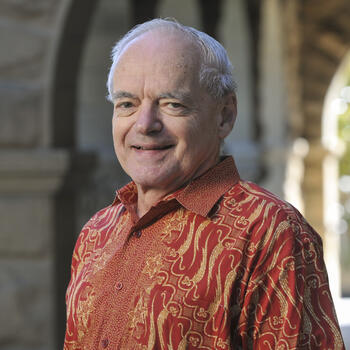
By Thomas Fingar

Image
thomasfingar 3x4
Managing the United States’ relationship with China must be at the top of the new administration’s foreign policy agenda because the relationship is consequential for the region, the world and American interests. Successful management of bilateral issues and perceptions is increasingly difficult and increasingly important.

Alarmist predictions about China’s rise and America’s decline mischaracterize and overstate tensions in the relationship. There is little likelihood that the next U.S. administration will depart from the “hedged engagement” policies pursued by the last eight U.S. administrations. America’s domestic problems cannot be solved by blaming China or any other country. Indeed, they can best be addressed through policies that have contributed to peace, stability and prosperity.

Strains in U.S.-China relations require attention, not radical shifts in policy. China is not an enemy and the United States does not wish to make it one. Nor will or should the next administration resist changes to the status quo if change can better the rules-based international order that has served both countries well. Washington’s objective will be to improve the liberal international system, not to contain or constrain China’s role in that system.

The United States and China have too much at stake to allow relations to become dangerously adversarial, although that is unlikely to happen. But this is not a reason to be sanguine. In the years ahead, managing the relationship will be difficult because key pillars of the relationship are changing. For decades, the strongest source of support for stability in U.S.-China relations has been the U.S. business community, but Chinese actions have alienated this key group and it is now more likely to press for changes than for stability. A second change is occurring in China. As growth slows, Chinese citizens are pressing their government to make additional reforms and respond to perceived challenges to China’s sovereignty.

The next U.S. administration is more likely to continue and adapt current policies toward China and Asia more broadly than to pursue a significantly different approach. Those hoping for or fearing radical changes in U.S. policy will be disappointed..

Thomas Fingar is a Shorenstein Distinguished Fellow and former chairman of the U.S. National Intelligence Council. He leads a research project on China and the World that explores China’s relations with other countries.


U.S.-Japan relations

By Daniel Sneider

Image
danielsneider 3x4
U.S.-Japan relations have enjoyed a remarkable period of strengthened ties in the last few years. The passage of new Japanese security legislation has opened the door to closer defense cooperation, including beyond Japan’s borders. The Japan-Korea comfort women agreement, negotiated with American backing, has led to growing levels of tripartite cooperation between the U.S. and its two principal Northeast Asian allies. And the negotiation of a bilateral agreement within the Trans-Pacific Partnership (TPP) talks brought trade and investment policy into close alignment. The U.S. election, however, brings some clouds to this otherwise sunny horizon.

Three consecutive terms held by the same party would certainly preserve the momentum behind the ‘pivot to Asia’ strategy of the last few years, especially on the security front. Still there are some dangers ahead. If Japan moves ahead to make a peace treaty with Russia, resolving the territorial issue and opening a flow of Japanese investment into Russia, that could be a source of tension. The new administration may also want to mend fences early with China, seeking cooperation on North Korea and avoiding tensions in Southeast Asia.

The big challenge, however, will be guiding the TPP through Congress. While there is a strong sentiment within policy circles in favor of rescuing the deal, perhaps through some kind of adjustment of the agreement, insiders believe that is highly unlikely. The Sanders-Warren wing of the Democratic party has been greatly strengthened by this election and they will be looking for any sign of retreat on TPP. Mrs. Clinton has an ambitious agenda of domestic policy initiatives – from college tuition and the minimum wage to immigration reform – on which she will need their support. One idea now circulating quietly in policy circles is to ‘save’ the TPP, especially its strategic importance, by separating off a bilateral Japan-U.S. Free Trade Agreement. Tokyo is said to be opposed to this but Washington may put pressure on for this option, leaving the door open to a full TPP down the road. .

Daniel Sneider is the associate director for research and a former foreign correspondent. He is the co-author of Divergent Memories: Opinion Leaders and the Asia-Pacific Wars (Stanford University Press, 2016) and is currently writing about U.S.-Japan security issues.


North Korea

By Kathleen Stephens

Image
kathleenstephens 3x4
North Korea under Kim Jong Un has accelerated its campaign to establish itself as a nuclear weapons state. Two nuclear tests and multiple missile firings have occurred in 2016. More tests, or other provocations, may well be attempted before or shortly after the new American president is inaugurated next January. The risk of conflict, whether through miscalculation or misunderstanding, is serious. The outgoing and incoming administrations must coordinate closely on policy and messaging about North Korea with each other and with Asian allies and partners.

From an American foreign policy perspective, North Korea policy challenges will be inherited by the next president as “unfinished business,” unresolved despite a range of approaches spanning previous Republican and Democratic administrations. The first months in a new U.S. president’s term may create a small window to explore potential new openings. The new president should demonstrate at the outset that North Korea is high on the new administration’s priority list, with early, substantive exchanges with allies and key partners like China to affirm U.S. commitment to defense of its allies, a denuclearized Korean Peninsula and the vision agreed to at the Six-Party Talks in the September 2005 Joint Statement of Principles. Early messaging to Pyongyang is also key – clearly communicating the consequences of further testing or provocations, but at the same time signaling the readiness of the new administration to explore new diplomatic approaches. The appointment of a senior envoy, close to the president, could underscore the administration’s seriousness as well as help manage the difficult policy and political process in Washington itself.

2017 is a presidential election year in South Korea, and looks poised to be a particularly difficult one. This will influence Pyongyang’s calculus, as will the still-unknown impact of continued international sanctions. The challenges posed by North Korea have grown greater with time, but there are few new, untried options acceptable to any new administration in Washington. Nonetheless, the new administration must explore what is possible diplomatically and take further steps to defend and deter as necessary. .

Kathleen Stephens is the William J. Perry Distinguished Fellow and former U.S. ambassador to the Republic of Korea. She is currently writing and researching on U.S. diplomacy in Korea.


Southeast Asia and the South China Sea

By Donald K. Emmerson

Image
donaldkemmerson 3x4
The South China Sea is presently a flashpoint, prospectively a turning point, and actually the chief challenge to American policy in Southeast Asia. The risk of China-U.S. escalation makes it a flashpoint. Future historians may call it a turning point if—a big if—China’s campaign for primacy in it and over it succeeds and heralds (a) an eventual incorporation of some portion of Southeast Asia into a Chinese sphere of influence, and (b) a corresponding marginalization of American power in the region.

A new U.S. administration will be inaugurated in January 2017. Unless it wishes to adapt to such outcomes, it should:

(1) renew its predecessor’s refusal to endorse any claim to sovereignty over all, most, or some of the South China Sea and/or its land features made by any of the six contending parties—Brunei, China, Malaysia, the Philippines, Taiwan, Vietnam—pending the validation of such a claim under international law.

(2) strongly encourage all countries, including the contenders, to endorse and implement the authoritative interpretation of the U.N. Convention on the Law of the Sea (UNCLOS) issued on July 12, 2016, by an UNCLOS-authorized court. Washington should also emphasize that it, too, will abide by the judgment, and will strive to ensure American ratification of UNCLOS.

(3) maintain its commitment to engage in publicly acknowledged freedom of navigation operations (FONOPs) in the South China Sea on a regular basis. Previous such FONOPs were conducted in October 2015 by the USS Lassen, in January 2016 by the USS Wilbur, in May 2016 by the USS Lawrence, and in October 2016 by the USS Decatur. The increasingly lengthy intervals between these trips, despite a defense official’s promise to conduct them twice every quarter, has encouraged doubts about precisely the commitment to freedom of navigation that they were meant to convey.

(4) announce what has hitherto been largely implicit: The FONOPs are not being done merely to brandish American naval prowess. Their purpose is to affirm a core geopolitical position, namely, that no single country, not the United States, nor China, nor anyone else, should exercise exclusive or exclusionary control over the South China Sea.

(5) brainstorm with Asian-Pacific and European counterparts a range of innovative ways of multilateralizing the South China Sea as a shared heritage of, and a resource for, its claimants and users alike. .

Donald K. Emmerson is a senior fellow emeritus and director of the Southeast Asia Program. He is currently editing a Stanford University Press book that examines China’s relations with Southeast Asia.


Global governance

By Phillip Y. Lipscy

Image
phillipylipscy 3x4
The basic features of the international order established by the United States after the end of World War II have proven remarkably resilient for over 70 years. The United States has played a pivotal role in East Asia, supporting the region’s rise by underpinning geopolitical stability, an open world economy and international institutions that facilitate cooperative relations. Absent U.S. involvement, it is highly unlikely that the vibrant, largely peaceful region we observe today would exist. However, the rise of Asia also poses perhaps the greatest challenge for the U.S.-supported global order since its creation.

Global economic activity is increasingly shifting toward Asia – most forecasts suggest the region will account for about half of the global economy by the midpoint of the 21st century. This shift is creating important incongruities within the global architecture of international organizations, such as the United Nations, International Monetary Fund and World Bank, which are a central element of the U.S.-based international order and remain heavily tilted toward the West in their formal structures, headquarter locations and personnel compositions. This status quo is a constant source of frustration for policymakers in the region, who seek greater voice consummate with their newfound international status. 

The next U.S. administration should prioritize reinvigoration of the global architecture.  One practical step is to move major international organizations toward multiple headquarter arrangements, which are now common in the private sector – this will mitigate the challenges of recruiting talented individuals willing to spend their careers in distant headquarters in the West. The United States should join the Asian Infrastructure Investment Bank, created by China, to tie the institution more closely into the existing architecture, contribute to its success and send a signal that Asian contributions to international governance are welcome. The Asian rebalance should be continued and deepened, with an emphasis on institution-building that reassures our Asian counterparts that the United States will remain a Pacific power. .

Philip Y. Lipscy is an assistant professor of political science and the Thomas Rohlen Center Fellow. He is the author of the forthcoming book Renegotiating the World Order: Institutional Change in International Relations (Cambridge University Press, 2017).


Population aging

By Karen Eggleston

Image
kareneggleston 3x4
Among the most pressing policy challenges in Asia, U.S. policymakers should bear in mind the longer-term demographic challenges underlying Asia’s economic and geopolitical resurgence. East Asia and parts of Southeast Asia face the headwinds of population aging. Japan has the largest elderly population in the world and South Korea’s aging rate is even more rapid. By contrast, South Asian countries are aging more gradually and face the challenge of productively employing a growing working-age population and capturing their “demographic dividend” (from declining fertility outweighing declining mortality). Navigating these trends will require significant investment in the human capital of every child, focused on health, education and equal opportunity.

China’s recent announcement of a universal two-child policy restored an important dimension of choice, but it will not fundamentally change the trajectory of a shrinking working-age population and burgeoning share of elderly. China’s population aged 60 and older is projected to grow from nearly 15 percent today to 33 percent in 2050, at which time China’s population aged 80 and older will be larger than the current population of France. This triumph of longevity in China and other Asian countries, left unaddressed, will strain the fiscal integrity of public and private pension systems, while urbanization, technological change and income inequality interact with population aging by threatening the sustainability and perceived fairness of conventional financing for many social programs.

Investment in human capital and innovation in social and economic institutions will be central to addressing the demographic realities ahead. The next administration needs to support those investments as well as help to strengthen public health systems and primary care to control chronic disease and prepare for the next infectious disease pandemic, many of which historically have risen in Asia. .

Karen Eggleston is a senior fellow and director of the Asia Health Policy Program. She is the editor of the recently published book Policy Challenges from Demographic Change in China and India (Brookings Institution Press/Shorenstein APARC, 2016).


Trade

By Yong Suk Lee

Image
Portrait of Yong Suk Lee.
Trade policy with Asia will be one of the main challenges of the new administration. U.S. exports to Asia is greater than that to Europe or North America, and overall, U.S. trade with Asia is growing at a faster rate than with any other region in the world. In this regard, the new administration’s approach to the Trans-Pacific Partnership will have important consequences to the U.S. economy.

Anti-globalization sentiment has ballooned in the past two years, particularly in regions affected by the import competition from and outsourcing to Asia. However, some firms and workers have benefited from increasing trade openness. The U.S.-Korea Free Trade Agreement of 2012, for example, led to substantial growth in exports in the agricultural, automotive and pharmaceutical sectors. Yet, there are winners and losers from trade agreements. Using an economist’s hypothetical perspective, one would assume firms and workers in the losing industry move to the exporting sector and take advantage of the gains from trade. In reality, adjustment across industries and regions from such movements are slow. Put simply, a furniture worker in North Carolina who lost a job due to import competition cannot easily assume a new job in the booming high-tech industry in California. They would require high-income mobility and a different skill set.

Trade policy needs to focus on facilitating the transition of workers to different industries and better train students to prepare for potential mobility in the future. Trade policy will also be vital in determining how international commerce is shaped. As cross-border e-commerce increases, it will be in the interest of the United States to participate in and lead negotiations that determine future trade rules. The Trans-Pacific Partnership should not simply be abandoned. The next administration should educate both policymakers and the public about the effects of trade openness and the economic and strategic importance of trade agreements for the U.S. economy.

Yong Suk Lee is the SK Center Fellow and deputy director of Korea Program. He leads a research project focused on Korean education, entrepreneurship and economic development.

Hero Image
urbanization beijing
A woman walks past a construction site in Beijing, China, Sept. 2014.
GREG BAKER/AFP/Getty Images
All News button
1
616 Serra StreetEncina Hall E301Stanford, CA94305-6055
(650) 724-5253 (650) 723-6530
0
ngan_do_kim.jpg Ph.D.

Ngan Do is the Developing Asia Health Policy Postdoctoral Fellow for the 2016-17 academic year.  She is strongly interested in health system related issues, especially health financing, human resources for health, and health care service delivery. She implemented comparison studies at regional level as well as imposed herself to field work in Cambodia, Lao, Philippines, Korea, and Vietnam. At Stanford, Ngan will work on the public hospital reforms in Asia, focusing on dual practice of public hospital physicians and provider payment reforms. Ngan achieved her Ph.D. degree in health policy and management at the College of Medicine, Seoul National University. She earned her master degree on public policy at the KDI School of Public Policy and Management in Seoul, Korea and her bachelor degree on international relations at the Diplomacy Academy of Vietnam (previously the Institute for International Relations). 

Developing Asia Health Policy Postdoctoral Fellow, 2016-17
News Type
Commentary
Date
Paragraphs

Donald Emmerson joined KQED’s radioshow “Forum” to discuss U.S. President Barack Obama’s final trip to Asia, where the president met with world leaders in various forums including the G-20 in Hangzhou and, in Vientiane, the East Asia Summit among other meetings related to the Association of Southeast Asian Nations.

Emmerson, who directs the Southeast Asia Program at the Shorenstein Asia-Pacific Research Center, said the tour represented Obama’s commitment to a vision of U.S. engagement in the region and to supporting multilateral institutions—cornerstones of the administration’s “pivot to Asia” strategy.

“No American president has ever had the kind of interaction with Southeast Asia that President Obama has,” said Emmerson, noting the president’s frequent visits to the region and many sessions with its leaders.

Along with three other guests on the show, Emmerson also responded to questions on North Korea and the territorial disputes in the South China Sea.

Listen to the full program here.

Hero Image
Flickr DOS East Asia Summit
U.S. President Barack Obama participates in a meeting at the East Asia Summit in Phnom Penh, Cambodia, in November 2012.
Flickr/Department of State – William Ng
All News button
1
Authors
Lisa Griswold
News Type
Q&As
Date
Paragraphs

In a Q&A, Stanford postdoctoral fellow Darika Saingam explains why Thailand's battle against drugs continues and what is needed to introduce good policy that works to prevent illegal drug trade and supports recovering addicts.

Despite Thailand’s decade-long crackdown on drugs, demand for illegal substances has risen. A green leaf drug known as ‘kratom’ is a symbol of this rise as young people eagerly adopt the drug for entertainment and join an older generation of laborers who chewed it to survive long hours of work in the fields—and are now heavily addicted. Curtailing substance abuse and its consequences takes good public policy and solutions must be area-specific and evidence-based, according to a Stanford postdoctoral fellow.

Darika Saingam, the 2015-16 Developing Asia Health Policy Postdoctoral Fellow, has conducted two cross-sectional surveys and more than 1,000 interviews with drug users, recovered addicts, and local public officials in an effort to better understand the evolution of substance abuse in southern Thailand.

At Stanford, she is preparing two papers that offer policy options suitable for Thailand and other developing countries in Southeast Asia. Saingam spoke with the Shorenstein Asia-Pacific Research Center (APARC) where she will give a public talk on May 17. The interview text below was edited for brevity.

For decades, Thailand has been an epicenter of drugs. Can you describe the extent of the problem today?

According to a 2014 report, 1.2 million people were involved in illegal drug activities across Thailand. The total number of drug cases saw a 41 percent increase from 2013 to 2014. New groups of drug traffickers are mobilizing while existing groups are still active. Drug users who are young become drug dealers as they get older. The number of drug users below 15 years of age has increased dramatically.

According to your research, what drives Thais toward illegal drug use and the trafficking business?

Adults in Thailand use drugs to relieve stress and counteract the effects of work. Adolescents use them for entertainment. Historically, farmers and laborers from rural areas of Thailand would use opium for pain relief. More recently, a consumable tablet known as yaba has become popular along with crystal methamphetamine and marijuana. Young people are increasingly using yaba and kratom.

Thailand is still a developing country, but it is industrializing quickly. Social and cultural norms have been shifting and people want an improved quality of life. A lot of young people are unemployed and lack social support and are therefore more likely to turn to drug trafficking for economic opportunity. The economic recession and political strife in countries bordering Thailand have exacerbated the situation.


Image
drug policy 1a
    
Image
drug policy 2

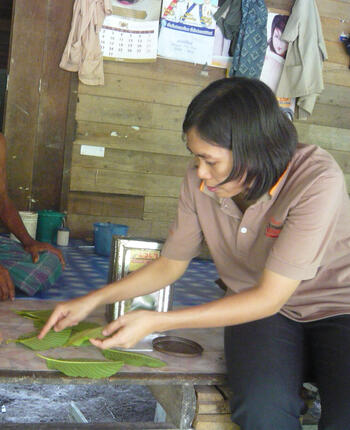
Photos (left to right): A man holds up a kratom leaf. / Saingam examines kratom leaves as part of her research to understand illegal cultivation practices.


What is kratom and why is it popular?

For nearly a century, the native people of Thailand have chewed kratom. It is a leaf that grows on trees resembling a coffee plant. Historically, kratom was used to reduce strain following physical labor, to be able to work harder and longer, and to better tolerate heat and sunlight. Kratom is also embedded in Thai culture and given as a spiritual offering in religious ceremonies. My field research in the southern province of Nakhon Si Thammarat has shown that these motivations are still true today.

Within the past seven years, kratom use has skyrocketed and people are using it in increasingly harmful ways. Chewing kratom is not immediately harmful to health, but combining it with other substances is. This is the recent trend. Users have created new ways to consume it such as in a drink known as a ‘4x100.’ It contains boiled kratom leaves, cough syrup and soft drinks. Additional methamphetamines and benzodiazepines are sometimes added to that mixture.

What strategies must be employed to control substance abuse?

The first step is to realize that the patterns of substance abuse are specific to each location therefore solving the problem must also be. Drug usage is also dynamic. Placing hard control measures on one substance often provokes the emergence of another in its place therefore a holistic approach is important.

Thailand should employ multiple strategies toward effective prevention and control of substance abuse. These strategies include examining the problem and creating policies from an economic perspective (supply and demand), an institutional perspective (national and international drug control cooperation), and a social perspective (structural supports for recovered addicts and mobilization of public participation).


What is the Thai government doing to address the drug problem, and what could they be doing better?

Politicians in Thailand must do a better job at representing the people. Government health workers are often gathering information, assessing needs, and reporting findings to politicians, but these needs are not being accurately addressed. An example of this is politicians ordering to cut down kratom trees – a public display that does not get at the root cause of the problem. The reality is that drug users will quickly find substitutes. According to my study, of the regular users that stopped using kratom, more than 50 percent turned to alcohol instead and did so on a daily basis. This is merely a shift from one substance to another.

On the upside, a crop substitution program created under King Bhumibol Adulyadej offers a successful working model. The program works to replace opium poppy farming with cash crop production. It began in 1969 and is cited for helping an estimated 100,000 people convert their drug crop production to sustainable agricultural activities. Crops cultivated can be sold for profit in nearby towns. The program has also introduced a wide variety of crops and discouraged the slash-and-burn technique of clearing land. It is win-win because it stymies drug trade and provides economic opportunity while also being ecologically sound. This type of program should continue to be scaled up.

Can this model be co-opted elsewhere? What lessons from other countries could inform Thailand’s approach?

Yes, the model could plausibly be implemented in other areas in Thailand and in other Southeast Asian nations.

I think a judicial mechanism such as the kind seen in France could benefit the rural areas in Thailand. The French government has established centers across the country that act as branches of the court that try delinquency cases of minor to moderate severity, and also recommend support services for drug users. Members of the magistrate and civil society actors manage center operations thus placing some responsibility back onto the local community.

I believe an opportunity also exists for Thailand to legalize kratom. Legalization would show a respect for the cultural tradition of chewing kratom leaves and allow the government to suggest safer ways of using it. Bolivia has created a successful model of this through its legalization of coca leaves. Coca in its distilled form is cocaine, but left as a leaf, it is not a narcotic. Indigenous peoples are allowed to chew coca leaves. The government policy is being credited for a decrease in cocaine production as well.

Hero Image
drug policy headline
Stanford postdoctoral fellow Darika Saingam conducts interviews and collects data in southern Thailand.
All photos courtesy of Darika Saingam
All News button
1
Shorenstein APARC616 Serra StreetEncina Hall E301Stanford, CA 94305-6055
0
paul_schuler.jpg Ph.D.

Paul Schuler joins the Walter H. Shorenstein Asia-Pacific Research Center as a Lee Kong Chian Southeast Asia Fellow for 2018 from the University of Arizona's School of Government and Public Policy where he is an assistant professor. 

His research focuses on institutions and public opinion within authoritarian regimes, with a particular focus on Vietnam. During his fellowship, he will be completing a book project on the evolution of the Vietnam National Assembly since 1986, which he compares to the Chinese National People's Congress. During his fellowship, he will also begin projects examining public support in Vietnam for climate change mitigation policies as well as other research on the role of personality in determining regime support. For more information on these projects, see his website: www.paulschuler.me.

Schuler's other work has appeared in top-ranking journals such as American Political Science Review, Legislative Studies Quarterly, Comparative Political Studies, and the Journal of East Asian Studies. He holds a Ph.D in political science from the University of California, San Diego. 

2018-2019 Lee Kong Chian NUS-Stanford Fellow on Contemporary Southeast Asia, Visiting Scholar
2014-2015 Shorenstein Postdoctoral Fellow on Contemporary on Contemporary Asia
Shorenstein APARC616 Serra StreetEncina Hall E301Stanford, CA 94305-6055
(650) 725-2507 (650) 723-6530
0
pham_ngoc_minh.jpg Ph.D.

Pham Ngoc Minh joins the Walter H. Shorenstein Asia-Pacific Research Center (Shorenstein APARC) as the 2014-2015 Developing Asia Health Policy Fellow as a health researcher and administrator.

His main interests are public health, disease prevention and the rural-urban divide in developing countries. At Stanford, Pham will be studying epidemiological trends and policy perspectives of diabetes in Vietnam, particularly those among adults in mountainous areas of that country. Pham has more than six years of experience working as a medical lecturer at the Thai Nguyen University of Medicine and Pharmacy in Vietnam, and spent two and a half years conducting postdoctoral research in Japan. He received a Bachelor of Medicine from the Thai Nguyen University of Medicine and Pharmacy, a BA in English from Hanoi University, an MPH from the University of Melbourne, and a PhD in medical science from Kyushu University.

2014-2015 Developing Asia Health Policy Postdoctoral Fellow
Authors
Lisa Griswold
News Type
News
Date
Paragraphs

The Obama administration’s policy of “re-balance” toward Asia, that began as early as 2009, is now increasingly under stress, as those in the region question American staying power and China emerges as a challenger to U.S. dominance. As the territorial disputes in the East and South China Seas in recent months have demonstrated, China’s relations with the region and the United States have become visibly strained, bringing the U.S. re-balance policy into question and raising concerns about security tensions and the danger of conflict. 

U.S.-China relations are heading, for the foreseeable future, into “a very scratchy time,” predicted Kenneth Lieberthal, a respected senior China scholar at The Brookings Institution, in his keynote speech delivered at the annual Oksenberg Lecture on June 3 at the Shorenstein Asia-Pacific Research Center.

Lieberthal told a standing room audience in Encina Hall that while the U.S. attempt to temper its relations with China and others has “worked quite well over time,” now, “at a geostrategic level, we seem to be sliding with increasing speed toward an inflection point in U.S.-China relations.”

Lieberthal was joined by a panel of China experts, including Cui Liru of the China Institutes of Contemporary International Relations (CICIR), and Stanford’s Karl Eikenberry and Thomas Fingar, distinguished fellows at the Freeman Spogli Institute for International Studies, and Jean C. Oi, director of the Stanford China Program.

The discussion was part of the Oksenberg Lecture, an annual dialogue that functions as a policy workshop on U.S.-Asia relations, named in honor of late professor and senior fellow Michel Oksenberg (1938–2001). Oksenberg was a noted China specialist, who served as a senior member of the National Security Council and is credited as the architect of the normalization of relations with China under the Carter administration in the late 1970s.

Points of tension in the U.S.-China relationship have been increasingly visible. Senior American officials have assailed China for its aggressive actions toward its neighbors over the Diaoyu/Senkaku Islands and in South China Sea, including its latest altercations with Vietnam and the Philippines. The United States recently indicted five members of China’s People’s Liberation Army for carrying out cyber espionage against U.S. technology companies.

Incidents like these have prompted both countries to throw harsh words at each other, leading to a situation of brinkmanship. However, Lieberthal pointed out that tense relations between the United States and China are certainly not new. Most notably, relations took a nosedive in 1989 when China cracked down on democratization protests at Tiananmen Square, in 1999 after the accidental bombing of the Chinese Embassy in Serbia, and in 2008, in response to the global financial crisis.

The U.S.-China relationship has been riddled with periods of distrust in the past. But now, “the speed and scale of China’s economic growth, especially over the last two decades, has also increased concerns, on all sides, that the evolving distribution of power may create new frictions and suspicions,” Lieberthal said.

Yet, refusing to work with each other is not an option, the senior scholar, who also served in the Clinton administration, told the audience. Without the United States and China in conversation, progress in multilateral areas such as climate change and trade would falter, he argued. Given the two countries’ position as the world’s largest economies, the international system would effectively be constrained if the two were entrenched in long-term bitterness.

Lieberthal recognized the common admonition, “if we treat China as an enemy, it will surely become one,” saying this warning could be applied to both sides. China and the United States must make greater efforts to manage and mitigate tensions.

“The question is whether we can prevent bad things, not only specific conflicts, but the political tensions and politics that make cooperation on major issues very, very difficult at best.”

He then outlined a few steps that could help China and the United States sort out their disputes. His recommendations began with the need for strong determination on the part of top political leaders to move things forward and the importance of clear, consistent use of vocabulary when discussing issues.

As a final point, but one that was offered as a contingent factor to success, Lieberthal said U.S.-China relations and both countries’ roles in greater Asia will depend on “how effective each of us is in dealing with domestic reforms,” because, “that will determine how dynamic, how vibrant, how innovative, and how secure we feel.”

______________________________________________________ 

During the lecture, Ret. Lt. Gen. Karl Eikenberry shared his observations from the Shangri-La Dialogue, an inter-governmental security forum held from May 30 – June 1 in Singapore. The Dialogue has in recent years become a gathering of premiere defense ministers to discuss security issues in Track I and “quasi-track” meetings.

Afterward, Eikenberry talked with Shorenstein APARC about key highlights and implications that emerged from the Dialogue:


IISS Photo KEikenberry Gallery Shangri-La Dialogue

Photo credit: Flickr/The International Institute for Strategic Studies 

Media reported a tense environment overlaid the Dialogue. What was the general atmosphere there?

The remarks at the Shangri-La Dialogue by Japanese Prime Minister Abe and U.S. Defense Secretary Hagel on the one hand, and Chinese General Wang Guanzhong, made clear very different views on the causes for tension surrounding various maritime sovereignty claims in the East and South China Seas. Still, if you read the full text of all three speeches and the Q&As that followed, there is still great emphasis placed on dialogue and common interests. And in the many meetings that took place between national delegations on the margins of the conference events, the emphasis was on cooperation. 

What revelations at the Dialogue were surprising?

I think the degree to which dissatisfaction with China’s assertive behavior in pursuing its maritime claims was expressed by many of the participants – not just the United States and Japan. Vietnam, the Philippines and India were explicit. Analysts have said the only China (through threatening behavior) could contain China by catalyzing a counterbalancing response. From the results of the Dialogue, I think this is correct.   

Japanese Prime Minister Shinzo Abe emphasized values and international law throughout his keynote speech. What is your take on this?

The Prime Minister did emphasize both democracy and rule of law during his prepared remarks and answers to questions from conference participants. He was drawing an obvious distinction between Japan’s and China’s political systems and commitment to approaches to resolving territorial disputes. I think the Prime Minister is trying to establish Japan as a leader in East and Southeast Asia, and wanted to make clear what he views as important differences between the Japanese and Chinese “models.” 

U.S. Defense Secretary Chuck Hagel referenced China’s suspension of the U.S.-China Cyber Working Group. What direction do you think the cybersecurity dialogue will go now?

It was unfortunate that China suspended its participation in the U.S.-China Cyber Working Group after the U.S. Government’s indictment of five People’s Liberation Army officers for alleged cyber theft. The U.S. Government has been providing the PRC Government with evidence of cyber theft being conducted by entities in China and has failed to receive any meaningful response so the indictments seem warranted. It would seem that the Cyber Working Group is precisely the forum to discuss this matter and the many related to managing the cyber domain with agreed rules and procedures. Working Groups provide a forum to address disagreement and disputes. I think China’s response was counterproductive and hope the government will indicate a willingness to resume the dialogues in the near future.

Where do you see the regional security conversation heading next?

The risk is that security dialogues will be divided into two camps – one led by the United States and its close allies and partners, and the other by China – somewhat isolated at this time but seeking to entice Asian nations to bandwagon to its side. Perhaps further regional economic integration can facilitate a more common approach to security, but this year’s Shangri-La Dialogue is perhaps a warning that trends, for now, are not heading in a positive direction.

Hero Image
oksenberg lecture 2014 headline 2
Kenneth Lieberthal of The Brookings Institution delivered the keynote speech at the annual Oksenberg Lecture on June 3.
Irene Bryant/Debbie Warren
All News button
1
News Type
News
Date
Paragraphs

Shorenstein APARC postdoctoral fellowships offer a unique opportunity for recent graduates to reside at Stanford for a year to further their research and engage with scholars. The Center annually offers multiple Shorenstein Postdoctoral Fellowships in Contemporary Asia, and one Postdoctoral Fellowship in Asia Health Policy.

Fellows develop their dissertations for publication, present their research, and participate in Center activities related to and beyond their specialty. Most importantly, they establish valuable connections with professionals that continue long after they leave Stanford.

Postdoctoral fellows go on to pursue teaching positions and advisory roles at top universities and research organizations around the world. They often continue to contribute to Shorenstein APARC publications, and participate in conferences and related activities into the future.

Shorenstein APARC is delighted to welcome its latest group of exceptional postdoctoral fellows this autumn:

Shorenstein Postdoctoral Fellows

Jianzhi (Jason) Zhao is completing his PhD in international development and economic policy at the University of Maryland. His current research interests are focused on development economics and empirical and international corporate finance, particularly China. His dissertation focuses on how China’s financial system interacts with state-owned enterprises, and policy perspectives of China’s banking sector and macroeconomic stability. At Stanford, Zhao will continue his dissertation work and extend his research analyzing how a firm’s connection to government affects performance and investment behavior. Zhao holds BAs in finance and business administration from Jiangzi University of Science and Technology, and an MA in economics from Fudan University.

Paul Schuler is a political scientist whose current research focuses on liberalization under authoritarian rule and political change in Southeast Asia, particularly Vietnam. His dissertation focuses on how the Vietnam Communist Party has liberalized the legislature in order to gain information, co-opt opposition and stabilize power sharing. At Stanford, Schuler will develop his dissertation work into a book manuscript and pursue other projects related to governance under authoritarian rule. Schuler will receive his PhD in political science from the University of California, San Diego – Graduate School of International Relations and Pacific Studies in 2014. He holds a BA in journalism and government & politics from the University of Maryland, and an MA in Pacific international affairs from UC – San Diego. 

Developing Asia Health Policy Postdoctoral Fellow 

Pham Ngoc Minh is a health researcher and administrator. His main interests are public health, disease prevention and the rural-urban divide in developing countries. At Stanford, Pham will be studying epidemiological trends and policy perspectives of diabetes in Vietnam, particularly those among adults in mountainous areas of that country. Pham has more than six years of experience working as a medical lecturer at the Thai Nguyen University of Medicine and Pharmacy in Vietnam, and spent two and a half years conducting postdoctoral research in Japan. He received a Bachelor of Medicine from the Thai Nguyen University of Medicine and Pharmacy, a BA in English from Hanoi University, an MPH from the University of Melbourne, and a PhD in medical science from Kyushu University.

Hero Image
ColumnNewsfeed
All News button
1
Subscribe to Vietnam