-

The opening up of Myanmar (Burma) and the steps undertaken taken toward political reform in that formerly isolated dictatorship have been among Asia's most dramatic and least expected events.  But the establishment of full democracy is still on the agenda and faces many challenges.  How willing is the current government in Burma to allow a full and free exercise of political rights, including media freedom?  A panel of experts, including Aung Zaw, the editor and founder of The Irrawaddy and this year's recipient of the Shorenstein Award for Journalism in Asia, will address that question in discussing "Burma's Democracy:  How Real?"

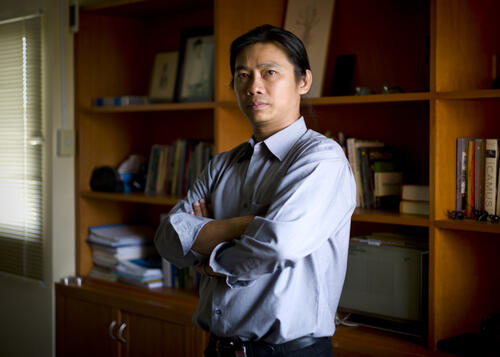
Stanford University’s Walter H. Shorenstein Asia-Pacific Research Center (Shorenstein APARC) is pleased to announce Aung Zaw as the 2013 recipient of the Shorenstein Journalism Award. Zaw has been selected for his leadership in establishing independent media in Myanmar (Burma) and his dedication to integrity in reporting on Southeast Asia.

Image
 Aung Zaw

Aung Zaw is the founding editor-in-chief and executive director of The Irrawaddy, an independent Burmese media organization operating in Myanmar and northern Thailand. Zaw has been an active campaigner for democratic reform in Burma/Myanmar over the last two decades. He was awarded the 2010 Prince Claus Fund Award for journalism along with two journalists from Iran and Cuba – and is recognized for his active dedication to achieving democratic governance in Burma and his work to uphold press freedom.

Zaw studied Botany at Rangoon University. As a student activist in Burma, he was part of the 1988 protests in Rangoon against the Burmese military regime of General Ne Win. He was arrested and detained for a week in Rangoon’s notorious Insein prison where he was severely tortured during interrogation about his pro-democracy activities. Upon release Aung Zaw continued to work with the resistance movement until the military staged a coup in September that year and he was forced to leave the country for neighboring Thailand.

Two years later, Aung Zaw founded the Burma Information Group (BIG) in Bangkok, to document human rights violations in Burma. He began to write political commentaries for national newspapers in Thailand and internationally, and in late 1993 launched The Irrawaddy News Magazine in Bangkok, covering Burma affairs. He worked in Bangkok for two years producing The Irrawaddy Magazine until relocating to the more secure position in Chiang Mai in the north of Thailand.

In February 2012, Aung Zaw was able to return to his homeland for the first time in more than 20 years for a temporary visit as an independent journalist. By the end of 2012, The Irrawaddy was able to establish a media and news office in central Yangon, returning to Burma/Myanmar to practice independent journalism, whilst retaining a regional office in Thailand.

In 2013, the government lifted ban on The Irrawaddy and other exiled websites, the Irrawaddy English magazine and the Irrawaddy Dateline Current Affairs TV program is available for audiences in Myanmar. Aung Zaw writes for New York Times, International Herald Tribune, Time, The Guardian, Bangkok Post, The Nation and several publications in the Europe. His interviews have also appeared on CN, BBC and Al Jazeera. He is the author of the Face of Resistance and is a recent Visiting Scholar at UC Berkeley, School of Journalism.

Bechtel Conference Center

Aung Zaw 2013 Journalism Prize Winner and Founder and Editor, The Irrawaddy News Magazine Panelist
Nayan Chanda Director of Publications and the Editor of YaleGlobal Online Magazine Panelist Yale Center for the Study of Globalization
0
Senior Fellow Emeritus at the Freeman Spogli Institute for International Studies
Affiliated Faculty, CDDRL
Affiliated Scholar, Abbasi Program in Islamic Studies
aparc_dke.jpg PhD

At Stanford, in addition to his work for the Southeast Asia Program and his affiliations with CDDRL and the Abbasi Program in Islamic Studies, Donald Emmerson has taught courses on Southeast Asia in East Asian Studies, International Policy Studies, and Political Science. He is active as an analyst of current policy issues involving Asia. In 2010 the National Bureau of Asian Research and the Woodrow Wilson International Center for Scholars awarded him a two-year Research Associateship given to “top scholars from across the United States” who “have successfully bridged the gap between the academy and policy.”

Emmerson’s research interests include Southeast Asia-China-US relations, the South China Sea, and the future of ASEAN. His publications, authored or edited, span more than a dozen books and monographs and some 200 articles, chapters, and shorter pieces.  Recent writings include The Deer and the Dragon: Southeast Asia and China in the 21st Century (ed., 2020); “‘No Sole Control’ in the South China Sea,” in Asia Policy  (2019); ASEAN @ 50, Southeast Asia @ Risk: What Should Be Done? (ed., 2018); “Singapore and Goliath?,” in Journal of Democracy (2018); “Mapping ASEAN’s Futures,” in Contemporary Southeast Asia (2017); and “ASEAN Between China and America: Is It Time to Try Horsing the Cow?,” in Trans-Regional and –National Studies of Southeast Asia (2017).

Earlier work includes “Sunnylands or Rancho Mirage? ASEAN and the South China Sea,” in YaleGlobal (2016); “The Spectrum of Comparisons: A Discussion,” in Pacific Affairs (2014); “Facts, Minds, and Formats: Scholarship and Political Change in Indonesia” in Indonesian Studies: The State of the Field (2013); “Is Indonesia Rising? It Depends” in Indonesia Rising (2012); “Southeast Asia: Minding the Gap between Democracy and Governance,” in Journal of Democracy (April 2012); “The Problem and Promise of Focality in World Affairs,” in Strategic Review (August 2011); An American Place at an Asian Table? Regionalism and Its Reasons (2011); Asian Regionalism and US Policy: The Case for Creative Adaptation (2010); “The Useful Diversity of ‘Islamism’” and “Islamism: Pros, Cons, and Contexts” in Islamism: Conflicting Perspectives on Political Islam (2009); “Crisis and Consensus: America and ASEAN in a New Global Context” in Refreshing U.S.-Thai Relations (2009); and Hard Choices: Security, Democracy, and Regionalism in Southeast Asia (edited, 2008).

Prior to moving to Stanford in 1999, Emmerson was a professor of political science at the University of Wisconsin-Madison, where he won a campus-wide teaching award. That same year he helped monitor voting in Indonesia and East Timor for the National Democratic Institute and the Carter Center. In the course of his career, he has taken part in numerous policy-related working groups focused on topics related to Southeast Asia; has testified before House and Senate committees on Asian affairs; and been a regular at gatherings such as the Asia Pacific Roundtable (Kuala Lumpur), the Bali Democracy Forum (Nusa Dua), and the Shangri-La Dialogue (Singapore). Places where he has held various visiting fellowships, including the Institute for Advanced Study and the Woodrow Wilson International Center for Scholars. 


Emmerson has a Ph.D. in political science from Yale and a BA in international affairs from Princeton. He is fluent in Indonesian, was fluent in French, and has lectured and written in both languages. He has lesser competence in Dutch, Javanese, and Russian. A former slam poet in English, he enjoys the spoken word and reads occasionally under a nom de plume with the Not Yet Dead Poets Society in Redwood City, CA. He and his wife Carolyn met in high school in Lebanon. They have two children. He was born in Tokyo, the son of U.S. Foreign Service Officer John K. Emmerson, who wrote the Japanese Thread among other books.

Selected Multimedia

Date Label
Donald K. Emmerson Senior Fellow at FSI, Emeritus; Affiliated Faculty, CDDRL; Affiliated Scholar, Abbasi Program in Islamic Studies and Director, Southeast Asia Forum Panelist Stanford University
Daniel C. Sneider Associate Director for Research, Shorenstein Asia-Pacific Research Center Moderator Stanford University
Panel Discussions
News Type
News
Date
Paragraphs

Microblogs, Youtube, and mobile communications. These are a few of the digital platforms changing how we connect, and subsequently, reshaping global societies. 

Confluence of technology and pervasive desire for information has in effect created widespread adoption. There is no doubt the Information Technology (IT) revolution is in full swing.

Comparing case studies across Asia and the United States, the fifth and final Stanford Kyoto Trans-Asian Dialogue (DISCONTINUED) considered opportunities and challenges posed by digital media. Experts and top-level administrators from Stanford and universities across Asia, as well as policymakers, journalists, and business professionals, met in Kyoto on Sept. 12-13, 2013.

Relevant questions asked included: What shifts have occurred in traditional versus digital media for how people get information, and how does this differ across countries? What is the potential for digital media in civil society and democratization? Is it a force for positive change or a source of instability?

In the presentations and discussion sessions, participants raised a number of key, policy-relevant points, which are highlighted in the Dialogue’s final report. These include:

Digital media does not, on its own, automatically revolutionize politics or foster greater democratization. While the Internet and digital media can play an instrumental role, particularly where traditional media is highly controlled by the government, participants cautioned against overemphasizing the hype. One conception is that the Internet can instead be viewed as a catalyst or powerful multiplier, but only if a casual chain of latent interest exists. That being said, greater exposure of youth to digital media, particularly in areas of tight media control, can open new areas of awareness.

The upending of traditional media business models has not been replaced by viable digital media business models. As media organizations struggle with their business models, the quality of reporting is threatened. For traditional organizations, maintaining public trust can be challenging, particularly during wars after disasters, while in areas with previously tightly controlled press, digital media may be perceived as more authentic. On the one hand, policy-driven agenda setting may be easier in some issue areas, but digital media may amplify interest in controversial issues, particularly with history issues in Asia.

As Cloud Computing platforms provided by a small group of mostly U.S. companies is increasingly the underlying platform for digital media—as well as our digital lives in general—issues of information security and privacy are at the forefront of much of the public’s mind. Revelations by former U.S. contractor Edward Snowden about the extent of the US government’s espionage activities raise concerns among journalists concerned with issues such as free speech of the press, media independence from government, and protection of sources. 

Previous Dialogues have brought together a diverse range of scholars and thought leaders from Japan, South Korea, China, Vietnam, Thailand, Indonesia, Singapore, India, Australia and the United States. Participants have explored issues such as the global environmental and economic impacts of energy usage in Asia and the United States; the question of building an East Asian regional organization; and addressing higher education policy and the dramatic demographic shift across Asia.

The annual Stanford Kyoto Trans-Asian Dialogue was made possible through the generosity of the City of Kyoto, the Freeman Spogli Institute for International Studies at Stanford University, and Yumi and Yasunori Kaneko.

All News button
1
News Type
News
Date
Paragraphs

FOR MORE INFORMATION, CONTACT: Lisa Griswold

STANFORD, California – Stanford University’s Walter H. Shorenstein Asia-Pacific Research Center (Shorenstein APARC) is pleased to announce Aung Zaw as the 2013 recipient of the Shorenstein Journalism Award. Zaw has been selected for his leadership in establishing independent media in Myanmar (Burma) and his dedication to integrity in reporting on Southeast Asia. 

Launched in 2002, the Shorenstein Journalism Award recognizes outstanding journalists who are leaders in constructing a new role for reporting on Asia, including incorporation of Internet-based journalism and social media. The award was originally designed to honor distinguished American journalists for their work on Asia, but since 2011, Shorenstein APARC re-envisioned the award to encompass distinguished Asian journalists who pave the way for press freedom, and have aided in the growth of mutual understanding between Asia and the United States. Shorenstein APARC is delighted to recognize Zaw as the first Burmese recipient of the award.

Aung Zaw’s commitment to independent journalism flows from his long involvement in the struggle against authoritarian military rule in Myanmar and his engagement in the movement for democracy in that Southeast Asian nation. For two decades, Aung Zaw was an active participant in the resistance to military rule and the push for greater press freedom. In 1988, he participated in the mass protests of students, monks, housewives and ordinary citizens against the regime of General Ne Win.

Zaw was arrested, interrogated, and held in the Insein prison for his pro-democracy activities. Upon release, Zaw continued to work with the resistance movement until the military staged a coup in September of that year, whereupon he was forced into exile in neighboring Thailand. From there, he wrote political commentaries for various media outlets and launched The Irrawaddy magazine with a group of fellow Burmese exiles.

Upon the selection of Aung Zaw as the 2013 Shorenstein Journalism Award recipient, jury member Nayan Chanda of Yale University’s Center for the Study on Globalization said:

 “In the darkness that descended over Burma in the years following the brutal military crackdown on the democracy movement, former student leader Aung Zaw was one of the few who kept a flickering lamp burning from exile. Nothing was more important than to get news out of the country where fear stalked and jails overflowed with detainees. From his exile perch in Thailand, Aung Zaw published The Irrawaddy which emerged as an important news magazine not only for a muzzled Burma, but it also covered stories from all over Southeast Asia that were often left out by mainstream media. Aung Zaw's contribution to bringing original news and analysis from Southeast Asia to the world cannot be overestimated.” 

The Irrawaddy newsmagazine is published in both English and Burmese and features in-depth analysis and interviews with experts from Myanmar and contributors from around the world. As the first independent publication in Myanmar, The Irrawaddy remains a significant resource for current news on the dynamic political and economic environment. In 2012, Zaw returned to his homeland of Myanmar for the first time in 24 years and established a local office for The Irrawaddy in Yangon. This past year, the Burmese government lifted the ban on major media, allowing for readership and distribution of The Irrawaddy throughout the country.

In addition to managing The Irrawaddy, Zaw is a contributor for the New York Times, International Herald Tribune, The Guardian, Bangkok Post, The Nation, and several other publications based in Europe. He has been featured on interviews on CNN, BBC, and Al Jazeera. He is the author of Face of Resistance and has written publications distributed through the Irrawaddy Publishing Group, including ten-installments of The Dictators, a series that analyzes the lives and careers of Myanmar’s main military chiefs and their cohorts.

In 2010, Zaw was awarded the prestigious Price Claus Award for Journalism, which honors journalists who reflect progressive approaches to culturally focused journalism in developing countries. Zaw is currently a visiting scholar at Graduate School of Journalism at the University of California, Berkeley.

On March 6, 2014, Zaw will visit Stanford University to take part in a lunchtime panel discussion on the future of democracy in Myanmar. Zaw will receive the award at a dinner ceremony where he will deliver a talk on his work as a journalist and the role of the media in democratization of Myanmar. 

ABOUT THE AWARD

The Shorenstein Journalism Award honors a journalist not only for their distinguished body of work, but also for their promotion of free, vibrant media and for the future of relations between Asia and the United States. The award, which carries a prize of $10,000, is presented to a journalist who consistently creates innovative approaches to unravel the complexities of Asia to readers, among them the use of the Internet and how it can act as a catalyst for change.

The award was named after Walter H. Shorenstein, the philanthropist, activist, and businessman who endowed two institutions that are focused respectively on Asia and the press. The Shorenstein Asia-Pacific Research Center in the Freeman Spogli Institute for International Studies at Stanford University and the Joan Shorenstein Center on Press, Politics, and Public Policy in the Kennedy School of Government at Harvard University. The award honors Shorenstein’s legacy and endows rising journalists with a grant to continue their work.

Originally created to identify journalists based in the U.S. reporting on Asia, the Shorenstein Journalism Award now also recognizes Asian journalists who report on Asian affairs with readers in the U.S. and Asia. Past recipients have included: Barbara Demick of the Los Angeles Times (2012), Caixin Media of Caixin Weekly/Caijing Magazine (2011), Barbara Crossette of The Nation (2010), Seth Mydans of the New York Times (2009), Ian Buruma (2008), John Pomfret (2007), Melinda Liu of Newsweek and The Daily Beast (2006), Nayan Chanda (2005), Don Oberdofer (2004), Orville Schell(2003), and Stanley Karnow (2002). 

For the 2013 award, the distinguished selection jury includes:

Nayan Chanda is the director of publications and the editor of YaleGlobal Online Magazine at the Yale Center for the Study of Globalization. For nearly thirty years, Chanda was at the Hong Kong-based magazine, Far Eastern Economic Review. He writes the ‘Bound Together’ column in India’s BusinessWorld and is the author of Bound Together: How Traders, Preachers, Adventurers and Warrior Shaped Globalization. Chanda received the Shorenstein Journalism Award in 2005.

Susan Chira is the assistant managing editor for news and former foreign editor of the New York Times. Chira has extensive experience in Asia, including serving as Japan correspondent for the Times in the 1980s. During her tenure as foreign editor, the Times twice won the Pulitzer Prize for international reporting (2009 and 2007).

Donald K. Emmerson is a well-respected Indonesia scholar and director of Shorenstein APARC’s Southeast Asia Forum and a research fellow for the National Asia Research Program. Frequently cited in international media, Emmerson also contributes to leading publications, such as Asia Times and International Business Times.

Orville Schell is the Arthur Ross director at the Asia Society of New York’s Center on U.S.-China Relations and former jury member for the Pulitzer Prize for international reporting. Schell has written extensively on China and was awarded the 1997 George Peabody Award for producing the groundbreaking documentary the Gate of Heavenly Peace. He received the Shorenstein Journalism Award in 2003.

Daniel C. Sneider is the associate director for research at Shorenstein APARC and was a research fellow at the National Bureau for Asian Research. Sneider frequently contributes to publications such as Foreign Policy, Asia Policy, and Slate and has three decades of experience as a foreign correspondent and editor for publications including the Christian Science Monitor and the San Jose Mercury News.

Hero Image
Aung Zaw Official Logo 2
All News button
1
-
The Year of the Horse will run (so to speak) from 31 January 2014 to 18 February 2015.  Many domestic, regional, and global issues will occupy the attention of Southeast Asian leaders and societies and their counterparts in the US, China, and Japan among other countries.  In conversation with SEAF director Don Emmerson, Ernie Bower will highlight the most important of these policy issues and their implications.  Possible topics may include the repercussions of Chinese muscle-flexing over the East and South China Sea, political strife in Thailand, quinquennial elections in Indonesia, and Myanmar's leadership of ASEAN including the plan to declare an ASEAN Community in 2015. 
 
Ernest Z. Bower is one of America's leading experts on Southeast Asia, founding president and CEO of the business advisory firm BowerGroupAsia, a former president of the US-ASEAN Business Council, and a policy adviser to many private- and public-sector organizations in the US interested in Southeast Asia.  
 

Daniel and Nancy Okimoto Conference Room

Ernest Z. Bower Senior Adviser and Sumitro Chair for Southeast Asian Studies Speaker Center for Strategic and International Studies, Washington, DC
Seminars
Authors
Puangthong Pawakapan
News Type
News
Date
Paragraphs

The Southeast Asia Forum congratulates Puangthong Pawakapan, a professor of international relations and Southeast Asian studies at Chulalongkorn University in Bangkok and an "alumni" of SEAF.  In 2010-11, as a Shorenstein / Asia Foundation research fellow at APARC, she worked on a book manuscript on the Preah Vihear Temple controversy involving Thailand and Cambodia.  Her SEAF lecture on the subject was well received.  The manuscript has been published as State and Uncivil Society in Thailand at the Temple of Preah Vihear (Singapore: Institute of Southeast Asian Studies, 2013).  For more on Prof. Pawakapan, see <http://aparc.stanford.edu/people/Puangthong_Pawakapan>.

Hero Image
uncivilsociety puangthong seaf
All News button
1
Authors
News Type
Q&As
Date
Paragraphs

For several decades, Southeast Asia’s tracts of dense, old-growth rainforest have served as fertile ground for lumber, and much land has been converted to agriculture. Now, palm oil plantations are being planted where forests once stood.

In 2011, Indonesia, one of the region’s most prosperous countries, instituted a two-year moratorium on clearing new areas of forest, which is set to expire this May and has been criticized as having several loopholes. Other countries, including Cambodia and Myanmar, are losing forests rapidly.

Out of concern for climate change, international initiatives such as Reduced Emissions from Deforestation and forest Degradation (REDD+) have aimed to promote conservation and sustainable development in countries with significant forest cover. But these efforts do not always support local needs, and can inadvertently have negative impacts.

Tim Forsyth, a Lee Kong Chian NUS-Stanford Distinguished Fellow, speaks about the gap between conservation efforts and economic and social development in Southeast Asia. He is visiting Stanford this quarter from the London School of Economics and Political Science where he is a reader in environment and development at the Department of International Development.

What major types of forest management do we see across Southeast Asia today?

A number of countries have put laws in place to restrict illegal logging, and have established national park areas. These are usually old-growth rainforests that restrict logging and agriculture. The problem with national parks is that they put so many restrictions on land use that the vulnerable populations living around them either suffer or are forced to cut other trees. I have spent some years working in poorer villages in Indonesia and Thailand on the edge of protected forests, and usually conservation policies avoid the fact that people need to get livelihoods somehow. Government policy should acknowledge how these people are vulnerable to changes in crop prices and the availability of land, or else these people might be forced into breaking the rules of national parks.

There is also production forest, which usually includes forest plantations. These can include softwoods such as pine, or hardwoods such as teak — and increasingly oil palm for food and biofuels. Forest plantations are attractive to governments and businesses because they earn money and can provide timber for construction and exports. Sometimes, plantations also gain carbon credits, although this is not a lot of money so far. In terms of conservation, destroying old-growth forest and replacing it with a monoculture plantation is not good for biodiversity. It also does not benefit those local people who want to harvest forest products or use part of the land for agriculture.

Finally, there are community forests that are supposed to be places where people can grow food, live, and have forest cover. The definition of “community forest,” however, varies from place to place. In Thailand, for example, the way the government defines it is not very different from a conservation area, and consequently there is not much space for agriculture. The Philippines, on the other hand, is more decentralized and local people can shape the nature of the forest landscape more. Corruption, however, is a problem.

Is there an ideal model that successfully supports sustainable development? How does your research approach this issue?

There has been much progress in collaborations that involve willing governments, international advisors, and local actors — often in accordance with an international agreement such as the Convention on Biological Diversity. These collaborations are more useful than a single actor working alone, and they acknowledge a wider range of objectives.

A new initiative is Reducing Emissions from Deforestation and forest Degradation (REDD+). This is meant to encourage governments to slow down deforestation by rewarding them financially through carbon credits. But REDD+ has a number of challenges. The main problem is that the value of the credits is so low at the moment. REDD+ also overemphasizes forest cover, rather than forest quality. This means that if a satellite image of a country shows a lot of forest cover, that is good according to REDD+. But this gives no indication as to the biodiversity or the diversity of livelihoods inside a forest. It is a green light to all of the people who want fast-growing tree plantations, which makes them money and supplies them with wood for construction. In addition, it keeps a government happy because it supplies their country with timber and tax revenue, but this is not necessarily what you would call sustainable development.

There are elements of good models in different places, and it really depends on one’s viewpoint. Nepal offers a good example of community forestry because, in principle, it aims to engage local people more effectively and equally, and so can combine local development with the protection of national forests. From a development perspective, some forms of conservation can hurt poorer people and actually undermine conservation efforts. Therefore, in my work, I try to promote policy that acknowledges the needs of the more vulnerable populations. My research tries to make climate change policy more relevant to development processes in Southeast Asia. In my current project, I am seeing how policy recommendations about forests can be reshaped and reinterpreted locally in developing countries in order to address local interests. My goal is to understand how expert knowledge about climate change can be governed more effectively in order to enhance both development and conservation in Asia with better outcomes for everybody.

Image
What can people do in their everyday lives to help combat climate change?

The practical problem of dealing with forest destruction and climate change in Southeast Asia is also a function of social and economic trends. As countries become more prosperous, more and more people live in megacities, drive cars, live in air-conditioned apartments, and frequent shopping malls.

A couple of years ago in Bangkok, I took lots of photographs of t-shirts printed with global warming messages and of people carrying reusable bags. When I was there recently, all of these things had disappeared. In other words, there is a tendency for people to think of conservation efforts as a fashion trend.

I do not think that any city in Asia is doing enough. We have to start planning cities in ways that use fewer greenhouse gases, and also to encourage people to realize that they can be real agents of change. At the moment, many urban citizens believe they can implement climate change policy by managing rural and forested landscapes. Instead, they need to realize the problems of these approaches, and to see what they can do themselves.

Hero Image
Sumatra TF compressed Mar07 LOGO
Tim Forsyth stands in a cleared section of national parkland in Sumatra, Indonesia. | Courtesy Tim Forsyth
All News button
1
Subscribe to Thailand