


Ideas for ASEAN going forward
News Type
News
Date
Paragraphs
The Association for Southeast Asian Nations (ASEAN), a coalition of 10 Southeast Asian countries formed to promote regional development and security, will mark its 50th anniversary this year. While ASEAN’s longevity is a cause for celebration, it also calls for creative introspection regarding what it can and should do, according to Southeast Asia Program Director Donald K. Emmerson.
“There is a lot that ASEAN cannot do in its present form, under its present leaders, and in presently China-challenged conditions. Yet no one could objectively scan ASEAN’s first fifty years and conclude that the organization has remained the same – once a cow, always a cow.
“Whatever ASEAN does become, its alternative futures should be considered now, carefully and creatively, while there is still time to prefer one scenario over the others and to follow up with steps that make it more likely,” he writes in a paper featured in the February edition of TRaNS: Trans-Regional and -National Studies of Southeast Asia.
ASEAN, he says, needs to reexamine its goals and consider new means to achieve them, to brainstorm better ways of protecting its region from external control, and to reevaluate the nature and efficacy of the “ASEAN Way,” including its self-paralyzing commitment to unanimity as a precondition for collective action.
That commitment has already been breached for economic policy arrangements that allow a “two-speed ASEAN” to exist, where for less developed members, deadlines for economic reform are postponed, while for all other members, the deadlines remain unchanged. So, why not adapt that idea to regional security initiatives as well?
According to Emmerson, the Southeast Asia region is being threatened by China’s efforts to control land features in the South China Sea for the purposes of projecting coercive power. China uses the ASEAN Way’s requirement of consensus by promising economic support to specific ASEAN members in hopes of coopting them into vetoing any move by ASEAN to counter China’s campaign in the South China Sea.
Abetting China’s expansion, he says, are the rival claims to maritime sovereignty by some of ASEAN’s own members. Their failure to settle their own disagreements precludes the bargaining power that a unified ASEAN might bring to the table in talks with China.
Emmerson, who addressed these matters at Stanford in March, argues that a more innovative ASEAN will lead to a more secure region.
Regarding the South China Sea, for example, ASEAN could encourage an effort by its four claimant members to settle their own differences first by drafting an ASEAN agreement, signing it and presenting it to China to sign as well. Even if China refuses, at least ASEAN would have established a common position among the ASEAN countries most directly concerned.
In the paper, he discusses several ways of restructuring ASEAN. They include:
- ASEAN minus X: A subset of ASEAN members would move ahead on economic or security arrangements with the understanding that the remaining subset would join later.
- ASEAN Pacific Alliance: ASEAN would work with Chile, Colombia, Mexico and Peru to create a coalition that would strengthen ASEAN’s trans-Pacific ties.
- East Asia Summit (EAS): ASEAN would try to elevate this annual gathering of leaders, including China and the United States, into a capstone venue for cooperation on regional security.
Emmerson also urges outside observers to generate innovative policy proposals related to ASEAN and present them for discussion informally or in Track II dialogue formats.
“It’s time for ASEAN watchers to generate ideas for the grouping to consider, including initiatives that could be pursued by one, two or more member countries,” he said in a later interview. “The creative involvement of scholars, journalists, businesspeople and other analysts inside member states could socialize such proposals in local policy circles to make them better known and more feasible.”
In line with this vision, Emmerson is co-organizing a trilateral workshop on ASEAN reform, regional security, infrastructure building and economic regionalism. Hosted by the Shorenstein Asia-Pacific Research Center (APARC) and planned for this fall, it will evaluate proposals on these topics generated or compiled by Shorenstein APARC’s Southeast Asia Program and U.S.-Asia Security Initiative; the S. Rajaratnam School of International Studies in Singapore; and the Strategic and Defense Studies Centre in Canberra. Details about the conference will be posted in the coming months.
Hero Image

All News button
1


Australian envoy to the US discusses trade and pattern of populism
News Type
News
Date
Paragraphs
Australian Ambassador to the United States Joe Hockey delivered remarks at the Shorenstein Asia-Pacific Research Center (APARC) on Monday. Addressing a Stanford audience, he said shared values define the Australia-United States relationship, and upon that foundation, the two countries work together to confront challenges facing the Asia-Pacific region.
The public seminar, Australia-United States Relationship in the 21st Century, co-sponsored by the Southeast Asia Program and U.S.-Asia Security Initiative, began with remarks from Hockey which were followed by a question and answer session moderated by Donald K. Emmerson, an emeritus senior fellow in the Freeman Spogli Institute for International Studies.
“America has somehow managed to build a global empire that the rest of the world wants to join,” said Hockey, who before becoming ambassador, served as treasurer of Australia and for 17 years as a parliamentarian.
“It’s the first empire in the history of humanity that hasn't had to invade a host of different nations in order to spread its values and increase its influence. The United States has managed to do it simply on the basis of values they believe in,” he added.
The United States, Hockey said, has underpinned its values through a sustained network of allies and strategic partners—Australia among them—that, similar to America, pledge to uphold human rights and freedoms.
Dissatisfaction, however, and voices demanding reform continue to spread inside and outside of the United States. Hockey said he sees a pattern in the populist movements happening around the world, each of them overlaid with an “anti-establishment mood.”
Two clear examples, Hockey cited, were Brexit and the election of Donald Trump to the U.S. presidency, and most recently, the resignation of Italian Prime Minister Matteo Renzi resulting from a referendum on laws concerning the composition of the country’s legislature.
Parallels can be seen between anti-establishment views in democratic and non-democratic societies, he said. For example, terrorist groups like the Islamic State attract sympathizers who feel they lack the ability to influence change within current structures.
Hockey said, “It's a failure of the institutions to respond in part to the needs of the people. That has been the ‘oxygen’ that’s fed resistance.
“The question is how we respond and how we include people along the way—which is what they are demanding. And to that, there is no easy answer.”
Describing the Trans-Pacific Partnership (TPP) as more than a trade deal, Hockey called it a “strategic partnership” and also an “immense disappointment” that President-elect Trump has said repeatedly that the United States will no longer be involved in it once the next administration takes office.
Bilateral trade agreements between the 11 other signatories could offer an alternative to the TPP, but domestic pressures in each country would slow the negotiation process and make it difficult to ratify anything. Those kinds of political realities would, however, encourage substitutes, he said.
“When one leader steps back, another steps in,” said Hockey, also a former chair of the G20 Finance Ministers and Central Bank Governors.
Hockey suggested that the Regional Comprehensive Economic Partnership (RCEP), a proposed trade agreement linking 16 Asian countries, would be sought as a substitute in the absence of the TPP. The United States is not a part of RCEP, which by design is a “by Asia for Asia” trade agreement.
Following the seminar, Hockey participated in roundtable discussions with Stanford faculty, researchers and students. He held meetings with Karl Eikenberry, the Oksenberg-Rohlen Fellow at Shorenstein APARC and former U.S. ambassador to Afghanistan, and George Shultz, the Thomas W. and Susan B. Ford Distinguished Fellow at the Hoover Institution and former U.S. secretary of state, among others.
Shorenstein APARC will host the Australian American Leadership Dialogue at Stanford this January. The Dialogue is a gathering of scholars and practitioners from Australia and the United States that aims to promote exchange of views on foreign policy, innovation and health, and to deepen the bilateral relationship.
Hero Image

All News button
1
Shorenstein APARC scholars explore Asia policy challenges facing next administration
- Read more about Shorenstein APARC scholars explore Asia policy challenges facing next administration
News Type
Commentary
Date
Paragraphs
As a new U.S. administration assumes office next year, it will face numerous policy challenges in the Asia-Pacific, a region that accounts for nearly 60 percent of the world’s population and two-thirds of global output.
Despite tremendous gains over the past two decades, the Asia-Pacific region is now grappling with varied effects of globalization, chief among them, inequities of growth, migration and development and their implications for societies as some Asian economies slow alongside the United States and security challenges remain at the fore.
Seven scholars from Stanford’s Shorenstein Asia-Pacific Research Center (APARC) offered views on policy challenges in Asia and some possible directions for U.S.-Asia relations during the next administration.
View the scholars' commentary by scrolling down the page or click on the individual links below to jump to a certain topic.
Southeast Asia and the South China Sea
U.S.-China relations
By Thomas Fingar
Image

Alarmist predictions about China’s rise and America’s decline mischaracterize and overstate tensions in the relationship. There is little likelihood that the next U.S. administration will depart from the “hedged engagement” policies pursued by the last eight U.S. administrations. America’s domestic problems cannot be solved by blaming China or any other country. Indeed, they can best be addressed through policies that have contributed to peace, stability and prosperity.
Strains in U.S.-China relations require attention, not radical shifts in policy. China is not an enemy and the United States does not wish to make it one. Nor will or should the next administration resist changes to the status quo if change can better the rules-based international order that has served both countries well. Washington’s objective will be to improve the liberal international system, not to contain or constrain China’s role in that system.
The United States and China have too much at stake to allow relations to become dangerously adversarial, although that is unlikely to happen. But this is not a reason to be sanguine. In the years ahead, managing the relationship will be difficult because key pillars of the relationship are changing. For decades, the strongest source of support for stability in U.S.-China relations has been the U.S. business community, but Chinese actions have alienated this key group and it is now more likely to press for changes than for stability. A second change is occurring in China. As growth slows, Chinese citizens are pressing their government to make additional reforms and respond to perceived challenges to China’s sovereignty.
The next U.S. administration is more likely to continue and adapt current policies toward China and Asia more broadly than to pursue a significantly different approach. Those hoping for or fearing radical changes in U.S. policy will be disappointed..
Thomas Fingar is a Shorenstein Distinguished Fellow and former chairman of the U.S. National Intelligence Council. He leads a research project on China and the World that explores China’s relations with other countries.
U.S.-Japan relations
By Daniel Sneider
Image

Three consecutive terms held by the same party would certainly preserve the momentum behind the ‘pivot to Asia’ strategy of the last few years, especially on the security front. Still there are some dangers ahead. If Japan moves ahead to make a peace treaty with Russia, resolving the territorial issue and opening a flow of Japanese investment into Russia, that could be a source of tension. The new administration may also want to mend fences early with China, seeking cooperation on North Korea and avoiding tensions in Southeast Asia.
The big challenge, however, will be guiding the TPP through Congress. While there is a strong sentiment within policy circles in favor of rescuing the deal, perhaps through some kind of adjustment of the agreement, insiders believe that is highly unlikely. The Sanders-Warren wing of the Democratic party has been greatly strengthened by this election and they will be looking for any sign of retreat on TPP. Mrs. Clinton has an ambitious agenda of domestic policy initiatives – from college tuition and the minimum wage to immigration reform – on which she will need their support. One idea now circulating quietly in policy circles is to ‘save’ the TPP, especially its strategic importance, by separating off a bilateral Japan-U.S. Free Trade Agreement. Tokyo is said to be opposed to this but Washington may put pressure on for this option, leaving the door open to a full TPP down the road. .
Daniel Sneider is the associate director for research and a former foreign correspondent. He is the co-author of Divergent Memories: Opinion Leaders and the Asia-Pacific Wars (Stanford University Press, 2016) and is currently writing about U.S.-Japan security issues.
North Korea
By Kathleen Stephens
Image

From an American foreign policy perspective, North Korea policy challenges will be inherited by the next president as “unfinished business,” unresolved despite a range of approaches spanning previous Republican and Democratic administrations. The first months in a new U.S. president’s term may create a small window to explore potential new openings. The new president should demonstrate at the outset that North Korea is high on the new administration’s priority list, with early, substantive exchanges with allies and key partners like China to affirm U.S. commitment to defense of its allies, a denuclearized Korean Peninsula and the vision agreed to at the Six-Party Talks in the September 2005 Joint Statement of Principles. Early messaging to Pyongyang is also key – clearly communicating the consequences of further testing or provocations, but at the same time signaling the readiness of the new administration to explore new diplomatic approaches. The appointment of a senior envoy, close to the president, could underscore the administration’s seriousness as well as help manage the difficult policy and political process in Washington itself.
2017 is a presidential election year in South Korea, and looks poised to be a particularly difficult one. This will influence Pyongyang’s calculus, as will the still-unknown impact of continued international sanctions. The challenges posed by North Korea have grown greater with time, but there are few new, untried options acceptable to any new administration in Washington. Nonetheless, the new administration must explore what is possible diplomatically and take further steps to defend and deter as necessary. .
Kathleen Stephens is the William J. Perry Distinguished Fellow and former U.S. ambassador to the Republic of Korea. She is currently writing and researching on U.S. diplomacy in Korea.
Southeast Asia and the South China Sea
By Donald K. Emmerson
Image

A new U.S. administration will be inaugurated in January 2017. Unless it wishes to adapt to such outcomes, it should:
(1) renew its predecessor’s refusal to endorse any claim to sovereignty over all, most, or some of the South China Sea and/or its land features made by any of the six contending parties—Brunei, China, Malaysia, the Philippines, Taiwan, Vietnam—pending the validation of such a claim under international law.
(2) strongly encourage all countries, including the contenders, to endorse and implement the authoritative interpretation of the U.N. Convention on the Law of the Sea (UNCLOS) issued on July 12, 2016, by an UNCLOS-authorized court. Washington should also emphasize that it, too, will abide by the judgment, and will strive to ensure American ratification of UNCLOS.
(3) maintain its commitment to engage in publicly acknowledged freedom of navigation operations (FONOPs) in the South China Sea on a regular basis. Previous such FONOPs were conducted in October 2015 by the USS Lassen, in January 2016 by the USS Wilbur, in May 2016 by the USS Lawrence, and in October 2016 by the USS Decatur. The increasingly lengthy intervals between these trips, despite a defense official’s promise to conduct them twice every quarter, has encouraged doubts about precisely the commitment to freedom of navigation that they were meant to convey.
(4) announce what has hitherto been largely implicit: The FONOPs are not being done merely to brandish American naval prowess. Their purpose is to affirm a core geopolitical position, namely, that no single country, not the United States, nor China, nor anyone else, should exercise exclusive or exclusionary control over the South China Sea.
(5) brainstorm with Asian-Pacific and European counterparts a range of innovative ways of multilateralizing the South China Sea as a shared heritage of, and a resource for, its claimants and users alike. .
Donald K. Emmerson is a senior fellow emeritus and director of the Southeast Asia Program. He is currently editing a Stanford University Press book that examines China’s relations with Southeast Asia.
Global governance
By Phillip Y. Lipscy
Image

Global economic activity is increasingly shifting toward Asia – most forecasts suggest the region will account for about half of the global economy by the midpoint of the 21st century. This shift is creating important incongruities within the global architecture of international organizations, such as the United Nations, International Monetary Fund and World Bank, which are a central element of the U.S.-based international order and remain heavily tilted toward the West in their formal structures, headquarter locations and personnel compositions. This status quo is a constant source of frustration for policymakers in the region, who seek greater voice consummate with their newfound international status.
The next U.S. administration should prioritize reinvigoration of the global architecture. One practical step is to move major international organizations toward multiple headquarter arrangements, which are now common in the private sector – this will mitigate the challenges of recruiting talented individuals willing to spend their careers in distant headquarters in the West. The United States should join the Asian Infrastructure Investment Bank, created by China, to tie the institution more closely into the existing architecture, contribute to its success and send a signal that Asian contributions to international governance are welcome. The Asian rebalance should be continued and deepened, with an emphasis on institution-building that reassures our Asian counterparts that the United States will remain a Pacific power. .
Philip Y. Lipscy is an assistant professor of political science and the Thomas Rohlen Center Fellow. He is the author of the forthcoming book Renegotiating the World Order: Institutional Change in International Relations (Cambridge University Press, 2017).
Population aging
By Karen Eggleston
Image

China’s recent announcement of a universal two-child policy restored an important dimension of choice, but it will not fundamentally change the trajectory of a shrinking working-age population and burgeoning share of elderly. China’s population aged 60 and older is projected to grow from nearly 15 percent today to 33 percent in 2050, at which time China’s population aged 80 and older will be larger than the current population of France. This triumph of longevity in China and other Asian countries, left unaddressed, will strain the fiscal integrity of public and private pension systems, while urbanization, technological change and income inequality interact with population aging by threatening the sustainability and perceived fairness of conventional financing for many social programs.
Investment in human capital and innovation in social and economic institutions will be central to addressing the demographic realities ahead. The next administration needs to support those investments as well as help to strengthen public health systems and primary care to control chronic disease and prepare for the next infectious disease pandemic, many of which historically have risen in Asia. .
Karen Eggleston is a senior fellow and director of the Asia Health Policy Program. She is the editor of the recently published book Policy Challenges from Demographic Change in China and India (Brookings Institution Press/Shorenstein APARC, 2016).
Trade
By Yong Suk Lee
Image

Anti-globalization sentiment has ballooned in the past two years, particularly in regions affected by the import competition from and outsourcing to Asia. However, some firms and workers have benefited from increasing trade openness. The U.S.-Korea Free Trade Agreement of 2012, for example, led to substantial growth in exports in the agricultural, automotive and pharmaceutical sectors. Yet, there are winners and losers from trade agreements. Using an economist’s hypothetical perspective, one would assume firms and workers in the losing industry move to the exporting sector and take advantage of the gains from trade. In reality, adjustment across industries and regions from such movements are slow. Put simply, a furniture worker in North Carolina who lost a job due to import competition cannot easily assume a new job in the booming high-tech industry in California. They would require high-income mobility and a different skill set.
Trade policy needs to focus on facilitating the transition of workers to different industries and better train students to prepare for potential mobility in the future. Trade policy will also be vital in determining how international commerce is shaped. As cross-border e-commerce increases, it will be in the interest of the United States to participate in and lead negotiations that determine future trade rules. The Trans-Pacific Partnership should not simply be abandoned. The next administration should educate both policymakers and the public about the effects of trade openness and the economic and strategic importance of trade agreements for the U.S. economy.
Yong Suk Lee is the SK Center Fellow and deputy director of Korea Program. He leads a research project focused on Korean education, entrepreneurship and economic development.
Hero Image

All News button
1
President Obama's final Asia tour marks record of engagement in Southeast Asia
News Type
Commentary
Date
Paragraphs
Donald Emmerson joined KQED’s radioshow “Forum” to discuss U.S. President Barack Obama’s final trip to Asia, where the president met with world leaders in various forums including the G-20 in Hangzhou and, in Vientiane, the East Asia Summit among other meetings related to the Association of Southeast Asian Nations.
Emmerson, who directs the Southeast Asia Program at the Shorenstein Asia-Pacific Research Center, said the tour represented Obama’s commitment to a vision of U.S. engagement in the region and to supporting multilateral institutions—cornerstones of the administration’s “pivot to Asia” strategy.
“No American president has ever had the kind of interaction with Southeast Asia that President Obama has,” said Emmerson, noting the president’s frequent visits to the region and many sessions with its leaders.
Along with three other guests on the show, Emmerson also responded to questions on North Korea and the territorial disputes in the South China Sea.
Listen to the full program here.
Hero Image

All News button
1
Rethinking illegal drug policy in Thailand
News Type
Q&As
Date
Paragraphs
In a Q&A, Stanford postdoctoral fellow Darika Saingam explains why Thailand's battle against drugs continues and what is needed to introduce good policy that works to prevent illegal drug trade and supports recovering addicts.
Despite Thailand’s decade-long crackdown on drugs, demand for illegal substances has risen. A green leaf drug known as ‘kratom’ is a symbol of this rise as young people eagerly adopt the drug for entertainment and join an older generation of laborers who chewed it to survive long hours of work in the fields—and are now heavily addicted. Curtailing substance abuse and its consequences takes good public policy and solutions must be area-specific and evidence-based, according to a Stanford postdoctoral fellow.
Darika Saingam, the 2015-16 Developing Asia Health Policy Postdoctoral Fellow, has conducted two cross-sectional surveys and more than 1,000 interviews with drug users, recovered addicts, and local public officials in an effort to better understand the evolution of substance abuse in southern Thailand.
At Stanford, she is preparing two papers that offer policy options suitable for Thailand and other developing countries in Southeast Asia. Saingam spoke with the Shorenstein Asia-Pacific Research Center (APARC) where she will give a public talk on May 17. The interview text below was edited for brevity.
For decades, Thailand has been an epicenter of drugs. Can you describe the extent of the problem today?
According to a 2014 report, 1.2 million people were involved in illegal drug activities across Thailand. The total number of drug cases saw a 41 percent increase from 2013 to 2014. New groups of drug traffickers are mobilizing while existing groups are still active. Drug users who are young become drug dealers as they get older. The number of drug users below 15 years of age has increased dramatically.
According to your research, what drives Thais toward illegal drug use and the trafficking business?
Adults in Thailand use drugs to relieve stress and counteract the effects of work. Adolescents use them for entertainment. Historically, farmers and laborers from rural areas of Thailand would use opium for pain relief. More recently, a consumable tablet known as yaba has become popular along with crystal methamphetamine and marijuana. Young people are increasingly using yaba and kratom.
Thailand is still a developing country, but it is industrializing quickly. Social and cultural norms have been shifting and people want an improved quality of life. A lot of young people are unemployed and lack social support and are therefore more likely to turn to drug trafficking for economic opportunity. The economic recession and political strife in countries bordering Thailand have exacerbated the situation.
Image

Image
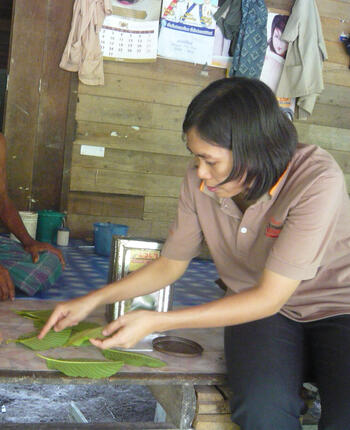
Photos (left to right): A man holds up a kratom leaf. / Saingam examines kratom leaves as part of her research to understand illegal cultivation practices.
What is kratom and why is it popular?
For nearly a century, the native people of Thailand have chewed kratom. It is a leaf that grows on trees resembling a coffee plant. Historically, kratom was used to reduce strain following physical labor, to be able to work harder and longer, and to better tolerate heat and sunlight. Kratom is also embedded in Thai culture and given as a spiritual offering in religious ceremonies. My field research in the southern province of Nakhon Si Thammarat has shown that these motivations are still true today.
Within the past seven years, kratom use has skyrocketed and people are using it in increasingly harmful ways. Chewing kratom is not immediately harmful to health, but combining it with other substances is. This is the recent trend. Users have created new ways to consume it such as in a drink known as a ‘4x100.’ It contains boiled kratom leaves, cough syrup and soft drinks. Additional methamphetamines and benzodiazepines are sometimes added to that mixture.
What strategies must be employed to control substance abuse?
The first step is to realize that the patterns of substance abuse are specific to each location therefore solving the problem must also be. Drug usage is also dynamic. Placing hard control measures on one substance often provokes the emergence of another in its place therefore a holistic approach is important.
Thailand should employ multiple strategies toward effective prevention and control of substance abuse. These strategies include examining the problem and creating policies from an economic perspective (supply and demand), an institutional perspective (national and international drug control cooperation), and a social perspective (structural supports for recovered addicts and mobilization of public participation).
What is the Thai government doing to address the drug problem, and what could they be doing better?
Politicians in Thailand must do a better job at representing the people. Government health workers are often gathering information, assessing needs, and reporting findings to politicians, but these needs are not being accurately addressed. An example of this is politicians ordering to cut down kratom trees – a public display that does not get at the root cause of the problem. The reality is that drug users will quickly find substitutes. According to my study, of the regular users that stopped using kratom, more than 50 percent turned to alcohol instead and did so on a daily basis. This is merely a shift from one substance to another.
On the upside, a crop substitution program created under King Bhumibol Adulyadej offers a successful working model. The program works to replace opium poppy farming with cash crop production. It began in 1969 and is cited for helping an estimated 100,000 people convert their drug crop production to sustainable agricultural activities. Crops cultivated can be sold for profit in nearby towns. The program has also introduced a wide variety of crops and discouraged the slash-and-burn technique of clearing land. It is win-win because it stymies drug trade and provides economic opportunity while also being ecologically sound. This type of program should continue to be scaled up.
Can this model be co-opted elsewhere? What lessons from other countries could inform Thailand’s approach?
Yes, the model could plausibly be implemented in other areas in Thailand and in other Southeast Asian nations.
I think a judicial mechanism such as the kind seen in France could benefit the rural areas in Thailand. The French government has established centers across the country that act as branches of the court that try delinquency cases of minor to moderate severity, and also recommend support services for drug users. Members of the magistrate and civil society actors manage center operations thus placing some responsibility back onto the local community.
I believe an opportunity also exists for Thailand to legalize kratom. Legalization would show a respect for the cultural tradition of chewing kratom leaves and allow the government to suggest safer ways of using it. Bolivia has created a successful model of this through its legalization of coca leaves. Coca in its distilled form is cocaine, but left as a leaf, it is not a narcotic. Indigenous peoples are allowed to chew coca leaves. The government policy is being credited for a decrease in cocaine production as well.
Hero Image

All News button
1
Darika Saingam
Encina Hall E301616 Serra StreetStanford, CA94305-6055
(650) 724-5321
(650) 723-6530
0
darika@stanford.edu
darika_saingam.jpg
Ph.D.
Darika Saingam joins the Walter H. Shorenstein Asia-Pacific Research Center as the Developing Asia Health Policy Postdoctoral Fellow for the 2015-16 year. Saingam’s research interests are public health, substance abuse, drug policy and Southeast Asia. While at Shorenstein APARC, she will research the evolution of substance-abuse control measures and related policy in Thailand. Saingam seeks to identify potentially effective policy directions suitable for Thailand, and other developing countries in Southeast and East Asia.
Saingam completed her doctorate in epidemiology at the Prince of Songkla University in 2012, and has served as a researcher at the University’s epidemiology unit since, as well as a researcher at the Thailand Substance Abuse Academic Network since 2014.
2015-16 Developing Asia Health Policy Postdoctoral Fellow
Pavin Chachavalpongpun
Encina Hall E301616 Serra StreetStanford, CA94305-6055
(650) 724-5595
(650) 723-6530
0
pavin@stanford.edu
Pavin_Chachavalpongpun.png
Ph.D.
Pavin Chachavalpongpun joins the Walter H. Shorenstein Asia-Pacific Research Center (Shorenstein APARC) during the 2015-2016 academic year from the Center for Southeast Asian Studies at Kyoto University, where he serves as associate professor.
His research interests include Thailand's domestic political and international relations, particularly the role of the Thai monarchy in the political domain in the past decades; politics of Myanmar and Indochinese states; politics of ASEAN; and the concept of nationalism and its relevance to domestic and foreign policy. During his time at Shorenstein APARC, Pavin will work on the concept of neo-royalism and the future of the Thai monarchy--an issue which is important at this critical juncture of the royal succession in Thailand. Pavin is the author of two books: "A Plastic Nation: The Curse of Thainess in Thai-Burmese Relations" and "Reinventing Thailand: Thaksin and His Foreign Policy". He is also a chief editor of the online journal Kyoto Review of Southeast Asia. After the coup of 2014, Pavin was twice summoned by the Thai military for his critical comments on its political intervention. Denying the legitimacy of the coup, Pavin rejected the summons. Shortly afterwards, a warrant was issued for his arrest and his passport was revoked. This situation forced him to apply for a refugee status with Japan. Pavin received his PhD from the School of Oriental and African Studies, University of London. He earned his BA from the Department of Political Science, Chulalongkorn University, Thailand.2015-16 Lee Kong Chian NUS-Stanford Distinguished Fellow on Contemporary Southeast Asia
Crossing Heaven's Border
Paragraphs

From 2007 to 2011 South Korean filmmaker and newspaper reporter Hark Joon Lee lived among North Korean defectors in China, filming an award-winning documentary on their struggles. Crossing Heaven’s Border is the firsthand account of his experiences there, where he witnessed human trafficking, the smuggling of illicit drugs by North Korean soldiers, and a rare successful escape from North Korea by sea.
As Lee traces the often tragic lives of North Korean defectors who were willing to risk everything for their hopes, he journeys to Siberia in pursuit of hidden North Korean lumber mills; to Vietnam, where defectors make desperate charges into foreign embassies; and along the 10,000-kilometer escape route for defectors stretching from China to Laos and to Thailand.
Desk, examination, or review copies can be requested through Stanford University Press.
All Publications button
1
Publication Type
Books
Publication Date
Book Publisher
Shorenstein APARC
Book Publisher External URL