Authors
Lisa Griswold
News Type
News
Date
Paragraphs

Myanmar's opening to the outside world and the country's tentative steps from military rule to democracy has captivated many observers of the region. But Aung Zaw, an exiled Burmese journalist pushing for democratic change, warns that the image of rapid reform does not necessarily match reality these days.

“What we see now is serious backsliding,” Zaw told a packed house at the Bechtel Conference Center on March 6.  “The changes have become more superficial; the changes are not real.” 

Zaw, the founding editor of The Irrawaddy newsmagazine, delivered these remarks at Stanford upon receiving the Shorenstein Journalism Award. This annual award is conferred upon a journalist who promotes mutual understanding between the U.S. and Asia, and also honors Asian journalists who have been at the forefront of the effort to create an independent media in the Asia-Pacific.

Zaw joined scholars Donald K. Emmerson and Daniel C. Sneider from the Walter H. Shorenstein Asia Pacific Research Center in the Freeman Spogli Institute for International Studies and Yale University’s Nayan Chanda at a lunchtime panel discussion of the question – “Burma's Democracy: How Real?

Zaw, who was forced into exile after the abortive democratic revolt of 1988, described Myanmar’s dynamic history as “up and down.” During the long period of military rule in the country, “Burma was a pariah,” he observed. The military government repressed all opposition, enriching itself while Burma slide into deep poverty, while the country was largely cut off from the outside world except for a trickle of tourists. But the regime made a clear decision to open the doors to the outside and, in response to international and domestic pressure, take tentative steps toward political change, including releasing political prisoners and allowing the media to operate more freely.

The panelists agreed that the uprisings within Burma, such as the Buddhist monk led revolt in 2007, and the leadership of Burmese human rights activist Aung San Suu Kyi pushed the regime toward change. In addition, Chanda and Emmerson pointed to the geopolitics of Burma, the desire of the regime to free itself from isolation and dependence only on China and North Korea as backers.

Zaw credited these changes with bringing some semblance of “communal balance” to the society. Emmerson argued, however, that the West has colored their view of Burma with a romantic notion of democratization that tends to overlook the still tentative, and somewhat transient, nature of the changes to date.

“The regime has carefully manipulated… international [public] opinion in trying to open the doors to the international community,” Zaw said. Especially in the past year, there have been efforts by the government to curb public protest and censorship has become pervasive once again. A commentary piece written by Zaw provides an analysis of the contemporary media environment in Myanmar.

The panel members pointed in particular to the rise of tensions between the Buddhist Burmese majority and ethnic and religious minorities in the country. In particular, they expressed concern over the discrimination against and violence suffered by minority Muslims, the ethnic Rohingya who live along the border with Bangladesh, often taking place with the complicity of government officials, or at least with their indifference. They suggested the government played upon anti-Muslim feelings to boost its popularity among the majority Buddhist populace.

With elections looming in 2015, the government may now feel it has been “moving too fast” toward reform and begun to ratchet back, warned Zaw. Conservative factions in Myanmar’s leadership who fear losing power may be gaining influence.

Nayan Chanda, the former editor of the Far Eastern Economic Review and a previous recipient of the Shorenstein Award, pointed to Myanmar’s long tradition of despotism. “Burmese rulers have had a way of governing the country that is still present among the generals we see in Burma today,” he said.

Emmerson focused his remarks on the significance of the changes in Burma to American foreign policy in the region. The Burmese shift away from Chinese domination and its opening to the West has been seen as a key part of the so-called U.S. “pivot” to Asia and its attempts to balance Chinese influence in East Asia. These changes allowed Myanmar to assume its role as chairman of the Association of Southeast Asian Nations (ASEAN), an annual rotation in leadership. But it is far from clear if the Burmese leadership is prepared to go toward a deeper democratic transformation. The upcoming presidential elections in 2015 remain an uncertainty. Aung San Suu Kyi is still constitutionally barred from running for president but she has been allowed to resume a powerful role in the system itself, no longer simply a “Joan of Arc” symbol of purity sitting on the outside.

In all this, the role of a free press in Burma is even more vital than ever. After his arrest in 1988 for his role in the uprising against General Ne Win’s regime, Zaw had to flee to neighboring Thailand where he has spent 25 years in exile. Zaw created The Irrawaddy, an émigré-based publication that is widely acclaimed for its on-the-ground analysis of Myanmar. In 2012, the publication reopened offices in Burma. 

The Irrawaddy’s diverse contributors offer an independent platform to unravel the complex developments within the country. The Shorenstein Award given to Zaw recognizes his history of leadership as a journalist in Burma.

“It is very exciting for us this year to give this award to Aung Zaw,” said Sneider, a member of the jury that selects the awardees. “He has been intimately involved in the process of not only creating independent media for Burma but also in the process of independent change itself, starting with his own activism in the 1980s.”

Zaw received the award at a dinner ceremony later on March 6 attended by students, faculty and prominent members of the Stanford community. “I feel very humbled,” Zaw told the Voice of America in an interview. “It is an acknowledgement to our work, our commitment and our independent journalism as we try to make things different [in Myanmar].”

The video and transcript of the event, and the original press release on Zaw being named the 2013 Award recipient are posted below.


An article was published by The Irrawaddy on Zaw’s acceptance of the award. Interviews conducted with Voice of America's Kyaw Zan Thaw in Burmese and Kaye Lin in English aired internationally on March 13 and are posted below. An interview was also conducted with LinkAsia and is scheduled to air in the upcoming week and will be subsequently posted online. 
 

Hero Image
Zaw Profile LOGO
All News button
1
News Type
News
Date
Paragraphs

Warning against the “dangers of excessive hubris,” former U.S. Ambassador Stephen W. Bosworth emphasized the intricacies and complexity of creating American foreign policy and called for the government to exercise greater restraint and better understand the countries it engages with.

The veteran diplomat and visiting lecturer at Stanford’s Freeman Spogli Institute for International Studies called for the United States to exercise greater self-restraint and better understand the history and current circumstances of countries it engages with. 

“The making of U.S. policy is inherently a very, very difficult enterprise,” said Bosworth, positioned at Stanford for winter quarter.

“The issues tend to be complex, and they frequently pose moral as well as political choices,” he said. “I found that perfection is usually the enemy of the good in the making of foreign policy and is, for the most part, unattainable.”

Foreign policy can be ambiguous and difficult at times; it is a process that can be compared to gardening because “you have to keep tending to it regularly,” Bosworth said, referencing former Secretary of State George Shultz’s well-known analogy.

Bosworth, who served for five decades in the U.S. government and for 12 years as dean of Tuft’s Fletcher School of Law and Diplomacy, delivered these thoughts in the first of three public seminars this quarter. He is the Frank E. and Arthur W. Payne Distinguished Lecturer in residence at FSI’s Walter H. Shorenstein Asia-Pacific Research Center (Shorenstein APARC).

He cautioned against America’s tendency to revert to military power when crisis occurs. “I believe that when at all possible, we need to choose diplomacy over force,” Bosworth asserted, “although it is sometimes true that diplomacy backed by potential force can be more effective.” 

Citing Afghanistan, Iraq and Southwest Asia, Bosworth noted these among other examples as situations of excessive power projected by the American foreign policy arm. In some cases, pride may have gotten the better of policymakers who sometimes “want to be seen as doers and solvers.”

Bosworth pointed out that the nature of our actions speaks loudly – both at home and abroad – thus sensitivity and sincerity are important in any international exchange.

Since the Vietnam War, American values and the push for democracy are not always well received by other countries. And there’s often good reason for that, he said.

“It is awkward for the U.S. to campaign for more democracy elsewhere when our own model seems to have increasing difficulty in producing reasonable solutions for our own problems,” he said.

Democracy is “not a cure-all” for every nation and this is reflected in the amended model adopted by countries such as Singapore, Indonesia and Burma. However, Bosworth said he remains confident that the American democratic system “will prevail and eventually work better than it seems to be working now.”

Bosworth will explore the challenges of maturing democracies in Japan and South Korea and negotiations and management of relations with North Korea in his two other Payne lectures. The Payne Lectureship brings prominent speakers to campus for their global reputation as visionary leaders, a practical grasp of a given field, and the capacity to articulate important perspectives on today’s global challenges.

Bosworth entered the Foreign Service in 1961, a difficult yet “exciting time to join the government,” he said.

“At the age of 21, I was the youngest person entering my class,” he said, “and of the 38 people, there were only two women…and were zero persons of color and only a handful who were not products of an Ivy League education.” The State Department of then is very different compared to the one that exists today; this signals positive, necessary change in the diplomatic corps.

Bosworth, having served three tours as a U.S. ambassador in South Korea (from 1997 to 2001); the Philippines (from 1984 to 1987); and Tunisia (from 1979 to 1981) and twice received the State Department’s Distinguished Service Award (in 1976 and 1986), has a long established career.

He brings great wisdom on foreign affairs given his extensive engagement as a practitioner and a writer, said former colleague and Shorenstein APARC distinguished fellow Michael H. Armacost.

“To say that Steve has had an extraordinarily distinguished career in the Foreign Service doesn't quite capture the range of his accomplishments, I can’t think of very many Foreign Service officers in this or any other generation that have left a footprint on big issues in three consecutive decades,” Armacost acknowledged. 

During his time at Stanford, Bosworth will hold seminars and mentor students who may be interested in pursuing a career in the Foreign Service, in addition to the two upcoming public talks.

A student seeking this very advice posed a question in the discussion portion following Bosworth’s talk.

Speaking to anyone considering a Foreign Service career, Bosworth said one must “think about it hard, and think again.” He said public service is a privilege, not so much a sacrifice as the typical notion holds. “It can be a great career as long as you have the right perspective on it,” he ended.

Hero Image
Bosworth speaking LOGO
All News button
1
-

The opening up of Myanmar (Burma) and the steps undertaken taken toward political reform in that formerly isolated dictatorship have been among Asia's most dramatic and least expected events.  But the establishment of full democracy is still on the agenda and faces many challenges.  How willing is the current government in Burma to allow a full and free exercise of political rights, including media freedom?  A panel of experts, including Aung Zaw, the editor and founder of The Irrawaddy and this year's recipient of the Shorenstein Award for Journalism in Asia, will address that question in discussing "Burma's Democracy:  How Real?"

Stanford University’s Walter H. Shorenstein Asia-Pacific Research Center (Shorenstein APARC) is pleased to announce Aung Zaw as the 2013 recipient of the Shorenstein Journalism Award. Zaw has been selected for his leadership in establishing independent media in Myanmar (Burma) and his dedication to integrity in reporting on Southeast Asia.

Image
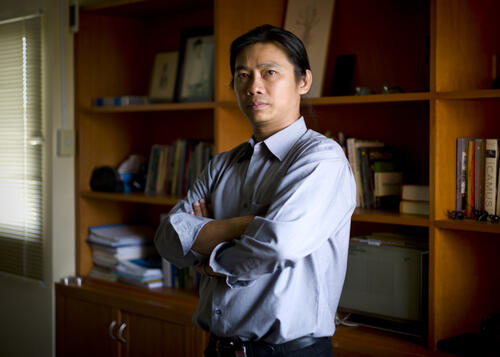
 Aung Zaw

Aung Zaw is the founding editor-in-chief and executive director of The Irrawaddy, an independent Burmese media organization operating in Myanmar and northern Thailand. Zaw has been an active campaigner for democratic reform in Burma/Myanmar over the last two decades. He was awarded the 2010 Prince Claus Fund Award for journalism along with two journalists from Iran and Cuba – and is recognized for his active dedication to achieving democratic governance in Burma and his work to uphold press freedom.

Zaw studied Botany at Rangoon University. As a student activist in Burma, he was part of the 1988 protests in Rangoon against the Burmese military regime of General Ne Win. He was arrested and detained for a week in Rangoon’s notorious Insein prison where he was severely tortured during interrogation about his pro-democracy activities. Upon release Aung Zaw continued to work with the resistance movement until the military staged a coup in September that year and he was forced to leave the country for neighboring Thailand.

Two years later, Aung Zaw founded the Burma Information Group (BIG) in Bangkok, to document human rights violations in Burma. He began to write political commentaries for national newspapers in Thailand and internationally, and in late 1993 launched The Irrawaddy News Magazine in Bangkok, covering Burma affairs. He worked in Bangkok for two years producing The Irrawaddy Magazine until relocating to the more secure position in Chiang Mai in the north of Thailand.

In February 2012, Aung Zaw was able to return to his homeland for the first time in more than 20 years for a temporary visit as an independent journalist. By the end of 2012, The Irrawaddy was able to establish a media and news office in central Yangon, returning to Burma/Myanmar to practice independent journalism, whilst retaining a regional office in Thailand.

In 2013, the government lifted ban on The Irrawaddy and other exiled websites, the Irrawaddy English magazine and the Irrawaddy Dateline Current Affairs TV program is available for audiences in Myanmar. Aung Zaw writes for New York Times, International Herald Tribune, Time, The Guardian, Bangkok Post, The Nation and several publications in the Europe. His interviews have also appeared on CN, BBC and Al Jazeera. He is the author of the Face of Resistance and is a recent Visiting Scholar at UC Berkeley, School of Journalism.

Bechtel Conference Center

Aung Zaw 2013 Journalism Prize Winner and Founder and Editor, The Irrawaddy News Magazine Panelist
Nayan Chanda Director of Publications and the Editor of YaleGlobal Online Magazine Panelist Yale Center for the Study of Globalization
0
Senior Fellow Emeritus at the Freeman Spogli Institute for International Studies
Affiliated Faculty, CDDRL
Affiliated Scholar, Abbasi Program in Islamic Studies
aparc_dke.jpg PhD

At Stanford, in addition to his work for the Southeast Asia Program and his affiliations with CDDRL and the Abbasi Program in Islamic Studies, Donald Emmerson has taught courses on Southeast Asia in East Asian Studies, International Policy Studies, and Political Science. He is active as an analyst of current policy issues involving Asia. In 2010 the National Bureau of Asian Research and the Woodrow Wilson International Center for Scholars awarded him a two-year Research Associateship given to “top scholars from across the United States” who “have successfully bridged the gap between the academy and policy.”

Emmerson’s research interests include Southeast Asia-China-US relations, the South China Sea, and the future of ASEAN. His publications, authored or edited, span more than a dozen books and monographs and some 200 articles, chapters, and shorter pieces.  Recent writings include The Deer and the Dragon: Southeast Asia and China in the 21st Century (ed., 2020); “‘No Sole Control’ in the South China Sea,” in Asia Policy  (2019); ASEAN @ 50, Southeast Asia @ Risk: What Should Be Done? (ed., 2018); “Singapore and Goliath?,” in Journal of Democracy (2018); “Mapping ASEAN’s Futures,” in Contemporary Southeast Asia (2017); and “ASEAN Between China and America: Is It Time to Try Horsing the Cow?,” in Trans-Regional and –National Studies of Southeast Asia (2017).

Earlier work includes “Sunnylands or Rancho Mirage? ASEAN and the South China Sea,” in YaleGlobal (2016); “The Spectrum of Comparisons: A Discussion,” in Pacific Affairs (2014); “Facts, Minds, and Formats: Scholarship and Political Change in Indonesia” in Indonesian Studies: The State of the Field (2013); “Is Indonesia Rising? It Depends” in Indonesia Rising (2012); “Southeast Asia: Minding the Gap between Democracy and Governance,” in Journal of Democracy (April 2012); “The Problem and Promise of Focality in World Affairs,” in Strategic Review (August 2011); An American Place at an Asian Table? Regionalism and Its Reasons (2011); Asian Regionalism and US Policy: The Case for Creative Adaptation (2010); “The Useful Diversity of ‘Islamism’” and “Islamism: Pros, Cons, and Contexts” in Islamism: Conflicting Perspectives on Political Islam (2009); “Crisis and Consensus: America and ASEAN in a New Global Context” in Refreshing U.S.-Thai Relations (2009); and Hard Choices: Security, Democracy, and Regionalism in Southeast Asia (edited, 2008).

Prior to moving to Stanford in 1999, Emmerson was a professor of political science at the University of Wisconsin-Madison, where he won a campus-wide teaching award. That same year he helped monitor voting in Indonesia and East Timor for the National Democratic Institute and the Carter Center. In the course of his career, he has taken part in numerous policy-related working groups focused on topics related to Southeast Asia; has testified before House and Senate committees on Asian affairs; and been a regular at gatherings such as the Asia Pacific Roundtable (Kuala Lumpur), the Bali Democracy Forum (Nusa Dua), and the Shangri-La Dialogue (Singapore). Places where he has held various visiting fellowships, including the Institute for Advanced Study and the Woodrow Wilson International Center for Scholars. 


Emmerson has a Ph.D. in political science from Yale and a BA in international affairs from Princeton. He is fluent in Indonesian, was fluent in French, and has lectured and written in both languages. He has lesser competence in Dutch, Javanese, and Russian. A former slam poet in English, he enjoys the spoken word and reads occasionally under a nom de plume with the Not Yet Dead Poets Society in Redwood City, CA. He and his wife Carolyn met in high school in Lebanon. They have two children. He was born in Tokyo, the son of U.S. Foreign Service Officer John K. Emmerson, who wrote the Japanese Thread among other books.

Selected Multimedia

Date Label
Donald K. Emmerson Senior Fellow at FSI, Emeritus; Affiliated Faculty, CDDRL; Affiliated Scholar, Abbasi Program in Islamic Studies and Director, Southeast Asia Forum Panelist Stanford University
Daniel C. Sneider Associate Director for Research, Shorenstein Asia-Pacific Research Center Moderator Stanford University
Panel Discussions
News Type
News
Date
Paragraphs

FOR MORE INFORMATION, CONTACT: Lisa Griswold

STANFORD, California – Stanford University’s Walter H. Shorenstein Asia-Pacific Research Center (Shorenstein APARC) is pleased to announce Aung Zaw as the 2013 recipient of the Shorenstein Journalism Award. Zaw has been selected for his leadership in establishing independent media in Myanmar (Burma) and his dedication to integrity in reporting on Southeast Asia. 

Launched in 2002, the Shorenstein Journalism Award recognizes outstanding journalists who are leaders in constructing a new role for reporting on Asia, including incorporation of Internet-based journalism and social media. The award was originally designed to honor distinguished American journalists for their work on Asia, but since 2011, Shorenstein APARC re-envisioned the award to encompass distinguished Asian journalists who pave the way for press freedom, and have aided in the growth of mutual understanding between Asia and the United States. Shorenstein APARC is delighted to recognize Zaw as the first Burmese recipient of the award.

Aung Zaw’s commitment to independent journalism flows from his long involvement in the struggle against authoritarian military rule in Myanmar and his engagement in the movement for democracy in that Southeast Asian nation. For two decades, Aung Zaw was an active participant in the resistance to military rule and the push for greater press freedom. In 1988, he participated in the mass protests of students, monks, housewives and ordinary citizens against the regime of General Ne Win.

Zaw was arrested, interrogated, and held in the Insein prison for his pro-democracy activities. Upon release, Zaw continued to work with the resistance movement until the military staged a coup in September of that year, whereupon he was forced into exile in neighboring Thailand. From there, he wrote political commentaries for various media outlets and launched The Irrawaddy magazine with a group of fellow Burmese exiles.

Upon the selection of Aung Zaw as the 2013 Shorenstein Journalism Award recipient, jury member Nayan Chanda of Yale University’s Center for the Study on Globalization said:

 “In the darkness that descended over Burma in the years following the brutal military crackdown on the democracy movement, former student leader Aung Zaw was one of the few who kept a flickering lamp burning from exile. Nothing was more important than to get news out of the country where fear stalked and jails overflowed with detainees. From his exile perch in Thailand, Aung Zaw published The Irrawaddy which emerged as an important news magazine not only for a muzzled Burma, but it also covered stories from all over Southeast Asia that were often left out by mainstream media. Aung Zaw's contribution to bringing original news and analysis from Southeast Asia to the world cannot be overestimated.” 

The Irrawaddy newsmagazine is published in both English and Burmese and features in-depth analysis and interviews with experts from Myanmar and contributors from around the world. As the first independent publication in Myanmar, The Irrawaddy remains a significant resource for current news on the dynamic political and economic environment. In 2012, Zaw returned to his homeland of Myanmar for the first time in 24 years and established a local office for The Irrawaddy in Yangon. This past year, the Burmese government lifted the ban on major media, allowing for readership and distribution of The Irrawaddy throughout the country.

In addition to managing The Irrawaddy, Zaw is a contributor for the New York Times, International Herald Tribune, The Guardian, Bangkok Post, The Nation, and several other publications based in Europe. He has been featured on interviews on CNN, BBC, and Al Jazeera. He is the author of Face of Resistance and has written publications distributed through the Irrawaddy Publishing Group, including ten-installments of The Dictators, a series that analyzes the lives and careers of Myanmar’s main military chiefs and their cohorts.

In 2010, Zaw was awarded the prestigious Price Claus Award for Journalism, which honors journalists who reflect progressive approaches to culturally focused journalism in developing countries. Zaw is currently a visiting scholar at Graduate School of Journalism at the University of California, Berkeley.

On March 6, 2014, Zaw will visit Stanford University to take part in a lunchtime panel discussion on the future of democracy in Myanmar. Zaw will receive the award at a dinner ceremony where he will deliver a talk on his work as a journalist and the role of the media in democratization of Myanmar. 

ABOUT THE AWARD

The Shorenstein Journalism Award honors a journalist not only for their distinguished body of work, but also for their promotion of free, vibrant media and for the future of relations between Asia and the United States. The award, which carries a prize of $10,000, is presented to a journalist who consistently creates innovative approaches to unravel the complexities of Asia to readers, among them the use of the Internet and how it can act as a catalyst for change.

The award was named after Walter H. Shorenstein, the philanthropist, activist, and businessman who endowed two institutions that are focused respectively on Asia and the press. The Shorenstein Asia-Pacific Research Center in the Freeman Spogli Institute for International Studies at Stanford University and the Joan Shorenstein Center on Press, Politics, and Public Policy in the Kennedy School of Government at Harvard University. The award honors Shorenstein’s legacy and endows rising journalists with a grant to continue their work.

Originally created to identify journalists based in the U.S. reporting on Asia, the Shorenstein Journalism Award now also recognizes Asian journalists who report on Asian affairs with readers in the U.S. and Asia. Past recipients have included: Barbara Demick of the Los Angeles Times (2012), Caixin Media of Caixin Weekly/Caijing Magazine (2011), Barbara Crossette of The Nation (2010), Seth Mydans of the New York Times (2009), Ian Buruma (2008), John Pomfret (2007), Melinda Liu of Newsweek and The Daily Beast (2006), Nayan Chanda (2005), Don Oberdofer (2004), Orville Schell(2003), and Stanley Karnow (2002). 

For the 2013 award, the distinguished selection jury includes:

Nayan Chanda is the director of publications and the editor of YaleGlobal Online Magazine at the Yale Center for the Study of Globalization. For nearly thirty years, Chanda was at the Hong Kong-based magazine, Far Eastern Economic Review. He writes the ‘Bound Together’ column in India’s BusinessWorld and is the author of Bound Together: How Traders, Preachers, Adventurers and Warrior Shaped Globalization. Chanda received the Shorenstein Journalism Award in 2005.

Susan Chira is the assistant managing editor for news and former foreign editor of the New York Times. Chira has extensive experience in Asia, including serving as Japan correspondent for the Times in the 1980s. During her tenure as foreign editor, the Times twice won the Pulitzer Prize for international reporting (2009 and 2007).

Donald K. Emmerson is a well-respected Indonesia scholar and director of Shorenstein APARC’s Southeast Asia Forum and a research fellow for the National Asia Research Program. Frequently cited in international media, Emmerson also contributes to leading publications, such as Asia Times and International Business Times.

Orville Schell is the Arthur Ross director at the Asia Society of New York’s Center on U.S.-China Relations and former jury member for the Pulitzer Prize for international reporting. Schell has written extensively on China and was awarded the 1997 George Peabody Award for producing the groundbreaking documentary the Gate of Heavenly Peace. He received the Shorenstein Journalism Award in 2003.

Daniel C. Sneider is the associate director for research at Shorenstein APARC and was a research fellow at the National Bureau for Asian Research. Sneider frequently contributes to publications such as Foreign Policy, Asia Policy, and Slate and has three decades of experience as a foreign correspondent and editor for publications including the Christian Science Monitor and the San Jose Mercury News.

Hero Image
Aung Zaw Official Logo 2
All News button
1
Authors
News Type
Q&As
Date
Paragraphs

For several decades, Southeast Asia’s tracts of dense, old-growth rainforest have served as fertile ground for lumber, and much land has been converted to agriculture. Now, palm oil plantations are being planted where forests once stood.

In 2011, Indonesia, one of the region’s most prosperous countries, instituted a two-year moratorium on clearing new areas of forest, which is set to expire this May and has been criticized as having several loopholes. Other countries, including Cambodia and Myanmar, are losing forests rapidly.

Out of concern for climate change, international initiatives such as Reduced Emissions from Deforestation and forest Degradation (REDD+) have aimed to promote conservation and sustainable development in countries with significant forest cover. But these efforts do not always support local needs, and can inadvertently have negative impacts.

Tim Forsyth, a Lee Kong Chian NUS-Stanford Distinguished Fellow, speaks about the gap between conservation efforts and economic and social development in Southeast Asia. He is visiting Stanford this quarter from the London School of Economics and Political Science where he is a reader in environment and development at the Department of International Development.

What major types of forest management do we see across Southeast Asia today?

A number of countries have put laws in place to restrict illegal logging, and have established national park areas. These are usually old-growth rainforests that restrict logging and agriculture. The problem with national parks is that they put so many restrictions on land use that the vulnerable populations living around them either suffer or are forced to cut other trees. I have spent some years working in poorer villages in Indonesia and Thailand on the edge of protected forests, and usually conservation policies avoid the fact that people need to get livelihoods somehow. Government policy should acknowledge how these people are vulnerable to changes in crop prices and the availability of land, or else these people might be forced into breaking the rules of national parks.

There is also production forest, which usually includes forest plantations. These can include softwoods such as pine, or hardwoods such as teak — and increasingly oil palm for food and biofuels. Forest plantations are attractive to governments and businesses because they earn money and can provide timber for construction and exports. Sometimes, plantations also gain carbon credits, although this is not a lot of money so far. In terms of conservation, destroying old-growth forest and replacing it with a monoculture plantation is not good for biodiversity. It also does not benefit those local people who want to harvest forest products or use part of the land for agriculture.

Finally, there are community forests that are supposed to be places where people can grow food, live, and have forest cover. The definition of “community forest,” however, varies from place to place. In Thailand, for example, the way the government defines it is not very different from a conservation area, and consequently there is not much space for agriculture. The Philippines, on the other hand, is more decentralized and local people can shape the nature of the forest landscape more. Corruption, however, is a problem.

Is there an ideal model that successfully supports sustainable development? How does your research approach this issue?

There has been much progress in collaborations that involve willing governments, international advisors, and local actors — often in accordance with an international agreement such as the Convention on Biological Diversity. These collaborations are more useful than a single actor working alone, and they acknowledge a wider range of objectives.

A new initiative is Reducing Emissions from Deforestation and forest Degradation (REDD+). This is meant to encourage governments to slow down deforestation by rewarding them financially through carbon credits. But REDD+ has a number of challenges. The main problem is that the value of the credits is so low at the moment. REDD+ also overemphasizes forest cover, rather than forest quality. This means that if a satellite image of a country shows a lot of forest cover, that is good according to REDD+. But this gives no indication as to the biodiversity or the diversity of livelihoods inside a forest. It is a green light to all of the people who want fast-growing tree plantations, which makes them money and supplies them with wood for construction. In addition, it keeps a government happy because it supplies their country with timber and tax revenue, but this is not necessarily what you would call sustainable development.

There are elements of good models in different places, and it really depends on one’s viewpoint. Nepal offers a good example of community forestry because, in principle, it aims to engage local people more effectively and equally, and so can combine local development with the protection of national forests. From a development perspective, some forms of conservation can hurt poorer people and actually undermine conservation efforts. Therefore, in my work, I try to promote policy that acknowledges the needs of the more vulnerable populations. My research tries to make climate change policy more relevant to development processes in Southeast Asia. In my current project, I am seeing how policy recommendations about forests can be reshaped and reinterpreted locally in developing countries in order to address local interests. My goal is to understand how expert knowledge about climate change can be governed more effectively in order to enhance both development and conservation in Asia with better outcomes for everybody.

Image
What can people do in their everyday lives to help combat climate change?

The practical problem of dealing with forest destruction and climate change in Southeast Asia is also a function of social and economic trends. As countries become more prosperous, more and more people live in megacities, drive cars, live in air-conditioned apartments, and frequent shopping malls.

A couple of years ago in Bangkok, I took lots of photographs of t-shirts printed with global warming messages and of people carrying reusable bags. When I was there recently, all of these things had disappeared. In other words, there is a tendency for people to think of conservation efforts as a fashion trend.

I do not think that any city in Asia is doing enough. We have to start planning cities in ways that use fewer greenhouse gases, and also to encourage people to realize that they can be real agents of change. At the moment, many urban citizens believe they can implement climate change policy by managing rural and forested landscapes. Instead, they need to realize the problems of these approaches, and to see what they can do themselves.

Hero Image
Sumatra TF compressed Mar07 LOGO
Tim Forsyth stands in a cleared section of national parkland in Sumatra, Indonesia.
Courtesy Tim Forsyth
All News button
1
-

Since the resignation of Indonesia’s authoritarian president Suharto in 1998, the country has made great strides in consolidating a democratic government. But it is by no means a model of tolerance. The rights of religious minorities are routinely trampled. Regulations against blasphemy and proselytizing are routinely used to prosecute minorities including atheists, Ahmadiyah, Bahais, Christians, and Shias. As of 2012 Indonesia had over 280 religiously motivated regulations restricting minority rights. 

Hard-line groups such as the Islam Defenders Front use narrow interpretations of local and national legislation as a key tool to suppress minorities. In 2006 two ministers in President Susilo Bambang Yudhoyono's cabinet jointly decreed stricter legal requirements for building a house of worship. The decree is enforced only on religious minorities, often when Islamists pressure local officials to refuse to authorize the construction of Christian churches or to harass those worshiping in “illegal” churches. More than 430 such churches have been closed since. Violent attacks on religious minorities have become more frequent—from 216 cases in 2010, to 244 in 2011, to 264 in 2012. What explains this record of intimidation? Can it be stopped, and if so, how?

Andreas Harsono is widely published. He co-wrote In Religion's Name: Abuses against Religious Minorities in Indonesia (Human Rights Watch, 2013). His commentaries appeared in 2012 in outlets ranging from The New York Times to The Myanmar Times. Other writings include My “Religion” Is Journalism (2010), a collection of his Indonesian-language essays. In 2003 he helped establish the Pantau Foundation, which trains Indonesian journalists and defends media freedom. In 1999 he was awarded a Nieman Fellowship on Journalism at Harvard. He co-founded the Southeast Asian Press Alliance (Bangkok,1998), the Institute for the Study of the Free Flow of Information (Jakarta, 1995), and the Alliance of Independent Journalists (Jakarta, 1994). Earlier in his career he edited Pantau, a monthly Indonesian magazine on journalism and the media. Still earlier he worked as a reporter for The Nation (Bangkok) and The Star (Kuala Lumpur). He describes himself as a “journalist-cum-activist”—an identity richly illustrated by his career.

Related Resources

Indonesia: Religious Minorities Targets of Rising Violence (HRW, press release)

Indonesia: Rising Violence Against Religious Minorities (HRW, slideshow)

In Religion’s Name: Abuses Against Religious Minorities in Indonesia (HRW, report)

Daniel and Nancy Okimoto Conference Room

Andreas Harsono Indonesia Researcher Speaker Human Rights Watch
Seminars
Authors
News Type
Q&As
Date
Paragraphs

Fresh off his re-election victory, Barack Obama—the “Pacific President”—became the first president to visit Myanmar and Cambodia when he traveled to the Southeast Asian countries in November.

The trip highlights the region’s importance to the United States and signals that Obama’s second term will significantly focus on Asian trade, security and governance issues.

Eight Walter H. Shorenstein Asia-Pacific Research Center scholars sat down to discuss reactions to the election in Asia, and possible directions for U.S.-Asia relations and foreign policy during the second Obama administration.

How do you think countries in Asia view the outcome of the U.S. presidential election?

Karl Eikenberry: Overall, I think the countries of Asia will view President Obama’s reelection as positive, including because of the likely continuity in American policy toward the region.

Thomas Fingar: Beijing is troubled by Obama’s policies toward Asia because it sees them as directed against China and detrimental to its interests. But it was more troubled by Romney’s rhetoric during the campaign and probably interprets the election outcome as portending more continuity than change in U.S. policy. On balance, Beijing would rather deal with a devil it knows than cope with the uncertainties of a new U.S. administration.

Gi-Wook Shin: There was some concern in South Korea that Mitt Romney would have reverted to the hardline North Korea policy of George W. Bush’s first term. It would have created a bit of tension between the United States and South Korea, so in that context many Koreans are relieved that Obama was re-elected.

David Straub: Interestingly, President Obama personally is overwhelmingly popular in South Korea, but opinion polls show that most South Koreans continue to have complex, even critical views of American foreign policy under him.

Is President Obama likely to make major changes to Asia policy in his second term?

Eikenberry: Some of the people in key positions in the second Obama administration will change, including Secretary of State Hillary Clinton, but President Obama will of course be in office for four more years. He has been in Asia and knows the players. He has a clear strategy, so overall I expect continuity in his administration’s Asia policy. 

Michael H. Armacost: Events are really what shape foreign policy, and developments can occur that are hard to predict.

Henry S. Rowen: We tend to assume there is a continuity or gradual evolution to events, but there are also discontinuities. Something could happen in North Korea, for example. Unexpected events do happen from time to time, and the question is to try to figure out what they might be.

How could U.S. China policy develop?

Fingar: If President Obama has a clear plan for his second term, its goals and priorities are not yet clear to the Chinese. They worry that he may continue, or ratchet up, efforts they see as designed to constrain China’s rise. That said, they know that steady relations with the United States are essential for their own continued economic success and will respond positively to U.S. efforts to reduce distrust and enhance strategic stability. They will be troubled, however, by likely—and overdue—U.S. pressure to secure enforcement of China’s intellectual property and other trade-related commitments, and by likely U.S. efforts to deepen trade relations with other countries.

How could the possible election of a more conservative Japanese government during the second term of the Obama administration affect U.S.-Japan relations?

Armacost: The Trans-Pacific Partnership is an issue where we both have potential constraints on the extent to which Japan can be included, and it is not certain whether that will change very much under a Liberal Democratic Party (LDP) administration. Secondly, there is the longstanding Okinawa base issue. The LDP did not do anything about the base from 1996 onward, and that will probably also be the case if the LDP comes into power again. Finally, the United States will probably push Japan to take more of a stand on the ongoing Senkaku/Diaoyu Islands dispute with China.

After the failure of the United States’ Leap Day agreement with North Korea this year, and especially with the election of a new South Korean government next month, do you think that Obama’s second term could bring a renewed effort in diplomacy with North Korea?

Shin: It will be important to watch the outcome of the South Korean election. If the opposition party wins, they will move very quickly to engage with North Korea and the question then will be how the United States will respond.

Straub: In any event, the United States periodically reaches out to North Korea, to test it or just because time has passed. It may do so again after the election, particularly since there is a still fairly new leadership in North Korea, and also because there are elections or leadership changes in all the countries in the region. A number of the Six Party Talks member states, likely including South Korea, may also push harder for a resumption of those talks, which were never held during President Obama’s first term. But the Obama administration will be cautious because it was burned by North Korea’s breaking of their Leap Day agreement.

What direction might U.S. policy toward South Asia take?

Eikenberry: Our presence in Afghanistan is going to remain an important part of our overall military posture in Central, South, and East Asia. Managing properly the transition to full Afghan responsibility for their internal security will remain very high on President Obama’s agenda. At the same time, it will be important to keep some U.S. counterterrorism capability in Afghanistan, with the permission of the Afghan government.  

The nature of our security dialogue with Pakistan will change in emphasis from one that since 9/11 has mostly been informed by international terrorism. If we continue to make progress against Al Qaida, I expect our conversation with Pakistan will place more emphasis on its nuclear weapons programs and deployments. This is a potentially destabilizing issue and a concern not only to India, but also to China.

There has been a steady appreciation in the current and future importance of India. It will continue to be key in terms of the administration’s broader Asia-Pacific policy, but with a clear understanding of the limits of defense engagement with India.

Will the rebalancing, or “pivot,” toward Asia continue to be a central theme in U.S. foreign policy in Obama’s second term?

Eikenberry: Last year, when President Obama announced the rebalancing to Asia, I think this was done in part to signal to the world that we were putting the decade of costly wars in Iraq and Afghanistan behind us and looking forward—that the U.S. “was back.” I do not believe we will see any short-term major change in the deployment of military capabilities to the Asia-Pacific region, but the rebalancing could have profound consequences in the longer term. It will likely inform the prioritization of our future defense modernization and the development of military doctrine, which in turn drives procurement.

Donald K. Emmerson: Asia will continue to loom large on Washington's policy horizon. Although the pivot was originally all about security, the rebalance has since been "rebalanced" to encompass economic concerns. In July 2012 when Secretary Clinton went to Phnom Penh to attend the security-focused ASEAN Regional Forum, she brought along the largest delegation of American businesspeople ever to visit Southeast Asia. Their presence upgraded the profile of the U.S.-ASEAN Business Forum, which met the following day. The Obama administration has also taken the lead in promoting a Trans-Pacific Partnership to liberalize Asia-Pacific trade. 

President Obama's mid-November trip to Southeast Asia is further evidence of the pivot's continuation. In mid-November he will become the first U.S. president ever to have visited Myanmar and Cambodia. He will stop in Thailand as well. In Phnom Penh he will attend the U.S.-ASEAN Summit and the East Asia Summit. A key issue at these meetings will be the quarrels over sovereignty in the South China Sea between China, Taiwan, the Philippines, Vietnam, Malaysia, and Brunei. To the extent that the United States appears to be intervening against Beijing in these disputes, the "pivot" will be interpreted as a move to check China.

Armacost: There is no doubt that the Asia rebalancing strategy will endure, but the components and the apportionment of resources may change. President Obama may have initially overplayed engagement with China, and now he is probably hedging too much. But it does not change the fact that there is a lot at stake in terms of our relationship with China and that we have to engage the government. So it is a question then of where to strike a balance between hedging and engagement. After the election, there is also the question now of what happens to U.S. trade policy, and whether the Trans-Pacific Partnership will include India, China, and Japan.

Daniel C. Sneider: If you look at the president’s broader message and the one he carried in the campaign, he is very focused on restructuring and moving toward a more innovation-centered U.S. economy to develop new sources of employment. In addition to being concerned about climate change, he is also seriously looking at alternative energy resources as a source of real growth in the U.S. economy and as a way to move away from foreign fossil fuel dependency. Focusing more on the Asia-Pacific region is also quite consistent with these goals.

Hero Image
ElectionNight NEWSFEED
Confetti obscures the stage as U.S. President Barack Obama celebrates after winning the U.S. presidential election, Chicago, November 2012.
REUTERS/Philip Scott- Andrews
All News button
1
Authors
News Type
Q&As
Date
Paragraphs

Myanmar has made tremendous strides in its political and economic reform efforts since Thein Sein assumed the presidency in March 2011. But how stable is the country today, and how much has democracy taken root?

Donald K. Emmerson, director of the Southeast Asia Forum, recently discussed Myanmar’s path to democracy within the context of the country’s history, the current unrest in Rakhine State, and looking ahead to 2014 when Myanmar chairs the Association of Southeast Asian Nations and prepares for its next presidential election.

How committed is Myanmar’s current leadership to democratization?

We should understand that rather than a transformation to a true liberal democracy we are seeing political and economic reform, and also that there is a lot going on below the surface of the government that we cannot see.

President Thein Sein does appear genuinely committed to reform. During a meeting in August 2011, he and Aung San Suu Kyi worked out the plan in which she would run for election. That plan was critical for the reforms that have happened since, even if Aung San Suu Kyi and the National League for Democracy have no real legislative power.

At the end of the day, Myanmar’s critical institution is still the Tatmadaw, the military. The constitution grants the military a quarter of the seats in parliament and the right to nominate the most important of the country’s two vice presidents. In July, when the first vice president, long known as a hard-liner, stepped down due to “health reasons,” the president replaced him with an ostensibly more moderate vice admiral. In making this transfer, Thein Sein may have wanted to ensure a smooth continuation of the reforms.

Although public figures in Myanmar are politically diverse, nearly everyone now claims to be a “reformer" (considered good) as opposed to a “spoiler." This even applies to individuals from more conservative military backgrounds who may have taken part in past repression. If the country’s stability comes under serious threat, such men could revert to harder-line views.

Ultimately, apart from the balance of forces between reformers and spoilers inside the military, national stability is and will remain a key requisite to further liberalization and the consolidation of democracy.

How stable is Myanmar at present?

It depends on where you are. If you are in Naypyidaw, the capital, or in Yangon, caught up in the influx of investors, fortune-seekers, and diplomats, things probably look pretty good—opportunistic and venal, but dynamic and potentially beneficial. However, if you are in the restive north or in clash-ridden Rakhine State, which borders Bangladesh, then things probably look really bad.

Myanmar's many ethnic minorities tend to live on the periphery of the country. These border areas have been marked by endemic unrest and violence for a very long time. The latest flare-up in Rakhine is particularly unfortunate because it implicates a group that is identified both by ethnicity and by religion: the Rohingya. They are Muslims, and they have long been subject to discrimination at the hands of the Burman-Buddhist majority. According to some estimates, as many as 200,000 Rohingya have fled across the border to escape the latest violence. The government in majority-Muslim Bangladesh, unwilling to alienate Nyapyidaw by appearing to harbor the refugees, has begun to push some of them back into Myanmar.

Assuming that Bangladesh does not champion the Rohingyas’ cause, the violence in Rakhine State is unlikely to disrupt Myanmar’s stability on a national scale. But it will reinforce the “need” of spoilers in the Tatmadaw to enlarge the military’s presence and its budget to prevent the clashes from getting further out of hand. And that could strengthen the nationalist legitimacy of the military and its rationale for retaining a political role.

How could reform change Myanmar, and what are some potential challenges to that process?

The urgent priority for Thein Sein is performance. It is vital that he be able to point to the positive results of reform. In aid, investment, and trade, Western countries, China, India, and other outside powers can facilitate meaningful economic growth, or be seen as abetting cronyism and corruption. If the reforms foster a high-performing economy in which incomes start to go up and a middle class begins to form, one can be more optimistic about the future. But if official repression of the Rohyingya intensifies, if other ethnic-minority grievances are reignited, if fighting spreads, and the Tatmadaw regains its former clout, disillusioned Westerners will be less willing to work with a regime they no longer trust.

As we move toward 2015, the stakes for reform are rising. Myanmar is scheduled to hold elections in that year. Thein Sein will be 75 years old, and so will Aung San Suu Kyi. He has said that he will not run, although he could change his mind. She is constitutionally barred from running, and her party is not currently strong enough to push through an amendment. What if neither one is available to run? Who will continue the process of reform, if it is still under way?

If 2015 bears watching, so does 2014. For the length the latter year, Myanmar will chair the Association of Southeast Asian Nations (ASEAN). The authorities in Naypyidaw will host all of ASEAN's major meetings in 2014. Some of these gatherings will involve the United States and other countries at ministerial and head-of-state levels. In 2015 ASEAN will inaugurate a first-ever, Southeast Asia-wide ASEAN Community encompassing economic, political-security, and socio-cultural cooperation. In 2014 Myanmar will oversee the Community’s final preparation. If in the meantime an intra-military coup occurs and the winner cracks down, the leaders of democratic countries will think twice before agreeing to lend legitimacy to such a regime by attending its events.

Despite these uncertainties, there is a real chance that reforms will take root. Myanmar is not likely to become a fully stable and liberal democracy, at least not soon, but it could, with skill, help, and luck, become a “good enough” democracy of sorts.

Hero Image
AungSanSuuKyi NEWSFEED
Aung San Suu Kyi, chairperson of Myanmar's National League for Democracy, speaks at the World Economic Forum in June 2011. Myanmar has made tremendous strides in its political and economic reform efforts since last year.
World Economic Forum/ Sikarin Thanachaiary
All News button
1
Subscribe to Burma