-

This SEMINAR has been CANCELLED.

---------

Special Japan Studies Program and CEAS Series: Winter-Spring 2011-12

Looking Back, Looking Forward: Japan's March 11 Disasters One Year Later

The earthquake, tsunami, and nuclear disaster that hit Japan in March 2011 had both immediate catastrophic consequences and long term repercussions. Fundamental areas of Japan’s environment, economy, society, and collective national psyche were deeply affected, giving rise to a broad range of urgent issues. These include economic debates about how to meet the country’s energy demands with nuclear power plants offline, and what path to take for the country’s energy future; political crises, including criticism of the government’s disaster response; the psychological challenges of coping with trauma and grief; a daunting environmental clean-up; and social developments, including a new wave of civil society activism. This series brings together scholars and activists from a wide range of specialties to take stock of how the Japanese have been affected by the disasters, and to assess the efforts of residents, volunteers, and policy makers to recover and move forward.

Philippines Conference Room

Kiyoyuki Seguchi Research Director Speaker the Canon Institute for Global Studies; formerly head of the Bank of Japan’s Beijing Office
Seminars
-

PLEASE NOTE: VENUE CHANGED TO THE

OKSENBERG CONFERENCE ROOM, ENCINA HALL 3RD FLOOR

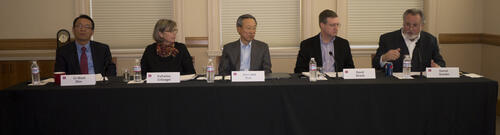
Kim Jong Il’s sudden death December 17, 2011 has prompted wildly varied speculation that the anachronistic North Korean state may collapse, reform, lash out at the South, or reunify with it. What does the dynastic leadership change to Kim’s young son Kim Jong Un really portend? Will the succession proceed smoothly? Will the new leadership undertake changes or reforms? Will ordinary North Koreans fare better? What about the prospects for inter-Korean relations and denuclearization? And how should the United States and other members of the international community respond? Walter H. Shorenstein Asia-Pacific Research Center experts will tackle these and other questions that bear not only on the future of the Korean Peninsula but on peace and stability in all of Northeast Asia.


Image

Oksenberg Conference Room

Shorenstein APARC
Encina Hall E301
616 Jane Stanford Way
Stanford, CA 94305-6055
(650) 724-8480 (650) 723-6530
0
Senior Fellow at the Freeman Spogli Institute for International Studies
Professor of Sociology
William J. Perry Professor of Contemporary Korea
Professor, by Courtesy, of East Asian Languages & Cultures
Gi-Wook Shin_0.jpg PhD

Gi-Wook Shin is the William J. Perry Professor of Contemporary Korea in the Department of Sociology, senior fellow at the Freeman Spogli Institute for International Studies, and the founding director of the Korea Program at the Walter H. Shorenstein Asia-Pacific Research Center (APARC) since 2001, all at Stanford University. In May 2024, Shin also launched the Taiwan Program at APARC. He served as director of APARC for two decades (2005-2025). As a historical-comparative and political sociologist, his research has concentrated on social movements, nationalism, development, democracy, migration, and international relations.

In Summer 2023, Shin launched the Stanford Next Asia Policy Lab (SNAPL), which is a new research initiative committed to addressing emergent social, cultural, economic, and political challenges in Asia. Across four research themes– “Talent Flows and Development,” “Nationalism and Racism,” “U.S.-Asia Relations,” and “Democratic Crisis and Reform”–the lab brings scholars and students to produce interdisciplinary, problem-oriented, policy-relevant, and comparative studies and publications. Shin’s latest book, The Four Talent Giants, a comparative study of talent strategies of Japan, Australia, China, and India to be published by Stanford University Press in the summer of 2025, is an outcome of SNAPL.

Shin is also the author/editor of twenty-seven books and numerous articles. His books include The Four Talent Giants: National Strategies for Human Resource Development Across Japan, Australia, China, and India (2025)Korean Democracy in Crisis: The Threat of Illiberalism, Populism, and Polarization (2022); The North Korean Conundrum: Balancing Human Rights and Nuclear Security (2021); Superficial Korea (2017); Divergent Memories: Opinion Leaders and the Asia-Pacific War (2016); Global Talent: Skilled Labor as Social Capital in Korea (2015); Criminality, Collaboration, and Reconciliation: Europe and Asia Confronts the Memory of World War II (2014); New Challenges for Maturing Democracies in Korea and Taiwan (2014); History Textbooks and the Wars in Asia: Divided Memories (2011); South Korean Social Movements: From Democracy to Civil Society (2011); One Alliance, Two Lenses: U.S.-Korea Relations in a New Era (2010); Cross Currents: Regionalism and Nationalism in Northeast Asia (2007);  and Ethnic Nationalism in Korea: Genealogy, Politics, and Legacy (2006). Due to the wide popularity of his publications, many have been translated and distributed to Korean audiences. His articles have appeared in academic and policy journals, including American Journal of SociologyWorld DevelopmentComparative Studies in Society and HistoryPolitical Science QuarterlyJournal of Asian StudiesComparative EducationInternational SociologyNations and NationalismPacific AffairsAsian SurveyJournal of Democracy, and Foreign Affairs.

Shin is not only the recipient of numerous grants and fellowships, but also continues to actively raise funds for Korean/Asian studies at Stanford. He gives frequent lectures and seminars on topics ranging from Korean nationalism and politics to Korea's foreign relations, historical reconciliation in Northeast Asia, and talent strategies. He serves on councils and advisory boards in the United States and South Korea and promotes policy dialogue between the two allies. He regularly writes op-eds and gives interviews to the media in both Korean and English.

Before joining Stanford in 2001, Shin taught at the University of Iowa (1991-94) and the University of California, Los Angeles (1994-2001). After receiving his BA from Yonsei University in Korea, he was awarded his MA and PhD from the University of Washington in 1991.

Selected Multimedia

Director of the Korea Program and the Taiwan Program, Shorenstein Asia-Pacific Research Center
Director of Stanford Next Asia Policy Lab, APARC
Date Label
Gi-Wook Shin Speaker

Shorenstein APARC
Encina Hall C324
616 Serra Street
Stanford University
Stanford, CA 94305-6055

(650) 724-6404 (650) 723-6530
0
2011-2012 Koret Fellow
ParkJoonWoo_Web.jpg

Joon-woo Park, a former senior diplomat from Korea, is the 2011–12 Koret Fellow with the Korean Studies Program (KSP).

Park brings over 30 years of foreign policy experience to Stanford, including a deep understanding of the U.S.-Korea relationship, bilateral relations, and major Northeast Asian regional issues. In view of Korea’s increasingly important presence as a global economic and political leader, Park will explore foreign policy strategies for furthering this presence. In addition, he will consider possibilities for increased U.S.-Korea collaboration in their relations with China, as well as prospects for East Asian regional integration based on the European Union (EU) model. He will also teach a course during the winter quarter, entitled Korea's Foreign Policy in Transition.

In 2010, while serving as ambassador to the EU, Park signed the EU-South Korea Free Trade Agreement (FTA) in Brussels. That same year he also completed the Framework Agreement, strengthening EU-South Korea collaboration on significant global issues, such as human rights, the non-proliferation of nuclear weapons, and climate change. Park’s experience with such major bilateral agreements comes as the proposed Korea-U.S. FTA is nearing ratification.

Park holds a BA and an MA in law from Seoul National University.

The Koret Fellowship was established in 2008 through the generosity of the Koret Foundation to promote intellectual diversity and breadth in KSP, bringing leading professionals in Asia and the United States to Stanford to study U.S.-Korea relations. The fellows conduct their own research on the bilateral relationship, with an emphasis on contemporary relations, with the broad aim of fostering greater understanding and closer ties between the two countries.

Joon-woo Park Speaker
Katharina Zellweger Speaker

No longer in residence.

0
Associate Director of the Korea Program
david_straub_cropped.jpg

David Straub was named associate director of the Korea Program at the Walter H. Shorenstein Asia-Pacific Research Center (Shorenstein APARC) on July 1, 2008. Prior to that he was a 2007–08 Pantech Fellow at the Center. Straub is the author of the book, Anti-Americanism in Democratizing South Korea, published in 2015.

An educator and commentator on current Northeast Asian affairs, Straub retired in 2006 from his role as a U.S. Department of State senior foreign service officer after a 30-year career focused on Northeast Asian affairs. He worked over 12 years on Korean affairs, first arriving in Seoul in 1979.

Straub served as head of the political section at the U.S. embassy in Seoul from 1999 to 2002 during popular protests against the United States, and he played a key working-level role in the Six-Party Talks on North Korea's nuclear program as the State Department's Korea country desk director from 2002 to 2004. He also served eight years at the U.S. embassy in Japan. His final assignment was as the State Department's Japan country desk director from 2004 to 2006, when he was co-leader of the U.S. delegation to talks with Japan on the realignment of the U.S.-Japan alliance and of U.S. military bases in Japan.

After leaving the Department of State, Straub taught U.S.-Korean relations at the Johns Hopkins University's School of Advanced International Studies in the fall of 2006 and at the Graduate School of International Studies of Seoul National University in spring 2007. He has published a number of papers on U.S.-Korean relations. His foreign languages are Korean, Japanese, and German.

David Straub Speaker
Daniel C. Sneider Moderator
Panel Discussions
Date Label
-

In the year following Japan’s 3/11 triple disaster of the Tohoku earthquake, tsunami, and Fukushima nuclear incident, fundamental issues in Japan’s political economy are being debated. Potentially major restructuring of Japan’s corporate and political institutional landscape are on the horizon.

Japan’s electricity industry is on the brink of sweeping reform. Tokyo Electric Power Company (TEPCO), one of the country’s largest firms, faces potential insolvency from the decommissioning of nuclear reactors and reparations. The deregulation and creation of a new regulatory framework for Japan’s electricity markets can potentially stimulate innovation, economic growth, and entrepreneurship. Investment into smart-grids and rebuilding of the Tohoku region provide opportunities as well as risks.

Political institutions are also being reexamined. On the government side, the clear failure of governance structures is fueling a debate for restructuring administration of the power industry. The ineffective political leadership during the crisis is causing a re-examination of how politicians, bureaucrats, and firms deal with contingencies. More broadly, the 3/11 crisis has influenced political dynamics, as criticism of Prime Minister Kan’s government fueled its downfall, and the specter of this disaster will loom over political debates.

This conference brings together leading scholars, influential experts, many of whom hold key positions in the reform process, and highly informed observers of Japan’s post-3/11 adjustments.

Brief Agenda


Welcome: Gi-Wook Shin, Stanford University

Session I: Reforming Japan's Energy Industry: In Search of Institutional Change to Promote Innovation

Chair: Masahiko Aoki, Stanford University

Kazuhiko Toyama, Industrial Growth Platform, Inc.
Innovation of the Electric Power Industry in Japan's Post-Fukushima Era

Koichiro Ito, Stanford University
Reforming Japan's Power Industry

Discussant: Frank Wolak, Stanford University
Reforming the Japanese Power Sector: Lessons From Around the World

Lunch

Session II: Political Agendas of Japan's Energy Policy: Opportunities and Constraints

Chair: Daniel Sneider, Stanford University

Keita Nishiyama, Innovation Network of Japan
An Insider's View on Policy Processes and Policy Recommendations for the Japanese Electricity Industry

Steven Vogel, University of California, Berkeley
Japanese Politics After March 2011

Discussants:
Daniel Aldrich
, Purdue University
Phillip Lipscy, Stanford University

Session III: The Disaster's Societal Impacts and Visions Moving Forward

Chair: Michael Armacost, Stanford University

Florian Coulmas, German Institute for Japanese Studies
Japan's Societal Reaction to the Disaster

Masahiko Aoki, Stanford University
Prospects for Japan's Industrial Restructuring in the Global Perspective

Discussants:
Takeo Hoshi
, University of California, San Diego
Kenji Kushida, Stanford University

Bechtel Conference Center

Shorenstein APARC
Encina Hall E301
616 Jane Stanford Way
Stanford, CA 94305-6055
(650) 724-8480 (650) 723-6530
0
Senior Fellow at the Freeman Spogli Institute for International Studies
Professor of Sociology
William J. Perry Professor of Contemporary Korea
Professor, by Courtesy, of East Asian Languages & Cultures
Gi-Wook Shin_0.jpg PhD

Gi-Wook Shin is the William J. Perry Professor of Contemporary Korea in the Department of Sociology, senior fellow at the Freeman Spogli Institute for International Studies, and the founding director of the Korea Program at the Walter H. Shorenstein Asia-Pacific Research Center (APARC) since 2001, all at Stanford University. In May 2024, Shin also launched the Taiwan Program at APARC. He served as director of APARC for two decades (2005-2025). As a historical-comparative and political sociologist, his research has concentrated on social movements, nationalism, development, democracy, migration, and international relations.

In Summer 2023, Shin launched the Stanford Next Asia Policy Lab (SNAPL), which is a new research initiative committed to addressing emergent social, cultural, economic, and political challenges in Asia. Across four research themes– “Talent Flows and Development,” “Nationalism and Racism,” “U.S.-Asia Relations,” and “Democratic Crisis and Reform”–the lab brings scholars and students to produce interdisciplinary, problem-oriented, policy-relevant, and comparative studies and publications. Shin’s latest book, The Four Talent Giants, a comparative study of talent strategies of Japan, Australia, China, and India to be published by Stanford University Press in the summer of 2025, is an outcome of SNAPL.

Shin is also the author/editor of twenty-seven books and numerous articles. His books include The Four Talent Giants: National Strategies for Human Resource Development Across Japan, Australia, China, and India (2025)Korean Democracy in Crisis: The Threat of Illiberalism, Populism, and Polarization (2022); The North Korean Conundrum: Balancing Human Rights and Nuclear Security (2021); Superficial Korea (2017); Divergent Memories: Opinion Leaders and the Asia-Pacific War (2016); Global Talent: Skilled Labor as Social Capital in Korea (2015); Criminality, Collaboration, and Reconciliation: Europe and Asia Confronts the Memory of World War II (2014); New Challenges for Maturing Democracies in Korea and Taiwan (2014); History Textbooks and the Wars in Asia: Divided Memories (2011); South Korean Social Movements: From Democracy to Civil Society (2011); One Alliance, Two Lenses: U.S.-Korea Relations in a New Era (2010); Cross Currents: Regionalism and Nationalism in Northeast Asia (2007);  and Ethnic Nationalism in Korea: Genealogy, Politics, and Legacy (2006). Due to the wide popularity of his publications, many have been translated and distributed to Korean audiences. His articles have appeared in academic and policy journals, including American Journal of SociologyWorld DevelopmentComparative Studies in Society and HistoryPolitical Science QuarterlyJournal of Asian StudiesComparative EducationInternational SociologyNations and NationalismPacific AffairsAsian SurveyJournal of Democracy, and Foreign Affairs.

Shin is not only the recipient of numerous grants and fellowships, but also continues to actively raise funds for Korean/Asian studies at Stanford. He gives frequent lectures and seminars on topics ranging from Korean nationalism and politics to Korea's foreign relations, historical reconciliation in Northeast Asia, and talent strategies. He serves on councils and advisory boards in the United States and South Korea and promotes policy dialogue between the two allies. He regularly writes op-eds and gives interviews to the media in both Korean and English.

Before joining Stanford in 2001, Shin taught at the University of Iowa (1991-94) and the University of California, Los Angeles (1994-2001). After receiving his BA from Yonsei University in Korea, he was awarded his MA and PhD from the University of Washington in 1991.

Selected Multimedia

Director of the Korea Program and the Taiwan Program, Shorenstein Asia-Pacific Research Center
Director of Stanford Next Asia Policy Lab, APARC
Date Label
Gi-Wook Shin Speaker Stanford University
0
Henri and Tomoye Takahashi Professor of Japanese Studies, Department of Economics, Emeritus
Senior Fellow at the Freeman Spogli Institute for International Studies, Emeritus
Senior Fellow at Stanford Institute for Economic Policy Research (SIEPR)
2011_MasaAoki2_Web.jpg PhD

Masahiko Aoki was the Henri and Tomoye Takahashi Professor Emeritus of Japanese Studies in the Department of Economics, and a senior fellow of the Stanford Institute of Economic Policy Research and the Freeman Spogli Institute for International Studies at Stanford University.

Aoki was a theoretical and applied economist with a strong interest in institutional and comparative issues. He specialized in the theory of institutions, corporate architecture and governance, and the Japanese and Chinese economies.

His most recent book, Corporations in Evolving Diversity: Cognition, Governance, and Institutions, based on his 2008 Clarendon Lectures, was published in 2010 by Oxford University Press. It identifies a variety of corporate architecture as diverse associational cognitive systems, and discusses their implications to corporate governance, as well their modes of interactions with society, polity, and financial markets within a unified game-theoretic perspective. His previous book, Toward a Comparative Institutional Analysis, was published in 2001 by MIT Press. This work developed a conceptual and analytical framework for integrating comparative studies of institutions in economics and other social science disciplines using game-theoretic language. Aoki's research has been also published in the leading journals in economics, including the American Economic Review, Econometrica, the Quarterly Journal of Economics, Review of Economic Studies, the Journal of Economic Literature, Industrial and Corporate Change, and the Journal of Economic Behavior and Organizations.

Aoki was the president of the International Economic Association from 2008 to 2011, and is also a former president of the Japanese Economic Association. He is a fellow of the Econometric Society and the founding editor of the Journal of Japanese and International Economies. He was awarded the Japan Academy Prize in 1990, and the sixth International Schumpeter Prize in 1998. Between 2001 and 2004, Aoki served as the president and chief research officer of the Research Institute of Economy, Trade, and Industry, an independent administrative institution specializing in public policy research in Japan.

Aoki graduated from the University of Tokyo with a B.A. and an M.A. in economics, and earned a Ph.D. in economics from the University of Minnesota in 1967. He was formerly an assistant professor at Stanford University and Harvard University and served as both an associate and full professor at the University of Kyoto before rejoining the Stanford faculty in 1984.

CV
Masahiko Aoki Speaker Stanford University
Kazuhiko Toyama Speaker Industrial Growth Platform, Inc.
Koichiro Ito Speaker Stanford University
Frank Wolak Speaker Stanford University
Daniel C. Sneider Speaker Stanford University
Keita Nishiyama Speaker Innovation Network of Japan
Steven Vogel Speaker University of California, Berkeley
Daniel Aldrich Speaker Purdue University
0
Former Thomas Rohlen Center Fellow at the Freeman Spogli Institute for International Studies
Former Assistant Professor of Political Science
phillip_lipscy_2018.jpg PhD

Phillip Y. Lipscy was the Thomas Rohlen Center Fellow at the Freeman Spogli Institute for International Studies and Assistant Professor of Political Science at Stanford University until August 2019. His fields of research include international and comparative political economy, international security, and the politics of East Asia, particularly Japan.

Lipscy’s book from Cambridge University Press, Renegotiating the World Order: Institutional Change in International Relations, examines how countries seek greater international influence by reforming or creating international organizations. His research addresses a wide range of substantive topics such as international cooperation, the politics of energy, the politics of financial crises, the use of secrecy in international policy making, and the effect of domestic politics on trade. He has also published extensively on Japanese politics and foreign policy.

Lipscy obtained his PhD in political science at Harvard University. He received his MA in international policy studies and BA in economics and political science at Stanford University. Lipscy has been affiliated with the Reischauer Institute of Japanese Studies and Weatherhead Center for International Affairs at Harvard University, the Institute of Social Science at the University of Tokyo, the Institute for Global and International Studies at George Washington University, the RAND Corporation, and the Institute for International Policy Studies.

For additional information such as C.V., publications, and working papers, please visit Phillip Lipscy's homepage.


Phillip Lipscy Speaker Stanford University
0
Former Shorenstein APARC Fellow
Michael_Armacost.jpg PhD

Michael Armacost (April 15, 1937 – March 8, 2025) was a Shorenstein APARC Fellow at the Walter H. Shorenstein Asia-Pacific Research Center (Shorenstein APARC) from 2002 through 2021. In the interval between 1995 and 2002, Armacost served as president of Washington, D.C.'s Brookings Institution, the nation's oldest think tank and a leader in research on politics, government, international affairs, economics, and public policy. Previously, during his twenty-four-year government career, Armacost served, among other positions, as undersecretary of state for political affairs and as ambassador to Japan and the Philippines.

Armacost began his career in academia, as a professor of government at Pomona College. In 1969, he was awarded a White House Fellowship and was assigned to the Secretary and Deputy Secretary of State. Following a stint on the State Department's policy planning and coordination staff, he became a special assistant to the U.S. ambassador in Tokyo from 1972 to 74, his first foreign diplomatic post. Thereafter, he held senior Asian affairs and international security posts in the State Department, the Defense Department, and the National Security Council. From 1982 to 1984, he served as U.S. ambassador to the Philippines and was a key force in helping the country undergo a nonviolent transition to democracy. In 1989, President George Bush tapped him to become ambassador to Japan, considered one of the most important and sensitive U.S. diplomatic posts abroad.

Armacost authored four books, including, Friends or Rivals? The Insider's Account of U.S.–Japan Relations (1996), which draws on his tenure as ambassador, and Ballots, Bullets, and Bargains: American Foreign Policy and Presidential Elections (2015). He also co-edited, with Daniel Okimoto, the Future of America's Alliances in Northeast Asia, published in 2004 by Shorenstein APARC. Armacost served on numerous corporate and nonprofit boards, including TRW, AFLAC, Applied Materials, USEC, Inc., Cargill, Inc., and Carleton College, and he currently chairs the board of The Asia Foundation.  

A native of Ohio, Armacost graduated from Carleton College and earned his master's and doctorate degrees in public law and government from Columbia University. He received the President's Distinguished Service Award, the Defense Department's Distinguished Civilian Service Award, the Secretary of State's Distinguished Services Award, and the Japanese government’s Grand Cordon of the Order of the Rising Sun.

Date Label
Michael H. Armacost Speaker Stanford University
Florian Coulmas Speaker German Institute for Japanese Studies
0
Former Henri H. and Tomoye Takahashi Senior Fellow in Japanese Studies at the Freeman Spogli Institute for International Studies
Former Professor, by courtesy, of Finance at the Graduate School of Business
takeo_hoshi_2018.jpg PhD

Takeo Hoshi was Henri and Tomoye Takahashi Senior Fellow at the Freeman Spogli Institute for International Studies (FSI), Professor of Finance (by courtesy) at the Graduate School of Business, and Director of the Japan Program at the Shorenstein Asia-Pacific Research Center (APARC), all at Stanford University. He served in these roles until August 2019.

Before he joined Stanford in 2012, he was Pacific Economic Cooperation Professor in International Economic Relations at the Graduate School of International Relations and Pacific Studies (IR/PS) at University of California, San Diego (UCSD), where he conducted research and taught since 1988.

Hoshi is also Visiting Scholar at Federal Reserve Bank of San Francisco, Research Associate at the National Bureau of Economic Research (NBER) and at the Tokyo Center for Economic Research (TCER), and Senior Fellow at the Asian Bureau of Finance and Economic Research (ABFER). His main research interest includes corporate finance, banking, monetary policy and the Japanese economy.

He received 2015 Japanese Bankers Academic Research Promotion Foundation Award, 2011 Reischauer International Education Award of Japan Society of San Diego and Tijuana, 2006 Enjoji Jiro Memorial Prize of Nihon Keizai Shimbun-sha, and 2005 Japan Economic Association-Nakahara Prize.  His book titled Corporate Financing and Governance in Japan: The Road to the Future (MIT Press, 2001) co-authored with Anil Kashyap (Booth School of Business, University of Chicago) received the Nikkei Award for the Best Economics Books in 2002.  Other publications include “Will the U.S. and Europe Avoid a Lost Decade?  Lessons from Japan’s Post Crisis Experience” (Joint with Anil K Kashyap), IMF Economic Review, 2015, “Japan’s Financial Regulatory Responses to the Global Financial Crisis” (Joint with Kimie Harada, Masami Imai, Satoshi Koibuchi, and Ayako Yasuda), Journal of Financial Economic Policy, 2015, “Defying Gravity: Can Japanese sovereign debt continue to increase without a crisis?” (Joint with Takatoshi Ito) Economic Policy, 2014, “Will the U.S. Bank Recapitalization Succeed? Eight Lessons from Japan” (with Anil Kashyap), Journal of Financial Economics, 2010, and “Zombie Lending and Depressed Restructuring in Japan” (Joint with Ricardo Caballero and Anil Kashyap), American Economic Review, December 2008.

Hoshi received his B.A. in Social Sciences from the University of Tokyo in 1983, and a Ph.D. in Economics from the Massachusetts Institute of Technology in 1988.

Former Director of the Japan Program at the Shorenstein Asia-Pacific Research Center
CV
Takeo Hoshi Speaker University of California, San Diego
0
Former Research Scholar, Japan Program
kenji_kushida_2.jpg MA, PhD
Kenji E. Kushida was a research scholar with the Japan Program at the Walter H. Shorenstein Asia-Pacific Research Center from 2014 through January 2022. Prior to that at APARC, he was a Takahashi Research Associate in Japanese Studies (2011-14) and a Shorenstein Postdoctoral Fellow (2010-11).
 
Kushida’s research and projects are focused on the following streams: 1) how politics and regulations shape the development and diffusion of Information Technology such as AI; 2) institutional underpinnings of the Silicon Valley ecosystem, 2) Japan's transforming political economy, 3) Japan's startup ecosystem, 4) the role of foreign multinational firms in Japan, 4) Japan's Fukushima nuclear disaster. He spearheaded the Silicon Valley - New Japan project that brought together large Japanese firms and the Silicon Valley ecosystem.

He has published several books and numerous articles in each of these streams, including “The Politics of Commoditization in Global ICT Industries,” “Japan’s Startup Ecosystem,” "How Politics and Market Dynamics Trapped Innovations in Japan’s Domestic 'Galapagos' Telecommunications Sector," “Cloud Computing: From Scarcity to Abundance,” and others. His latest business book in Japanese is “The Algorithmic Revolution’s Disruption: a Silicon Valley Vantage on IoT, Fintech, Cloud, and AI” (Asahi Shimbun Shuppan 2016).

Kushida has appeared in media including The New York Times, Washington Post, Nihon Keizai Shimbun, Nikkei Business, Diamond Harvard Business Review, NHK, PBS NewsHour, and NPR. He is also a trustee of the Japan ICU Foundation, alumni of the Trilateral Commission David Rockefeller Fellows, and a member of the Mansfield Foundation Network for the Future. Kushida has written two general audience books in Japanese, entitled Biculturalism and the Japanese: Beyond English Linguistic Capabilities (Chuko Shinsho, 2006) and International Schools, an Introduction (Fusosha, 2008).

Kushida holds a PhD in political science from the University of California, Berkeley. He received his MA in East Asian Studies and BAs in economics and East Asian Studies with Honors, all from Stanford University.
Kenji E. Kushida Speaker Stanford University
Conferences

The Japan Studies Program aims to be a hub for scholarship on political change in Japan. We regularly bring together leading scholars for workshops, which produce cutting-edge edited volumes and special issue journal publications. 

Politics in Japan have been undergoing substantial changes over the past decade. The Japanese elections of 2007 and 2009 brought about the most significant political change in postwar Japan since the formation of the Liberal Democratic Party in 1955: the ascent of the Democratic Party of Japan to power. 

Paragraphs

The landscape within which Japanese companies innovate stands altered by
events of the past two decades. Buffeted and metamorphosed by the forces of a severe
asset value shock followed by a decade of economic malaise, then a decade of growth,
and now the recent financial crisis, Japanese firms are transforming their innovation
strategies because the institutional basis of those strategies seems to be altered by new
economic realities. Even though the basis of the strategies, and perhaps the strategies
themselves, are changing, Japan is maintaining its level of innovation according to recent
data. Small companies seem to be increasingly part of recent innovation. So we ask,
how is the level maintained given that the strategies that created Japan's acknowledged
industrial innovativeness seem to be transformed by events?

All Publications button
1
Publication Type
Working Papers
Publication Date
Authors
Paragraphs

Aims:

We evaluated the factors associated with inpatient costs including total costs, pharmaceutical costs and laboratory costs for diabetes-related admissions.

Patients and Methods:

Using data for 960 adult patients admitted between May 2005 and April 2008 with a primary or secondary diagnosis of type 2 diabetes mellitus (DM) at Sir Run Run Shaw Hospital affiliated with Zhejiang University Medical School (SRRSH) in Hangzhou, China, we evaluate the association between patient characteristics and inpatient costs with multivariable regression analyses.

Results:

Total inpatient costs were positively associated with age, higher UKPDS stroke risk score, and presence of any complication. A regression that included patient socioeconomic and clinical characteristics explained 21.5% of the variation in total inpatient costs; regression estimates indicate that patients with coronary artery disease, retinopathy, nephropathy, neuropathy, and diabetic foot had inpatient costs that were respectively 93.7%, 14.0%, 17.5%, 11.5% and 89.0% higher than otherwise similar patients without those complications. Pharmaceutical costs did not differ by insurance coverage. Insured patients spent 7-16% more on laboratory tests than otherwise similar patients did.

Conclusions:

Clinical factors, especially presence of diabetes-related complications, appear to be the primary determinants of variation in inpatient costs for patients with type 2 DM in China. To mitigate the health costs increases associated with China's DM epidemic, policymakers should focus on cost-effective ways to manage patients in outpatient settings to prevent the complications associated with diabetes.

All Publications button
1
Publication Type
Journal Articles
Publication Date
Journal Publisher
Experimental and Clinical Endocrinology & Diabetes
Authors
Brian Chen
Karen Eggleston
Paragraphs

This paper uses macro-level data between 1997 and 2008 to evaluate the effects of China’s pharmaceutical price regulations. We find that these regulations had short-run effects on medicine price indexes, reducing them by less than 0.5 percentage points. The effects could have been slightly reinforced when these regulations were imposed on more medicines. However, these regulations failed to reduce household health expenditures and the average profitability of the pharmaceutical industry, and firms on the break-even edge were worse off. Finally, although these regulations have no significant effects on the price of substitutes or complements for medicines, they increased expensive medicine imports.

All Publications button
1
Publication Type
Working Papers
Publication Date
Journal Publisher
Asia Health Policy Program working paper #26
Authors
Paragraphs

Entrepreneurs and entrepreneurship played a critical role in transforming Japan’s telecommunications sector. Between the mid-1990s and mid-2000s, in a sector long dominated by a stable set of large actors with well-established patterns of interaction, entrepreneurs introduced new technologies, new business models, and new norms of interaction. The subsequent transformation of Japan’s telecommunications sector was dramatic, providing consumers with not only fast and sophisticated services but also low prices and an entire new ecosystem of mobile content—a considerable departure from Japan’s long track record of being known as producer- rather than consumer-oriented, with consumers enjoying high-end services and products, but at high prices. Yet, these transformative entrepreneurs were not acting in a vacuum. Regulatory shifts in telecommunications were critical in providing opportunities for entrepreneurs, while simultaneously protecting them from large incumbent firms. These regulatory shifts were driven by the political dynamics of the 1990s as Japan struggled through its post-bubble economic malaise and political changes.

All Publications button
1
Publication Type
Journal Articles
Publication Date
Journal Publisher
Social Science Japan Journal
Authors
Kenji E. Kushida
Paragraphs

The sixth session of the Korea-U.S. West Coast Strategic Forum was held in the Bechtel Conference Center at Stanford University on June 8, 2011. Established in 2006 by Stanford University and now convening semi-annually alternating between Stanford and Seoul, the Forum brings together distinguished South Korean (Republic of Korea, or ROK) and American scholars, experts, and former military and civilian officials to discuss North Korea, the U.S.-ROK alliance, and regional dynamics in Northeast Asia. Stanford University’s Walter H. Shorenstein Asia-Pacific Research Center is co-organizer of the Forum with the Sejong Institute of Korea. Operating as a closed workshop under the Chatham House Rule of individual confidentiality, the Forum allows participants to engage in candid, in-depth discussion of current issues of vital national interest to both countries.

All Publications button
1
Publication Type
Policy Briefs
Publication Date
Journal Publisher
Shorenstein APARC
Subscribe to Northeast Asia