Shorenstein APARC's annual overview for academic year 2017-18 is now available.
Download it for information on the wide variety of Center research from the the past academic year, Shorenstein APARC's educational activities, and major Center events like the Shorenstein Journalism Award.
Future Visions: Challenges and Possibilities of Korean Studies in North America — Social Science panel. From left to right: UC Berkeley's Laura Nelson, University of Michigan's Jordan Siegel, Stanford's Yong Suk Lee, USC's David Kang, Harvard's Paul Chang.
How can Korean studies faculty cultivate supportive and critical scholarly communities with graduate students? What can be done to overcome the severe constraints on Korean language training in North America? Why is there a dearth of Korea scholarship in academic literature? And how should Korean studies librarians prepare for the future in the light of new technologies and young researchers’ increasing interest in digital scholarship?
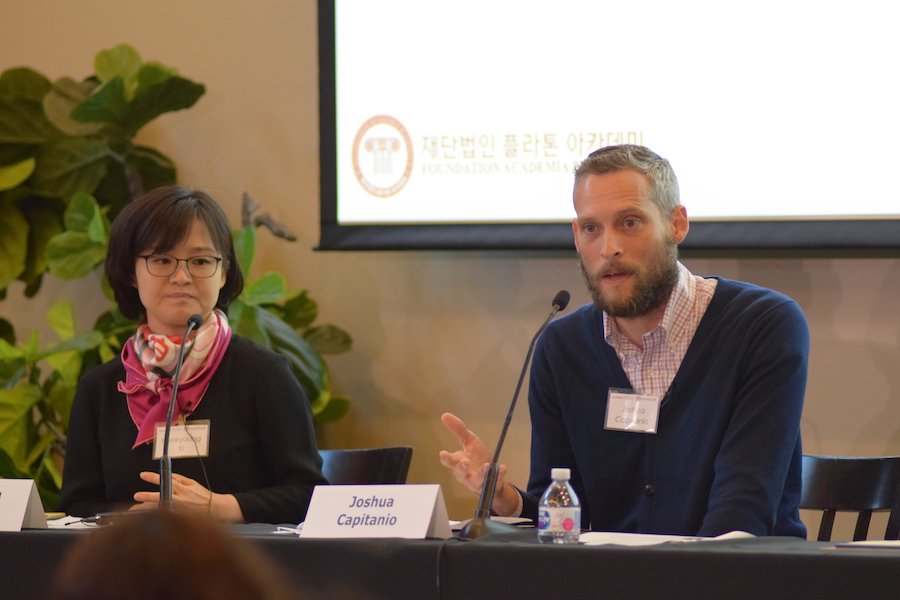
These were some of the questions examined at a two-day conference, “Future Visions: Challenges and Possibilities of Korean Studies in North America,” convened by the Korea Program of Stanford’s Shorenstein Asia-Pacific Research Center (APARC) on November 1-2. Co-sponsored by the Seoul-based Foundation Academia Platonica, the conference, the first of its kind, gathered distinguished Korean studies scholars from twelve North American institutions to consider the state of the field, assess its challenges, and carry forward a vision for its future direction and potential. Its six unique panels focused not only on the major disciplines of Korean studies—history, literature, and the social sciences—but also on language education, library collections and services, and Korean Wave.
“The presentations and discussions by our fellow experts reflected the breadth and depth of Korean studies in North America,” says APARC Director and the Korea Program Director Gi-Wook Shin. “Our program was established at Stanford in 2001 and has since become a leader in Korean studies in North America, so it is a special privilege for us to bring together colleagues from eminent institutions around the continent to further advance Korean studies education and research in the academic and policy worlds, and to build upon our track record of action and achievements.”
“The field of Korean studies, however,” notes Shin, “has significantly changed over the past seventeen years and it isn’t without its challenges. This is our opportunity to consider frankly where we go next and how we could explore the path ahead together.”
Conference participants indeed engaged in deep conversations and shared ideas and dilemmas regarding teaching in the different disciplines of Korean studies in North America. Harvard sociologist Paul Chang listed three types of challenges facing the field: publication, academic, and professional challenges. David C. Kang, professor of international relations and director of the Korean Studies Institute at the University of Southern California, emphasized the publication challenge: why is it, asked Kang, that top academic journals in the discipline of political science and international relations publish so much more scholarship about Europe than they do about Korea and Asia at large, even while the rise of Asian nations is surely one of the most consequential issues of the twenty-first century? The onus, Kang argued, comes back to East Asia scholars “to produce better and more compelling scholarship, and to better train graduate students.”
University of British Columbia's Ross King and conference participants.
Yet complex issues surround the question of how to broaden graduate coursework—and whether to do so. Korean language and linguistics expert Ross King, head of the department of Asian Studies at the University of British Columbia in Vancouver, Canada, was one of several panelists who considered the obstacles to graduate training, among different aspects of academic challenges facing the field of Korean studies. King probed into how Sinocentrism and what he called the “Mandarin conceit”—that is, the notion that training in Literary Sinitic should be predicated on a near-native proficiency in modern Mandarin Chinese—are emerging as a major stumbling block to the study of premodern Korean literary culture. He also pointed to the constraints on language training in both Korean and hanmun in North America, which, he claimed, is why we can probably anticipate continued decrease in the number of ethnically non-Korean (non-Korea-educated) graduate students undertaking graduate study in Korean literature.
University of Washington's Hyokyoung Yi (left) and Stanford's Joshua Capitanio at a panel on library collections and service.
Sung-Ock Sohn, who coordinates the Korean language program in the department of Asian languages and cultures at the University of California – Los Angeles, further shed light on King’s prediction. She explained that while enrollments in Korean language classes have shown a sharp increase in American higher education institutions in the past decade, particularly at the introductory level and among ethnically non-Korean students, there is a high attrition rate of students from an introductory to advanced Korean classes nationwide.
How should the field move forward?
Participants proposed a host of ideas to that end. These included helping graduate students collaborate with colleagues in Korea; dedicating funding for junior faculty to spend periods of time before tenure conducting research and honing language skills in Korea at appropriate institutions, and for mid-career scholars to spend a year in Korea; emphasizing the application of social science theories and methods to premodern and modern East Asia; motivating scholars to apply a comparative lens to the study of the historical and contemporary experience of East Asia; and integrating linguistic and cultural diversity in Korean language classes by, for example, incorporating service learning in authentic contexts and extending the content spectrum to include topics such as Korean popular culture.
Image
K-pop star Siwon Choi (left) highlights closing panel on Korean Wave.
Korean Wave was the focus of the conference’s widely attended closing panel that featured K-pop star Siwon Choi, a member of Korean boy band Super Junior, and multi-platinum music producer Dominique Rodriguez, managing director of SM Entertainment USA. They spoke about the global reach of Korean pop music and some of the ways in which Korean popular culture could stimulate interest in Korean studies. Dafna Zur, assistant professor in Stanford’s department of East Asian languages and cultures, who chaired the panel, challenged her students to consider “what it means not just to monetize culture but to design culture with specific markets and audience in mind.” The Stanford Daily published a detailed article on the panel.
“We are grateful to Foundation Academia Platonica for its generous support of Stanford’s Korea Program at Shorenstein APARC and for making this conference possible through our shared vision for the future of Korean studies in North America,” said Gi-Wook Shin. “Our thanks also go to our many other friends and partners, including the Korea Foundation that has helped achieve great results through its commitment to promoting understanding of Korea in academia and beyond and its support of the overseas Korean Studies Program since its establishment in 1991.”
South Korean TV company SBS NBC filmed the conference that will be featured in an upcoming documentary about Korean studies in the United States.
Read the conference report or listen to the audio recordings of the sessions, below.
On November 2, the Korea Program’s Future Visions conference closed with a panel featuring Siwon Choi — a member of Korean boy band Super Junior — and SM Entertainment USA director and music producer Dominique Rodriguez. Panelists spoke about the global reach of Korean pop music (K-pop) and how it could be a key stimulator of Korean studies in America and the rest of the West.
On August 9, 2018 the Shorenstein Asia Pacific Research Center (APARC) Japan Program hosted a conference, "Break Through: Women in Silicon Valley, Womenomics in Japan." Women thought-leaders and entrepreneurs from Stanford, Silicon Valley, and Japan came together to discuss innovative ideas for narrowing the gender gap, and cultivating interpersonal support networks and collaboration across the pacific. The program combined panel presentations with participatory exercises and startup showcases which afford participants the opportunity to 1) discuss progress and challenges in women's advancement in Silicon Valley and Japan, 2) share practices and organizational features that better enable the hiring and retaining of women, 3) showcase Silicon Valley and Japanese women entrepreneurs and 4) provide tools for branding and building support networks.
The Break Through conference was supported by the Acceleration Program in Tokyo for Women (APT), a program that aims to shape a new narrative by providing opportunities for women entrepreneurs to build networks, receive mentoring, and become a focal point for dynamism. The program, spearheaded by Tokyo's first female governor, Yuriko Koike, is undertaken by the Tokyo Metropolitan government and supported by Tohmatsu Venture Support.
The full conference report, now available, outlines the issues and offers an analysis of the themes that were discussed in the presentations, panels and participatory exericses throughout the day.
On August 9, 2018, the Shorenstein Asia Pacific Research Center (APARC) hosted a conference, “Break Through: Women in Silicon Valley, Womenomics in Japan" with support from the Acceleration Program in Tokyo for Women (APT). Women thought-leaders and entrepreneurs from Stanford, Silicon Valley, and Japan came together to discuss innovative ideas for narrowing the gender gap, and cultivated interpersonal support networks and collaboration across the Pacific. The report, which is an outcome of the conference, offers an analysis and discussion of the themes and takeaways from the day.
All Publications button
1
Publication Type
Policy Briefs
Publication Date
Journal Publisher
Japan Program at the Shorenstein Asia-Pacific Research Center
In 2012, as giants such as Facebook, Twitter, and Google began to position themselves as the go-to places to read news, a little-known news app called SmartNews emerged and started gaining popularity in Japan. The SmartNews app has since been dubbed “App of the Year” on Google Play and won the “Best of” award in Apple’s App store, launched US operations in 2014, and now has over 10 million monthly active users in US and Japan.
In the age of fake news and information polarization, SmartNews is working to deliver to users a balanced diet of quality information from trusted journalism sources. The SmartNews news app uses machine learning to deliver curated news from more than 3000 sources and identify fake news. The SmartNews Delivery Algorithm not only considers users’ likes and clicks and other behavior on the app to generate suggestions, but also applies political balancing algorithms to ensure multiple viewpoints are expressed on important topics, and diversification algorithms to help break the filter bubble.
In this public forum, SmartNews Director of Product Management Yuhei Nishioka will talk about SmartNews’ story and growth trajectory, competing in the current news app landscape, and finally, discuss the process and considerations in creating the SmartNews News Delivery Algorithm. Introduction by Rich Jaroslovsky Vice President for Content and Chief Journalist of SmartNews and former Wall Street Journal White House correspondent.
MAIN SPEAKER:
Yuhei Nishioka, Director of Product Management, SmartNews
INTRODUCTION BY:
Rich Jaroslovsky, Vice President for Content and Chief Journalist, SmartNews and former Wall Street Journal White House correspondent
AGENDA:
4:15pm: Doors open 4:30pm-5:30pm: Main Content, followed by discussion 5:30pm-6:00pm: Networking
Please note there is significant construction taking place on campus, which is greatly affecting parking availability and traffic patterns at the university. Please plan accordingly.
Yuhei Nishioka, Director of Product Management, SmartNews
This third volume in the Japan Decides series remains the premier venue for scholarly research on Japanese elections. Spotlighting the 2017 general election, the contributors discuss the election results, party politics, coalition politics with Komeito, the cabinet, constitutional revision, new opposition parties, and Abenomics. Additionally, the volume looks at campaigning, public opinion, media, gender issues and representation, North Korea and security issues, inequality, immigration and cabinet scandals. With a topical focus and timely coverage of the latest dramatic changes in Japanese politics, the volume will appeal to researchers and policy experts alike, and will also make a welcome addition to courses on Japanese politics, comparative politics and electoral politics.
Chapter 15, Abenomics' Third Arrow: Fostering Future Competitiveness?, was written by Shorenstein APARC Research Scholar, Kenji Kushida.
The digital transition of the world economy is now entering a phase of broad and deep societal impact. While there is one overall transition, there are many different sectoral transformations, from health and legal services to tax reports and taxi rides, as well as a rising number of transversal trends and policy issues, from widespread precarious employment and privacy concerns to market monopoly and cybercrime. This Research Handbook offers a rich and interdisciplinary synthesis of some of the recent research on the digital transformations currently under way.
This comprehensive study contains chapters covering sectoral and transversal analyses, all of which are specially commissioned and include cutting-edge research. The contributions featured are global, spanning four continents and seven different countries, as well as interdisciplinary, including experts in economics, sociology, law, finance, urban planning and innovation management. The digital transformations discussed are fertile ground for researchers, as established laws and regulations, organizational structures, business models, value networks and workflow routines are contested and displaced by newer alternatives.
This book will be equally pertinent to three constituencies: academic researchers and graduate students, practitioners in various industrial and service sectors and policy makers.
Chapter 17 of this book, The Impact of Digital Technologies on Innovation Policy, was written by Shorenstein APARC Research Scholar Kenji Kushida.
Given that much of the global leadership in value creation over the past couple of decades has been driven by the Silicon Valley model – not only a geographic region but a distinct ecosystem of complementary characteristics – the basic question this paper asks is how far Japan’s Abenomics reforms are pushing Japan towards being able to compete in an era dominated by Silicon Valley firms.
To answer this, the first section of this paper looks at content of the third arrow of Abenomics. The second section then distills the Silicon Valley ecosystem into its key characteristics, sorts each of these characteristics according to the underlying institutions to put forth a model, and briefly evaluates whether third arrow reforms move Japan closer to a Silicon Valley model of entrepreneurship and innovation.
China and the United States both have public needs that far outstrip the abilities of their governments alone to deliver. Zeckhauser and Donahue will discuss their book (joint with Karen Eggleston) exploring an important, and perhaps surprising, shared feature of efforts by policymakers in China and the United States to forge prosperous, stable futures for their citizens: public-private collaboration to accomplish some of each society’s most vital collective purposes. Collaborative governance entails private engagement in public tasks on terms of shared discretion. Zeckhauser and Donahue will discuss the two countries’ collaborative approaches to health policy and elder care, comparing and contrasting with approaches to other activities ranging from education and infrastructure to hosting the Olympics.
Image
Richard Zeckhauser is the Frank P. Ramsey Professor of Political Economy, Kennedy School, Harvard University. He graduated from Harvard College (summa cum laude) and received his Ph.D. there. He is an elected fellow of the Econometric Society, the Institute of Medicine (National Academy of Sciences), and the American Academy of Arts and Sciences. In 2014, he was named a Distinguished Fellow of the American Economic Association. His contributions to decision theory and behavioral economics include the concepts of quality-adjusted life years (QALYs), status quo bias, betrayal aversion, and ignorance (states of the world unknown) as a complement to the categories of risk and uncertainty. Many of his policy investigations explore ways to promote the health of human beings, to help markets work more effectively, and to foster informed and appropriate choices by individuals and government agencies. Zeckhauser has published over 300 articles and several books.
Image
John D. Donahue is the Raymond Vernon Senior Lecturer in Public Policy, Kennedy School, Harvard University. He is also Faculty Chair of the Master in Public Policy (MPP) Program and the SLATE Curriculum Initiative Co-Chair for Cases and Curriculum. His teaching, writing, and research mostly deal with public sector reform and with the distribution of public responsibilities across levels of government and sectors of the economy, including extensive work with the HKS-HBS joint degree program. He has written or edited twelve books, most recently Collaborative Governance (with Richard J. Zeckhauser, 2011) and Ports in a Storm (with Mark H. Moore, 2012). He served in the first Clinton Administration as an Assistant Secretary and then as Counselor to the Secretary of Labor. Donahue has consulted for business and governmental organizations, including the National Economic Council, the World Bank, and the RAND Corporation, and serves as a trustee or advisor to several nonprofits. A native of Indiana, he holds a BA from Indiana University and an MPP and PhD from Harvard.