This seminar features two scholars discussing their research on health, retirement, and long-term care in China and Singapore. First Dr. Zhou discusses her co-authored study “Health Care Utilization at Retirement: Evidence from Urban China,” which explores the causal effect of retirement on health care utilization among urban workers using medical claims data and employing a regression discontinuity design based on mandatory retirement ages. The results show that retirement significantly increases outpatient care utilization, in part because of lower patient cost sharing and reduced opportunity cost of time after retirement.
Professor Chia will then discuss innovative policy responses in Singapore to finance the retirement and healthcare needs of its aging population. One component of her research uses actuarial modelling and simulations to explore the adequacy of the long-term care (LTC) insurance program in Singapore, also known as ElderShield, for reducing LTC cost. Dr. Chia will also discuss retirement adequacy, taking into consideration the unique housing finance mechanisms in Singapore and other social measures. Singapore also introduced healthcare policies targeted at specific cohorts and trust funds to enhance social protection. The Pioneer Generation Fund of S$8 billion was earmarked to subsidize healthcare costs for the pioneer generation (cohorts aged 65 and above in 2014). Simulation studies show that the adequacy of the pioneer generation fund depends on healthcare cost inflation and market performance of funds. Most recently, a trust fund of S$6.1bn will be set up to prefund healthcare subsidies for the Merdeka Generation (those born in the 1950s). Besides, a total of S$5.1 billion will go to a new LTC Support Fund that will help fund subsidies for long term care support measures. This measure will improve the adequacy of the LTC Insurance. Financing healthcare needs by setting aside funds, while innovative, is sustainable. However, pre-funding social protection for subsequent cohorts can be challenging amidst an ageing populace and economic challenges.
Image
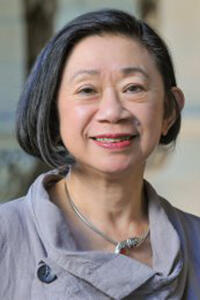
Dr Ngee-Choon Chia is an Associate Professor in the Department of Economics at the National University of Singapore (NUS). She is concurrently Director of the Singapore Centre of Applied and Policy Research (SCAPE) and Co-director of the Next Age Institute at NUS. She is the Co-editor of the Singapore Economic Review. Her research interests include pension economics, health economics and the fiscal impacts of ageing. She has consulted for major international agencies such ADB, ADBI, IDRC and the World Bank. She has also conducted collaborative research on social security with government agencies in Singapore.
Image
Dr. Qin Zhou is currently a visiting scholar in Stanford University. She serves as an Associate Professor in the University of International Business and Economics in Peking, China. Her research interests include Health Economics, Public Health, and Applied Econometrics. She is mainly focused on the study of Chinese health insurance and policy evaluation. She was awarded the "Australia-APEC Women in Research" fellowship and conducted a project entitled "Social Security Systems in Relation to Healthcare Utilization and Health Behaviors in Australia" in 2017. Her work at Stanford is to collaborate with Prof. Karen Eggleston to study the integration of urban-rural health insurance systems in China and other relative topics.
616 Serra MallEncina Hall E301Stanford, CA 94305-6055
0
nanjia@stanford.edu
nan_jia.jpg
Ph.D.
Nan Jia joined the Walter H. Shorenstein Asia-Pacific Research Center (Shorenstein APARC) during the 2019-2020 academic year as a visiting scholar, from the University of Southern California, where she serves as Associate Professor of Strategic Management at the Marshall School of Business. She obtained her Ph.D. in Strategic Management from the University of Toronto's Joseph L. Rotman School of Management.
No recording will be allowed during the program. RSVP required for admission. No walk-ins.
Experts talk about a new Cold War between China and the United States. The world’s two largest economies are in open trade conflict, engaged in technological competition and stoking geopolitical uncertainty. The Oksenberg Conference will explore the causes that underlie today’s intensified conflict between the United States and China. We ask: What has precipitated the confrontational approach that currently unites U.S. policy towards China? What is the future of our strategic competition in the technological, economic and security realms? If U.S.-China rivalry is allowed to escalate, what might its implications be for our international liberal order? If a “new” Cold War is forming, how might it follow or diverge from the “old” Soviet-era Cold War?
Image
The Oksenberg Conference, held annually honors the legacy of the late Professor Michel Oksenberg (1938–2001) who was a senior fellow at Shorenstein APARC and the Freeman Spogli Institute for International Studies. Professor Oksenberg also served as a key member of the National Security Council when the United States normalized relations with China, and consistently urged that the United States engage with Asia in a more considered manner. In tribute, the Oksenberg Lecture recognizes distinguished individuals who have helped to advance understanding between the United States and the nations of the Asia-Pacific.
Agenda
2:35-3:05 PM Conversation with Dr. Condoleezza Rice, former U.S. Secretary of State and National Security Advisor
3:05-3:30 PM Audience Q & A
3:30-3:45 PM Break
3:45-4:25 PM Panel discussion with Prof. David M. Lampton and Amb. Michael A. McFaul
4:25-5:00 PM Audience Q & A
Speakers
Image
David M. Lampton is Oksenberg-Rohlen Fellow and Research Scholar at FSI and affiliated with Walter H. Shorenstein Asia-Pacific Research Center (Shorenstein APARC). He also is the Hyman Professor of China Studies and Director of the China Studies Program at the Johns Hopkins School of Advanced International Studies (SAIS) Emeritus. Dr. Lampton's current book project is focused on the development of high-speed railways from southern China to Singapore. He is the author of a dozen books and monographs, including Following the Leader: Ruling China, from Deng Xiaoping to Xi Jinping (University of California Press, 2014, and second edition 2019) and The Three Faces of Chinese Power: Might, Money, and Minds (University of California Press, 2008). He has testified at multiple congressional and commission sessions and published numerous articles, essays, book reviews, and opinion pieces in many venues popular and academic in both the western world and in Chinese-speaking societies, including Foreign Affairs, Foreign Policy, The American Political Science Review, The China Quarterly, The New York Times, The Washington Post,and many others.
Formerly President of the National Committee on United States-China Relations, Professor Lampton consults with government, business, and social sector organizations, and has served on the boards of several non-governmental and educational organizations, including the Asia Foundation for which he served as chairman. The recipient of many academic awards, he is an Honorary Senior Fellow of the American Studies Institute of the Chinese Academy of Social Sciences, former Gilman Scholar at Johns Hopkins, and the inaugural winner of the Scalapino Prize in 2010, awarded by the National Bureau of Asian Research and the Woodrow Wilson International Center for Scholars in recognition of his exceptional contributions to America’s understanding of the vast changes underway in Asia.
Image
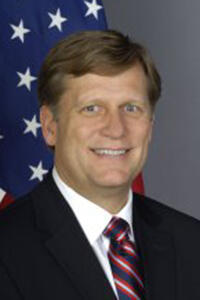
Michael McFaul is the Ken Olivier and Angela Nomellini Professor of International Studies in Political Science; Director and Senior Fellow at the Freeman Spogli Institute for International Studies (FSI); and the Peter and Helen Bing Senior Fellow at the Hoover Institution, all at Stanford University. He was also the Distinguished Mingde Faculty Fellow at the Stanford Center at Peking University from June to August of 2015. He joined the Stanford faculty in 1995. Professor McFaul is also an analyst for NBC News and a contributing columnist to The Washington Post.
Dr. McFaul served for five years in the Obama administration, first as Special Assistant to the President and Senior Director for Russian and Eurasian Affairs at the National Security Council at the White House (2009-2012), and then as U.S. Ambassador to the Russian Federation (2012-2014). He has authored several books, most recently TheNew York Timesbestseller, From Cold War to Hot Peace: An American Ambassador in Putin’s Russia. Earlier books include Advancing Democracy Abroad: Why We Should, How We Can; Transitions to Democracy: A Comparative Perspective(eds. with Kathryn Stoner); Power and Purpose: American Policy toward Russia after the Cold War (with James Goldgeier); and Russia’s Unfinished Revolution: Political Change from Gorbachev to Putin.
Image
Jean C. Oi is the William Haas Professor of Chinese Politics in the Department of Political Science and a Senior Fellow of FSI at Stanford University. She is the founding director of the Stanford China Program at Shorenstein APARC and is the founding Lee Shau Kee Director of the Stanford Center at Peking University. Professor Oi has published extensively on political economy and the process of reform in China. Her books include Zouping Revisited: Adaptive Governance in a Chinese County, co-edited with Steven Goldstein (2018); and Challenges in the Process of China’s Urbanization, co-edited with Karen Eggleston and Wang Yiming (2017); Rural China Takes Off (1999); Property Rights and Economic Reform in China (1999), co-edited with Andrew Walder; and State and Peasant in Contemporary China (1989). Professor Oi also has an edited volume, China’s Path to the Future: Challenges, Constraints, and Choices, co-edited with Dr. Thomas Fingar (forthcoming, Stanford University Press). Her recent articles include “Unpacking the Patterns of Corporate Restructuring during China’s SOE Reform,” co-authored with Xiaojun Li in Economic and Political Studies (2018); and “Reflections on 40 Years of Rural Reform,” in Jacques deLisle and Avery Goldstein, eds., Reform and Opening: 40 Years and Counting, forthcoming. Her current research centers on fiscal reform and local government debt as well as continuing SOE reforms in China.
Image
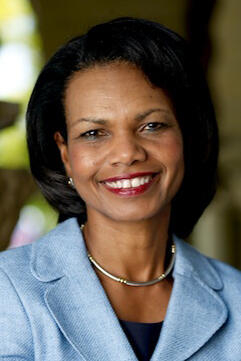
Secretary Condoleezza Rice is currently the Denning Professor in Global Business and the Economy at the Stanford Graduate School of Business; the Thomas and Barbara Stephenson Senior Fellow on Public Policy at the Hoover Institution; and a professor of Political Science at Stanford University. She is also a founding partner of RiceHadleyGates, LLC.
From January 2005 to 2009, Rice served as the 66th Secretary of State of the United States, the second woman and first African American woman to hold the post. Rice also served as President George W. Bush’s Assistant to the President for National Security Affairs (National Security Advisor) from January 2001 to 2005, the first woman to hold the position.
Rice served as Stanford University’s Provost from 1993 to 1999, during which she was the institution's chief budget and academic officer. As Provost, she was responsible for a $1.5 billion annual budget and the academic program involving 1,400 faculty members and 14,000 students. In 1997, she also served on the Federal Advisory Committee on Gender -- Integrated Training in the Military.
From 1989 through March 1991, Rice served on President George H.W. Bush’s National Security Council staff. She served as Director; Senior Director of Soviet and East European Affairs; and, Special Assistant to the President for National Security Affairs. In 1986, while an international affairs fellow of the Council on Foreign Relations, Rice also served as Special Assistant to the Director of the Joint Chiefs of Staff.
As professor of Political Science, Rice has been on the Stanford faculty since 1981 and has won two of the highest teaching honors – the 1984 Walter J. Gores Award for Excellence in Teaching and the 1993 School of Humanities and Sciences Dean's Award for Distinguished Teaching.
She has authored and coauthored numerous books, including three bestsellers, Democracy: Stories from the Long Road to Freedom (2017); No Higher Honor: A Memoir of My Years in Washington (2011); and Extraordinary, Ordinary People: A Memoir of Family (2010). She also wrote Germany Unified and Europe Transformed: A Study in Statecraft (1995) with Philip Zelikow; The Gorbachev Era (1986) with Alexander Dallin; and Uncertain Allegiance: The Soviet Union and the Czechoslovak Army (1984).
In 1991, Rice cofounded the Center for a New Generation (CNG), an innovative, after-school academic enrichment program for students in East Palo Alto and East Menlo Park, California. In 1996, CNG merged with the Boys and Girls Club of the Peninsula (an affiliate club of the Boys and Girls Clubs of America). CNG has since expanded to local BGCA chapters in Birmingham, Atlanta, and Dallas. She remains an active proponent of an extended learning day through after school programs.
Since 2009, Rice has served as a founding partner at Rice Hadley Gates, LLC, an international strategic consulting firm based in Silicon Valley and Washington, D.C. The firm works with senior executives of major companies to implement strategic plans and expand in emerging markets. Other partners include former National Security Advisor Stephen J. Hadley and former Secretary of Defense Robert M. Gates.
Rice currently serves on the boards of Dropbox, an online-storage technology company; C3, an energy software company; and Makena Capital, a private endowment firm. In addition, she is vice chair of the board of governors of the Boys and Girls Clubs of America; a member of the board of the Foundation for Excellence in Education; and a trustee of the Aspen Institute. Previously, Rice served on various additional boards, including those of: the George W. Bush Institute; the Commonwealth Club; KiOR, Inc.; the Chevron Corporation; the Charles Schwab Corporation; the Transamerica Corporation; the Hewlett-Packard Company; the University of Notre Dame; the John F. Kennedy Center for the Performing Arts; and, the San Francisco Symphony Board of Governors.
In 2013, Rice was appointed to the College Football Playoff Committee, formerly the Bowl Championship Series.
Born in Birmingham, Alabama, Rice earned her bachelor's degree in political science, cum laude and Phi Beta Kappa, from the University of Denver; her master’s from the University of Notre Dame; and her Ph.D. from the Graduate School of International Studies at the University of Denver.
Rice is a Fellow of the American Academy of Arts and Sciences and has been awarded fifteen honorary doctorates. She currently resides in Stanford, California.
Bechtel Conference Center 616 Serra Mall Encina Hall, Central, 1st Floor Stanford, CA 94305
David M. Lampton
<br><i>Oksenberg-Rohlen Fellow, FSI, Stanford University</i><br><br>
Michael A. McFaul
<br><i>Director, Freeman Spogli Institute for International Studies (FSI); Professor, Political Science, Stanford University; Senior Fellow, Hoover Institution </i><br><br>
Jean C. Oi (Moderator)
<br><i>Director, Stanford China Program; William Haas Professor of Chinese Studies, Stanford University</i><br><br>
Secretary Condoleezza Rice
<br><i>The Denning Professor in Global Business and the Economy, Stanford Graduate School of Business; The Thomas and Barbara Stephenson Senior Fellow on Public Policy, Hoover Institution; Professor of Political Science, Stanford University</i><br><br>
STANFORD, CA, March 11, 2019 — The Walter H. Shorenstein Asia-Pacific Research Center (APARC), Stanford University’s hub for interdisciplinary research, education, and engagement on contemporary Asia and the sponsor of the Shorenstein Journalism Award for excellence in coverage of the Asia-Pacific, is pleased to introduce an all-new selection committee for the award, comprising diverse journalistic and Asia expertise. APARC now welcomes nominations for the 2019 award. The deadline for nomination submissions is 5pm Pacific time on Friday, March 29, 2019.
An annual tradition since 2002, the Shorenstein Journalism Award carries a cash prize of US $10,000 and recognizes outstanding veteran journalists who have spent their careers helping audiences around the world interpret the complexities of the Asia-Pacific region. It honors the legacy of APARC’s benefactor, Mr. Walter H. Shorenstein, and his twin passions for promoting excellence in journalism and understanding of Asia. “With this award we are committed to advancing journalism that persistently and courageously seeks accuracy, deep reporting, and nuanced U.S.-Asia dialogue,” said APARC Director Gi-Wook Shin.
Over the course of its history, the award has recognized world-class journalists who push the boundaries of coverage of the Asia-Pacific region and help advance mutual understanding between audiences in the United States and their Asian counterparts. Recent honorees include Anna Fifield, Caixin Media, Ian Johnson, Jacob Schlesinger, Siddharth Varadarajan, and Aung Zaw. The award alternates between recipients whose work has mostly been published through American news media and recipients whose work has mostly been conveyed through news media in one or more parts of the Asia-Pacific region. The 2019 award will recognize a recipient from the latter category, which oftentimes includes candidates who work at the forefront of the battle for press freedom.
APARC has recently assembled a new selection committee for the award that presides over the judging of nominees and is responsible for the selection of honorees. “I am delighted to welcome our new committee members who have all distinguished themselves in their careers and bring expertise across journalism, policy, and Asia research and reporting,” noted Director Shin.
The selection committee for the Shorenstein Journalism Award includes Wendy Cutler, Vice President and Managing Director, Washington, D.C. Office, Asia Society Policy Institute; James Hamilton, Hearst Professor of Communication, Chair of the Department of Communication, and Director of the Stanford Journalism Program, Stanford University; Raju Narisetti, Director of the Knight-Bagehot Fellowship in Economics and Business Journalism and Professor of Professional Practice at Columbia Journalism School; Philip Pan, Asia Editor, The New York Times; and Prashanth Parameswaran, Senior Editor, The Diplomat.
For the Shorenstein award, the Asia-Pacific region is defined broadly to include Northeast, Southeast, South, and Central Asia and Australasia. Both individual journalists with considerable body of work and journalism organizations are eligible for the award. Nominees’ work may be in traditional forms of print or broadcast journalism and/or in new forms of multimedia journalism. APARC is seeking 2019 award nomination submissions from editors, publishers, scholars, journalism-related associations, and entities focused on researching and interpreting the Asia-Pacific region. The award will be presented by APARC at Stanford in the Autumn quarter of 2019.
For complete details about the award, nominations and procedures, and past winners, please visit the Shorenstein Journalism Award page. Submissions are accepted electronically through 5pm Pacific time on Friday, March 29, 2019, via an online form.
About the Walter H. Shorenstein Asia-Pacific Research Center
The Walter H. Shorenstein Asia-Pacific Research Center (Shorenstein APARC) addresses critical issues affecting the countries of Asia, their regional and global affairs, and U.S.-Asia relations. As Stanford University’s hub for the interdisciplinary study of contemporary Asia, APARC produces policy-relevant research, provides education and training to students, scholars, and practitioners, and strengthens dialogue and cooperation between counterparts in the Asia-Pacific and the United States. Founded in 1983, APARC today is home to a scholar community of distinguished academics and practitioners in government, business, and civil society, who specialize in trends that cut across the entire Asia-Pacific region. For more information, visit https://aparc.fsi.stanford.edu.
Lijun Zhang is a global affiliate visiting scholar at the Walter H. Shorenstein Asia-Pacific Research Center (Shorenstein APARC) for 2018-19. Dr. Zhang is the Chairman of the Board of V1 Group Ltd., one of the top 100 internet companies in China and has been engaged in economic system reform, entrepreneurship and innovation in the fields of telecom, internet and media. Additionally, he served as a member and Chairman of the APEC Business Advisory Council for 14 years contributing to regional economic development. Prior to joining Shorenstein APARC, Dr. Zhang was a research scholar in the department of engineering at Stanford researching the theory of disruptive innovations. While at Shorenstein APARC, he will continue his research on the innovation development of countries in the Asia-Pacific region. Dr. Zhang earned both his masters and PhD in world economics from Nankai University.
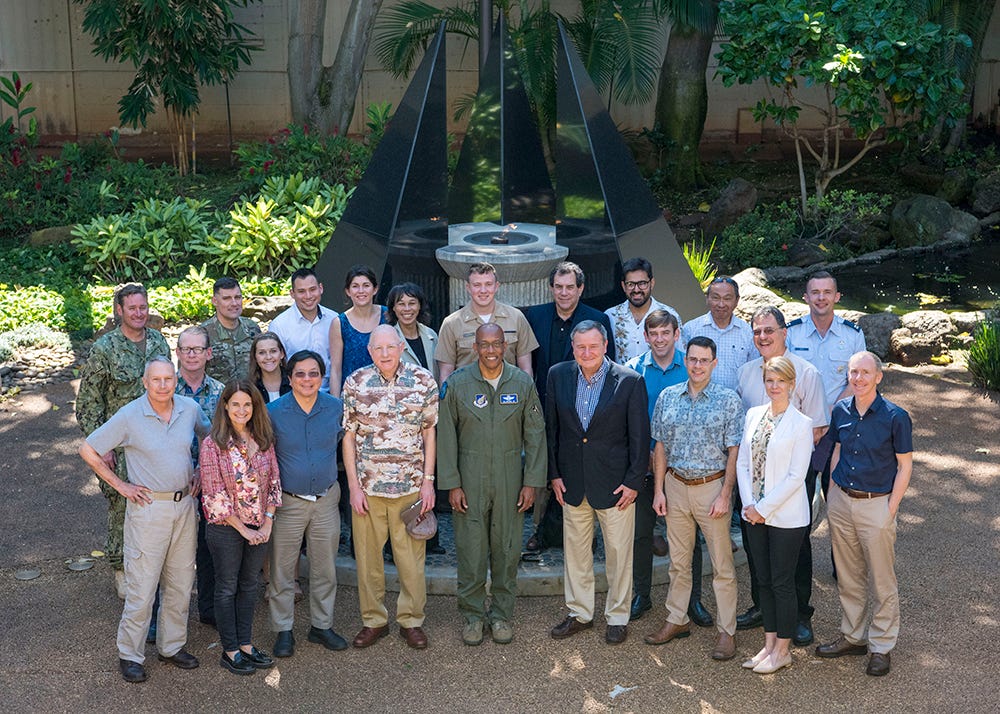
A group of 20 faculty and fellows participate in an orientation visit to Indo-Pacific Command headquarters, Honolulu, Hawaii, February 21–22, 2019, organized and sponsored by the U.S.-Asia Security Initiative. Photo courtesy of the U.S.-Asia Security Initiative
On February 21–22, faculty and fellows from Stanford University traveled to Oahu, Hawaii for an orientation visit at the United States Indo-Pacific Command (INDOPACOM), the U.S. military command responsible for the conduct of the U.S. military’s missions throughout the Indian and Pacific Oceans, and Asia.
The visit brought together scholars and researchers from Stanford, the Massachusetts Institute of Technology, the Council on Foreign Relations, and Macquarie University, Australia. Organized by the U.S.-Asia Security Initiative (USASI) and the Shorenstein Asia-Pacific Research Center at the Freeman Spogli Institute for International Studies (FSI), the visit included meetings with the commanders and staffs of INDOPACOM and five of its subordinate commands (U.S. Army Pacific, U.S. Pacific Fleet, U.S. Air Forces Pacific, U.S. Marine Forces Pacific, and U.S. Special Operations Command Pacific), and a tour of Arleigh Burke-class Aegis destroyer USS John Paul Jones (DDG-52).
The visitors also interacted with the U.S. Army’s 25th Infantry Division’s leadership and the unit’s Jungle Training Center. The busy itinerary provided the group a superb opportunity to learn about INDOPACOM’s and its subordinate units’ threat assessments, capabilities, doctrine, regional partnerships, and readiness challenges.
These trips offer great access to America’s armed forces to those whose research focuses on or relates to national security issues, says Karl Eikenberry.
Karl Eikenberry, Director of the U.S.-Asia Security Initiative (USASI), a former U.S. ambassador to Afghanistan and himself a retired U.S. Army lieutenant general said: “USASI has over the past five years organized annual trips to U.S. military commands for Stanford FSI faculty and fellows. These trips offer great access to America’s armed forces to those whose research focuses on or relates to national security issues. The insights gained inform analysis, while the host organizations gain fresh perspectives different from those found within their commands.”
Photo courtesy of the U.S.-Asia Security Initiative
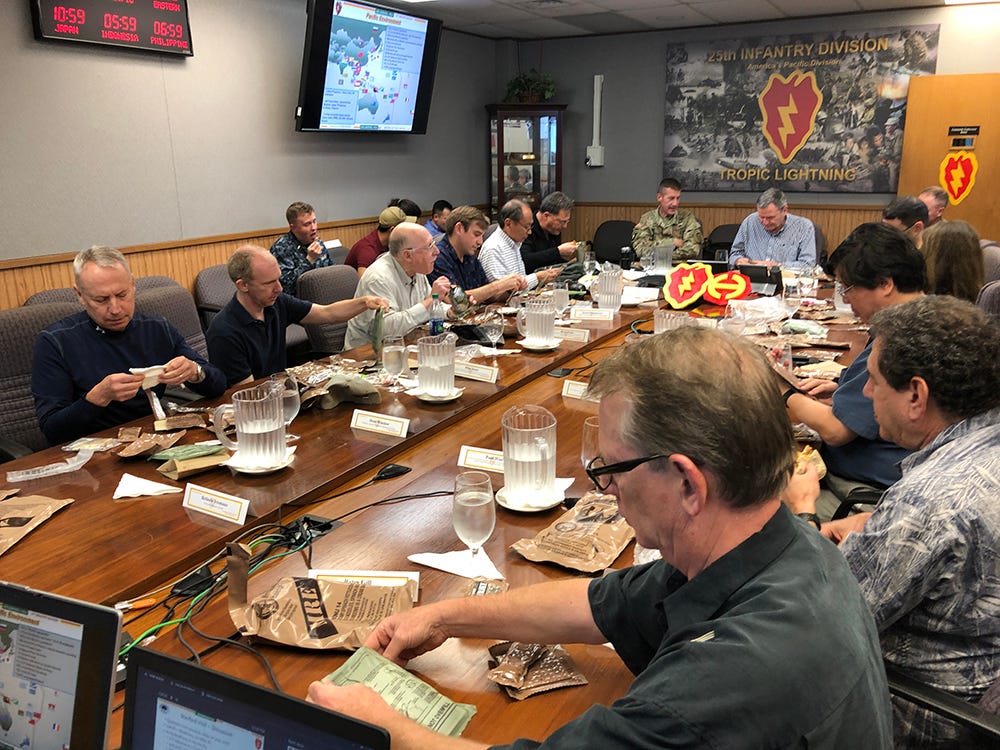
Discussions began on February 21st at Camp H.M. Smith, the Headquarters of INDOPACOM. Brigadier General Jonathan Braga, U.S. Army, SOCPAC Commander and his staff discussed his command’s unique capabilities and roles in both conventional and counterterrorist/counterinsurgency warfare operations. Major General Michael Minihan, U.S. Air Force, INDOPACOM Chief of Staff, then hosted a wide-ranging session on his organization’s implementation of the National Security Strategy and National Defense Strategy at a time of dynamic change within the region.
Photo courtesy of Timothy R. Mungie
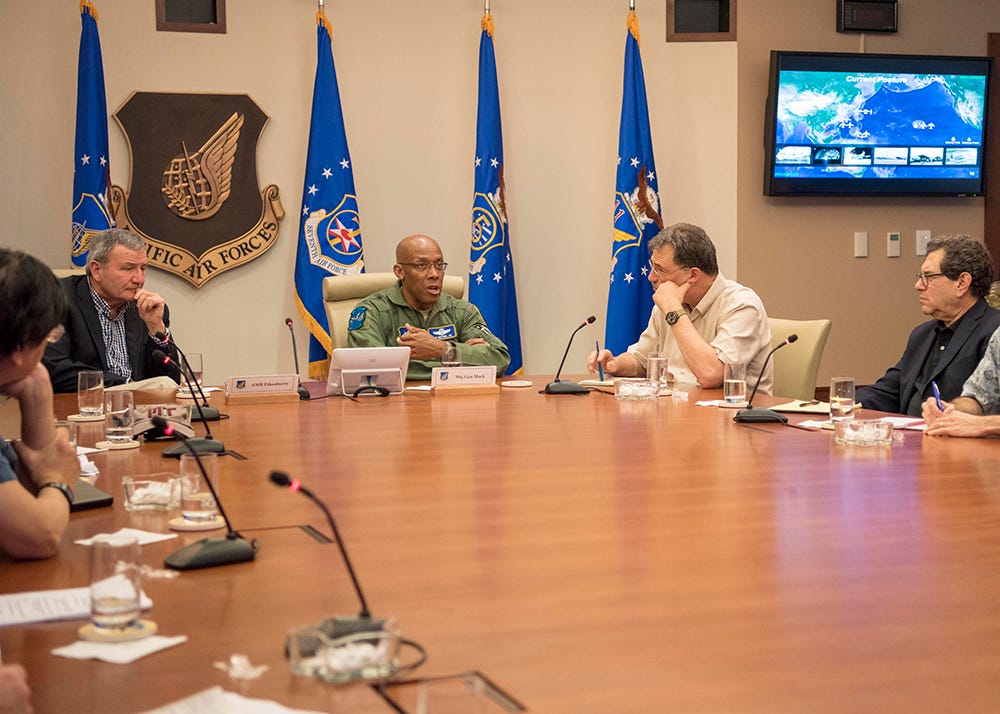
This was followed by a working lunch at the INDOPACOM Flag Mess with key staff members of MARFORPAC who explained U.S. Marine force posture and contingency missions throughout the Pacific Region. The Stanford group then proceeded to Hickam Field and met with General Charles Brown, Commander, PACAF, and his Deputy Commander, Major General Russell Mack. General Brown detailed the critical role played by airlift and airpower in the vast Indo-Pacific region, and the development of new concepts for the employment of U.S. Air Force capabilities in joint (inter-service) and combined (inter-allied) operations.
Photo courtesy of Timothy R. Mungie
The visiting faculty and fellows then transited to Pearl Harbor for a tour of USS John Paul Jones led by Commanding Officer, Commander Jesse Mink, United States Navy, and Executive Officer, Commander Robert Watts, USN. Noteworthy was the destroyer’s sophisticated integrated air, surface, and underseas warfare systems, and the emphasis placed on resilience in high-end combat situations. Following the ship tour, the group attended a PACFLT command briefing chaired by the Commander, Admiral John Aquilino.
The dialogue made clear PACFLT’s emphasis on a holistic approach to deterrence and decisive operations, with an eye on future requirements. The first day of the trip ended with a working reception at the historic “Nimitz House” hosted by Admiral Aquilino, offering the attendees a chance to engage in conversations with the Commander and his staff.
The second day of the trip began with an introduction to the Daniel K. Inouye Asia-Pacific Center for Security Studies (APCSS), followed by expert presentations and breakout sessions on select topics including the Chinese One Belt One Road plan, the security of Taiwan, pandemic threats in the Indo-Pacific region, and cyber operations. The Stanford team then traveled to Fort Shafter for a meeting with Brigadier General Pete Andrysiak, U.S. Army and Chief of Staff, USARPAC. BG Andrysiak and the USARPAC staff elaborated on the evolving U.S. Army’s regional doctrine and extensive partnership activities.
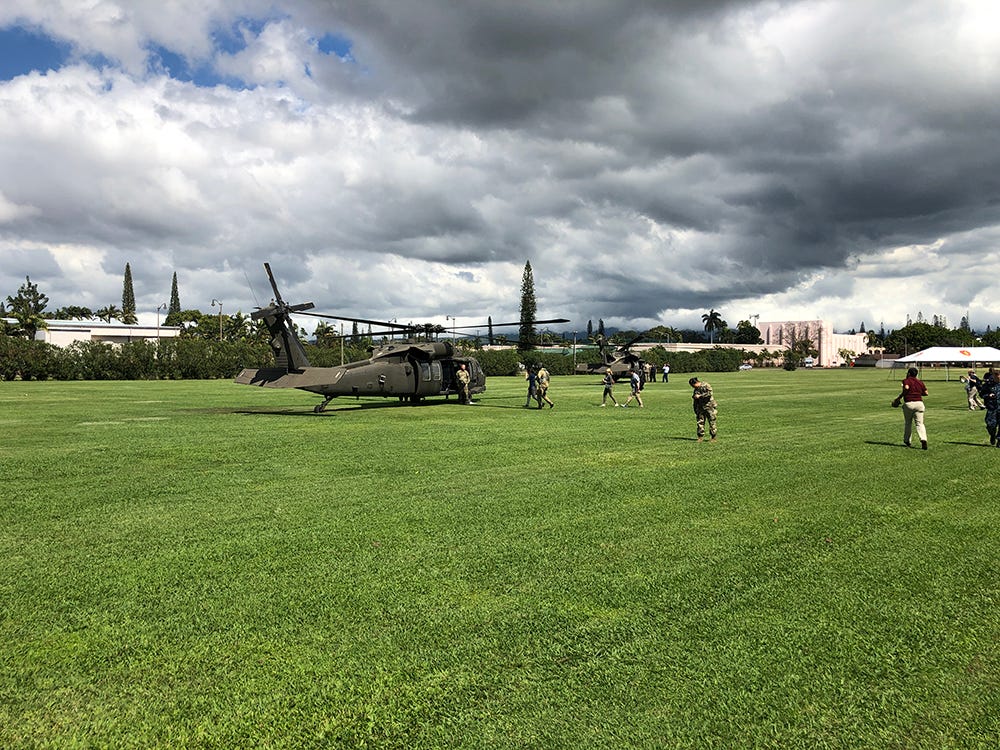
A highlight of the group’s time in Oahu came with a visit to the U.S. Army’s 25th Infantry Division at Schofield Barracks, and the 25th ID Jungle Training center via UH-60 Blackhawk Helicopters. There Brigadier General J.B. Vowell, Assistant Division Commander, 25th Infantry Division and U.S. Army Hawaii (himself a former FSI Senior Military Fellow), discussed the division’s extensive missions throughout the region, including in the Korean Peninsula.
Photo courtesy of Francis Fukuyama
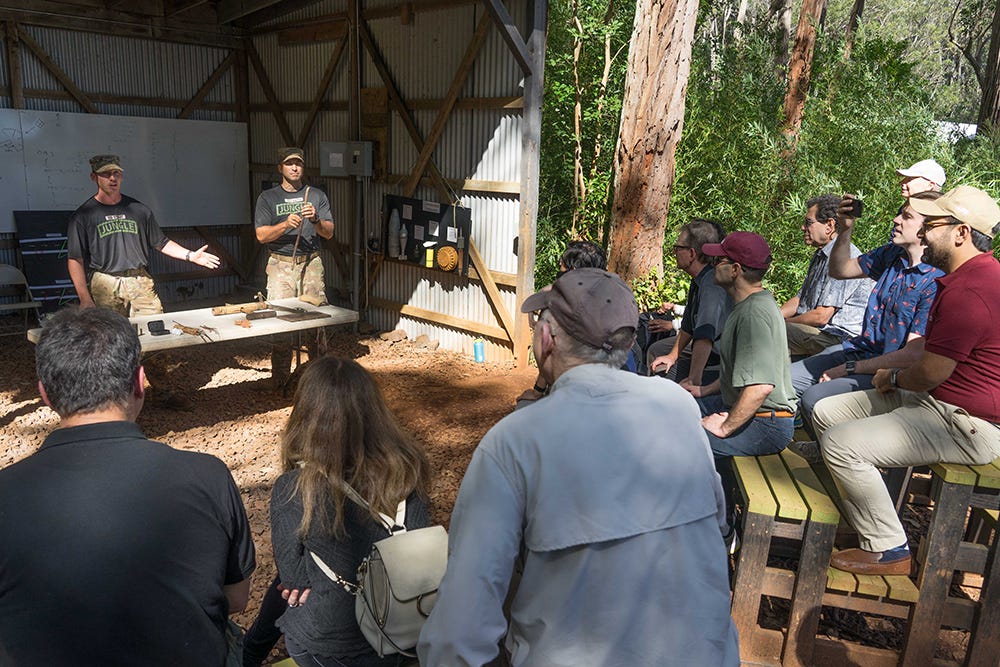
Faculty and fellows were also able to “get their boots (or at least tennis shoes) muddy” in the U.S. Army’s rugged training area in northern Oahu, with highly skilled soldiers demonstrating jungle warfare tactics and techniques. The trip ended with the participants hosting a reception at the Hale Koa Hotel Warriors Lounge for their many hosts over the past two days.
The trip to INDOPACOM Headquarters provided a rare opportunity for participants to talk directly with senior U.S. military leaders in the most important region of the world and to gain a better understanding of their perspectives and the many challenges that they are addressing. Faculty and fellows interacted with junior leaders at the tactical level, helping them gain an appreciation of the ethos of those serving at the cutting edge. The hosts all commented on the benefit of learning the views of scholars, many of whom have spent their academic careers writing about national security issues.
The trip provided fascinating insights into how the U.S. military views the rapidly evolving national security challenges in the Indo-Pacific region, says Larry Diamond.
“The trip provided fascinating insights into how the U.S. military views the rapidly evolving national security challenges in the Indo-Pacific region, and how it is organized to defend against the threats. You can read about much of this in the media and the journals, but there is just no substitute for being there, seeing our facilities on the ground, and engaging directly with the remarkable men and women (and one thing that struck me is that there are quite a number of women) who are responsible for our defense,” said Larry Diamond, senior fellow at the Hoover Institution and at the Center on Democracy, Development & the Rule of Law (CDDRL) at FSI.
FSI scholars particularly valued the opportunity to connect one-on-one.
“It was invaluable to meet and hear directly from the individuals and organizations who are working so hard to ensure our security,” said Center for International Security and Cooperation (CISAC) Senior Research Scholar Megan Palmer. For CISAC Pre-doctoral Fellow Erik Lin-Greenberg, “the opportunity to interact with decision-makers from tactical to strategic levels was incredibly valuable and helped inform my own research.”
From October 22–23, 2018, the U.S.-Asia Security Initiative (USASI) at Stanford University, in conjunction with the Institute for China-U.S. People-to-People Exchange at Peking University and the American Academy of Arts and Sciences (AAAS), gathered scholars and policy practitioners at the Stanford Center at Peking University to participate in the “Civil Wars, Intrastate Violence, and International Responses” workshop. The workshop was an extension of a project examining the threats posed by intrastate warfare launched in 2015 and led by AAAS and Stanford University’s Freeman Spogli Institute for International Studies. The goal of this workshop was to facilitate frank discussions exposing participants to a wide range of views on intrastate violence and international responses.
The workshop was divided into sessions that assessed trends in intrastate violence since the end of the Cold War, examined the threats to international security posed by civil wars and intrastate violence, and evaluated international responses, including an analysis of the limits of intervention and a discussion of policy recommendations. Participants also had an opportunity to make closing comments and recommendations for future research.
This report provides an executive summary and summaries of the workshop sessions on a non-attribution basis.
While President Trump and North Korean leader Kim Jong-un’s June 2018 meeting ended with a broad statement — committing to “establish new U.S.-DPRK relations” for “a lasting and stable peace regime on the Korean Peninsula” — they will aim to take more concrete steps forward at their second summit in Hanoi this week.
Between the lines: To keep up the diplomatic momentum, Trump and Kim will need to minimize existing ambiguities and divergences on key issues — including the definition of denuclearization — and produce a comprehensive road map that lays out the specifics of their proclaimed shared vision. Without these agreements, the Hanoi summit could be easily denigrated as “just another show.”
Where it stands: Trump and Kim each face immense pressure, both international and domestic, to make progress.
Trump needs to earn political trust back in Washington to continue negotiating with North Korea. His strategy so far has been to convince Kim that North Korea’s denuclearization would bring the country a “bright future.”
At the same time, Trump must address Kim’s concerns about whether any agreement reached with his administration will withstand the Democrat-controlled House and survive the post-Trump era.
Between the lines: Successful diplomacy sometimes entails purposeful ambiguities, and the ambiguities of the first Trump-Kim summit might indeed have been strategic. At this critical juncture, however, a failure on Trump’s and Kim’s part to commit to defined objectives could hurt the bilateral relationship.
The bottom line: Trump and Kim need support more than ever to advance their diplomatic endeavors. While spectators have good reason to be skeptical, and one can only be cautiously hopeful with North Korea, a return to confrontation or "strategic patience" is in no one’s interest.
Gi-Wook Shin is the William J. Perry Professor of Contemporary Korea and director of the Walter H. Shorenstein Asia-Pacific Research Center at Stanford University.
Hero Image
A banner hung opposite the Marriott Hotel in Hanoi, Vietnam, where President Trump is expected to stay during his summit with Kim Jong-un, on Feb. 25. | Carl Court via Getty Images
Shorenstein APARC is pleased to announce the selection of two scholars as postdoctoral fellows for the 2019-20 academic year. They will begin their appointments at Stanford in the coming Autumn quarter.
The Center offers the Shorenstein Postdoctoral Fellowship on Contemporary Asia to recent doctoral graduates dedicated to research and writing on contemporary Asia, primarily in the areas of political, economic, or social change in the Asia-Pacific region, or international relations and international political economy in the region. The Center’s Asia Health Policy Program sponsors the Asia Health Policy Postdoctoral Fellowship, supporting young scholars who pursue original research on contemporary health or healthcare policy of high relevance to low- and middle-income countries in the Asia-Pacific region
Fellows develop their dissertations and other projects for publication, present their research, and participate in the intellectual life at the Center and at Stanford at large. Our postdoctoral fellows often go on to pursue careers at top universities and research organizations around the world and continue to contribute to APARC research and publications.
Meet our new postdoctoral scholars:
Image
Radhika Jain Asia Health Policy Postdoctoral Fellow
What are the conditions necessary to ensure the effectiveness of public health insurance programs?
Radhika Jain is completing her doctorate in the Department of Global Health at Harvard University. She studies the role of the private sector in the health system, frictions in health care markets, and the incidence of public health policy benefits.
Radhika’s dissertation examines the extent to which government subsidies for health care under insurance are captured by private hospitals instead of being passed through to patients, and whether accountability measures can help patients claim their entitlements. Radhika’s research has been supported by grants from the Weiss Family Fund and the Jameel Poverty Action Lab (JPAL). She has worked on impact evaluations of health programs in India and on the implementation of HIV programs across several countries in sub-Saharan Africa. She also held a doctoral fellowship at the Center for Global Development.
At Shorenstein APARC, Radhika will refine her dissertation research for publication in academic journals and start new work on the structure of health care markets in India and the impacts of measures to increase the effectiveness of public health insurance.
Image
Hannah June Kim Shorenstein Postdoctoral Fellow on Contemporary Asia
How does modernization influence cultural democratization in East Asia?
Hannah June Kim is completing her doctorate in the Department of Political Science at the University of California, Irvine. She researches public opinion, political behavior, theories of modernization, economic development, and democratic citizenship, focusing on East Asia.
Hannah’s dissertation examines how and why people view democracy in systematically different ways in six countries: China, Japan, Korea, Singapore, Taiwan, and Vietnam. Developing unique categories of democratic citizenship that measure the cognitive, affective, and behavioral patterns of individuals, she finds that state-led economic development limited the growth of cultural democratization among middle class groups in all three dimensions. The results imply that the classic causality between modernization and democratization may not be universally applicable to different cultural contexts.
At Shorenstein APARC, Hannah will work on developing her dissertation into a book manuscript and make progress on her next project that explores democratization and gender empowerment in East Asia. Hannah received an MA in International Studies from Korea University and a BA from UCLA. Her work has been published, or is forthcoming, in The Journal of Politics, PS: Political Science & Politics, and the Japanese Journal of Political Science.
Since its establishment, DNX Ventures (formerly Draper Nexus Ventures) has acted as a bridge between growing Silicon Valley businesses and large Japanese firms. Since 2011, DNX Ventures has created more than 100 partnerships between its portfolio companies and its over 25 large Japanese corporate LPs. During this seminar, Managing Director of DNX Ventures Hiro Rio Maeda will extrapolate from his over 15 years of experience in both corporate venture capital and venture capital and extensive experience working with both startups and large Japanese corporations to discuss the basics of venture capital, and how Japanese corporations leverage venture capital to push forward open innovation initiatives. From a VC perspective: how are decisions about strategic investments made? How does money flow? What ratio of successful investments to non-successful investments do VCs aim for? From a large Japanese corporate perspective: how do large Japanese firms use VC to achieve open innovation goals? What are some of the obstacles to Japanese large firm-startup partnerships, and what are some of the ways to overcome these challenges? Maeda will answer these questions and more, as well as share examples of successful partnerships and large Japanese firms that are successfully harnessing Silicon Valley to further open innovation efforts.
SPEAKER:
Hiro Rio Maeda, Managing Director, DNX Ventures (formerly Draper Nexus)
BIO:
Hiro Rio Maeda is a Managing Director at venture capital firm DNX Ventures (formerly Draper Nexus). Rio focuses on investing in innovative companies in Cyber Security, mobile, storage, and retail tech area that could work on a global scale. His portfolio companies include Cylance, SafeBreach, JASK, vArmour, AppDome, Ayasdi, Remotium, Klout, Fyde, JoyMode, and Hom.ma.
Prior to joining DNX Ventures (formerly Draper Nexus), Rio spent six years at Globespan Capital Partners where he had put his resource on both investment and business development of Japan/US portfolio companies. Palo Alto Networks(NYSE: PANW) was a good example portfolio company that he took a lead on taking them to the Japanese market.
Prior to Globespan, Rio spent seven years at Sumitomo Corporation, a Japanese conglomerate trading company in which he had built expertise his international business skill in IT technologies and consumer web services in Tokyo and his capitalist career at Presidio Ventures (Sumitomo’s corporate venture capital arm) in Santa Clara.Japanese conglomerate trading company in which he had built expertise his international business skill in IT technologies and consumer web services in Tokyo and his capitalist career at Presidio Ventures (Sumitomo’s corporate venture capital arm) in Santa Clara.
AGENDA:
4:15pm: Doors open 4:30pm-5:30pm: Talk and Discussion 5:30pm-6:00pm: Networking