Authors
News Type
News
Date
Paragraphs
In an academic seminar sponsored by Pantech, held at the Press Center in Seoul, South Korea, Daniel C. Sneider says, "Neither the Obama administration, nor any future one, can afford to recognize North Korea as a nuclear weapons nation."

High-level American envoys visiting Seoul say they are cooperating with regional allies to dissuade North Korea from the path of nuclear weaponry and back to dialogue aimed at disarmament. The delegation is making stops around Asia for consultations on how to respond to last month's nuclear weapon test by the North.

Daniel Sneider is with Stanford University's Shorenstein Asia-Pacific Research Center. He says neither the Obama administration, nor any future one, can afford to recognize North Korea as a nuclear weapons nation.

"It would, for one thing, undermine our alliances with South Korea and Japan.. and, frankly it would set an increasing risk of serial proliferation in this region," he said. "It would give further encouragement to those - in Iran, first and foremost - who are on a similar path, who have sought and gotten the help of North Korea to get there. So we can't do that."

All News button
1
Authors
David Straub
News Type
Commentary
Date
Paragraphs

In recent months, North Korea has put on trial two young American journalists working for former Vice President Al Gore’s Current TV, launched a long-range rocket, and tested its second nuclear device. It has renounced the Beijing Six-Party nuclear talks and the 1953 Korean armistice agreement. It will likely soon fire another long-range rocket and may test a third nuclear device and stage limited military attacks against South Korea.

The regime’s actions are a source of serious concern. North Korea might transfer nuclear weapons technology to rogue states or terrorist groups. It has long sold its missiles to many countries in the troubled Middle East and South Asia, and two years ago the Israelis destroyed a nuclear facility that the North Koreans were building in Syria, possibly in coordination with Iran.

North Korea’s pursuit of reliable nuclear weapons and the long-range missiles with which to launch them constitutes a direct threat not only to the United States but even more so to U.S. allies Japan and South Korea. The Japanese and South Koreans may eventually feel forced to build their own nuclear arsenals, which could destroy the balance of power with China in East Asia.

Pyongyang has often engaged in provocative behavior, but lately the pace and tone of its threats have worsened considerably. After suffering a stroke last fall, North Korean leader Kim Jong-Il seems to have begun the process of naming his 26-year-old third son, Kim Jong-un, as his successor. The nuclear and rocket tests may have been aimed at boosting nationalistic enthusiasm for the move. Even in North Korea there may be those who question the legitimacy of yet another dynastic succession there.

But while extreme and anachronistic, North Korean leaders are not irrational. Fundamentally, they feel they must have a nuclear “deterrent,” as they call it, to re-balance their relationship with South Korea. North Korean leaders believe theirs to be the legitimate Korean regime on the peninsula, but they know that democratic South Korea is decades ahead of them, economically, diplomatically, and in conventional military terms.

Information about North Korea is scarce but two decades of dealing with North Korea have given American policymakers a much better understanding of the regime. The North’s brinkmanship playbook is now well known, and the Obama administration is determined not to play that game anymore. It has made clear it is willing to deal fairly with North Korea but that it will increase diplomatic, financial, and military pressures on the regime until it agrees to abandon its nuclear weapons program.

The United States will need to proceed very carefully. There is no perfect North Korea policy, no silver bullet that will suddenly end all of the challenges the regime poses. Although North Korea is basically a failing country, its artillery arrayed along the Demilitarized Zone just north of Seoul could cause hundreds of thousands of casualties there. Over the past decades, the North Koreans have come to believe that they almost always win when they engage in a game of chicken with the United States and South Korea. They will almost certainly continue their provocations until they think they have won the latest match.

The United States and its allies must game-out the many possible scenarios on the Korean Peninsula and be prepared for continuing North Korean provocations, something previous U.S. administrations have not done well. The aim should be gradually to limit North Korean room for maneuver and eventually force them to abandon their nuclear weapons and long-range missile programs. At the same time, the United States should ignore calls for drastic steps that risk war on the Korean Peninsula. North Korea’s nuclear and rocket programs are still primitive; the regime is weak. There is still time for stronger and smarter diplomacy - including both sticks and carrots - to work.

All News button
1
Authors
News Type
News
Date
Paragraphs

Thomas Fingar, a prominent intelligence expert and China scholar who served as the first Deputy Director of National Intelligence for Analysis and as chairman of the National Intelligence Council, has joined FSI Stanford effective January 2009. Fingar served on the Stanford staff for a decade after completing his PhD in political science here in 1977 and now returns as the 2008-2009 Payne Distinguished Lecturer. At the expiration of that appointment in December of 2009, he will become the inaugural Oksenberg Rohlen Distinguished Fellow at FSI.

"We are thrilled to welcome Tom Fingar back to Stanford," said FSI Director Coit D. Blacker, the Olivier Nomellini Professor in International Studies. "His experience and commanding knowledge of international security and intelligence issues - from contemporary China and Iran to the risks of nuclear proliferation and terrorism using weapons of mass destruction - will be of enormous benefit to our faculty, the students who will be our next generation of leaders, and the wider Stanford community."

FSI's Payne Distinguished Lectureship, named for Frank and Arthur Payne, annually presents to the larger Stanford community prominent speakers chosen for their international reputation as leaders, with an emphasis on visionary thinking, a broad grasp of a given field, and the capacity to articulate an important perspective on the global community and its challenges. Previous Payne lecturers have included Alejandro Toledo, Peter Piot, David Heymann, Joschka Fischer, Sir David Manning, Mohamed ElBaradei, Jorge Castaneda, Sadaka Ogata, Josef Joffe, and Bill Bradley.

While serving as the Payne Lecturer, Fingar will deliver three public lectures to the Stanford community. He will reside in FSI's Center for International Security and Cooperation (CISAC), co-directed by nuclear scientist Siegfried Hecker, director emeritus of the Los Alamos National Laboratory, and political scientist Scott D. Sagan, with Lynn Eden serving as acting co-director while Sagan is on sabbatical this year. "Stanford is fortunate to have a scholar-practitioner of Tom Fingar's stature engaging in our multidisciplinary efforts to address the complex security issues currently facing the international community," Hecker said.

A prominent China scholar who has published dozens of books and articles on Chinese politics and policymaking, Fingar will become the inaugural Oksenberg Rohlen Distinguished Fellow at FSI in 2010, based at the Walter H. Shorenstein Asia-Pacific Research Center (Shorenstein APARC). The Shorenstein center is world renowned for its work on contemporary political, economic, and security issues in Northeast Asia and houses the Asia-Pacific Scholars Program, which supports graduate students engaged in Asia-related studies.

Fingar has had a distinguished career in public service. He was assistant secretary of the State Department's Bureau of Intelligence and Research (INR) and principal advisor to the secretary on intelligence issues from July 2004 until May 2005, when he was named Deputy Director of National Intelligence for Analysis and chairman of the National Intelligence Council.  While at the State Department, he also served as Acting Assistant Secretary for Intelligence and Research (2003-04 and 2000-01), Principal Deputy Assistant Secretary (2001-03), Deputy Assistant Secretary for Analysis (1994-2000), director of the Office of Analysis for East Asia and the Pacific (1989-94), and chief of the China Division (1986-89).

Between 1975 and 1986, Fingar held a number of positions at Stanford, including senior research associate at CISAC and director of the university's U.S.-China Relations program, which ultimately, with other units, became Shorenstein APARC. He has also served as a consultant to many U.S. government agencies and private sector organizations.

Fingar holds a BA in government and history from Cornell and an MA and PhD from Stanford in political science. He will offer his first 2009 Payne distinguished lecture on March 11, 2009 from 4:30 - 6:00 pm in FSI's Bechtel Conference Center, 616 Serra Street. The address is free and open to the public.

All News button
1
News Type
Commentary
Date
Paragraphs
David Straub, the acting director of Korean Studies Program, argues that Obama administration will finally give diplomacy a chance to deal with the North Korean nuclear problem. He stresses that Senator Obama understands the difficulties of dealing with North Korea and will proceed carefully. If North Korea does not respond to this more nuanced American approach, he concludes, the international community is likely to be more supportive of U.S. efforts to constrain North Korean behavior.

Among conservatives in Korea and other American allied countries, there seems to be some anxiety about the election of a relatively unknown, young African-American liberal as the next American president. Typically, when a new U.S. president is elected, American diplomats seek to reassure allies by telling them that the incoming president will pursue fundamentally the same policies as the outgoing president. However, President Obama clearly will adopt a significantly different foreign policy than President Bush, including toward North Korea.

Obama’s soaring rhetoric has led to a widespread (and correct) impression of him as idealistic, but the long presidential campaign also revealed him to be a disciplined politician and a skillful manager. His foreign policy will be much closer to the prudent realpolitik of President Bush’s father than it will be to the “neo-con” approach of President Bush himself.
And while it is true that Obama does not have deep experience in foreign affairs, his youthful years spent in Indonesia and Hawaii, taken together with his successful navigation of American society as a young African-American man, have given him a genuine empathy for different peoples and cultures. He has the self-confidence and intelligence to listen with an open mind to others and then carefully to make his own decisions.

President Obama’s policy toward North Korea will defy stereotypes of the past. In some ways he will be “softer” on North Korea than President Bush; in other ways, he will be “tougher.”  Like President Bush and his predecessors, President Obama will take the position that he can never accept a North Korea with nuclear weapons. On the other hand, Obama will not engage in bluster such as “all options are on the table,” which most South Koreans reject and which only plays into the DPRK’s hands.

Instead, Obama will finally give diplomacy a fighting chance. Even during the past couple of years, President Bush remained very reluctant to engage fully in negotiations with North Korea. President Obama will order that a policy review be conducted expeditiously, and he will probably appoint a very senior special envoy to take charge of negotiations with North Korea. While maintaining the framework of the Six-Party Talks and consulting very closely with the Republic of Korea and Japan, he will also authorize meaningful bilateral negotiations with North Korea. If those negotiations bear real fruit, he may even visit Pyongyang himself if he is confident that he will be able to strike a deal completely ending North Korea’s nuclear ambitions.

President Obama will probably offer North Korea a “more for more” deal. In other words, compared to President Bush he will propose a much more detailed and concrete series of steps to be taken by North Korea, the United States, and other members of the Six-Party Talks. The aim will be agreement on an early end to North Korea’s nuclear weapons programs.

The North Koreans should not think that President Obama will be “easier” than President Bush. If, as may well be the case, the North Koreans reject President Obama’s approach or drag their feet in responding to it, he, unlike President Bush, will have the international credibility to work more effectively with other members of the Six-Party Talks and the international community to limit North Korea’s options.

Moreover, as a hardheaded domestic politician, President Obama will be careful to avoid situations in which the Republican opposition could credibly criticize him as being naïve about North Korea. Indeed, Obama’s team recognizes clearly that, having declared itself a nuclear weapons state and tested a nuclear device, North Korea may not be prepared to verifiably give up its nuclear weapons ambitions.

In formulating and conducting his policy toward North Korea, President Obama will have access to many trusted experts on North Korea, beginning with Vice President Biden and his staff. Obama is also advised by a number of experienced officials from the Clinton administration, from former Defense Secretary Bill Perry to former career diplomat Jeffrey Bader.

U.S. relations with the Republic of Korea are key to any successful American policy toward North Korea. Obama and his team fully appreciate the importance of U.S.-ROK relations and the security alliance. They will coordinate very closely with the Lee Myung-bak administration and never sacrifice the interests of the Republic of Korea, which is immeasurably more important to the United States than the DPRK is or ever will be.
 
President Obama will support the implementation of the agreements President Bush reached with the Republic of Korea on the realignment of U.S. Forces of Korea and the transfer of wartime operational control, as befits the ROK’s military and economic might.
 
Under President Obama, the United States will also aim to approve, with some adjustments, the U.S.-ROK Free Trade Agreement, although it may take a year or so to do so as he perforce deals first with the global financial and economic crises and wars in Iraq and Afghanistan.  President Obama must be cognizant of the viewpoint of leading congressional Democrats and the constituencies they represent. It may be counterproductive if the ROK pushes too hard, too fast for U.S. approval of the FTA.
 
Obama’s inauguration will also open up new possibilities for U.S.-ROK coordination and cooperation on global issues. Unlike President Bush, whose early unilateralist mindset and specific policies caused dismay among international friends and foes alike, President Obama begins with a vast reservoir of sympathy and respect throughout the world. That will make it easier, and more useful, for the Republic of Korea to cooperate globally more with the United States.
 
In short, South Koreans should be reassured, not that President Obama’s foreign policy will be like that of President Bush, but that it will be different. Perhaps South Koreans will even begin to feel that their alliance with the United States is not just one that they feel they must have for their country’s long-term interests – but also one of which they can feel proud.

All News button
1
News Type
Commentary
Date
Paragraphs

"With the current affairs such as the financial crisis and the Iraq War," Gi-wook Shin says, "the new Obama administration may not have the North Korea issues on its priority list for a while.  Lee Myung-bak administration, meanwhile,  is urged to revisit the workable policies of the past as well as to initiate the pragmatic diplomacy towards the collaboration between South Korea and the U.S."

All News button
1
Authors
Phillip Lipscy
News Type
Commentary
Date
Paragraphs
Professor Phillip Lipscy discusses the current international financial crisis and provides insight for future reforms. "The IMF and World Bank should be reformed to better reflect the interests and concerns of rising economic powers. Voting shares need to be further redistributed to reflect underlying economic realities. Decision making rules should be modified to give greater weight or agenda-setting authority to regional actors -- the US may have a strong interest in loans to Mexico, but Japan may have a greater stake in Indonesia. Assignment of the top positions should be made truly competitive. Core functions should be decentralized -- both institutions are headquartered in Washington, impeding employment of top talent from Asia and limiting intellectual exchange."

Major international crises often produce tectonic shifts in international relations. Under pressure from key European counterparts, President Bush has agreed to a "new Bretton Woods" summit on Nov. 15.

It would be hard to overstate the potential significance of this meeting. The first Bretton Woods, in 1944, set the rules for monetary relations among nations, and it created the International Monetary Fund (IMF) and the World Bank.

While European leaders are pushing for greater regulation and a major overhaul of the international financial order, US policymakers have been lukewarm, emphasizing the preservation of free-market capitalism. This transatlantic drama has obscured the more fundamental problem—how to accommodate the historic shift of economic power away from the West toward Asia.

Including India, broader East Asia encompasses more than half of the world's population. The region already accounts for about one-third of global economic output, oil consumption, and CO2 emissions, and this is only likely to grow in the future. Over the course of the 21st century, Asia's economic and geopolitical weight in the world will, in all likelihood, come to rival that of Europe in the 19th century. Asian problems will become increasingly indistinguishable from global problems.

In the face of such dramatic change, the IMF and World Bank are becoming relics of a bygone era. At the time of their creation, by US and European negotiators, the major challenge was to get capital flowing from the US to war-ravaged Europe. The days of the US as creditor state are long gone—our massive current account deficit is financed by importing nearly $1 trillion in foreign capital every year. Major US banks are being rescued by sovereign wealth funds and financial institutions from the Middle East and East Asia. China and Japan alone held over $600 billion of securities issued by Fannie Mae and Freddie Mac, making the bailout of those institutions a major foreign policy issue.

Despite these changed realities, both Bretton Woods institutions remain dominated by the West. By convention, the IMF is led by a European, the World Bank by a US national. The US is the only country with veto power over important decisions in either body.

My analysis of voting shares in the IMF indicates that the Allied powers of World War II have been consistently overrepresented compared to Axis powers despite the passing of more than 60 years since the end of that war. Studies show that IMF lending is biased in favor of recipients with strong economic and diplomatic ties to the US and key European states at the expense of other members.

This unbalanced representation had real consequences during the Asian Financial Crisis of 1997-98, when the IMF, as part of its rescue operation, implemented policies widely viewed as contrary to Asian interests. During the crisis, Japanese financial authorities proposed an Asian Monetary Fund as a potential alternative source of liquidity. This proposal was rejected by US officials, who feared dilution of IMF authority. However, over the past decade, East Asian states have stockpiled foreign currency reserves and developed regional cooperation that may eventually develop into a credible alternative to the IMF.

The IMF and World Bank should be reformed to better reflect the interests and concerns of rising economic powers. Voting shares need to be further redistributed to reflect underlying economic realities. Decisionmaking rules should be modified to give greater weight or agenda-setting authority to regional actors—the US may have a strong interest in loans to Mexico, but Japan may have a greater stake in Indonesia. Assignment of the top positions should be made truly competitive. Core functions should be decentralized—both institutions are headquartered in Washington, impeding employment of top talent from Asia and limiting intellectual exchange.

An international financial architecture that fragments or remains centered on the West as Asia rises will probably prove grossly ineffective. Europe attempted much the same during the turbulent period between the two World Wars, resurrecting a system based on British hegemony even as Britain was in relative decline. Those were scary times, with free riding and beggar-thy-neighbor policies feeding mutual distrust and economic catastrophe.

This will not be the last financial crisis we face. Next time, ad hoc cooperation by the US and Europe may prove insufficient. Franklin Roosevelt had the foresight to include China on the United Nations Security Council long before that nation became a geopolitical heavyweight. Similar foresight should be brought to bear as world leaders debate the future of the international financial architecture.

All News button
1
-

In addition to Iraq, Afghanistan, Pakistan, the financial crisis, and the housing crisis (as if that were not enough!), the next American president will have his hands full with matters on the Korean peninsula.  What will be the future of Six Party talks?  What is the status of the leadership in Pyongyang?  How do changes in leadership in Washington (and potentially in Pyongyang) affect outcomes?  What are the prospects for US-ROK relations?  And what of the KORUS FTA?  Victor Cha, former director of Asian affairs at the White House, will lead a discussion on these issues.

Professor Cha is director of Asian Studies and holds the D.S. Song Chair in the Department of Government and School of Foreign Service at Georgetown University.  He left the White House in May 2007 after serving since 2004 as Director for Asian Affairs at the National Security Council.  At the White House, he was responsible primarily for Japan, the Korean peninsula, Australia/New Zealand and Pacific Island nation affairs.   Dr. Cha was also the Deputy Head of Delegation for the United States at the Six Party Talks in Beijing, and received two Outstanding Service commendations during his tenure at the NSC.  

He is the award-winning author of Alignment Despite Antagonism: The United States-Korea-Japan Security Triangle (Stanford University Press) (winner of the 2000 Ohira Book Prize) and co-author of Nuclear North Korea: A Debate on Engagement Strategies (Columbia University Press, 2004).  He has written articles on international relations and East Asia in journals including Foreign Affairs, International Security, Political Science Quarterly, Survival, International Studies Quarterly, and Asian Survey.   Professor Cha is a former John M. Olin National Security Fellow at Harvard University, two-time Fulbright Scholar, and Hoover National Fellow,  CISAC Fellow, and William J. Perry Fellow at Stanford University.

Image
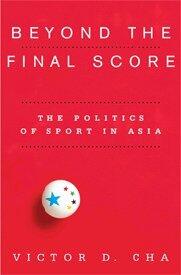
beyond the final score
He serves as an independent consultant, and has testified before Congress on Asian security issues.  He has been a guest analyst for various media including CNN, ABC Nightline, NBC Today Show, CBS Morning Show, Fox News, MSNBC, CNBC, BBC, ESPN, Sports Illustrated, and National Public Radio.

His new book Beyond the Final Score: The Politics of Sport in Asia (Columbia University Press, 2008) looks at the politics of sports and the Beijing Olympics. Cha holds a BA and Ph.D. from Columbia University, MA from University of Oxford.

This event is sponsored by the Pantech Group in Korea.

Philippines Conference Room

Victor D. Cha Director of Asian Studies Speaker Georgetown University
Seminars
Authors
News Type
Commentary
Date
Paragraphs

In the waning days of the Clinton administration, the momentum for engagement with North Korea, building from the earlier agreement to freeze its nuclear program and a moratorium on ballistic missile launches, accelerated to the brink of full-scale normalization of relations. The U.S. presidential election in 2000 brought that diplomatic freight train to an abrupt halt.

Will the 2008 election bring yet another dramatic change in U.S. Korea policy?

The answer, based on the published positions of the two candidates and conversations with his senior Asia policy advisors, seems to be NO. There are important differences of emphasis in the approaches of both candidates, which I will discuss, but the bottom line is that both men are likely to pick up where President George W. Bush leaves off.

There are two fundamental reasons why U.S. policy toward Korea – and more broadly in Northeast Asia --- will not change dramatically. First, Asia will continue to suffer from a deficit of presidential attention. The arc of crisis – Iraq, Iran, Afghanistan and Pakistan -- will necessarily still command, as it has for almost 8 years, the attention of senior American policymakers. Even that will have to fight for space with the growing global financial crisis.

Second, both candidates agree on the broad outlines of an Asia policy, one that does not depart radically from the one pursued by the Bush administration. As a senior McCain advisor put it to me: “There is not a huge difference on Asia between Obama and McCain.” Privately, Obama advisors also stress that there will not be a huge break with current U.S. policy.

Both campaigns are critical of the lack of attention paid to Asia and the need for the U.S. to be more proactive to strengthen existing alliances and to join the discussion about new forms of regional integration. Both candidates support the need to engage, rather than confront, a rising China. Both men call for the U.S. to pay more attention to management of our alliances with South Korea and Japan. And both Obama and McCain support the North Korean nuclear negotiations carried out by President Bush in his second term, although privately both campaigns are critical of the deal that has been struck.

If there are differences, they can be found in two areas – support for the Korea US free trade agreement and the willingness to directly engage North Korea and its regime.

Free Trade and the KORUS Free Trade Agreement

If there is one single issue regarding Korea on which Senators Obama and McCain clearly part company, it is the future of the free trade agreement negotiated with the Bush administration. Senator McCain is an unambiguous supporter of the FTA, not only as a trade pact but also as a symbol of the broader partnership between the U.S. and South Korea.

Senator Obama also supports free trade but is critical of this and other agreements, such as NAFTA, for failing to ensure market access and the protection of labor rights and the environment. Privately, Obama’s advisors understand the symbolic value of the FTA to the alliance, but they plan to ask Seoul to reopen talks on market access, particularly for the automobile industry. Their position reflects the importance of trade unions and the role of some key states – Michigan most of all – in the election outcome. Even if Obama loses, the Democrats are likely to strengthen their control of Congress, making approval of the FTA difficult under any circumstances.

Negotiating with Pyongyang: Back to the Future?

Both the McCain and the Obama camps publicly back the Bush administration’s negotiations with Pyongyang, but both are also privately critical, though for different reasons.

The Obama team is heavily populated by former Clinton administration officials who were involved in the negotiation of the 1994 Agreed Framework with North Korea. They see the current deal as an inevitably flawed bargain, the result of the refusal of the administration to seriously engage the North directly until it had crossed the red line of nuclear weapons testing. With little leverage, not least the credible threat of coercion, we are left with containing the plutonium production of the North, and hoping that a grand bargain down the line can yield full denuclearization.

Obama recognizes the need for “close coordination and consultation with our allies South Korea and Japan,” as one of his advisors put it in a published interview, and supports continuing the Six Party Talks. But the emphasis is clearly on direct talks with North Korea, though conducted with a principled toughness that the Bush administration has not exhibited in its final months in office.

That readiness to conduct direct negotiations, up to conclusion of a peace treaty with Pyongyang and full normalization of relations, is where the two candidates part company. The Republican nominee is clearly uncomfortable with direct dealings with Pyongyang – his position resembles the first term of the Bush administration more than the second in that respect. His advisory team combines realists, mainly veterans of the Powell State Department, and neoconservatives, reproducing the divisions that thwarted coherent policy-making in that first Bush term.

In the end, the views of McCain himself may be decisive. He was an opponent of the Agreed Framework, an agreement he characterized as “appeasement.” He maintained this stance into the Bush administration, vocally opposing any direct negotiations with the North Koreans as long as they maintained the right to develop nuclear weapons. He has been critical as well of the main deal struck by President Bush in his second term – “I didn’t believe in the KEDO agreement that President Clinton made and I don’t believe in this one,” he said in January.

McCain, according to an interview with one of his senior Asia advisors, would “seek a return to the core principles of denuclearization known as CVID, or complete, verifiable, irreversible, dismantlement.” The demand for CVID was the watchword of the Bush administration’s earlier stance, in effect a call for Pyongyang to abandon its nuclear option as a first step. But that demand was dropped after Pyongyang called the Bush administration’s bluff by exploding a nuclear device in October, 2006.

McCain also wants to “broaden our policy goals related to North Korea” beyond nuclear issues, to including human rights, economic and political reform, and reduction of the conventional military threat from North Korea, goals also set out at the outset of the Bush administration. McCain has repeatedly referred to the North Korean regime, and its leader, Kim Jong Il, in harsh terms and embraced a policy of “rogue state rollback.”

Realistically, however, McCain offers no credible, practical means to reach these goals. He reserves, as does Obama, the option to use force. But concretely he comes back to the strategy of pressing China to bring North Korea to heel. Unfortunately the Bush administration also relied on China and found there were clear limits to Beijing’s ability to control or its willingness to press its North Korean client. In the end, McCain may have little option but to follow Bush to Pyongyang’s doorstep.

One Caveat – Events Matter

Despite the powerful impetus to maintain continuity in U.S. policy toward the Korean peninsula, no matter whom is elected in November, there is one important caveat to keep in mind – events matter. Unplanned, and unforeseen, developments could force Korea to the top of the President’s agenda. Already we have seen the reports of Kim Jong Il’s serious illness trigger fresh concerns about a possible collapse of political authority in Pyongyang. A simultaneous rush by China, South Korea and the United States to fill a vacuum of power in the North could upset all calculations. For South Korea, and President Lee Myung-bak, it is always best to prepare for the unexpected.

Hero Image
sneider
All News button
1
News Type
News
Date
Paragraphs

While the United States has been focused on the Middle East, dramatic changes have been taking place in Asia. The region is relatively peaceful and economic growth has been impressive. However, new powers have emerged, while some of our old friends have become more assertive within the region. Michael Armacost and J. Stapleton Roy, two of America's foremost Asia policy experts, offer advice to the incoming US administration in their piece "Asian Policy Challenges for the Next President" written for the Asia Foundation's America's Role in Asia - The Asia Foundation program.

All News button
1
Date Label
Subscribe to Middle East and North Africa