-
Modern Authoritarianism and Geopolitics: Thoughts on a Policy Framework

Once upon a time, there was a seductive story about twin revolutions, a political one in France and an industrial one in Britain, that supposedly ushered in our modern world. This narrative never sat well with empirical realities, yet it lives on in textbooks. What might be a more persuasive framework for a global history of the modern era? What are the implications for research and the teaching of history?

ABOUT THE SPEAKER

Image
Steve Kotkin
Stephen Kotkin is the John P. Birkelund Professor of History and International Affairs in what used to be called the Woodrow Wilson School and in the History Department of Princeton University, as well as a Senior Fellow (adjunct) at the Hoover Institution at Stanford University. He directs the Princeton Institute for International and Regional Studies and co-directs its program in History and the Practice of Diplomacy, which he founded. He also founded Princeton’s Global History Initiative. His scholarship encompasses geopolitics and authoritarian regimes in history and in the present.

Kotkin has published two volumes of a three-volume history of the world as seen from Stalin’s desk: Paradoxes of Power, 1878-1928 (Penguin, November 2014) and Waiting for Hitler, 1929-1941 (Penguin, October 2017). The final installment, Totalitarian Superpower, 1941-1990s, is underway. He writes reviews and essays for Foreign Affairs, the Times Literary Supplement, and The Wall Street Journal, and served as the business book reviewer for The New York Times Sunday Business Section. He is an occasional consultant for governments and some private companies. PhD UC Berkeley (1988).


Image
CDDRL APARC Logos

Online, via Zoom

Stephen Kotkin John P. Birkelund Professor of History and International Affairs
Lectures
Authors
Oriana Skylar Mastro
News Type
Commentary
Date
Paragraphs

This essay was originally published in Foreign Affairs magazine.

As Russian President Vladimir Putin intensifies his assault on Ukraine, a growing number of U.S. military and foreign policy analysts are voicing concern that China may be emboldened by Russia’s example and try to take Taiwan by force. “If Russia can grab chunks of Ukraine or install a puppet regime and withstand economic sanctions, that could embolden nationalists in China to look to Taiwan and think they could do the same,” Ian Johnson, a China expert at the Council on Foreign Relations, has argued. Representative Michael McCaul, Republican of Texas, made a similar argument in an interview last month, as did retired Army General Jack Keane, who said that Chinese President Xi Jinping sees “weakness in the West and how that can advantage him in terms of his national objectives as well.”

Xi is certainly watching events in Ukraine, but his calculus for whether to use force against Taiwan is shaped primarily by domestic factors, not foreign ones. As I have argued in Foreign Affairs, Chinese leaders are considering “armed reunification” with Taiwan more seriously than at any time in the last 50 years. But Xi will assert Chinese control over the island only if he is confident his military can conduct a successful amphibious invasion and if he believes the timing is right for his own career.


Sign up for our newsletters to receive in-depth analysis from our experts.


Shifts in the international environment would be important for Taiwan if they changed Xi’s thinking on either count. But the war in Ukraine has not. Xi’s views about U.S. power and resolve and about the likely international response to an invasion of Taiwan probably remain unchanged. If anything, China’s desire not to invite comparisons with Russia at a time when the world is united against Moscow will lengthen its timeline for taking control of Taiwan, not shorten it.

Too Big to Sanction?

The economic sanctions that the United States, Canada, and many European countries have imposed on Russia give China little reason for pause. To the contrary, these punitive measures simply confirm Beijing’s previous assessments of the possible economic repercussions of using force against Taiwan. Chinese leaders expect the economic costs of an invasion to be heavy but acceptable—partly because of how the international community has responded to Chinese provocations in the past and partly because Beijing’s foreign policy is designed to convince countries to stay out of China’s “internal” affairs, such as the status of Taiwan.

That is not to say the economic measures Washington and its allies have imposed on Russia in recent days are insignificant. The United States and European countries have blocked Russia’s access to most of its foreign currency reserves, making it impossible for Moscow to intervene to prop up its collapsing currency. They have frozen the assets of senior Russian officials, including Putin himself. And they have moved to exclude big Russian banks from SWIFT, the global financial messaging system.

China’s ability to retaliate against the West with economic sanctions of its own is much greater than Russia’s.
Oriana Skylar Mastro

But the United States and its allies could do more to punish Russia. They could bar all transactions with Russia, whether trade or financial. They could seize all Russian assets within their jurisdictions. Washington could announce secondary sanctions on anyone using U.S. dollars for any transaction with Russia. Most important, the United States could use these and other measures to prevent Russia from exporting oil and gas. Letting Russia continue to export oil and gas would be like letting China sell consumer electronics even after it had taken Taiwan by force.

If the United States and its allies have been cautious in their response to Russia, they are likely to be even more restrained when responding to China — and Beijing knows it. China’s ability to retaliate against the West with economic sanctions of its own is much greater than Russia’s. Singapore, which announced trade and banking restrictions against Moscow, trades about $2.5 billion worth of goods with Russia each year — but $57 billion worth of goods with China. China’s leaders likely do not fear U.S.-led economic sanctions in the event of a Taiwan takeover because they probably think that China’s own productive capacity, resources, and friendly partners will allow them to survive on their own, especially since China will soon be the world’s largest economy. They are probably right. China could absorb the types of sanctions being imposed on Russia. And given China’s ability to inflict pain on Western countries, any measures levied against Beijing would likely be softer than those imposed on Moscow.

Taiwan Is Not Ukraine

The Western military response to Russia’s invasion of Ukraine will have an even smaller impact than sanctions on China’s thinking about Taiwan. True, neither the United States nor NATO has deployed troops to fight on Ukraine’s behalf. And U.S. military assistance to Ukraine has been modest: late last month, President Joe Biden instructed the State Department to release up to an additional $350 million worth of weapons from U.S. stocks to Ukraine.

But Russia would have to invade a NATO ally without provoking a U.S. military response for Chinese leaders to seriously question Washington’s commitment to defending Taiwan. Biden has made clear from the beginning of the crisis that his administration will never send troops to Ukraine—a stark contrast with his rhetoric on Taiwan. Just last week, Biden stated unequivocally that the United States would defend Taiwan in the event of a Chinese attack. As a show of support, he also sent to the island a delegation of former U.S. officials led by Mike Mullen, a former chairman of the Joint Chiefs of Staff.

Chinese planners largely assume the United States would intervene militarily on behalf of Taiwan.
Oriana Skylar Mastro

In any case, Chinese planners largely assume the United States would intervene militarily on behalf of Taiwan. What some of them question is whether the United States could amass enough forces fast enough to blunt a Chinese assault on the island. Ironically, if the United States had launched a military operation in response to Russia’s invasion of Ukraine, Chinese leaders would have had further reason to question Washington’s ability to thwart a Chinese assault on Taiwan. The United States does not have the resources to fight the Russians in Europe and prepare adequately for a great-power war in Asia.  

Of course, these facts have not prevented China from trying to manipulate the narrative to undermine Taiwan’s resolve. Chinese state media has been flush with stories about how the United States did not come to Ukraine’s aid and therefore won’t come to Taiwan’s either. Like much of what appears on Chinese state media, however, these stories reflect what Chinese leaders want the world to believe—not what they believe themselves.

Not the Right Time

Chinese leaders are without a doubt considering an attack on Taiwan, but now is not the right time. China’s military is still honing the capabilities it would need to take and hold the island. And Xi is unlikely to take a dangerous gamble on Taiwan before the next Party Congress in late 2022, when he is widely expected to secure a third term as general secretary of the Chinese Communist Party. Xi is also working hard to lessen China’s technological dependence on the West, thus minimizing the impact on any further decoupling after a possible war. For all these reasons, an assault on Taiwan before 2025 is unlikely.

If anything, the crisis in Ukraine creates an additional incentive for China to wait. Beijing does not want the world to equate the two scenarios. From China’s perspective, Ukraine is an independent country engaged in a border dispute with Russia. Taiwan, by contrast, “has always been an inalienable part of China’s territory,” as China’s ambassador to the Association of Southeast Asian Nations, Deng Xijun, put it late last month. In other words, linking the two issues would undermine China’s claim to the island.

China also understands that moving against Taiwan now would solidify fears in the West of an axis of autocrats. The United States may not have the resolve to fight a protracted war to defend Taiwan. But suddenly faced with a need to defend freedom and democracy against an authoritarian alliance, Washington could muster a greater military response and convince its allies to do the same. Partly for this reason, China has desperately tried to maintain some semblance of neutrality during the Ukrainian crisis.

Russia’s invasion of Ukraine has certainly changed aspects of the international order. It has rallied European countries against Russia, prompted Germany to increase defense spending, and even convinced historically neutral countries such as Finland, Sweden, and Switzerland to take a stance against Moscow. From China’s perspective, however, nothing Russia or its adversaries have done meaningfully alters the calculus on Taiwan. 

Headshot of Oriana Skylar Mastro

Oriana Skylar Mastro

Center Fellow at the Freeman Spogli Institute for International Studies

Read More

Army Reserve members during practice
Commentary

Ukraine Is a Distraction from Taiwan

Getting bogged down in Europe will impede the U.S.’s ability to compete with China in the Pacific.
Ukraine Is a Distraction from Taiwan
President Xi and Kim Jong Un meet on a TV screen
Commentary

North Korea Is Becoming an Asset for China

Pyongyang’s Missiles Could Fracture America’s Alliances
North Korea Is Becoming an Asset for China
Chinese military propaganda depicting the Second Taiwan Strait Crisis of 1958.
News

Reassessing China’s Capabilities and Goals for Strategic Competition

On the World Class podcast, Oriana Skylar Mastro argues that in order to set effective policy toward China, the United States needs to better understand how and why China is projecting power.
Reassessing China’s Capabilities and Goals for Strategic Competition
Hero Image
Protesters display placards in front of the Representative Office of the Moscow-Taipei Coordination Commission to protest against Russia’s military invasion of Ukraine on February 25, 2022 in Taipei, Taiwan.
Lam Yik Fei/ Getty Images
All News button
1
Subtitle

Russia’s War in Ukraine Doesn’t Presage a Chinese Assault on Taiwan

Date Label
Authors
Oriana Skylar Mastro
News Type
Commentary
Date
Paragraphs

This commentary was originally published by The Wall Street Journal.


A Russian invasion of Ukraine would be the most consequential use of military force in Europe since World War II and could put Moscow in a position to threaten U.S. allies in Europe. Many in the American foreign-policy establishment argue that the appropriate U.S. response to any such invasion is a major American troop deployment to the Continent. This would be a grave mistake.

The U.S. can no longer afford to spread its military across the world. The reason is simple: an increasingly aggressive China, the most powerful state to rise in the international system since the U.S. itself. By some measures, China’s economy is now the world’s largest. And it has built a military to match its economic heft. Twenty-five years ago, the Chinese military was backward and obsolete. But extraordinary increases in Beijing’s defense budget over more than two decades, and top political leaders’ razor-sharp focus, have transformed the People’s Liberation Army into one of the strongest militaries the world has ever seen.


Sign up for APARC newsletters to receive our experts' commentary and analysis.


China’s new military is capable not only of territorial defense but of projecting power. Besides boasting the largest navy in the world by ship count, China enjoys some capabilities, like certain types of hypersonic weapons, that even the U.S. hasn’t developed.

Most urgently, China poses an increasingly imminent threat to Taiwan. Xi Jinping has made clear that his platform of “national rejuvenation” can’t be successful until Taiwan unifies with the mainland—whether it wants to or not. The PLA is growing more confident in its ability to conquer Taiwan even if the U.S. intervenes. Given China’s military and economic strength, China’s leaders reasonably doubt that the U.S. or anyone else would mount a meaningful response to an invasion of Taiwan. To give a sense of his resolve, Mr. Xi warned that any “foreign forces” standing in China’s way would have “their heads . . . bashed bloody against a Great Wall of steel forged by over 1.4 billion Chinese people.”

If Taiwan falls into Chinese hands, the U.S. will find it harder to defend critical allies like Japan and the Philippines, while China will be able to project its naval, air and other forces close to the U.S. and its territories

The U.S. must defend Taiwan to retain its credibility as the leader of a coalition for a free and open Indo-Pacific. From a military perspective, Taiwan is a vital link in the first island chain of the Western Pacific. If Taiwan falls into Chinese hands, the U.S. will find it harder to defend critical allies like Japan and the Philippines, while China will be able to project its naval, air and other forces close to the U.S. and its territories. Taiwan is also an economic dynamo, the ninth-largest U.S. trading partner of goods with a near-monopoly on the most advanced semiconductor technology—to which the U.S. would most certainly lose access after a war.

The Biden administration this month ordered more than 6,000 additional U.S. troops deployed to Eastern Europe, with many more potentially on the way. These deployments would involve major additional uncounted commitments of air, space, naval and logistics forces needed to enable and protect them. These are precisely the kinds of forces needed to defend Taiwan. The critical assets—munitions, top-end aviation, submarines, and intelligence, surveillance and reconnaissance capabilities—that are needed to fight Russia or China are in short supply. For example, stealthy heavy bombers are the crown jewel of U.S. military power, but there are only 20 in the entire Air Force.

The U.S. has no hope of competing with China and ensuring Taiwan’s defense if it is distracted elsewhere. It is a delusion that the U.S. can, as Pentagon press secretary John Kirby said recently, “walk and chew gum at the same time” with respect to Russia and China. Sending more resources to Europe is the definition of getting distracted. Rather than increasing forces in Europe, the U.S. should be moving toward reductions.

To be blunt: Taiwan is more important than Ukraine. America’s European allies are in a better position to take on Russia than America’s Asian allies are to deal with China.

There is a viable alternative for Europe’s defense: The Europeans themselves can step up and do more for themselves, especially with regard to conventional arms. This is well within Europe’s capacity, as the combined economic power of the NATO states dwarfs that of Russia. NATO allies spend far more on their militaries than Russia. To aid its European allies, the U.S. can provide various forms of support, including lethal weapons, while continuing to remain committed to NATO’s defense, albeit in a more constrained fashion, by providing high-end and fungible military capabilities. The U.S. can also continue to extend its nuclear deterrent to NATO.

The U.S. should remain committed to NATO’s defense but husband its critical resources for the primary fight in Asia, and Taiwan in particular. Denying China the ability to dominate Asia is more important than anything that happens in Europe. To be blunt: Taiwan is more important than Ukraine. America’s European allies are in a better position to take on Russia than America’s Asian allies are to deal with China. The Chinese can’t be allowed to think that America’s distraction in Ukraine provides them with a window of opportunity to invade Taiwan. The U.S. needs to act accordingly, crisis or not.

Ms. Mastro is a center fellow at the Shorenstein Asia-Pacific Research Center, part of Stanford’s Freeman Spogli Institute for International Studies, and a nonresident senior fellow at the American Enterprise Institute. Mr. Colby is a principal at the Marathon Initiative and author of “The Strategy of Denial: American Defense in an Age of Great Power Conflict.”

Headshot of Oriana Skylar Mastro

Oriana Skylar Mastro

Center Fellow at the Freeman Spogli Institute for International Studies
Full Biography

Read More

President Xi and Kim Jong Un meet on a TV screen
Commentary

North Korea Is Becoming an Asset for China

Pyongyang’s Missiles Could Fracture America’s Alliances
North Korea Is Becoming an Asset for China
Chinese military propaganda depicting the Second Taiwan Strait Crisis of 1958.
News

Reassessing China’s Capabilities and Goals for Strategic Competition

On the World Class podcast, Oriana Skylar Mastro argues that in order to set effective policy toward China, the United States needs to better understand how and why China is projecting power.
Reassessing China’s Capabilities and Goals for Strategic Competition
Taiwan Wall
Commentary

Would the United States Come to Taiwan's Defense?

On CNN's GPS with Fareed Zakaria, APARC Center Fellow Oriana Skylar Mastro shares insights about China's aspirations to take Taiwan by force and the United States' role, should a forceful reunification come to pass.
Would the United States Come to Taiwan's Defense?
Hero Image
Army Reserve members during practice
U.S. Army Reserve members during a Cold Weather Operations Course near Fort McCoy, Wisconsin, Jan. 13, 2022.
U.S. Army Reserve photo by Sgt. 1st Class Clinton Wood
All News button
1
Subtitle

Getting bogged down in Europe will impede the U.S.’s ability to compete with China in the Pacific.

Date Label

Shorenstein APARC
Stanford University
Encina Hall, Room E301
Stanford, CA 94305-6055

(650) 736-0656 (650) 723-6530
0
mike_breger.jpg

Michael (Mike) Breger joined APARC in 2021 and serves as the Center's communications manager. He collaborates with the Center's leadership to share the work and expertise of APARC faculty and researchers with a broad audience of academics, policymakers, and industry leaders across the globe. 

Michael started his career at Stanford working at Green Library, and later at the Center for Russian, East European and Eurasian Studies, serving as the event and communications coordinator. He has also worked in a variety of sales and marketing roles in Silicon Valley.

Michael holds a master's in liberal arts from Stanford University and a bachelor's in history and astronomy from the University of Virginia. A history buff and avid follower of international current events, Michael loves learning about different cultures, languages, and literatures. When he is not at work, Michael enjoys reading, painting, music, and the outdoors.

Communications Manager
Date Label
Authors
News Type
News
Date
Paragraphs

On September 29, the APARC China Program hosted Thomas Fingar and Stephen Stedman for the program “Rebuilding International Institutions.” The program, which was moderated by China Program Director Jean Oi, examined the future of international institutions such as the United Nations (UN), World Trade Organization (WTO), and World Health Organization (WHO) in our evolving global political landscape. While Fingar and Stedman acknowledged that such institutions facilitated attainment of unprecedented peace and prosperity after WWII, they also asked difficult questions: Are these institutions still adequate? And if not, how will we change them?

Shorenstein APARC Fellow Thomas Fingar kicked off the session by asking whether or not US-China tensions would impede cooperation on major global challenges, or if those challenges were so serious as to render such rivalries immaterial. Perhaps the most obvious example of such a crisis is the current COVID-19 pandemic. The efforts to curb the virus’ spread not only by individual countries, but also by international organizations like the WHO, have proven largely inadequate. According to Fingar, our existing institutions need to be reformed or supplemented to deal with these types of threats. However, such an overhaul of our international systems will be difficult, he says.

How, then, will we go about such a massive project? Stephen Stedman, Deputy Director at Stanford’s Center on Democracy, Development, and the Rule of Law (CDDRL), responded by explaining that the current failure of international cooperation makes such undertakings tough. Globalization has been a double-edged sword: On one hand, more contact, perhaps inherently, leads to increased tension. The resurgence of traditional notions of sovereignty in 2010, kickstarted by the opposition of countries like Russia and China to what was seen as UN overreaching, has led to a reduction of international cooperation overall. On the other hand, Fingar posits that our interconnectedness may force us toward cooperation despite rivalries as we face more and more transnational threats. International institutions create rules to organize and manage our many interconnected relationships so that we can deal with our problems effectively and reduce friction.

Stedman also pointed to the upcoming US elections and the major impact their outcome will have on how these problems are addressed—or not. In the last four year, the United States has pulled back significantly from international institutions and agreements, leaving a gap that China has started to fill. Furthermore, despite the US’s retreat from international responsibility, the country still remains a critical actor in global initiatives. China’s embrace of a global leadership role is not inherently negative, but its future relationship with the US will need to be “managed in a way that you get greater cooperation and not just paralysis.” Stedman says that it is likely that progress will need to be made on a bilateral front in order to have productive conversations about international issues with China.

Concluding on an optimistic note, Fingar voiced his hope that the current tensions and negative perceptions between rivals might ultimately “be mitigated by success in dealing with a common problem,” because “experience does shape perceptions.”

A video recording of this program is available upon request. Please contact Callista Wells, China Program Coordinator at cvwells@stanford.edu with any inquiries.

Read More

View of building roof in the Forbidden City complex and the Beijing skyline in the background
News

New Fellowship on China Policy Seeks to Strengthen U.S.-China Relations

Stanford University’s Shorenstein Asia-Pacific Center invites applications for the inaugural 2021-22 China Policy Fellowship from experts with research experience on issues vital to the U.S. China policy agenda and influence in the policymaking process.
New Fellowship on China Policy Seeks to Strengthen U.S.-China Relations
Cover of the book Fateful Decisions: Choices That Will Shape China's Future
News

Thomas Fingar and Jean Oi Analyze the Choices and Challenges Facing China’s Leaders

Fingar and Oi joined the National Committee on U.S.-China Relations to discuss their edited volume, ‘Fateful Decisions: Choices that Will Shape China’s Future.’
Thomas Fingar and Jean Oi Analyze the Choices and Challenges Facing China’s Leaders
Woman in a face mask looking at a stock market board
News

Pressing “Re-start”: Business Operations in China after COVID-19 – Highlights of Survey Results and Conversation with Prominent China CxOs

“[T]he biggest challenge for us is really how to . . . navigate through all the unknowns. I mean, at that time [of COVID-19], at every stage we were facing different challenges . . . different phases” stated Zhiqiang (ZZ) Zhang, President of ABB (China).
Pressing “Re-start”: Business Operations in China after COVID-19 – Highlights of Survey Results and Conversation with Prominent China CxOs
Hero Image
Photograph of the UN building in Geneva, Switzerland Image by Mat Reding on Unsplash
All News button
1
Subtitle

Fingar and Stedman spoke as part of the APARC program “Rebuilding International Institutions,” which examined the future of international institutions such as the United Nations (UN), World Trade Organization (WTO), and World Health Organization (WHO) in our evolving global political landscape.

Date Label
Authors
Yong Suk Lee
News Type
Blogs
Date
Paragraphs

Technology companies in South Korea helped tackle COVID-19. The U.S. government can incentivize U.S. tech companies do the same.

As a resident of Silicon Valley heading into our second week under the shelter in place order, what surprises me is the sudden low profile of the tech companies that dominate this area. Until just a month ago it seemed like these companies were taking over the world - churning out new products, connecting people online, providing information and news, and in turn driving equity and real estate prices to unprecedented new highs. But as the COVID-19 cases explode in the US, we rarely hear about them. Public health workers are at the frontlines fighting the war against COVID-19, and grocery stores and retailers are stepping up to the challenge of trying to maintain normalcy of life and providing for the people.

I wonder whether Apple is still pre-occupied with the development of the next iteration of the iPhone, and Google with the development for better search algorithms. Wouldn’t today’s tech companies with their vast resources, creative minds, and technical skill be able to help minimize the impact of COVID-19?

Tech companies in South Korea have played an important role in containing the spread of the virus and reducing casualties. Soon after the first COVID-19 case was confirmed within South Korea, at least four tech companies have launched apps that provide detailed information of the movement of all people who tested positive for COVID-19 – from which restaurant the person visited at what time, to the seat number the person sat in which movie theatre.

The information was collected from a variety of sources including smartphone location data and credit card transactions. The names were anonymized but providing such detailed information raised privacy concerns. However, the South Korean government was swift to declare COVID-19 a public health emergency, which ultimately gave the people the right to information for their safety, and companies to use such data. Moreover, the government allowed companies to by-pass traditional regulatory hurdles.

When Seegene, a biotech company in Seoul, used artificial intelligence to develop South Korea’s first COVID-19 test kit, it needed to get government approval for use. The approval process typically can take over a year, but the Korea Center for Disease Control approved it in a week. Though COVID-19 cases surged in South Korea soon after its first case, the aggressive testing policy and the information provided through these apps have helped South Korea to quickly “flatten the curve,” that is, slow the rate of new infections.

So why don’t we see U.S. tech companies developing new technologies and innovation that can help contain the spread of the virus, minimize the impact, and develop strategies that help people cope with the crisis? It’s because such actions would not generate immediate returns to the company. Despite the greater societal benefit of slowing down the spread of the virus, unless there are clear private returns CEOs and shareholders will be unlikely to devote their resources to fighting a virus with so much uncertainty.

In simple economics terms, it’s a classic case of market failure; and the standard remedy in cases of market failure is government intervention. The government needs to provide incentives, either through relaxing regulatory hurdles or by subsidizing research and development, to encourage tech companies to help contain the virus and minimize the impact of COVID-19 on our society. It is not an issue of big vs. small government, but governments creating the right incentives when private firms can’t easily make the right call.

The U.S. has finally taken measures in the manufacturing sector to fight COVID-19. The White House after several days of going back and forth, eventually invoked the Defense Production Act to order GM to produce ventilators. But hospitals around the country also need masks and personal protection equipment. Unlike smaller countries without a strong manufacturing base, the U.S. has the manufacturing capacity to produce these goods, if the will is there. These manufactured goods are essential for our doctors and nurses in helping patients and fighting the virus.

However, we need more innovative approaches, beyond traditional public health approaches, to fight COVID-19 and future pandemics. Tech companies, in addition to pharmaceuticals and biotech companies that are developing vaccines and cures, can play a significant role in fighting pandemics. Tech companies can use information and communication technology (ICT) to inform the public and reduce the spread of diseases, use machine learning to diagnose new diseases, predict future outbreaks and the spread of current outbreaks, and predict when and which resources would be in need in different parts of the country. Furthermore, there may be more innovative ways to tackle the virus that many of us have not yet thought of. The government can induce tech companies to actively take action by offering R&D grants and loans, providing access to critical information and data, and reducing red-tape.

The South Korean government recognized the urgency of the situation and enlisted the help of private tech firms allowing them to do what they do best with minimal red tape and access to the necessary resources. The European Union has recently put out a call for startups that are developing technologies and innovation related to COVID-19 to apply for fast-track funding.

Chinese tech giants like Alibaba and Tencent, potentially through explicit or implicit government directive, have been actively involved in fighting the COVID-19 crisis. Alibaba has deployed an AI algorithm that predicts COVID-19 from lung CT scans. The procedure only takes a few seconds, which not only substantially speeds up diagnosis but also reduces the risk of doctors and nurses being exposed to the virus. Tencent has committed over 1.5 billion Yuan (over 210 million USD) to help fight COVID-19, which will be spent on prevention and control but also on funding companies that are developing new ways to overcome the pandemic and help with the recovery.

People are sacrificing their individual rights and income. Small businesses are closing doors. All this for the good of the greater public. U.S. tech companies, together with the right push from the federal and state governments, should be able to put aside private returns and short-termism for the moment and work towards an innovative approach to mitigating the impact of today’s crisis.

Yong Suk Lee is an Economist at the Freeman Spogli Institute for International Studies and the Deputy Director of the Korea Program at Stanford University.

Hero Image
gettyimages 98590925
Photo: Justin Sullivan - Getty Images
All News button
1
-

The Shorenstein Asia-Pacific Research Center cordially invites its faculty, scholars, staff, affiliates, and their families to join APARC's first International Potluck Day! Join us to celebrate the diversity of APARC through a multicultural smorgasbord of food. Bring a dish from your home country or family heritage to share with the APARC community as we take the time to mix, mingle, and celebrate the diversity that makes APARC special.

Due to current circumstances, we will be postponing this event until further notice. Thank you for your understanding.

Paragraphs

In Live Long and Prosper?, a new eBook edited by David Bloom, AHPP director Karen Eggleston contributes the chapter "Understanding 'Value for Money' in Healthy Ageing," in which she advocates for and explains the concept of "net value of medical care," a metric that helps quantify the social value of spending on healthcare. Understanding value for money, Eggleston writes, is a way of "determining which services and technologies are unnecessary and which are of high value," a determination that is of increasing importance for aging societies, in which "spending for chronic diseases represents a large and increasing part of public and private budgets." 

All Publications button
1
Publication Type
Books
Publication Date
Authors
Lisa Lee
News Type
News
Date
Paragraphs

Jointly with partners throughout Asia, the Asia Health Policy Program (AHPP) at Shorenstein APARC has developed comparative research on health care use, medical spending, and clinical outcomes for patients with diabetes in the region and other parts of the world as a lens for understanding the economics of chronic disease management. Karen Eggleston, AHPP director and APARC deputy director, recently traveled to South Korea, where she led three project-related events.

On November 29, a workshop on Net Value Diabetes Management was held at Seoul National University (SNU) School of Medicine. This was the third such workshop convened through the project, following two previous ones held in Beijing at the Stanford Center at Peking University. Another workshop, on diabetes modeling, hosted by the Mt. Hood Diabetes Challenge Network, was held at Chung Ang University on December 1. Finally, on December 5, Eggleston held an information session, titled Comparative Economics Research on Diabetes, during the 2019 International Diabetes Federation (IDF) at BEXCO in Busan. These events were also made available through video conferencing to enable remote participation by collaborators who were unable to travel to Korea.

[Learn more about AHPP’s Net Value in Diabetes Management research project]

Diabetes Net Value Workshop

The workshop brought together team members from multiple health systems — including South Korea, Japan, Taiwan, Hong Kong, Thailand, India, the Netherlands, and the United States — to discuss comparative research on the economics of diabetes control. Eggleston shared the results of a study outlined in a working paper on the net value of diabetes management in Japan, the Netherlands, Taiwan, and Hong Kong. This research is part of a broader series of studies aimed to help address the policy challenge of finding the best strategies to improve health through cost effective prevention and healthcare productivity in chronic disease management.

The key to this research was to measure changes in quality or health outcomes over time by predicting mortality risk using blood pressure, blood sugar, and other factors amenable to patient and provider control and improvement (controlling for age and duration of diabetes diagnosis). The research seeks to understand how we can control cost and eliminate waste without cutting out the things that are valuable and improving people’s quality of life. Further studies probe determinants of relative net value of a pay-for-performance program in Taiwan, adherence to medications and vertical integration in Japan, and net value based on a randomized controlled trial in India.

Image
Two women and three men talking with each other in a conference room

Karen Eggleston (left) with workshop participants.

Young Kyung Do of SNU reported that according to his evaluation project for diabetes care, the quality of care and treatment in South Korea has improved and is similar to Hong Kong and Singapore. The goal of the program is to provide more comprehensive care to diabetes patients.

Talitha Feestra of the Netherlands net value team presented her proposal for joint research to develop new prediction models for specific populations as a core component of health economics decision models in Diabetes. Feestra will take the lead to develop the plan and time frame for the continuation of this research in 2020.

Several additional comparative studies were proposed and discussed. Participants who attended the workshop and contributed to discussion included Junfeng Wang from the Netherlands net value team; Jianchao Quan and Carmen Ng from Hong Kong University; Daejung Kim from the Korea Institute for Health and Social Affairs (KIHASA); Taehoon Lee, Eun Sil Yoon, and Hongsoo Kim from SNU; Piya Hanvoravongchai from Chulalongkorn University; and Gregory Ang from National University of Singapore. Remote participants included Vismanathan Baskar from Madras Diabetes Research Foundation; Wasin Laohavinij from Chulalongkorn University (visiting Stanford University autumn quarter); and Rachel Lu from Chang Gung University.

Mt. Hood Diabetes Challenge Workshop on Diabetes Modeling

Philip Clarke from the Health Economics Research Center, University of Oxford, presented the history of insulin as a cure for diabetes and discussed in detail methods for economic modeling of diabetes, including quality of life and diabetes cost, drawing from his rich experience developing the UK Prospective Diabetes Study outcomes model. The second presenter was Andrew Palmer of University of Tasmania, Australia. His presentation included many additional economic modeling pointers, especially regarding drawing in the literature for building models.

Image
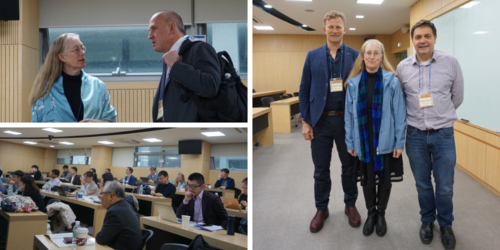
Collage of three photos showing people posing to the camera and seated in a lecture hall

Karen Eggleston with participants at the Mt. Hood Diabetes Challenge Workshop; (right hand side) from left to right: Andrew Palmer, Karen Eggleston, Philip Clarke.

We are grateful to Professors Clarke and Palmer for graciously allowing the AHPP network researchers to join the workshop both in person and remotely, adding to their chronic disease modeling skills, and for inviting Karen Eggleston to present a keynote at the Mt Hood conference that took place before the modeling workshop.

Information Session: Comparative Economics Research on Diabetes

The third and final component of the diabetes research events was held on December 5 as part of the International Diabetes Federation congress in Busan, Korea, and presented the network to clinicians and public health researchers. Participants from China, India, and Australia attended. They shared updates on their individual projects and discussed methods and ideas for future collaboration.

Hero Image
A group of people posing to the camera
All News button
1
Authors
Noa Ronkin
News Type
News
Date
Paragraphs

Understanding the value of chronic disease care is critical to confronting the challenges of aging societies. In a new ebook published by the Centre for Economic Policy Research, APARC Deputy Director and Asia Health Policy Program Director Karen Eggleston provides a framework for assessing the social value of health spending.

The world population is aging faster than ever before and governments must confront the increasing burden of healthcare spending on their economies. At a time when the economics of aging is inseparable from the economics of healthcare, successful adaptations to older population age structures necessitate better understanding of the value of medical care. Policymakers, in particular, must incorporate value into considerations of healthcare cost growth, so they can determine the extent to which average health improvements offset added cost, reduce cases in which health spending rises without sufficient corresponding health outcomes, and reward those in which “we are getting what we pay for.”

A new book chapter, authored by APARC Deputy Director and Asia Health Policy Program Director Karen Eggleston, provides a framework for assessing the social value of health spending. Titled “Understanding ‘value for money’ in healthy aging,” the chapter is part of an ebook, Live Long and Prosper? The Economics of Ageing, published by the Centre for Economic Policy Research (CEPR).

[To receive more stories like this directly to your inbox subscribe to our newsletters.]

Quality-Adjusted Cost of Care

How do health economists incorporate value into measurements of health spending and how do they measure the social value of medical care? First they assume each additional year of life brings a given monetary value. Then they measure the growth in value to patients as monetized gains in “quality-adjusted life-years,” a metric that includes increases in life expectancy and quality of life. The difference between the change in health spending and the change in monetized gains on improved survival is the net change in quality-adjusted health spending or the net value of medical care.

Understanding the value of chronic disease care is especially critical in aging societies, as governments must transform their health systems to support patients who will live with chronic diseases for decades. Health benefits of medical care, however, are difficult to aggregate across disparate services and diseases, and hence focusing on management of a single important chronic disease allows researchers to develop metrics of quality improvement and value that are linked to rigorous clinical studies. Eggleston describes a recent international research collaboration, which she was part of, that did just that. The researchers studied quality adjustment for one disease of growing global prevalence, type 2 diabetes, in four different health systems: one in Europe (the Netherlands) and three in East Asia (Japan, Hong Kong, and Taiwan).

Results of the study suggest that, in each health system, the value of improved survival outweighs the increase in health spending. For example, in the case of Japan, Eggleston and her colleagues found a positive value net of $2,595 for $100,000 value of a life-year. They also compared net value across the four health systems and different patient samples, finding mean net value that ranged between $600 and $10,000 for a $100,000 value of a life-year. Moreover, net value was positive for all age groups and remains positive and significant for individuals well beyond traditional retirement ages. These results, says Eggleston, indicate “the importance of continuing investments in medical treatments and services that deliver health outcomes of commensurate or higher value.”

Policy Implications

Confronting the challenges of aging societies requires careful thinking about the value of investments in new technologies for managing chronic conditions. To promote healthy aging governments must be “resiliently persistent in measuring the value of innovations for healthy aging and rewarding those that deliver high net value,” argues Eggleston. The goal should be improving the “value for money” of medical care rather than applying largescale cost controls that might stifle important breakthroughs.

The four-system study by Eggleston and her colleagues provides a framework for developing methods for assessing quality improvement and the net value of chronic disease spending and, more broadly, for measuring the value of healthy aging.


Download Eggleston’s chapter as part of the entire ebook >>

Learn more about Dr. Karen Eggleston’s research agenda seeking to assess net value in diabetes management and to identify and analyze innovation for healthy aging.

Hero Image
Closeup on a hand of an old man.
All News button
1
Subscribe to Europe