Health
-

Air pollution is a silent and invisible killer more lethal than violence, diseases, and smoking.  More than 95 percent of the global population lives in areas with unhealthy air by WHO standards.  Moreover, long-term exposure to polluted air can increase the probability of succumbing to COVID-19.  

Scientific solutions to contain air pollution are available, but limited progress has been made in implementing them.  Temporally, there has been an uneven success in reducing pollution even in the same locality over time, as exemplified by the exercise of political power to change the color of the sky leading up to the 2008 Beijing Olympics (aka Olympic Blue).  

In this talk, Professor Shen will discuss her new book, The Political Regulation Wave: A Case of How Local Incentives Systematically Shape Air Quality in China (Cambridge University Press, 2022).  Departing from extant works, which focus on air data manipulation or the effect of campaigns, the book asks, what explains the systematic temporal variation in actual and reported air quality after controlling for top-down implementation campaigns?  Making use of new data, approaches, and techniques from across social and environmental sciences, the book shows that local leaders ordered different levels of regulation over time based on what their political superiors desired, leading to the titular “waves” of regulation and pollution.  However, the effectiveness of their regulatory efforts depends on the level of ambiguity in controlling a particular pollutant.  When ambiguity dilutes regulatory effectiveness, having the right incentives and enhanced monitoring is insufficient for successful policy implementation.

You can read and download her book in pdf format here.

Image
Portrait of Shiran Victoria Shen
Shiran Victoria Shen forged her own path at Stanford University by simultaneously completing a Ph.D. in political science and an MS in civil and environmental engineering in five years after graduating Phi Beta Kappa, Sigma Xi, and with high honors from Swarthmore College. Her research explores the intersections of political science, public policy, environmental sciences, and engineering, with a particular understanding of how local politics influence environmental governance. Her first book, The Political Regulation Wave: A Case of How Local Incentives Systematically Shape Air Quality in China, was published by Cambridge University Press in March 2022.  In dissertation form, it was the recipient of two major association awards, the American Political Science Association’s Harold D. Lasswell Award and the Association for Public Policy Analysis and Management’s Ph.D. Dissertation Award. Earlier versions of its parts received the American Political Science Association’s Paul A. Sabatier Award for the best paper in science, technology & environmental politics and the Southern Political Science Association’s Malcolm Jewell Award for the best overall graduate student paper.

You can learn more about her work at http://svshen.com and follow her on Twitter @SVictoriaShen.

Via Zoom

Shiran Victoria Shen National Fellow, Hoover Institution, Stanford University; Assistant Professor of Environmental Politics, University of Virginia
Seminars
Shorenstein APARC Encina Hall E301 Stanford University
1
Visiting Scholar at APARC, 2021-2022
huijun_cynthia_chen.jpeg Ph.D

Dr. Cynthia Chen joined the Walter H. Shorenstein Asia-Pacific Research Center (APARC) as visiting scholar with the Asia Health Policy Program during the 2022 winter and spring quarters. She is an Assistant Professor at the National University of Singapore (NUS). Her current research focuses on the well-being and older adults, healthcare financing, and the economics of ageing. She is interested in how demographic, economic and social changes can affect the burden of care, financing needs and optimal resource allocation in the future. Her research has been supported by the Singapore’s Ministry of Health, Ministry of Education, the US National Institutes of Aging, and the Thai Health Promotion Foundation among others. To date, she has published more than 45 internationally peer-reviewed journals on societal ageing, the burden of chronic diseases, and cost-effectiveness research. Dr. Chen obtained her Ph.D. in Public Health, Masters and BSc in Statistics from NUS.

Paragraphs

China’s national health reforms over the past two decades have brought the system closer to the modern, safe, reliable, and accessible health system that is commensurate with China’s dramatic economic growth, improvement in living standards, and high hopes for the next generation.

China’s national health reforms of 2009—continuing many reforms undertaken since SARS (2003)—consolidated a system of social health insurance covering the entire population for basic health services, contributing to a surge in healthcare utilization while reducing out-of-pocket costs to patients – which declined from 56% to 28% of total health expenditures between 2003 and 2017. An expanded basic public health service package, funded by per capita government budget allocations that include a higher central government subsidy for lower-income provinces, provides basic population health services to all Chinese. Now the governance structure consolidates the purchaser role for social health insurance schemes under the National Healthcare Security Administration, with most other health sector functions under the National Health Commission. China’s world-leading technological prowess in multiple fields spanning digital commerce to artificial intelligence—and accompanying innovative business models such as WeDoctor that have not yet been fully integrated into the health system—hold promise for supporting higher quality and more convenient healthcare for China’s 1.4 billion.

However, many challenges remain, from dealing with COVID-19 and its aftermath to other lingering challenges, from promoting healthy aging to the political economy of addressing patient-provider tensions, changing provider payment to promote “value” rather than volume, and deciding which new medical therapies qualify as “basic” for the basic medical insurance schemes. To make China’s investments in universal health coverage and the accompanying rapid medical spending growth sustainable in the longer run, policies need to help the most vulnerable avoid illness-induced poverty, increase health system efficiency, strengthen primary care, and reform provider payment systems.

All Publications button
1
Publication Type
Testimonies
Publication Date
Subtitle
Testimony before the U.S.-China Economic and Security Review Commission
Authors
Karen Eggleston
Authors
News Type
News
Date
Paragraphs

Of the many issues that the COVID-19 pandemic has brought into focus, foremost in the spotlight is the vital role that healthcare systems play in societal wellbeing and security. Around the world, health systems of all types have had to rapidly adapt, reassess, and react to constantly changing needs.

The 2020-21 Asia Health Policy Program (AHPP) colloquium series, “Health, Medicine, and Longevity: Exploring Public and Private Roles,” brings together academics, theorists, on-the-ground NGO leaders, and government advisors to explore how partnerships between public providers and private organizations affect the quality and access to healthcare the world over.

The series recently featured a keynote address by Harvard economist Oliver Hart, the 2016 co-recipient of the Nobel Prize in Economics for his work on contract theory — a framework known as ‘The Proper Scope of Government.’ Hart joined AHPP Director and APARC Deputy Director Karen Eggleston to reflect on the impact his theory has had across disciplines in the 25 years since its publication and on the future of research into contract theory. Watch the conversation with Hart below.

[Subscribe to our newsletters to stay informed on research happening at APARC.]

Oliver Hart and the ‘Proper Scope of Government’

Hart’s seminal economic theory, ‘The Proper Scope of Government,” underpins much of the research into public-private partnerships in healthcare. Hart developed this touchstone framework jointly with Andrei Shleifer and Robert W. Vishny to better evaluate when a government should provide a service itself and when it should contract with a private provider for support and execution of services.

The model outlined in Hart, Shleifer, and Vishny’s original 1996 working paper is designed to help providers and contractors consider the costs and benefits of a proposed contractual service agreement. While this model was originally applied to the case of prison privatization, the framework has served as an invaluable tool for researchers in multiple sectors including health policy and provision.

Reflections and Updates to the Theory

In reflecting on ‘The Proper Scope of Government,’ there are things Hart would like to see more fully incorporated into the theory to enrich its real-world applicability. Chiefly among these is better accounting for contractual incompleteness or the reality that a contract cannot anticipate and outline every possible unforeseen event or area of ambiguity. However, modeling contractual incompleteness is notoriously difficult given the almost-limitless factors of variability.

Some of Hart’s recent work on guiding principles responds to this challenge. Rather than trying to predict every aspect of a contractual relationship within the framing and language of a standard contract model, Hart argues that mutually agreed-upon guiding principles —such as equity, loyalty, and honesty — can serve as a foundation for navigating inevitable areas of ambiguity and potential conflict that a contract does not specifically state or that the original theory does not fully account for.

These guiding principles also help preserve space for renegotiation and innovation, which are necessary in an era of rapid technological advances and explosion of measurable data. In this context, Hart cautions against the mentality of ‘more is more:’

“If you put more and more things into the contract and then something happens that wasn’t in the contract, the fact that you put so much more in may make it more difficult to negotiate about the thing that you didn’t put in.”

 Applying ‘The Proper Scope of Government’

Hart shared a prime example of his theory at work in health systems in a case study of the Vancouver Island Health Authority. Traditionally, family physicians would continue as the primary care provider for their patients even if a patient needed hospitalization. But a change of law in 2006 required all specialized in-hospital care be contracted to hospitalists with little to no crossover with care provided by family practice physicians.

The result was a rise in caseload and stress levels amongst hospital specialists and repeated failed negotiations of the standard contract. The addition of guiding principles to the contract, however, provided avenues where reasonable solutions and additional communications could happen beyond the limits of the formal contract.

This is just one case of innumerable where Hart’s work has helped inform and contextualize how policymakers consider relationships between the public and private spheres of healthcare. Responding to the praise and input from fellow economists presented in a tribute documentary to the impact of his framework, Hart remarked:

“I hadn't realized how many people have been influenced by this paper and how they've been using it in different contexts. I knew some of the applications, but there were others I didn't, and it’s been truly amazing to see that.”

Looking Toward the Future

The tradeoffs between public and private partnerships in healthcare systems across the world will continue to be a dynamic and evolving area of research that will rely on theories such as ‘The Proper Scope of Government’ for framing and application. Looking towards the future, Hart was hopeful but cautious about the vitality of the kind of theoretical tradition which allowed for the development of his original theory. He recognizes that specialties such as contract theory and contractual incompleteness are inherently “messy” and somewhat out of vogue with current trends in economics which tend to favor theories that are “impressive, clever, and non-obvious,” regardless of whether they address important questions.

As he iterated in his Nobel Prize lecture, the incomplete world of contracts nonetheless “underlies numerous significant phenomena, some of which have great policy relevance,” and therefore fully deserving of upcoming economists’ time and efforts.

Further Research into Public-Private Partnerships

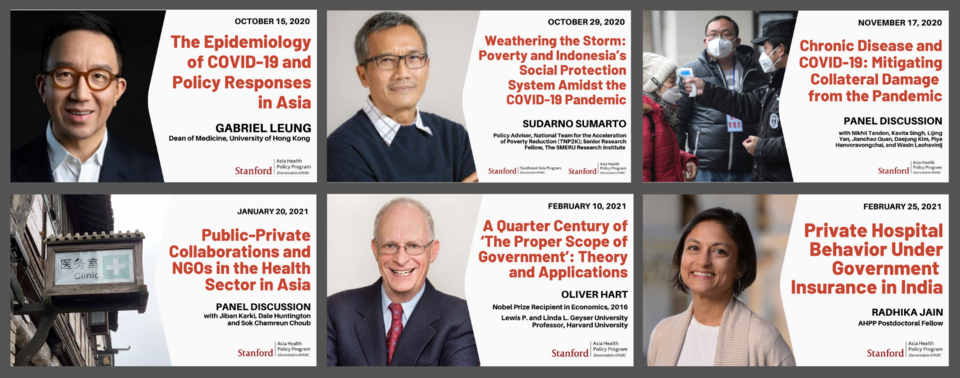
The Asia Health Policy Program’s 2020-21 colloquium series focuses on the roles and impacts of public-private partnerships in healthcare and the tradeoffs in equity, accessibility, and cost that come with contracted agreements in health systems. All of the events from the colloquium series are available on our YouTube channel. Click the thumbnails below to start exploring.

Collaborative governance — that is, relationships involving both the private and public sectors in the pursuit of public value — is part of ongoing research by Karen Eggleston. Her forthcoming book, The Dragon, the Eagle, and the Private Sector (Cambridge University Press), co-authored with Harvard’s John D. Donahue and Richard J. Zeckhauser, examines the ways in which collaborative governance works across a wide range of policy arenas in China and the United States, with the goal of empowering public decisionmakers to more wisely engage the private sector. Join us for the book launch event, which will be held jointly with the Harvard Kennedy School on March 5 


Image
Thumbnail images for the webinar events in the AHPP's 2020-21 colloquium series, "Health, Medicine, and Longevity: Exploring Public and Private Roles."

Read More

Male Japanese doctor showing senior patient records on a clipboard
News

Health Signals Increase Preventive Care, Improve Health Outcomes for Individuals at High Risk of Diabetes, Evidence from Japan Shows

Among the general population, however, researchers including Asia Health Policy Program Director Karen Eggleston find no evidence that additional care improves health outcomes.
Health Signals Increase Preventive Care, Improve Health Outcomes for Individuals at High Risk of Diabetes, Evidence from Japan Shows
An elderly individual travels in a cart up a street.
News

Researchers Develop New Method for Projecting Future Wellness of Aging Populations

Asia Health Policy Director Karen Eggleston and her colleagues unveil a multistate transition microsimulation model that produces rigorous projections of the health and functional status of older people from widely available datasets.
Researchers Develop New Method for Projecting Future Wellness of Aging Populations
A communications robot named Pepper by Softbank
Q&As

Robots May Be the Right Prescription for Struggling Nursing Homes

Karen Eggleston and Yong Suk Lee speak to the Oliver Wyman Forum on how robotics and advancing technologies are helping staff in Japanese nursing homes provide better and safer care to their patients.
Robots May Be the Right Prescription for Struggling Nursing Homes
Hero Image
[Left] A nurse assists an elderly woman in a wheel chair; [Right] Oliver Hart
The AHPP 2020-21 colloquium series explores the roles of the public and private sectors in providing equitable and accessible health services. The keynote address was given by Nobel laureate Oliver Hart.
Getty Images
All News button
1
Subtitle

In its 2020-21 colloquium series, the Asia Health Policy Program weighs the balance, benefits, and considerations in providing health services through national governments and contracting with private organizations.

Authors
Callista Wells
News Type
News
Date
Paragraphs

To celebrate its May Release, the Stanford China Program hosted a virtual book launch event for Fateful Decisions: Choices That Will Shape China’s Future (Stanford University Press) on June 2nd. Joining co-authors Thomas Fingar (Shorenstein APARC Fellow, Stanford University) and Jean C. Oi (Director, Stanford China Program; William Haas Professor of Chinese Politics, Stanford University) were contributors Karen Eggleston (Senior Fellow at FSI; Director of the Asia Health Policy Program, Shorenstein APARC, Stanford University), Barry Naughton (Sokwanlok Chair of Chinese International Affairs, School of Global Policy and Strategy, UC San Diego), and Andrew Walder (Senior Fellow at FSI; Denise O'Leary and Kent Thiry Professor, Stanford University). As Fingar and Oi point out in their volume, despite China’s extraordinary growth over the past 40 years, the country’s future is uncertain. China has enjoyed optimal conditions for development since the 1980s, but new hurdles including an aging populace, the loss of comparative economic advantage, a politically entrenched elite, and a population with rising expectations will test the country’s leaders. With each focusing on a different facet of China’s challenges, the panelists gathered to share their expertise and provide the audience with a glimpse into what the future might hold for this important country.

Following an introduction from Professor Jean Oi, the program kicked off with Professor Barry Naughton of University of California, San Diego, who discussed his chapter entitled “Grand Steerage.” Professor Naughton argued that, as it plans for the future, China’s policymaking is becoming increasingly technology-focused, particularly in the realm of economic policy. Naughton further notes that China’s economy is becoming simultaneously more state-guided and more centered around technology. This decision is a gamble, though: China is investing heavily in high-tech industries, advancing massive, centrally steered projects like the Greater Bay Area initiative and the Xiong’an New District. If they are successful, says Naughton, this will indeed be an incredible success. But, if they are not, China’s losses will be major: “There’s not really a middle ground.”

After Professor Naughton was Professor Karen Eggleston, an expert on health policy in Asia. Professor Eggleston’s chapter, “Demographic and Healthcare Challenges,” deals with emerging obstacles for China’s healthcare system, including population aging and the problems that come with it, like chronic diseases and elder care. Although China’s healthcare system has improved dramatically in recent decades, it has done so unevenly, notes Eggleston: life expectancy has greatly increased, but with disparities according to income, region, and urban vs. rural status; universal healthcare is available, but the benefit level is low, effectively limiting the standard of care many can receive. The ratio of health spending to GDP is also increasing, yet it is still modest compared to high-income countries. The COVID-19 crisis has, of course, introduced even more challenges: Will China be able to distribute future vaccines equitably? Will this crisis negatively affect young people’s decisions to choose healthcare as a career? Will telemedicine, which has seen a surge under the pandemic, improve or exacerbate existing disparities? China faces a multitude of constraints and choices going forward if it hopes to meet its population’s healthcare needs.

The audience then had a chance to hear from co-editor Thomas Fingar, speaking on his chapter, “Sources and Shapers of China’s Foreign Policy.” Fingar noted three key takeaways from both his chapter and his talk: Firstly, China’s foreign policy is a fundamental part of its national policy. Secondly, the global political environment plays an important role in shaping both foreign and domestic policy which, thirdly, plays an important role in shaping foreign policy. The conditions that allowed China to flourish over the past 40 years, emphasized Fingar, are very different from those of the present. In the 1970s and 80s, China was able to take advantage of Cold War bipolarity, globalization was in its infancy, and “China was the only significant developing country willing to embark, at that time, on the export-led path of development.” In recent years, though, China’s behavior internationally has alienated other countries; there are many competitors pursuing its style of development; and its needs and aspirations have changed, requiring more raw materials and depending upon multi-national economic agreements. Fingar suggests two potential foreign policy options: China could continue with its wolf warrior diplomacy, which has “alienated essentially all China’s neighbors to some degree,” or it could return to a style more similar to that of the 1980s and 90s Reform and Opening era. It remains to be seen which style will win out.

Finally, Professor Andrew Walder concluded the program with his discussion of China’s political future at large. His chapter, “China’s National Trajectory,” follows China’s remarkable advancement in recent years and “tr[ies] to divine what a lower growth era will mean for China’s political future.” The last 40 years of rapid growth have generated support for China’s political system, more patriotism, the near eradication of democracy movements, and an elite unity not seen in the 1970s and 80s. However, low growth rates could mean a reversal for many of these trends, says Walder. While the aforementioned support for and stability of the Chinese government was maintained by ever-improving living standards and upward mobility, a low growth period (coupled with an aging population) means the government will no longer be able to rely on these trends for popular support. Rather, it will need to improve its provision of public services to address present-day challenges. Regardless, argues Walder, the low growth era will undoubtedly lead to “dynamic changes underneath the façade of stability of Chinese politics….”

For more insights on the modern obstacles China faces and what they mean for the country’s future, check out Fateful Decisions: Choices That Will Shape China's Future, available for purchase now.

Read More

Elderly Chinese citizens sit together on a park bench.
Q&As

Karen Eggleston Examines China’s Looming Demographic Crisis, in Fateful Decisions

Karen Eggleston Examines China’s Looming Demographic Crisis, in Fateful Decisions
Quote from Thomas Fingar and Jean Oi from, "China's Challeges: Now It Gets Much Harder"
Commentary

Now It Gets Much Harder: Thomas Fingar and Jean Oi Discuss China’s Challenges in The Washington Quarterly

Now It Gets Much Harder: Thomas Fingar and Jean Oi Discuss China’s Challenges in The Washington Quarterly
Hero Image
Fateful Decisions book cover
All News button
1
Authors
Noa Ronkin
News Type
News
Date
Paragraphs

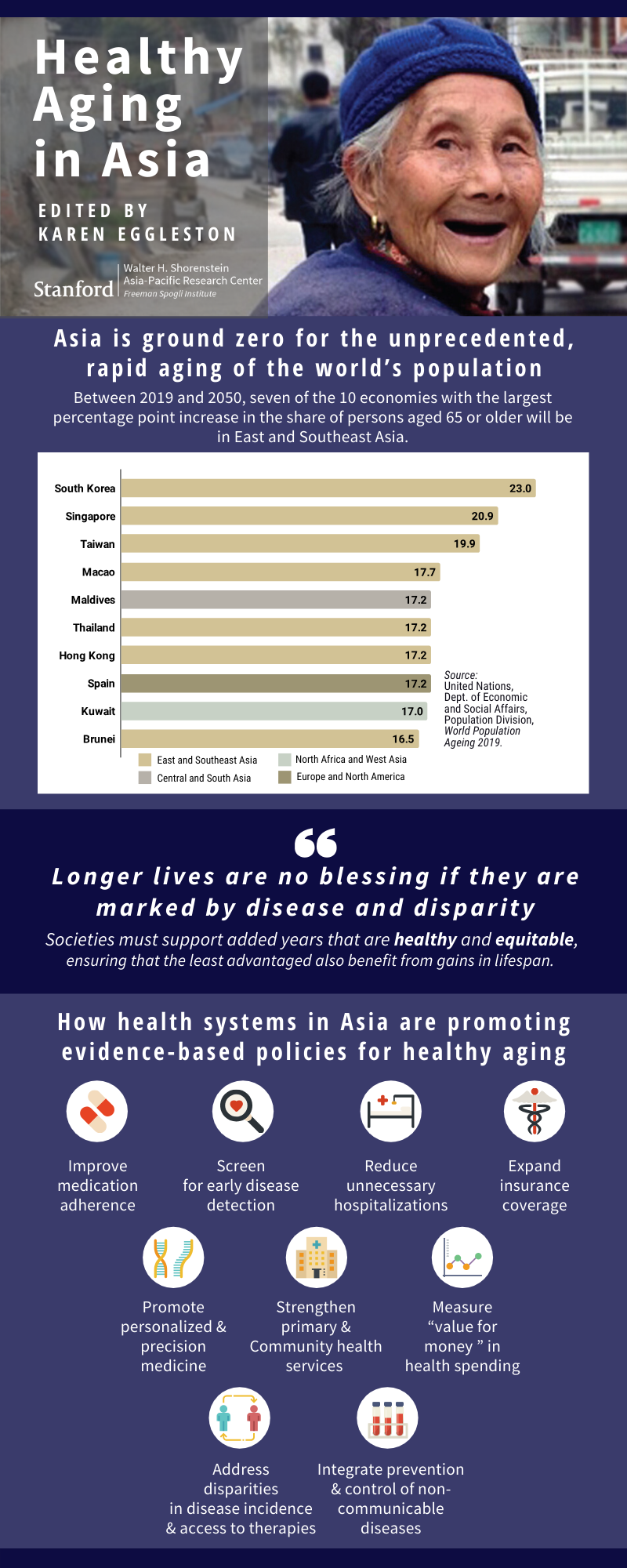
Rapid population aging is transforming societies around the world, and the Asia-Pacific region is on the frontlines of this unprecedented demographic shift. Life expectancy in Japan, South Korea, and much of urban China has now outpaced that of the United States and other high-income countries. With this triumph of longevity, however, comes a host of health, social, and economic challenges.

Longer lifespans will necessitate working to older ages, “but extending work lives will only be feasible if the added years are healthy ones, and will only be equitable if the least advantaged also benefit from healthy aging,” writes APARC Deputy Director and Asia Health Policy Program Director Karen Eggleston in her new book, Healthy Aging in Asia. “The great blessing of longer lives dims when clouded by pain, disability, and loss of dignity.”

[Listen to our conversation with Eggelston about the book and continue reading below. To receive stories like this directly in your inbox sign up for APARC newsletters]

Shorenstein APARC · Healthy Aging In Asia | Karen Eggleston

Image
Poster featuring the book Healthy Aging in Asia


Societies around the world must reduce disparities in health outcomes and address the older age-associated rise in the burden of noncommunicable diseases (NCDs) such as diabetes, hypertension, and cancer. Indeed, the COVID-19 pandemic has underscored the vulnerability of older adults suffering from NCDs to newly emerging pathogens and the importance of building long-term, resilient health systems.


How are health systems in Asia promoting evidence-based policies for healthy aging? What strategies have they used to prevent NCDs, screen for early disease detection, raise the quality of care, improve medication adherence, reduce unnecessary hospitalizations, and increase “value for money” in health spending?

The concise chapters in Healthy Aging in Asia examine these questions, covering multiple aspects of policy initiatives and economic research on healthy longevity in diverse Asian economies — from cities such as Singapore and Hong Kong to powerhouses such as Japan, India, and China — as they transform their health systems to support wellbeing in older age. Eggleston edited and contributed multiple chapters to this new volume, now available via Brookings Institution Press. This publication is part of APARC’s in-house series with the Brookings Institution.

Dr. Karen Eggleston

Karen Eggleston

Senior Fellow at the Freeman Spogli Institute for International Studies, Director of the Asia Health Policy Program, and Deputy Director of the Shorenstein Asia-Pacific Research Center
Full Biography

Read More

Karen Eggleston speaking to an online panel.
News

Karen Eggleston Testifies on China’s Healthcare System to Congressional Review Commission

Asia health policy expert Karen Eggleston provides testimony for a U.S.-China Economic and Security Review Commission hearing on China's domestic healthcare infrastructure and the use of technology in its healthcare system amid COVID-19.
Karen Eggleston Testifies on China’s Healthcare System to Congressional Review Commission
Elderly Chinese citizens sit together on a park bench.
Q&As

Karen Eggleston Examines China’s Looming Demographic Crisis, in Fateful Decisions

Karen Eggleston Examines China’s Looming Demographic Crisis, in Fateful Decisions
Michael McFaul, Xueguang Zhou, Karen Eggleston, Gi-Wook Shin, Don Emmerson, and Yong Suk Lee
News

FSI Hosts APARC Panel on COVID-19 Impacts in Asia

Scholars from each of APARC's programs offer insights on policy responses to COVID-19 throughout Asia.
FSI Hosts APARC Panel on COVID-19 Impacts in Asia
All News button
1
Subtitle

Asia health policy expert Karen Eggleston’s new volume, ‘Healthy Aging in Asia,’ examines how diverse Asian economies – from Singapore and Hong Kong to Japan, India, and China – are preparing for older population age structures and transforming health systems to support patients who will live with chronic disease for decades.

Paragraphs
Cover of Healthy Aging in Asia that shows an elderly woman in a Chinese village.
Life expectancy in Japan, South Korea, and much of urban China has now outpaced that of the United States and other high-income countries. With this triumph of longevity, however, comes a rise in the burden of noncommunicable diseases (NCDs) like diabetes and hypertension, reducing healthy life years for individuals in these aging populations, as well as challenging the healthcare systems they rely on for appropriate care.  
 
The challenges and disparities are even more pressing in low- and middle-income economies, such as rural China and India. Moreover, the COVID-19 pandemic has underscored the vulnerability to newly emerging pathogens of older adults suffering from NCDs, and the importance of building long-term, resilient health systems. 
 
What strategies have been tried to prevent NCDs—the primary cause of morbidity and mortality — as well as to screen for early detection, raise the quality of care, improve medication adherence, reduce unnecessary hospitalizations and increase “value for money” in health spending? 
 
Fourteen concise chapters cover multiple aspects of policy initiatives for healthy aging and economic research on chronic disease control in diverse health systems — from cities such as Singapore and Hong Kong to large economies such as Japan, India, and China. 
 

Desk, examination, or review copies can be requested through Stanford University Press.

All Publications button
1
Publication Type
Books
Publication Date
Authors
Karen Eggleston
Book Publisher
Shorenstein APARC
Paragraphs

Abstract: Soil-transmitted helminths (STHs) infect over one billion people worldwide. There is concern that chronic infection with STHs among school-aged children may detrimentally affect their development, including their health, cognition, and education. However, two recent Cochrane reviews examining the impact of deworming drugs for STH on nutrition, hemoglobin, and school performance found that randomized controlled trials (RCTs) in the literature provide an insufficient evidence base to draw reliable conclusions. This study uses a cluster-RCT to add to existing evidence by assessing the impact of a deworming intervention on nutrition, cognition, and school performance among schoolchildren in rural China. The intervention, implemented by local health practitioners in a setting with a baseline infection prevalence of 41.9% (95% confidence interval [CI] = 39.8%, 43.9%) and infection intensity of 599.5 eggs per gram of feces among positive-tested schoolchildren (95% CI = 473.2, 725.8), consisted of distributing a 400-mg dose of albendazole accompanied with educational training about STH infection, treatment, and prevention. The intervention was conducted twice over the course of the study—at baseline in May 2013 and later in November 2013. We found that the deworming intervention reduced both infection prevalence and infection intensity, but these declines in infection were not accompanied by an impact on outcomes of nutrition, cognition, or school performance. Our interpretation is that the impact of deworming was attenuated by the light infection intensity in our sample population. Evidence from future RCTs is needed to assess the effect of deworming on key outcomes in areas with moderate and severe worm infections.

All Publications button
1
Publication Type
Journal Articles
Publication Date
Journal Publisher
American Journal of Tropical Medicine and Hygiene
Authors
Scott Rozelle
Paragraphs

Abstract: Social interactions in infancy have implications for long-term outcomes. This study uses data from a sample of 1412 rural Chinese infants aged 6–12 and 24–30 months to examine the relationship between peer interactions and cognitive development. Over 75% of the infants in this sample had less than three peers and around 20% had no peers in both periods. The prevalence of cognitive delays is high within this sample and increases as infants age. Multivariate analysis reveals that peer interaction is significantly associated with cognitive development. Heterogeneous analysis suggests that peer interactions and mental development may be related to the child’s primary caregiver and the distance from the child’s household to the center of their village.

All Publications button
1
Publication Type
Journal Articles
Publication Date
Journal Publisher
Chinese Journal of Sociology
Authors
Scott Rozelle
Number
2
Paragraphs

Abstract: More than 60 million children in rural China are “left-behind”—both parents live and work far from their rural homes and leave their children behind. This paper explores differences in how left-behind and non-left-behind children seek health remediation in China’s vast but understudied rural areas. This study examines this question in the context of a program to provide vision health care to myopic rural students. The data come from a randomized controlled trial of 13,100 students in Gansu and Shaanxi provinces in China. The results show that without a subsidy, uptake of health care services is low, even if individuals are provided with evidence of a potential problem (an eyeglasses prescription). Uptake rises two to three times when this information is paired with a subsidy voucher redeemable for a free pair of prescription eyeglasses. In fact, left-behind children who receive an eyeglasses voucher are not only more likely to redeem it, but also more likely to use the eyeglasses both in the short term and long term. In other words, in terms of uptake of care and compliance with treatment, the voucher program benefitted left-behind students more than non-left-behind students. The results provide a scientific understanding of differential impacts for guiding effective implementation of health policy to all groups in need in developing countries.

Keywords: randomized controlled trial; rural China; left-behind children; healthcare

All Publications button
1
Publication Type
Journal Articles
Publication Date
Journal Publisher
International Journal of Environmental Research and Public Health
Authors
Scott Rozelle
Subscribe to Health