Health Outcomes
Authors
Noa Ronkin
News Type
News
Date
Paragraphs

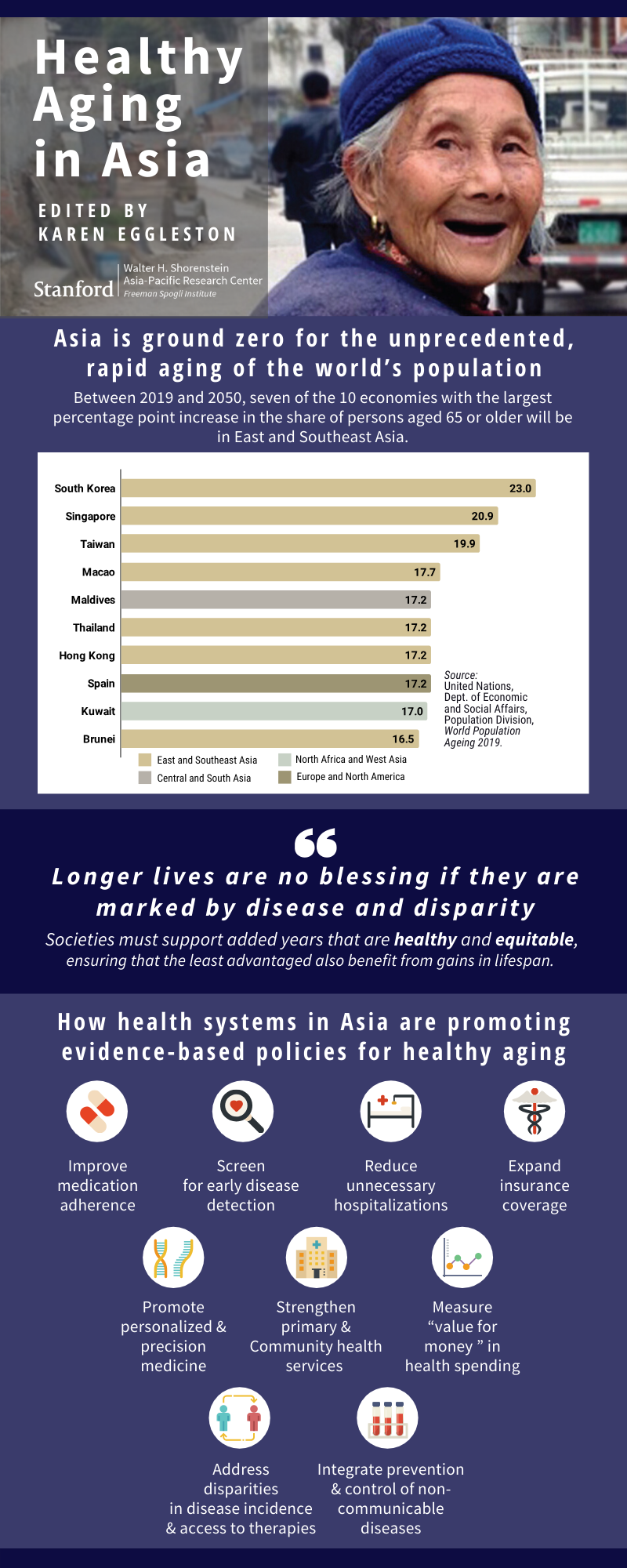
Rapid population aging is transforming societies around the world, and the Asia-Pacific region is on the frontlines of this unprecedented demographic shift. Life expectancy in Japan, South Korea, and much of urban China has now outpaced that of the United States and other high-income countries. With this triumph of longevity, however, comes a host of health, social, and economic challenges.

Longer lifespans will necessitate working to older ages, “but extending work lives will only be feasible if the added years are healthy ones, and will only be equitable if the least advantaged also benefit from healthy aging,” writes APARC Deputy Director and Asia Health Policy Program Director Karen Eggleston in her new book, Healthy Aging in Asia. “The great blessing of longer lives dims when clouded by pain, disability, and loss of dignity.”

[Listen to our conversation with Eggelston about the book and continue reading below. To receive stories like this directly in your inbox sign up for APARC newsletters]

Shorenstein APARC · Healthy Aging In Asia | Karen Eggleston

Image
Poster featuring the book Healthy Aging in Asia


Societies around the world must reduce disparities in health outcomes and address the older age-associated rise in the burden of noncommunicable diseases (NCDs) such as diabetes, hypertension, and cancer. Indeed, the COVID-19 pandemic has underscored the vulnerability of older adults suffering from NCDs to newly emerging pathogens and the importance of building long-term, resilient health systems.


How are health systems in Asia promoting evidence-based policies for healthy aging? What strategies have they used to prevent NCDs, screen for early disease detection, raise the quality of care, improve medication adherence, reduce unnecessary hospitalizations, and increase “value for money” in health spending?

The concise chapters in Healthy Aging in Asia examine these questions, covering multiple aspects of policy initiatives and economic research on healthy longevity in diverse Asian economies — from cities such as Singapore and Hong Kong to powerhouses such as Japan, India, and China — as they transform their health systems to support wellbeing in older age. Eggleston edited and contributed multiple chapters to this new volume, now available via Brookings Institution Press. This publication is part of APARC’s in-house series with the Brookings Institution.

Dr. Karen Eggleston

Karen Eggleston

Senior Fellow at the Freeman Spogli Institute for International Studies, Director of the Asia Health Policy Program, and Deputy Director of the Shorenstein Asia-Pacific Research Center
Full Biography

Read More

Karen Eggleston speaking to an online panel.
News

Karen Eggleston Testifies on China’s Healthcare System to Congressional Review Commission

Asia health policy expert Karen Eggleston provides testimony for a U.S.-China Economic and Security Review Commission hearing on China's domestic healthcare infrastructure and the use of technology in its healthcare system amid COVID-19.
Karen Eggleston Testifies on China’s Healthcare System to Congressional Review Commission
Elderly Chinese citizens sit together on a park bench.
Q&As

Karen Eggleston Examines China’s Looming Demographic Crisis, in Fateful Decisions

Karen Eggleston Examines China’s Looming Demographic Crisis, in Fateful Decisions
Michael McFaul, Xueguang Zhou, Karen Eggleston, Gi-Wook Shin, Don Emmerson, and Yong Suk Lee
News

FSI Hosts APARC Panel on COVID-19 Impacts in Asia

Scholars from each of APARC's programs offer insights on policy responses to COVID-19 throughout Asia.
FSI Hosts APARC Panel on COVID-19 Impacts in Asia
All News button
1
Subtitle

Asia health policy expert Karen Eggleston’s new volume, ‘Healthy Aging in Asia,’ examines how diverse Asian economies – from Singapore and Hong Kong to Japan, India, and China – are preparing for older population age structures and transforming health systems to support patients who will live with chronic disease for decades.

Paragraphs

In Live Long and Prosper?, a new eBook edited by David Bloom, AHPP director Karen Eggleston contributes the chapter "Understanding 'Value for Money' in Healthy Ageing," in which she advocates for and explains the concept of "net value of medical care," a metric that helps quantify the social value of spending on healthcare. Understanding value for money, Eggleston writes, is a way of "determining which services and technologies are unnecessary and which are of high value," a determination that is of increasing importance for aging societies, in which "spending for chronic diseases represents a large and increasing part of public and private budgets." 

All Publications button
1
Publication Type
Books
Publication Date
Authors
Noa Ronkin
News Type
News
Date
Paragraphs

Understanding the value of chronic disease care is critical to confronting the challenges of aging societies. In a new ebook published by the Centre for Economic Policy Research, APARC Deputy Director and Asia Health Policy Program Director Karen Eggleston provides a framework for assessing the social value of health spending.

The world population is aging faster than ever before and governments must confront the increasing burden of healthcare spending on their economies. At a time when the economics of aging is inseparable from the economics of healthcare, successful adaptations to older population age structures necessitate better understanding of the value of medical care. Policymakers, in particular, must incorporate value into considerations of healthcare cost growth, so they can determine the extent to which average health improvements offset added cost, reduce cases in which health spending rises without sufficient corresponding health outcomes, and reward those in which “we are getting what we pay for.”

A new book chapter, authored by APARC Deputy Director and Asia Health Policy Program Director Karen Eggleston, provides a framework for assessing the social value of health spending. Titled “Understanding ‘value for money’ in healthy aging,” the chapter is part of an ebook, Live Long and Prosper? The Economics of Ageing, published by the Centre for Economic Policy Research (CEPR).

[To receive more stories like this directly to your inbox subscribe to our newsletters.]

Quality-Adjusted Cost of Care

How do health economists incorporate value into measurements of health spending and how do they measure the social value of medical care? First they assume each additional year of life brings a given monetary value. Then they measure the growth in value to patients as monetized gains in “quality-adjusted life-years,” a metric that includes increases in life expectancy and quality of life. The difference between the change in health spending and the change in monetized gains on improved survival is the net change in quality-adjusted health spending or the net value of medical care.

Understanding the value of chronic disease care is especially critical in aging societies, as governments must transform their health systems to support patients who will live with chronic diseases for decades. Health benefits of medical care, however, are difficult to aggregate across disparate services and diseases, and hence focusing on management of a single important chronic disease allows researchers to develop metrics of quality improvement and value that are linked to rigorous clinical studies. Eggleston describes a recent international research collaboration, which she was part of, that did just that. The researchers studied quality adjustment for one disease of growing global prevalence, type 2 diabetes, in four different health systems: one in Europe (the Netherlands) and three in East Asia (Japan, Hong Kong, and Taiwan).

Results of the study suggest that, in each health system, the value of improved survival outweighs the increase in health spending. For example, in the case of Japan, Eggleston and her colleagues found a positive value net of $2,595 for $100,000 value of a life-year. They also compared net value across the four health systems and different patient samples, finding mean net value that ranged between $600 and $10,000 for a $100,000 value of a life-year. Moreover, net value was positive for all age groups and remains positive and significant for individuals well beyond traditional retirement ages. These results, says Eggleston, indicate “the importance of continuing investments in medical treatments and services that deliver health outcomes of commensurate or higher value.”

Policy Implications

Confronting the challenges of aging societies requires careful thinking about the value of investments in new technologies for managing chronic conditions. To promote healthy aging governments must be “resiliently persistent in measuring the value of innovations for healthy aging and rewarding those that deliver high net value,” argues Eggleston. The goal should be improving the “value for money” of medical care rather than applying largescale cost controls that might stifle important breakthroughs.

The four-system study by Eggleston and her colleagues provides a framework for developing methods for assessing quality improvement and the net value of chronic disease spending and, more broadly, for measuring the value of healthy aging.


Download Eggleston’s chapter as part of the entire ebook >>

Learn more about Dr. Karen Eggleston’s research agenda seeking to assess net value in diabetes management and to identify and analyze innovation for healthy aging.

Hero Image
Closeup on a hand of an old man.
All News button
1
Authors
Noa Ronkin
News Type
News
Date
Paragraphs

In a new article published by the Milken Institute Review, APARC Deputy Director and Asia Health Policy Program Director Karen Eggleston offers an overview of the successes of China’s health reforms and the challenges ahead if the country is to increase the efficiency of health care delivery as it expands quality and usage.

Creating a high-quality universal health care system is an immense challenge anywhere, let alone in a country as large and diverse as China. But equal access to care will become ever more important as China converges on higher incomes, slower economic growth, population aging, and dependence on a skilled workforce to approach OECD living standards. With its health reforms over the past two decades, its growing technological prowess, and its application of innovative business models, China has made significant progress towards supporting higher-quality and more convenient health care for its 1.4 billion people. However, it is yet to deal with a host of challenges.

In a new article, Healing One-Fifth of Humanity, published in fall quarter 2019 of the Milken Institute Review, APARC Deputy Director and Asia Health Policy Program Director Karen Eggleston offers a progress report on China’s efforts to provide decent health care to all of its citizens, detailing how the reforms are working and what is left to do.

[To get more stories like this delivered directly to your inbox sign up to receive our newsletters.]

A Tale of Two Chinas

One complex challenge China faces is addressing the gap in living standards between its rising middle class and its poorest citizens. Eggleston’s research shows stark gaps between urban and rural China in multiple measures, including life expectancy (almost 10 years differences as of 2013), infant mortality, and under-age-5 mortality. Health outcomes differ along other dimensions, too — between urban regions with higher and lower per capita income and among individuals with more or fewer years of schooling.

There are also striking inequalities in the burden of chronic disease and in health care and risk protection. For example, diabetes is associated with greater excess mortality in rural China, although prevalence is higher in urban areas. Moreover, although China has attained universal health coverage and put in place policies to enhance access while decreasing households’ out-of-pocket spending burden, the coverage of rural insurance is less generous than coverage for urbanites. Therefore, the prospect of catastrophic medical spending on delayed care remains substantially higher for rural than urban residents.

Additional challenges abound in multiple other areas, from addressing patient-provider tensions and trust, to changing provider incentives to promote value rather than volume, to deciding which new medical therapies qualify as basic. In broad terms, argues Eggleston, “China must build an infrastructure that increases the efficiency of health care delivery as it expands quality and usage.”

An important issue is the extent to which leveling public policy will ameliorate disparities, even as an array of social and economic forces push to widen disparities in health, health care use and burden of medical spending over a lifetime. The good news, says Eggleston, is that the process of catching up on one critical component of social justice, that is, universal health care, has begun, and there is evidence suggesting “that health investments can narrow the gaps in outcomes by compensating for health disadvantages.” There is also good reason to believe that policies that go beyond direct medical intervention – notably, investments in the quantity and quality of schooling – can have even greater influence on health and survival than access to medical care.

“The challenge now,” concludes Eggleston, “is to persist in an endeavor that requires flexibility, sensitivity to competing interests — and lots and lots of money.”


Hero Image
Young patients receive treatment at Chongqing Children's Hospital in Chongqing Municipality, China.
China Photos / Getty Images
All News button
1
Authors
Noa Ronkin
News Type
News
Date
Paragraphs

Asia Health Policy Program Director Karen Eggleston and colleagues examine China’s progress in enhancing financial protection under its social health insurance to achieve universal health coverage.

In 2009, China launched comprehensive health system reforms to address challenges such as increasing rates of non-communicable diseases and population aging, problems with health financing and healthcare delivery, and overall growing health expectations of its people. Promoting universal health coverage by building a social health insurance system was a central pillar of the reforms.

After a decade of system reforms, has the Chinese government made good on its commitment to bolster universal health coverage? In a new article published in a BMJ collection, a team of four co-authors including Karen Eggleston, APARC’s deputy director and director of the Asia Health Policy Program, evaluates China’s progress towards enhancing financial protection of social health insurance and identifies the main gaps that need to be filled to achieve universal health coverage. Their article is part of a special BMJ collection with Peking University that marks the tenth anniversary of China’s health system reforms by analyzing their accomplishments and challenges ahead.

The 2009 reforms aimed to cover the entire Chinese population with one of three (since 2012 one of two) basic social health schemes. To provide added financial protection to patients with critical illnesses, catastrophic medical insurance was initially launched in 2012 and implemented nationally in 2015. Eggleston and her co-authors determine that the expansion of health insurance has had several major successes. First, it improved access to and use of healthcare. In 2011, China achieved near-universal health insurance coverage, with more than 95% of the Chinese population covered by health insurance. Moreover, the annual inpatient hospital admission rate increased from 3.6% in 2003 to 17.6% in 2017, and admission rates for outpatient services were much higher than the global average.

Second, the expansion of health insurance coverage reduced the share of out-of-pocket heath expenses in total health expenditure, thus raising the level of financial protection. Third, catastrophic medical insurance was also effective in supplementing the basic social health insurance schemes and provided extra financial protection to a range of vulnerable groups. By 2017, more than a billion people in China were covered by such insurance.

However, much remains to be done. Out-of-pocket health expenditures remain fairly high and are one of the main reasons for catastrophic health expenses and low financial protection in China, which disproportionately affect deprived populations. Catastrophic medical insurance currently does not target underprivileged people, while medical aid is relatively small in scale and covers only a minority of patients with catastrophic health expenses.

Eggleston and her colleagues conclude that the Chinese government should focus on underprivileged populations within the current insurance system and enhance their financial protection as an important element of targeted poverty alleviation. Such targeting, the researchers emphasize, requires a clear and integrated policy encompassing the basic social health insurance schemes, catastrophic medical insurance, medical aid, and improved healthcare efficiency.


Hero Image
A doctor checks a young girl in a countryside clinic at Shihao Township on October 13, 2007 in Qijiang County of Chongqing Municipality, China.
A doctor checks a young girl in a countryside clinic at Shihao Township in Qijiang County of Chongqing Municipality, China.
China Photos/ Getty Images
All News button
1
Authors
Noa Ronkin
News Type
News
Date
Paragraphs

Type 2 diabetes has become a major public health problem in South Asia in recent decades. The region is now home to an estimated 84 million people suffering from diabetes—approximately one-fifth of the world’s 451 million adults with diabetes—a number that is expected to rise by 78% by 2045. Even more concerning, across South Asia the disease burden increasingly occurs in the most productive midlife period. Among Indians, for example, diabetes is estimated to occur on average 10 years earlier than their western counterparts, and almost half of Indian patients with type 2 diabetes are diagnosed before age 40.

How do South Asian health system influence diabetes care? What is the magnitude of the economic impact of diabetes in South Asia? And what can be done to mitigate that economic burden? These are some of the questions that a team of researchers, including Karen Eggleston, APARC’s deputy director and director of the Asia Health Policy Program, set out to answer in a new study published in the journal Current Diabetes Reports.

Eggleston co-authored the study with Kavita Singh of the Public Health Foundation of India and the Centre for Chronic Disease Control in New Delhi, and with M. Venkat Narayan, Professor of Medicine and Epidemiology and Director of the Global Diabetes Research Center at Emory University. They find that diabetes-related complications lead to enormous treatment costs, causing catastrophic medical spending and illness-induced poverty for many households.

The new study is related to a broader research project led by Eggleston, entitled Net Value in Diabetes Management, that compares health care use, medical spending, and clinical outcomes for patients with diabetes as a lens for understanding the economics of caring for patients with complicated chronic diseases across diverse health systems. This international collaborative research convenes teams of clinicians and health economists in ten countries (and growing) across Asia, as well as the United States and The Netherlands. Together, they analyze big data—detailed, longitudinal patient-level information for large samples from each country, including millions of records of clinical encounters, health-check-up, and medical spending—to compare the health care use and patient outcomes for adults with type 2 diabetes in their health systems.

In the new publication, Eggleston and her co-authors first introduce several unique features that characterize the type 2 diabetes epidemic in South Asia. These include a high risk of developing diabetes even at lower levels of body mass index than observed among western populations; a high prevalence of glucose intolerance, low levels of HDL cholesterol, and high levels of triglycerides; a relationship between impaired fetal nutrition, diabetes, and cardiovascular risk; and the likelihood of rapid urbanization impacting the diabetes burden of the wealthy and the underprivileged differently.

Furthermore, South Asian countries face difficult challenges in delivering diabetes care. The health sector in the region has little organized financing, leading to heavy out-of-pocket spending by patients. Limited availability and affordability of anti-diabetic drugs is a major driver of lower use of such medicines. These factors, combined with a general lack of health care professionals and infrastructural resources and low quality of healthcare governance, all contribute to poor health outcomes.

Eggleston and her co-authors assess the current literature on the economic impact of diabetes in South Asia. They show that, compared with the high prevalence of diabetes in South Asian countries, the total health spending as a percentage of GDP in the region has remained low and fairly constant (3-4% in most countries) over the last two decades, with less than 1% of GDP spent on healthcare by the government, and a miniscule 0.2% by pre-paid private insurance, resulting in a large proportion of out-of-pocket healthcare spending. The financial burden of diabetes and its complications can therefore have catastrophic implications for households that are often driven to sacrifice disastrous proportions of their income to cover treatment costs.

Diabetes causes premature mortality, high morbidity, and disability. To mitigate the economic and social welfare burden of the disease, the researchers conclude, policymakers in South Asia must take urgent action “to increase investment in evaluating cost-effective strategies to manage diabetes and preventative approaches.” The team offers a set of policy recommendations, including monitoring the economic burden of diabetes and the quality of care; focusing on the screening and prevention of diabetes and its risk factors; strengthening government health facilities and primary care services; expanding access to affordable, essential medicines, and more.


Hero Image
People receiving diabetes care in a rural clinic in India Trinity Care Foundation via Flickr (CC BY-NC-ND 2.0)
All News button
1
Paragraphs

With an estimated 84 million people suffering from diabetes in South Asia, the disease imposes substantial economic burdens on individuals, families, and society. Furthermore, since the disease burden increasingly occurs in the most productive midlife period, it adversely affects workforce productivity and macroeconomic development. Diabetes-related complications lead to markedly higher treatment costs, causing catastrophic medical spending for many households, thus underscoring the importance of preventing diabetes-related complications.

This review describes the unique features of the diabetes epidemic in South Asia, critically assesses and identifies the gaps in the current literature on the economic impact of diabetes in South Asia, and finally, offers recommendations on ways to mitigate the economic burden of diabetes.

All Publications button
1
Publication Type
Journal Articles
Publication Date
Journal Publisher
Current Diabetes Reports
Authors
Karen Eggleston
Authors
Noa Ronkin
News Type
News
Date
Paragraphs

People who are acquainted with the work of Shorenstein APARC’s Asia Health Policy Program (AHPP) may be aware of the Innovation for Healthy Aging collaborative research project led by APARC Deputy Director and AHPP Director Karen Eggleston. This project, which identifies and analyzes productive public-private partnerships advancing healthy aging solutions in East Asia and other regions, encompasses an upcoming volume, co-authored by Eggleston with Harvard University professors Richard Zeckhauser and John Donohue, about public and private roles in governance of multiple sectors in China and the United States, including health care and elderly care. This volume, however, is not the first collaboration between Eggleston and Zeckhauser.

Zeckhauser, the Frank P. Ramsey Professor of Political Economy at Harvard University’s Kennedy School, is known for his many policy investigations that explore ways to promote the health of human beings, to help markets work more effectively, and to foster informed and appropriate choices by individuals and government agencies. In 2006, Eggleston and Zeckhauser co-wrote a paper about antibiotic resistance as a global threat, an issue that has since received much attention as it has become a critical public health and public policy challenge. Zeckhauser was a pioneer in framing antibiotic resistance as a global threat.

On October 20, 2018, Eggleston was among some 150 colleagues, students, and friends who participated in a special symposium at the Kennedy School to celebrate Zeckhauser’s 50th anniversary of teaching and research, and to anticipate what the next 50 years might bring in the multiple fields he has influenced throughout his long career.

Eggleston joined the first of two panels in that symposium, where she spoke about Zeckhauser’s impact on health policy and about what academics and policymakers should be tackling next on the path to addressing the global threat of antibiotic resistance.

The panel was moderated by Harvard Professor Edward Glaeser. In addition to Eggleston, it included Jeffrey Liebman, Daniel Schrag, and Cass Sunstein.

A video recording of the panel is made available by the Kennedy School. Listen to Eggleston’s remarks (beginning at the 8:42 and 36:20 time marks):


Hero Image
Karen Eggleston speaking on a panel celebrating Harvard Professor Richard Zeckhauser. Harvard Kennedy School
All News button
1
Paragraphs

Improving the quality of primary care may reduce avoidable hospital admissions. Avoidable admissions for conditions such as diabetes are used as a quality metric in the Health Care Quality Indicators of the Organization for Economic Cooperation and Development (OECD). Using the OECD indicators, we compared avoidable admission rates and spending for diabetes-related complications in Japan, Singapore, Hong Kong, and rural and peri-urban Beijing, China, in the period 2008–14. We found that spending on diabetes-related avoidable hospital admissions was substantial and increased from 2006 to 2014. Annual medical expenditures for people with an avoidable admission were six to twenty times those for people without an avoidable admission. In all of our study sites, when we controlled for severity, we found that people with more outpatient visits in a given year were less likely to experience an avoidable admission in the following year, which implies that primary care management of diabetes has the potential to improve quality and achieve cost savings. Effective policies to reduce avoidable admissions merit investigation.


All Publications button
1
Publication Type
Journal Articles
Publication Date
Journal Publisher
Health Affairs
Authors
Karen Eggleston
616 Serra StreetEncina Hall E301Stanford, CA94305-6055
0
natt_hongdilokkul.jpg Ph.D.

Natt Hongdilokkul joins the Walter H. Shorenstein Asia-Pacific Research Center (APARC) during the 2017-2018 academic year as a postdoctoral scholar in Developing Asia Health policy. His research interests concern the effect of universal health care on household outcomes and welfare using micro-level panel data in Thailand. He received a PhD and an MA in Economics from Simon Fraser University, Canada, and another MA and a BA in Economics from Thammasat University, Thailand.

Developing Asia Health Policy Postdoctoral Fellow, 2017-18
Subscribe to Health Outcomes