Gender
News Type
News
Date
Paragraphs

The Japan Program at the Shorenstein Asia-Pacific Research Center (APARC), in collaboration with the United States-Japan Foundation and Japan Society for the Promotion of Science, has published a report with findings from the inaugural conference, Womenomics, the Workplace, and Women, held in November 2016.

The two-day conference, which gathered 20 speakers and a substantial audience at Stanford, initiated dialogue about women’s leadership and work-life balance in Japan and the United States and encouraged the formation of a cross-sector network of experts seeking to build pathways to advance opportunity for women in both countries.

“The conference provided a unique opportunity for a diverse group of individuals to come together and explore how to tackle challenges that women continue to face on both sides of the Pacific,” said Mariko Yoshihara Yang, a visiting scholar and Japan Program Fellow at Shorenstein APARC, who organized the conference. “I believe the knowledge, perspectives and networks shared will go far beyond the two days we convened at Stanford, and make a valuable contribution to the movement to achieve gender equality and revitalize the Japanese economy.”

The conference report includes a set of actions that Japanese and American policy researchers and practitioners can pursue to promote women's leadership. A statement with the actions is arranged by organization type and published directly below.

Download the statement and full report.


Ten Actions Japan can take to Promote Women’s Leadership

Authors: Shelley Correll, Diane Flynn, Ari Horie, Atsuko Horie, Takeo Hoshi, Rie Kijima, Chiyo Kobayashi, Sachiko Kuno, Mitsue Kurihara, Kenji Kushida, Yoky Matsuoka, Emily Murase, Nobuko Nagase, Akiko Naka, Mana Nakagawa, Yuko Osaki, Machiko Osawa, Myra Strober, Kenta Takamori, Kazuo Tase, Mariko Yoshihara Yang

Government

The Japanese government should establish concrete measures to achieve targets stipulated in the Fourth Basic Plan for Gender Equality, which was approved by the Japanese Cabinet on December 25, 2015, and went into effect in April 2016. The following reforms will help promote this process and distribute benefits to all workers equally. A special emphasis was placed on ensuring versatility across many sectors.

1. Abolish the income tax deduction and social security premium exemption for dependent spouses and increase family care allowance. The spousal exemptions that allow income tax breaks and social security premiums discourage many married women from seeking full-time employment. The Japanese government has recently proposed to scale back the spousal tax break by raising the annual threshold from ¥1.03 to ¥1.5 million or less starting in 2018. However, this incremental measure will act only as a short-term solution. Japan needs a conclusive solution to best utilize women as the workforce. By completely eliminating the spousal exemption and providing family care allowance, more women will be incentivized to take on full-time and leadership positions in the workplace. Families with young children and aging parents will be compensated with family care allowance.

2. Expand the scope of corporate disclosure on gender equality and establish a “Women’s Empowerment Index.” The public database on gender equality, launched by the Cabinet Office in 2014 and administered by the Ministry of Health, Labor and Welfare since 2016, remains limited in its scope and scale. The government should add more substantial measures in the rubric such as hours of overtime work and “re-entry/on-ramping” rate of women, and mandate the reporting requirement. Based on the expanded database, the government should calculate a Women’s Empowerment Index and issue certifications to people with high ratings. The index would be embedded in the parameters for stakeholder decision-making and provide financial incentives for corporations to sustain a more diverse work environment.

Large Corporations

To increase women’s participation in the workplace, companies need to eliminate gender-based stereotypes in hiring and promotion practices, encourage more women to pursue full-time positions, and support women who seek to re-enter the labor force after temporary leave. Large corporations in Japan can take the following actions to lead these changes:

3. Scrutinize the yardsticks used for recruitment and promotion, and eliminate evaluation criteria that systematically sorts out certain candidates. Companies need to provide training to mid-career managers and top leaders to address unconscious biases in the workplace. It is critical to ensure a level-playing field for women and men.

4. Introduce a legal ceiling and penalties for overtime work and lift compulsory job transfers that disrupt family life. This will help change the prevailing work culture of devotion and self-sacrifice. Companies should consider decentralizing personnel administration so local offices will more closely monitor individual needs and preferences of employees’ and reflect them into their career trajectories. Such reforms will encourage more women to apply for full-time employment and leadership opportunities while reducing premature resignations of women with families.

5. Create a mandate for departments to establish and provide clear job descriptions for each position to ensure consistency across departments. This would allow employees to better articulate their skill sets when seeking new job opportunities within organizations or when they re-enter the labor market after taking breaks in their careers. In the long term, this will help Japan develop a more robust external labor market that promotes mobility between organizations and across sectors, not just within companies.

6. Create clear evaluation criteria for women with specialized careers and raise their visibility within and outside the organization. Visibility of an employee’s technical skills is known to influence her or his prospect for advancement. When women propose ideas based on their specialization, they should employ “amplification” techniques, where they repeat each other’s ideas to increase their credibility during meetings and brainstorming sessions. Corporate leaders should also make a point of acknowledging their expertise and vouch for their competence. Large corporations should facilitate their promotion to manager and board member positions.

Start-ups

Although women are still underrepresented in entrepreneurial leadership positions, the gender gap is less severe in the startup sector than in large corporations. Thus, promotion of entrepreneurship in general will increase the chances for women’s empowerment and leadership.

7. Create platforms to catalyze startups led by women and raise the visibility of successful female entrepreneurs. There should be a platform where novice and experienced entrepreneurs can interact. Routine exchange among successful female founders and aspiring entrepreneurs will help build a community that catalyzes women-led startups as they try to turn ideas into full-time businesses. Similarly, there should be a platform where female leaders in small startups and large corporations meet regularly to provide mutual mentorship. Corporate executives could learn the latest business trends while female entrepreneurs expand their professional networks.

8. Expand policies to encourage a culture of entrepreneurship with specific incentives for female entrepreneurs. The government should consider increasing the public funding for startups led by women and provide robust legal support for female entrepreneurs. Increased assistance to incubators and accelerators, specializing in supporting female founders, would also contribute to women’s empowerment.

Educational Institutions

Educational institutions play a key role in creating knowledge to ensure gender equality, promoting awareness and nurturing a bias-free mindset among young people. Furthermore, women’s advancement in education generally yields greater participation in the economy and society. Recent advancements have created a reversal among the OECD countries. More than half of all students graduating from secondary and higher education are female; however, Japan is still behind. The following two initiatives will help close the gap:

9. Strengthen gender equality promotion office at educational institutions. This includes hiring a dedicated diversity officer, who will help universities conduct gender analyses of leadership posts and monitor women in academic leadership positions. Furthermore, universities should introduce family friendly policies to support young faculty members. When faculty members take parental leave, universities should provide funding for temporary staff to lay the groundwork for their return. In addition, academic conferences held at universities should provide childcare services for out-of-town participants.

10. Create continuing education centers to offer certificate programs to provide skills and training for women and men looking to re-enter the workforce. The programs could provide specialized knowledge as well as skill development including self-assessment, counseling, resume-building, practice interviewing, and unconscious bias training. This will allow workers access to education and support throughout their onboarding process and transition into the workplace. These centers should also provide career services to match qualified workers with potential employers.

Hero Image
womenomics conference report headline Rod Searcey
All News button
1
Authors
Lisa Griswold
News Type
News
Date
Paragraphs

Japanese and American scholars and practitioners gathered at Stanford recently for “Womenomics, the Workplace, and Women,” a full-day conference seeking to find pathways to advance opportunity for women in society and the workplace.

Nearly 75 people attended the public conference, which included 20 speakers and was co-sponsored by Stanford’s Shorenstein Asia-Pacific Research Center and the Clayman Institute for Gender Research, as well as the United States-Japan Foundation and the Japan Society for the Promotion of Science.

Takeo Hoshi, director of the Japan Program at Shorenstein APARC, noted that women in Japan and the United States have long encountered obstacles related to gender. Currently, the United States and Japan rank 45th and 111th, respectively, on the Global Gender Gap Index.

“The conference is a unique opportunity for experts from Japan and Silicon Valley to learn from each other and their countries’ recent attempts to tackle gender diversity, particularly in the areas of business and technology,” Hoshi said.

The Japanese government’s inclusion of women’s advancement in its economic growth strategy 'Abenomics,' named after Prime Minister Shinzo Abe, is “one of the few good policies,” Hoshi said, yet complex cultural constraints and workplace policies need to change in order for it to work. Similarly, in Silicon Valley, while strides have been made, gender diversity still lags in corporate leadership and boards of directors especially in the areas of STEM (science, technology, engineering and mathematics).

Panelists shared perspectives on women’s status, leadership and work-life balance in both countries throughout four panel discussions led by Hoshi, and Shelley Correll, director of the Clayman Institute and professor of sociology; Kenji Kushida, Japan Program research scholar; and Mariko Yoshihara Yang, a visiting scholar at Shorenstein APARC.

One broad theme that emerged in the discussions: gender equity progress takes time. Closing the gender gap will come incrementally and a multidisciplinary approach could help the process. 

Areas highlighted by the panelists included a need to address unconscious bias and to improve programs that support women in the workplace as well as those seeking to re-enter the labor force after taking time off, such as increased access to childcare and elimination of “evening work” for those who hold full-time jobs.

Panelists suggested expanding educational opportunities, mentorship and peer-to-peer networks among women, as well as training centered on gender equity for all employees. Quotas and government incentives for organizations that adopt equity practices were also proposed to achieve greater female representation.

Additional discussions took place between the panelists in a closed-door workshop the following day. A report that details outcomes and a set of policy recommendations is expected in 2017; the full list of panelists, topics addressed and conference agenda can be viewed here.

Hero Image
womenomics conference headline
Japan Program visiting scholar Mariko Yoshihara Yang chairs a panel discussion at the conference "Womenomics, the Workplace, and Women" on Nov. 4, 2016, at the Bechtel Conference Center.
Rod Searcey
All News button
1
-

As Japan faces a shrinking and aging population, it must pursue productivity growth to remain a wealthy nation. Women, long underrepresented Japan’s workforce, are receiving renewed attention with the Abe administration’s slogan of Womenomics as part of his Abenomics economic reform package. In the second World Assembly for Women in Tokyo (named WAW!) in late August 2015, Prime Minister Abe even went so far as to say “Abenomics is Womenomics.” At the same time as the WAW! meeting, the National Diet passed a law requiring large companies to analyze their current status of women and set numerical targets in one of several areas. Now that the issue of women in the workplace is being taken more seriously than ever before, it is time to mobilize serious research in the form of policy evaluation, create a new dialogue that can spark innovative ideas by injecting Silicon Valley ideas and people into U.S.-Japan policy discussions, and link entrepreneurs, policymakers, and researchers from both sides to cultivate sustained interpersonal networks. 

This conference takes on the issue of women leadership and women’s positions in the Japanese workforce and society, with the objective to bring issues to the table and explore concrete mechanisms by which government policy, business practices, and social factors can be influences to make concrete progress for women's leadership and participation in Japan.

Sponsored by the US-Japan Foundation (USJF), Japan Society for the Promotion of Science (JSPS), and Stanford University's Shorenstein Asia-Pacific Research Center (S-APARC) and Clayman Institute for Gender Research.


*The below program is subject to change.

Conference Program

8:55-9:25                  Registration and Breakfast

9:25-9:40                  Welcome & Opening Remarks

Takeo Hoshi (Stanford University)

David Janes (US-Japan Foundation)

Toru Tamiya (Japan Society for the Promotion of Science)

9:40-11:00                Panel Discussion I:

Women in the Silicon Valley Ecosystem- Progress and Challenges

                                  Chair:                     Shelley Correll (Stanford University)

                                  Panelists:             Ari Horie (Women's Startup Lab)

 Yoky Matsuoka

                                  Emily Murase (San Francisco Department on the Status of Women)

Mana Nakagawa (Facebook)


11:00-11:20              Coffee Break

11:20-12:40              Panel Discussion II:                                 

Women in the Japanese Economy- Progress and Challenges

                                  Chair:                    Mariko Yoshihara Yang (Stanford University)

                                  Panelists:             Mitsue Kurihara (Development Bank of Japan)

 Akiko Naka (Wantedly)

 Yuko Osaki (Ministry of Internal Affairs and Communications, Japanese Government)

                                  Machiko Osawa (Japan Women's University)


12:40-14:00              Lunchtime

14:00-15:20              Panel Discussion III:  

Women's Advancement in the Workplace

                                  Chair:                 Takeo Hoshi (Stanford University)

 Panelists:             Keiko Honda (Multilateral Investment Guarantee Agency (MIGA), the World Bank Group)

 Chiyo Kobayashi (Washington Core)

                                  Sachiko Kuno (S&R Foundation)

  Kazuo Tase (Deloitte Tohmatsu Consulting)        


15:20-15:40             Coffee Break

15:40-17:00             Panel Discussion IV:  

Work-Life Balance and Womenomics

                                  Chair:                     Kenji Kushida (Stanford University)

                                  Panelists:            Diane Flynn (ReBoot Career Accelerator for Women)

Atsuko Horie (Sourire)

Nobuko Nagase (Ochanomizu Women's University)

                                 Myra Strober (Stanford University)

17:00-17:05            Closing Remarks


Conferences
Authors
Lisa Griswold
News Type
News
Date
Paragraphs

South Korea is facing a number of challenges. Not unlike other advanced economies in Asia, the country is confronted with a declining working-age population, reduction in birth rates, and risk of long-term stagnation.

A team of Stanford researchers at Stanford’s Shorenstein Asia-Pacific Research Center (APARC), in collaboration with other scholars from around the world, is increasingly thinking about those challenges and is working on a number of research initiatives that explore potential solutions in leveraging benefits from globalization.

The researchers propose that Korea can extract value from two major movements of people – outflows of its own population (diaspora) and inflows of foreigners (immigrants and visitors), all of whom hold the capacity to build social capital – a network of people who have established trust and in turn spread ideas and resources across borders.

Engaging diaspora

Emigration is traditionally viewed as a loss of human capital – ‘brain drain’ – movement of skills out of one country and into another, but Stanford professor Gi-Wook Shin and Koret Fellow Joon Nak Choi support an alternative view of outward flows of citizens.

Shin and Choi suggest that people who leave their countries of origin but never return can still provide value to their home country through ‘brain linkage,’ which advocates that there is economic opportunity in cross-national connections despite a lack of physical presence. This concept is a focus of their research which was recently published in the book Global Talent: Skilled Labor and Mobility in Korea.

“What we’re trying to do is to extend the thinking – to not just look at potential losses of having your people go abroad but also the potential gains,” Choi said. “Previous studies have found that if you have more of these relationships or ‘brain linkages,’ you have more trade and more flow of innovations between countries.”

People who stay in a host country become participants in the local economy and often conduct influential activities such as starting companies, providing advice and sitting on boards of directors, Choi said, and these transactions enact flows of resources from home country to host country and vice versa.

Choi, who outside of his fellowship is an assistant professor at Hong Kong University of Science and Technology, said that this way of thinking pulls away from a zero-sum view of the world and instead sees it as “more globalized, cosmopolitan and diffuse.”

He leads a research project with Shin focused on global talent and cultural movement in East Asia, and over the past quarter, taught a graduate seminar on the Korean development model.

“Cross-national ties are harder to establish than those that are geographically close, but they provide invaluable means of sharing information and brokering cooperation that may otherwise be impossible on other levels,” said Shin, who is also the director of Shorenstein APARC. “In many ways, social ties can be a good strategy to gain a competitive edge. This is an area we endeavor to better understand through our research efforts on Korea.”

Shin has described his own identity of being a part of the very system they are studying. He grew up in Korea, arrived in the United States as a graduate student and has since stayed for three decades and frequently engages the academic and policy communities in Korea.

One cross-national initiative that he recently started is a collaborative study between scholars at Shorenstein APARC and Kyung Hee University in Seoul. The two-year study evaluates the social capital impact of a master’s degree program at the Korean university that trains select government officials from developing countries.


Image
internationalization embed 1

An international cohort including many researchers from Stanford’s Shorenstein Asia-Pacific Research Center have been conducting group interviews with international students at Korean and Japanese universities to better understand their motivations to stay or go following their completion of a degree or non-degree program at Korean universities. Their initial results reveal that gaps in cross-cultural understanding and opportunities cause feelings of disassociation, but recent internationalization efforts are helping to address those gaps and support innovation, knowledge sharing and local economic growth. An op-ed on the topic authored by Stanford professor Gi-Wook Shin and Yonsei University associate professor Rennie Moon can be viewed here. Credit: Flickr/SUNY – Korea/crop and brightness applied


Harnessing foreign skilled labor

Globalization has also led to migration of people to regions that lack an adequate supply of skilled workers in their labor force. This new infusion of people is an opportunity to bridge the gap, according to the researchers.

“In order to be successful, countries need a large talented labor pool to invest in,” said Yong Suk Lee, the SK Center Fellow in the Freeman Spogli Institute for International Studies and affiliate of the Korea Program. “Innovation is not something like a technology ladder which has a more obvious and strategic trajectory, it’s more about investing in people and taking risks on their ideas.”

Korea currently has a shortage of ‘global talent’ – individuals who hold skills valuable in the international marketplace. Yet, Korea is well positioned to reduce the shortage.

The country produces a vast amount of skilled college graduates. Nearly 70 percent of Koreans between the age of 25 and 34 have the equivalent of a bachelor’s degree. Korea has the highest percentage of young adults with a tertiary education among Organisation for Economic Co-operation and Development (OECD) countries. Another study found that the foreign student population in Korea has risen by 13 percent in the past five years.

Universities are moving to “internationalize” in seeking to both recruit faculty and students from abroad and to retain them as skilled workers in the domestic labor force. A new book published by Shorenstein APARC Internationalizing Higher Education in Korea: Challenges and Opportunities in Comparative Perspective assesses efforts by institutions in Korea, China, Japan, Singapore and the United States through nine separately authored chapters.


[[{"fid":"223565","view_mode":"crop_870xauto","fields":{"format":"crop_870xauto","field_file_image_description[und][0][value]":"","field_file_image_alt_text[und][0][value]":false,"field_file_image_title_text[und][0][value]":false,"field_credit[und][0][value]":"","field_caption[und][0][value]":"","field_related_image_aspect[und][0][value]":"","thumbnails":"crop_870xauto"},"type":"media","field_deltas":{"2":{"format":"crop_870xauto","field_file_image_description[und][0][value]":"","field_file_image_alt_text[und][0][value]":false,"field_file_image_title_text[und][0][value]":false,"field_credit[und][0][value]":"","field_caption[und][0][value]":"","field_related_image_aspect[und][0][value]":"","thumbnails":"crop_870xauto"}},"link_text":null,"attributes":{"width":"870","class":"media-element file-crop-870xauto","data-delta":"2"}}]]


Shin and Yonsei University associate professor Rennie Moon, who served as book editors and chapter authors, found that Korea has on average more outbound students (students who leave Korea to study elsewhere) than inbound students (international students who come to Korea to study). The figure above compares five countries and finds that Korea and China are more outbound-driven while Singapore, Japan and the United States are more inbound-driven.

“For most national and private universities in Korea, internationalization is more inbound-oriented—attracting foreign students, especially from China and Southeast Asia,” said Yeon-Cheon Oh, president of Ulsan University and former Koret Fellow at Shorenstein APARC who co-edited Internationalizing Higher Education in Korea. “In many ways, it’s about filling up students numbers. There needs to be a balance in inbound and outbound student numbers in order for internationalization to have an optimal effect.”

International students that do come to Korea are on average not staying long after graduation, though. The researchers identify reasons being difficulty in adapting to the local culture, inability to attain dual citizenship, language barriers, and low wages in comparison to that of native Koreans; in short – it is not easy to assimilate fully.

These and other barriers facing foreigners in Korea are a focus of a broader research project led by Shin and Moon that aims to propose functional steps for policymakers striving to internationalize their countries and to shift the discourse on diversity.

Developing a narrative

The Korean government has expanded efforts to recruit foreign students to study at Korean universities – many of which now rank in the top 200 worldwide – but addressing education promotion is only one area.

“The challenge is to propose a pathway that rallies around a general narrative,” Lee said, citing a need for internationalization to be coordinated across immigration policy, labor standards, and social safety nets.

An international group of experts in Korean affairs gathered at Stanford earlier this year at the Koret Workshop to address the challenge of creating a cohesive narrative, focused on Korea as the case study. The Koret Foundation of San Francisco funds the workshop and fellowship in its mission to support scholarly solutions to community problems and to create societal and policy change in the Bay Area and beyond.


Image
internationalization embed 3

The Koret Workshop brings together an international panel of experts on Korean affairs at Stanford. From 2015-2016, the workshops focused on higher education, globalization and innovation in Korea. Above, Michelle Hsieh (far right) speaks during a question and answer session following her presentation on Korean and Taiwanese small and medium enterprises, next to her is former U.S. Ambassador to the Republic of Korea Kathleen Stephens, Stanford consulting professor Richard Dasher, former U.S. foreign affairs official David Straub, and Korea University professor Myeong Hyeon Cho.


The interdisciplinary nature of the workshop was an important aspect, according to Lee, and Michelle Hsieh, one of 27 participants of the conference that covered a range of areas from entrepreneurship to export promotion policies in Korea.

“The workshop demonstrated how internationalization of higher education – and academic research in general – can be achieved by constructing cross-cutting ties,” said Hsieh, who was a postdoctoral fellow at Shorenstein APARC from 2006-07 and is now an associate research fellow at Academia Sinica in Taiwan.

“Participating in the workshop made me realize I really miss the lively and rigorous discussions at Shorenstein APARC, where researchers are interdisciplinary with diverse backgrounds yet focused on a common research interest,” Hsieh said. “I think debate and discussion in that kind of setting can illuminate a completely different take.”

The workshop will result in a book that features multiple areas and policy directions for Korea’s development. The lessons included are also envisioned to apply to other emerging countries facing similar trends of demographic change and economic slowdown. Shorenstein APARC expects to publish the book next year.

Hero Image
internationalization headline Getty Images
All News button
1
Paragraphs
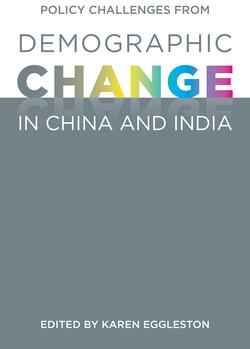
Abstract cover image for book Policy Challenges from Demographic Change in China and India

The world’s two most populous countries face numerous policy challenges from rapid demographic change. Drawing on social science expertise from China, India, and the United States, the contributors examine the social and economic challenges for policies across a range of domains, from China’s changed family planning policies and India’s efforts to address gender imbalance, to both countries’ policies regarding old-age support, human capital investment, poverty alleviation, and broader issues of governance.

Sections focus on:

  • Policy Challenges and Economic Impact
  • Fertility and Sex Imbalance
  • Human Capital and Urbanization
  • Population Aging

Desk or examination copies can be ordered from Stanford University Press.

All Publications button
1
Publication Type
Books
Publication Date
Authors
Karen Eggleston
Book Publisher
Shorenstein APARC
Authors
Lisa Griswold
News Type
News
Date
Paragraphs

China announced plans to discontinue its “one-child policy” in October, relaxing over three decades of controversial family planning policies and changing to a universal two-child policy. This new policy is a step forward, but China’s population aging and gender imbalance will create challenges for decades, according to a leading Stanford health researcher.

“China has reached a certain level of social and economic development where low fertility and population aging have become norms,” said Karen Eggleston, a senior fellow in the Freeman Spogli Institute (FSI) and director of the Asia Health Policy Program. “Similar trends are seen in Japan and South Korea, and governments are struggling to catch up.”


[[{"fid":"214529","view_mode":"crop_870xauto","fields":{"format":"crop_870xauto","field_file_image_description[und][0][value]":"","field_file_image_alt_text[und][0][value]":false,"field_file_image_title_text[und][0][value]":false,"field_credit[und][0][value]":"Rod Searcey","field_caption[und][0][value]":"","field_related_image_aspect[und][0][value]":"0","thumbnails":"crop_870xauto"},"type":"media","field_deltas":{"1":{"format":"crop_870xauto","field_file_image_description[und][0][value]":"","field_file_image_alt_text[und][0][value]":false,"field_file_image_title_text[und][0][value]":false,"field_credit[und][0][value]":"Rod Searcey","field_caption[und][0][value]":"","field_related_image_aspect[und][0][value]":"0","thumbnails":"crop_870xauto"}},"link_text":null,"attributes":{"width":"870","style":"margin-bottom: 30px; margin-left: 15px; float: right; width: 250px; height: 285px;","class":"media-element file-crop-870xauto","data-delta":"1"}}]]


The policy change comes amid concerns of potential labor shortages and a burgeoning aging population that could pressure the Chinese economy for years to come. 

The country has had record growth – China’s GDP growth rate averaged 8.6 percent over the past five years – which is now slowing. That trend coupled with China’s rising life expectancy reinforces the need for a healthy, economically productive population to support the elderly, experts say.

“Demographers who study China knew a policy change was coming, but not when,” said Eggleston. “The policy was strategically announced with the Five Year Plan – a sort of developmental roadmap for the country.”

A forthcoming book, Policy Challenges from Demographic Change in China and India, edited by Eggleston examines the policy challenges posed by demographic change in China and India, from family planning to social pensions systems that support the elderly. One chapter looks exclusively at population policy, sex ratio and fertility in China.

A spur to action?

A shift to a consistent, nationwide two-child policy is a step in the right direction, Eggleston said, and it is unlikely to translate to a boom in the birthrate.

Some areas of the country and specific couples already enjoyed a two-child policy due to local policy differences and an earlier national policy easing. In 2013, the Chinese government allowed couples with a husband or wife from a single-child family to have a second child.

Chinese cities that never had a one-child policy to begin with, like Hong Kong and Macau, have very low fertility. A recent article in China Journal noted that, despite the ubiquity of the one-child policy campaign, China’s rapid economic development since 1980 deserves the “lion’s share of credit” for reduced births as the country’s total fertility rate has declined.

“The real question is how responsive the Chinese will be,” Eggleston said. “It’s not clear that there will be a noticeable response in the short or medium-term.”

Implementation of the policy will take time, but China will work “quite expeditiously” to apply such policies so that people’s expectations are met. Alongside legal change of China’s varying local policies, it’s expected that China will employ several public education campaigns and its cadre of family planning staff as conduits for disseminating the new national policy, Eggleston said.


Image
Chinese Family Planning Poster

A 1986 poster highlights China's one-child policy.

Credit: Flickr/Collection Stefan R. Landsberger, International Institute of Social History (Amsterdam).


But other factors are at play, too, such as urbanization and changes in labor force participation.

“Young and middle-aged couples will be thinking twice about having another child because of education expense, job demands and the need to support aging parents,” Eggleston said.

paper published by Eggleston and three other scholars in the Journal of Labor & Development analyzed how employment of females from rural areas affected fertility, using data from a survey of 2,355 married women in China. The survey examined “off-farm” employment, which was defined as travel to another village, town or city for work.

The researchers found that off-farm employment for those women reduced the probability of having more than one child by 54.8 percent and the probability of preferring more than one child by 49.6 percent. An earlier blog piece on VoxEU highlighted those research outcomes.

Another aspect of China’s demographic change is gender imbalance. Male preference has long been a cultural factor in China and, with the pressures of the one-child policy, a cause behind its skewed population.

That reality will not dramatically change soon, Eggleston said. Even if the end to the one-child policy brought the sex ratio at birth back to normal levels, the existing imbalance of the younger population will create millions of “forced bachelors” among poorer men who cannot find brides, as well as a whole set of related issues.

Choice restored

What the policy assuredly does, though, is remove a barrier. Many Chinese women who before did not have the opportunity to give birth to a second child, now have that opportunity.


[[{"fid":"221573","view_mode":"crop_870xauto","fields":{"format":"crop_870xauto","field_file_image_description[und][0][value]":"","field_file_image_alt_text[und][0][value]":false,"field_file_image_title_text[und][0][value]":false,"field_credit[und][0][value]":"","field_caption[und][0][value]":"","field_related_image_aspect[und][0][value]":"","thumbnails":"crop_870xauto"},"type":"media","field_deltas":{"3":{"format":"crop_870xauto","field_file_image_description[und][0][value]":"","field_file_image_alt_text[und][0][value]":false,"field_file_image_title_text[und][0][value]":false,"field_credit[und][0][value]":"","field_caption[und][0][value]":"","field_related_image_aspect[und][0][value]":"","thumbnails":"crop_870xauto"}},"link_text":null,"attributes":{"width":"870","style":"margin-right: 15px; padding: 10px; float: left; height: 321px; width: 230px;","class":"media-element file-crop-870xauto","data-delta":"3"}}]]


“This is a crucial arena of choice restored to the Chinese,” Eggleston wrote of the 2013 policy relaxation in a brief presented at the Federal Reserve Bank of Kansas City.

Previously, the absence of such a freedom led some couples to face substantial fines from the government, depending on the local variation of the one-child policy.

“Regardless of the new policy, demographic trends point to the importance of investing in child education, nutrition and skill development,” Eggleston said.

A similar message is carried in a chapter in Policy Challenges, co-authored by Sanghyop Lee and Qiulin Chen, who suggest that putting resources toward human capital development – education and health – can offset the destabilizing effects of demographic transition.

Research being done by FSI’s Rural Education Action Program led by Stanford professor Scott Rozelle works to directly inform education, health and nutrition policy in China.

Spending more on education – particularly for women and girls – is win-win. It complements pro-employment policies, and boosts productivity for women and the economy as a whole, Eggleston said.

Hero Image
beijing woman ballons
A woman in Beijing, China, holds children's balloons.
Flickr/Michael Abshear
All News button
1
News Type
Commentary
Date
Paragraphs


On Sept. 3, Japanese Prime Minister Shinzo Abe reshuffled his cabinet, bringing more than double the number of female ministers on board, in line with his pledge to revive the economy based in part on increased participation of women in business and politics.

Traditionally, Japan has provided tax and pension incentives for women to stay at home or work part-time; however, Mr. Abe seeks to change this and has laid out a plan in the “third arrow” of his administration’s economic policy.

Takeo Hoshi, an economist and director of the Japan Program at the Shorenstein Asia-Pacific Research Center, spoke with Deutsche Welle about the administration’s leadership shift and policy goals.

“Relying on women to work more is an excellent idea because the Japanese economy has underutilized women’s talents in the past,” he says.

The full article is available on Deutsche Welle online.

Hero Image
flickr global panorama japan pm shinzo abe 2013
Japanese Prime Minister Shinzo Abe seen arriving at the Asia-Pacific Economic Cooperation meeting in 2013.
Flickr/Global Panorama
All News button
1
-

Keynote Speakers

WANG YIMING, Deputy Secretary General, National Development and Reform Commission (NDRC)

The Institutional Problems in China’s Urbanization Process

CAI FANG, Director, Institute of Population Studies, China Academy of Social Sciences

Urbanization and Labor Markets in China

LI SHUZHUO, Director, Institute for Population and Development Studies, School of Public Policy and Administration, Xi’an Jiaotong University

Fertility, Sex Ratio, and Family Planning Policies in China

Stanford Center at Peking University

Conferences
-

Drawing on data collected through comparative ethnographic fieldwork on Chinese investments in Zambia in the past five years, this talk seeks to answer the questions: What is the peculiarity of Chinese capital? What are the impacts of Chinese investments on African development? Rejecting both the Western rhetoric of “Chinese colonialism” and the Chinese self-justification of “south-south collaboration”, Lee examines the mechanisms, interests and limits of Chinese power through a double comparison: between Chinese and non-Chinese companies, and between copper and construction.

Ching Kwan Lee is a professor of sociology at the University of California, Los Angeles, and currently a fellow at the Center for Advanced Study in the Behavioral Science at Stanford. Her research interests include labor, development, political sociology, global ethnography and China. She is author of Against the Law: Labor Protests in China’s Rustbelt and Sunbelt and Gender and the South China Miracle. She is working on two book projects, one on Chinese investment and labor practices in Zambia, and the other on forty years of state and society relations in China. 

Philippines Conference Room

Ching Kwan Lee Professor of Sociology Speaker University of California, Los Angeles
Seminars
Subscribe to Gender