Shorenstein APARCStanford UniversityEncina Hall E301Stanford, CA 94305-6055
0
Koret Fellow, 2019-20
Visiting Scholar at APARC
robert_king.png
Ph.D.
Robert R. King was a Visiting Scholar, Koret Fellow at the Walter H. Shorenstein Asia-Pacific Research Center (Shorenstein APARC) during the 2019 fall term. He is the former U.S. Special Envoy for North Korean Human Rights Issues at the U.S. Department of State (2009-2017). He is Special Advisor to the Korea Chair at the Center for Strategic and International Studies (CSIS), a non-resident Fellow at the Korea Economic Institute, and a member of the board of the Committee for Human Rights in North Korea.
Ambassador King’s research interests include North Korea human rights, Northeast Asia, U.S. foreign policy, and the Congressional role in U.S. foreign affairs. During his time at Shorenstein APARC, he researched the United States efforts to promote human rights in North Korea.
Before assuming his position at the Department of State, King was Staff Director and Minority Staff Director of the Foreign Affairs Committee of the U.S. House of Representatives (2001-2009). He served as Chief of Staff to Congressman Tom Lantos of California (1983-2008). He was a White House Fellow on the staff of the National Security Council (1977-1978), and Senior Analyst and Assistant Director of Research at Radio Free Europe in Munich, Germany (1970-1977).
King holds a PhD and an MALD in international relations from the Fletcher School of Law and Diplomacy and a BA in political Science from Brigham Young University.
President Trump has stopped even mentioning North Korea’s abysmal human rights record in order to secure meetings with Leader Kim Jong-un ostensibly to make progress on serious security issues with North Korea. After 18 months of White House effort and two and a half summits, however, there has been little progress on denuclearization. Ambassador King argues that we must push North Korea on human rights in order to encourage the government in Pyongyang to respond positively the wishes of its own citizens. Unless we do this, we are unlikely to see real progress on shifting North Korea’s focus from nuclear weapons and missiles to the wellbeing of its own people.
Image
Ambassador Robert R. King is former Special Envoy for North Korean human rights issues at the Department of State (2009-2017). Since leaving that position, he has been senior advisor to the Korea Chair at the Center for Strategic and International Studies (CSIS), a senior fellow at the Korea Economic Institute (KEI), and a board member of the Committee for Human Rights in North Korea (HRNK) in Washington, D.C. Previously, Ambassador King served for 25 years on Capitol Hill (1983-2008) as chief of staff to Congressman Tom Lantos (D-California), and staff director of the House Foreign Affairs Committee (2001-2008).
Robert R. King
<i>2019-20 Koret Fellow, Shorenstein APARC, Stanford University</i>
The Korea Program at the Walter H. Shorenstein Asia-Pacific Research Center is pleased to welcome Robert R. King and Victor Cha as Koret fellows in Korean studies during the 2019-20 academic year. Supported by the Koret Foundation, the Koret Fellowship brings leading professionals to Stanford to conduct research on contemporary Korean affairs with the broad aim of strengthening ties between the United States and Korea.
Image
Robert R. King will join the Korea Program as Koret Fellow during the fall quarter of 2019. King served as special envoy for North Korean human rights Issues, an ambassadorial ranked position at the Department of State (2009-2017). The role was established by Congress in the North Korea Human Rights Act with a mandate to “coordinate and promote efforts to improve respect for the fundamental human rights of the people of North Korea.” Since leaving the Department of State, Ambassador King has been senior advisor to the Korea chair at the Center for Strategic and International Studies (CSIS), a senior fellow at the Korea Economic Institute (KEI), and a board member of the Committee for Human Rights in North Korea (HRNK).
Earlier, Ambassador King served for 25 years (1983-2008) on Capitol Hill as chief of staff to Congressman Tom Lantos (D-California), and as staff director and minority staff director of the House Foreign Affairs Committee (2001-2008). King received a Ph.D. in International Relations from the Fletcher School of Law and Diplomacy, Tufts University and a B.A. from Brigham Young University.
Image
Victor Cha, professor of government and international affairs at Georgetown University, will join the Korea Program as the Koret Fellow through the winter quarter of 2020. He is the author of five books, including The Impossible State: North Korea, Past and Future (Haper Collins, 2012) and Powerplay: Origins of the American Alliance System in Asia (Princeton University Press, 2016). He holds Georgetown's Dean's Award for teaching for 2010, the Distinguished Research Award for 2011, and a Distinguished Principal Investigator Award for 2016.
Professor Cha left the White House in 2007 after serving since 2004 as Director for Asian Affairs at the National Security Council, where he was responsible for Japan, the Korean peninsula, Australia/New Zealand, and Pacific Island affairs. He serves as Senior Advisor at CSIS, and is a non-resident Fellow in Human Freedom at the George W. Bush Institute in Dallas, Texas. He received a Ph.D. from Columbia University, M.A. from the University of Oxford, and MIA and B.A. from Columbia University.
STANFORD, CA, March 11, 2019 — The Walter H. Shorenstein Asia-Pacific Research Center (APARC), Stanford University’s hub for interdisciplinary research, education, and engagement on contemporary Asia and the sponsor of the Shorenstein Journalism Award for excellence in coverage of the Asia-Pacific, is pleased to introduce an all-new selection committee for the award, comprising diverse journalistic and Asia expertise. APARC now welcomes nominations for the 2019 award. The deadline for nomination submissions is 5pm Pacific time on Friday, March 29, 2019.
An annual tradition since 2002, the Shorenstein Journalism Award carries a cash prize of US $10,000 and recognizes outstanding veteran journalists who have spent their careers helping audiences around the world interpret the complexities of the Asia-Pacific region. It honors the legacy of APARC’s benefactor, Mr. Walter H. Shorenstein, and his twin passions for promoting excellence in journalism and understanding of Asia. “With this award we are committed to advancing journalism that persistently and courageously seeks accuracy, deep reporting, and nuanced U.S.-Asia dialogue,” said APARC Director Gi-Wook Shin.
Over the course of its history, the award has recognized world-class journalists who push the boundaries of coverage of the Asia-Pacific region and help advance mutual understanding between audiences in the United States and their Asian counterparts. Recent honorees include Anna Fifield, Caixin Media, Ian Johnson, Jacob Schlesinger, Siddharth Varadarajan, and Aung Zaw. The award alternates between recipients whose work has mostly been published through American news media and recipients whose work has mostly been conveyed through news media in one or more parts of the Asia-Pacific region. The 2019 award will recognize a recipient from the latter category, which oftentimes includes candidates who work at the forefront of the battle for press freedom.
APARC has recently assembled a new selection committee for the award that presides over the judging of nominees and is responsible for the selection of honorees. “I am delighted to welcome our new committee members who have all distinguished themselves in their careers and bring expertise across journalism, policy, and Asia research and reporting,” noted Director Shin.
The selection committee for the Shorenstein Journalism Award includes Wendy Cutler, Vice President and Managing Director, Washington, D.C. Office, Asia Society Policy Institute; James Hamilton, Hearst Professor of Communication, Chair of the Department of Communication, and Director of the Stanford Journalism Program, Stanford University; Raju Narisetti, Director of the Knight-Bagehot Fellowship in Economics and Business Journalism and Professor of Professional Practice at Columbia Journalism School; Philip Pan, Asia Editor, The New York Times; and Prashanth Parameswaran, Senior Editor, The Diplomat.
For the Shorenstein award, the Asia-Pacific region is defined broadly to include Northeast, Southeast, South, and Central Asia and Australasia. Both individual journalists with considerable body of work and journalism organizations are eligible for the award. Nominees’ work may be in traditional forms of print or broadcast journalism and/or in new forms of multimedia journalism. APARC is seeking 2019 award nomination submissions from editors, publishers, scholars, journalism-related associations, and entities focused on researching and interpreting the Asia-Pacific region. The award will be presented by APARC at Stanford in the Autumn quarter of 2019.
For complete details about the award, nominations and procedures, and past winners, please visit the Shorenstein Journalism Award page. Submissions are accepted electronically through 5pm Pacific time on Friday, March 29, 2019, via an online form.
About the Walter H. Shorenstein Asia-Pacific Research Center
The Walter H. Shorenstein Asia-Pacific Research Center (Shorenstein APARC) addresses critical issues affecting the countries of Asia, their regional and global affairs, and U.S.-Asia relations. As Stanford University’s hub for the interdisciplinary study of contemporary Asia, APARC produces policy-relevant research, provides education and training to students, scholars, and practitioners, and strengthens dialogue and cooperation between counterparts in the Asia-Pacific and the United States. Founded in 1983, APARC today is home to a scholar community of distinguished academics and practitioners in government, business, and civil society, who specialize in trends that cut across the entire Asia-Pacific region. For more information, visit https://aparc.fsi.stanford.edu.
“I learned long ago to never predict anything about North Korea.”
So began the keynote address by Anna Fifield, veteran journalist and winner of the 2018 Shorenstein Journalism Award. Speaking at the Award’s seventeenth annual panel discussion “How North Korea Is, and Isn’t, Changing under Kim Jong Un,” Fifield, the Beijing bureau chief for The Washington Post , shared some of the many observations she has made since she first began covering North Korea in 2004.
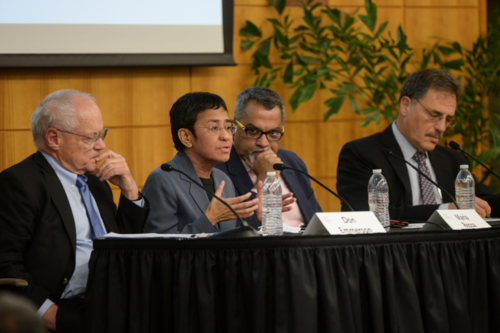
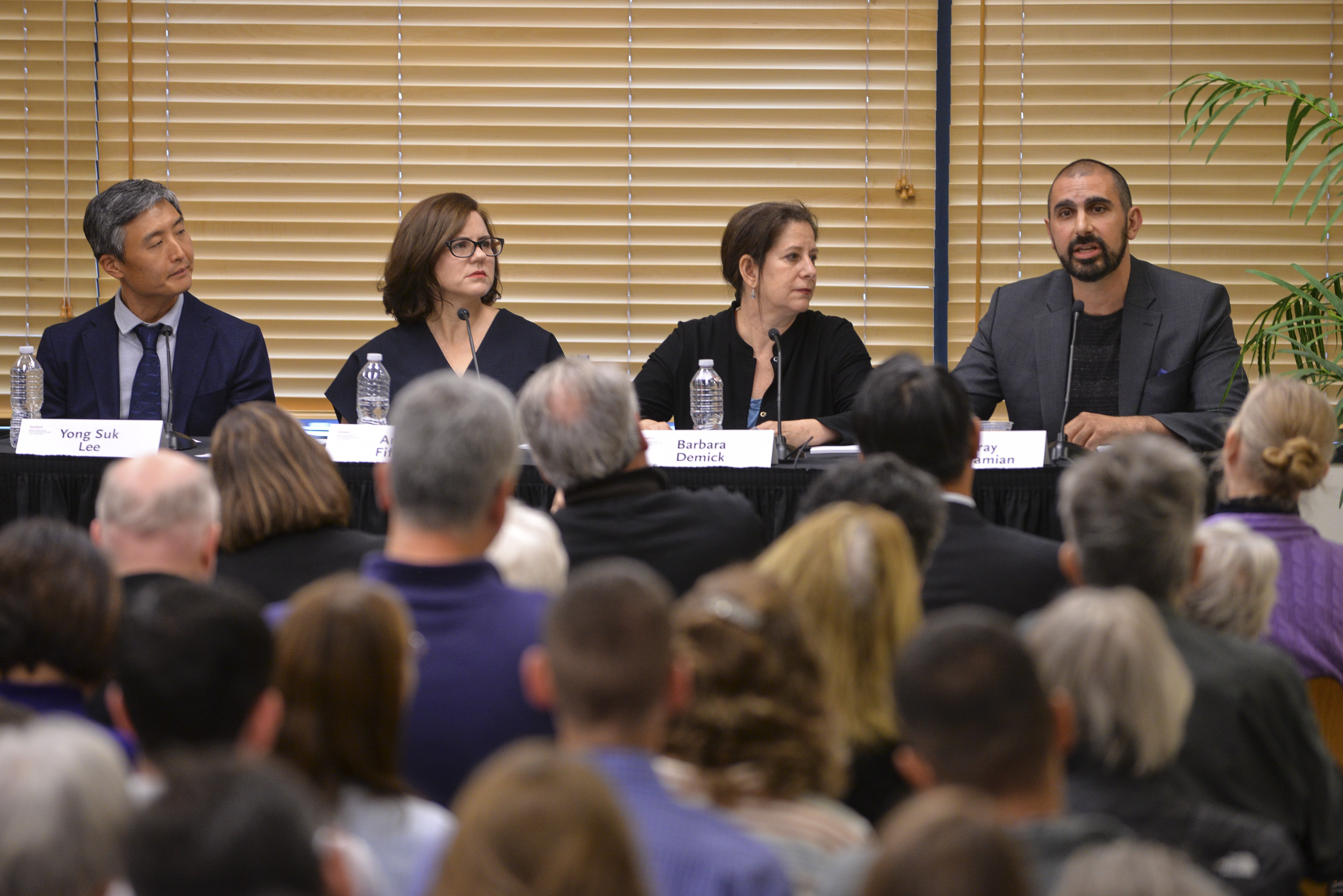
Two other North Korea experts joined Fifield at the panel: Barbara Demick, New York correspondent of the Los Angeles Times, formerly head of the bureaus in Beijing and Seoul, and the 2012 Shorenstein award winner; and Andray Abrahamian, the 2018-2019 Koret Fellow, whose previous role as executive director of Choson Exchange and other projects took him to the DPRK nearly 30 times. Yong Suk Lee, deputy director of the Korea Program at Shorenstein APARC, chaired the panel.
The presence of another person—the Dear Respected Comrade himself—was also very much felt in the room, if only in spirit.
Barbara Demick (center) speaks at 2018 Shorenstein Journalism Award.
Survival at any cost
At various points throughout its 70-year history, experts have predicted the demise of the "Hermit Kingdom." Fifield herself admitted to occasionally thinking along such terms.
And yet the country continues to prove them wrong.
“[D]uring my first stint covering North Korea, [I] just couldn’t envisage any way that this regime could survive the death of the second-generation leader and the transition to a third generation,” she said. “Kim Il Sung had created a myth of revolutionary heroism around himself, and a myth of divine selection around his son, Kim Jong Il. How could the North Korean people, who no longer live in a Hermit Kingdom, tolerate a third leader called Kim, let alone one who had no highly exaggerated or plain fictional back story?”
“Yet," Fifield continued, "here we are. Next month, Kim Jong Un will celebrate seven years in charge of North Korea.”
One prominent reason for the nation's recent survival, and an idea put forward by Fifield and supported by her co-panelists, was the development of markets in the communist state.
For decades, North Korea operated under the centrally-planned communist model. Even as China pursued reform and as the Soviet Union collapsed, the North Korean state maintained its central position in the economy.
However, following the famines of the 1990s, the state had no choice but to allow market activity to develop. Under the third Kim markets have continued to grow.
“There are now more than 400 established, state-sanctioned markets in North Korea,” said Fifield. “That’s more than double the number that existed when Kim Jong Un took over at the end of 2011.”
A side effect of this nascent market economy has been the emergence of new elites in the purported “classless” society. Fifield described the development of a capital within the capital—“Pyonghattan”—where newfound elites purchase clothes from western retailers and undergo plastic surgery for their eyelids.
Abrahamian concurred, noting that Kim Jong Un made sure to coddle this upper middle and upper class in Pyongyang. "The old way of doing that under Kim Jong Il and his father, Kim Il Sung, was very much through a loyalty and gift economy," Abrahamian said. "Money was not necessary in the old North Korea. Now it is. You do need it to get your daily necessities, and if you’re lucky enough, the products [from the “outside world”] help you to have a more pleasurable life through the market.”
At the other end of the spectrum, North Koreans turn to the markets not out of entrepreneurial zeal, but out of a need to survive. As an example, Fifield described meeting a mother and daughter living near the border with China. The mother took her daughter out of school in order to raise pigs and make tofu. Before dawn, they trekked into the mountains to tend crops of corn. It was a back-breaking existence. "If they were lucky, they made enough money each day to buy food for themselves," Fifield said. "Many days, they did all this to break even."
Andray Abrahamian responds to a question from the audience.
A smart tyrant not to be underestimated
The panel continued to focus on the man currently at the helm in North Korea.
“When I returned for my second go at covering the Koreas, I wanted to figure out how he’d done it," said Fifield. "How had this podgy young upstart with no qualifications other than being born into this family managed to take control of this regime…? How had he managed to keep intact this anachronistic system that should have died years, even decades, before?”
Fifield emphasized that her comments did not equate to admiration for Kim Jong Un. “He’s a tyrant,” she reminded the room. “But he’s a smart tyrant who’s been operating in a calculating way. To treat him as a joke or a madman is to underestimate the threat of him.”
“Kim Jong Un has not allowed these markets to flourish because he cares about the people and their wellbeing,” Fifield continued. “He has demonstrated time and time again that he doesn’t care at all about the people.”
“There’s only one thing he cares about and that is staying in power.”
Demick cautioned further against over-estimating the positive impact of market development on life in North Korea. “The people Anna interviewed for her groundbreaking series in 2017 in The Washington Post were disgusted with the system,” said Demick. “With the income inequality, with the corruption, with the controls.”
“For them, what’s the worst thing about North Korea? Simply being born there.”
The panelists participated in a lively audience Q & A.
A celebration of journalism
The Shorenstein Journalism Award, which carries a cash prize of $10,000, recognizes accomplished journalists committed to critical reporting on and exploring the complexities of Asia through their writing. It alternates between honoring recipients from the West, who mainly address American audiences, and recipients from Asia, who pave the way for freedom of the press in their countries. Established in 2002, the award honors the legacy of APARC benefactor Mr. Walter H. Shorenstein. A visionary businessman, philanthropist, and champion of Asian-American relations, Shorenstein was dedicated to promoting excellence in journalism and a deeper understanding of Asia.
While the reporting of each year's recipient focuses on different regions and areas of interest, the award consistently recognizes quality journalism. In his welcome remarks, panel chair Yong Suk Lee stated, “In the face of current attacks on journalists and on the truth in the United States and the world, [Shorenstein APARC is] even more committed to excellence in journalism, and to defending independent and free media."
Fifield’s co-panelists spoke at length about how deserving she was of the award. Before their first meeting in Seoul, Abrahamian confessed to harboring skepticism about Fifield. “I had read some of her work before and knew she had analytical chops, but thought to myself that journalists are always fighting for the next scoop.” However, after talking to Fifield for only a few minutes, Abrahamian readily dropped his guard. “I told myself, 'This is a special journalist; she's got something.’"
A previous recipient of the Shorenstein Journalism Award herself, Demick was equally enthusiastic in her praise of Fifield. “For the last four years, [Anna] had owned the North Korea story like no other journalist I’ve met, including myself.”
Fifield was presented with the Shorenstein award and prize at a private evening ceremony.
Watch Fifield’s keynote speech below. An audio version is availalbe on our SoundCloud channel.
Hero Image
Panel chair Yong Suk Lee (left) listens as 2018 Shorenstein Journalism Award winner Anna Fifield speaks to audience.
The evidentiary weight of North Korean defectors’ testimony depicting crimes against humanity has drawn considerable attention from the international community in recent years. Despite the ramped-up attention to North Korean human rights, what remains unexamined is the rise of the transnational advocacy network which drew attention to the issue in the first place. In their new book, North Korean Human Rights: Activists and Networks, Andrew Yeo and Danielle Chubb lead a team of scholars in tracing the emergence and evolution of North Korean human rights activism. Together they challenge existing conceptions of transnational advocacy, how they operate, and why they provoke a response from even the most recalcitrant regimes. In this event, Professor Yeo draws particular attention to the politics of North Korean human rights in both domestic and international contexts. He explains the relevance and importance of human rights even as the diplomatic environment on the Korean Peninsula shifts from pressure towards engagement.
Image
Andrew Yeo is Associate Professor of Politics and Director of Asian Studies at The Catholic University of America in Washington DC. He is the author of the forthcoming book, Asia's Regional Architecture: Alliances and Institutions in the Pacific Century (Stanford University Press 2019) and has written or co-edited three other books: North Korean Human Rights: Activists and Networks (Cambridge University Press 2018); Living in an Age of Mistrust:An Interdisciplinary Study of Declining Trust and How to Get it Back (Routledge Press 2017); and Activists, Alliances, and Anti-U.S. Base Protests (Cambridge University Press 2011). His research and teaching interests include international relations theory; East Asian regionalism; Asian security; narratives and discourse; the formation of beliefs, ideas, and worldviews; civil society; social and transnational movements, overseas basing strategy and U.S. force posture; Korean politics; and North Korea. He is a former term member of the Council on Foreign Relations and the recipient of Catholic University's Young Faculty Scholar's Award in 2013. He received his Ph.D. in Government from Cornell University, and BA in Psychology and International Studies from Northwestern University.
The Republic of China on Taiwan spent nearly four decades as a single-party state under dictatorial rule (1949-1987) before transitioning to liberal democracy. This talk is based on an ethnographic study of street-level police practices during the first rotation in executive power following the democratic transition (i.e. the first term of the Chen Shui-bian administration, 2000-2004). Summarizing the argument of a forthcoming book, Dr. Jeffrey T. Martin focuses on an apparent paradox, in which the strength of Taiwan's democracy is correlated to the weakness of its police powers. Martin explains this paradox through a theory of "jurisdictional pluralism" which, in Taiwan, is organized by a cultural distinction between sentiment, reason, and law as distinct foundations for political authority. An overt police interest in sentiment (qing) was institutionalized during the martial law era, when police served as an instrument for the cultivation of properly nationalistic political sentiments. Martin's fieldwork demonstrates how the politics of sentiment which took shape under autocratic rule continued to operate in everyday policing in the early phase of the democratic transformation, even as a more democratic mode of public reason and the ultimate power of legal right were becoming more significant.
Image
Jeffrey T. Martin is an assistant professor in the Departments of Anthropology and East Asian Languages and Cultures at the University of Illinois at Urbana Champaign. He specializes in the anthropological study of modern policing, and has conducted research in China, Taiwan, Hong Kong, and the USA. His research interests focus on historical continuity and change in police culture, especially as this culture reflects specific changes in the legal, bureaucratic, or technical dimensions of police operations. Prior to joining the University of Illinois, Dr. Martin taught in the Sociology Department at the University of Hong Kong, and in the Graduate Institute of Taiwan Studies at Chang Jung Christian University.
Jeffrey T. Martin
<i>Assistant Professor, Anthropology and East Asian Languages and Cultures, University of Illinois at Urbana Champaign</i>
616 Serra StreetEncina Hall E301Stanford, CA94305-6055
(650) 724-5594
(650) 723-6530
0
amissb@stanford.edu
antje_missbach
Ph.D.
Antje Missbach joins the Walter H. Shorenstein Asia-Pacific Center (Shorenstein APARC) during fall 2017 from Monash University, Melbourne, where she serves as a senior research fellow at the School of Social Sciences. Her research interests focus on socio-legal dimensions of irregular migration in Southeast Asia; trafficking in persons, human smuggling and related transnational crimes in the Asia-Pacific region; global asylum policies and refugee protection as well as diaspora politics and long-distance nationalism. During her time at Shorenstein APARC, she will work on a number of issues regarding formal and informal refugee protection in Indonesia and the wider region. Antje is the author of Troubled transit: asylum seekers stuck in Indonesia, (2015) and Politics and conflict in Indonesia: the role of the Acehnese diaspora (2011) and the co-editor of Linking people: Connections and encounters between Australians and Indonesians (2015 with Jemma Purdey). She regularly writes opinion pieces for The Conversation, Inside Indonesia, and Jungle World. She holds a Ph.D. from The Australian National University, Canberra and a Magister from Humboldt-University in Berlin, Germany.
Visiting Scholar
2017-2018 Lee Kong Chian NUS-Stanford Fellow on Contemporary Southeast Asia
Rural areas of China have made remarkable progress in reducing adult mortality within the past 15 years yet broadened health insurance was not a casual factor in that decline, according to a new study by an international research team that includes Asia Health Policy Program Director Karen Eggleston.
The New Cooperative Medical Scheme (NCMS), a government-subsidized insurance program that began in 2002-03, expanded to cover all of rural China within a decade. Examining NCMS and cause-specific mortality data for a sample of 72 counties between 2004 and 2012, the researchers found that there were no significant effects of health insurance expansion on increased life expectancy.
The study, published in the September issue of Health Affairs, showed results consistent with previous studies that also did not find a correlation between insurance and survival, although much research confirms NCMS increased access to healthcare, including preventive services, and shielded families from high health expenditures.
Commenting on the study, Eggleston said population health policies remain central to China’s efforts to increase life expectancy and to bridge the gap between rural and urban areas.
Eggleston also noted that multiple factors beyond the availability of health care determine how long people live, and anticipates the research team will continue to explore the impacts of NCMS by extending the study to look at infants and youth.
Read the study (may require subscription) and view a related article on the Stanford Scope blog.
Hero Image
Farmers dry star anise seeds in a country yard in Tanbin Township, China, Nov. 26, 2005.
616 Serra StreetEncina Hall E301Stanford, CA94305-6055
(650) 725-6445
(650) 723-6530
0
jetschke@stanford.edu
Anja Jetschke joins the Walter H. Shorenstein Asia-Pacific Research Center (Shorenstein APARC) from January through March from the University of Göttingen’s department of political science, where she is a professor of international relations.
Her research interests focus on the design and effects of international institutions, with a particular focus on regional organizations in Asia. Her Comparative Regional Organizations Project (CROP) currently develops the world’s largest database on regional organizations with the aim of evaluating the explanatory power of a neglected determinant of institutional design: the diffusion of institutional designs among regional organizations. While at Shorenstein APARC, Anja Jetschke will also work on the effects of refugee flows on regional human rights commitment in Southeast Asia.
Anja Jetschke is currently the Vice-President of the German Political Science Association. From 2012-2015 she headed a research program on international governance at the German Institute of Global and Area Studies (Hamburg) and was an assistant professor at the University of Freiburg. She also held research fellowships at the WZB Berlin Social Science Center, Ohio State University and the University of Berlin. Her publications include many articles and chapters on comparative regionalism, ASEAN, and the AICHR, and a prize-winning book, Human Rights and State Security: Indonesia and the Philippines (2011). Her doctorate is from the European University (Florence).