Climate change
Authors
Callista Wells
News Type
News
Date
Paragraphs

The Stanford Center at Peking University (SCPKU), the Center on Democracy, Development and the Rule of Law (CDDRL), and the APARC China Program jointly hosted a workshop on China’s Belt and Road Initiative (BRI) in early March. The workshop, held on March 2 and 3, welcomed researchers from around the world with expertise in the Initiative. Unfortunately, because of the rapidly developing health emergency related to the coronavirus, participants from not only China, but also Japan, were prevented from attending. As described by Professor Jean Oi, founding director of SCPKU and the China Program, and Professor Francis Fukuyama, director of CDDRL and the Ford Dorsey Master's in International Policy, who co-chaired the workshop, the meeting aimed to provide a global perspective on the BRI, consolidate knowledge on this opaque topic, and determine the best method and resources for future research.  

The workshop began with presentations from several of the invited guests. Dr. Atif Ansar from the University of Oxford’s Saïd Business School kicked off the first day by describing not only the tremendous opportunity that the BRI presents to developing economies, but also the serious pitfalls that often accompany colossal infrastructure projects. Pointing out the poor returns on investment of mega infrastructure projects, Ansar examined the frequest cost and schedule overruns, random disasters, and environmental degradation that outweigh the minimal benefits that they generally yield. China’s own track record from domestic infrastructure projects does little to mitigate fear of these risks, Ansar claimed. In response, he urged professional management of BRI investments, institutional reforms, and intensified deployment of technology in BRI projects. Dr. Ansar was followed by Dr. Xue Gong of the S. Rajaratnam School of International Studies, Nanyang Technological University, Singapore. Dr. Gong’s analysis centered on the extent to which China’s geopolitical motivations influenced its outward foreign direct investments (OFDI). Although her research was still in the early stages, her empirical analysis of China’s OFDI inflows into fifty BRI recipient countries from 2007-2018 nevertheless revealed that geopolitical factors often outweigh economic factors when it comes to China’s OFDI destinations.

Image
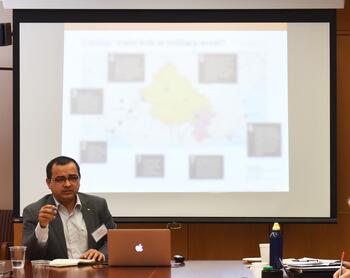
Amit Bhandari of Gateway House: Indian Council on Global Relations presents his research at the Belt and Road Workshop.
Participants then heard presentations from Amit Bhandari of Gateway House: Indian Council on Global Relations and Professor Cheng-Chwee Kuik of the National University of Malaysia. Mr. Bhandari’s talk focused on Chinese investments in India’s six neighboring countries, which tend to center more on energy rather than connectivity projects. He first found that the investments are generally not economical for the host countries because they come with high costs and high interest rates. Secondly, he argued that these projects often lacked a clear economic rationale, appearing instead to embed a geopolitical logic not always friendly to India. Professor Kuik, by contrast, provided a counterexample in his analysis of BRI projects in Southeast Asia. He described how, in Southeast Asia, host countries’ reception of the BRI has varied substantially; and how various stakeholders, including states, sub-states and other entities, have used their leverage to shape outcomes more or less favorable to themselves. Kuik’s analysis injected complexity into the often black-and-white characterizations of the BRI. He highlighted the multidimensional dynamics that play out among local and state-level players in pursuit of their goals, and in the process of BRI implementation.

Professor Curtis J. Milhaupt and Scholar-in-Residence Jeffrey Ball, both at Stanford Law School, followed with individual presentations on the role of State-Owned Enterprises (SOEs) in the BRI and the emissions impact of the BRI on climate change, respectively. Professor Milhaupt  characterized Chinese SOEs as both geopolitical and commercial actors, simultaneously charged with implementing Party policies and attaining corporate profits. Chinese SOEs are major undertakers of significant overseas BRI projects, acting not only as builders but also as investors, partners, and operators. This situation, Milhaupt asserted, carries significant risks for SOEs because these megaprojects often provide dismal returns, have high default rates, and can trigger political backlash in their localities. Milhaupt highlighted the importance of gathering firm-level data on businesses actually engaged in BRI projects to better infer geostrategic, financial, or other motivations. Jeffrey Ball turned the discussion to carbon emissions from BRI projects and presented preliminary findings from his four-country case studies. He concluded that, on aggregate, the emissions impact of the BRI is still “more brown than green.” Twenty-eight percent of global carbon emissions may be accounted for by BRI projects, Ball asserted, underscoring the importance of the BRI to the future of global climate change.

The day concluded with presentations by  Michael Bennon, Managing Director at the Stanford Global Projects Center, and Professor David M. Lampton, Oksenberg-Rohlen Fellow at the Freeman Spogli Institute for International Studies. Bennon first presented findings from two empirical case studies of BRI projects and then went on to describe how the BRI is now practically the “only game in town” for infrastructure funding for developing countries. Lengthy environmental review processes at Western multilateral banks have turned the World Bank, for example, from a lending bank into a “knowledge bank,” he argued. He also highlighted that, in general, economic returns on BRI projects for China are very poor, even though recipient countries may accrue macroeconomic benefits from these projects. Finally, Professor Lampton turned the discussion back to Southeast Asia, where China is currently undertaking massive cross-border high-speed rail projects through eight ASEAN countries. He described how each host country had varying capacity to negotiate against its giant neighbor, and how the sequential implementation of these cross-border rail projects also had varying impacts on the negotiating positions of these host countries. BRI played out differently in each country, in other words, eliciting different reactions, push-backs and negotiated terms.

The second day of the workshop was dedicated to working toward a collaborative approach to future BRI research. The group discussed the key gaps in the existing research, including how to know what China’s true intentions are, how to measure those intentions, who the main players and their interests in both China and the host countries are, and even what the BRI is, exactly. Some cautioned that high-profile projects may not be representative of the whole. Participants brainstormed about existing and future sources of data, and stressed the importance of diversifying studies and seeking empirical evidence.

Hero Image
Participants in the Belt and Road Initiative Workshop at Stanford University, March 2-3, 2020.
All News button
1
Paragraphs

Truth to Power, the first-ever history of the U.S. National Intelligence Council (NIC), is told through the reflections of its eight Chairs in the period from the end of the Cold War until 2017. Co-editors Robert Hutchings and Gregory Treverton add a substantial introduction placing the NIC in its historical context going all the way back to the Board of National Estimates in the 1940s, as well as a concluding chapter that highlights key themes and judgments.

APARC Fellow Thomas Fingar, who chaired the NIC from 2005 to 2008, is one of the contributors to the book. In his chapter “New Mission, New Challenges”, Fingar discusses some of the challenges during his service with the agency. In particular, he reflects on two specific obstacles he faced during his tenure: executing the intelligence reforms drafted in the wake of 9/11, and repairing damage done to the NIC’s credibility by the failures of the National Intelligence Estimate (NIE) on Iraqi weapons of mass destruction (WMD).


All Publications button
1
Publication Type
Books
Publication Date
Authors
Thomas Fingar
Paragraphs

This report was produced for the Abe Fellows Global Forum 2017 symposiums on climate change, held in partnership with Stanford University's Walter H. Shorenstein Asia Pacific Research Center (Abe Global | Stanford, October 20, 2017) and the Asia Society Texas Center (Abe Global | Houston, October 18, 2017), respectively. 

Energy-intensive production has been both a leading contributor to climate change as well as one of the keys to modern economic growth over the last several centuries. In the post-WWII era, the “economic miracles” of Asian growth—starting with Japan, and followed by South Korea, Taiwan, China, and now increasingly India—have lifted hundreds of millions of people out of poverty. At the same time, these “economic miracles” have created huge pollution problems which have adversely affected the health of millions of people while speeding up the effects of climate change.

Some early developers from this group—including Japan—have made efforts to clean up their air and water, created more energy efficient economies, lowered their carbon footprints and contributed to initiatives to slow global warming. The Fukushima nuclear power plant disaster forced Japan to take even more aggressive action to reduce energy consumption and lessen its impact on the global environment. In contrast, the United States, as a sizeable nation-state both in its geographic area and economy, is one of the world’s largest polluters and recently made recent headlines when it withdrew from the Paris Agreement negotiated at the 2015 United Nations Climate Change Conference (COP21).

Putting into place effective measures to curtail climate change while creating sustainable societies requires international cooperation. The series of extreme weather events in the US in 2017 are only some the most recent disasters to remind us of climate change’s threat to our economy, our society, and our individual daily lives.


All Publications button
1
Publication Date
Journal Publisher
Abe Fellowship Program and Social Science Research Council
Authors
News Type
News
Date
Paragraphs

Forty-eight national security and foreign policy leaders urged U.S. government and businesses to take action to fight climate change in a statement released by the Partnership for a Secure America. Thomas Fingar, a distinguished fellow in the Freeman Spogli Institute for International Studies, is a signatory. The statement can be accessed by clicking here.

Hero Image
5811865885 d45256bd02 o
A sergeant operates a sling on a UH-60 Blackhawk above a swollen Missouri River near North Sioux City, South Dakota. Flight crews are helping deliver sand bags to areas affected by flooding.
Flickr/U.S. Department of Defense
All News button
1
-

Mr. Rudd served as Australia’s 26th Prime Minister from 2007 to 2010, then as Foreign Minister from 2010 to 2012, before returning to the Prime Ministership in 2013. As Prime Minister, Mr. Rudd led Australia’s response during the Global Financial Crisis. Australia's fiscal response to the crisis was reviewed by the IMF as the most effective stimulus strategy of all member states. Australia was the only major advanced economy not to go into recession. Mr. Rudd is also internationally recognized as one of the founders of the G20 which drove the global response to the crisis, and which in 2009 helped prevent the crisis from spiraling into a second global depression.

As Prime Minister and Foreign Minister, Mr. Rudd was active in global and regional foreign policy leadership. He was a driving force in expanding the East Asia Summit to include both the US and Russia in 2010. He also initiated the concept of transforming the EAS into a wider Asia Pacific Community to help manage deep-routed tensions in Asia by building over time the institutions and culture of common security in Asia. On climate change, Mr. Rudd ratified the Kyoto Protocol in 2007 and legislated in 2008 for a 20% mandatory renewable energy target for Australia. Mr. Rudd launched Australia's challenge in the International Court of Justice with the object of stopping Japanese whaling in the Southern Ocean. Mr Rudd drove Australia’s successful bid for its current non-permanent seat on the United Nation’s Security Council and the near doubling of Australia's foreign aid budget.

Mr. Rudd remains engaged in a range of international challenges including global economic management, the rise of China, climate change and sustainable development. He is on the International Advisory Panel of Chatham House. He is a proficient speaker of Mandarin Chinese, a Visiting Professor at Tsinghua University and funded the establishment of the Australian Centre on China in the World at the Australian National University. He was a co-author of the recent report of the UN Secretary General's High Level Panel on Global Sustainability – “Resilient People, Resilient Planet" and chairs the World Economic Forum's Global Agenda Council on Fragile States. He also remains actively engaged in indigenous reconciliation.

Bechtel Conference Center

Kevin Rudd 26th Prime Minister of Australia Speaker
Conferences
Authors
News Type
Q&As
Date
Paragraphs

For several decades, Southeast Asia’s tracts of dense, old-growth rainforest have served as fertile ground for lumber, and much land has been converted to agriculture. Now, palm oil plantations are being planted where forests once stood.

In 2011, Indonesia, one of the region’s most prosperous countries, instituted a two-year moratorium on clearing new areas of forest, which is set to expire this May and has been criticized as having several loopholes. Other countries, including Cambodia and Myanmar, are losing forests rapidly.

Out of concern for climate change, international initiatives such as Reduced Emissions from Deforestation and forest Degradation (REDD+) have aimed to promote conservation and sustainable development in countries with significant forest cover. But these efforts do not always support local needs, and can inadvertently have negative impacts.

Tim Forsyth, a Lee Kong Chian NUS-Stanford Distinguished Fellow, speaks about the gap between conservation efforts and economic and social development in Southeast Asia. He is visiting Stanford this quarter from the London School of Economics and Political Science where he is a reader in environment and development at the Department of International Development.

What major types of forest management do we see across Southeast Asia today?

A number of countries have put laws in place to restrict illegal logging, and have established national park areas. These are usually old-growth rainforests that restrict logging and agriculture. The problem with national parks is that they put so many restrictions on land use that the vulnerable populations living around them either suffer or are forced to cut other trees. I have spent some years working in poorer villages in Indonesia and Thailand on the edge of protected forests, and usually conservation policies avoid the fact that people need to get livelihoods somehow. Government policy should acknowledge how these people are vulnerable to changes in crop prices and the availability of land, or else these people might be forced into breaking the rules of national parks.

There is also production forest, which usually includes forest plantations. These can include softwoods such as pine, or hardwoods such as teak — and increasingly oil palm for food and biofuels. Forest plantations are attractive to governments and businesses because they earn money and can provide timber for construction and exports. Sometimes, plantations also gain carbon credits, although this is not a lot of money so far. In terms of conservation, destroying old-growth forest and replacing it with a monoculture plantation is not good for biodiversity. It also does not benefit those local people who want to harvest forest products or use part of the land for agriculture.

Finally, there are community forests that are supposed to be places where people can grow food, live, and have forest cover. The definition of “community forest,” however, varies from place to place. In Thailand, for example, the way the government defines it is not very different from a conservation area, and consequently there is not much space for agriculture. The Philippines, on the other hand, is more decentralized and local people can shape the nature of the forest landscape more. Corruption, however, is a problem.

Is there an ideal model that successfully supports sustainable development? How does your research approach this issue?

There has been much progress in collaborations that involve willing governments, international advisors, and local actors — often in accordance with an international agreement such as the Convention on Biological Diversity. These collaborations are more useful than a single actor working alone, and they acknowledge a wider range of objectives.

A new initiative is Reducing Emissions from Deforestation and forest Degradation (REDD+). This is meant to encourage governments to slow down deforestation by rewarding them financially through carbon credits. But REDD+ has a number of challenges. The main problem is that the value of the credits is so low at the moment. REDD+ also overemphasizes forest cover, rather than forest quality. This means that if a satellite image of a country shows a lot of forest cover, that is good according to REDD+. But this gives no indication as to the biodiversity or the diversity of livelihoods inside a forest. It is a green light to all of the people who want fast-growing tree plantations, which makes them money and supplies them with wood for construction. In addition, it keeps a government happy because it supplies their country with timber and tax revenue, but this is not necessarily what you would call sustainable development.

There are elements of good models in different places, and it really depends on one’s viewpoint. Nepal offers a good example of community forestry because, in principle, it aims to engage local people more effectively and equally, and so can combine local development with the protection of national forests. From a development perspective, some forms of conservation can hurt poorer people and actually undermine conservation efforts. Therefore, in my work, I try to promote policy that acknowledges the needs of the more vulnerable populations. My research tries to make climate change policy more relevant to development processes in Southeast Asia. In my current project, I am seeing how policy recommendations about forests can be reshaped and reinterpreted locally in developing countries in order to address local interests. My goal is to understand how expert knowledge about climate change can be governed more effectively in order to enhance both development and conservation in Asia with better outcomes for everybody.

Image
What can people do in their everyday lives to help combat climate change?

The practical problem of dealing with forest destruction and climate change in Southeast Asia is also a function of social and economic trends. As countries become more prosperous, more and more people live in megacities, drive cars, live in air-conditioned apartments, and frequent shopping malls.

A couple of years ago in Bangkok, I took lots of photographs of t-shirts printed with global warming messages and of people carrying reusable bags. When I was there recently, all of these things had disappeared. In other words, there is a tendency for people to think of conservation efforts as a fashion trend.

I do not think that any city in Asia is doing enough. We have to start planning cities in ways that use fewer greenhouse gases, and also to encourage people to realize that they can be real agents of change. At the moment, many urban citizens believe they can implement climate change policy by managing rural and forested landscapes. Instead, they need to realize the problems of these approaches, and to see what they can do themselves.

Hero Image
Sumatra TF compressed Mar07 LOGO
Tim Forsyth stands in a cleared section of national parkland in Sumatra, Indonesia.
Courtesy Tim Forsyth
All News button
1
-

Officials, scholars, and activists have long believed in improving environmental policy in developing countries by fostering desirable values and practices through networks of experts. Tim Forsyth will question this faith by arguing that all too often such networks ignore the limitations of global environmental assessments and the politics involved in producing and using expert opinion. Using preliminary evidence from Indonesia and Thailand, he will show how Procrustean advice and local agendas affect efforts to mitigate climate change, and what that can mean for the generation of greenhouse gas (through energy use) and its absorption in sinks (through forest conservation). Forsyth argues that more deliberative institutions of environmental information, judgment, and decision can better accommodate local knowledge and vulnerabilities, strike productive balances between mitigation and adaptation, and thereby address climate change in Southeast Asia in more timely and effective ways.

Tim Forsyth is Reader in Environment and Development in the Department of International Development at the London School of Economics and Political Science. He has published widely on matters of politics of environmental science and policy in Southeast Asia including Critical Political Ecology: The Politics of Environmental Science (Routledge, 2003); Forest Guardians, Forest Destroyers: The Politics of Environmental Knowledge in Northern Thailand (with A. Walker, Washington University Press, 2008); and International Investment and Climate Change: Energy Technologies for Developing Countries (Earthscan, 1999). He was a co-author of the chapter on climate change in the international Millennium Ecosystem Assessment (2005).

Philippines Conference Room

Shorenstein APARC
Stanford University
Encina Hall, Room C309
Stanford, CA 94305-6055

(650) 736-0756 (650) 723-6530
0
2013 Lee Kong Chian NUS-Stanford Distinguished Fellow
ForsythTim_WEB.jpg PhD

Tim Forsyth joins the Walter H. Shorenstein Asia-Pacific Research Center (Shorenstein APARC) during the 2012–13 academic year from the London School of Economics and Political Science, where he is a reader in environment and development at the Department of International Development.

His research interests encompass environmental governance, with particular reference to Southeast Asia. The main focus is in implementing global environmental policy with greater awareness of local development needs, and in investigating the institutional design of local policy that can enhance livelihoods as well as mitigate climate change. Fluent in Thai, Forsyth has worked in Thailand, Indonesia, the Philippines and Vietnam. He will use his time at Shorenstein APARC to study how global expertise on climate change mitigation is adopted and reshaped according to development agendas in Southeast Asia.

Forsyth is on the editorial advisory boards of Global Environmental Politics, Progress in Development Studies, Critical Policy Studies, Social Movement Studies, and Conservation and Society. He has published widely, including recent papers in World Development and Geoforum.He is also the author of Critical Political Ecology: The Politics of Environmental Science (2003); Forest Guardians, Forest Destroyers: the Politics of Environmental Knowledge in Northern Thailand (2008, with Andrew Walker); and editor of the Routledge Encyclopedia of International Development(2005, 2011).

Forsyth holds a PhD in development from the University of London, and a BA in geography from the University of Oxford.

Timothy Forsyth 2013 Lee Kong Chian NUS-Stanford Distinguished Fellow Speaker
Seminars
Subscribe to Climate change