Diplomacy
News Type
Commentary
Date
Paragraphs

North Korea today threatened military action against South Korea if it did not end its propaganda broadcasts along the Demilitarized Zone (DMZ) within 48 hours. The broadcasts against the North are being systematically blared by loudspeakers over the border.   

South Korea resumed the broadcasts earlier this week after an 11-year hiatus, in retaliation for North Korea’s planting landmines just outside a South Korean DMZ guard post that crippled two South Korean soldiers on Aug. 4.

David Straub, associate director of the Korea Program at the Walter H. Shorenstein Asia-Pacific Research Center and a former Korean affairs director at the U.S. Department of State, offers insights on the situation. Straub also spoke on PRI's "The World" radioshow on Aug. 20, the audioclip and summary can be accessed by clicking here.

What’s behind the current tensions on the Korean Peninsula?

Fundamentally, the current situation is just another symptom of the underlying problem, which is the division of Korea into two competing states, with one of them—North Korea—having a Stalinist totalitarian system and a Maoist-style cult of personality. Since North Korea can’t compete with the South economically and diplomatically, it uses the threat of force or the actual use of it to try to intimidate South Korea. The North Koreans know that South Korea tends to “blink first” and step back because it is democratic and its leaders are concerned about civilian casualties.

The current situation is also related to the leadership transition in North Korea, with leader Kim Jong Un succeeding his father Kim Jong Il three years ago. Kim Jong Un still feels insecure, which is clearly evidenced by his execution of his powerful uncle Jang Seong-taek in 2013 and many other leaders there as well. To solidify support for his rule, he also manufactures a South Korean threat to rally his people behind him.

What does North Korea want?

North Korea’s immediate demand is that South Korea stop its propaganda broadcasts across the DMZ. The South Korean broadcasts criticize the North Korean system and its leaders, which is something that the North, with its cult of personality, can’t accept. But the South resumed the broadcasts only because the North Koreans recently snuck into the South Korean side of the DMZ and viciously planted landmines just outside a South Korean guard post. These were clearly intended to maim South Korean soldiers. They did just that, blowing the legs off two young men.

The North Korean regime’s long-term aim is not just to survive but also to get the upper hand on South Korea, and eventually try again to reunify the peninsula on its own terms. That explains why North Korea behaves as it does, rather than reform its system and reconcile with the South.

The North also demands an end to all U.S. and South Korean military exercises on the peninsula—even though the North has a much larger military than the South and U.S. forces there combined and is developing nuclear weapons and other weapons of mass destruction. Ultimately, the North wants to end the U.S.-South Korean alliance and see U.S. forces withdrawn from the peninsula, in the belief that it will open the way to eventual victory over the South.

Why did the South resume the broadcasts? Was it a good idea?

South Korea resumed the loudspeaker broadcasts in retaliation for the maiming of two of its soldiers on August 4th. Rather than retaliate by attacking militarily, the South resumed the loudspeaker broadcasts because the South Korean military knows that North Korean leaders hate them.

The South Korean military believes that North Korean leaders hate the broadcasts because they are effective in educating young North Korean soldiers and civilians in earshot about the nature of the regime and its leaders. The South Korean military seems to assume that the broadcasts are effective in that regard because they anger the North Korean leaders so much. But I think the reason the broadcasts anger the North Korean leaders is due to the cult of personality. The North Korean system can’t accept the idea of its leaders being criticized.

So I don’t think it was necessarily a wise step on the part of the South Korean military to resume the broadcasts. On the other hand, politically, by crippling two South Korean soldiers, the North Koreans had left South Korea with no option but to respond in some way. After the North Koreans killed fifty South Koreans in two separate sneak attacks five years ago, the South Korean government warned that it was not going to sit back the next time. The resumption of the broadcasts has further raised tensions but, frankly, given the danger of war on the peninsula, the South doesn’t have a lot of good ways to respond to North Korean provocations.

How serious is the situation?

North Korea has now threatened military action in 48 hours if South Korea doesn’t end the propaganda broadcasts. The North often makes threats. Usually, it doesn’t carry them out, but sometimes it does.

The United States and South Korea are conducting an annual military exercise together in the South until the end of August—something else that the North Koreans are demanding an end to. Most experts feel that the North is unlikely to launch a major provocation while the American presence is bolstered and the U.S. and South Korean militaries are paying full attention. The North Korean leaders know they are weaker than our side, so they usually avoid frontal assaults and instead engage in sneak attacks, at times and places and in ways of their own choosing.

There is more uncertainty in recent years because of the aggressive and threatening behavior thus far of Kim Jong Un, who is young and inexperienced. He seems anxious about his position in the North and prepared to take risks to bolster it, including rallying the people behind him by raising tensions with the South. We also don’t know if the North feels freer to engage in major provocations because it has developed at least a handful of nuclear devices since its first nuclear test in 2006.

So I myself wouldn’t be afraid to visit Seoul now but the situation bears even closer watching than usual.

Hero Image
dmz flickr stephan
North Korean soldiers stand guard at the Demilitarized Zone, 2008.
Flickr/(stephan)
All News button
1
Paragraphs

A version of this paper, "Security Challenges in a Turbulent World: Fewer Enemies, More Challenges, and Greater Anxiety," delivered at the International Areas Studies Symposium at the University of Okalhoma, on Feb. 26, 2015, is also available in English by clicking here.

All Publications button
1
Publication Type
Commentary
Publication Date
Journal Publisher
Institute of International and Strategic Studies, Peking University
Authors
Thomas Fingar
Number
21
News Type
News
Date
Paragraphs

Karl Eikenberry, a distinguished fellow at Stanford’s Freeman Spogli Institute for International Studies, will serve on the Commission on Language Learning at the American Academy of Arts and Sciences (AAAS). The new commission is part of a national effort to examine the state of American language education.

The commission will work with scholarly and professional organizations to gather research about the benefits of language instruction and to initiate a national conversation about language training and international education.

Eikenberry joins eight other commissioners, including: Martha Abbott, executive director of the American Council on the Teaching of Foreign Languages; Nicholas Dirks, chancellor of the University of California at Berkeley; and Diane Wood, chief judge, of the 7th U.S. Circuit Court of Appeals. The group is led by Paul LeClerc, director of Columbia University’s Global Center in Paris.

Eikenberry, who is also a member of the AAAS Commission on Humanities and Social Sciences, contributed to “The Heart of the Matter,” a 2013 report that aims to advance dialogue on the importance of humanities and social sciences for the future of the United States.

Hero Image
karl eikenberry headline
All News button
1
Authors
Lisa Griswold
News Type
News
Date
Paragraphs

As people around the world look to support earthquake relief efforts in Nepal, scholars from Stanford and the London School of Economics and Political Science offer new research that can help donors make better decisions about where and how to contribute their money.

“NGO reports tend to focus on quantity in delivery, such as numbers of homes and people served—but not on quality,” write Yong Suk Lee (Stanford) and J. Vernon Henderson (LSE).

In a forthcoming paper, the coauthors evaluate reconstruction efforts in Indonesia following the 2004 earthquake and tsunami, and find two trends: aid agencies that directly execute their services—point-to-point—perform the highest quality work. And, when agencies contract their services, higher quality work is performed when a global, not domestic, implementer completes the work.

Knowing this reality, and with improved disclosure of outcomes, the coauthors hope that donors would be able to make more informed choices.

Fishing village survey 

iceh map Figure 1. A map details the survival rate of the population and flood damage within northern Indonesia in 2004. Darker shaded areas show a higher survival rate, lighter shaded areas show a lower survival rate. Striped areas denote flooding, largely on the northeastern border. Boundaries marked with thicker lines are ‘kabupaten,’ or county divisions, and lightly colored lines are ‘kecamatan,’ or sub-county units larger than a village alone. (Courtesy of Yong Lee).
Through fieldwork and three rounds of surveys – in 2005, 2007 and 2009 – Henderson and Lee investigated aid work in Aceh, an area of coastal villages in northern Indonesia (Figure 1).

Humanitarian efforts there focused on “hard aid” such as construction of houses and fishing boats. Total aid delivered amounted to $7.7 billion and was implemented by international and domestic aid agencies—some directly and some as contractors—as well as the Indonesian government.

First, Henderson and Lee conducted a pilot survey, and then with a cohort of surveyors from the University of Indonesia, held interviews with village leaders and fishing families. Participants were asked to rate their housing accommodation, and if applicable, how their fishing activity compared to before the disaster.

“Mostly, we sat with villagers to see how willing they were to talk about aspects of aid,” Lee said. “Since it was several years after the tsunami hit, people were pretty open throughout the process.”

Data from those surveys was combined with information from the Recovery Aceh-Nias relief project database maintained by the government and the U.N., as well as demographic information provided by participants.

Delivering aid: Global v. local

Empirical analysis revealed that aid agencies such as the Red Cross and Catholic Relief Services reflected higher quality aid delivery (at a mean quality near 3.00), while agencies such as Save the Children and Concern Worldwide reflected lower quality (at a mean quality between 1.0-1.5).

“What’s surprising is that reputation didn’t really line up with what was expected,” Lee said, citing a few renowned agencies that didn’t receive high marks.

Lee said this could be explained by the fact that aid agencies that specialize in disaster recovery are better equipped, while a learning curve might exist for agencies with wider missions.

Global aid agencies are more likely to have logistical experience given their reach across multiple disaster situations. And while all NGOs face reputational costs for their results, global aid agencies are greater exposed to criticism because, by size, they’re more visible.

Yet, while global aid agencies and implementers may have the raw skills, local implementers have the cultural know-how.

“Local implementers might not have the most experience – like how to construct a house or manufacture a fishing boat – but they will likely know what’s actually desired,” Lee said. “So, there are obvious tradeoffs at play.”

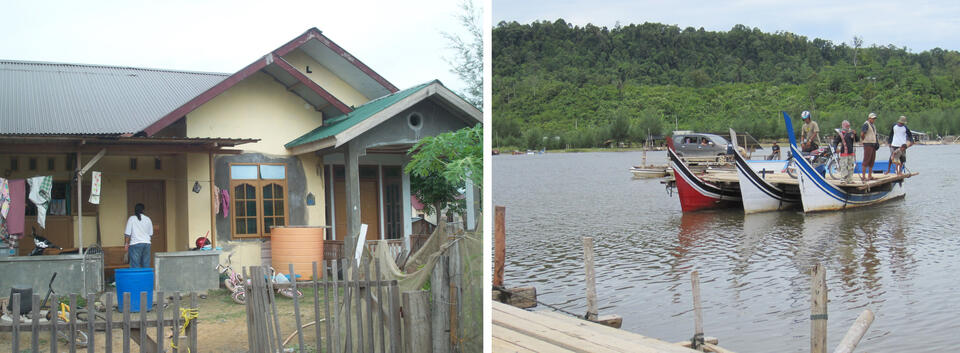
For example, villagers reported bad ventilation in houses. This was because some aid agencies used small windows and concrete instead of wood material more traditionally used in Indonesia. Some boats were impossible to use because of improper design; they sank upon first use or fell apart after a few months.


Image
Collection of photos from fieldwork in Aceh, Indonesia, provided courtesy of Yong Lee. Upper left: A house built in an aid project village shows windows retrofitted after initial construction. Upper right: Boats constructed by aid agencies for fishing activity are refashioned to serve as water taxis for people and cars. Lower: Fishing boats sit unused on the side of the road many of them impossible to use, according to villagers surveyed.
Upper left: A house built in an aid project village shows windows retrofitted after initial construction. Upper right: Boats constructed by aid agencies for fishing activity are refashioned to taxi people and cars. Lower: Fishing boats sit unused on the side of the road many of them impossible to operate, according to villagers surveyed. (Courtesy of Yong Lee).


Logistics and oversight

Aid delivery depends in many ways on the location and scale of the disaster. But, a few main aspects can determine if an aid agency doing its own work or operating as an implementer meets or exceeds expectations.

Henderson and Lee suggest that agencies that were highly supervisory had greater positive outcomes from their workers. In the case of Aceh, better monitoring and insistence on quality by leadership is a likely corollary between construction of better quality homes and boats.

“Rather than just give money, NGOs need to really oversee the projects. Organization and management are essential facets,” Lee said. “And that requires a lot of additional effort on their part.”

Oversight is especially relevant in disaster situations because of the often-overwhelming need for reconstruction. A flood of less-skilled workers enters the market to fill this gap, and on average the quality of work degrades.

“It’s much more difficult to impose quality control at this point,” Lee said. “So the implication that comes out of it is how does the implementer effectively utilize less-skilled workers.”

Getting to know the implementers and evaluating their work in-progress would help ensure quality on behalf of the aid agency. And, better dissemination of information about aid outcomes would help assure donors that their monies are being applied in the best possible way.

Future study

Most “hard aid” delivered to Aceh’s villages had finished by 2010, but “soft aid” such as democracy promotion and women’s empowerment stayed longer.

Henderson and Lee conducted one final survey in 2011. The data has been offered as open source material for researchers along with the larger data set.

Noting this, Lee said, “We’re thrilled that people are looking into the data further. It’s exactly what we wanted.”

Research projects applying the data include the impact of the tsunami on Aceh’s local economies and health effects on the population, among other areas.

Hero Image
nep 20150506 wfp angeli mendoza 2747
A United Nations Humanitarian Air Service helicopter offloads relief supplies from the World Food Programme in Gorkha District, Nepal. Villagers help distribute tents and food.
WFP/Angeli Mendoza
All News button
1
News Type
News
Date
Paragraphs

Gi-Wook Shin, director of Stanford’s Shorenstein Asia-Pacific Research Center, presented the policy report Tailored Engagement at the Korea Foundation for Advanced Studies in late March. The event in Seoul coincided with the public release of the report in Korean.

Shin delivered a keynote lecture on the study which offers steps that South Korea can take to establish sustainable dialogue with North Korea. The report is an outcome of a longstanding research project seeking to understand the future domestic and global implications of North Korea’s situation.

Shin’s lecture was followed by remarks from Korea Program Associate Director David Straub and a panel discussion among four other experts. The panelists shared their observations on the current political climate in and around the Korean Peninsula.

Video from the event is available below:

Gi-Wook Shin’s lecture (in Korean)

David Straub’s remarks (in English)

Panel discussion (in Korean)

More than 320 people attended the event including students, policymakers and academics. The event marked the second occasion in Seoul where the Stanford team presented the report. In late 2014, they briefed the Special Committee on Inter-Korean Relations, Exchange and Cooperation of the South Korean National Assembly. An article about the briefing can be accessed here.

Shin is a professor of sociology, director of Shorenstein APARC, and a senior fellow at the Freeman Spogli Institute for International Studies. Straub is the associate director of the Korea Program at Shorenstein APARC.

Hero Image
profile shin Korea Foundation for Advanced Studies
All News button
1
Paragraphs

"North Korean Human Rights: A Long Journey with Little Progress" examines human rights in the Democratic People's Republic of Korea (DPRK, or North Korea) and the approaches that the European Union has taken to address the situation. In this paper, Mike Cowin provides perspective on EU-DPRK engagement; the two sides officially established diplomatic relations in May 2001. The EU and its members have continued to raise the human rights issue during bilateral meetings. But, North Korea says it will continue to refuse dialogue if the EU continues to sponsor resolutions against North Korea at the UN Human Rights Commission/Council. The EU has rejected this as a precondition. "The EU has had no incentive or justifiable reason to take the initiative to break out of this chicken-and-egg dilemma...The DPRK has also maintained its position. The gap between the two sides has therefore widened," he writes. Cowin suggests the EU could take additional steps to restart EU-DPRK engagement.

Mike Cowin is the 2014-15 Pantech Fellow in the Korea Program at the Walter H. Shorenstein Asia-Pacific Research Center. Before coming to Stanford, he served as the deputy head of mission at the British Embassy in Pyongyang, North Korea. He has also served in the British embassies in Seoul from 2003 to 2007, and in Tokyo from 1992 to 1997.

All Publications button
1
Publication Type
Policy Briefs
Publication Date
Journal Publisher
Shorenstein Asia-Pacific Research Center
Authors
Mike Cowin
News Type
Q&As
Date
Paragraphs

The attack on Mark Lippert, the American ambassador to South Korea, made headlines worldwide on Thursday. Since his arrival in Seoul last October, Lippert received high marks from the Korean people and the media for his accessibility to the public there. Lippert, a Stanford graduate, is a very close friend of President Obama, who has called him “brother,” and attended his ambassadorial swearing-in ceremony.

The Shorenstein Asia-Pacific Research Center asked David Straub to discuss the incident and its significance. The associate director of the Korea Program at Stanford, Straub served as a career diplomat at the U.S. embassy in Seoul from 1999 to 2002 and is the author of the forthcoming book about that period called Anti-Americanism in Democratizating South Korea.

What actually happened?

A South Korean extreme left-wing activist, Kim Ki-jong, slashed Ambassador Lippert with a kitchen knife Thursday morning at a public event in Seoul. Koreans at the event immediately wrestled the assailant to the floor, but not before he had inflicted several wounds on the ambassador: a long, deep gash on his cheek and cuts to his wrist and fingers. The ambassador was taken straightway to hospital, where surgeons repaired the damage in a three-hour operation. The prognosis is that he will regain the full use of his fingers in about six months, and that the scar on his face will be barely noticeable in one or two years. His doctors plan to remove the eighty stitches on his cheek on Monday, and, if all is well, release him from the hospital then. But it was a close call. Had the face wound extended only one inch farther down, it would have severed his carotid artery.

How is Ambassador Lippert doing?

He told his doctors on Friday that the facial wound was not bothering him particularly, but he did have some pain in his wrist and fingers. Doctors say he has some nerve damage there but the pain should ease soon. Ambassador Lippert’s response has been laudable. Consistent with the outstanding way he has comported himself in Korea since his arrival, he promptly tweeted on Thursday that he was “Doing well & in great spirits!” I am also aware that he was even responding to email wishes from some Stanford friends on Thursday.

Was Kim acting alone? How was it possible for him to perpetrate this attack?

Kim was the only person who attacked Ambassador Lippert, and he has stated that he acted alone.  Kim was a member of the organization that hosted Ambassador Lippert, but had not been invited to the function. The incident is still being investigated but Korean press reports say that the U.S. embassy declined South Korean police protection some time ago. Korea is considered a relatively safe country for American diplomats. This will all be sorted out in coming days and weeks, and U.S. and South Korean authorities will determine if other security arrangements are needed for Ambassador Lippert. In any event, it does not appear that this was an egregious security or intelligence failure on anyone’s part. Ambassadors are public figures and it’s not possible to provide them with perfect protection.

What was the assailant’s motivation?

Kim said that he wanted to emphasize that the United States is responsible for preventing improved inter-Korean relations because it does such things as participate in the ongoing combined military exercises with South Korean forces. North Korea cites the annual exercises as a pretext for not talking with the South, claiming each year that they are a prelude to an invasion. But Kim is a sad sack figure even within South Korea’s anti-American far left, which is a very small but vocal minority. Kim has been arrested many times in the past for outrageous and violent behavior, such as throwing pieces of concrete at the Japanese ambassador in 2010. He heads his own little NGO, but the Korean left has mostly avoided him because of his bizarre behavior. He even set himself on fire in 2007 near the Blue House to protest an alleged attack on an associate. Although I have never met him, it is my impression that Kim is clearly mentally and emotionally unstable.

How have the Korean government and people responded?

From the people who wrestled the assailant to the ground, to the surgeons and the thousands of people who are wishing Ambassador Lippert well, South Koreans have responded with an outpouring of support. Ambassador Lippert has already conveyed his deep gratitude for that on Twitter. President Park, who is currently on an official visit to the Middle East, telephoned Ambassador Lippert on Thursday; so did Foreign Minister Yun Byung-se. President Obama also called the ambassador to wish him a speedy recovery. Unfortunately, North Korea’s reaction has been very different: its official media applauded the attack as “deserved punishment” for “a warmongering United States.”

There are press reports that South Koreans are worried that this attack could hurt U.S.-Korean relations.

There is indeed considerable concern being expressed in South Korea at the moment that the incident could hurt bilateral relations, but there is no reason at all to believe that will be the case. Top U.S. officials have already stated that the incident will only strengthen U.S.-Korean relations. I recall the reaction in Seoul to the mass shooting by Seung-hui Cho at Virginia Tech in 2007. Cho had grown up in the United States but remained a Korean citizen. Many South Koreans were very fearful that the U.S. government would punish South Koreans, such as by not issuing visas, and that Americans would attack South Koreans on the streets in the United States. Of course, nothing like that happened. Americans understood the tragedy for what it was: not a “Korean” but a fellow human being with severe mental illness and access to guns.

You say that Kim appears to have a mental disability. But there are press reports that he lectured for the South Korean unification ministry’s education institute as well as at a major university in Seoul. How could such a person get those positions?

I am curious and concerned about those reports. For me, the bigger question about that is not Kim’s particular policy views but how someone with such obvious behavioral and apparently mental issues could receive such positions. But he held those jobs several years ago, so perhaps his behavior has become worse in the meantime.

I understand that Kim has already been charged with attempted murder and that Korean authorities are considering whether to charge him under the National Security Law owing to frequent travel to North Korea and possible other links with the North Korean government.

Unless Korean authorities find evidence that Kim was working for North Korea, which I doubt was the case (but which should of course be investigated due to his numerous trips to the country), it would be unfortunate for U.S.-South Korean relations to charge him under the controversial National Security Law. The U.S. government has criticized that law for decades for the McCarthyite way South Korean governments have sometimes implemented it to suppress alleged “pro-North Korean” thinking. Some South Korean leaders are calling the incident “pro-North Korean terrorism” and the work of “pro-North Korean forces.” That seems to me to be unwisely elevating the violent behavior of one deranged person and ascribing to it a significance it does not deserve.

Ambassador Lippert’s Twitter handle is @mwlippert.

Hero Image
obama lippert
In 2009, President Barack Obama confers with Mark Lippert, the then-National Security Council chief of staff. Since Oct. 2014, Lippert has served as the U.S. ambassador to South Korea.
Flickr/White House - Pete Souza
All News button
1
News Type
News
Date
Paragraphs

The Shorenstein Asia-Pacific Research Center (APARC) hosted its inaugural event in New Delhi, a public seminar titled India’s Relations with its Northeast Asian Neighbors, in late 2014. Experts from Shorenstein APARC and the Brookings Institution’s India Center spoke about recent developments in India’s foreign policy under the nation’s new prime minister, Narendra Modi, and provided an outlook on where India fits in the context of an emerging Northeast Asia.

The panel consisted of Stanford scholars: Gi-Wook Shin, professor of sociology and director of Shorenstein APARC; Michael Armacost, a Shorenstein Distinguished Fellow; and Karl Eikenberry, a Shorenstein Distinguished Fellow; and Brookings scholars: Vikram S. Mehta, executive chairman; and W.P.S. Sidhu, a senior fellow.

Video and transcript of the event are available below. A list of key discussion points was also written up by Brookings India and is available by clicking here.


The seminar was one event in a larger visit by Shorenstein APARC to New Delhi. Armacost, Eikenberry, Shin, and Huma Shaikh, the associate director for administration, hosted a series of private roundtable discussions at two universities, Jawaharlal Nehru University and Delhi University.

Kathleen Stephens, the then-charge d’affaires for the United States in India, also hosted Shorenstein APARC at Roosevelt House, the official U.S. ambassadorial residence. There, at the entrance, the group was greeted with a Stanford “S” prepared in “rangoli” style, an Indian custom of welcoming guests with an intricate design made of colored rice and flowers.

On Twitter, Stephens (@AmbStephens) shared a series of tweets, a few are included below:


Image
stephens tweets


Stephens was the Koret Distinguished Fellow in the Korea Program at Shorenstein APARC from 2013-14; she served as U.S. ambassador to the Republic of Korea from 2008 to 2011, among other posts. 

The events were part of an effort to reinvigorate the South Asia Initiative, a Stanford program that seeks to conduct policy-relevant research and convene conferences on topics related to the United States and the nations of South Asia.

Hero Image
newdelhi headline
An entrance to the Taj Mahal in New Delhi, India.
All News button
1
Paragraphs

The thirteenth session of the Korea-U.S. West Coast Strategic Forum, held in Seoul on December 11, 2014, convened senior South Korean and American policymakers, scholars and regional experts to discuss North Korea policy and recent developments in the Korean peninsula. Hosted by the Korea Program at the Walter H. Shorenstein Asia-Pacific Research Center at Stanford University, the Forum is also supported by the Korea National Diplomatic Academy.

All Publications button
1
Publication Type
Policy Briefs
Publication Date
Subscribe to Diplomacy