Diplomacy
Authors
Gi-Wook Shin
News Type
Commentary
Date
Paragraphs

Seventy-one years ago today, Japan formally surrendered in World War II. Though the end of war may seem part of the distant past, the cultural and political legacy of that conflict still looms large over the international stage, particularly in Asia. U.S. President Barack Obama’s visit this past May to Hiroshima did more than pay homage to the victims of the atomic bombing carried out by the United States more than seven decades ago. The President also stepped into the complex and often treacherous realm of wartime historical memory, Daniel Sneider and Stanford professor Gi-Wook Shin write in a piece for the Stanford University Press blog.

Shin and Sneider, director and associate director for research of the Shorenstein Asia-Pacific Research Center, respectively, are co-authors of the book Divergent Memories and lead a multiyear research project that examines historical reconciliation in Asia.

Hero Image
abe obama hiroshima
U.S. President Barack Obama and Japanese Prime Minister Shinzo Abe shake hands at Hiroshima Peace Memorial Park, Japan, May 27, 2016.
Wikimedia Commons (crop applied)
All News button
1
Paragraphs

The sixteenth session of the Korea-U.S. West Coast Strategic Forum, held at Stanford University on June 28, 2016, convened senior South Korean and American policymakers, scholars and regional experts to discuss North Korea policy and recent developments on the Korean Peninsula. Hosted by the Korea Program at the Walter H. Shorenstein Asia-Pacific Research Center at Stanford University, the Forum is also supported by the Sejong Institute.

All Publications button
1
Publication Type
Policy Briefs
Publication Date
Journal Publisher
Shorenstein APARC
-

In this sixteenth session of the Strategic Forum, former senior American and South Korean government officials and other leading experts will discuss current developments in the Korean Peninsula and North Korea policy, the future of the U.S.-South Korean alliance, and a strategic vision for Northeast Asia. The session is hosted by the Korea Program in association with The Sejong Institute, a top South Korean think tank.

Workshops
Authors
News Type
Commentary
Date
Paragraphs

When Barack Obama became the first sitting U.S. president to visit Hiroshima, his speech outlined the threat to humanity of nuclear weapons and the need for humankind to turn its ingenuity to the task of achieving a world free of them. Reactions were largely warm, but as Shorenstein APARC Associate Director for Research Daniel Sneider writes, the voices of those who found his remarks lacking may serve as a signpost toward a future of deeper reconciliation in the Asia-Pacific.

Read the Nippon.com editorial in English and Japanese.

Hero Image
Obama embraces Hiroshima survivor
U.S. President Barack Obama hugs Shigeaki Mori, an atomic bomb survivor, during a ceremony at Hiroshima Peace Memorial Park in Hiroshima, Japan, May 27, 2016.
Getty Images
All News button
1
Paragraphs
In 2014 Ambassador Stephen W. Bosworth was a Payne Distinguished Lecturer at the Walter H. Shorenstein Asia-Pacific Research Center (APARC) in the Freeman Spogli Institute (FSI) of International Studies at Stanford University. Bosworth, who passed away in January 2016, was a three-time U.S. ambassador, served in numerous academic and government posts, and had an extensive career in the United States Foreign Service.
 
To commemorate his career in public service as well as his contributions to the center and to FSI, Shorenstein APARC has published his three lectures in this book. The content ranges from Bosworth's diplomatic career and his thoughts on the promotion of democracy, to the North Korean nuclear issue, to the overall state of the U.S. alliances in Asia.
All Publications button
1
Publication Type
Books
Publication Date
Authors
Stephen W. Bosworth
Number
978-1-931368-44-5
Paragraphs

In this three-part NBR Special Report, experts from the United States, South Korea, and Japan offer critical insights into both the past and future of trilateral cooperation and provide recommendations for leaders in all three nations to move the relationship forward.

All Publications button
1
Publication Type
Policy Briefs
Publication Date
Journal Publisher
National Bureau of Asian Research (NBR)
Authors
News Type
News
Date
Paragraphs

The Walter H. Shorenstein Asia-Pacific Research Center (APARC), a Stanford hub focused on the interdisciplinary study of contemporary Asia, has been awarded a commendation from the Ministry of Foreign Affairs of Japan, the country’s official government arm that conducts its foreign policy.

The annual award recognizes individuals and organizations that have promoted mutual understanding between Japan and the United States, and among other countries and regions. Shorenstein APARC, part of the Freeman Spogli Institute for International Studies, is one of four award recipients in the Bay Area and of 173 total recipients around the world.

“It is a great honor to receive an award given on behalf of the Japanese foreign minister,” said Gi-Wook Shin, director of Shorenstein APARC and professor of sociology. “We strive to advance research and dialogue between Japan and the United States, and this commendation serves to further motivate us in our efforts.”

The research center has a program that facilitates social science-oriented research on contemporary Japan, and convenes outreach activities closely tied to its research agenda.

In the past year, the center hosted 10 visiting fellows from Japan through its corporate affiliates program; a workshop in Tokyo with scholars and former government officials focused on the U.S.-Japan security alliance; and a public panel discussion at Stanford on U.S.-Japan relations in conjunction with the conferral of the Shorenstein Journalism Award.

Faculty and students also participated in the visit of Japanese Prime Minister Shinzo Abe to Stanford in April 2015. Abe was the first prime minister of Japan to visit the university and spoke on innovation.

On Oct. 28, the award was presented to the center at a ceremony held by the Consulate General of Japan in San Francisco. Shorenstein APARC faculty and affiliates in attendance included Michael Armacost, Shorenstein APARC distinguished fellow and former U.S. ambassador to Japan; Donald Emmerson, FSI senior fellow emeritus; Thomas Fingar, Shorenstein APARC distinguished fellow; Takeo Hoshi, FSI senior fellow and director of Shorenstein APARC's Japan Program; Gi-Wook Shin; Daniel Sneider, associate director for research; Kathleen Stephens, the William J. Perry Distinguished Fellow; and Xueguang Zhou, professor of sociology.

Hero Image
us japan journalism
All News button
1
News Type
Commentary
Date
Paragraphs

Japanese Prime Minister Shinzo Abe and his Liberal Democratic Party won by a landslide in the national election for the upper house of parliament on July 10. Writing for Toyo Keizai, Shorenstein APARC Associate Director for Research Daniel Sneider said American policymakers hope the Prime Minister will use the fresh mandate to kick-start stalled economic reforms and to move ahead on implementation of Japan’s new security legislation. Read the article here.

Hero Image
japan election ldp shinzo abe
Japanese Prime Minister and ruling Liberal Democratic Party leader Shinzo Abe places a red paper rosette on an LDP candidate's name to indicate an election victory at the party's headquarters, Tokyo, July 10, 2016.
All News button
1
Authors
Lisa Griswold
News Type
News
Date
Paragraphs

A new course jointly taught by Stanford and Peking University brought together students and scholars in China and the United States in dialogue using videoconferencing.

Each week during the past spring quarter, students at Stanford and Peking University (PKU) gathered in a classroom to learn, just as they would for any other course. The only difference was these students were neither in the same classroom nor on the same continent.

Despite being separated by nearly 6,000 miles, 18 students in Palo Alto and 28 students in Beijing held ‘face-to-face’ conversations via high definition videoconference in a course taught by American and Chinese scholars. On each side, they sat in a three-rowed amphitheater and looked directly ahead – not at a whiteboard – but at a screen that projects a video ‘wall’ of their colleagues at the other campus. The venue, known as a ‘Highly Immersive Classroom,’ enabled the distance learning experience between the two universities, using advanced software to create a cross-Pacific virtual classroom. The course titled The United States, China, & Global Security, led by former U.S. Ambassador to Afghanistan Karl Eikenberry and PKU professor Fan Shiming, was organized under the auspices of the U.S.-Asia Security Initiative whose research focuses on security challenges in Asia with teaching as one of its core activities.

“We set out to host a course that addressed topics critical to China and the United States in a new type of classroom format,” said Eikenberry, the Oksenberg-Rohlen Distinguished Fellow in the Shorenstein Asia-Pacific Research Center and director of the Initiative. “What resulted was a truly unique academic exchange that considered topics even beyond the bilateral relationship and carried a certain ‘Silicon Valley spirit’ being divided by an ocean yet connected through technology.”

“I loved the cybersecurity class because there was a lot of candor on both sides.”

-Shan Jee Chua, PKU graduate student

Over eight weeks, a select group of graduate students from the two universities explored a wide array of subjects related to international security, ranging from terrorism to trade and energy and the environment. The course aimed to provide students with a forum to discuss current issues in U.S.-China relations and to analyze areas that could be applied to other case studies. 

“Because each week was a different topic, it didn’t feel like I was just thinking about the United States and China again every Wednesday night,” said Sam Ide, a Stanford graduate student who studies China’s relations with Central Asia. “Each session was very interesting to me in a different way.”

Guest-taught by prominent scholars and former senior government officials from the United States and China, the course sessions allocated thirty minutes for each lecturer to present, followed by a thirty minute question-and-answer period in which students were given the opportunity to interact with the lecturers and their peers on the other campus. Lecturers from Stanford included nuclear scientist Siegfried Hecker, former U.S. Secretary of Energy Steven Chu, and Thomas Fingar, a former deputy director at the U.S. Office of the Director of National Intelligence; and from PKU, Dean of the School of International Studies Jia Qingguo, and arms control and disarmament expert Han Hua. All discussions were off-the-record to encourage candid exchange of ideas. 


Image
course 3

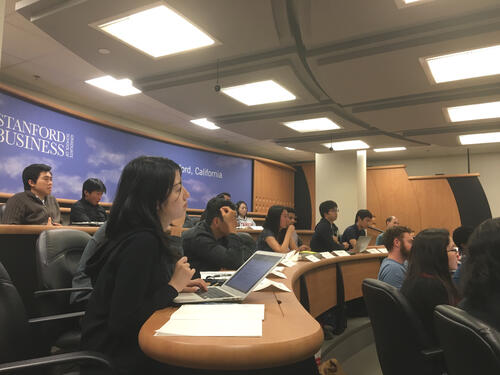
At Stanford's Highly Immersive Classroom in Palo Alto, students look ahead at their counterparts in Beijing.


One course session in particular resonated with students. The session, taught by Zha Daojiong, a professor of political economy at PKU and Herbert Lin, a senior research scholar at Stanford’s Freeman Spogli Institute for International Studies, focused on the changing nature and future of cybersecurity relations between China and the United States.

“I loved the cybersecurity class because there was a lot of candor on both sides,” PKU student Shan Jee Chua recalled.

Kimberly Chang, a second year Stanford graduate student in management science and engineering, noted that it was beneficial to hear the Chinese view on cyber “because most of the talk within the United States has been from an American perspective.”

“Hopefully, I'll be able to meet some of these people in real life who I've met on the 'wall.'”

-Sam Ide, Stanford graduate student

The course revealed a broader range of perspectives and provided a chance to interact first-hand with international colleagues while remaining at their home campus. Discussion amongst peers uncovered the “behind the scenes stories” and added context to media reports found online or in print, said Seung Kim, a student in Stanford’s East Asian studies program.

Besides the technology, a unique aspect of the course was its diversity. More than half of the course participants were international, representing 15 countries beyond China and the United States. That setting encouraged debate and reinforced the notion that “neither the United States nor China is the center of the universe,” said Zhu Jun Zhao, a PKU international relations student.

When students were asked what could bring about better understanding between China and the United States, continued dialogue was a common answer. The future of U.S.-China relations rests in the hands of people talking to one another: “I think we need more honest conversations,” Chang said.

And for some students, an opportunity to hold those conversations in-person may be close. Ide said he anticipates traveling to Beijing over the summer and plans to try and meet with a few of his counterparts whom he met through the course.

“Hopefully, I’ll be able to meet some of these people in real life who I’ve met on the ‘wall.’”

Related Links:

Video showcases SCPKU's Highly Immersive Classroom enabling co-teaching across the Pacific

Hero Image
course 2
At the Stanford Center at Peking University in Beijing, Peking University professor Fan Shiming presents his remarks during a session of "The United States, China, & Global Security," a joint course taught by Stanford and Peking University via videoconference; Palo Alto, May 2016.
All News button
1
Authors
News Type
News
Date
Paragraphs

On the heels of the IISS Shangri-La Dialogue, scholars, members of think tanks and former U.S. and Chinese government officials came to Beijing to discuss what many participants considered “the most important bilateral relationship” in the world: the relationship between the United States and China. As former U.S. Ambassador John Negroponte described during his opening remarks, the relationship, “if properly managed,” can result in an enormous boon for the world; but if mismanaged, can bring great harm to global stability and prosperity.

Stanford and Peking University jointly hosted a forum titled “A Changing Global and Political Order: Perspectives from China-United States Cooperation” on June 6-7 in Beijing. All attendees, who participated in their capacity as private individuals, acknowledged that a level of uncertainty and tension clouds the bilateral relationship, exemplified most clearly in the territorial disputes in the South China Sea. Having participated in the restoration of Sino-U.S. relations in 1972, Negroponte and former Chinese Ambassador Wu Jianmin remarked upon the geopolitical rationale that first motivated this rapprochement: to counter the Soviet Union. They noted that the bilateral relationship has grown increasingly robust and multi-dimensional over time. For example, Wu cited that trade between the United States and China has increased exponentially, from a mere US$1 billion in 1978 to $550 billion in 2015. Investment, economic cooperation and competition have also grown. Despite disagreements on regional security matters, both countries have worked together on global challenges such as climate change, North Korean and Iranian nuclear issues, anti-piracy efforts and the Ebola outbreak.

However, with China’s rapid rise, both militarily and economically, and as the developing world has gained increasing clout on the world’s stage, many participants suggested that the current global order, originally envisaged in 1944 with the Bretton-Woods Agreement, needed an update. Many participants, especially on the Chinese side, stated that the “balance of power was shifting” with the G7/G8 yielding economic momentum to the G20. The American participants generally did not share Chinese views of a power transition, but conceded that reforms were necessary to the global order to take into account China’s meteoric rise.  Participants did not dispute the benefits that China has derived from the current international order and most agreed that some type of evolutionary change is needed to increase inclusivity. As one participant asked regarding China’s perception of the United States (and vice versa), “Are we foes, enemies or friends?” Despite such ambiguity, U.S.-China cooperation is essential to effecting any type of change.

Questions were rife and specificity was scant with respect to what the key changes were or the mechanisms by which those reforms should be effected, however. Which countries should partake in this decision-making body? Should other entities and institutions other than nation-states be included? What are the rules of participation and criteria for membership? How large should the governing body be? What key reforms need to be undertaken?

Both Negroponte and Wu disavowed the zero-sum mentality of the Cold War, which, Wu stated, continues to impact perceptions on both sides. They both highlighted the critical importance of frequent dialogue by the Chinese and American heads of state and by their militaries. Calling summit-level meetings between the two presidents “indispensable,” Negroponte emphasized that “[both] leaders have to understand [the] viewpoints and attitudes of each country” in order to formulate the right policies. Negroponte added, “[d]iplomacy at that level is probably more important than it has ever been.”

As this summary of the forum is posted, we note with sadness the untimely death of Ambassador Wu Jianmin on June 18, 2016, in a tragic car accident in Wuhan, China.

Related Links:

Photo gallery from the conference

Hero Image
 i5a7017 23
A panel of experts gathered at Stanford Center at Peking University to give closing remarks at a forum titled “A Changing Global and Political Order: Perspectives from China-United States Cooperation” on June 7.
Courtesy of Peking University
All News button
1
Subscribe to Diplomacy