Health and Medicine

FSI’s researchers assess health and medicine through the lenses of economics, nutrition and politics. They’re studying and influencing public health policies of local and national governments and the roles that corporations and nongovernmental organizations play in providing health care around the world. Scholars look at how governance affects citizens’ health, how children’s health care access affects the aging process and how to improve children’s health in Guatemala and rural China. They want to know what it will take for people to cook more safely and breathe more easily in developing countries.

FSI professors investigate how lifestyles affect health. What good does gardening do for older Americans? What are the benefits of eating organic food or growing genetically modified rice in China? They study cost-effectiveness by examining programs like those aimed at preventing the spread of tuberculosis in Russian prisons. Policies that impact obesity and undernutrition are examined; as are the public health implications of limiting salt in processed foods and the role of smoking among men who work in Chinese factories. FSI health research looks at sweeping domestic policies like the Affordable Care Act and the role of foreign aid in affecting the price of HIV drugs in Africa.

News Type
News
Date
Paragraphs

The Walter H. Shorenstein Asia-Pacific Research Center (APARC), in pursuit of training the next generation of scholars on contemporary Asia, has selected three postdoctoral fellows for the 2016-17 academic year. The cohort includes two Shorenstein Postdoctoral Fellows and one Developing Asia Health Policy Fellow; they carry a broad range of interests from hospital reform to the economic consequences of elite politics in Asia.

The fellows will begin their year of academic study and research at Stanford this fall.

Shorenstein APARC has for more than a decade sponsored numerous junior scholars who come to the university to work closely with Stanford faculty, develop their dissertations for publication, participate in workshops and seminars, and present their research to the broader community. In 2007, the Asia Health Policy Program began its fellowship program to specifically support scholars undertaking comparative research on Asia health and healthcare policy.

The 2016-17 fellows’ bios and their research plans are listed below:


Shorenstein Postdoctoral Fellows


Image
aditya dasgupta   photo
Aditya "Adi" Dasgupta is completing his doctorate in the Department of Government at Harvard University. At Stanford, he will work on converting his dissertation on the historical decline of single-party dominance and transformation of distributive politics in India into a book manuscript. More broadly, his research interests include the comparative economic history of democratization and distributive politics in emerging welfare states, which he studies utilizing formal models and natural experiments. He received a Bachelor of Arts from Cambridge University and a Master of Science from Oxford University and has worked at the Public Defender Service in Washington D.C., his hometown.


Image
dong zhang photo2
Dong Zhang is a political scientist whose research interests include political economy of development, with focus on the economic consequences of elite politics, and on the historical origins of long-run economic development. His dissertation examines the political logic of sustaining state capitalism model in weakly institutionalized countries with a primary focus on China. At Stanford, Zhang will develop his dissertation into a book manuscript and pursue other research projects on comparative political economy and authoritarian politics. He will receive his doctorate in political science from Northwestern University in 2016. Zhang holds bachelor’s degrees in public policy and economics, and a master’s degree in public policy from Peking University, Beijing.


Developing Asia Health Policy Postdoctoral Fellow


Image
ngando pic
Ngan Do is strongly interested in health system related issues, especially health financing, human resources for health, and health care service delivery. Do implemented comparison studies at regional level as well as participated in fieldwork in Cambodia, Lao, the Philippines, Korea and Vietnam. At Stanford, she will work on the public hospital reforms in Asia, focusing on dual practice of public hospital physicians and provider payment reforms. Do achieved her doctorate in health policy and management at the College of Medicine, Seoul National University. She earned her master’s degree in public policy at the KDI School of Public Policy and Management in Seoul, and her bachelor’s degree in international relations at the Diplomacy Academy of Vietnam (previously the Institute for International Relations).


Hero Image
160105 3244
All News button
1
-

Universal Health Coverage (UHC) is a well-embraced policy goal in the 21th century, which aims to ensure financial risk protection while assuring access to quality care.  However, up to this date, out-of-pocket (OOP) payment remains the principal means of financing health care throughout much of Asia, which leaves people financially unprotected in the face of illness.  High OOP payment at point of service is likely to either make people become medically impoverished after paying for health care, or force people to forgo treatment needed, which is detrimental to one’s health.   This presentation is based on empirical results derived from EQUITAP  (Equity in Asia-Pacific Health Systems) Project II on catastrophic payment that aims to estimate the magnitude and distribution of OOP payments for health care in 23 countries and territories in the Asia-Pacific Region in 2007.  We also draw comparisons to the results in 2000 as changes arise due to various reforms implemented since 2000.

Image
rachel lu
Jui-fen Rachel Lu, is the Fulbright Visiting Scholar at the Center for East Asian Studies, Stanford University, and Professor in the Graduate Institute of Business and Management and Department of Health Care Management, College of Management, at Chang Gung University in Taiwan, where she teaches comparative health systems, health economics, and health care financing and has served as department chair (2000-2004), Associate Dean (2009-2010) and Dean of the College of Management (2010-2013).  She earned her B.S. from National Taiwan University, and her M.S. and Sc.D. from Harvard University, and she was also a Takemi Fellow at Harvard (2004-2005) and is an Honorary Professor at Hong Kong University (2007-2017). She cofounded the Taiwan Society of Health Economics (TaiSHE) in 2008 and is currently the President of TaiSHE (2014-2017).  Professor Lu also serves as a board director for the International Health Economics Association (iHEA) (2016) and a member of the Arrow Award Committee for iHEA (2014-2016).

Her research interests are in assessing the impact of the NHI program on health care markets and household consumption patterns, and comparative health systems in the Asia-Pacific region with a focus on equity performance.  She is a long-time and active member of the Equitap (Equity in Asia-Pacific Health Systems) research network.  Professor Lu has also been appointed to serve on several advisory boards to the Taiwan Ministry of Health and Welfare and National Health Insurance Administration, Ministry of Science and Technology.

She received the Minister Wang Jin Naw Memorial Award for Best Paper in Health Care Management in 2002 and was the recipient of the IBM Faculty Award in 2009.

Jui-fen Rachel Lu, Sc.D. Fulbright Visiting Scholar, Center for East Asian Studies, Stanford University
Seminars
News Type
News
Date
Paragraphs

Seventeen faculty members and researchers from Stanford’s Freeman Spogli Institute for International Studies were hosted at U.S. Pacific Command (USPACOM) Headquarters in Hawaii for an intensive orientation on Feb. 4-5. The visit aimed to advance collaboration and to offer a deeper understanding of USPACOM’s operations to Stanford scholars who study international security and Asia.

Admiral Harry B. Harris, Jr., Commander of USPACOM, together with his commanders and staff, welcomed the delegation. Harris’s meeting with Stanford faculty is the second in recent months. The USPACOM visit and earlier speech at Stanford Center at Peking University are part of a series of activities driven by the U.S.-Asia Security Initiative. Led by Ambassador Karl Eikenberry, the Initiative seeks to provide constructive interaction between academic and governmental experts on the many and diverse security challenges facing the Asia-Pacific region.

“Engaging deeply in conversations with those who are on the frontlines is incredibly valuable,” said trip participant Coit Blacker, FSI senior fellow and professor of international studies. “This is especially true for academics who focus much of their attention thinking about the prospects for international peace and security but not necessarily considering their direct application on a military-level.”


[[{"fid":"222122","view_mode":"crop_870xauto","fields":{"format":"crop_870xauto","field_file_image_description[und][0][value]":"","field_file_image_alt_text[und][0][value]":"","field_file_image_title_text[und][0][value]":"","field_credit[und][0][value]":"","field_caption[und][0][value]":"","field_related_image_aspect[und][0][value]":"","thumbnails":"crop_870xauto"},"type":"media","attributes":{"width":"870","style":"line-height: 1.538em;","class":"media-element file-crop-870xauto"}}]]

Image
pacom 3

Top: (Left) The Stanford delegation watches a demonstration of a 2-minute drill. / (Right) Karen Eggleston boards a UH-60 Blackhawk helpcopter enroute to the Lightning Academy with her colleagues. Bottom: The delegation takes a group photo on-site.


On the first day, FSI scholars spoke with military officers about the command’s strategies and challenges it faces, such as population aging and sovereignty disputes over the South China Sea. Discussions were followed with a tour of USS Michael Murphy, a guided missile destroyer which routinely conducts operations in the Western Pacific including the South China Sea.

Karen Eggleston, FSI senior fellow and director of the Asia Health Policy Program, was one of the discussants on the USPACOM trip. Her research focuses on health policy in Asia, specifically the effects of demographic change and urbanization.

“As a health economist, the visit yielded for me a behind-the-scenes sense of how members of the military respond to pandemics and humanitarian situations, and of the ongoing dialogue with their counterparts in Asian nations,” Eggleston said. “I think that kind of military-to-military engagement provides an area rich with questions and best practices that could in some ways be shared as a model among other nations.”

Other activities on the first day included a briefing by the U.S. Pacific Fleet command, informal presentations and dialogue between the Stanford participants and the USPACOM staff, and working with senior leaders of the U.S. Pacific Air Forces command.

On the second day, the group visited the U.S. Army’s installation at Schofield Barracks. There, they observed a command post simulation and field exercise including units of the 25th Infantry Division. Graduates from the U.S. Army’s jungle survival training school also shared their impressions of applying lessons in the field. Researchers from the Asia-Pacific Center for Strategic Studies (APCSS) joined the Stanford delegation later in the day. Both sides discussed research outcomes and avenues for future exchanges. The day concluded with an extensive tour of USS Mississippi, a Virginia-class attack submarine. FSI has long engaged military officers through a senior military fellows program. Started in 2009 by the Center for International Security and Cooperation, the program remains active today with five fellows conducting research at Stanford.

Lt. Col. Jose Sumangil, a 2015-16 U.S. Air Force Senior Military Fellow, participated in the Stanford delegation at USPACOM.

“The trip was an excellent opportunity to showcase how the U.S. ‘rebalance to Asia’ strategy is implemented on a day-to-day basis – for example, providing a look into the decision-making process that could occur should a situation arise in the South China Sea,” Sumangil said. “It’s incredibly important to build this kind of understanding among experts studying Asia, and I think we helped do that here.”

USPACOM is one of the largest U.S. military commands with four major service components (U.S. Pacific Fleet, U.S. Pacific Air Forces, U.S. Army Pacific, U.S. Marine Forces); it is tasked with protecting U.S. people and interests, and enhancing stability in the Asia-Pacific Region.

Hero Image
pacom headline
A Stanford delegation of 17 faculty members and researchers visited U.S. Pacific Command (USPACOM) Headquarters in Hawaii, Feb. 4-5, 2016.
All News button
1
-

China implemented a Zero-markup Policy for Essential Drugs (ZPED) since 2009 and this study evaluated the impact of ZPED on patients, county hospital revenue, and government subsidy levels. Data from Ningshan and Zhenping county hospitals were collected. The primary method of analysis was difference-in-differences. The results showed that ZPED had significant effects on patients and county hospital revenue but limited impact on government subsidy levels.  With regard to patients, for outpatient services, the total expense per visit and the drug expense per visit reduced by 19.02 CNY (3.12 USD) and by 27.20 CNY (4.47 USD), respectively. Importantly, this implies that the non-drug expense increased by 8.18 CNY (1.34 USD) for outpatient services. For inpatient services, the total expense per admission reduced by 399.6 CNY (65.60 USD), with reduction in both drug and non-drug expenses. With regard to the impact on county hospital revenue, ZPED led to an increase in health care provision and a sustained total hospital income despite a decrease in drug revenue. Lastly, the research demonstrates that with minimal or no subsidy, the government can catalyze the zero-markup policy and generate positive outcomes for patients and county hospitals.

Image
yanfang su4x6
Yanfang’s research focuses primarily on health systems from a political economy perspective. She holds a BA in Economics from Dongbei University of Finance and Economics, China, a Master’s in Management from Tsinghua University, China, and a ScD in Global Health and Population from Harvard University, USA. As the first author or the corresponding author, Yanfang has published on evaluation of health policy, equity of healthcare utilization, and estimates of elasticity of demand for healthcare in Health Policy, International Journal for Equity in Health, PLOS ONE, Chinese Health Economics, Chinese Journal of Health Policy, and other academic journals. She has also published news articles in Harvard College Global Health Review, HSPH International Student Newsletter, Hong Kong Economic Journal and People's Daily Overseas Edition. Yanfang's other research interests include survey methodology and field experiments, with a particular interest in cognitive interviewing, list experiments and anchoring vignette methods. Besides research, Yanfang is committed to community service. She is the initiator and currently the project director of the pilot, “Free Prenatal Text Messages to Improve Newborn Health”. Her team has been supported by the UBS Optimus Foundation (with 160,000 USD) to serve 6,000 pregnant women in rural Shaanxi, China, from 2013 to 2016. Prior to Harvard, Yanfang was a Visiting Researcher with the Hong Kong Policy and Research Institute in 2005 and a Research Fellow at Tsinghua University in 2007. In 2009, she entered a training program on qualitative program evaluation at the Center for Disease Control (CDC) in Atlanta, Georgia. Following this, in 2010, she became a Desmond and Whitney Shum Fellow at Harvard's Fairbank Center for Chinese Studies. Currently, she is a Policy Consultant to Bill & Melinda Gates Foundation.

Yanfang Su, Sc.D Policy Consultant, Bill & Melinda Gates Foundation
Seminars
-

Background: Substance abuse has been an important social and public health problem in Thailand for decades. The National Household Survey on Substance and Alcohol Use in Thailand, which has been conducted 5 times, shows that substance abuse has steadily increased. Extrapolated country-wide in recent data, the estimated number of people who had ever used at least one addictive substance at some time in their life was 3,531,436 or 7.30% of the total population aged 12-65 years. Krathom, Methamphetamine, Ice, and cannabis were the most prevalent substances of abuse.

Methods: Historical documentation, policy reports, and group discussion with key professionals who work in the substance abuse community were used in this study. The objectives of this study were to complete a document review, determine the effectiveness of previous  Thai illegal substance measures, and consider options for the future.

Findings: Although the Thai government has dedicated human resources and an enormous budget to controlling drug use, substance abuse has become a more severe problem when compared with previous years. There are many organizations trying to create and develop programs, measures, and policies for dealing with substance abuse. These policies usually have had loopholes which resulted in corruption of officers, undercutting the public health value, creating dilemmas for impoverished families experiencing drug abuse, ignoring human rights, and creating a negative attitude among society toward drug users. Barriers to establishing successful drug abuse policies in Thailand include limited access to data and data management, a lack of efficiency and cost-benefit measures and policies, and limited use of evidence-based research.

Conclusion: To address illegal substance abuse in the future, the stakeholders should work to reduce the incidence of new sellers and the prevalence of new users. This would result in diminishing the health impact and criminal aspect of illegal substance use, increase social awareness, and motivate communities to participate in managing this issue. To reach these goals, the policy should concurrently aim at curtailing the supply of illicit drugs and reducing their demand. The strategies relevant to drug policy consist of primary prevention, services for chronic drug users, supply control and regulations, prescription regimes, and the use of criminal sanctions, especially consideration of decriminalization of krathom use.

Image
darika 4x6
Darika Saingam is a researcher from Thailand. Her research works have focused on patterns and consequences of alcohol, tobacco, and illegal substance use. Currently she joins the Walter H. Shorenstein Asia-Pacific Research Center as the Developing Asia Health Policy Postdoctoral Fellow for the 2015-16 year. She completed her doctorate in epidemiology at the Prince of Songkla University in 2012, and has worked as a researcher at the University’s epidemiology unit since, as well as a researcher at the Thailand Substance Abuse Academic Network since 2014.

Darika Saingam 2015-16 Developing Asia Health Policy Postdoctoral Fellow
Seminars
-

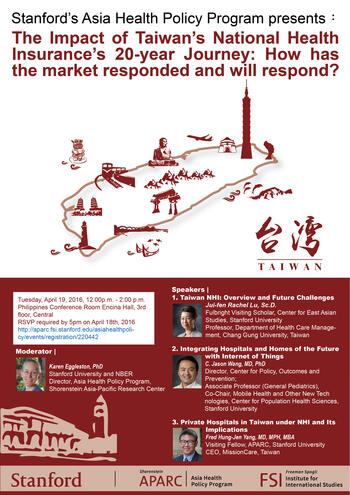
Image
april 19 flyer
In 2015, Taiwan National Health Insurance (NHI) is celebrating its 20th anniversary since its historical inauguration in 1995. The NHI program, which provides universal health coverage (UHC) to Taiwan’s population of 23 million, has had a profound impact on Taiwan's health care market.   This seminar will showcase Taiwan's NHI scheme, the challenges encountered, and the market responses.

The single-payer NHI program, operated by National Health Insurance Administration (NHIA), was established through integrating three existing social insurance schemes and extended the coverage to the then uninsured 43% of the population. Taiwan NHI offers comprehensive benefit coverage that includes ambulatory care as well as inpatient services. On the service side, Taiwan has a market-oriented health care delivery system, reflecting its free-enterprise economy, as evidenced by the pluralistic organization of health services. Hospital ownership is mixed where public hospitals only account for 35% of all beds. Sixty-three percent of allopathic physicians are salaried employees of hospitals; the remainder, fee-for-service private practitioners. Over the years, hospitals have developed large outpatient departments and affiliated clinics for primary care in order to maintain inpatient volume and compete with private practitioners who operate free-standing clinics with beds. There is no gate keeping mechanism and the insured essentially enjoy complete freedom of choice which is likely a source of overuse.

NHI revenue mainly relies on payroll-based premiums, supplemented by a levy on non-payroll income and government subsidies. In 2013, NHI spent roughly NTD 492 (USD 16.4) billion on medical claims, accounting for approximately 52% of national health expenditures, and in total, Taiwan devoted 6.6% of GDP to health.  As a single payer, NHIA has effectively exploited its market power to experiment with various payment reforms in its 20-year history.  NHIA gradually set up separate global budgets for dental services, Chinese medicines, primary care services, and hospital services since 1998.  The annual growth rate of the total NHI budget is negotiated among stakeholders. 

Our seminar will look to the future with presentations on innovative healthcare delivery models and coping strategies by private hospitals.

Shorenstein APARC
Stanford University
Encina Hall E301
Stanford, CA 94305-6055

(650) 723-9072 (650) 723-6530
0
Senior Fellow at the Freeman Spogli Institute for International Studies
Professor, by courtesy, Health Policy
Faculty Research Fellow of the National Bureau of Economic Research
Faculty Affiliate at the Stanford Center on China's Economy and Institutions
karen-0320_cropprd.jpg PhD

Karen Eggleston is a Senior Fellow at the Freeman Spogli Institute for International Studies (FSI) at Stanford University and Director of the Stanford Asia Health Policy Program at the Shorenstein Asia-Pacific Research Center at FSI. She is also a Fellow with the Center for Innovation in Global Health at Stanford University School of Medicine, and a Faculty Research Fellow of the National Bureau of Economic Research (NBER). Her research focuses on government and market roles in the health sector and Asia health policy, especially in China, India, Japan, and Korea; healthcare productivity; and the economics of the demographic transition.

Eggleston earned her PhD in public policy from Harvard University and has MA degrees in economics and Asian studies from the University of Hawaii and a BA in Asian studies summa cum laude (valedictorian) from Dartmouth College. Eggleston studied in China for two years and was a Fulbright scholar in Korea. She served on the Strategic Technical Advisory Committee for the Asia Pacific Observatory on Health Systems and Policies and has been a consultant to the World Bank, the Asian Development Bank, and the WHO regarding health system reforms in the PRC.

Director, Asia Health Policy Program at the Walter H. Shorenstein Asia-Pacific Research Center
Stanford Health Policy Associate
CV
Date Label
Moderator Director, Asia Health Policy Program, Shorenstein Asia Pacific Research Center, Stanford University
Jui-fen Rachel Lu Professor, Department of Health Care Management Speaker Chang Gung University, Taiwan
C. Jason Wang Associate Professor (General Pediatric), Co-Chair, Mobile Health and Other New Technologies, Center for Population Health Sciences Speaker Stanford University
Fred Hung-Jen Yang Visiting Fellow, APARC, Stanford University Speaker CEO, MissionCare, Taiwan
Seminars
News Type
News
Date
Paragraphs

The Japan Program held the third annual Stanford Summer Juku on Japanese Political Economy from August 10-13. Over 40 scholars from various parts of the US and Japan participated in the conference, which took place at the Bechtel Conference Center at Encina Hall. The first two days focused on political science and the second day on economics. Distinctive features of the Summer Juku are the long times allotted to each paper to allow for two in-depth discussants and discussion among participants, as well as ample time for informal discussions and interactions among participants allowing for collaborations and expansion of the network of researchers on Japan in political science and economics. Particularly notable this year was a large number of cross-disciplinary and cross-national collaborations between scholars ranging from political science, economics, management, infomatics, and medicine.

The first day included four papers in political science. Amy Catalinac from New York University presented her paper, "Positioning Under Alternative Electoral Systems: Evidence from 7,497 Japanese Candidate Election Manifestos", with discussants Gary Cox (Stanford) and Harukata Takenaka (National Graduate Institute for Policy Studies, Japan).

Daniel Smith (Harvard University) presented a paper co-authored by Yusaku Horiuchi (Dartmouth College) and Teppei Yamamoto (MIT) entitled "Identifying Multidimensional Policy Preferences of Voters in Representative Democracies: A Cojoint Field Experiment in Japan". The Discussants for the paper were Kay Shimizu (Columbia University) and Karen Jusko (Stanford).

Harukata Takenaka from the National Graduate Institute for Policy Studies presented his paper on “Changes in Power of Japanese Prime Minister: Still Away from a Westminster Model.” Tsuneo Akaha (Middlebury Institute of International Studies at Monterey) and Kenji Kushida (Stanford University) were the discussants.

The fourth paper was “Territorial Issues and Support for the Prime Minister: A survey Experiment on Rally-‘Round-the Flag Effect in Japan” by Tetsuro Kobayashi (National Institute of Informatics, Japan) and Azusa Katagiri (Stanford), discussed by Tsuneo Akaha (Middlebury Institute of International Studies at Monterey) and Daniel Smith (Harvard).

The second day focused on political economy and international relations. Gene Park (Loyola Marymount University, and former Shorenstein Fellow at APARC) presented his paper co-authored with Saori Katada (University of Southern California) and Giacomo Chiozza (Vanderbilt University) entitled “Policy ideas and monetary policy: The Bank of Japan's delayed break with the monetary orthodoxy". Discussants were Azusa Katagiri (Stanford) and Ayako Saiki (De Netherlandsche Bank).

The second paper of the day was "The Political Economy of the Trans-Pacific Partnership: Implications beyond Economics" by Hiroki Takeuchi (Southern Methodist University), discussed by Kay Shimizu (Columbia University) and Gene Park (Loyola Marymount University). 

After lunch, Llewelyn Hughes (Australian National University) presented "Lead Markets, Vertical Specialization, and Standards Competition in Electric Vehicles" with discussants Kenji Kushida (Stanford University) and Phillip Lipscy (Stanford University). The final session was "Renegotiating the World Order: Institutional Change in International Relations” which were select chapters from a book manuscript by Phillip Lipscy (Stanford University). The discussants were Amy Catalinac (New York University) and Llewelyn Hughes (Australian National University). A group dinner followed the second day.

The third day was the kick-off for economics papers, where we also saw cross-disciplinary collaborations with colleagues from the US and Japan.

Karen Eggleston (Stanford University) presented “Medical spending and health care utilization in Japan, 2010-2014: Projections from Future Elderly Model microsimulation”, which was co-authored by Hawre Jajal (Stanford University), Brian K. Chen (University of Southern California), Hideki Hashimoto (University of Tokyo), Toshiaki Iizuka (University of Tokyo), Lena Shoemaker (Stanford University), and Jay Bhattacharya (Stanford University). Yong Suk Lee (Stanford University) was the discussant.

The second paper, "The adverse effects of value-based purchasing in health care: dynamic quantile regression with endogeneity" by Galina Besstremyannaya (Visiting Scholar, Stanford University), was discussed by Jay Battacharya (Stanford University) and Takeo Hoshi (Stanford University).

The third paper was ""How Do Agricultural Markets Respond to Radiation Risk? Evidence from the 2011 Disaster in Japan" by Kayo Tajima (Rikkyo University), Masashi Yamamoto (University of Toyama), and Daisuke Ichinose (Rikkyo University). Discussants for the paper presented by Tajima were Satoshi Koibuchi (Chuo University and Visiting Scholar, Stanford University) and Yong Suk Lee (Stanford University).

The final paper for the third day was "Shocks and Shock Absorbers in Japanese Bonds and Banks During the Global Financial Crisis" by Hyonok Kim (Tokyo Keizai University), Yukihiro Yasuda (Hitotsubashi University), and James A. Wilcox (University of California, Berkeley). Discussants were Sabrina Howell (New York University) and Suparna Chakraborty (University of San Francisco).

The final day included two papers. The first was "Impact of Financial Intermediary's Information Production on Market Value of Firm: Case Studies on the DBJ's Liquidity Providing During the Financial Crisis and the Environmental Rating of Firm" by Hiroaki Suzuoka (Development Bank of Japan), Atsushi Motohashi (Development Bank of Japan), Shinya Nakamura (Development Bank of Japan), Tomoya Maruoka (Development Bank of Japan), and Takamasa Uesugi (Development Bank of Japan), presented by Takamasa Uesugi. Discussants were Jess Diamond (Hitotsubashi University) and Masami Imai (Wesleyan University). The final paper was "Selective Disclosure: The Case of Nikkei Preview Articles" by William N. Goetzmann (Yale School of Management), Yasushi Hamao (University of Southern California), and Hidenori Takahashi (Kobe University), presented by Yasushi Hamao. Eiichiro Kazumori (University of Buffalo) was the discussant.

After the completion of four days of Summer Juku, participants who had enough time before their flights held an “uchiage” (completion celebration) gathering—a tradition at the conclusion of the Summer Juku—at “The Patio” in downtown Palo Alto for further informal exchange over drinks and appetizers.

Hero Image
img 5138
The participants of the Stanford Summer Juku held in August, 2015
All News button
1
-

Stanford Summer Juku on Japanese Political Economy (SSJ-JPE)

August 10-13, 2015

Oksenberg Conference Room

Stanford Japan Program at Shorenstein Asia-Pacific Research Center

The Japan Program at the Walter H. Shorenstein Asia-Pacific Research Center (S-APARC) at Stanford University started Stanford Summer Juku (SSJ) in 2013.  In SSJ, researchers on Japanese politics and Japanese economy get together and discuss their research in a relaxed setting. The third annual meeting is held at Stanford on August 10-13, 2015.  The first two days again focus on research in political science/political economy and international relations, and the latter two days focus on research in economics and business.

Takeo Hoshi, Kenji E. Kushida, Phillip Lipscy


Report - Stanford Summer Juku 2015


Program

8/10/2015

8:30-9:00    Breakfast

9:00-10:15  Session I:

"Positioning Under Alternative Electoral Systems: Evidence from 7,497 Japanese Candidate Election Manifestos", Amy Catalinac (Harvard University)

Discussants:
Gary Cox (Stanford University)
Harukata Takenaka (National Graduate Institute for Policy Studies)
 

10:15-10:45  Break

10:45-12:00  Session II:

"Identifying Multidimensional Policy Preferences of Voters in Representative Democracies: A Cojoint Field Experiment in Japan", Yusaku Horiuchi (Dartmouth College), Daniel Smith (Harvard University), and Teppei Yamamoto (Massachusetts Institute of Technology)

Discussants:
Kay Shimizu (Columbia University)
Karen Jusko (Stanford University)
 

12:00-1:00  Lunch

1:00-2:15    Session III:

"Changes in Power of Japanese Prime Minister: Still Away from a Westminster Model", Harukata Takenaka (National Graduate Institute for Policy Studies)

Discussants:
Tsuneo Akaha (Middlebury Institute of International Studies at Monterery)
Kenji Kushida (Stanford University)
 

2:15- 3:30   Session IV:

"Territorial Issues and Support for the Prime Minister: A Survey Experiment on Rally-‘Round-the Flag Effect in Japan", Tetsuro Kobayashi (National Institute of Informatics, Japan), Azusa Katagiri (Stanford University)

Discussants:
Tsuneo Akaha (Middlebury Institute of International Studies at Monterery)
Daniel Smith (Harvard University)


8/11/2015

8:30-9:00   Breakfast

9:00-10:15 Session I:

"Institutions and central bank norm diffusion: The Bank of Japan's delayed break with the monetary orthodoxy", Gene Park (Loyola Marymount University), Saori Katada (University of Southern California), Giacomo Chiozza (Vanderbilt University)

Discussants:
Azusa Katagiri (Stanford University)
Ayako Saiki (De Netherlandsche Bank)
 

10:15-10:45  Break

10:45-12:00  Session II:

"The Political Economy of the Trans-Pacific Parternship: Implications beyond Economics", Hiroki Takeuchi (Southern Methodist University)

Discussants:
Kay Shimizu (Columbia University)
Gene Park (Loyola Marymount University)
 

12:00-1:00  Lunch

1:00-2:15    Session III:

"Lead Markets, Vertical Specialization, and Standards Competition in Electric Vehicles", Llewelyn Hughes (George Washington University)

Discussants:
Kenji Kushida (Stanford University)
Phillip Lipscy (Stanford University)
 

2:15-3:30    Session IV:

"Renegotiating the World Order: Institutional Change in International Relations (select chapters from book manuscript)", Phillip Lipscy (Stanford University)

Discussants:
Amy Catalinac (Harvard University)
Llewelyn Hughes (George Washington University)
 

6:30        Group Dinner at Gravity Bistro and Wine Bar (544 Emerson St, Palo Alto, CA 94301)


8/12/2015

8:30-9:00    Breakfast

9:00-10:15  Session I:

"Medical spending and health care utilization in Japan, 2010-2040: Projections from a Future Elderly microsimulation", Hawre Jajal (Stanford University), Brian K. Chen (University of Southern California), Karen Eggleston (Stanford University), Hideki Hashimoto (University of Tokyo), Toshiaki Iizuka (University of Tokyo), Lena Shoemaker (Stanford University), and Jay Bhattacharya (Stanford University)

Discussants:
Yong Suk Lee (Stanford University)
TBD

10:15-10:45  Break

10:45-12:00  Session II:

"The adverse effects of value-based purchasing in health care: dynamics quantile regression with endogeneity", Galina Besstremyannaya (Visiting Scholar, Stanford University)

Discussants:
Jay Battacharya (Stanford University)
Takeo Hoshi (Stanford University)

12:00-1:00  Lunch

1:00-2:15    Session III:

How Do Agricultural Markets Respond to Radiation Risk? Evidence from the 2011 Disaster in Japan", Kayo Tajima (Rikkyo University), Masashi Yamamoto (University of Toyama), and Daisuke Ichinose (Rikkyo University)

Discussants:
Satoshi Koibuchi (Chuo University and Visiting Scholar, Stanford University)
Yong Suk Lee (Stanford University)

2:15-3:30    Session IV:

"Shocks and Shock Absorbers in Japanese Bonds and Banks During the Global Financial Crisis", Hyonok Kim (Tokyo Keizai University), Yukihiro Yasuda (Hitotsubashi University), and James A. Wilcox (University of California, Berkeley)

Discussants:
Sabrina Howell (New York University)
Suparna Chakraborty (University of San Francisco)


8/13/2015

8:30-9:00    Breakfast

9:00-10:15  Session I:

"Impact of Financial Intermediary's Information Production on Market Value of Firm: Case Studies on the DBJ's Liquidity Providing During the Financial Crisis and the Environmental Rating of Firm", Hiroaki Suzuoka (Development Bank of Japan), Atsushi Motohashi (Development Bank of Japan), Shinya Nakamura (Development Bank of Japan), Tomoya Maruoka (Development Bank of Japan), and Takamasa Uesugi (Development Bank of Japan)

Discussants:
Jess Diamond (Hitotsubashi University)
Masami Imai (Wesleyan University)

10:15-10:45  Break

10:45-12:00  Session II:

"Selective Disclosure: The Case of Nikkei Preview Articles", William N. Goetzmann (Yale School of Management), Yasushi Hamao (University of Southern California), and Hidenori Takahashi (Kobe University)

Discussants:
Eiichiro Kazumori (University of Buffalo)
TBD

12:00-1:00  Lunch


Authors
Lisa Griswold
News Type
News
Date
Paragraphs
Myanmar’s historic election last year brought an end to more than 50 years of military rule, ushering in the National League for Democracy party led by Aung San Suu Kyi. A new administration brings with it an opportunity to rehabilitate the country’s fragile health system, experts wrote in the Lancet.
 
In the editorial, Stanford health economist Karen Eggleston and co-authors Thant Sun Htoo, Ngoc Minh Pham and Phyu Phyu Thin Zaw call for innovative leadership in Myanmar’s public healthcare system, which is currently facing substantial challenges and inequalities. Creating policies that equitably allocate health resources should be a key goal of the administration that has set out to achieve universal health coverage by 2030. This would not only work to raise public health but also build much-needed trust between the population and government, they said.
 
Pham and Zaw are both former visiting fellows of the Asia Health Policy Program, who spent the 2014-15 academic year working on research activities at the Walter H. Shorenstein Asia-Pacific Research Center. Last July, Zaw wrote an op-ed in The Diplomat highlighting a doctor-led campaign against the “militarization” of the Ministry of Health called the “Black Ribbon Movement.” The movement is comprised of doctors and healthcare staff who are protesting the appointment of military staff to top health administration positions.
 
The Lancet's focus on healthcare in Myanmar coincided with the global commemoration of Universal Health Coverage Day, an annual day that urges greater action toward ensuring equal access to essential health services worldwide: http://universalhealthcoverageday.org/.

The Stanford Program on International and Cross-Cultural Education also interviewed Zaw while at Stanford. In this video released on March 10, Zaw highlights the changes Myanmar has already undertaken to reform its healthcare sytem and the challenges the country still faces.


Hero Image
rtr34r42
Myanmar pro-democracy leader Aung San Suu Kyi attends a parliamentary meeting at the Lower House of Parliament in Naypyitaw, July 9, 2012. | Reuters/Soe Zeya Tun
All News button
1
Subscribe to Health and Medicine