Business
-

We have reached venue capacity.  RSVPs are no longer being accepted.

In China, Japan, and Korea, large companies have historically played predominant roles in their economies. However, with startups often driving disruptive innovation in the current digital global era, the question is how incumbent large firms can adapt, adjust, and harness the power of small firms while making use of their existing resources. This panel brings together perspectives from China, Japan and Korea. 

In China, we have seen the explosive growth of information technology firms such as Alibaba and Tencent, who are now at the technological forefront of several areas such as using data and artificial intelligence for financial tech (Fintech) offerings. What are the key features of China's entrepreneurship ecosystem and how do large firms work with new firms?

In Japan, a major challenge is how to unleash potential innovations currently held by large companies who are unable to capitalize on them. World Innovation Lab (WiL) is a Palo Alto and Tokyo based company structured as an investment fund, designed to assist large Japanese companies carve out potential intellectual property into startups, and to harness Silicon Valley startups through investments and partnerships. ANA is a large Japanese airline company that has partnered with WiL to find new strategies for driving its next wave of innovations.

South Korea is home to some of the most competitive firms in the high tech areas, and the question is to how to remain at the forefront of high value added activities in rapidly commoditizing offerings. Samsung Research America is focused on harnessing Silicon Valley through development of software, user experience, and services for the next generation of products. 

Panelists:

Image
Tao Li  Founder and Executive Director, APUS Group

Li is widely believed as an innovative visionary and highly strategic entrepreneur. Before founding APUS Group, Li served as senior Vice President of Qihoo 360 (QIHU NYSE), a major internet company player known for its antivirus software. Prior to that, Li has involved with several well-known companies like Datang Telcom, 3721. He is an internet expert with expert internet knowledge, distribution channels and marketing experience. Mr. Li is an active venture capitalist that has invested in dynamic startup companies from media and VR technology to video advertising companies, both domestically and abroad. Li received a Bachelor of Engineering degree from Zhengzhou University in 1998. Currently Li is a Finance EMBA student in Tsinghua University.


Image
Aki Koto, Partner,  World Innovation Lab (WiL)

Mr. Koto enjoys working with visionary entrepreneurs in frontier tech such as VR/AR, Bitcoin, IoT, and Autonomous Driving as the investment partner. He is also passionate about WiL’s corporate innovation efforts to bring WiL’s corporate partners’ organizational and corporate cultures more in line with Silicon Valley’s ethos. Through his facilitation of the Design Thinking Workshops and mentorship of the workshop facilitators, he has deepened his relationships with corporate executives which are influential in opening up business development opportunities between corporations and startup companies.


Image
Hideaki Matsumoto, Manager, Digital Design Lab, All Nippon Airways (ANA)

Mr. Matsumoto is in charge of researching and creating new business, service, and process innovation models. Currently, he is investigating new business paradigms in the areas of education and sports that fully leverage ANA's brand, assets, and strengths. He is actively researching startups and cutting-edge technology related to these two fields both in Japan and around the world. Prior to ANA, he worked in the R&D Center at Canon and was responsible for developing new recognition technologies like OCR, form recognition and face recognition. He holds both a BS and MS from Kyushu University.


Image
Pranav Mistry, Head of Think Tank Team and Senior Vice President, Samsung Research America

Pranav Mistry is a computer scientist and inventor. He is currently Head of Think Tank Team at Samsung Research America and is best known for his work on SixthSense, Samsung Galaxy Gear and Project Beyond. His research interests include Wearable Computing, Augmented reality, Ubiquitous computing, Gestural interaction, AI, Machine vision, Collective intelligence and Robotics. The World Economic Forum honored Mistry as one of the Young Global Leader in 2013. Prior to his current position, he has worked with Microsoft, Google, CMU, NASA, UNESCO and Japan Science & Technology, to name a few. Pranav was a PhD candidate at the MIT Media Lab and earned his MA in Media Arts and Sciences from MIT, MDES from IIT, Bombay and a BS in Computer Science and Engineering.


Image
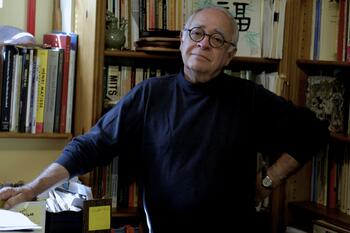
Portrait of Kenji Kushida
Kenji Kushida, Research Scholar, Japan Program, Shorenstein APARC, Stanford University (Moderator)

Kushida’s research interests are in the fields of comparative politics, political economy, and information technology. He has four streams of academic research and publication: political economy issues surrounding information technology such as Cloud Computing; institutional and governance structures of Japan’s Fukushima nuclear disaster; political strategies of foreign multinational corporations in Japan; and Japan’s political economic transformation since the 1990s.

Oksenberg Conference Room

Encina Hall, 3rd Floor

Panel Discussions
News Type
News
Date
Paragraphs

William F. Miller, a former provost at Stanford University, a founding member of the university's Computer Science Department, and former CEO of SRI, died at the age of 91 on Wednesday, September 27.

Miller held an array of other leadership, industry, and academic roles, but at Shorenstein Asia-Pacific Research Center (APARC), Bill was better known as one of the leaders of the Stanford Program on Regions of Innovation and Entrepreneurship (SPRIE), along with Henry S. Rowen and Marguerite Gong Hancock. SPRIE was established at Shorenstein APARC in 2001 after the publication of The Silicon Valley Edge by Stanford University Press, co-edited by Miller, Rowen, Hancock, and Chong-Moon Lee; the book, the program's research, and Miller and Rowen's vast experience were responsible for a steady stream of visitors to Encina Hall, all looking to understand the Valley's success and replicate it abroad.

Two more books were published by SPRIE, focusing on the rise of innovation in Asia: Making IT: The Rise of Asia in High Tech (2006), and Greater China's Quest for Innovation (2008). In 2011, the program moved to the Graduate School of Business.

Full details on Bill Miller's life, as a leader, an entrepreneur, a tireless advisor and advocate, and as a generous human being, can be found here.

Hero Image
svm 43
William F. Miller speaks in Madrid in 2007.
Courtesy Stanford Program on Regions of Innovation and Entrepreneurship
All News button
1
-

GROW is an automated solution to evaluate job candidates, developed by Tokyo-based people analytics startup, Institution for a Global Society (IGS). GROW was developed with the idea that the hiring process is often a missed opportunity to collect, utilize and exchange feedback that could change people’s behaviors for the better. The solution has developed into a tool that both helps students to understand their strengths and weaknesses, while at the same time assists HR in hiring based on competencies and personality traits. GROW uses artificial intelligence learning algorithms to analyze assessment data from both candidates and evaluators, looking for patterns to improve its ability to accurately screen candidates over time. In place of human intuition, GROW uses big data to develop a scientific, objective, and constantly-improving engine to recruit, screen, and develop human capital. In his presentation, Founder and CEO of IGS, Masahiro Fukuhara will speak about founding IGS, developing GROW, and the opportunities and challenges that its widespread interest has presented. 

Bio

Image

Masahiro Fukuhara is founder and CEO of Tokyo-based people analytics startup Institution for a Global Society (IGS), which he started in 2010. Prior to founding IGS, Fukuhara was managing director at asset management firm Barclays Global Investors (BGI) where he made investment decisions based on computer-driven models. Fukuhara earned his Bachelor’s degree in Economics from Keio University and MBA from INSEAD. He holds Master’s degree (with Honors) in International Finance from Grandes Ecoles HEC and Ph.D. from Tsukuba University Graduate School of Business Sciences (Ph.D. in Business Administration). He is currently a Visiting Professor at the center for FinTEK (Finance, Technology, and Economy) at Keio University as well as adjunct professor at Hitotsubashi University’s Graduate School of International Corporate Strategy.

Agenda

4:15pm: Doors open 
4:30pm-5:30pm: Talk and Discussion 
5:30pm-6:00pm: Networking

RSVP Required

 
For more information about the Silicon Valley-New Japan Project please visit: http://www.stanford-svnj.org/
 

NOTE: This event takes place during Stanford’s Homecoming Weekend. The parking slots in front of Encina Hall will not be available that day, and there may be higher demand than usual for parking on campus. Please take that into consideration when planning your travel.

Masahiro Fukuhara, Founder and CEO, Institution for a Global Society
Seminars
-

The conference is brought to you by the Shorenstein Asia-Pacific Research Center Japan Program's Stanford Silicon Valley-New Japan Project and Mistletoe, Inc.

This event is at full capacity. Please contact Amanda Stoeckicht at amst@stanford.edu if you have any questions.

As we enter the coming age of universal automation, this conference seeks to spark a discussion among thought leaders, technologists, and social entrepreneurs about the replacement of human labor by artificial intelligence and robotics and what that might mean for the future of human welfare and labor opportunities. There is increasing debate regarding the possibility of a new underclass of 'zero economic citizens.' How shall we address these challenges? Does the answer lie in lowering the cost of living? Is it the Universal Basic Income? Or something else? What might be the role of technologies for geographic mobility, sustainability, and community platforms.

Along with keynote presentations and panel discussions, the conference will also feature a startup showcase and participatory world-building exercise.

*The below program is subject to change.

Conference Program

8:30-9:00                  Registration and Breakfast

9:00-9:05                  Welcome

9:05-10:45                Keynote Presentations

Taizo Son (Mistletoe)

Marina Gorbis (Institute for the future)

Sam Altman (Y Combinator)

10:45-11:00              Coffee Break

11:00-12:15                Startup Showcase

Afero

Alesca Life

AstroScale

Binded

Cocoa Motors

Homma

Leomo

ModuleQ

Vivita

Wota

12:15-12:30              Break

12:30-13:00              Mistletoe Fellows Program Announcement

13:00-14:00              Lunch

14:00-15:15              Panel & Debate Sessions: Technology and Social Change in 2045                          

Panel 1: 

Cities of the Future: Removing Barriers to New Ideas with Innovation Districts and Regulatory Sandboxes

Moderator: Ashkan Soltani

Panelists:   Neal Gorenflo (Sheareable)

Taizo Son (Mistletoe)

           Joe Quirk (Seasteading Institute)

           Kaidi Ruusalepp (Funderbeam)           

Panel 2:

The Autonomous Lifestyle: Can Tech-Enabled Mobility Improve Welfare and Opportunity?

Moderator: Kenji Kushida (Stanford University)

Panelists:   Frances Colon (Cenadores Puerto Rico)

Steve Cousins (Savioke)

            Toshi Hoo (IFTF)        


Panel 3:

Reimagining Social Entrepreneurship: Designing Collaboration and Community

                                       Moderator:     Ernestine Fu (Alsop Louie Partners)

Panelists:    Anh Bui (Benetech)

  Chuck Eesley (Stanford University)   

  Daniel Goldman (Ignition Angels)

             Luan Niu (Enviu)


15:15-15:30             Break

15:30-17:30             Zero Economic Citizen in 2045: A World Building Exercise                  

Joshua McVeigh-Schultz (University of Southern California)

Karl Baumann (Univeristy of Southern California)

Elena Marquez Segura (UC Santa Cruz)                         

17:30-17:35             Closing Remarks

17:35-18:35             Cocktail Reception


Conferences
616 Serra StreetEncina Hall E301Stanford, CA94305-6055
0
hongwei_yu Ph.D.

Hongwei Yu joins the Walter H. Shorenstein Asia-Pacific Research Center as a visiting scholar for the fall of 2017.  He is an assistant professor in Institute of Quality Development Strategy of Wuhan University. His research interests focus on economic growth quality and quality competition. From 2008 to 2015, he was the research assistant of two professors and an associated professor in related fields. He has worked on four different research projects and is now presiding over two projects on regional industry quality competitiveness.  He has so far had 13 papers published or forthcoming on journals and academic conference proceedings.

He is currently working on the issues of zombie firms and corporate restructuring in China.  He has joined the Employer-Employee Survey (CEES) of Chinese manufacturing in 2015, and gained plenty of research data on this topic. Based on this data, he is putting his effort into two working papers: the statistical analysis on zombie firms in China and the study on the relationships between political connection, entrepreneurship and zombies firms.

Visiting Scholar
616 Serra StreetEncina Hall E301Stanford, CA94305-6055
0
dongmin_yao.jpg Ph.D.

Dongmin Yao joins the Walter H. Shorenstein Asia-Pacific Research Center (Shorenstein APARC) during the 2017-2018 academic year from Central University of Finance and Economics (Beijing, China) where he serves as an associate professor.

His research interests encompass Basic theories of public finance; State governance and government behavior; Game theory; Micro Econometrics and organizational economics. During his time at Shorenstein APARC, Yao will participate in a study of modes of governance in Chinese bureaucracy.

Yao has led several national research projects including Projects of the National Social Science Foundation of China and the Nation Science Foundation Project. Besides, Yao serves as an editor of many top academic journals in China and contributed articles regularly to these publications. Yao has also won a lot of significant awards, like Wu yuzhang Humanities Social Science Award (one of the highest awards in the field of humanism social science in China and Yao is the youngest recipient of it), The Second Prize of the 6th National Excellent Public Finance Research Achievement (by Chinese Public Finance Society) and The Third Prize of the 7th Excellent Achievement in Scientific Research (Social Science) of College (by China’s Ministry of Education).  

Yao holds a PhD in game theory from Renmin University of China. He received his MA in mathematical finance and BA in international economics and trade, both from Central University of Finance and Economics, Beijing, China.

Visiting Scholar
616 Serra StreetEncina Hall E301Stanford, CA94305-6055
0
rui_wu Ph.D.

Dr. Rui Wu currently serves as an assistant professor in Department of Innovation, Entrepreneurship, and Strategy in School of Economics and Management at Tsinghua University (Tsinghua SEM). She accomplished her PhD in business administration from University of Southern California, Marshall School of Business, MA in economics from University of California, Los Angeles (UCLA), and BA in economics and international finance from Peking University, School of Economics. She teaches graduate level courses in strategic management, including strategic alliances, cooperative strategies, and research seminars. Prior to her doctoral training, she worked as a research analyst on Rwandan Projects in the Africa Division of World Bank in Washington, D.C..

Dr. Rui Wu’s research covers a broad range of firm-level strategic decisions, with a focus on Chinese firms and their inter-firm relationships. Her primary research areas include collaborative innovation, top-management teams, and political influences, all in the context of Chinese manufacturing firms. She has been a member and reviewer for annual conferences of Academy of Management (AOM), Strategic Management Society (SMS), and International Association for Chinese Management Research (IACMR). She also serves as an ad hoc reviewer for multiple top-tier journals.

Visiting Scholar
616 Serra StreetEncina Hall E301Stanford, CA94305-6055
0
hak_kyu_sohn Ph.D.

Hak-kyu Sohn joins the Shorenstein Asia-Pacific Research Center as a Visiting Scholar during the 2017-18 academic year.

Sohn is founder and chairman of East Asia Future Foundation; former chairman of the Democratic Party; and former governor of Gyeonggi Province, in South Korea. His research interest is in how South Korea can be prepared for changes in international relations as well as for the fourth industrial revolution.

Sohn received a DPhil in Politics from University of Oxford, UK, and a BA in Political Science from Seoul National University.

Visiting Scholar
616 Serra StreetEncina Hall E301Stanford, CA94305-6055
0
hirofumi_uchida Ph.D.

Hirofumi Uchida joins the Walter H. Shorenstein Asia-Pacific Research Center (Shorenstein APARC) during the 2017-2018 academic year from the Kobe University’s Graduate School of Business Administration where he serves as a professor of Banking and Finance.

Uchida’s research interests focus on banking, financial institutions, and financial system architecture. During his stay at Shorenstein APARC, Uchida will conduct research on startup finance in the U.S. from the perspective of an international comparison with Japan. For this research, he receives Abe Fellowship (Social Science Research Council).

Uchida's research has been published in International Economic Review, Journal of Money, Credit and Banking, Journal of Financial Intermediation, Economica, and Journal of Banking and Finance, among others. He is also an associate editor of Journal of Money, Credit, and Banking, and a member of the Study Group for Earthquake and Enterprise Dynamics (SEEDs) and the Money & Finance Research Group (MoFiR). 

Uchida received his M.A. in Economics in 1995 and his Ph.D. in Economics in 1999, both from Osaka University. Prior to joining Kobe University in 2009, Uchida was with the Kyoto Institute for Economic Research at Kyoto University, and the Faculty of Economics at Wakayama University. He was also a visiting scholar at the Kelley School of Business, Indiana University as a 2003 Fulbright Scholar.

Visiting Scholar
Subscribe to Business