FSI researchers consider international development from a variety of angles. They analyze ideas such as how public action and good governance are cornerstones of economic prosperity in Mexico and how investments in high school education will improve China’s economy.
They are looking at novel technological interventions to improve rural livelihoods, like the development implications of solar power-generated crop growing in Northern Benin.
FSI academics also assess which political processes yield better access to public services, particularly in developing countries. With a focus on health care, researchers have studied the political incentives to embrace UNICEF’s child survival efforts and how a well-run anti-alcohol policy in Russia affected mortality rates.
FSI’s work on international development also includes training the next generation of leaders through pre- and post-doctoral fellowships as well as the Draper Hills Summer Fellows Program.
Shorenstein APARC's center overviews provide detailed information about Shorenstein APARC's mission, history, faculty, financial support, organizational structure, projects, and programs.
Mathias Hoffmann is Professor of Economics at the University of Zurich. His research focuses on the macroeconomic aspects of international financial integration and on the link between financial markets and the macro-economy more generally. His recent published articles include papers on the determinants of international capital flows and imbalances, the international transmission of business cycles, on international risk sharing and banking regulation. Prior to arriving in Zurich, he was Professor at the University of Dortmund in Germany and a Lecturer at Southampton University (UK). He holds a PhD in Economics from the European University Institute in Florence and obtained his undergraduate education in economics and mathematics at WHU School of Management, Brandeis University and the University of Bonn.
Mathias Hoffmann is a fellow of CESifo Munich and has held visiting positions, at the University of California at Berkeley, the Deutsche Bundesbank, the Hong Kong Monetary Authority and Keio University.
Prof. Booth will assess the socioeconomic consequences of Japanese colonialism in Taiwan, Korea, and Manchuria from 1910 to 1945. She will compare Japan’s policies with those implemented by other colonial powers in South and Southeast Asia. In particular she will address the writings of what has been termed the “Stanford School”—an influential group of scholars who published widely on Japanese colonial policies over the last fifty years. Their work has been used to support the argument that Japanese rule was more developmental than that of other colonial powers, and that it laid the foundations for the stellar economic performance of Taiwan and the Republic of Korea in the decades after 1950. She will challenge these conclusions by comparing economic and social indicators for Korea, Taiwan, and Manchuria with those from other Asian colonies and also from Thailand. While Japan’s colonies, especially Taiwan, do score well on some indicators, they do less well on others. The notion that Japanese rule was exceptionally “developmental” does not merit support.
Image
Anne Booth has been an Asia-focused professor of economics in the School of Oriental and African Studies, University of London, since 1991. She studies the modern economic history of Southeast Asia with emphasis on the 20th century. Her many writings in this field include Colonial Legacies: Economic and Social Development in East and Southeast Asia. Her latest book, Economic Change in Modern Indonesia, is due from Cambridge University Press in April. Before coming to SOAS, she held research and teaching positions in Singapore and Australia. Her degrees are from Victoria University of Wellington (BA) and the Australian National University (PhD). Before 1991 she held research and teaching positions in Singapore and Australia. She grew up in New Zealand.
Anne Booth
2015-16 NUS-Stanford Lee Kong Chian Distinguished Fellow on Southeast Asia, Stanford University
2015-16 NUS-Stanford Lee Kong Chian Distinguished Fellow on Southeast Asia, Stanford University
South Korea and the United States are “completely aligned” on North Korea strategy, the chief American diplomat in South Korea said to a Stanford audience on Monday.
Mark Lippert, who assumed the role of U.S. ambassador to the Republic of Korea in 2014, delivered remarks at a public seminar, “Perspectives on the U.S.-Korea Alliance,” organized by the Korea Program at the Walter H. Shorenstein Asia-Pacific Research Center.
Arriving from the Washington summit of President Obama and Korean President Park Geun-hye, Lippert spoke of the success of the state visit. The U.S.-Korea relationship is in “as good a shape as it’s ever been,” and that secure foundation is allowing the two countries to forge ahead on shared challenges, including North Korea, trade and global health.
Mark Lippert expressed optimism about the U.S.-ROK alliance at a Stanford talk on Oct. 19, 2015.
“We want to get back to credible and authentic negotiations towards a denuclearized Korea,” Lippert said, explaining that U.S.-Korea strategy toward North Korea aligns in three main areas: diplomacy, economics and deterrence.
He said the United States and South Korea are invested in getting to a place where the North Koreans will “come back to the table” for discussions on ending their nuclear program, noting the continuing viability of the Six Party Talks mechanism which has been stalled for more than five years.
Lippert also cited U.S.-Korea strategic cooperation on sanctions against North Korea, and defense capabilities aimed to deter the threat of a North Korea with nuclear and long-range missile capacity.
Looking ahead, “The United States strongly supports calls for reunification of the Korean Peninsula,” he said. Human rights, a free economy and a democratically elected government in the North would be a priority in that pursuit.
Lippert said the United States is supportive of inter-Korean talks and reunions for families separated by the Korean War, both announced earlier this year. On Tuesday, hundreds of South Koreans crossed the border to meet with North Korean relatives, who have been separated for more than six decades.
Partnering on the economic level was another key aspect of the summit, Lippert said, and the Trans-Pacific Partnership (TPP) was among items discussed. The United States, as one of 12 TPP member nations, would welcome an application from South Korea should they choose to pursue it, he said.
Lippert acknowledged that South Korea already has bilateral trade agreements with 10 out of the 12 TPP member nations, including one with the United States. The U.S.-Korea Free Trade Agreement (KORUS) came into force in 2012 and is moving toward full implementation, he said. The United States’ sixth largest trading partner is South Korea.
Following his formal remarks, Lippert took questions from the audience.
Michael Armacost, a Shorenstein Distinguished Fellow, asked Lippert how Japan and China figured into the summit discussions following recent developments. In September, President Park attended a military parade in Beijing that marked the 70th anniversary of the end of World War II. She was the only leader from a democratic country at the event.
Responding on China, Lippert said the United States is supportive of South Korea engaging with China. “We don’t view this as a zero-sum game,” he said, likening South Korea’s regional relationships to a situation where “all boats rise” together.
Dafna Zur, a professor of Korean culture and literature, asked Lippert to talk about how his education informed his career in public service.
Lippert attended Stanford and studied political science and international policy studies.
His education, he said, was invaluable in preparing him for the diverse situations and people that a diplomatic career brings.
Lippert encouraged students to savor conversation and debate in the classroom. Participating in that kind of forum not only “makes you a more informed person” but also “sharpens your analytic skills,” he said.
Prior to becoming ambassador, Lippert held senior positions in the Department of Defense and the White House and served in the U.S. Navy.
Following the event, Lippert met with faculty members of Shorenstein APARC and the Freeman Spogli Institute for International Studies for a roundtable discussion, chaired by Kathleen Stephens, a distinguished fellow at Shorenstein APARC and former U.S. ambassador to the Republic of Korea (2008-11).
Embedded photo: Mark Lippert speaks at Stanford on Oct. 19, 2015. Photo credit: Heather Ahn.
Hero Image
Korean President Park Geun-hye (left) and U.S. President Barack Obama have an in-depth discussion at a White House summit. This picture is from their first summit in Washington in May 2013. Their second summit took place in October 2015. | Flickr/Korea.net - Cheong Wa Dae (crop applied)
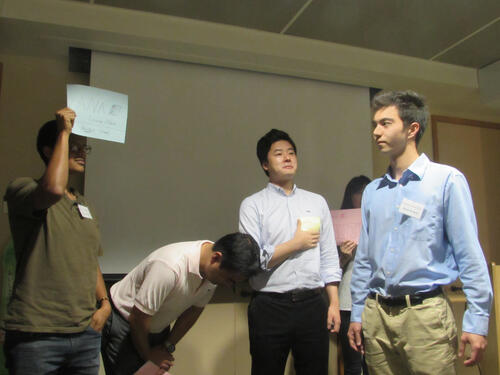
Stanford students worked together to pitch marketing ideas to a major Japanese airline at an event last Tuesday. The event, called an “ideathon,” is part of a series of events seeking to strengthen the U.S.-Japan relationship through exchange of ideas.
The ideathon was the first of its kind at the Shorenstein Asia-Pacific Research Center, led by the Japan Program under the rubric of the Stanford Silicon Valley-New Japan Project (SV-NJ). The project is supported in part by All Nippon Airways (ANA), the Japanese airline featured at the event.
Nineteen students participated, from both undergraduate and graduate levels and across disciplines – including students from the Graduate School of Business, and other majors including economics, mathematics, computer science, philosophy and East Asian studies.
Placed on a team with others they had just met, students were encouraged to assemble quickly and generate solutions to the challenge: how can ANA strengthen its brand awareness in the United States?
ANA is seeking to double in size in the next three years, yet it faces a few obstacles in this endeavor, including a customer base that is mostly in Japan and low brand visibility internationally, according to a senior employee that presented at the event.
“Who had heard of ANA before this event?” asked Hiroyuki Miyagawa, a marketing executive at ANA. Few hands raised in the audience.
Organized into four teams, each student team was joined by an ANA employee who listened in and offered guidance and a chance to learn from a longtime practitioner.
One and a half hours later, with Post-it notes and scribbled diagrams sprinkled across tables, each team emerged ready to present their 3-minute pitch to a panel of judges. The panel included executives from ANA, the World Innovation Lab (WiL), a venture capital firm in Palo Alto, and bTrax, a San Francisco based design firm.
Below are a few pictures from the event.
Image
Team Three acts out a skit. | They proposed that ANA establish lounges for the general public to gather in and purchase goods from Uniqlo and Muji, two Japanese lifestyle retailers. The lounges would offer a place to reinforce ANA's brand outside of the airport, they said.
Image
Team Four puts their heads together to generate ideas. | In their pitch, the team noted that baseball is a popular sport among Americans and Japanese. They recommended baseball be a focus of the marketing campaign, and said television and social media would best reach the target audience.
Image
Team Five explains their marketing approach. | Flying can lead to some unpleasant experiences, and a way ANA can set itself apart is to make those experiences manageable, and even enjoyable, they said. Their proposal was to bring new amenities to the in-flight experience such as a care package for people who sit in the middle seat.
Image
Team One poses for a picture after their presentation. | In their pitch, they recommended using ANA’s association with Japan to differentiate from other global airlines. Their approach included creating a film that features an American celebrity traveling on ANA.
The winning team was Team One whose concept was to use a celebrity figure – Ellen DeGeneres – in their advertising. They said that the target audience could relate to DeGeneres, and her already-established following would be an advantage.
The judges commended Team One for the creativity of their idea and its level of feasibility. Team One consisted of students Yaqian Fan, Michael Hong, Sam Ide, Lu Li and Adelbert Tan.
Kenji Kushida, a Stanford alumnus and project leader of SV-NJ, said:
“When I was a student, I craved for an opportunity to brainstorm solutions to real-world challenges and to do it in an environment that provided instant feedback,” he said, “We were able to make that happen here with the support of ANA and WiL, and are thrilled with the outcome."
Co-sponsored by the Stanford Center for International Development
In 1986 then-Stanford professor Moses Abramovitz argued in a seminal article that all countries that are relatively backward in their levels of productivity had the potential for rapid advance, and indeed could quickly catch up with the leading economies if they could realize that potential. Their ability to catch up was to a large extent determined by their “social capability.” Although a number of European economies and Japan had narrowed the productivity gap with the USA in the post-1950 era, few low or middle income economies had managed to do this. Prof. Booth will examine the record inside Southeast Asia, where the gap in per capita GDP between Singapore and Malaysia compared with the region’s other economies has not narrowed much since 1960, and compared with some of them has actually widened. A particular puzzle concerns the Philippines, which was well ahead on most economic and social indicators in 1960 compared with Thailand and Indonesia, but fell behind over the ensuing 50+ years. Prof. Booth will explore the reasons for this.
Image
Anne Booth has been an Asia-focused professor of economics in the School of Oriental and African Studies, University of London, since 1991. She studies the modern economic history of Southeast Asia with emphasis on the 20th century. Her many writings in this field include Colonial Legacies: Economic and Social Development in East and Southeast Asia. Her latest book, Economic Change in Modern Indonesia, is due from Cambridge University Press in April. Before coming to SOAS, she held research and teaching positions in Singapore and Australia. Her degrees are from Victoria University of Wellington (BA) and the Australian National University (PhD). Before 1991 she held research and teaching positions in Singapore and Australia. She grew up in New Zealand.
After several years of tough negotiations, agreement was reached this month among 12 nations, led by the United States and Japan, to form the Trans-Pacific Partnership, a multilateral trade and investment pact that promises to transform economic relations in the Asia-Pacific region and beyond. South Korea and China, the two largest economies in the region not involved in the TPP talks, now face the choice of opting to join the new pact, or remain outside. And approval of the pact also faces tough sledding in the U.S. Congress and elsewhere. A panel of experts from Shorenstein APARC will discuss these questions, and the strategic implications of the TPP for the region.
Freeman Spogli Institute for International Studies
Stanford University
Encina Hall, C-327
Stanford, CA 94305-6055
(650) 723-9149
(650) 723-6530
0
tfingar@stanford.edu
Affiliated Scholar at The Center for International Security and Cooperation (CISAC)
tom_fingar_vert.jpg
PhD
Thomas Fingar is an affiliate at the The Center for International Security and Cooperation (CISAC) in the Freeman Spogli Institute for International Studies at Stanford University. He was the inaugural Oksenberg-Rohlen Distinguished Fellow from 2010 through 2015 and the Payne Distinguished Lecturer at Stanford in 2009.
From 2005 through 2008, he served as the first deputy director of national intelligence for analysis and, concurrently, as chairman of the National Intelligence Council. Fingar served previously as assistant secretary of the State Department’s Bureau of Intelligence and Research (2000-01 and 2004-05), principal deputy assistant secretary (2001-03), deputy assistant secretary for analysis (1994-2000), director of the Office of Analysis for East Asia and the Pacific (1989-94), and chief of the China Division (1986-89). Between 1975 and 1986 he held a number of positions at Stanford University, including senior research associate in the Center for International Security and Arms Control.
Fingar is a graduate of Cornell University (A.B. in Government and History, 1968), and Stanford University (M.A., 1969 and Ph.D., 1977 both in political science). His most recent books are From Mandate to Blueprint: Lessons from Intelligence Reform (Stanford University Press, 2021), Reducing Uncertainty: Intelligence Analysis and National Security (Stanford University Press, 2011), The New Great Game: China and South and Central Asia in the Era of Reform, editor (Stanford University Press, 2016), Uneasy Partnerships: China and Japan, the Koreas, and Russia in the Era of Reform (Stanford, 2017), and Fateful Decisions: Choices that will Shape China’s Future, co-edited with Jean Oi (Stanford, 2020). His most recent article is, "The Role of Intelligence in Countering Illicit Nuclear-Related Procurement,” in Matthew Bunn, Martin B. Malin, William C. Potter, and Leonard S Spector, eds., Preventing Black Market Trade in Nuclear Technology (Cambridge, 2018)."
Senior Fellow Emeritus at the Freeman Spogli Institute for International Studies
Affiliated Faculty, CDDRL
Affiliated Scholar, Abbasi Program in Islamic Studies
aparc_dke.jpg
PhD
At Stanford, in addition to his work for the Southeast Asia Program and his affiliations with CDDRL and the Abbasi Program in Islamic Studies, Donald Emmerson has taught courses on Southeast Asia in East Asian Studies, International Policy Studies, and Political Science. He is active as an analyst of current policy issues involving Asia. In 2010 the National Bureau of Asian Research and the Woodrow Wilson International Center for Scholars awarded him a two-year Research Associateship given to “top scholars from across the United States” who “have successfully bridged the gap between the academy and policy.”
Emmerson’s research interests include Southeast Asia-China-US relations, the South China Sea, and the future of ASEAN. His publications, authored or edited, span more than a dozen books and monographs and some 200 articles, chapters, and shorter pieces. Recent writings include The Deer and the Dragon: Southeast Asia and China in the 21st Century (ed., 2020); “‘No Sole Control’ in the South China Sea,” in Asia Policy (2019); ASEAN @ 50, Southeast Asia @ Risk: What Should Be Done? (ed., 2018); “Singapore and Goliath?,” in Journal of Democracy (2018); “Mapping ASEAN’s Futures,” in Contemporary Southeast Asia (2017); and “ASEAN Between China and America: Is It Time to Try Horsing the Cow?,” in Trans-Regional and –National Studies of Southeast Asia (2017).
Earlier work includes “Sunnylands or Rancho Mirage? ASEAN and the South China Sea,” in YaleGlobal (2016); “The Spectrum of Comparisons: A Discussion,” in Pacific Affairs (2014); “Facts, Minds, and Formats: Scholarship and Political Change in Indonesia” in Indonesian Studies: The State of the Field (2013); “Is Indonesia Rising? It Depends” in Indonesia Rising (2012); “Southeast Asia: Minding the Gap between Democracy and Governance,” in Journal of Democracy (April 2012); “The Problem and Promise of Focality in World Affairs,” in Strategic Review (August 2011); An American Place at an Asian Table? Regionalism and Its Reasons (2011); Asian Regionalism and US Policy: The Case for Creative Adaptation (2010); “The Useful Diversity of ‘Islamism’” and “Islamism: Pros, Cons, and Contexts” in Islamism: Conflicting Perspectives on Political Islam (2009); “Crisis and Consensus: America and ASEAN in a New Global Context” in Refreshing U.S.-Thai Relations (2009); and Hard Choices: Security, Democracy, and Regionalism in Southeast Asia (edited, 2008).
Prior to moving to Stanford in 1999, Emmerson was a professor of political science at the University of Wisconsin-Madison, where he won a campus-wide teaching award. That same year he helped monitor voting in Indonesia and East Timor for the National Democratic Institute and the Carter Center. In the course of his career, he has taken part in numerous policy-related working groups focused on topics related to Southeast Asia; has testified before House and Senate committees on Asian affairs; and been a regular at gatherings such as the Asia Pacific Roundtable (Kuala Lumpur), the Bali Democracy Forum (Nusa Dua), and the Shangri-La Dialogue (Singapore). Places where he has held various visiting fellowships, including the Institute for Advanced Study and the Woodrow Wilson International Center for Scholars.
Emmerson has a Ph.D. in political science from Yale and a BA in international affairs from Princeton. He is fluent in Indonesian, was fluent in French, and has lectured and written in both languages. He has lesser competence in Dutch, Javanese, and Russian. A former slam poet in English, he enjoys the spoken word and reads occasionally under a nom de plume with the Not Yet Dead Poets Society in Redwood City, CA. He and his wife Carolyn met in high school in Lebanon. They have two children. He was born in Tokyo, the son of U.S. Foreign Service Officer John K. Emmerson, who wrote the Japanese Thread among other books.
Kathleen Stephens was the William J. Perry Distinguished Fellow at Stanford University's Shorenstein Asia-Pacific Research Center from 2015 to 2017
Kathleen Stephens, a former U.S. ambassador to the Republic of Korea, is the William J. Perry Fellow in the Korea Program at the Walter H. Shorenstein Asia-Pacific Research Center (APARC). She has four decades of experience in Korean affairs, first as a Peace Corps volunteer in rural Korea in the 1970s, and in ensuing decades as a diplomat and as U.S. ambassador in Seoul.
Stephens came to Stanford previously as the 2013-14 Koret Fellow after 35 years as a U.S. Foreign Service officer. Her time at Stanford, though, was cut short when she was recalled to the diplomatic service to lead the U.S. mission in India as charge d'affaires during the first seven months of the new Indian administration led by Narendra Modi.
Stephens' diplomatic career included serving as acting under secretary of state for public diplomacy and public affairs in 2012; U.S. ambassador to the Republic of Korea from 2008 to 2011; principal deputy assistant secretary of state for East Asian and Pacific affairs from 2005 to 2007; and deputy assistant secretary of state for European and Eurasian affairs from 2003 to 2005, responsible for post-conflict issues in the Balkans, including Kosovo's future status and the transition from NATO to EU-led forces in Bosnia-Herzegovina.
She also served in numerous positions in Asia, Europe and Washington, D.C., including as U.S. consul general in Belfast, Northern Ireland, from 1995 to 1998, during the negotiation of the Good Friday Agreement, and as director for European affairs at the White House during the Clinton administration, and in China, following normalization of U.S.-PRC relations.
Stephens holds a bachelor’s degree in East Asian studies from Prescott College and a Master of Public Administration from Harvard University, in addition to honorary degrees from Chungnam National University and the University of Maryland. She studied at the University of Hong Kong and Oxford University, and was an Outward Bound instructor in Hong Kong. She was previously a senior fellow at Georgetown University's Institute for the Study of Diplomacy.
Stephens' awards include the Presidential Meritorious Service Award (2009), the Sejong Cultural Award, and Korea-America Friendship Association Award (2013). She is a trustee at The Asia Foundation, on the boards of The Korea Society and Pacific Century Institute, and a member of the American Academy of Diplomacy.
In many decades of western news coverage of China, 2012 was a watershed moment. In the space of just a few months, a Bloomberg News team headed by correspondent Michael Forsythe publishing a sweeping expose of how relatives of China’s new leader, Xi Jinping, had earned vast fortunes in a variety of often disguised business deals. Soon after, David Barboza of the New York Times published his own revelations of the wealth accumulated by the relatives of Chinese premier Wen Jiabao. Both exposes followed remarkable reporting by the Beijing press corps about the scandal which led to the fall of one-time Chongqing Communist Party Chief Bo Xilai.
These stories broke new ground, not only in terms of what they revealed about China’s new rich - but also as examples of a new kind of investigative journalism that has become increasingly important for covering a rapidly changing China. The correspondents took advantage of China’s evolution towards a more open, internationally engaged, market-style economy to unravel a series of complex, opaque, often hidden set of business dealings reaching to the highest levels in the People’s Republic.
The behind-the-scenes story of the journalists who conducted the investigations - and faced the dramatic, controversial, and often frightening consequences - is the subject of “Follow the Money.” Based on extensive interviews with most of the leading figures involved, the film chronicles the emergence of a new kind of journalism that will become increasingly crucial as reporters - and the public at large - seek to understand the dynamics of a new, wealthy, and increasingly powerful China.
Mike Chinoy was CNN's Senior Asia Correspondent and served as a foreign correspondent for more than thirty years. After joining CNN at its London bureau in 1983, Chinoy served as Beijing Bureau Chief from 1987 to 1995. During that time he covered the 1989 events at Tiananmen Square, earning the CableACE, duPont and Peabody awards. He was also Hong Kong Bureau Chief for five years. His other awards include the Silver Medal from the New York Film Festival and Asian Television Awards for his reporting in Indonesia and Taiwan. Chinoy's published two books, China Live: People Power and the Television Revolution (1999) and Meltdown: The Inside Story of the North Korean Nuclear Crisis (2008). He taught at the USC Annenberg School of Communication and ran the School's Hong Kong summer program 2007-2009. From 2006-2009 he was Edgerton Senior Fellow at the Pacific Council for International Policy.
Mike Chinoy
<i>Senior Fellow, U.S.-China Institute, University of Southern California</i>

 FSI researchers consider international development from a variety of angles. They analyze ideas such as how public action and good governance are cornerstones of economic prosperity in Mexico and how investments in high school education will improve China’s economy.



 Mark Lippert expressed optimism about the U.S.-ROK alliance at a Stanford talk on Oct. 19, 2015.