Foreign Policy
-

Image
sagan 3x2 copy
The volatile relationship between the United States and North Korea has left the American public questioning whether North Korea is a threat or not. Existing polls suffer from poor design and, thus, provide a confusing and often contradictory narrative of U.S. public opinion on North Korea. As a result, a number of critical questions remain unanswered: Are Americans willing to live with the North Korean nuclear threat? Under what conditions would the public support using military force to accomplish what sanctions and diplomacy have not? What are the characteristics of the individuals willing to risk war against North Korea today? Professor Scott D. Sagan will discuss the findings of a recent survey experiment and offer a unique perspective to the ongoing public debate.

Scott D. Sagan is the Caroline S.G. Munro Professor of Political Science, the Mimi and Peter Haas University Fellow in Undergraduate Education, and Senior Fellow at the Center for International Security and Cooperation and the Freeman Spogli Institute at Stanford University. Before joining the Stanford faculty, Sagan was a lecturer in the Department of Government at Harvard University. From 1984 to 1985, he served as special assistant to the director of the Organization of the Joint Chiefs of Staff in the Pentagon. Sagan has also served as a consultant to the office of the Secretary of Defense and at the Sandia National Laboratory and the Los Alamos National Laboratory. In 2017, he received the International Studies Association’s Susan Strange Award which recognizes the scholar whose “singular intellect, assertiveness, and insight most challenge conventional wisdom and intellectual and organizational complacency" in the international studies community. Sagan was also the recipient of the National Academy of Sciences William and Katherine Estes Award in 2015, for his pioneering work addressing the risks of nuclear weapons accidents and the causes of nuclear proliferation.     


Okimoto Conference Room
Encina Hall, 3rd Floor
616 Serra Street, Stanford

Scott D. Sagan <i>Caroline S.G. Munro Professor of Political Science, Stanford University</i>
Seminars
-

North Korea is the land of punditry, controversy and bad intelligence.  Policy debates swirl in Washington over how U.S. policy should address this foreign policy challenge.  Much of these debates is informed by a mix of opinion, ideology and politics.   How do we make sense of it all? Victor Cha and his Beyond Parallel microsite at CSIS try to cut through the noise to bring data to the study of North Korea and foreign policy.  He will discuss five data points that are critical to an understanding of the North Korea problem today and its policy challenges.

Image
victor cha small
Victor Cha holds the D.S. Song-KF Professorship in Government and International Affairs at Georgetown University. In 2009, he was also named as Senior Adviser for Asia and Korea Chair at the Center for Strategic and International Studies in Washington, D.C. He left the White House in 2007 after serving since 2004 as Director for Asian Affairs at the National Security Council.  At the White House, he was responsible primarily for Japan, the Korean peninsula, Australia/New Zealand and Pacific Island nation affairs.  Dr. Cha was also the Deputy Head of Delegation for the United States at the Six Party Talks in Beijing, and received two Outstanding Service commendations during his tenure at the NSC.  He is the author of five books, including the award-winning Alignment Despite Antagonism: The United States-Korea-Japan Security Triangle (Stanford University Press) (winner of the 2000 Ohira Book Prize), and The Impossible State: North Korea, Past and Future (Harper Collins Ecco, 2012) which was selected by Foreign Affairs as a “Best Book on the Asia-Pacific for 2012.” His newest book is Powerplay: Origins of the American Alliance System in Asia (Princeton University Press, 2016). He has testified before Congress numerous times on Asian security issues.  In 2018, he joined NBC and MSNBC as a News Contributor.  Prior to joining NBC, he had been a guest analyst for various media including CNN, ABC, NBC, CBS, The Colbert Report, Sports Illustrated, ESPN, Fox News, PBS, Huffington Post, Wall Street Journal, MSNBC, CNBC, BBC, and National Public Radio.  His op-eds have appeared in the Washington Post, New York Times, Los Angeles Times, USA Today, Foreign Policy, Japan Times, and Financial Times. He holds a B.A., an M.I.A., and a Ph.D. from Columbia University, as well as an M.A. from Oxford University.


Philippines Conference Room
Encina Hall, 3rd Floor
616 Serra Mall, Stanford, CA 94305

Victor Cha <i>Professor of Government, Georgetown University</i>
Seminars
-
Image
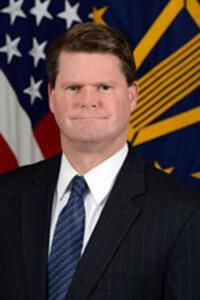
Randy Schriver
Mr. Randall Schriver
is the Assistant Secretary of Defense for Indo-Pacific Security Affairs. Mr. Schriver was appointed as Assistant Secretary of Defense by President Donald Trump on 8 January 2018. Prior to his confirmation, Mr. Schriver was one of five founding partners of Armitage International LLC, a consulting firm that specializes in international business development and strategies. He was also CEO and President of the Project 2049 Institute, a non-profit research organization dedicated to the study of security trend lines in Asia.
 
Previously, Mr. Schriver served as Deputy Assistant Secretary of State for East Asian and Pacific Affairs. He was responsible for China, Taiwan, Mongolia, Hong Kong, Australia, New Zealand, and the Pacific Islands. From 2001 to 2003, he served as Chief of Staff and Senior Policy Advisor to the Deputy Secretary of State. From 1994 to 1998, he worked in the Office of the Secretary of Defense, including as the senior official responsible for the day-to-day management of U.S. bilateral relations with the People's Liberation Army and the bilateral security and military relationships with Taiwan.
 
Prior to his civilian service, he served as an active duty Navy Intelligence Officer from 1989 to 1991, including a deployment in support of Operation Desert Shield/Desert Storm. After active duty, he served in the Navy Reserves for nine years, including as Special Assistant to the Chairman of the Joint Chiefs of Staff and an attaché at U.S. Embassy Beijing and U.S. Embassy Ulaanbaatar.
 
Mr. Schriver has won numerous military and civilian awards from the U.S. government and was presented while at the State Department with the Order of the Propitious Clouds by the President of Taiwan for service promoting U.S.-Taiwan relations. Mr. Schriver received a Bachelor of Arts degree in history from Williams College and a Master of Arts degree from Harvard University.
 

Oksenberg Conference Room
616 Serra Mall
Encina Hall, 3rd Floor, Central S350
Stanford, CA 94305

Randall Schriver Assistant Secretary of Defense for Indo-Pacific Security Affairs
-

RSVP required

NOTE: THIS EVENT IS CLOSED TO THE MEDIA 

No recording will be allowed during the program. RSVP required for admission. No walk-ins.

Experts talk about a new Cold War between China and the United States. The world’s two largest economies are in open trade conflict, engaged in technological competition and stoking geopolitical uncertainty. The Oksenberg Conference will explore the causes that underlie today’s intensified conflict between the United States and China. We ask: What has precipitated the confrontational approach that currently unites U.S. policy towards China? What is the future of our strategic competition in the technological, economic and security realms? If U.S.-China rivalry is allowed to escalate, what might its implications be for our international liberal order? If a “new” Cold War is forming, how might it follow or diverge from the “old” Soviet-era Cold War?

Image
2019 Oksenberg Conference
The Oksenberg Conference
, held annually honors the legacy of the late Professor Michel Oksenberg (1938–2001) who was a senior fellow at Shorenstein APARC and the Freeman Spogli Institute for International Studies. Professor Oksenberg also served as a key member of the National Security Council when the United States normalized relations with China, and consistently urged that the United States engage with Asia in a more considered manner. In tribute, the Oksenberg Lecture recognizes distinguished individuals who have helped to advance understanding between the United States and the nations of the Asia-Pacific.
 
Agenda
 
2:35-3:05 PM    Conversation with Dr. Condoleezza Rice, former U.S. Secretary of State and National Security Advisor
3:05-3:30 PM    Audience Q & A
3:30-3:45 PM    Break
3:45-4:25 PM    Panel discussion with Prof. David M. Lampton and Amb. Michael A. McFaul
4:25-5:00 PM    Audience Q & A


Speakers

Image
David M. Lampton
David M. Lampton is Oksenberg-Rohlen Fellow and Research Scholar at FSI and affiliated with Walter H. Shorenstein Asia-Pacific Research Center (Shorenstein APARC).  He also is the Hyman Professor of China Studies and Director of the China Studies Program at the Johns Hopkins School of Advanced International Studies (SAIS) Emeritus.  Dr. Lampton's current book project is focused on the development of high-speed railways from southern China to Singapore.  He is the author of a dozen books and monographs, including Following the Leader: Ruling China, from Deng Xiaoping to Xi Jinping (University of California Press, 2014, and second edition 2019) and The Three Faces of Chinese Power: Might, Money, and Minds (University of California Press, 2008).  He has testified at multiple congressional and commission sessions and published numerous articles, essays, book reviews, and opinion pieces in many venues popular and academic in both the western world and in Chinese-speaking societies, including Foreign Affairs, Foreign Policy, The American Political Science Review, The China Quarterly, The New York Times, The Washington Post,and many others.

Formerly President of the National Committee on United States-China Relations, Professor Lampton consults with government, business, and social sector organizations, and has served on the boards of several non-governmental and educational organizations, including the Asia Foundation for which he served as chairman.  The recipient of many academic awards, he is an Honorary Senior Fellow of the American Studies Institute of the Chinese Academy of Social Sciences, former Gilman Scholar at Johns Hopkins, and the inaugural winner of the Scalapino Prize in 2010, awarded by the National Bureau of Asian Research and the Woodrow Wilson International Center for Scholars in recognition of his exceptional contributions to America’s understanding of the vast changes underway in Asia.


Image
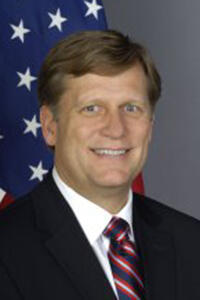
Amb. Michael McFaul
Michael McFaul is the Ken Olivier and Angela Nomellini Professor of International Studies in Political Science; Director and Senior Fellow at the Freeman Spogli Institute for International Studies (FSI); and the Peter and Helen Bing Senior Fellow at the Hoover Institution, all at Stanford University.  He was also the Distinguished Mingde Faculty Fellow at the Stanford Center at Peking University from June to August of 2015.  He joined the Stanford faculty in 1995.  Professor McFaul is also an analyst for NBC News and a contributing columnist to The Washington Post.  

Dr. McFaul served for five years in the Obama administration, first as Special Assistant to the President and Senior Director for Russian and Eurasian Affairs at the National Security Council at the White House (2009-2012), and then as U.S. Ambassador to the Russian Federation (2012-2014).  He has authored several books, most recently TheNew York Timesbestseller, From Cold War to Hot Peace: An American Ambassador in Putin’s Russia.  Earlier books include Advancing Democracy Abroad: Why We Should, How We Can; Transitions to Democracy: A Comparative Perspective(eds. with Kathryn Stoner); Power and Purpose: American Policy toward Russia after the Cold War (with James Goldgeier); and Russia’s Unfinished Revolution: Political Change from Gorbachev to Putin.  


Image
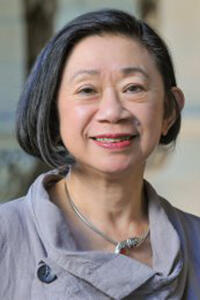
Jean Oi

Jean C. Oi is the William Haas Professor of Chinese Politics in the Department of Political Science and a Senior Fellow of FSI at Stanford University.  She is the founding director of the Stanford China Program at Shorenstein APARC and is the founding Lee Shau Kee Director of the Stanford Center at Peking University.  Professor Oi has published extensively on political economy and the process of reform in China.  Her books include Zouping Revisited:  Adaptive Governance in a Chinese County, co-edited with Steven Goldstein (2018); and Challenges in the Process of China’s Urbanization, co-edited with Karen Eggleston and Wang Yiming (2017); Rural China Takes Off (1999); Property Rights and Economic Reform in China (1999), co-edited with Andrew Walder; and State and Peasant in Contemporary China (1989).  Professor Oi also has an edited volume, China’s Path to the Future: Challenges, Constraints, and Choices, co-edited with Dr. Thomas Fingar (forthcoming, Stanford University Press).  Her recent articles include “Unpacking the Patterns of Corporate Restructuring during China’s SOE Reform,” co-authored with Xiaojun Li in Economic and Political Studies (2018); and “Reflections on 40 Years of Rural Reform,” in Jacques deLisle and Avery Goldstein, eds., Reform and Opening:  40 Years and Counting, forthcoming.  Her current research centers on fiscal reform and local government debt as well as continuing SOE reforms in China.


Image
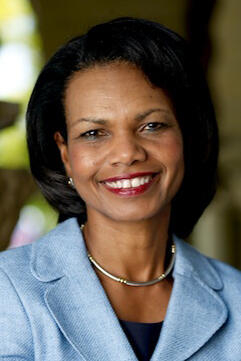
Secretary Condoleezza Rice

Secretary Condoleezza Rice is currently the Denning Professor in Global Business and the Economy at the Stanford Graduate School of Business; the Thomas and Barbara Stephenson Senior Fellow on Public Policy at the Hoover Institution; and a professor of Political Science at Stanford University. She is also a founding partner of RiceHadleyGates, LLC.

From January 2005 to 2009, Rice served as the 66th Secretary of State of the United States, the second woman and first African American woman to hold the post. Rice also served as President George W. Bush’s Assistant to the President for National Security Affairs (National Security Advisor) from January 2001 to 2005, the first woman to hold the position.

Rice served as Stanford University’s Provost from 1993 to 1999, during which she was the institution's chief budget and academic officer. As Provost, she was responsible for a $1.5 billion annual budget and the academic program involving 1,400 faculty members and 14,000 students. In 1997, she also served on the Federal Advisory Committee on Gender -­- Integrated Training in the Military.

From 1989 through March 1991, Rice served on President George H.W. Bush’s National Security Council staff. She served as Director; Senior Director of Soviet and East European Affairs; and, Special Assistant to the President for National Security Affairs. In 1986, while an international affairs fellow of the Council on Foreign Relations, Rice also served as Special Assistant to the Director of the Joint Chiefs of Staff.

As professor of Political Science, Rice has been on the Stanford faculty since 1981 and has won two of the highest teaching honors – the 1984 Walter J. Gores Award for Excellence in Teaching and the 1993 School of Humanities and Sciences Dean's Award for Distinguished Teaching.

She has authored and coauthored numerous books, including three bestsellers, Democracy: Stories from the Long Road to Freedom (2017); No Higher Honor: A Memoir of My Years in Washington (2011); and Extraordinary, Ordinary People: A Memoir of Family (2010). She also wrote Germany Unified and Europe Transformed: A Study in Statecraft (1995) with Philip Zelikow; The Gorbachev Era (1986) with Alexander Dallin; and Uncertain Allegiance: The Soviet Union and the Czechoslovak Army (1984).

In  1991,  Rice  cofounded  the  Center for  a  New  Generation  (CNG),  an  innovative,  after-­school academic enrichment program for students in East Palo Alto and East Menlo Park, California. In 1996, CNG merged with the Boys and Girls Club of the Peninsula (an affiliate club of the Boys and Girls Clubs of America). CNG has since expanded to local BGCA chapters in Birmingham, Atlanta, and Dallas. She remains an active proponent of an extended learning day through after school programs.

Since 2009, Rice has served as a founding partner at Rice Hadley Gates, LLC, an international strategic consulting firm based in Silicon Valley and Washington, D.C. The firm works with senior executives of major companies to implement strategic plans and expand in emerging markets. Other partners include former National Security Advisor Stephen J. Hadley and former Secretary of Defense Robert M. Gates.

Rice currently serves on the boards of Dropbox, an online-­storage technology company; C3, an energy software company; and Makena Capital, a private endowment firm. In addition, she is vice chair of the board of governors of the Boys and Girls Clubs of America; a member of the board of the Foundation for  Excellence in Education; and a trustee of the Aspen Institute. Previously, Rice served on various additional boards, including those of: the George W. Bush Institute; the Commonwealth Club; KiOR, Inc.; the Chevron Corporation; the Charles Schwab Corporation; the Transamerica Corporation; the Hewlett-­Packard Company; the University of Notre Dame; the John F. Kennedy Center for the Performing Arts; and, the San Francisco Symphony Board of Governors.

In 2013, Rice was appointed to the College Football Playoff Committee, formerly the Bowl Championship Series.

Born in Birmingham, Alabama, Rice earned her bachelor's degree in political science, cum laude and Phi Beta Kappa, from the University of Denver; her master’s from the University of Notre Dame; and her Ph.D. from the Graduate School of International Studies at the University of Denver.

Rice is a Fellow of the American Academy of Arts and Sciences and has been awarded fifteen honorary doctorates. She currently resides in Stanford, California.


Bechtel Conference Center
616 Serra Mall
Encina Hall, Central, 1st Floor
Stanford, CA 94305

David M. Lampton <br><i>Oksenberg-Rohlen Fellow, FSI, Stanford University</i><br><br>
Michael A. McFaul <br><i>Director, Freeman Spogli Institute for International Studies (FSI); Professor, Political Science, Stanford University; Senior Fellow, Hoover Institution </i><br><br>
Jean C. Oi (Moderator) <br><i>Director, Stanford China Program; William Haas Professor of Chinese Studies, Stanford University</i><br><br>
Secretary Condoleezza Rice <br><i>The Denning Professor in Global Business and the Economy, Stanford Graduate School of Business; The Thomas and Barbara Stephenson Senior Fellow on Public Policy, Hoover Institution; Professor of Political Science, Stanford University</i><br><br>
Lectures
News Type
News
Date
Paragraphs
STANFORD, CA, March 11, 2019 — The Walter H. Shorenstein Asia-Pacific Research Center (APARC), Stanford University’s hub for interdisciplinary research, education, and engagement on contemporary Asia and the sponsor of the Shorenstein Journalism Award for excellence in coverage of the Asia-Pacific, is pleased to introduce an all-new selection committee for the award, comprising diverse journalistic and Asia expertise. APARC now welcomes nominations for the 2019 award. The deadline for nomination submissions is 5pm Pacific time on Friday, March 29, 2019.
 
An annual tradition since 2002, the Shorenstein Journalism Award carries a cash prize of US $10,000 and recognizes outstanding veteran journalists who have spent their careers helping audiences around the world interpret the complexities of the Asia-Pacific region. It honors the legacy of APARC’s benefactor, Mr. Walter H. Shorenstein, and his twin passions for promoting excellence in journalism and understanding of Asia. “With this award we are committed to advancing journalism that persistently and courageously seeks accuracy, deep reporting, and nuanced U.S.-Asia dialogue,” said APARC Director Gi-Wook Shin.
 
Over the course of its history, the award has recognized world-class journalists who push the boundaries of coverage of the Asia-Pacific region and help advance mutual understanding between audiences in the United States and their Asian counterparts. Recent honorees include Anna Fifield, Caixin Media, Ian Johnson, Jacob Schlesinger, Siddharth Varadarajan, and Aung Zaw. The award alternates between recipients whose work has mostly been published through American news media and recipients whose work has mostly been conveyed through news media in one or more parts of the Asia-Pacific region. The 2019 award will recognize a recipient from the latter category, which oftentimes includes candidates who work at the forefront of the battle for press freedom.    
 
APARC has recently assembled a new selection committee for the award that presides over the judging of nominees and is responsible for the selection of honorees. “I am delighted to welcome our new committee members who have all distinguished themselves in their careers and bring expertise across journalism, policy, and Asia research and reporting,” noted Director Shin.
 
The selection committee for the Shorenstein Journalism Award includes Wendy Cutler, Vice President and Managing Director, Washington, D.C. Office, Asia Society Policy Institute; James Hamilton, Hearst Professor of Communication, Chair of the Department of Communication, and Director of the Stanford Journalism Program, Stanford University; Raju Narisetti, Director of the Knight-Bagehot Fellowship in Economics and Business Journalism and Professor of Professional Practice at Columbia Journalism School; Philip Pan, Asia Editor, The New York Times; and Prashanth Parameswaran, Senior Editor, The Diplomat.
 
For the Shorenstein award, the Asia-Pacific region is defined broadly to include Northeast, Southeast, South, and Central Asia and Australasia. Both individual journalists with considerable body of work and journalism organizations are eligible for the award. Nominees’ work may be in traditional forms of print or broadcast journalism and/or in new forms of multimedia journalism. APARC is seeking 2019 award nomination submissions from editors, publishers, scholars, journalism-related associations, and entities focused on researching and interpreting the Asia-Pacific region. The award will be presented by APARC at Stanford in the Autumn quarter of 2019.
 
For complete details about the award, nominations and procedures, and past winners, please visit the Shorenstein Journalism Award page. Submissions are accepted electronically through 5pm Pacific time on Friday, March 29, 2019, via an online form.
 
Please direct all inquiries to aparc-communications@stanford.edu.
 
###
 
About the Walter H. Shorenstein Asia-Pacific Research Center
The Walter H. Shorenstein Asia-Pacific Research Center (Shorenstein APARC) addresses critical issues affecting the countries of Asia, their regional and global affairs, and U.S.-Asia relations. As Stanford University’s hub for the interdisciplinary study of contemporary Asia, APARC produces policy-relevant research, provides education and training to students, scholars, and practitioners, and strengthens dialogue and cooperation between counterparts in the Asia-Pacific and the United States. Founded in 1983, APARC today is home to a scholar community of distinguished academics and practitioners in government, business, and civil society, who specialize in trends that cut across the entire Asia-Pacific region. For more information, visit https://aparc.fsi.stanford.edu.&nbsp;
 
Hero Image
2019 Shorenstein Journalism Award call for nominations on the background of Encina Hall front.
All News button
1
Authors
News Type
Q&As
Date
Paragraphs

Following the abrupt ending of the highly anticipated second bilateral summit between President Donald Trump and North Korean leader Kim Jong-un in Hanoi, APARC and CISAC scholars evaluate the result of the summit, its implications for regional relations in Northeast Asia, and the opportunities moving forward towards the goal of denuclearization of the Korean peninsula.

This Q&A with Noa Ronkin features Andray Abrahamian, the 2018-19 Koret Fellow in Korean Studies at APARC, whose work with the nonprofit Choson Exchange has taken him to the DPRK nearly 30 times; Siegfried S. Hecker, top nuclear security expert, former Director of the Los Alamos National Laboratory, Research Professor of Management Science and Engineering, Emeritus, and Senior Fellow at CISAC/FSI, Emeritus; and Gi-Wook Shin, Professor of Sociology, William J. Perry Professor of Contemporary Korea, Director of APARC, and founding Director of the Korea Program.

Q: What is your assessment of the summit outcome? Considering Trump's decision to end the summit early, do you support that “no deal is better than a bad deal?” Do you think the summit would have been better off with even a small deal just significant enough to keep the momentum going? 
 
Abrahamian: It's a disappointment, but we don't know yet if it is a catastrophe. I think that, ideally, once it was clear that both sides were escalating towards a grand bargain no one was ready for, the U.S. and DPRK teams could have taken a break and reconvened to attempt something less ambitious. For both sides it is better domestically to go back and be able to look tough rather than concede too much, but I do wonder why there was no intermediary position available between no deal and something too big.
 
Hecker: I am disappointed, but still optimistic. Disappointed because the opportunity to take concrete steps toward denuclearization and normalization was missed. Optimistic, because Trump and Kim did not return to the ‘fire and fury’ days of 2017. They left Hanoi on good terms. I don’t believe it was a question of bad deal or no deal. Rather, it appears the two sides were actually quite close to taking important steps, but couldn’t quite get there this time. It is not clear whether time just ran out or if President Trump’s challenge to Kim Jong-un to “go bigger” moved the goal posts at the last minute. 
 
Shin: Trump made the right move. No deal is better than a small or pointless deal that could hamper future negotiations. His decision sent a warning signal to North Korea that he wouldn’t let the country continue to set the tone and pace for the negotiations. Also, he gained more domestic political slack than the alternative would have gained him. The misfortune in Hanoi may impart a new, different kind of momentum to what is destined to be a fluctuating, arduous diplomatic process.
 
Q: So what's next? What do you expect from the US and DPRK given this new dynamic? What do you think needs to be done at the working level and at the leadership level? And what do you think will be the biggest hurdle in future negotiations? 
 
Abrahamian: Both sides carefully left future talks open through their statements after the summit. If one is searching for a positive outcome, it's that the leaders perhaps now realize that much, much more will have to be agreed upon before they meet again. This should help empower working-level talks. But time is short: a U.S. election looms next year and Donald Trump faces political challenges at home. This was a missed opportunity to consolidate a relationship-building process.
 
Hecker: The American and North Korean statements following the summit paint different pictures of the final bargaining positions, but both were positive and committed to return to the bargaining table. These differences should be surmountable at the bargaining table, but it will take time and a more concerted effort. So long as North Korea ends nuclear and missile testing, we have time to come to a proper compromise, but it must clearly involve some sanctions relief for the North Korean economy. One of the biggest hurdles on the American side is to overcome internal political divisions.
 
Shin: A return to hostility is unlikely. Both sides have refrained from escalating tension and are still committed to a diplomatic solution. The negotiations will resume. The Hanoi summit served as an opportunity for a much-needed reality check, for both sides, of the lingering divergences. The biggest hurdle continues to be how to define the terms and scope of denuclearization and the U.S. corresponding measures (simultaneous and parallel actions). Now that the discrepancies have become more apparent and starker, the working-level discussions need to agree on basic yet fundamental concepts and principles, while Trump and Kim should continue the process of trust-building; confidence and trust are a must in a top-down setting.
 
Q: Are there some roles that other key players can play, such as South Korea and China? Are there any impacts of this outcome on regional relations in Northeast Asia, such as inter-Korean and China-DPRK relations? 
 
Abrahamian: Perhaps South Korea can play a bridging role again, the way it did before the Singapore summit, when Trump "pre-emptively pulled out." In that case, President Moon's intervention helped get things back on track. It is unclear if he has the political capital with either side to make that happen again, but I suspect he will try. The collapse impacts a Kim Jong-un visit to Seoul, as now it would seem to be pressure on the US, rather than operating in space the US created. China is relatively marginalized, but happy to see no secondary sanctions threats or additional testing of missiles. Japan is perhaps the most pleased of all, given how isolated it has become on North Korea issues.
 
Hecker: The Moon Jae-in administration was hoping for a more positive outcome to allow it to promote economic cooperation with the North, which I consider to be one of the most important elements of achieving a peaceful Korean Peninsula. The Hanoi outcome may require an intensified North-South dialogue to assist the North-U.S. deliberations. I am not sure how all of this will affect China-DPRK relations. I would have preferred an outcome that allows DPRK to move closer to South Korea through some sanctions relief, than to have it depend more on China through continued maximum pressure. 
 
Shin: The outcome is clearly a major setback for South Korea, as it was anticipating progress on core issues that could jumpstart inter-Korean projects. It also became unclear whether Kim would make the planned visit to Seoul anytime soon. At the same time, this might be a perfect time for South Korea to play a meaningful role. So far, the country has been seen as advocating North Korea’s position with regards to an end-of-war declaration and to a lifting or easing of sanctions. This time around, President Moon needs to convince Chairman Kim that North Korea’s bold move toward denuclearization cannot be delayed if he wishes not to lose this rare opportunity with a U.S. president who is eager to make a “big” deal.
 
###
For more U.S.-DPRK diplomacy analysis and commentarty by APARC scholars, see our recent media coverage.
 
Hero Image
South Koreans watch TV screen reporting on the U.S. President Donald Trump press conference at Seoul Railway Station on February 28, 2019 in Seoul, South Korea
South Koreans watch TV screen reporting on the U.S. President Donald Trump press conference at Seoul Railway Station on February 28, 2019 in Seoul, South Korea.
Chung Sung-Jun/Getty Images
All News button
1
News Type
Q&As
Date
Paragraphs

We sat down with our 2018-19 Koret Fellow in Korean Studies Andray Abrahamian to discuss North Korea denuclearization and the approaching Trump-Kim second summit in Hanoi; Abrahamian's work with the nonprofit organization Choson Exchange that took him to North Korea nearly thirty times; his book that compares North Korea and Myanmar; and his fellowship experience. Watch: 


Hero Image
Andray Abrahamian sitting down for an interview at Stanford.
All News button
1
Authors
Andray Abrahamian
News Type
Commentary
Date
Paragraphs

The failure of high-level discussions may force Washington and Pyongyang to start more effective working-level talks.

HANOI—On Thursday afternoon, as it became clear that lunch between North Korean leader Kim Jong Un and U.S. President Donald Trump was off and that there would be no signing of an agreement between their two countries, storm clouds briefly gathered over Hoan Kiem Lake in Hanoi.
 
In the nearby Metropole hotel, the mood had darkened as well. The summit between the leaders was supposed to kick off a process of some form of denuclearization, through which the two countries would try to build a better relationship. Eventually, the sides hoped, zero-sum “I win, you lose” politics would be replaced by win-win cooperation. 
 
But the United States and North Korea couldn’t agree on the value of the Yongbyon nuclear complex. In a press conference that took the place of the scheduled lunch and signing, Trump said the North Koreans had wanted all sanctions lifted in return for the closure of Yongbyon. At midnight, North Korea’s Foreign Minister Ri Yong Ho contradicted the U.S. president, saying that his team had only sought some sanctions relief as per five articles adopted by the United Nations Security Council in 2016 and 2017. A Trump administration official later confirmed that Ri’s description was more accurate. Regardless, the two sides couldn’t agree on the core issue, and the summit was abruptly adjourned.
 
Read the full article in Foreign Policy.
Hero Image
Workers remove the U.S flag from a display that was erected for the DPRK-USA summit, ahead of the arrival of North Korean leader Kim Jong-un at the Presidential Palace on March 1, 2019 in Hanoi, Vietnam
Workers remove the U.S flag from a display that was erected for the DPRK-USA summit, ahead of the arrival of North Korean leader Kim Jong-un at the Presidential Palace on March 1, 2019 in Hanoi, Vietnam.
Carl Court/Getty Images
All News button
1
Paragraphs

From October 22–23, 2018, the U.S.-Asia Security Initiative (USASI) at Stanford University, in conjunction with the Institute for China-U.S. People-to-People Exchange at Peking University and the American Academy of Arts and Sciences (AAAS), gathered scholars and policy practitioners at the Stanford Center at Peking University to participate in the “Civil Wars, Intrastate Violence, and International Responses” workshop. The workshop was an extension of a project examining the threats posed by intrastate warfare launched in 2015 and led by AAAS and Stanford University’s Freeman Spogli Institute for International Studies. The goal of this workshop was to facilitate frank discussions exposing participants to a wide range of views on intrastate violence and international responses.

The workshop was divided into sessions that assessed trends in intrastate violence since the end of the Cold War, examined the threats to international security posed by civil wars and intrastate violence, and evaluated international responses, including an analysis of the limits of intervention and a discussion of policy recommendations. Participants also had an opportunity to make closing comments and recommendations for future research.

This report provides an executive summary and summaries of the workshop sessions on a non-attribution basis.
All Publications button
1
Publication Type
Policy Briefs
Publication Date
Authors
Authors
Gi-Wook Shin
News Type
Commentary
Date
Paragraphs

President Trump caught the world by surprise once again yesterday with a decision not to sign a deal with his North Korean counterpart, Chairman Kim Jong-un, in Hanoi, Vietnam. While walking away is a common tactic in working-level negotiation, what happened in Hanoi was a rare case and the least expected outcome.

Read the full article on Axios.

Hero Image
President Trump waves to camera at Hanoi Summit
President Trump at a news conference following his second summit with North Korean leader Kim Jong-un.
Tuan Mark via Getty Images
All News button
1
Subscribe to Foreign Policy