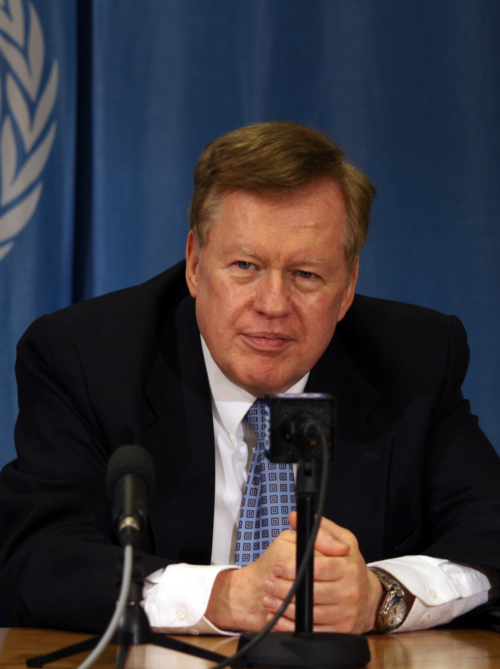
Over the last three years, the United States has done an about-face in terms of engaging North Korea on human rights. Some have argued that if we are to make progress on denuclearization with North Korea, we cannot press Pyongyang on human rights issues because we must develop a cooperative relationship. Raising human rights abuses will only make it more difficult to deal with security issues they argue. On the other hand, Ambassador King believes that human rights are not an issue that we raise after we have achieved our security goals. It is not just the right thing to do, it is an important and critical part of achieving real progress with North Korea on security issues and it is key to a better relationship between Washington and Pyongyang. Internal pressure from the North Korean elites and the public is necessary for positive change on security issues by the North, and this will only come about if there is progress on human rights. Furthermore, North Korea, like all UN member states, has agreed to observe UN human rights obligations. If the North fails to carry out its commitments on human rights, what assurance do we have that it will fulfill security obligations it accepts?
Image
Ambassador Robert King is former Special Envoy for North Korean human rights issues at the Department of State (2009-2017). Since leaving that position, he has been senior advisor to the Korea Chair at the Center for Strategic and International Studies (CSIS), a senior fellow at the Korea Economic Institute (KEI), and a board member of the Committee for Human Rights in North Korea (HRNK) in Washington, D.C. Previously, Ambassador King served for 25 years on Capitol Hill (1983-2008) as chief of staff to Congressman Tom Lantos (D-California), and staff director of the House Foreign Affairs Committee (2001-2008). Most recently, he was a 2019-20 Koret Fellow for the fall quarter at Stanford University.
The event is made possible through the generous support of the Koret Foundation.
Advisory on Novel Coronavirus (COVID-19)
In accordance with university guidelines, if you (or a spouse/housemate) have returned from travel to mainland China or South Korea in the last 14 days, we ask that you DO NOT come to campus until 14 days have passed since your return date and you remain symptom-free. For more information and updates, please refer to Stanford's Environmental Health & Safety website.
Robert R. King
Former Special Envoy for North Korean Human Right Issues
Shorenstein APARCStanford UniversityEncina Hall E301Stanford, CA 94305-6055
0
chav@stanford.edu
Koret Fellow, 2019-20
Visiting Scholar at APARC, Winter 2020
victor_cha-koret_fellow.jpg
Ph.D.
Victor Cha, professor of government and international affairs at Georgetown University, joined the Walter H. Shorenstein Asia-Pacific Research Center and the Korea Program as the Koret Fellow for the winter quarter of 2020. He is the author of five books, including The Impossible State: North Korea, Past and Future (Harper Collins, 2012) and Powerplay: Origins of the American Alliance System in Asia (Princeton University Press, 2016). He holds Georgetown's Dean's Award for teaching for 2010, the Distinguished Research Award for 2011, and a Distinguished Principal Investigator Award for 2016.
Professor Cha left the White House in 2007 after serving since 2004 as Director for Asian Affairs at the National Security Council, where he was responsible for Japan, the Korean peninsula, Australia/New Zealand, and Pacific Island affairs. He serves as Senior Advisor at CSIS, and is a non-resident Fellow in Human Freedom at the George W. Bush Institute in Dallas, Texas. He received a Ph.D. from Columbia University, M.A. from the University of Oxford, and MIA and B.A. from Columbia University.
WE HAVE REACHED VENUE CAPACITY AND ARE NO LONGER ACCEPTING RSVPS
Image
China has grown faster for longer than any country in recorded history. Is it market-oriented reform, state industrial policy, or some sophisticated blend of the two that explains this success? In this talk, Dr. Nicholas Lardy will also further examine what might explain China’s slowdown of recent years. Is China falling into the frequently fatal middle-income trap? Or have domestic policy choices led to the slowdown? Have trade frictions with the United States also contributed to China’s slowing growth? In addition, what should U.S. policy stance be towards China? Should the United States continue to ramp up restrictions on two-way flows of technology to try to further slow China’s growth? How successful is such a strategy likely to be and what costs to the United States would be inherent in such an approach?
Nicholas R. Lardy is the Anthony M. Solomon Senior Fellow at the Peterson Institute for International Economics. He joined the Institute in March 2003 from the Brookings Institution, where he was a senior fellow from 1995 until 2003. Before Brookings, he served at the University of Washington, where he was the director of the Henry M. Jackson School of International Studies from 1991 to 1995. From 1997 through the spring of 2000, he was also the Frederick Frank Adjunct Professor of International Trade and Finance at the Yale University School of Management. He is an expert on the Chinese economy. Lardy's most recent books are The State Strikes Back: The End of Economic Reform in China? (2019), Markets over Mao: The Rise of Private Business in China (2014), Sustaining China's Economic Growth after the Global Financial Crisis (2012), The Future of China's Exchange Rate Policy (2009), and China's Rise: Challenges and Opportunities (2008).
Southeast Asia, home to over 640 million people across 10 countries, is one of the world’s most dynamic and fastest growing regions. APARC just concluded the year 2019 with a Center delegation visit to two Southeast Asian capital cities, Hanoi and Bangkok, where we spent an engaging week with stakeholders in the academic, policy, business, and Stanford alumni communities.
Led by APARC Director Gi-Wook Shin, the delegation included APARC Deputy Director and Asia Health Policy Program Director Karen Eggleston, Southeast Asia Program Director Donald Emmerson, and APARC Associate Director for Communications and External Relations Noa Ronkin. Visiting Scholar Andrew Kim joined the delegation in Bangkok.
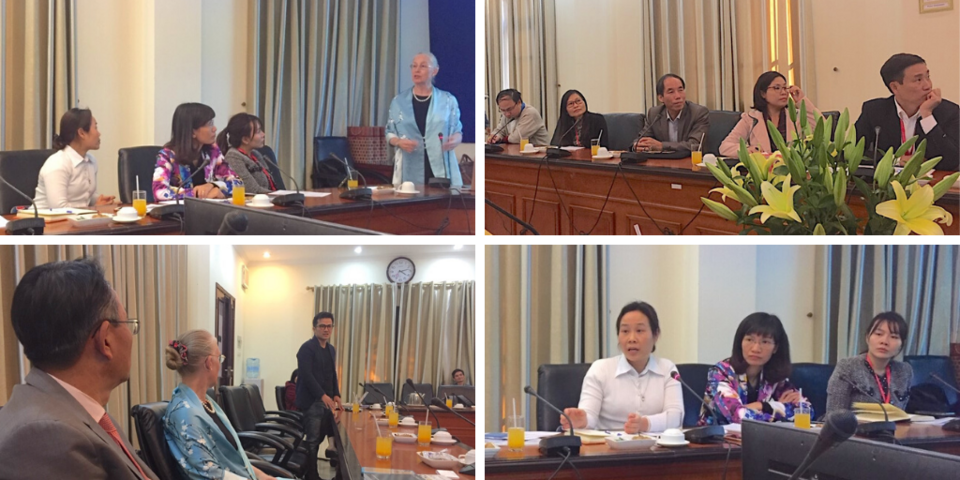
Karen Eggleston and participants at the roundtable held at Hanoi Medical University, December 9, 2019.
Throughout the day, Eggleston presented some of her collaborative research that is part of two projects involving international research teams: one that assesses public-private roles and institutional innovation for healthy aging and another that examines the economics of caring for patients with chronic diseases across diverse health systems in Asia and other parts of the world. We appreciated learning from our counterparts about the health care system and health care delivery in Vietnam.
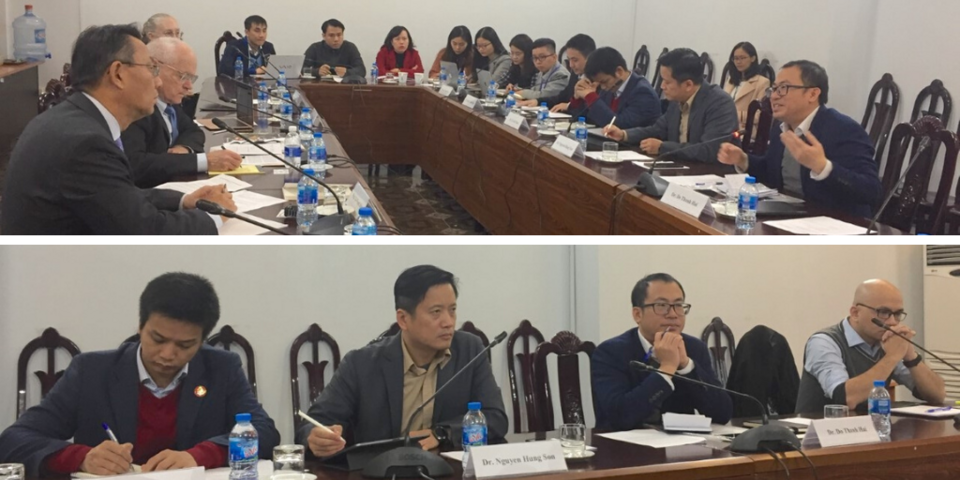
Shifting focus to international relations and regional security, day 2 in Hanoi opened with a roundtable, “The Rise of the Indo-Pacific and Vietnam-U.S. Relations,” held jointly with the East Sea Institute (ESI) of the Diplomatic Academy of Vietnam (DAV). Following a welcome by ESI Director General Nguyen Hung Son, the program continued with remarks by Shin, Emmerson, ESI Deputy Director General To Anh Tuan, and Assistant Director General Do Thanh Hai.
Image
Roundtable at the Diplomatic Academy of Vietnam, December 10, 2019.
The long-ranging conversation with DAV members included issues such as the future of the international order in Asia; the U.S. withdrawal from multilateralism; the concern about a lack of U.S. engagement in Southeast Asia, sparked by President Trump’s absence from the November 2019 summit of the Association of Southeast Asian Nations (ASEAN) at a time when China is bolstering its influence in the region and when ASEAN hopes to set a code of conduct with China regarding disputed waters in the South China Sea; the priorities for Vietnam as it assumes the role of ASEAN chair in 2020; and the challenges for the Vietnam-U.S. bilateral relationship amid the changing strategic environment in Southeast Asia.
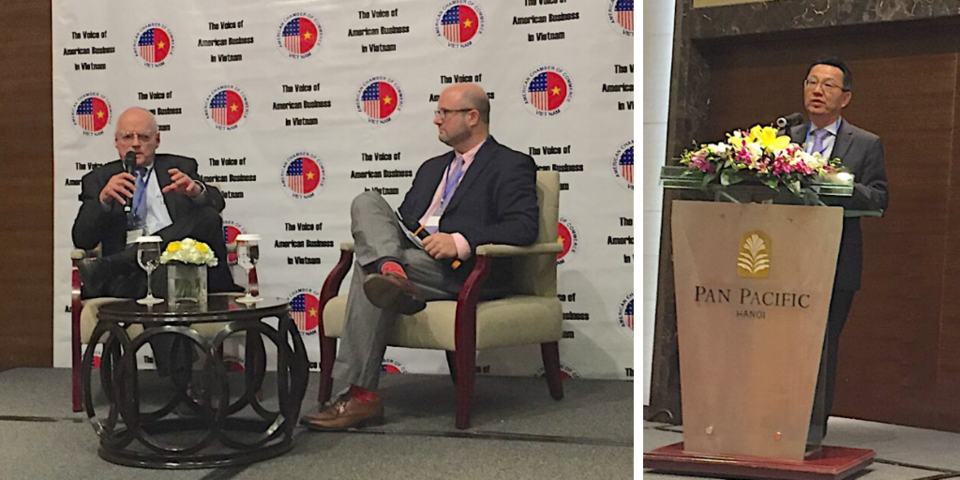
In the afternoon we were joined by members of the American Chamber of Commerce in Hanoi at an AmCham-hosted Lunch ‘n’ Learn session on Vietnam's challenges and opportunities amid the U.S.-China rivalry. The event featured Emmerson in conversation with AmCham Hanoi Executive Director Adam Sitkoff.
Image
(Left) Donald Emmerson in conversation with Adam Sitkoff; (right) Gi-Wook Shin welcomes AmCham Hanoi members; December 10, 2019.
Moving to Bangkok, delegation members Shin, Eggleston, Emmerson, and Kim spoke on a panel for executives of the Charoen Pokphand Group (C.P. Group), one of Thailand’s largest private conglomerates, addressing some of the core issues that lie ahead for Southeast Asia in 2020 and beyond in the areas of geopolitics, innovation, and health.
Image
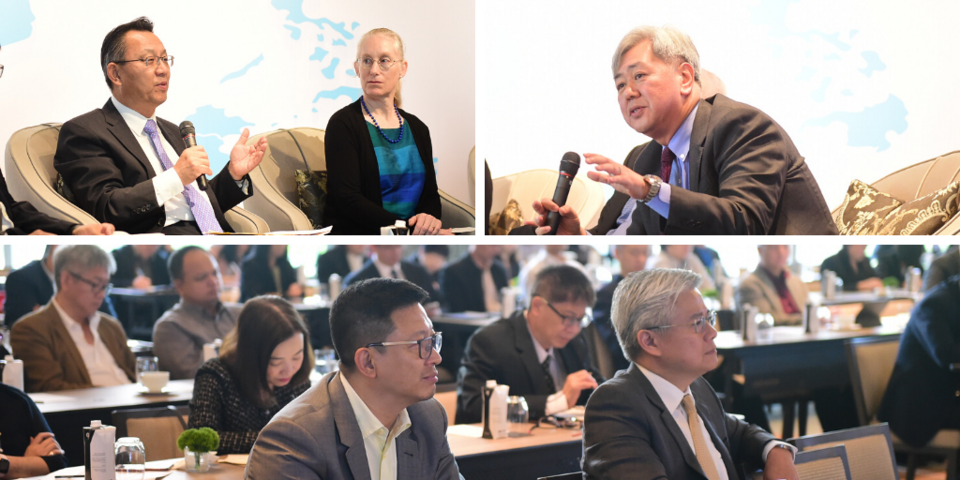
Top, from left to right: Gi-Wook Shin, Karen Eggleston, Andrew Kim; bottom: C.P. Group executive listening to the panel, December 12, 2019.
We also enjoyed a tour at True Digital Park, Thailand’s first startup and tech entrepreneur’s campus. Developed by the C.P. Group, True Digital Park aspires to be an open startup ecosystem that powers Thailand to become a global hub for digital innovation.
The following day, Shin and Emmerson participated in a public forum hosted by Chulalongkorn University’s Institute of Security and International Studies (ISIS Thailand), "Where Northeast Asia Meets Southeast Asia: The Great Powers, Global Disorder and Asia’s Future.” They were joined by ISIS Thailand Director Thitinan Pongsudhirak and Chulalongkorn University Faculty of Political Science Associate Dean for International Affairs and Graduate Studies Kasira Cheeppensook. The panel was moderated by Ms. Gwen Robinson, ISIS Thailand senior fellow and editor-at-large of the Nikkei Asian Review.
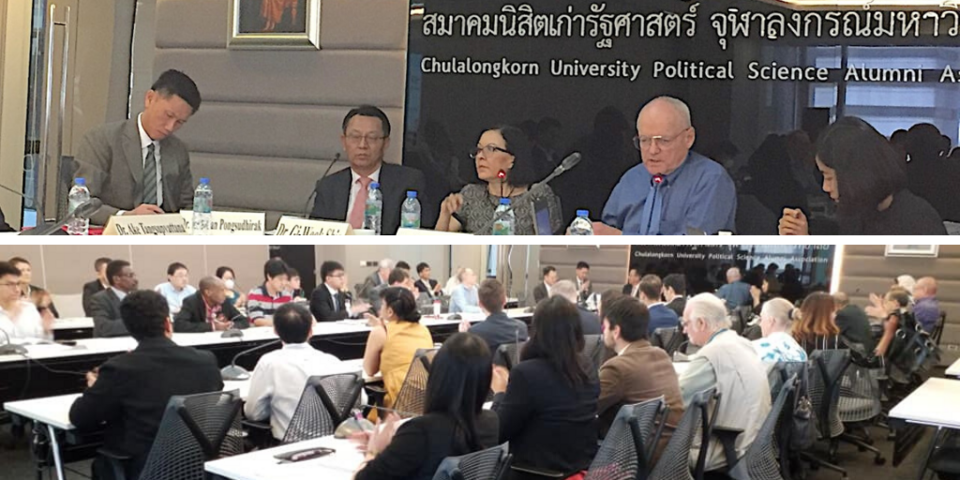
Image
ISIS Thailand forum participants and panelists, from left: Pngsukdhirak, Shin, Robinson, Emmerson, Cheeppensook; December 13, 2019.
As part of that discussion, Emmerson speculated that – driven by deepening Chinese economic and migrational involvement in Southeast Asia’s northern tier – Cambodia and Laos, less conceivably Myanmar, and still less conceivably Thailand could become incorporated de facto into an economically integrated “greater China” that could eventually reduce ASEAN to a more-or-less maritime membership in the region’s southern tier. Emmerson’s speculation was made in the context of his critique of ASEAN’s emphasis on its own “centrality” to the neglect of its lack of the proactivity that would serve as evidence of centrality and of a desire not to be rendered peripheral by the growing centrality-cum-proactivity of China. The event was covered by the Bangkok Post (although that report’s headline and quote of Emmerson are inaccurate, as neither the panel nor Emmerson predicted the “break-up of ASEAN.”)
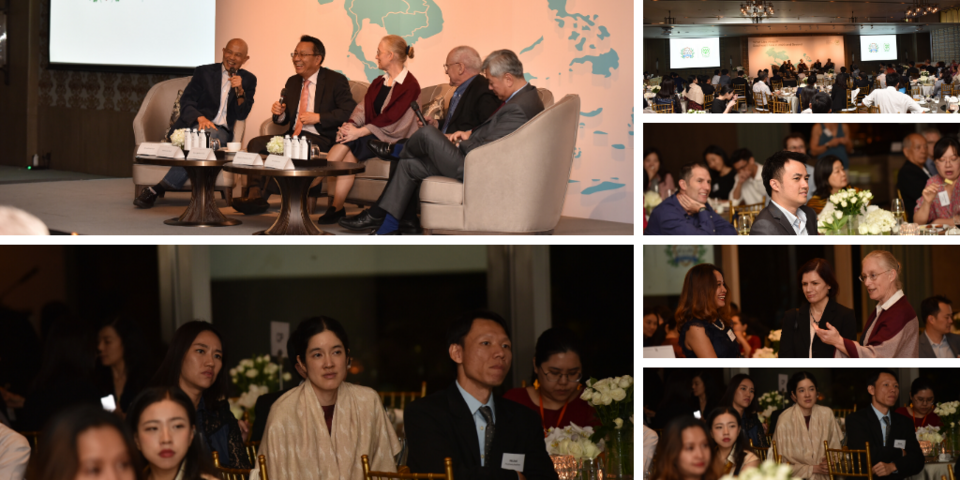
Stanford and IvyPlus alumni listening to the panel, December 13, 2019.
Moderated by Mr. Suthichai Yoon, a veteran journalist and founder of digital media outlet Kafedam Group, the conversation focused on the changing geopolitics of Southeast Asia, innovation and health in the region, and the opportunities and challenges facing Thailand-U.S. relations. It was a pleasure to meet many new and old friends from the Stanford and IvyPlus alumni communities.
APARC would like to thank our partners and hosts in Hanoi and Bangkok for their hospitality, collaboration, and the stimulating discussions throughout our visit. We look forward to keeping in touch!
Shorenstein APARC's annual overview for academic year 2018-19 is now available.
Learn about the research, events, and publications produced by the Center's programs over the last twelve months. Feature sections look at U.S.-China relations and the diplomatic impasse with North Korea, and summaries of current Center research on the socioeconomic impact of new technologies, the success of Abenomics, South Korean nationalism, and how Southeast Asian countries are navigating U.S.-China competition. Catch up on the Center's policy work, education initiatives, and outreach/events.
U.S.-China relations have evolved from past templates of "responsible stakeholder" and "G2" to new ones emphasizing strategic competition. What is the impact of this competition for broader stability in East Asia? How does the ongoing U.S.-China trade war impact U.S. allies in Asia? In particular, how does strategic competition between these two power affect the choices of key allied states like Korea? Professor Cha will present some research-in-progress on these topics that seeks a broader conceptualization of the costs and benefits behind the latest turn in U.S.-China relations.
Image
Victor Cha is a 2019-20 Koret Fellow at Stanford's Shorenstein Asia-Pacific Research Center during the winter quarter. He is Vice Dean and holds the D.S. Song-KF Chair in Government and International Relations at Georgetown University, and is also Senior Adviser at the Center for Strategic and International Studies (CSIS) in Washington D.C. He formerly served on the National Security Council staff and as the US Deputy head of delegation for the Six Party talks. Professor Cha received a PhD in political science and a master's in international affairs from Columbia University; an MA in philosophy, politics, and economics from the University of Oxford; and an AB in economics from Columbia University.
Victor Cha
<i>Professor of Government, Georgetown University</i>
Around the world, democracy is in retreat. In its Freedom in the World 2019 report, the independent watchdog organization Freedom House records the 13th consecutive year of global declines in political rights and civil liberties. “More authoritarian powers are now banning opposition groups or jailing their leaders, dispensing with term limits, and tightening the screws on any independent media that remain,” and “even long-standing democracies have been shaken by populist political forces,” shows the annual study. Internet freedom, too, continues to decline globally amid the crisis of social media, unveils Freedom House’s newly released Freedom on the Net 2019 report. Social media platforms – once considered liberation technologies – have become a conduit for surveillance, disinformation, and electoral manipulation, and “are now tilting dangerously toward illiberalism, exposing citizens to an unprecedented crackdown on their fundamental freedoms.”
These troubling developments are also manifested throughout the Asia-Pacific, where continuous scaling back in U.S. engagement and leadership is raising doubts about American power and purpose in the region, thus empowering forces that undermine democratic norms and processes.
At Shorenstein APARC, we are committed to building a solid foundation of education, knowledge, and dialogue about the critical challenges facing Asian nations and U.S.-Asia relations. That’s why we are dedicating a major portion of our programming this fall quarter and throughout the entire year to elucidating the threats to rights and liberties in the Asia-Pacific region.
The Battle for Truth and Press Freedom in the Philippines
“This is an existential moment for global power structures, turned upside down by technology. When journalists globally are under attack, democracy is under attack.” With these words, the internationally-esteemed investigative journalist and press freedom champion Maria Ressa opened her keynote address upon receiving the 2019 Shorenstein Journalism Award.
As CEO and executive editor of Rappler, she has led the Philippine independent news platform in shining critical light on the Duterte administration's drug war and unprecedented number of killings in the country. President Duterte in turn has made no secret of his dislike for Ressa and Rappler, accusing the platform for carrying "fake news." Ressa has been arrested twice this year, accused of corporate tax evasion and of violating security laws, and slapped with charges of cyber libel for a report that was published before the libel law came into effect. Since Duterte’s election in summer 2016, the Philippine government has filed at least 11 cases and investigations against Ressa and Rappler. “And all because I’m a journalist,” she says.
Ressa detailed the devastating effects that disinformation has had on press freedom, democracy, and civic discourse in the Philippines. “Our dystopian present is your dystopian future if nothing significant is done,” she cautioned. She was joined on the 18th annual Journalism Award panel by Stanford’s Larry Diamond, senior fellow at FSI and the Hoover Institution, and Raju Narisetti, director of the Knight-Bagehot Fellowship in Economics and Business Journalism and professor of professional practice at Columbia Journalism School.
Watch Ressa’s keynote and the entire panel proceedings:
North Korea continues to be one of the world’s worst human rights violators, ranking at the bottom of Freedom House’s list of countries designated as Not Free with the worst aggregate scores for political rights and civil liberties. Although North Korea has experienced some degree of social and economic change in recent years, the Kim Jong Un regime continues to tightly control access to information, suppress all dissent, heavily surveil residents, and subject political prisoners to torture, forced labor, and other atrocities.
As momentum for U.S.-DPRK diplomatic negotiations has ebbed and flowed since summer 2018, all eyes have been on the questions surrounding the North Korean nuclear problem, while the human rights problem has received little attention. However, argues APARC’s Koret Fellow in Korean Studies Robert R. King, addressing the North Korean human rights problem is essential to moving the country on denuclearization and security issues.
Ambassador King, former special envoy for North Korean human rights issues at the Department of State, recently spoke at a seminar hosted by APARC’s Korea Program. Creating pressure on the North Korean government from within by its own people is the only way we’re going to make progress on the security front, he claimed. “If we can help generate greater interest on the part of the people in what is happening with their own government, we can create the kind of constraints that democracy imposes on its leadership […] and that is why we need to focus attention, as well as on negotiating with North Korea, on access to information and human rights.”
Listen to highlights from Ambassador King’s talk:
Hong Kong: City in Turmoil
In Hong Kong, millions of people have been protesting for months against rights violations and increasing interference by the Chinese government in local affairs. On October 1, while the People’s Republic of China celebrated its 70th anniversary with a massive National Day parade in Beijing, on the other side of the border, Hong Kong experienced one of its most violent and chaotic days.
With those contrasting images still fresh on everyone’s minds, APARC and the China Program, along with FSI And the Center for East Asian Studies, co-hosted an expert panel that explained the root causes of Hong Kong’s unremitting protests, examined the future of “one country, two systems,” and considered how the United States and the international community should best respond.
Former Chief Secretary for Administration of the Hong Kong Government (1993-2001), the Honorable Anson Chan, delivered a piercing keynote address, followed by a discussion featuring Harry Harding, Professor of Public Policy at the University of Virginia, David M. Lampton, APARC/FSI Oksenberg-Rohlen Fellow, and Professor Ming Sing of Hong Kong University of Science and Technology.
Since 1997, Chan asserted, Hong Kong SAR’s successive chief executives have progressively failed to reassure the Hong Kong people that they would do their utmost to uphold “one country, two systems” and to defend Hong Kong’s autonomy. Instead, she argued, they have increasingly come across as “mouthpieces of the central government, towing the Beijing line.” Chan also suggested that “some years back, Beijing began to both lose confidence in the judgment and competence of the Hong Kong administration and to fear that growing sense of people’s identity as ‘Hong Kongers’ rather than Chinese citizens could pose a threat to the long-term, successful integration of Hong Kong into the motherland.” She closed her speech urging the Beijing leadership “to act with greater confidence and to trust us more completely with stewardship of our own future by allowing us to elect our own leaders.”
China’s mass internment of Uighurs and other Muslims in “reeducation” camps and detention facilities and its deployment of high-tech surveillance and police tactics in Xinjiang Uyghur Autonomous Region have been interpreted as a superpower’s attempt to annihilate the distinct identities of minority groups. Approximately ten million Muslim minorities in the region are under tight control, and over one million Uyghurs and other Turkic Muslims have allegedly disappeared into internment camps. While Beijing characterizes the camps as vocational training centers and has claimed that most of the detainees have been released, evidence for these claims is difficult to verify, as information dissemination regarding the region to the outside world is closely guarded.
To shed light into the crisis in Xinjiang, APARC convened a multidisciplinary panel of experts who provided historical context and critical social scientific analysis of the events unfolding in the region.
Image
From top left, clockwise: Lauren Hansen Restrepo, James Millward,, Darren Byler and Gardner Bovingdon.
James Millward, professor of Inter-societal history at Georgetown University’s Walsh School of Foreign Service, reviewed the historical background for the PRC assault on non-Han or non-Chinese culture in Xinjiang. Beginning in the early 2000s, the assault has included the razing of old Kashgar; the discouraging and then illegalizing of Muslim symbols such as head gear, prayer, and fasting in Ramadan; the disappearance of Uyghur script; and the securitization of the province by using police patrol, surveillance technologies, facial recognition, and biodata monitoring. The PRC hasn’t applied a single, top-down ethnic policy in Xinjiang, said Millward, but rather has rolled out different tactics it experimented with on local levels in different areas.
Lauren Hansen Restrepo, assistant professor in growth and structure of cities at Bryn Mawr College and an expert on Chinese development planning and urbanization in Xinjiang, explained how we got to the current crisis in the region by connecting seemingly disparate phenomena. She described the shifts in state power in Xinjiang and how, since 2014, “regional planning has broken every logic of urban planning in China,” resulting in the isolation and subordination of Uyghur-dominated urban centers and in the ossification of cities, as control has been seized from local governments and given to socialist land masters.
Anthropologist Darren Byler, whose research focuses on Uyghur dispossession and "terror capitalism" in the city of Ürümchi, the capital of Xinjiang, explained how, amid mass migration of Han people into the resource-rich region, Uyghurs had mostly been excluded from the new economy and how their identity as contemporary Muslims supported a vibrant public sphere not controlled by the state. The Chinese state, in turn, has merged Islamism with radicalism extremism. From the Chinese state and industry perspective, Byler said, the repression of Xinjiang’s Muslims promises stability and the detention camps are used as carriers of economy and new sources of cheap labor.
Indiana University’s Gardner Bovingdon, whose research focuses on politics in contemporary Xinjiang and the region’s modern history, reverted to the question of how we got to the current crisis, which he characterized as “one of the great state-engineered human rights disasters of our time.” He argued that, in the case of Xinjiang, the Chinese party transported and exacerbated a set of policies that had previously been applied to dealing with the Tibet problem. These policies, Bovingdon suggested, “are signs of a flailing, terrified party that doesn’t know what to do with Uighurs, but also feels no constraints from the international community on its behavior. And so the biggest problem now is to find a way to put constraints on a system that has operated untrammeled with devastating consequences.”
The panel "Xinjiang’s Muslims and the PRC" was cosponsored with the Center for Democracy, Development and the Rule of Law.
Hero Image
Clockwise from upper left: Relatives of alleged extrajudicial killings wear veils as they take part in a protest versus the drug war killings outside the military and police headquarters on July 17, 2019 in Manila, Philippines (Photo credit: Ezra Acayan/Getty Image); Workers pass propaganda posters as they cycle through Hungnam Fertilizer Complex on February 4, 2019 in Hamhung, North Korea (Photo credit: Carl Court/Getty Images); Pro-democracy protesters react as police fire tear gas during a demonstration on October 20, 2019 in Hong Kong (photo credit: Anthony Kwan/Getty Images); A mix of ethnic Uyghur and Han shopkeepers hold large wooden sticks as they are trained in security measures on June 27, 2017 next to the old town of Kashgar, in the far western Xinjiang province, China (photo credit: Kevin Frayer/Getty Images).
The recent escalation of diplomatic and trade disputes between South Korea and Japan has alarmed numerous observers and is rather confusing to many around the world to whom the two countries seem to have much to lose and little to gain by the deterioration of the bilateral relationship. What underlying forces are driving the conflict? Are these new forces, or the same historical forces coming to a head? How much are factors from the international environment, such as the behavior of the United States, influencing the current escalation?
These were some of the questions that took center stage at a recent conference, “Japan and South Korea on the Brink: Escalating Friction Amidst an Uncertain World,” convened jointly by APARC’s Japan Program and Korea Program. The conference brought together experts in the international affairs and trade relations of South Korea, Japan, and the United States to shed light into the current conflict between the two U.S. allies.
In his welcome remarks, APARC Director and Korea Program Director Gi-Wook Shin reminded the audience that Japan and South Korea have experienced tensions over colonial and wartime history and hence, in that sense, the recent conflict is nothing new. In the past, however, the tensions were mostly kept under control because the two countries well understood that it was in their mutual interest to maintain a cooperative relationship and keep history issues separate from other important economic and security issues. Over the past year, however, tensions over history have permeated economic and security issues amid rising nationalism in both countries.
A Problem of Alliance Management
The conference opened with a panel on diplomacy and international relations. Kak-Soo Shin, former Korean ambassador to Japan, situated the current crisis in the context of the regional strategy environment, noting that the Northern triangle – composed of North Korea, China, and Russia – has been gaining influence, while the Southern triangle – composed of South Korea, Japan, and the United States – has weakened. “The souring Japan-Korea relationship is a big blow to the maintenance of the Southern triangle and its ability to cope with the volatile security environment in Northeast Asia,” Shin cautioned.
Hitoshi Tanaka, chairman of the Institute for International Strategy at the Japan Research Institute, ltd., offered an overview of the reasons underlying the escalation in the bilateral relationship between Japan and South Korea, foremost of which, he said, is the declining mutual importance of the two nations to each other vis-à-vis China’s emergence as their largest trade partner. “Unless we feel that the future relationship is essential to both nations there is no way to address the conflict,” he said.
Joseph Yun, former deputy assistant secretary of state for Korea and Japan and former special representative on North Korea, emphasized that Tokyo and Seoul are “eroding the trilateral security arrangement that the United States has led in Northeast Asia since the end of the Second World War” – an arrangement that has been responsible for prosperity throughout Northeast Asia. The root problem, he argued, is alliance management, from which the United States “has been conspicuously absent.”
Watch the panel:
A Conflict in an Age of Changing Global Trade Order
The second panel turned eyes to the trade issues involved in the conflict between Japan and South Korea. Professor Yukiko Fukagawa of the School of Political Science and Economics at Waseda University, an expert in Korean economic development, observed that the friction between the two countries has escalated since 2000, when Korean global businesses like Hyundai and Samsung rose to fame. Since then, she argued, what has happened in Korea is a process of economic nationalism and “Korea seems to find it or interpret it as a kind of transitional justice against Japan.”
Seokyoung Choi, former Korean ambassador to the WTO and UN and former deputy minister for trade, explained the background for the Japan-Korea trade row and each side’s arguments. As a way forward, he said, both countries must consider several important imperatives, including the needs to cooperate in an era of tectonic changes to the global trade order, to address expanding fault lines in East Asia given the spillover effects of the U.S.-China trade war, and to complement for deficits of leadership and trust in Northeast Asia.
Aiko Lane, executive director of the U.S.-Japan Business Council, discussed the main concerns the Japan-Korea friction poses for U.S. businesses, including regulatory uncertainty, supply chain disruptions, and delays in shipment. Further escalation in the relationship, she argued, could potentially inflict long-term damage to the regional ICT and manufacturing industries. Potential impacts include driving costs up for consumers and making it more lucrative for other countries to supply semiconductor materials to Korea.
Watch the panel:
Hero Image
South Koreans participate in a rally to denounce Japan's new trade restrictions and Japanese Prime Minister Shinzo Abe on August 24, 2019 in Seoul.
What is strategic thinking? Are the foreign policies of some Southeast Asian states more strategic than those of others? If so, in what way, and with what implications for U.S. policy?
As the People’s Republic of China marks the 70th anniversary of its founding while Hong Kong prodemocracy protests intensify, Andrew Walder, the Denise O'Leary and Kent Thiry Professor and senior fellow at the Freeman Spogli Institute for International Studies, reflects on some of the changes in Chinese society and domestic policy, discusses his new book that offers a new interpretation of the Cultural Revolution, and shares details about his current research project.
Q: China is celebrating the 70th anniversary of the Chinese Communist Party’s rule, and of course the strategic shifts in Chinese foreign policy throughout the years are much more visible than the shifts in domestic policy. What have been some of the changes in that regard under Xi Jinping’s leadership?
Since Xi Jinping took office as president of the People’s Republic of China in 2013 he has changed the tone of the leadership, refocusing it on its survival. Now this is a regime that has seen nearly 30 years of 9 or 10 percent economic growth, has raised 400 million people out of poverty, and has generated significant upward mobility for very large swaths of the population, especially urban populations that have enjoyed a level of prosperity never experienced before. Yet Xi Jinping and the top Communist Party leadership seem to be driven by a strong concern for their survival.
So Xi has done three things. First, he has recentralized decision-making power and made himself a very powerful executive. Second, he has been cracking down ideologically on all talk about political reform – cracking down on universities, the media, human rights lawyers. That's actually led to significant alienation among educated populations. Third, he has launched a draconian anti-corruption campaign, arresting and imprisoning many people, including very high-ranking individuals.
Corruption in China isn’t as obvious as in a country like Russia and we, as foreigners, don't see it. But it’s likely that there are justified worries about the impact of corruption and the generation of wealth among the families of high-level officials, which seriously undermine the coherence and discipline of the Communist Party.
One interpretation of Xi’s actions is that he sees a lot of decay and observes the risks posed by the Chinese society’s openness to the outside world. He realizes that among the second generation – in his own family, in the families of other Party leaders, and among the best and brightest of China’s young, educated people – the Party really has no standing in terms of ideology. And he knows that most of the economic activity in China is generated in the private sector by people who are neither Party members nor under the subordination of the Party.
Xi’s actions could therefore be explained as a combination of conservatism and nationalism. But it could also be the case that Xi is perceptive and honest, observing cracks in the system that aren't yet visible to outsiders.
Q: What is your assessment of China’s economic policy choices? How can China sustain robust economic growth over the coming years?
I believe Xi’s ultimate worry is about China’s economic growth. He recognizes that China is a variant of the East Asian “miracle economies” – South Korea, Taiwan, Japan – that all experienced much lower rates of economic growth after their huge takeoff periods. China has reached a certain level of GDP per capita, but to continue to raise that and truly be competitive with the other advanced economies they need to do things differently, including becoming more efficient in the use of capital and addressing their heavy debt burden.
I see China’s leadership as stuck in a dilemma similar to that of the Soviet Union in the 1970s. That is, they've had a model that worked well – China is now the world's second largest economy, a superpower – but there’s no agreement on how to continue from here. One school of thought resists change, while a more progressive school recognizes that this model isn’t going to work forever and that it’s necessary to be more efficient and creative – downsize the state-owned enterprise sector, give private enterprises a more level playing field, etc. The argument against such progressive economic liberalization, however, is that it will cause the Party to lose control over the leading sectors of the economy. So far, Xi appears to represent this view.
Q: Last year, Xi enshrined his ideology, “Xi Jinping Thought on Socialism with Chinese Characteristics for a New Era,” in China’s constitution. Can this system promote the supremacy of the Communist Party to today’s Chinese, who are fundamentally different from the workers who were the soul of the Communist Revolution?
No. It's very hard to get the toothpaste back in the tube, if you will. I spend a lot of time in China, teaching and giving talks in Beijing and elsewhere, and I can say that Chinese students are far more savvy and critical than we might think, asking tough questions about issues such as state ownership of assets, the banking system, the rule of law. Obviously they react negatively when they hear foreigners criticizing their country and preaching to them about China’s lack of democracy or human rights abuses. I think Americans might similarly react to criticisms about our homelessness crisis or the Southern border crisis, though we know these are real problems.
Many young Chinese are much more critical of the leadership than portrayed by Western news media. This is a dynamic situation, and Xi seems to be trying to ward off something that he sees as real danger. Whether he's right or whether he's simply holding back progress in China I couldn’t say. However, as I do always tell people in China, Xi is certainly creating the conditions for strong support of the next leader who might want to take China to a more liberal direction.
Q: China is celebrating 70 years of Chinese Communist Party rule amid uncertainty that is testing its authority like never before. In particular, the relentless prodemocracy demonstrations in Hong Kong appear to have caught the Xi administration off guard. What are China’s options in dealing with the unrest in Hong Kong?
It’s hard to assess the situation in Hong Kong. I understand why it’s happening – over the last five or six years, most of the people I know in Hong Kong (students, academics, professionals) have been very worried about the erosion of rights and independence. But I'm surprised at how widespread the dissatisfaction is, how militant the protesters are, how there's no real connection between them and the elite Legislative Council prodemocracy camp, and how the unrest is not dissipating. The disagreement between China and the United States about what's happening and China’s accusations that the US is behind it all are very worrisome.
The Chinese leadership practically ruled out most of the effective response options. They clearly don't want to be seen as giving in and are worried about contagion to other cities in mainland China. But China’s political system isn’t good at responding to popular mobilized dissent and the leadership doesn’t truly understand free societies. They don't understand the concerns of people in Taiwan or Hong Kong, who have a way of life and freedoms that will be taken away by integration with the mainland under its current political system. Beijing cannot get away with applying in Hong Kong the type of intimidation and bullying it applies to its own society. I don't think the current leadership is imaginative or flexible enough to think creatively about how to get out of this situation.
Q: As the Chinse Community Party trumpets China’s stunning economic and military success, it aims to keep its history of catastrophic, often cruel policies and tragic events from its people. You have long studied the Cultural Revolution, a period rife in persecution, violence, and death, and have a new book about that, coming out next week. Tell us about it.
The book, Agents of Disorder: Inside China’s Cultural Revolution (Harvard University Press), charts the violence in China from 1966 to 1969. By May 1966, just seventeen years after its founding, the People’s Republic of China had become one of the most powerfully centralized states in modern history. But that summer everything changed. Mao Zedong called for students to attack intellectuals and officials who allegedly lacked commitment to revolutionary principles, and rebels responded by toppling local governments across the country. The book, which is the outcome of a long research project, Political Movements in an Authoritarian Hierarchy, aims to answer the question: Why did the Chinese party state collapse so quickly after the onset of the Cultural Revolution?
My answer to this question is based on analysis of a data set collated from over 2,000 local annals chronicling some 34,000 revolutionary episodes across China from 1966 to 1971. That research unveils two major findings.
The first is a new interpretation of what happened during that period. Standard accounts depict a revolution instigated from the top down and escalated from the bottom up through power seizures by rebel groups. But if you read the local histories and look at the scope of rebel activity and protest in the last half of 1966 through the beginning of 1967, it turns out there really wasn’t that much going on outside of a few major cities. Yet within that short period counties all over China had their governments overthrown. What happened was that low-ranking government officials overthrew their superiors, setting off a chain reaction of violence. Then army units sent to quell the disorders gave arms to those rebels that they supported, ushering in nearly two years of conflict that in various places came close to civil war.
The second finding is what I believe to be a fairly accurate estimate of the casualties during this entire period: how many people died, when, and how. My estimate is that 1.6 million people died, mostly when they tried to rebuild the government. Only a small percentage was killed by student Red Guards, which is what everyone thinks of in relation to the Cultural Revolution. In fact, every organization eventually had a campaign looking for class enemies and, ultimately, the repression that ended the disorder was worse than the violence it was meant to contain.
The other thing I do in the book is compare this period in China’s history to other infamous periods of state violence – Bosnia in the 1990s, the Soviet Great Terror of the late 1930s, the Indonesian massacres of suspected leftists in 1965, El Salvador's civil war, the Pol Pot regime in Cambodia, and Rwanda in 1994. I show that, in terms of total numbers of casualties, the Cultural Revolution comes second on the list, topped by Cambodia, which has almost the same number of killings. However, if you consider the rate of killing as a percentage of the population, then the Cultural Revolution ranks at the bottom of all the comparison cases and the worst case by far is Cambodia. If the intensity of the violence in China had been the same as in Cambodia then 150 million people would have been killed.
Beyond the story of the violence and bloodshed in the Cultural Revolution, there’s a big story here about how many people were persecuted yet survived. The Cultural Revolution put many, many people through hell, but many survived and regained positions of authority and power, leading the country in the 1980s, which is why they wrote about what happened in their localities.
Q: Could you share some details about your current research project?
My current project, Political Violence and State Repression, analyzes unusually detailed internal investigation reports compiled by the government of a Chinese province that experienced some of the most severe level of violence and highest death tolls during the Cultural Revolution. There were 90,000 casualties in that province that had a population of about 24 million – a death rate much higher than the average we talked about before. The question is why this happened in that particular province.
The available investigation reports contain close to 5,000 political events and associated casualties, for all 86 cities and counties in the province. For the last three years I've been working with research assistants to code this massive body of information into a data set, which is now almost ready for analysis. The quality, level of detail, and comprehensive coverage of the materials makes it possible to analyze state collapse and political violence with an unusual degree of precision and depth.